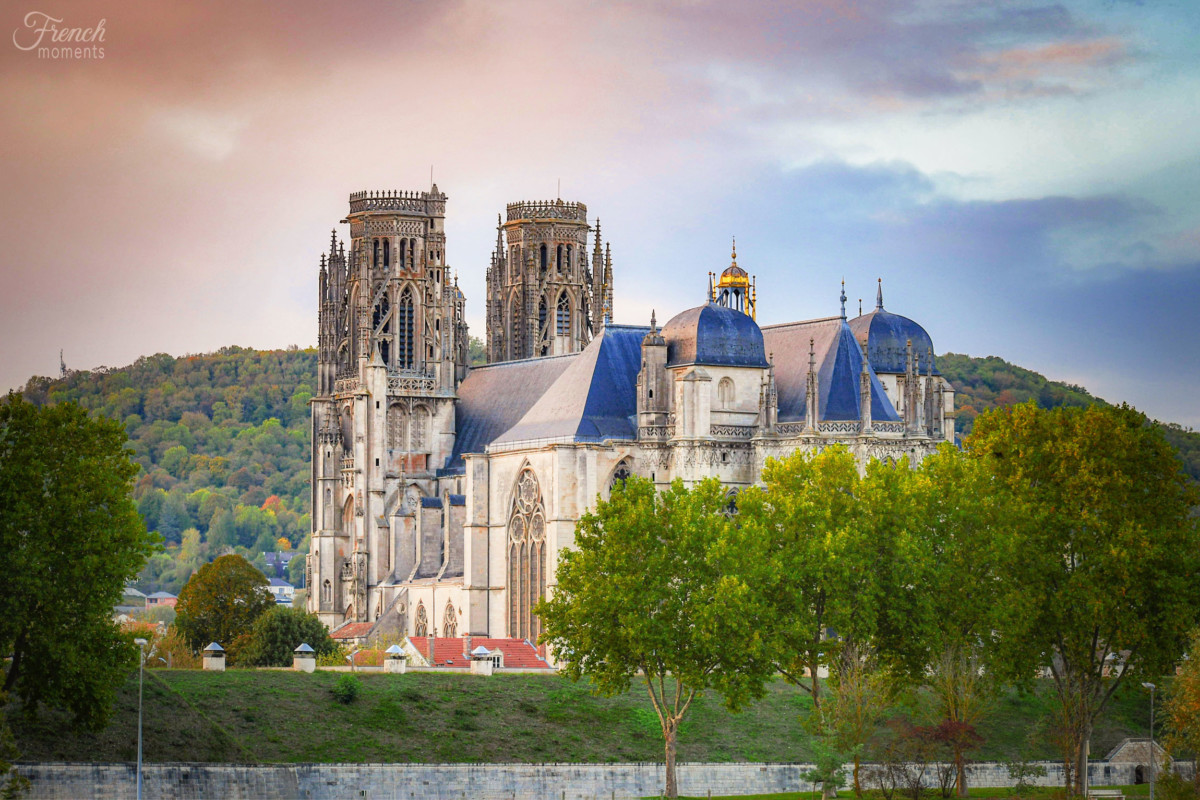


Approaching Toul, visitors admire the elegant silhouette of the Toul Cathedral, a witness to the rich historical past of this ancestral city of Lorraine.
The residents of the small town of Toul have good reason to be proud of their beautiful cathedral. And yet, it avoided the worst of the bombings of the Second World War, which required several decades of restoration.
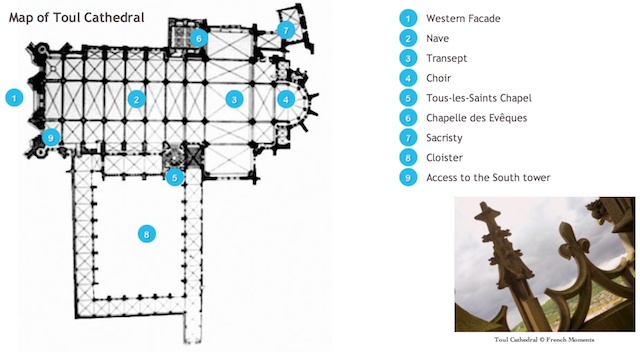
Historic Overview of Toul Cathedral
Toul Cathedral, dedicated to Saint Stephen, is one of the great Gothic monuments of Lorraine.
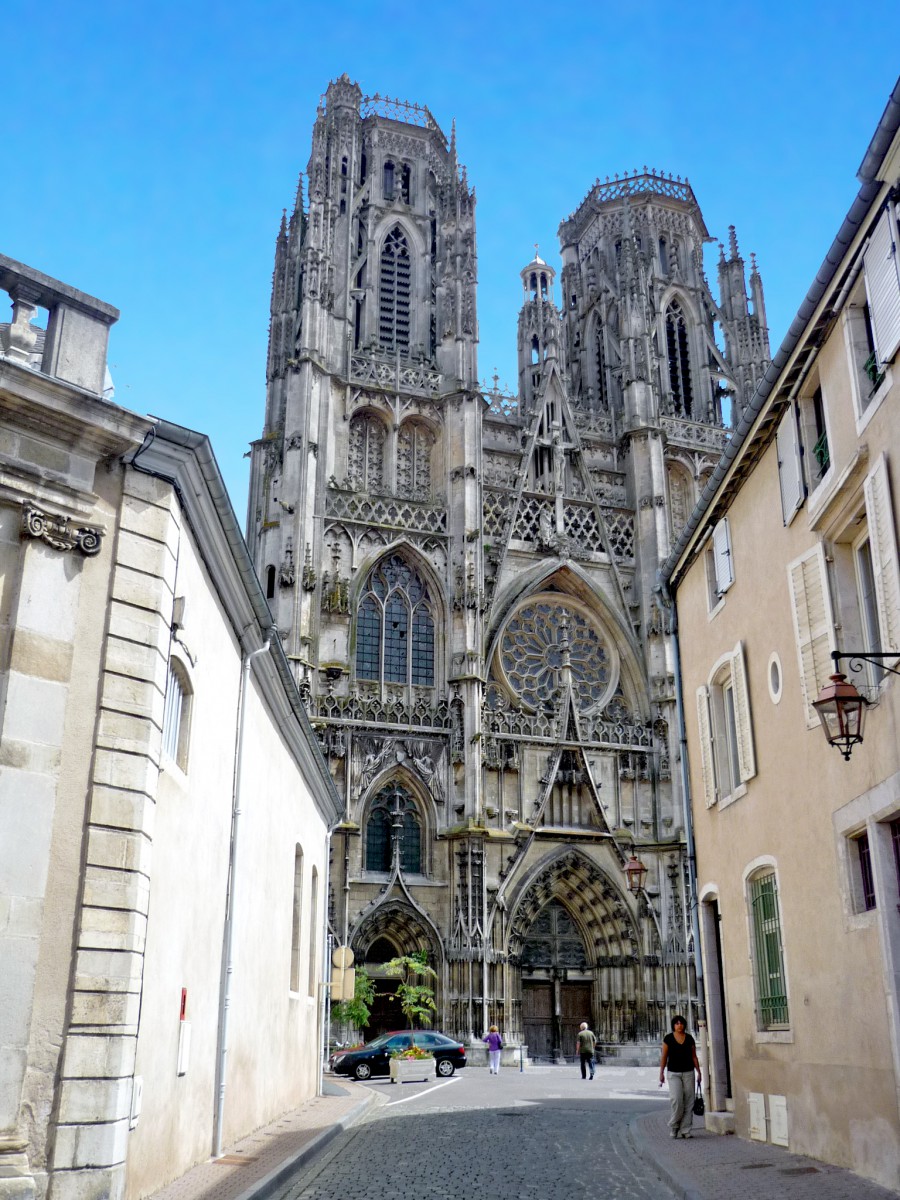
Its vast western façade, completed in the Flamboyant Gothic style, and its two towers make it one of the most striking cathedrals in eastern France.
It is also famous for its remarkable Gothic cloister, one of the largest in France.
Construction of the present cathedral began in the early 13th century, with work already underway before or around 1221.
The choir was the first major part to be built, and it was completed by 1235.
Over the course of the 13th century, the transept, part of the nave, and the eastern gallery of the cloister were added.
The nave was then continued in later phases, and the great western façade was finally completed in 1497, after a building campaign that stretched across nearly three centuries.
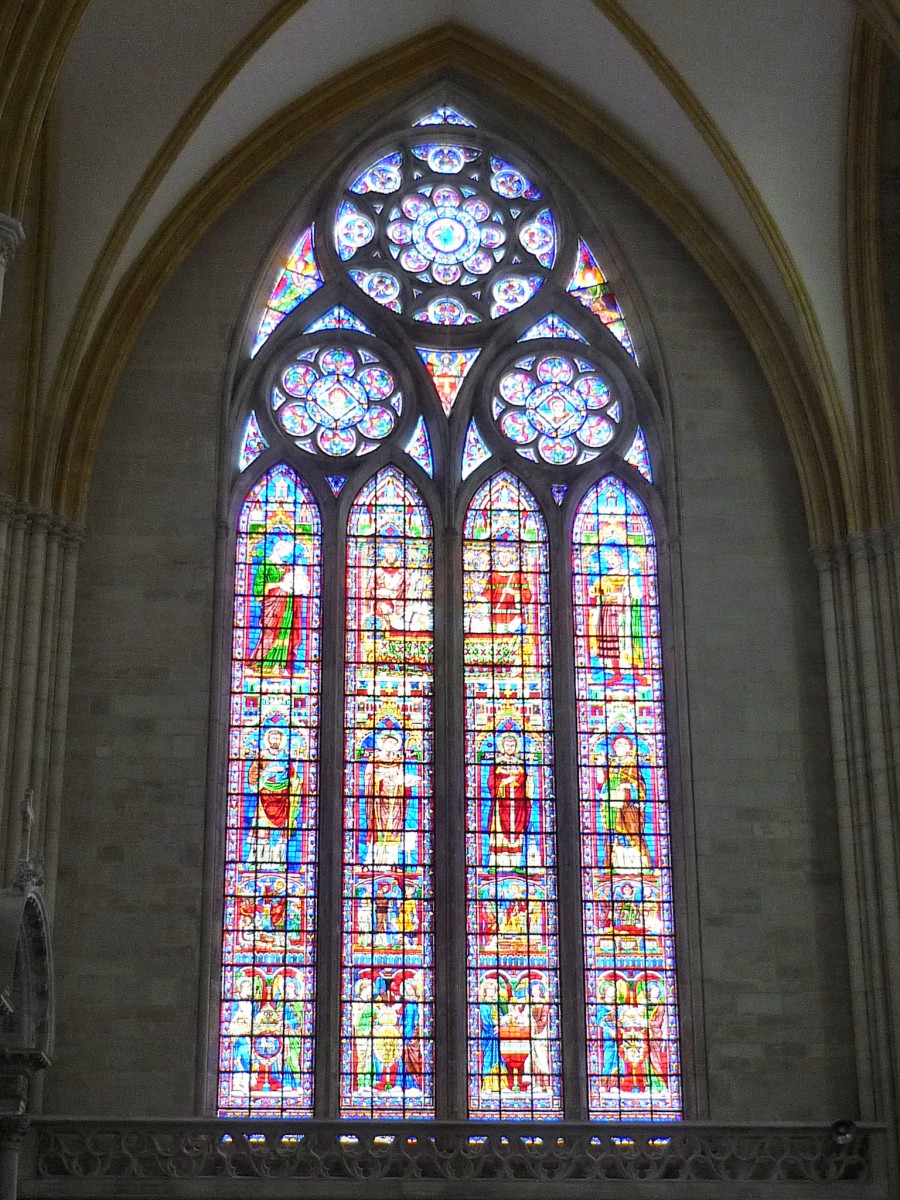
Although the cathedral is mainly Gothic, later centuries also left their mark.
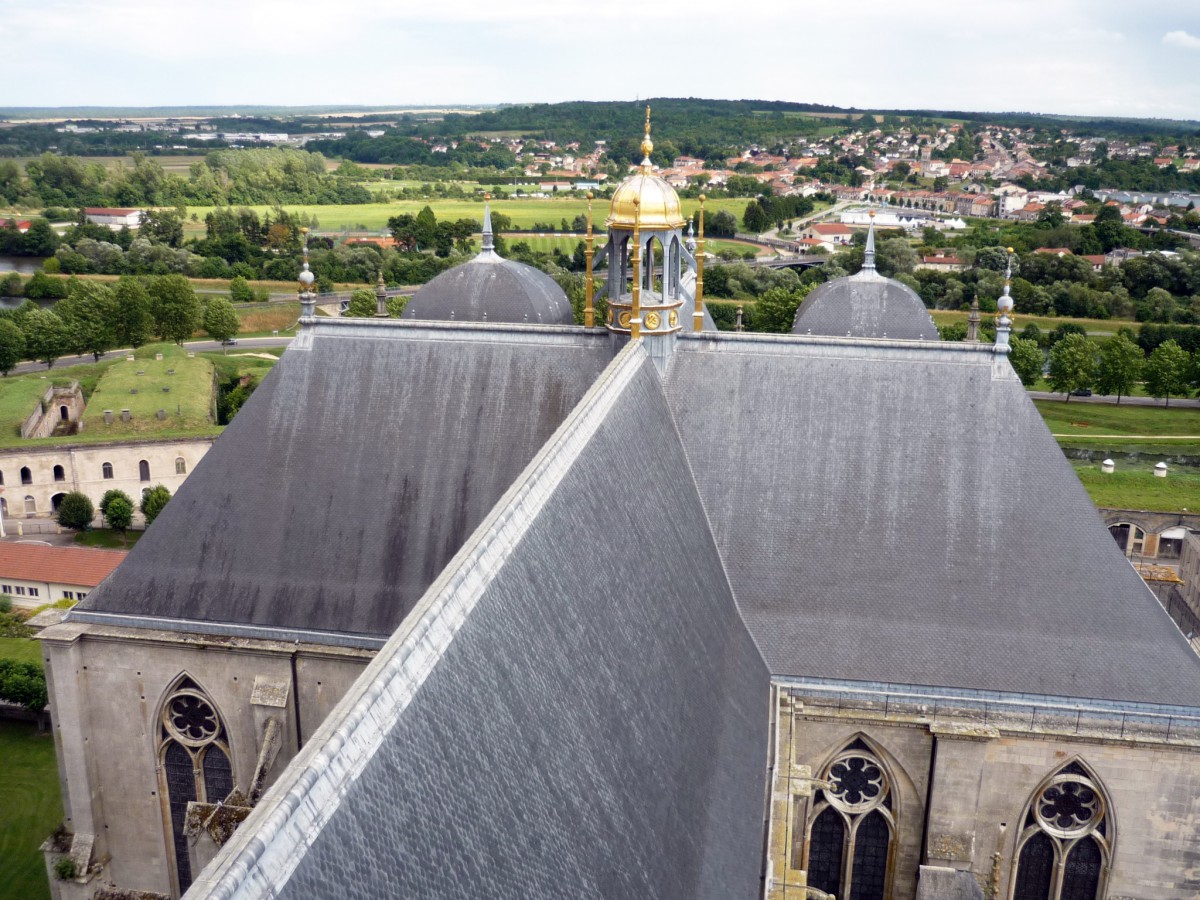
In the Renaissance period, features such as the dome, known as the Boule d’Or at the crossing and elegant chapels were added, giving the building some of its distinctive character beyond the medieval structure.
Toul Cathedral suffered severe damage in June 1940, when bombing caused a major fire.
The roof was destroyed, and for years the building remained exposed to the weather.
Emergency repairs after the war proved insufficient, and in 1978, the cathedral had to be closed for safety reasons.
A major restoration campaign finally began in earnest in 1981, with the reconstruction of the high roof structure.
Exterior restoration continued until 1995.
Since then, further work has gradually restored the cathedral’s interior and allowed visitors to appreciate once again the scale, light, and elegance of this great church.
Today, Toul Cathedral stands not only as a masterpiece of Gothic architecture, but also as a symbol of the city’s long religious and artistic history.
My book recommendation!
Its name? Simply:
Gothic: Architecture, Sculpture, Painting by Rolf Toman, Publisher: Ullmann
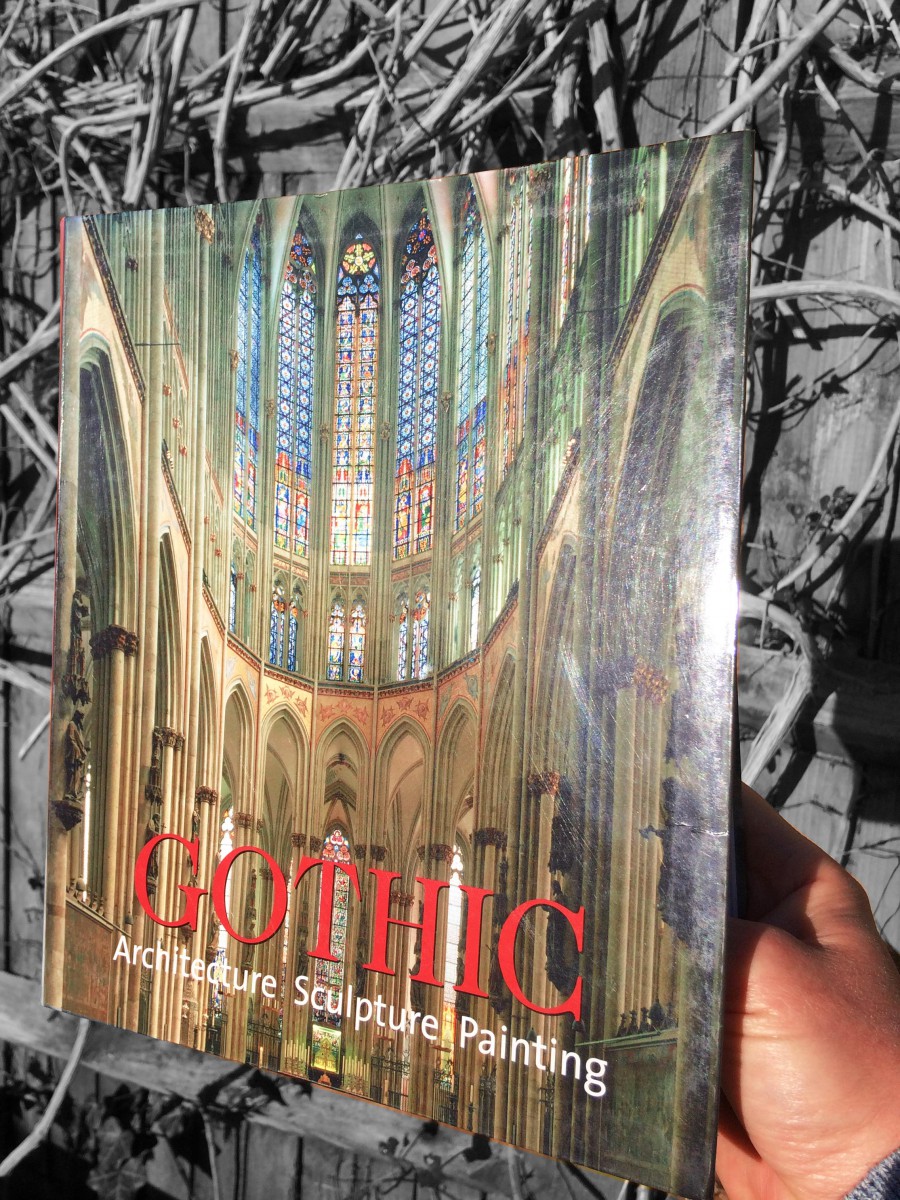
- My copy of the book “Gothic: Architecture, Sculpture, Painting”
This book has been a great resource for me, helping me better understand the Gothic movement in art from the 12th century to the Renaissance.
An architectural style that originated in France and spread throughout Europe.
Over 500 pages, it focuses on the development of Gothic architecture with many illustrations and photographs.
I’ve also found the in-depth discussion of the most diverse art forms, including painting, sculpture, metalwork and even book illumination!
It also includes specific coverage of the Cathars’ Heresy and the Papal Palace in Avignon. And, of course, it mentions the cathedral of Saint-Etienne de Toul!
This is definitely the book I recommend if, like me, you love everything about Gothic, such as churches, gargoyles, stained glass, flying buttresses, and so much more.
The Western Façade
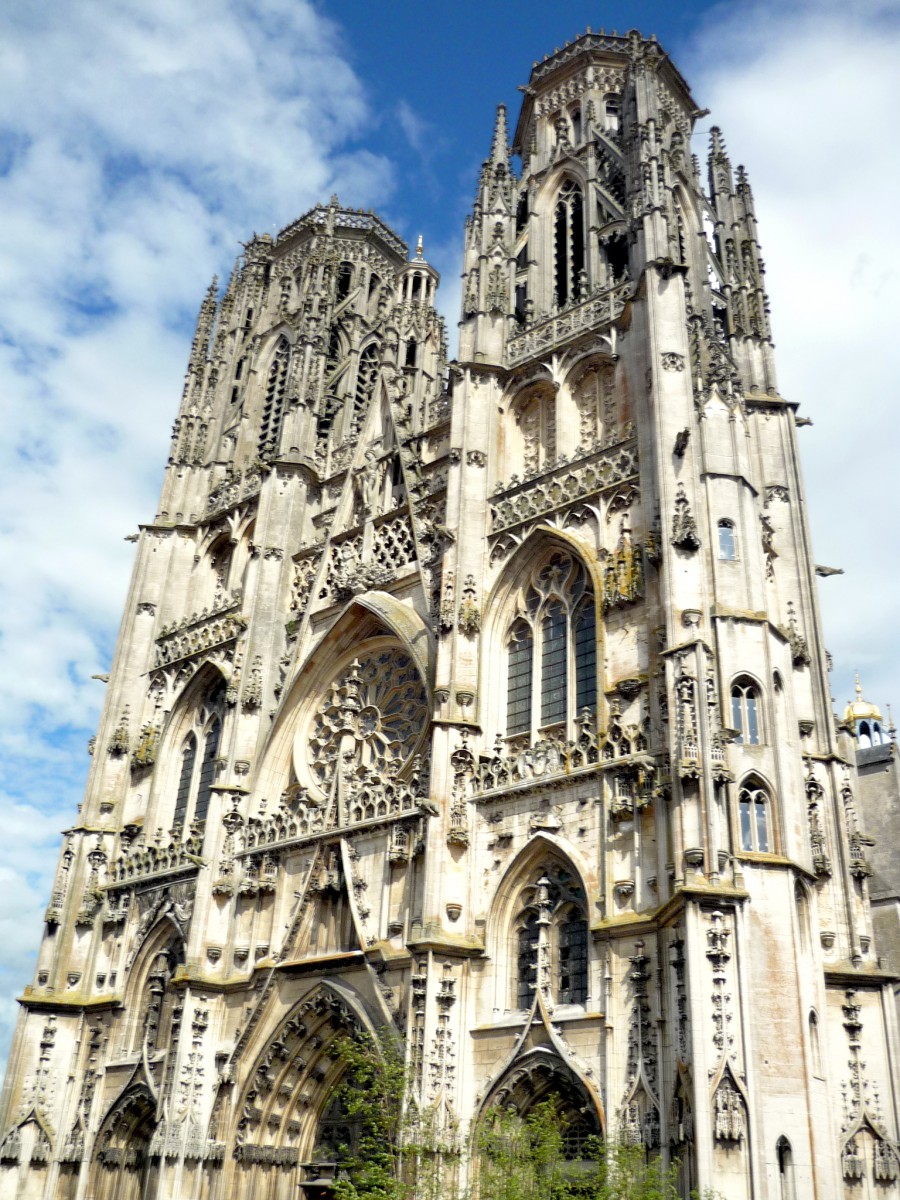
The western façade of Toul Cathedral is the most spectacular and theatrical part of the building.
While the rest of the cathedral is largely Early and High Gothic in spirit, the west front belongs above all to the Flamboyant Gothic phase, with its profusion of tracery, niches, pinnacles, balustrades, and vertical lines.
The façade as we see it today was completed late in the building campaign, broadly in the second half of the 15th century, and its two towers rise to about 65 metres.
The whole composition is remarkably harmonious despite the very long construction period of the cathedral, which began in 1221 and continued until around 1500.
What makes this façade so memorable is the way it combines width and height.
Instead of appearing as a heavy wall of stone, it feels almost like a lace screen stretched between the towers.
The design leads the eye upward in carefully organised stages: from the portals, to the sculpted zones above them, then to the rose window, the enormous central gable, and finally the octagonal tower stages and the Renaissance campanile above the centre.

1. The portals
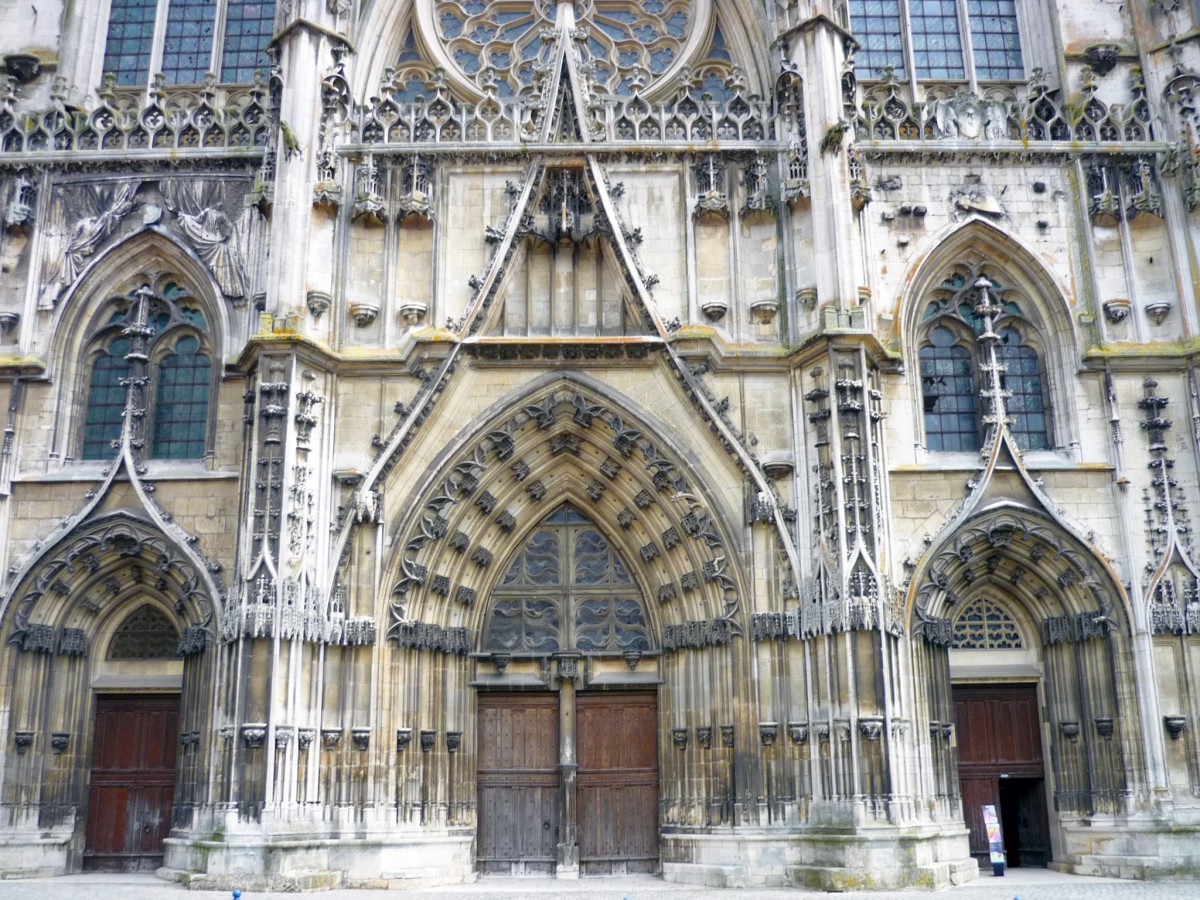
At the bottom of the façade are the three great western portals, which form the ceremonial entrance to the cathedral.
These deep Gothic doorways would once have been even richer in sculptural decoration than they appear today.
Like many French churches, Toul lost a great deal of its statuary during the French Revolution, which explains the sense of absence that one feels in parts of the façade.
Even so, the portals remain impressive for their pointed arches, layered mouldings, and the dense decorative carving that frames the entrances.
The central portal is naturally the most important in the composition, anchoring the entire façade.
Architecturally, this lower level gives the façade its weight and stability.
It is the broad, grounded base from which everything rises.
2. The sculpted zone above the portals
Above the portals comes a richly ornamented intermediate zone of niches, canopies, tracery, and small vertical elements.
This is one of the most characteristically Flamboyant parts of the composition.
Many of the statues that once stood here disappeared during the Revolution, leaving empty niches that still suggest how elaborate the façade must once have been.
This section matters because it acts as a transition between the doors below and the great rose window above.
It is neither as solid as the portal level nor as open as the upper parts of the façade.
Instead, it creates a richly textured middle band, full of rhythm and detail.
In visual terms, this is where the façade begins to feel less like a wall and more like an intricate Gothic screen.
A balustrade runs across the façade. These horizontal stone railings help organise the elevation into stages, while also providing a counterpoint to the strong upward pull of the towers, pinnacles, and the gable.
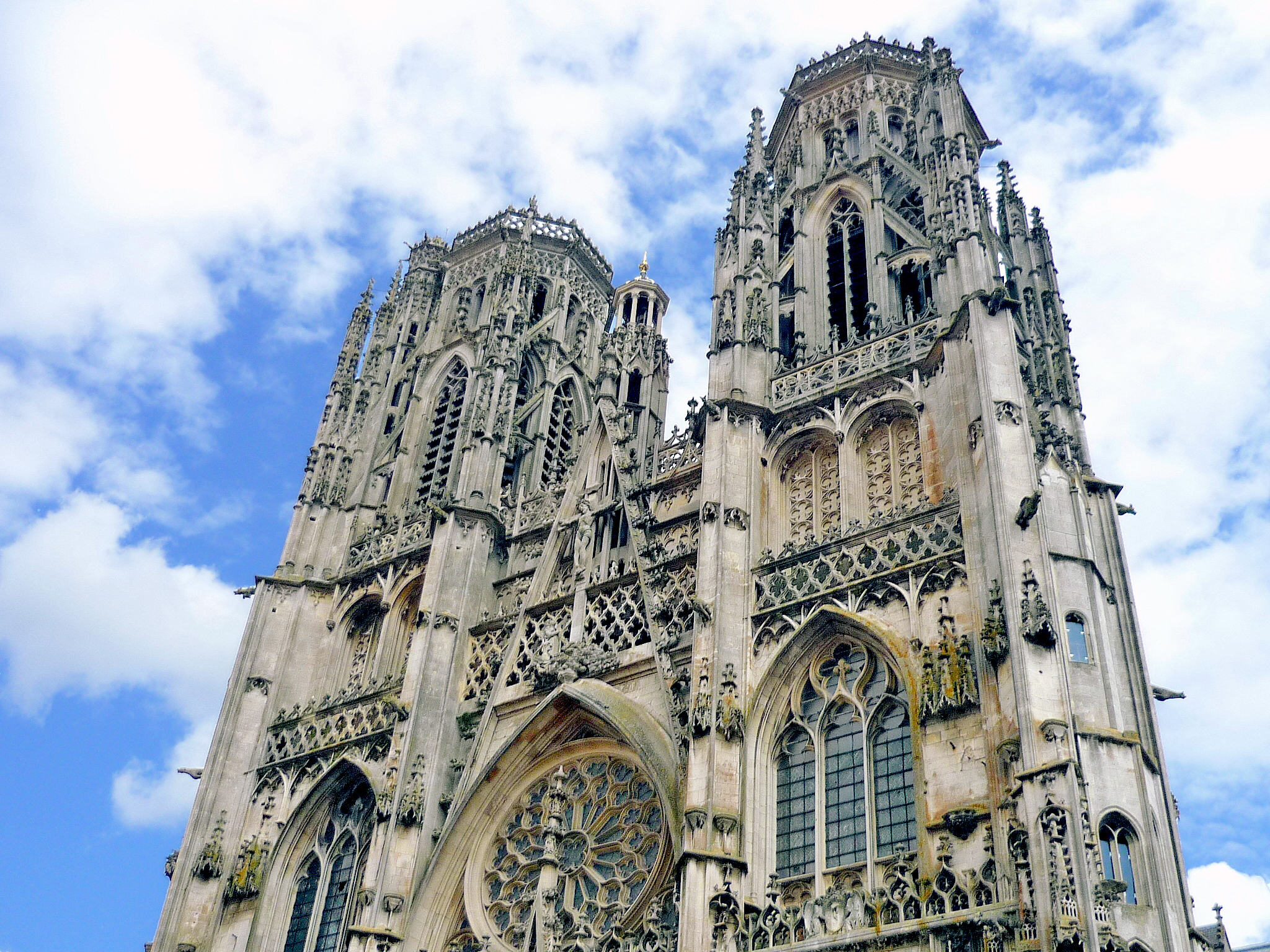
3. The rose window
At the centre of the third main zone is the great rose window, one of the façade’s focal points.
It is set above the portals and framed by a dense field of Gothic stonework.
This is the visual heart of the west front: the element that immediately draws the eye and gives the central section its sense of openness and lightness.
The rose at Toul is often described as having an eight-petalled form.
In Gothic architecture, a rose window is never just a decorative feature. It is both structural and symbolic.
Seen from outside, it provides a great circular contrast to all the pointed arches and vertical lines around it.
Seen from within, it would have brought filtered light into the cathedral.
On the façade of Toul, it marks the moment where the composition becomes less about entry and more about elevation — the eye begins to travel beyond the human scale of the doors into the soaring upper architecture of the church.
The rose window works almost like the façade’s “jewel” — not the largest element, but the one that gathers the composition together.
4. The great central gable
This is the most dramatic part of the façade and one of Toul Cathedral’s most distinctive features: the immense central gable rising above the rose window.
It is this gigantic triangular form that gives the façade so much of its upward energy.
Rather than stopping at the level of the rose, the façade surges higher still, creating an impression of momentum and vertical ambition that is entirely characteristic of late Gothic design.
The gable is not a plain geometric shape.
It is enriched with crockets, tracery, pinnacles, and sculptural detailing, so that even this large architectural mass seems animated and alive.
It is exceptionally large and one of the most memorable features of the west front.
This part of the façade is especially important visually because it fills the space between the towers.
Without it, the central section might feel comparatively low. With it, the whole façade becomes a unified vertical composition rather than simply a central block flanked by towers.
The campanile
One more feature deserves mention: above the central section, between the towers, rises the campanile added in 1534, with a bell dating from 1536.
This element belongs to the Renaissance rather than the Gothic phase.
It introduces a slightly different vocabulary — including classical details such as columns and round arches — and forms an elegant crown to the central axis of the façade.
5. The upper stages of the towers
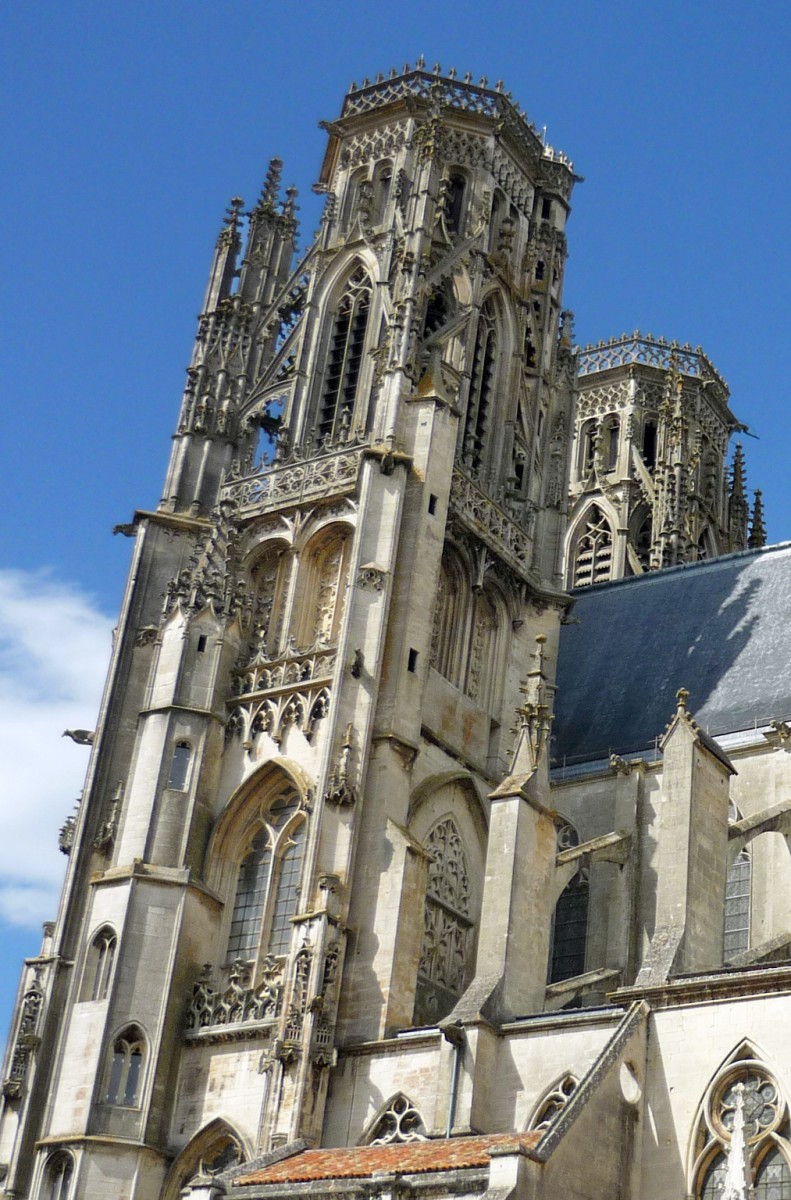
Above the lower rectangular portions, the towers develop into their upper stages, becoming one of the defining features of Toul Cathedral’s silhouette.
They rise to about 65 metres and are notable for their transition from a rectangular base to an octagonal upper form.
This change in geometry adds elegance and refinement: the towers feel lighter as they rise, rather than bulkier.
The towers are richly decorated with openwork Gothic detail, pointed openings, pinnacles, and balustrades.
They look powerful from afar, but close up, they are surprisingly delicate in their treatment, almost filigree-like in places.
This combination of mass and intricacy is one of the great pleasures of Flamboyant Gothic architecture.
It is also worth mentioning that the towers were apparently intended to receive spires, which were never built.
That unfulfilled intention matters because it helps explain the appearance of the façade today: magnificent and soaring, yet still with a sense of something projected beyond what was actually completed.
The Towers of Toul Cathedral
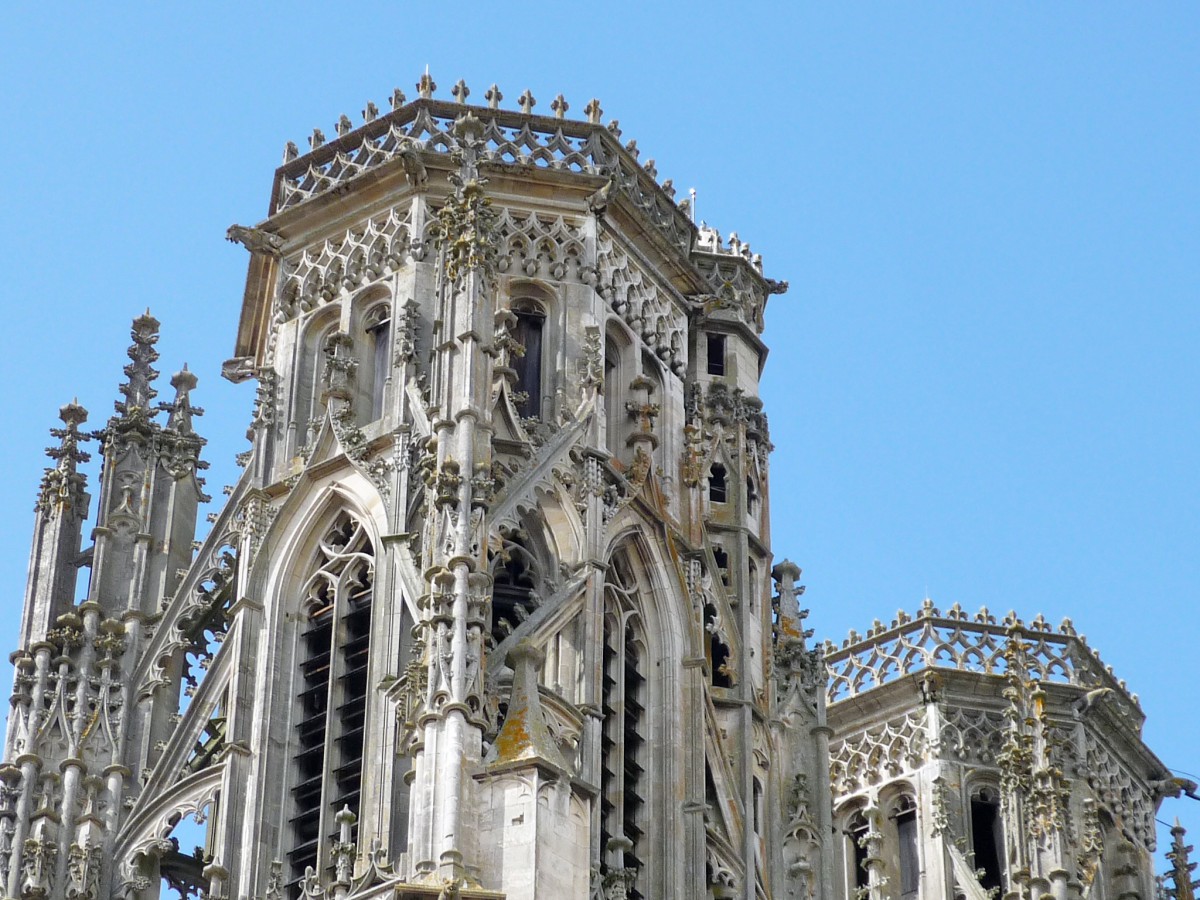
For lovers of Gothic architecture, climbing the towers of Toul Cathedral is one of the highlights of a visit.
The ascent takes visitors up the South Tower by a narrow spiral staircase of around 325 steps, leading first to the gallery that links the two western towers.
From here, the cathedral reveals an entirely different face: a world of gargoyles, pinnacles, carved stonework, and delicate Gothic details that are barely visible from the street below.
It is one of those rare moments when you can step behind the great façade and appreciate the craftsmanship of medieval builders at close range.
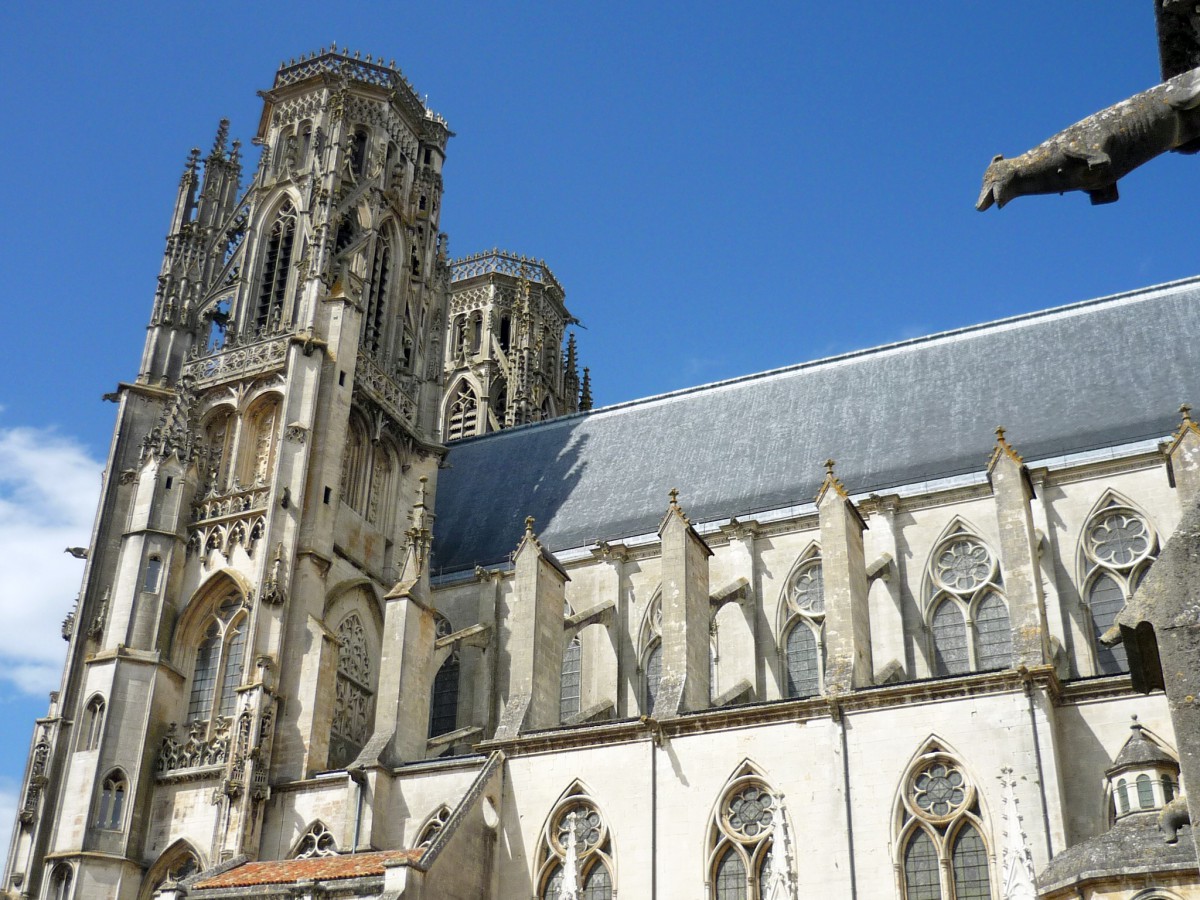
This gallery level is not just an architectural curiosity.
It also offers a striking perspective on the immense western façade itself, allowing visitors to understand how its balustrades, towers, and central gable are organised.
Seen from here, the façade feels less like a flat front and more like a complex stone structure, full of depth, passageways, and ornament.
A second spiral staircase continues to the top of the South Tower, where the reward is a magnificent 360-degree panorama.
From the summit, the rooftops and lanes of Toul spread out below, together with the city’s historic Vauban fortifications, the valley of the Moselle, and the surrounding countryside known as the Toulois.
The view makes clear just how strategically placed Toul has always been, between river, plains, and fortified walls.
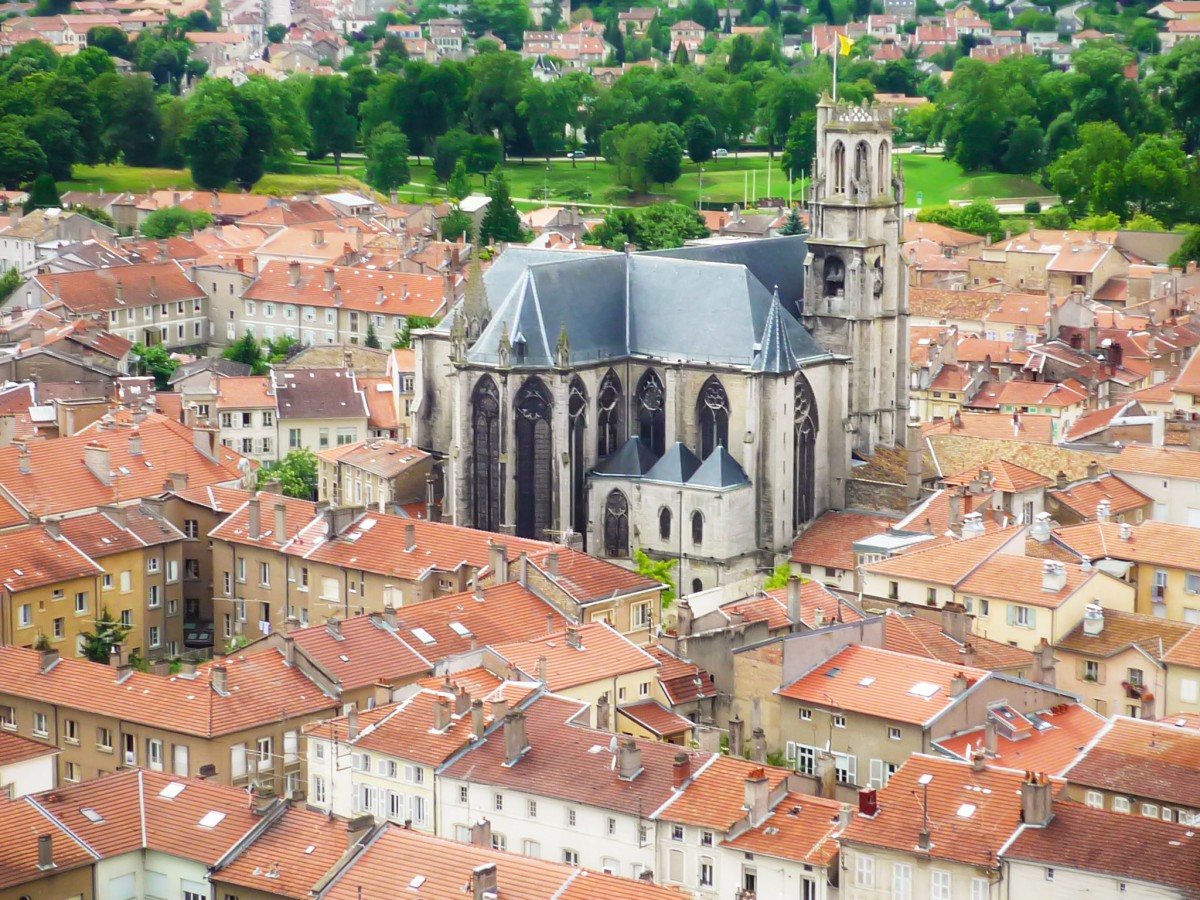
The climb is usually offered only on a seasonal basis, not year-round.
Current tourist information indicates that access is generally available in the summer season, roughly from late June or 1 July until mid-September or the Heritage Days, and may be restricted in bad weather.
Practical conditions also apply: access is normally reserved for visitors over 6 years old, with suitable shoes required.
Because opening arrangements can change, it is best to check locally before your visit.
The Interior of Toul Cathedral
The interior of Toul Cathedral makes an immediate impression through its light and its height.
Many Gothic churches feel solemn or shadowy, but here the first sensation is one of brightness.
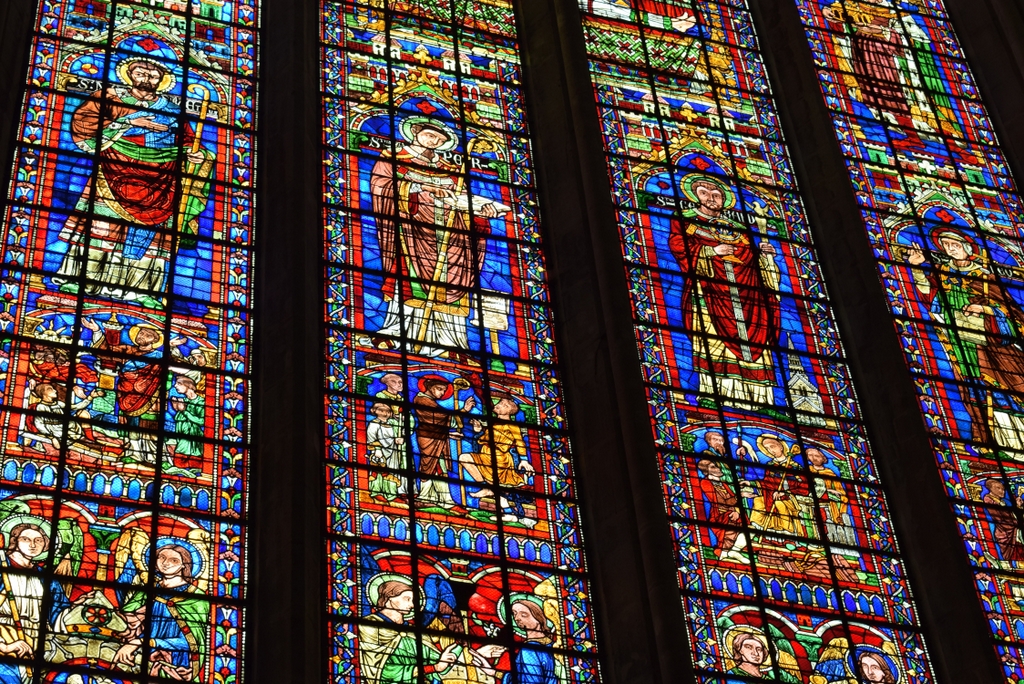
That effect comes partly from the abundance of stained glass and partly from the pale local stone, which reflects the light and gives the whole building a surprisingly luminous atmosphere.
The nave
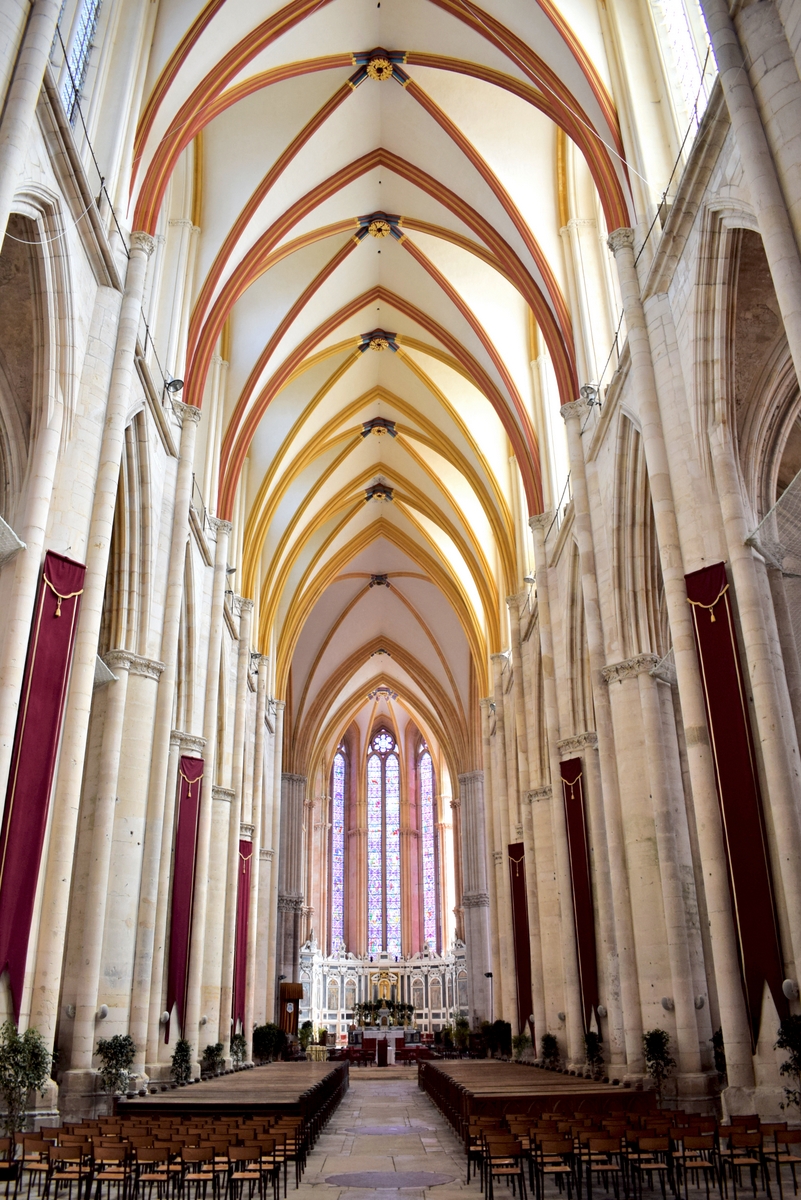
The nave, with its soaring elevation and clean Gothic lines, manages to feel both graceful and powerful at the same time.
It is this balance between lightness and strength that makes the interior so memorable.
The cathedral’s proportions also play a major role in this impression.
The nave is about 100 metres long, and the vault rises to around 30 metres, giving the space a strong vertical pull without making it feel oppressive.

Although the west front is the most exuberant part of the building, the rest of the cathedral is striking for its stylistic unity.
Even after a construction period stretching over several centuries, the interior retains a remarkable sense of coherence.
The All Saints Chapel
One of the most interesting surprises inside the cathedral is the All Saints Chapel, a Renaissance chapel added in the 16th century in the south aisle of the nave.
Older summaries often date it to 1532, but more recent references indicate that it was commissioned before 1549.
It became the burial chapel of Jean Forget, a chaplain and cantor of the chapter of canons.
What makes the All Saints Chapel especially remarkable is its trompe-l’oeil dome, created through sophisticated perspective effects.
Rather than relying only on structural daring, the chapel plays with the visitor’s eye, using illusion to create a striking sense of depth and elevation.
The dome is topped by a small lantern, which adds both elegance and extra light.
This chapel is often singled out as one of the cathedral’s most unusual interior features because it introduces a distinctly Renaissance sense of artistic play into a predominantly Gothic monument.
More broadly, the interior of Toul Cathedral rewards slow observation.
Beyond the height of the nave and the brightness of the stone, there are layers of history visible in the building itself: Gothic structure, Renaissance additions, later decoration, and the traces of major restoration campaigns after wartime damage.
The result is not a frozen medieval monument, but a living church shaped by several centuries of artistic ambition and renewal.
For visitors, it is best to check current local information before planning a visit, as access and opening arrangements may vary according to the season, tourist office hours, and religious services.
The Cathedral’s Cloister
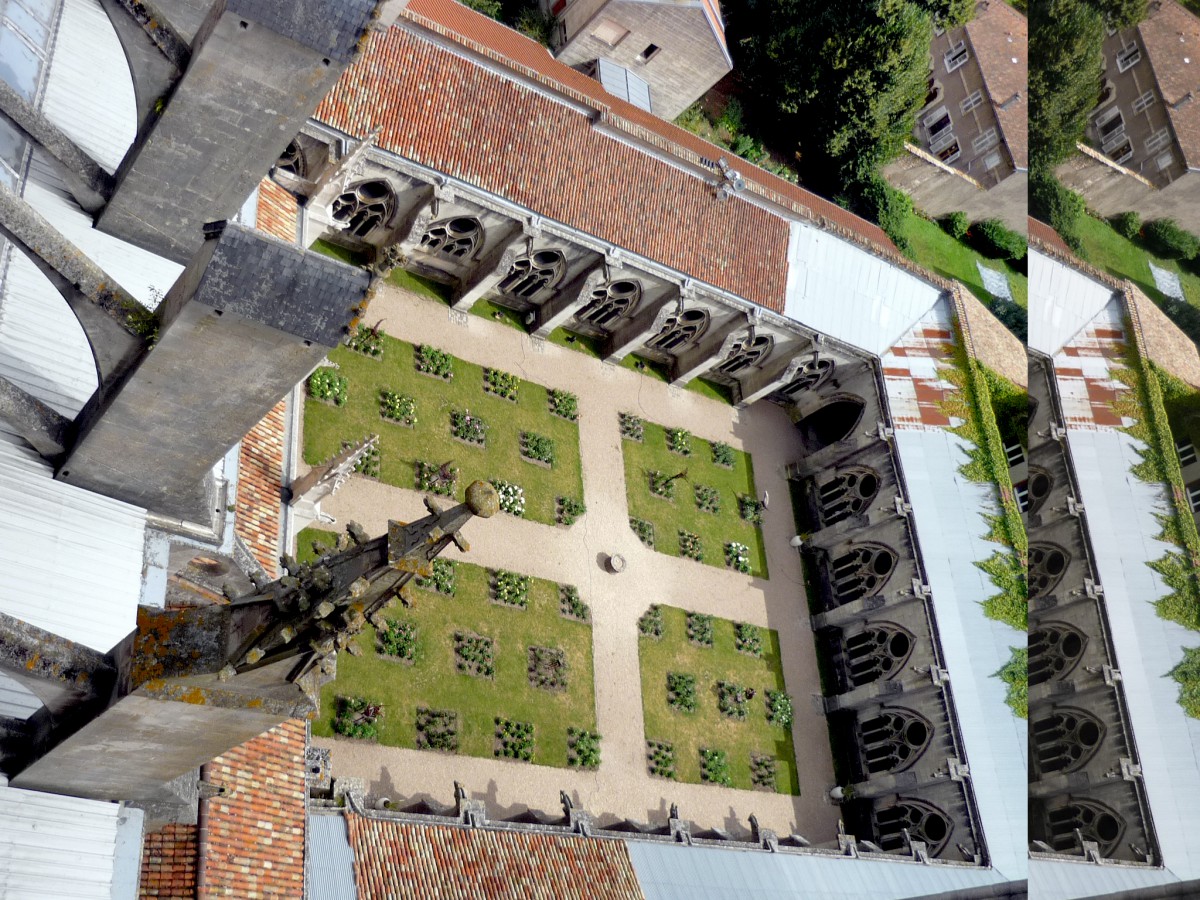
The cloister of Toul Cathedral is one of the monument’s most remarkable treasures.
Measuring around 54 metres by 42 metres, it is one of the largest Gothic cloisters in France.
Built in the 13th and 14th centuries, it lies slightly below the level of the cathedral and opens onto a central garden through broad Gothic bays, creating a beautiful sense of space, light, and calm.
Its four galleries are especially rewarding to explore at a slow pace.
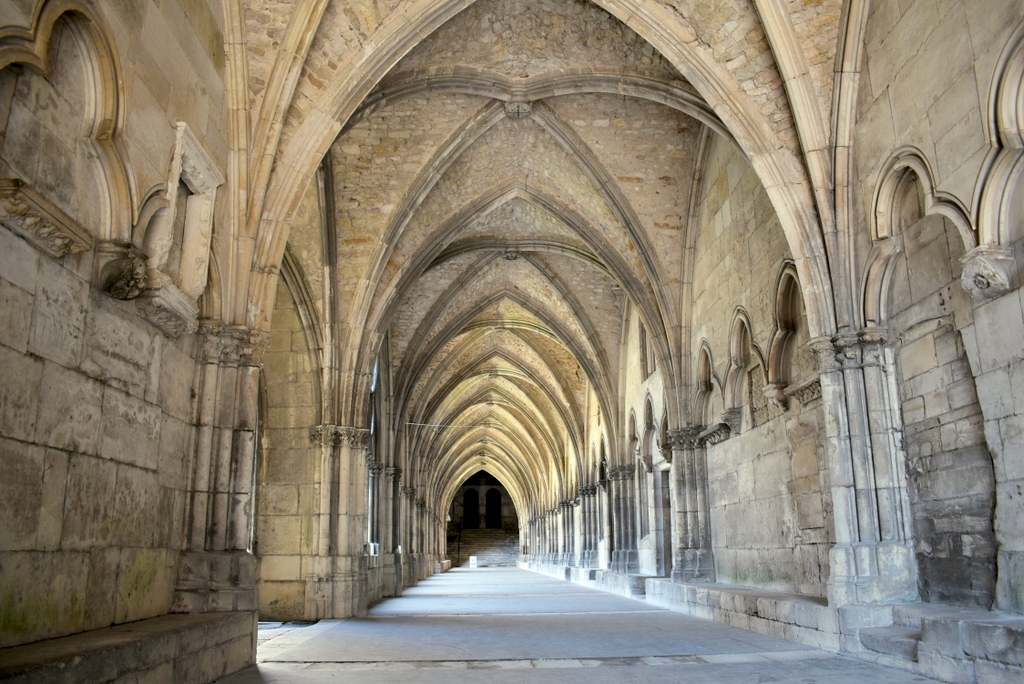
The architecture combines Gothic elegance with later touches, while the sculpted decoration reveals a wealth of detail: fantastic figures, flowers, animals, and a series of gargoyles that deserve close attention.
Far from being merely an architectural appendix to the cathedral, the cloister has a character of its own — more intimate, more peaceful, and deeply atmospheric.
Today, the cloister remains one of the most serene parts of a visit to Toul Cathedral.
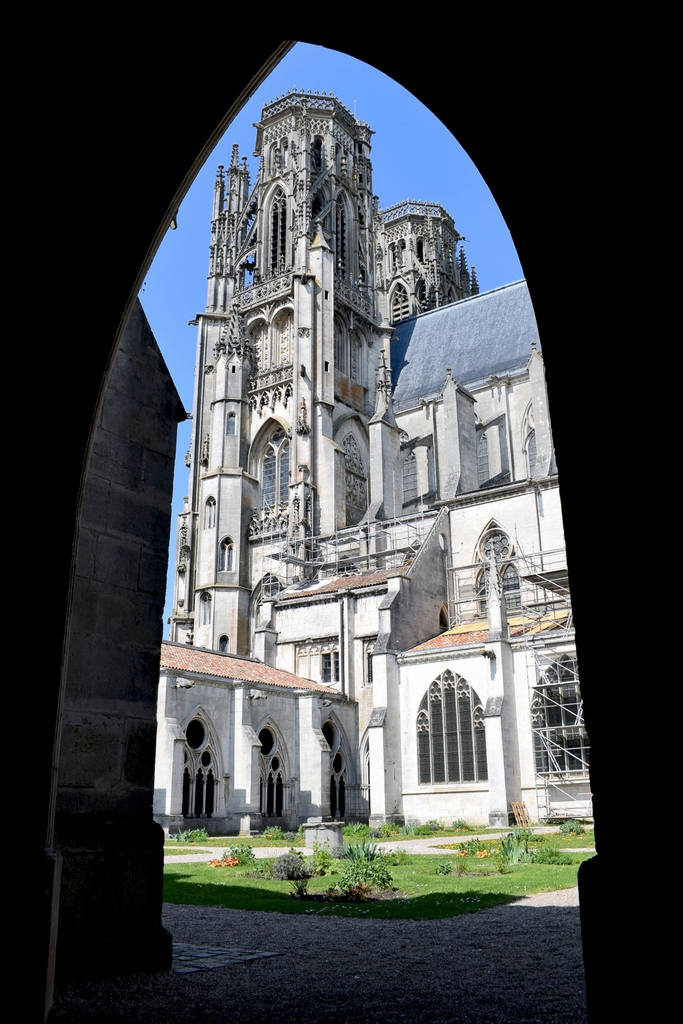
After the height of the nave and the splendour of the western façade, it offers a quieter encounter with the monument: a place of stone, silence, and contemplation, where the artistic richness of the cathedral can be appreciated in a more intimate setting.
Pin it on Pinterest :
For more information about the region of Toul, visit the website of the Toul Tourist Board