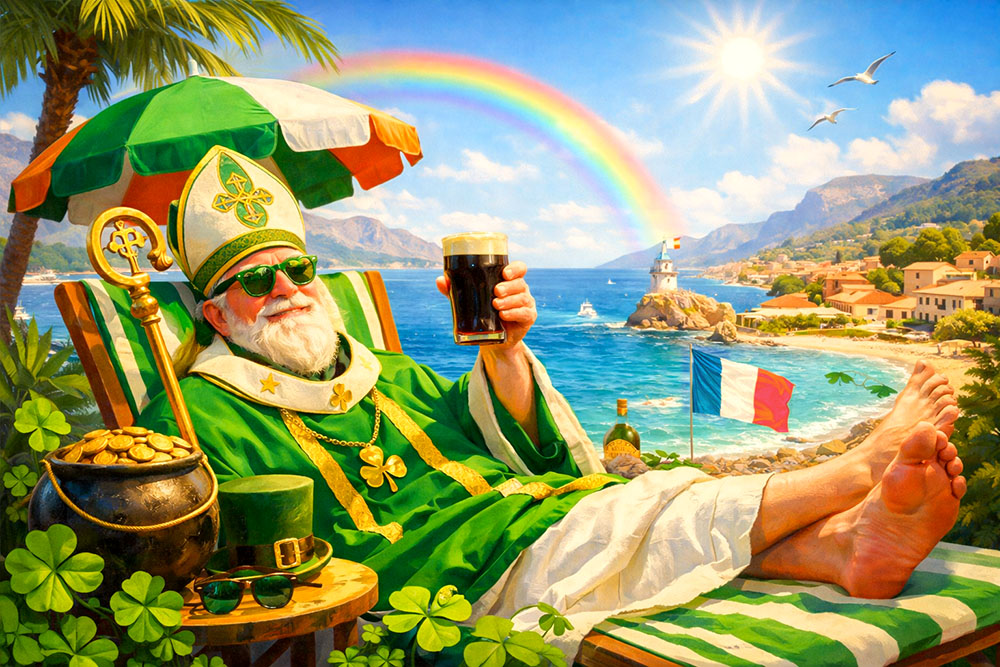

Saint Patrick’s Day marks the feast day of Ireland’s national hero, Saint Patrick, the patron saint who is said to have brought Christianity to the island in the 5th century. Every year on March 17, Ireland turns green with parades, music, and celebrations that have spread far beyond its borders.
But what about Saint Patrick’s Day in France, la fête de la Saint-Patrick?
Across the country, the day is increasingly marked by concerts of Celtic music, festive gatherings, and lively evenings in Irish pubs. In many major French cities, pubs fill with people eager to enjoy the atmosphere, raise a pint of beer, and celebrate a little piece of Irish culture.
Although the celebrations in France are usually more modest than in Dublin or New York, the enthusiasm for this Irish festival has grown steadily over the years.
So how did this Irish tradition make its way to France? And how exactly is Saint Patrick’s Day celebrated there today?
Let’s explore the origins and traditions behind this festival, which continues to gain popularity with the French year after year.
🎦 Watch a short presentation on Saint Patrick’s Day in France ⤵
Who was Saint Patrick?
Saint Patrick was born around AD 390 into a Romano-British family somewhere in Britain.
Although he received a Christian education, religion did not seem to play a very important role in his early life.
Everything changed when he was sixteen years old.
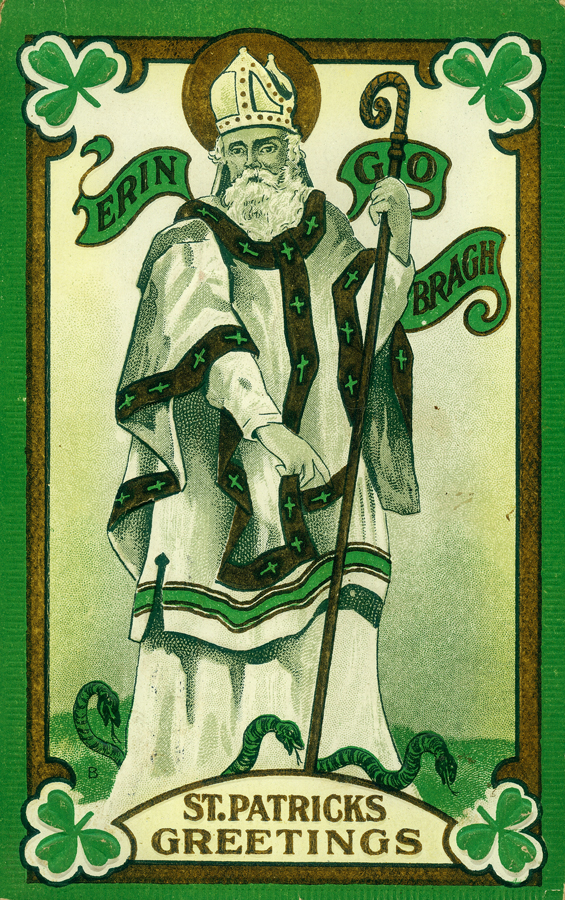
According to tradition, Patrick was captured by Irish raiders — often described as Scots or Pictish pirates — who took him to Ireland and sold him into slavery.
There he spent several years working as a shepherd, tending pigs and sheep in the Irish countryside.
Before his capture, Patrick was not particularly devout. But during those difficult years of isolation, he experienced a profound spiritual transformation.
He later wrote that it was during this time that he turned wholeheartedly to God and became deeply committed to the Christian faith.
After six years in captivity, Patrick managed to escape. He is said to have walked nearly 300 kilometres to reach the coast, where he boarded a ship that eventually brought him to Gaul, the region that corresponds roughly to modern-day France.
There, he continued his religious training and was eventually ordained a priest.
Some traditions even suggest that Patrick first landed in Armorica — today’s Brittany — and travelled across Gaul before reaching what he described as the “islands of the sea”, though the exact locations remain uncertain.
Saint Patrick on the French Riviera!
A later tradition places Patrick on the French Riviera, at the monastery of Saint-Honorat, located on the Lérins Islands off the coast of Cannes.
According to this story, Patrick spent around two years there studying theology with the monks of the famous abbey.
![The Lérins monastery off Cannes © Alberto Fernandez Fernandez - licence [CC BY 2.5] from Wikimedia Commons](https://frenchmoments.eu/wp-content/uploads/2023/01/Monastere-de-Lérins-©-Alberto-Fernandez-Fernandez-licence-CC-BY-2.5-from-Wikimedia-Commons-scaled.jpg)
Saint Patrick in Burgundy
Another tradition — equally uncertain — places him in Auxerre in Burgundy, where he is said to have studied under Saint Germain of Auxerre, eventually becoming a deacon and later a bishop.
![Auxerre Cathedral © Pline - licence [CC BY-SA 3.0] from Wikimedia Commons](https://frenchmoments.eu/wp-content/uploads/2023/01/Auxerre-Cathedral-©-Pline-licence-CC-BY-SA-3.0-from-Wikimedia-Commons-scaled.jpg)
In 432, at the request of Pope Celestine I, Patrick returned to Ireland as a missionary bishop.
After landing at Saul, near Downpatrick, he devoted himself to evangelising the island and establishing monastic communities that would play an important role in Irish Christianity.
Saint Patrick and the Shamrock
One of the most famous legends associated with Saint Patrick concerns the shamrock, which later became a powerful symbol of Ireland.
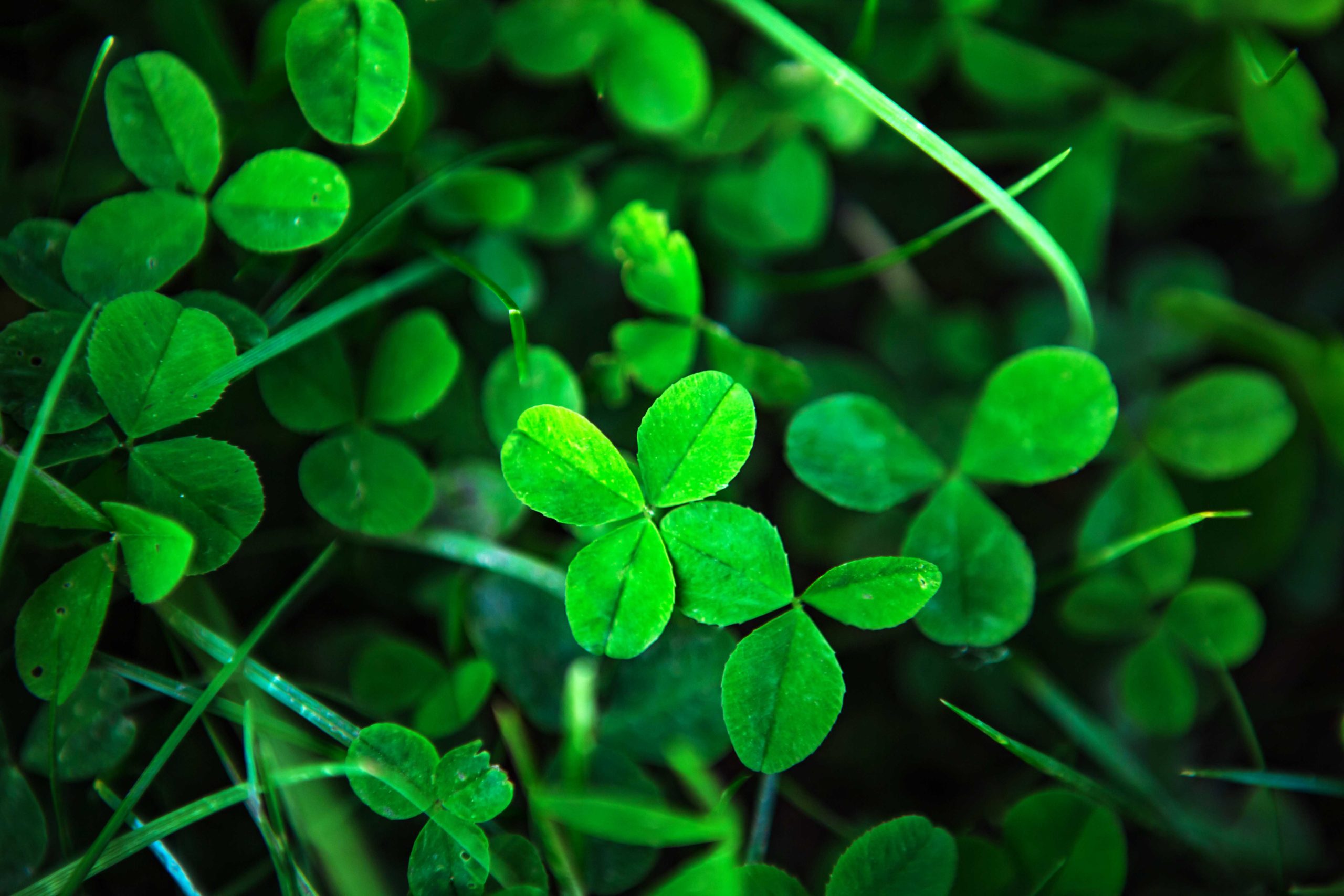
According to tradition, Patrick used the three leaves of the shamrock to explain the concept of the Holy Trinity — the Father, the Son and the Holy Spirit — during a sermon at the Rock of Cashel.
This simple image helped make the idea more understandable to the Irish people, and the shamrock gradually became a national symbol of Ireland. (The official emblem of the country, however, is the Celtic harp.)
Another legend links this symbolism to Saint-Honorat Island near Cannes.
It is said that Patrick described the Trinity Chapel there as representing the Holy Trinity, its architectural layout resembling a cloverleaf with a nave and three circular chapels.
To this day, many Irish people wear a sprig of shamrock on their lapel on Saint Patrick’s Day in memory of this famous teaching.
What is the difference between a clover and a shamrock?
In French, things are simple: there is only one word for plants of the Trifolium family — le trèfle.
In English, however, two words are commonly used: clover and shamrock.
To understand the difference, let’s start with a simple comparison.
Paris is in France.
But France is not only Paris.
The same idea applies to clovers and shamrocks.
Clover is the broader, generic term — like France.
Shamrock is more specific — like Paris.
In other words:
All shamrocks are clovers, but not all clovers are shamrocks.
What is a clover?
The word clover can refer to any of the roughly 300 species belonging to the Trifolium family.
Another term sometimes used for these plants is trefoil, which actually helps explain the meaning of the word. If we look at its roots:
- tri- or tre- meaning three
- -foil or -folium meaning leaf
So the word literally refers to a three-leaf plant.
Most clovers share this characteristic three-leaf structure.
Among the many species of clover, some of the best known include:
- Alsatian clover
- black clover
- red clover
- strawberry clover
- Swedish clover
- white clover
These plants are common throughout Europe and often grow naturally in fields and meadows.
What is a shamrock?
The word shamrock, on the other hand, refers to something more specific.
The term comes from the Irish Gaelic word seamróg, meaning “little clover.”
Most botanists believe that the plant traditionally called a shamrock is either:
white clover (Trifolium repens), or
suckling clover (Trifolium dubium).
More importantly, the shamrock has become a powerful national symbol of Ireland and a key emblem of Saint Patrick’s Day.
Traditionally, the shamrock has three leaves, not four. According to legend, Saint Patrick used this simple plant to explain the concept of the Holy Trinity — three persons united in one God — using the three leaves joined by a single stem.
What about four-leaf clovers?
If a “normal” clover has three leaves, what about the famous four-leaf clover?
In fact, a four-leaf clover is simply a rare genetic mutation of the ordinary three-leaf plant.
Anyone who has ever searched for one in a grassy field knows just how rare they can be!
Because of this rarity, the druids of ancient Celtic cultures believed that four-leaf clovers could protect against evil spirits.
Over time, the darker side of that belief faded away, and the plant became simply a symbol of good luck.
Today, the four leaves are often said to represent:
- faith,
- hope,
- love,
- luck.
The shamrock: symbol of Ireland… and of spring!
The shamrock is not only a symbol of Ireland and Saint Patrick’s Day — it is also closely associated with spring.
Using plants to celebrate the return of spring is a tradition found in many cultures.
In France, for example, people have long hung sprigs of boxwood or laurel in their homes on Palm Sunday, a symbol of renewal and fertility linked to the rebirth of nature.
Another example is the French tradition of giving lily of the valley (muguet) on May Day, a small flower that also represents happiness and good fortune.
In this way, the shamrock belongs to a wider family of spring symbols — simple plants that carry centuries of meaning and tradition.
No snakes in Ireland!
According to a popular legend, Saint Patrick once drove all the snakes out of Ireland.
In reality, historians and scientists agree that snakes probably never lived in Ireland after the last Ice Age. But the story has endured for centuries because it carries a powerful symbolic meaning.
In Christian tradition, the snakes are said to represent the pagan beliefs of the ancient Celts.
By driving them out of the island, Patrick symbolically illustrated the triumph of Christianity over the old polytheistic traditions of Ireland.
The image also echoes the biblical symbolism of the serpent, often associated with Satan and the forces opposed to the knowledge of the true God.
Last days and cult of the saint
Despite the immense popularity he enjoys today, Patrick’s life was not without difficulties.
During his lifetime, he faced strong opposition and hostility, both from local leaders and from certain members of the Christian community who questioned his authority and his mission.
After many years devoted to evangelising Ireland, Patrick eventually withdrew from active ministry.
According to tradition, he spent his final days at the Priory of Down, in Ulster.
He died in 461, leaving behind a Christian community that would soon flourish.
In the centuries that followed, Ireland became known as the “Island of Saints and Scholars.”
The cult of Saint Patrick gradually spread beyond Ireland.
Tradition credits the Irish missionary Fursy of Péronne in the 7th century with introducing the veneration of Saint Patrick to northern Gaul.
Today, in the Catholic tradition, Saint Patrick is recognised as the patron saint of Ireland, and he is also considered the patron saint of engineers and snake handlers.
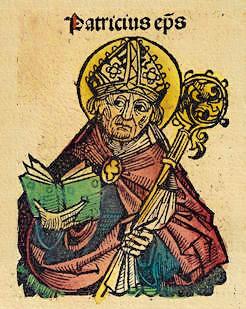
The origins of Saint Patrick’s Day
Saint Patrick’s Day was already being celebrated by the Irish as early as the 9th and 10th centuries.
Over time, the continued observance of the feast strengthened the association between Saint Patrick and the identity of Ireland itself.
Today, the celebration has become one of the most recognisable symbols of Irish culture worldwide — much as Bastille Day is associated with France or Independence Day with the United States.
The date of March 17 was formally recognised in the Irish calendar as early as 1607, when it was declared a religious feast day.
Contrary to a common misconception — often repeated by foreign media — Saint Patrick’s Day is not the national day of Ireland.
The country’s official national day is actually linked to the Easter Rising of 1916 and the birth of the modern Irish state.
In 1903, Saint Patrick’s Day was officially declared a public holiday in Ireland, reinforcing its importance as a major cultural and religious celebration.

Saint Patrick’s Day and Lent
Saint Patrick’s Day always falls during the period of Lent, the forty days of preparation leading up to Easter in the Christian calendar.
Because Lent is traditionally a time of fasting and restraint, it became customary for some Christians to temporarily suspend their Lenten fast on Saint Patrick’s Day in order to celebrate the feast.
The Church calendar also follows specific rules regarding the celebration of saints’ feast days.
When a feast coincides with particularly important liturgical periods, such as Holy Week, it may be moved to another date.
Saint Patrick’s Day has occasionally been affected by this adjustment.
For example, in 1940, the feast was observed on April 3 to avoid coinciding with Palm Sunday.
More recently, in 2008, it was celebrated on March 14 because March 17 fell during Holy Week.

A bit of vocabulary
Several different names are used to refer to this Irish celebration:
- Saint Patrick’s Day (or St. Patrick’s Day)
- Saint Paddy’s Day (or St. Paddy’s Day)
- Feast of Saint Patrick (or Feast of St. Patrick)
- Patty’s Day (especially in North America)
- Lá Fhéile Pádraig (in Irish Gaelic)
- La Saint-Patrick (in French)
- La fête de la Saint-Patrick (in French)
In French, the equivalent of the name Patrick is Patrice.
Saint Patrick’s Day in France
Saint Patrick’s Day began to gain visibility in France during the 1990s.
Its arrival followed a pattern similar to that of Halloween, another celebration of Celtic origin that became widely popular in Europe after being reintroduced through American culture and commercial promotion.
Since then, the Irish festival has gradually found its place in French cities.
![Saint Patrick's Day in France © Patrice CALATAYU - licence [CC BY-SA 2.0] from Wikimedia Commons](https://frenchmoments.eu/wp-content/uploads/2023/01/Gilets-Jaunes-in-Green-©-Patrice-CALATAYU-licence-CC-BY-SA-2.0-from-Wikimedia-Commons.jpg)
Every year on March 17, Irish expatriates living in France celebrate Saint Patrick’s Day, keeping alive a tradition from their homeland.
But the festivities are no longer limited to the Irish community.
Many French people who appreciate Irish culture — its music, pubs, and convivial spirit — now take part in the celebrations and proudly claim to be “Irish for a day.”
Celebrating Saint Patrick’s Day in France
In France, as elsewhere in the world, the celebrations revolve around the colour green and symbols of Irish culture.
Interestingly, green was not originally associated with Saint Patrick. Early depictions of the saint often featured blue. The colour green became strongly linked to Ireland in 1798 during the Irish Rebellion, when the shamrock was adopted as a nationalist symbol.
![Saint Patrick's Day parade in Belfort (2019) © Thomas Bresson - licence [CC BY 4.0] from Wikimedia Commons](https://frenchmoments.eu/wp-content/uploads/2023/01/Saint-Patricks-Day-in-Belfort-2019-02-©-Thomas-Bresson-licence-CC-BY-4.0-from-Wikimedia-Commons-scaled.jpg)
Today, on Saint Patrick’s Day, participants traditionally wear something green — whether a scarf, a hat, or even an entire outfit — to join in the festive atmosphere.
Across France, especially in larger cities such as Paris, Lyon, Bordeaux, Lille, Strasbourg, and Toulouse, celebrations may include:
- concerts of Celtic music,
- Irish dance performances,
- themed evenings in Irish pubs,
- and occasionally street parades or cultural events organised by Irish associations.
The growing popularity of Irish pubs in France over the past few decades has played a major role in spreading the celebration.
Many of these pubs organise special Saint Patrick’s Day events that attract large crowds.
![Saint Patrick's Day parade in Belfort (2019) © Thomas Bresson - licence [CC BY 4.0] from Wikimedia Commons](https://frenchmoments.eu/wp-content/uploads/2023/01/Saint-Patricks-Day-in-Belfort-2019-01-©-Thomas-Bresson-licence-CC-BY-4.0-from-Wikimedia-Commons-scaled.jpg)
Food and Drink: An Essential Part of the Celebration
But above all, Saint Patrick’s Day in France is often associated with food and drink inspired by Irish traditions.
Irish pubs and bars typically offer a selection of Irish beverages, including:
- Irish beers and stouts, such as Guinness, Murphy’s, Smithwick’s, and Harp,
- Irish whiskeys,
- Irish ciders,
- and the classic Irish coffee.
For many participants, the evening becomes an opportunity to enjoy Irish music, share a drink with friends, and experience — if only for a night — a little taste of Ireland.

Where to celebrate St Patrick’s Day in France?
Many events are organised throughout France on Saint Patrick’s Day. Here are a few examples.
Centre Culturel Irlandais in Paris
To learn more about the traditional Irish festival, you must go to the Irish cultural centre in the 5th arrondissement of Paris (located on the Rue des Irlandais!). On the programme: Celtic concert and exhibitions.
The Moulin Rouge goes green
Funny as it may seem, the Moulin Rouge goes green for Saint Patrick’s Day. The famous Parisian cabaret swaps its red facade for a sparkling green and puts on a show made in Ireland.
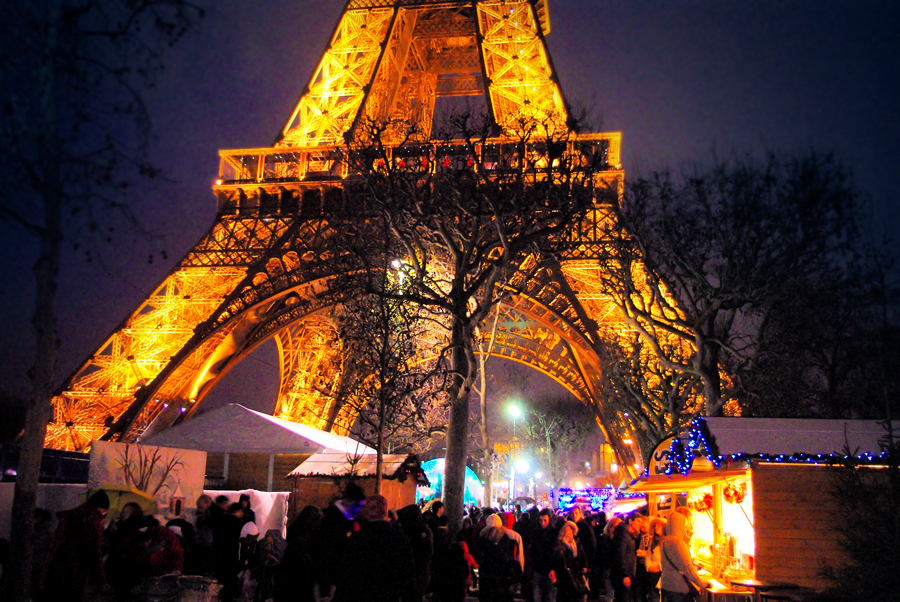
The Eiffel Tower lights up in green
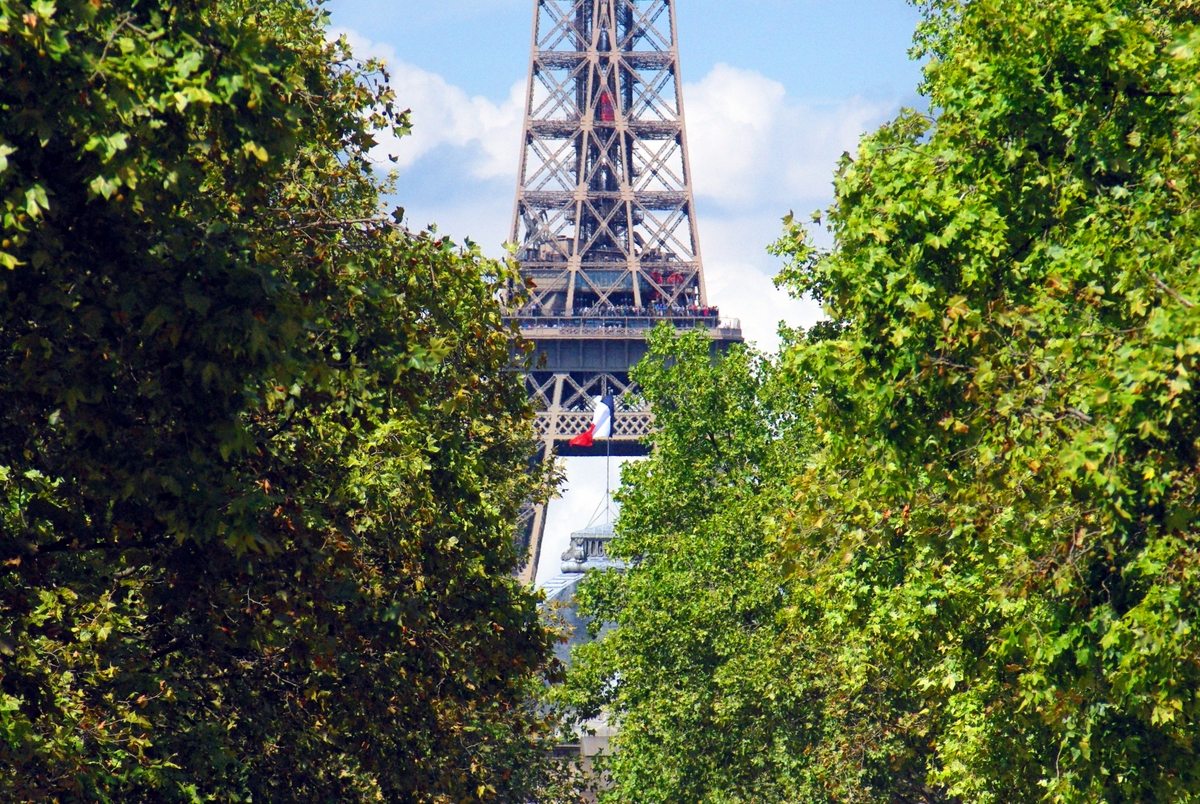
The Moulin Rouge is not the only monument to light up in green. The Eiffel Tower – and other Parisian monuments – are lit in green after dark. A magnificent sight to see at least once in your life!
Cannes goes Irish
The capital of French cinema is dressing up its most beautiful monuments in green: the town hall, the Palais des Festivals and the bridge on Rue Barthélémy! A tribute to Saint Patrick, who, according to legend, settled in the monastery of Saint-Honorat (on the island of Lérins) to study theology.
Brittany in the colours of Ireland
Saint Patrick’s Day is a festival that is strongly represented throughout Brittany. The twinning committees play an essential role in the expansion of this event. For example, in Lorient, it is an opportunity to celebrate its twinning with the city of Galway since 1974. Various festive events are organised for this occasion by the City in the centre of Lorient.
However, Saint Patrick’s Day in France does not have the same popularity as in the United States.
Saint Patrick’s Day in America
Following the Great Famine, many Irish emigrated to New York and New England in the mid-19th century.
These devout Catholics kept the habit of celebrating Saint Patrick’s Day on March 17.
However, America’s Saint Patrick’s Day celebrations existed long before this famous emigration episode.
The first celebration of the festival took place in Boston in 1737, and the first official parade in New York in 1762, i.e. in the days of the British colonies, before American independence.
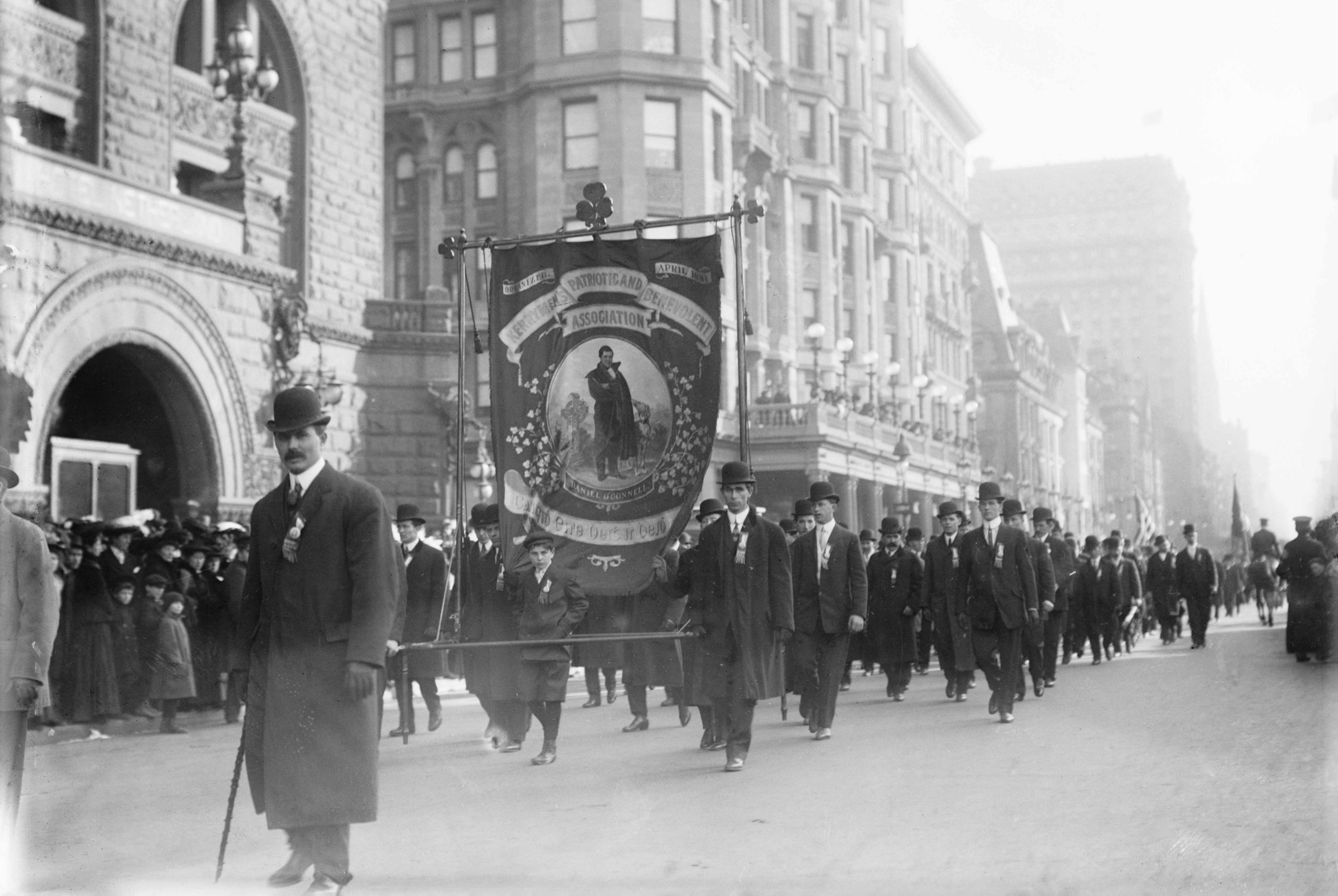
Today, New York City hosts the world’s largest Saint Patrick’s Day parade, with more than two million spectators on Fifth Avenue in front of the towers of St. Patrick’s Cathedral, a church built in the 19th century in the flamboyant style.
![Saint Patrick's Day Parade in New York City © James Felder - licence [CC BY 2.0] from Wikimedia Commons](https://frenchmoments.eu/wp-content/uploads/2023/01/Saint-Patricks-Day-Parade-New-York-©-James-Felder-licence-CC-BY-2.0-from-Wikimedia-Commons.jpg)
![Saint Patrick's Day Parade New York 02 © James Felder - licence [CC BY 2.0] from Wikimedia Commons](https://frenchmoments.eu/wp-content/uploads/2023/01/Saint-Patricks-Day-Parade-New-York-02-©-James-Felder-licence-CC-BY-2.0-from-Wikimedia-Commons.jpg)
Even today, American families of Irish descent send each other greeting cards with green designs reminiscent of the Irish shamrock. This shamrock, which Patrick used to explain the mystery of the Holy Trinity, has become the island’s emblem.

Find out more!
- Find out more about Spring in France.
- Read this article in French on our blog Mon Grand-Est 🇫🇷
- Read more on Wikipedia.
![Saint Patrick's Day parade in Montreal © Sandra Cohen-Rose and Colin Rose - licence [CC BY 2.0] from Wikimedia Commons](https://frenchmoments.eu/wp-content/uploads/2023/01/Saint-Patricks-Day-in-Montreal-©-Sandra-Cohen-Rose-and-Colin-Rose-licence-CC-BY-2.0-from-Wikimedia-Commons-scaled.jpg)
Pin it for later
Did you enjoy the reading? If so, please share this article on Facebook and Twitter, or pin the image below on Pinterest:
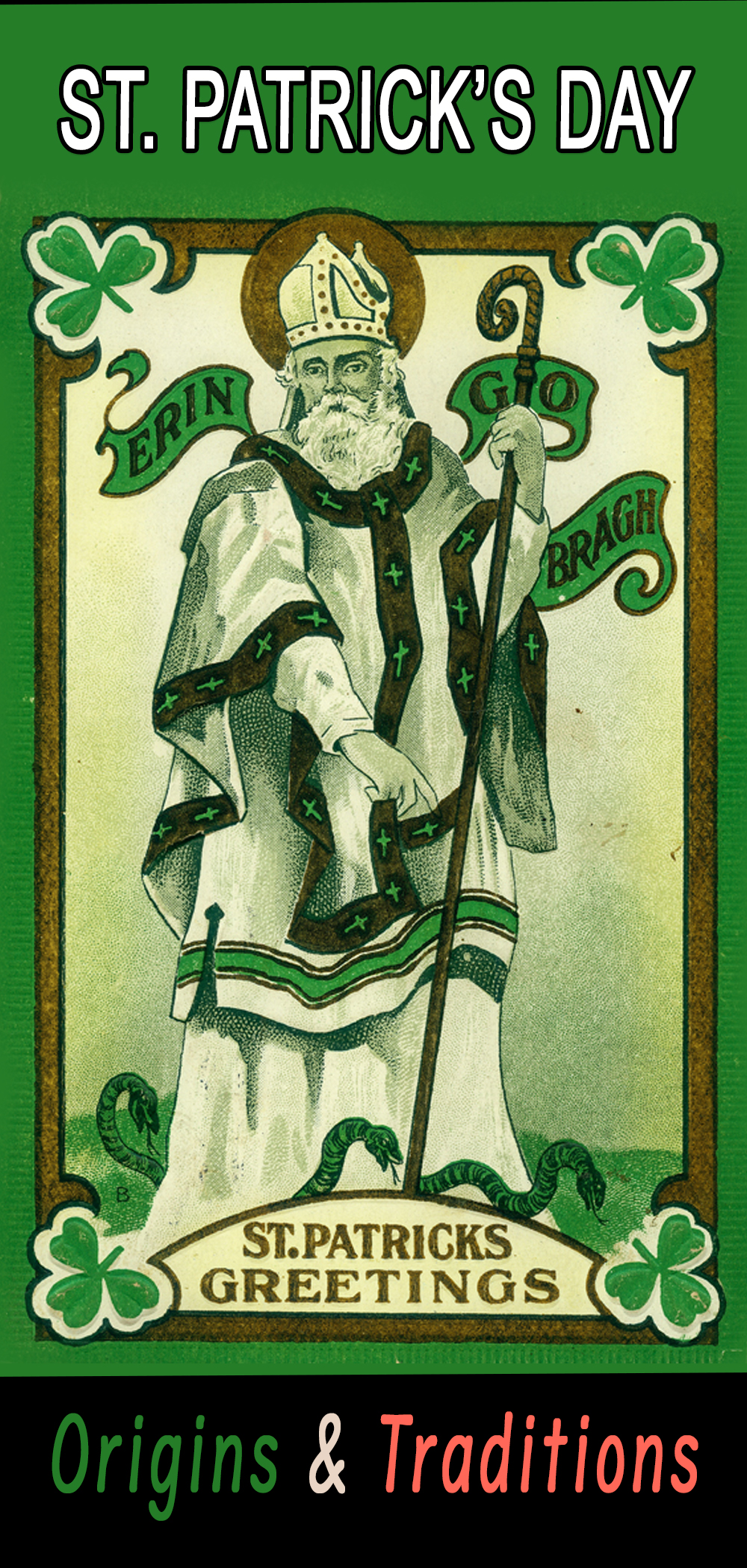
Featured image: Saint Patrick’s Day. Photo generated by OpenAI based on my prompts!