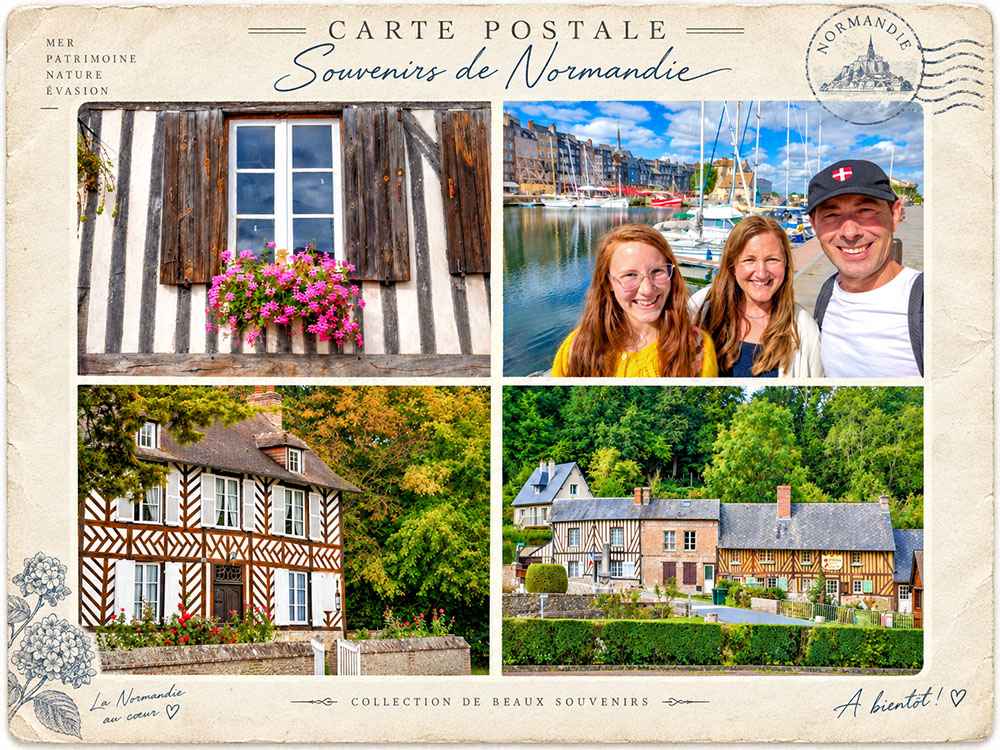
We have just returned from 16 days in the Pays d’Auge, one of the most beautiful corners of Normandy — and a region I had wanted to explore properly for a long time.
We based ourselves in the countryside near Livarot, right in the heart of the Pays d’Auge, and over the course of our stay we drove around 1,000 kilometres along its winding country roads.
That gave us plenty of time to go beyond the obvious sights.
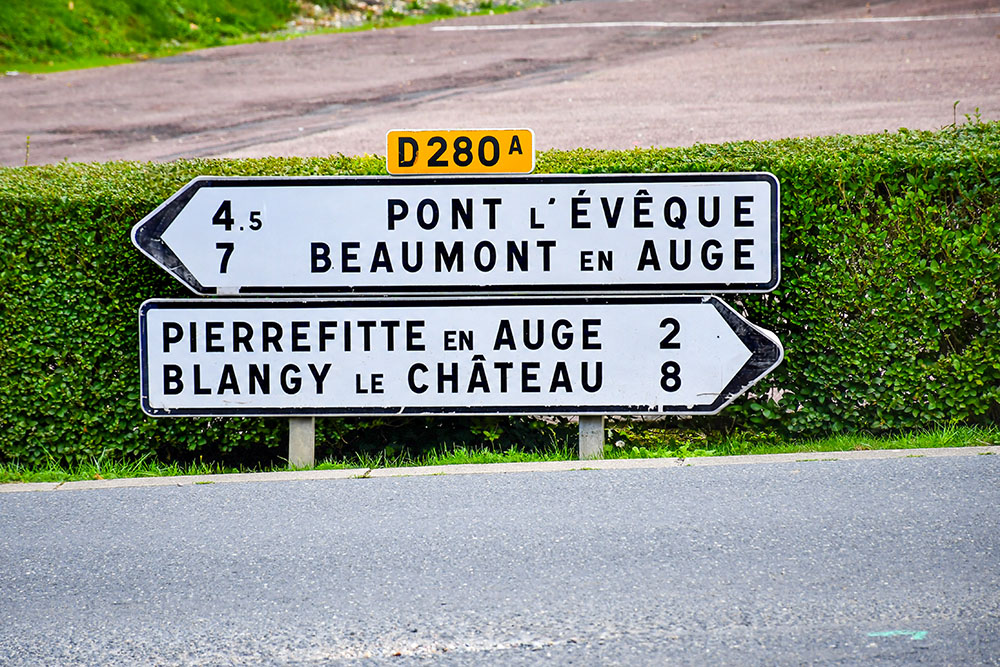
Road signs in the Pays d'Auge © French Moments
Of course, we visited well-known places such as Honfleur, Lisieux, Beuvron-en-Auge and Camembert. But some of my favourite discoveries were much smaller: quiet villages, half-timbered manor houses, unusual churches, cider farms, local cheese producers and landscapes we simply came across while driving from one place to another.
And that, I think, is one of the great pleasures of exploring the Pays d’Auge.
It is not a region where everything is concentrated around a handful of major attractions. Much of its charm lies between them: in the green valleys, apple orchards, old farmhouses and tiny villages scattered across the Norman countryside.
In this guide, I have selected 15 things to see and do in the Pays d’Auge, based on the places we actually visited and the experiences we enjoyed during those 16 days.
I’ll also explain where the Pays d’Auge is, what makes it distinctive, how long I think you should spend here, and why having a car makes such a difference when exploring this part of Normandy.
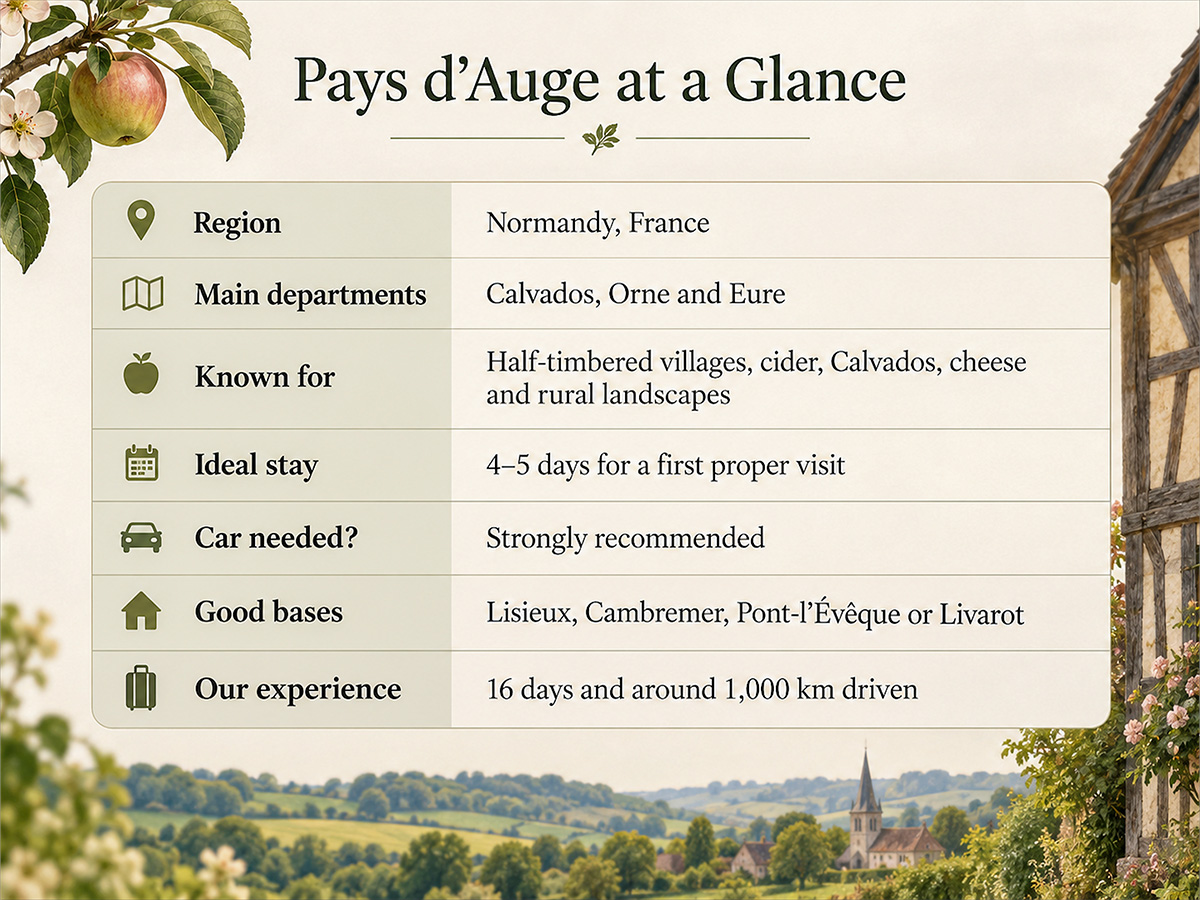
Where is the Pays d’Auge?
The Pays d’Auge is a historic and natural region of Normandy, stretching across parts of the Calvados, Orne and Eure départements in northwestern France.
Unlike a French département or administrative region, the Pays d’Auge does not have precisely defined official borders. It is better understood as a distinctive landscape and cultural area, centred largely on the valleys and rolling countryside around Lisieux.
To the north, the Pays d’Auge reaches the Côte Fleurie, the stretch of Normandy coast that includes places such as Honfleur, Trouville-sur-Mer, Deauville, Villers-sur-Mer and Cabourg.
Head inland and the scenery changes surprisingly quickly. Seaside resorts give way to green valleys, pastureland, apple orchards and a patchwork of small villages, farms and half-timbered manor houses.
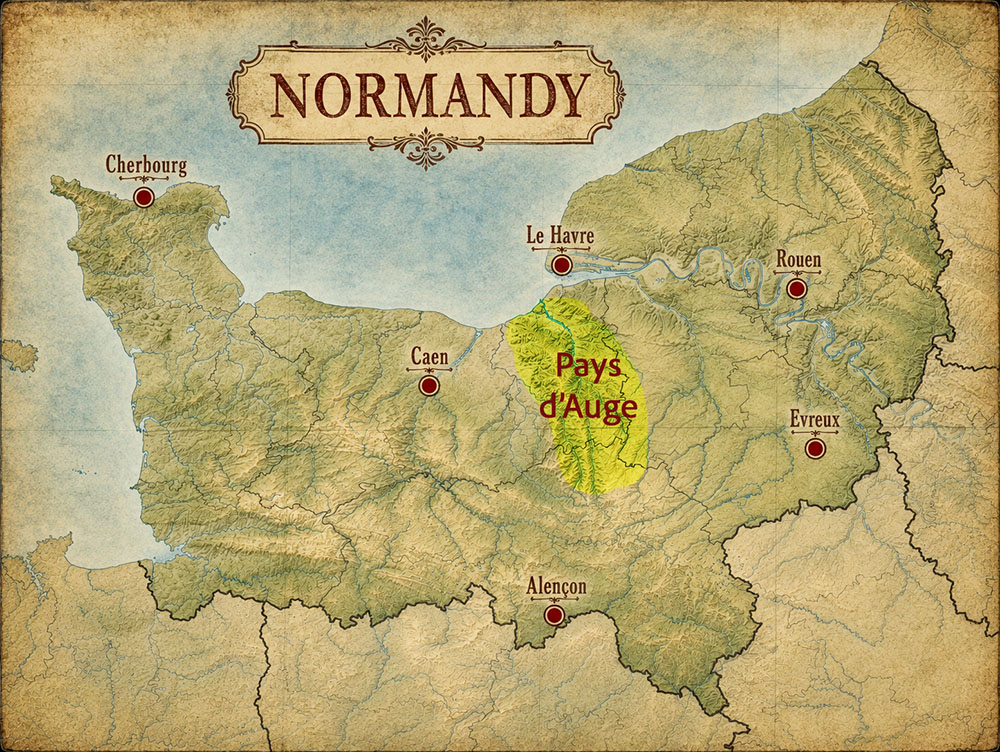
Lisieux is the main town in the heart of the region, while Pont-l’Évêque and Cambremer lie further north.
To the south, the Pays d’Auge extends towards Livarot, Vimoutiers and Camembert, crossing from Calvados into the Orne. Its eastern fringes reach into the Eure around places such as Cormeilles.
This means the Pays d’Auge covers a much larger and more varied area than you might initially imagine.
During our 16-day stay, we travelled from the coast at Honfleur and Villerville to Camembert and Vimoutiers in the south, and from Saint-Pierre-sur-Dives in the west to Cormeilles and Orbec further east.
That geographical variety is one of the reasons the Pays d’Auge is so rewarding to explore: within a relatively small part of Normandy, you can experience the coast, historic towns, tiny rural villages and some wonderfully peaceful countryside.
Watch my video on the Pays d'Auge!
In this 17-minute film, there is no commentary for most of the journey — just the landscapes, places and atmosphere we experienced along the way, accompanied by music.
What is the Pays d’Auge Famous For?
The Pays d’Auge is famous for its green countryside, half-timbered houses, apple orchards, cider and Calvados, dairy farming and some of Normandy’s best-known cheeses. It is one of those parts of France where the landscape, architecture and local food are closely connected.
Perhaps the most immediately recognisable feature is the countryside itself. Much of the Pays d’Auge is made up of rolling hills and valleys, with cattle grazing in lush pastures bordered by hedgerows. Apple trees appear everywhere, sometimes in large orchards and sometimes scattered around old farmhouses.
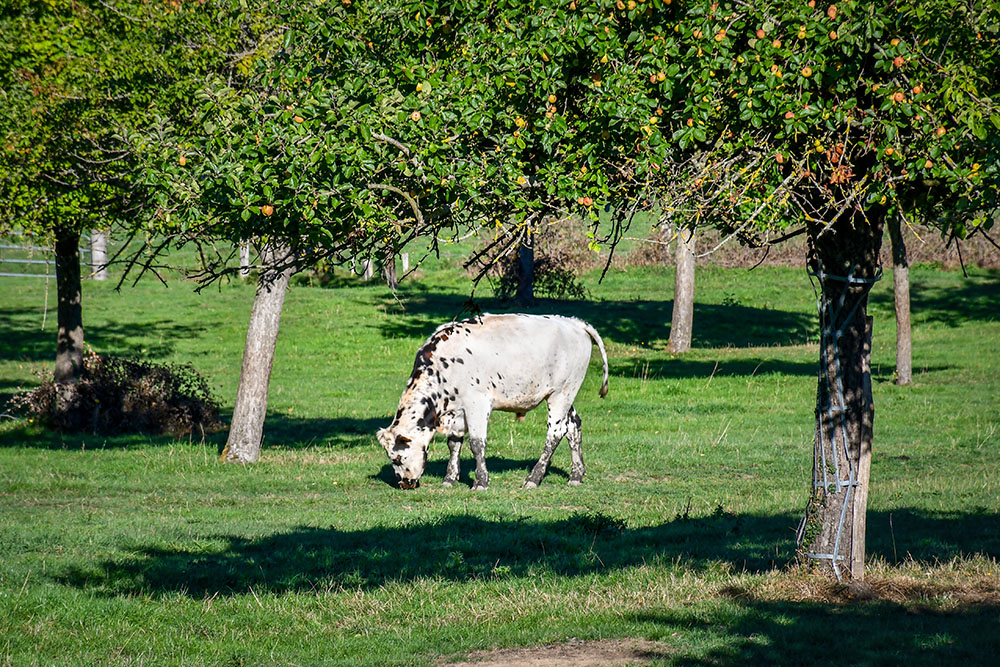
Cow grazing in a meadow near Livarot © French Moments
Then there is the architecture.
Traditional half-timbered houses, farms and manor houses are found throughout the region. Some are grand and beautifully restored; others stand almost unnoticed beside a country road.
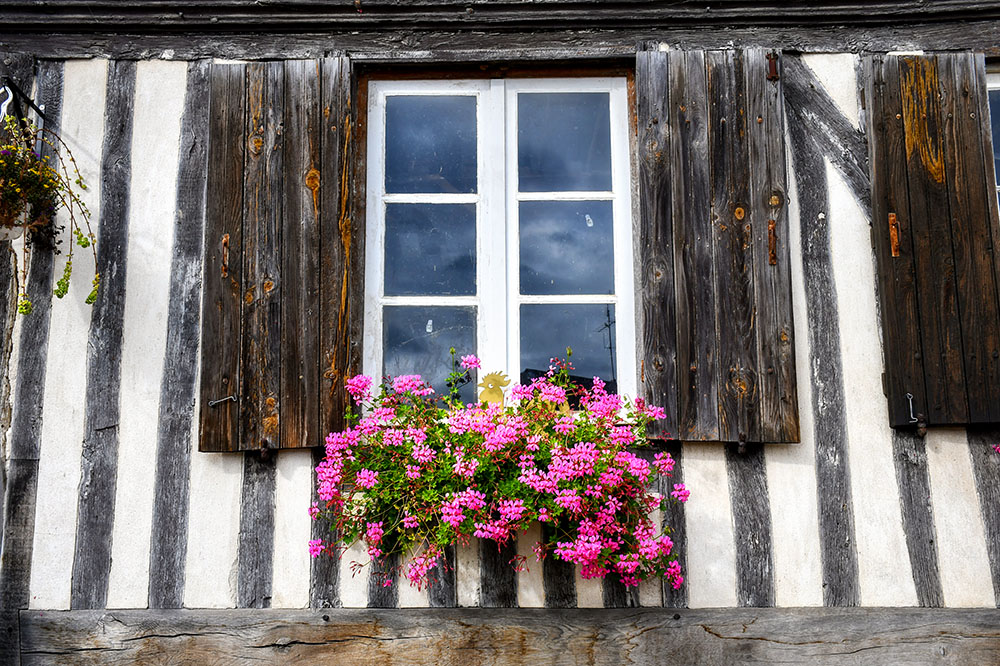
Blangy-le-Château © French Moments
After driving around the Pays d’Auge for two weeks, I was struck by just how much this architecture is part of the everyday landscape rather than something confined to a few particularly pretty villages.
Apples are another essential part of the region’s identity. They are used to make cider, Calvados and Pommeau, and there are numerous farms and small producers where you can discover how these traditional drinks are made.
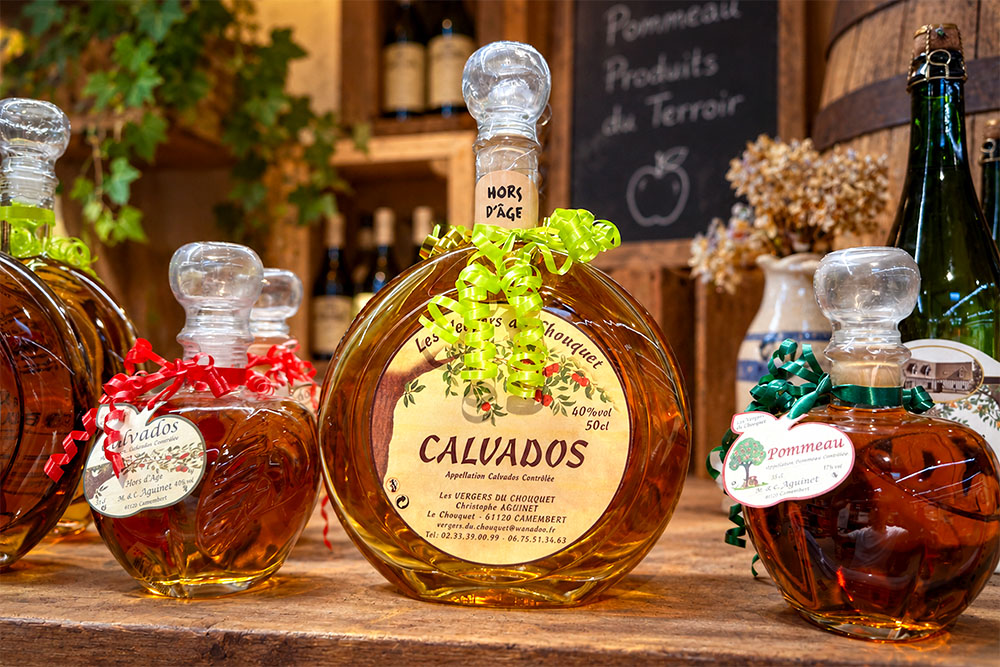
Cider, calvados and apple produce from the Pays d'Auge © French Moments
The Pays d’Auge is equally famous for cheese. Camembert, Livarot and Pont-l’Évêque are three of Normandy’s great cheeses, and all are deeply associated with this part of the region. One of the pleasures of travelling here is being able to visit the villages, farms and dairies connected with them.
You will also notice plenty of horses. The Pays d’Auge has a long tradition of horse breeding, with stud farms hidden behind hedges and white fences throughout the countryside.
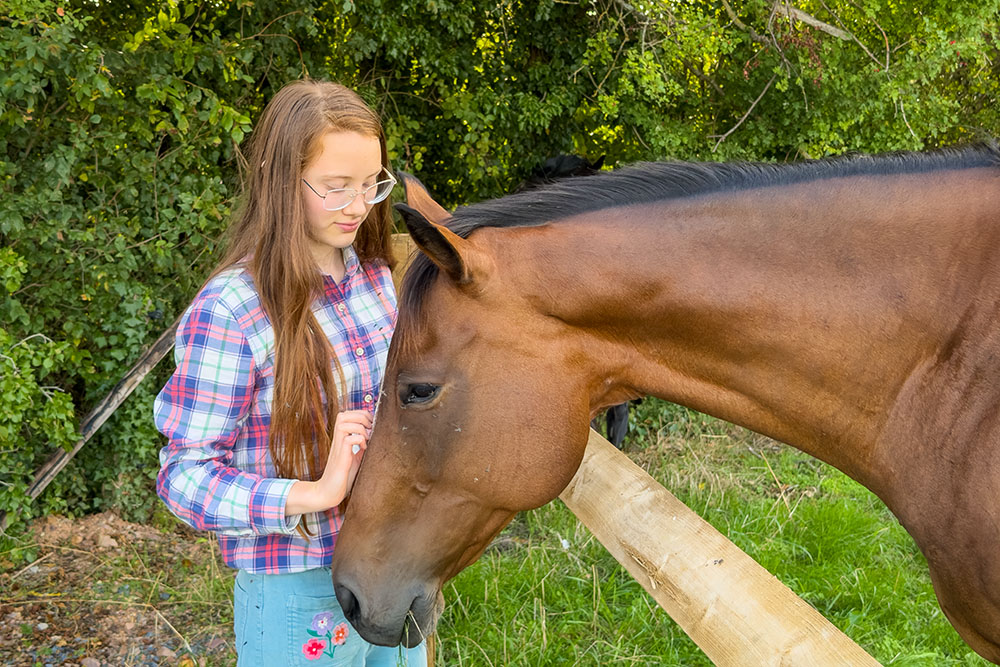
Our daughter bonding with a horse in the Pays d'Auge © French Moments
For me, however, what makes the Pays d’Auge particularly distinctive is the way all these elements come together. The orchards, cattle, timber-framed farms, manor houses, cheese and cider are not separate attractions created for visitors.
They are part of the landscape you travel through.
A Brief History of the Pays d’Auge
The history of the Pays d’Auge is closely tied to its landscape. Even its name is thought to come from the Latin Saltus Algie, meaning something like “damp forest” — an appropriate description for this wooded, well-watered corner of Normandy.
From Forest to Farmland
For centuries, this was primarily a rural land of scattered farms, small villages, religious communities and manor houses. Lisieux developed as the main urban centre, while much of the surrounding countryside remained characterised by dispersed settlement rather than large towns.
The landscape that visitors associate with the Pays d’Auge today was gradually shaped by agriculture. Fields were enclosed by hedges, while increasing areas of land were turned over to pasture. Cattle farming became particularly important, helping to create the green, enclosed countryside — or bocage — that still defines much of the region.
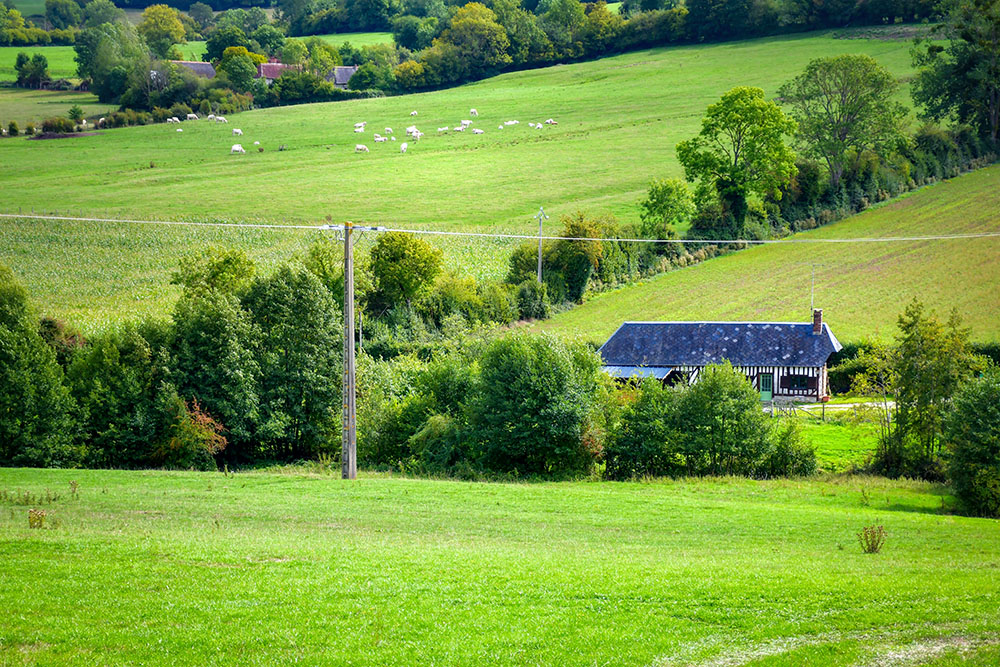
Green meadows near Camembert © French Moments
Timber, Orchards and the Bocage
This agricultural prosperity also left a remarkable architectural legacy.
From the late Middle Ages onwards, local timber was widely used to construct houses, farms and manor houses. Many surviving buildings date from the 16th, 17th and 18th centuries, and places such as Beuvron-en-Auge still contain particularly fine examples.
Apple growing became another defining feature of the region. Apples had been cultivated in Normandy since the Middle Ages, but orchards became increasingly important over the centuries. By the 19th century, they had become a dominant element of the Norman landscape, while improved transport links helped cider producers reach larger markets, including Paris.
The traditional pré-verger system — pasture planted with fruit trees — proved especially well suited to the Pays d’Auge. Cattle could graze beneath apple trees, allowing dairy farming and cider production to exist side by side.
This combination still explains much of what you see when driving through the area today.
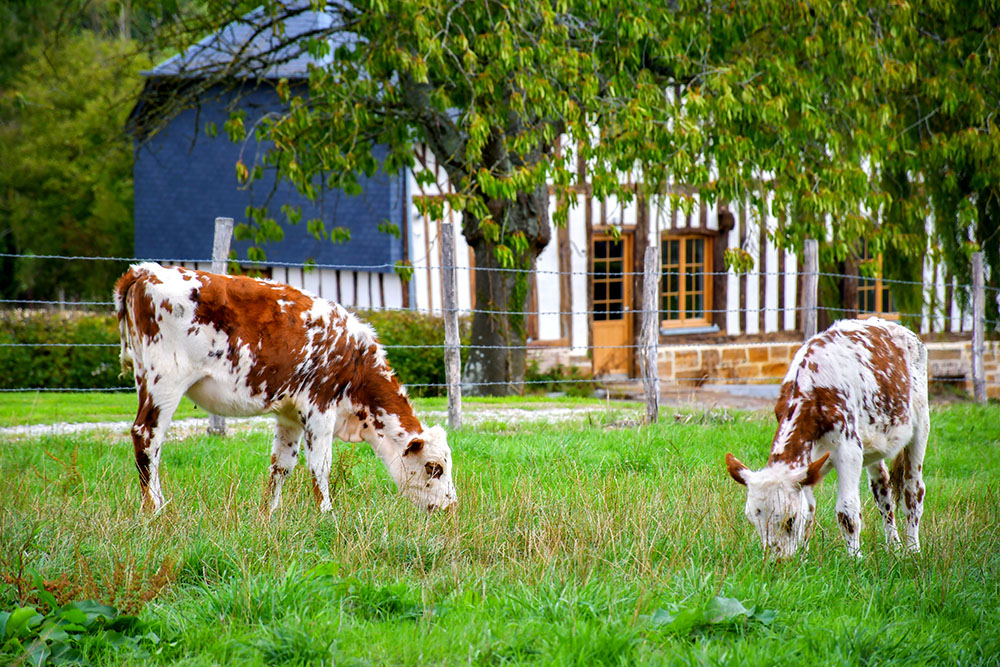
Cows grazing in an apple orchard near Camembert © French Moments
The Rise of the Côte Fleurie
The 19th century also brought major changes to the northern edge of the Pays d’Auge.
As seaside tourism developed along the Normandy coast, resorts on what became known as the Côte Fleurie grew rapidly. Villas, hotels and holiday homes appeared in places such as Trouville, Deauville, Houlgate and Cabourg, creating an elegant coastal landscape very different from the farms and villages only a few kilometres inland.
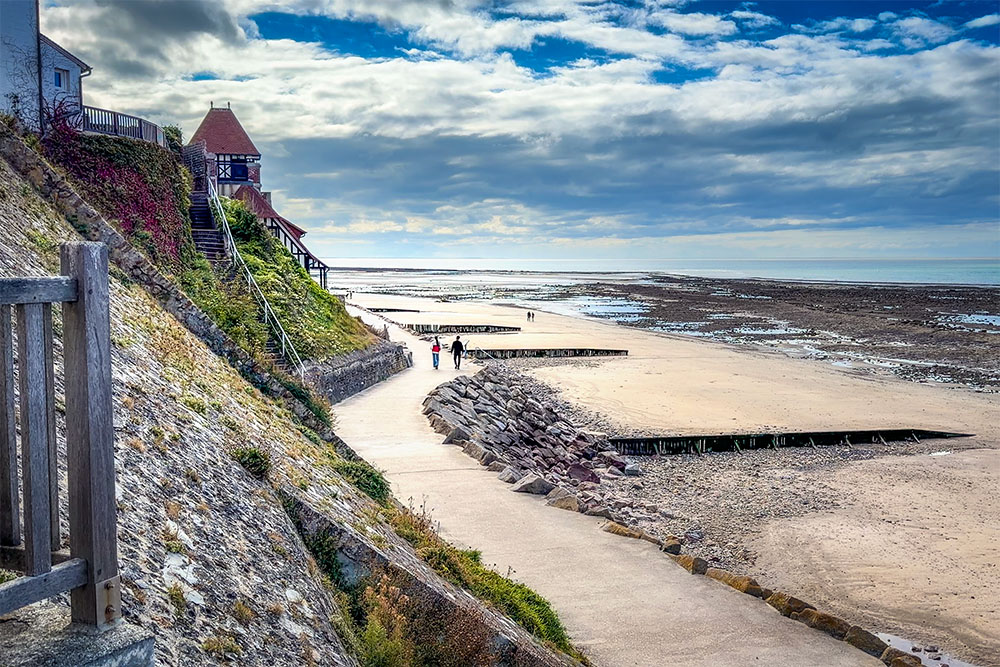
Côte Fleurie in Villerville © French Moments
The neo-Norman style that became fashionable there drew heavily on the region’s traditional half-timbered architecture.
Yet despite these changes, much of the interior of the Pays d’Auge has retained its strongly rural character.
That continuity is one of the things I found most striking during our stay. The half-timbered farms, apple orchards, grazing cattle and old manor houses do not feel like isolated remnants of the past.
Together, they still form the landscape of the Pays d’Auge today.
15 Things to See and Do in the Pays d’Auge
After 16 days exploring the region, these are the places and experiences that stood out most to me.
Some are well known. Others are much less obvious.
Together, they give a good sense of how varied the Pays d’Auge really is — from the coast and historic towns to cider farms, manor houses, tiny villages and quiet country roads.
1. Explore Honfleur and its Historic Harbour
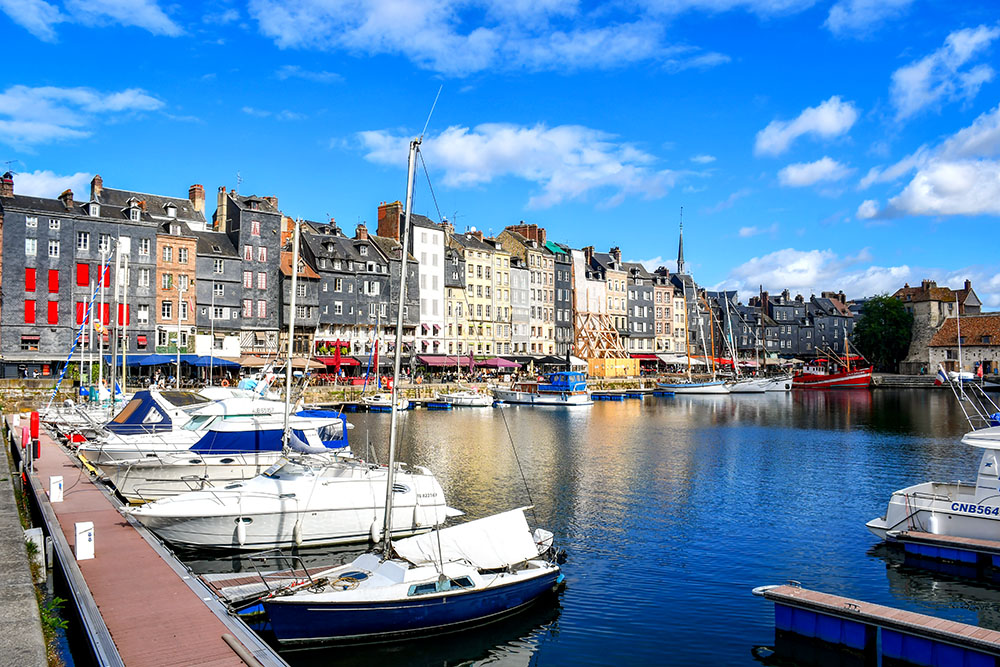
The Vieux-Bassin of Honfleur © French Moments
Honfleur is one of the best-known places in Normandy, and for good reason.
Its historic harbour, the Vieux Bassin, is surrounded by tall, narrow houses reflected in the water, while cafés, galleries and old streets make the town extremely photogenic.
I had wanted for years to take the classic photograph of the harbour for myself, so standing there with my camera was genuinely satisfying.
But Honfleur is much more than one postcard view.
The Lieutenance, at the entrance to the Vieux Bassin, is one of the most recognisable historic buildings in town and a surviving reminder of Honfleur’s former fortified harbour.
A short walk away, the Church of Sainte-Catherine is even more remarkable. Built largely of wood by local shipwrights, its unusual double nave has the feel of an upturned ship’s hull. The separate bell tower stands just across the square.
Honfleur also rewards wandering.
Step away from the harbour and you quickly find quieter streets, old houses, small squares and viewpoints overlooking the Seine estuary.
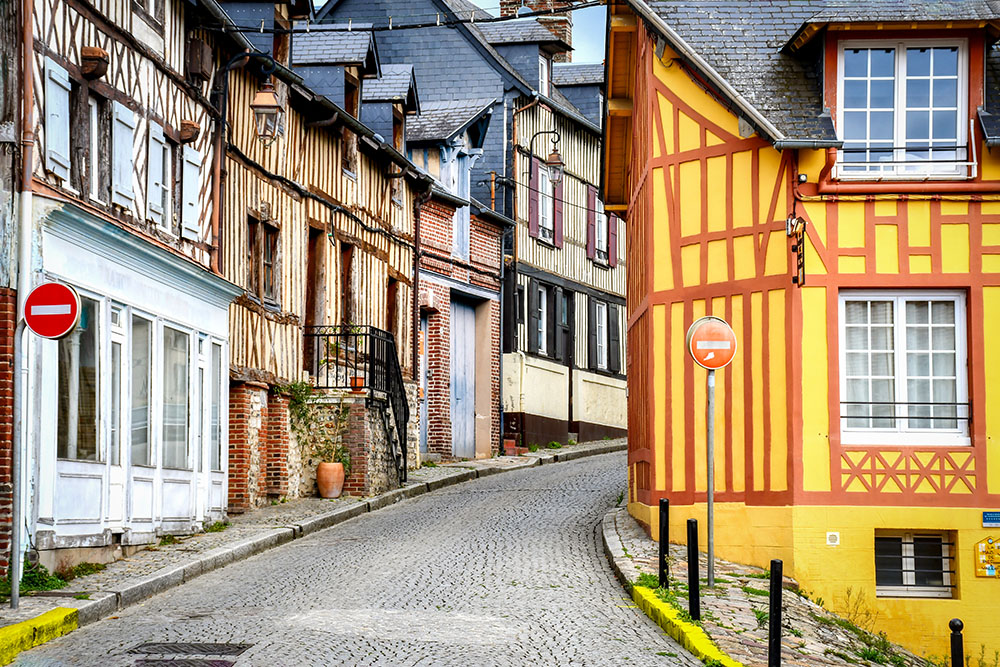
Half-timbered houses in Rue Bucaille in Honfleur © French Moments
The town has long attracted artists, and that creative atmosphere is still very noticeable today in its many galleries and studios.
Honfleur can certainly be busy, particularly around the Vieux Bassin, but I would still consider it an essential stop in the northern Pays d’Auge.
My advice is simple: do not just photograph the harbour and leave.
Give yourself time to explore the streets behind it, visit Sainte-Catherine and walk a little further than most day-trippers.
2. Discover Lisieux Beyond its Famous Basilica
Lisieux is known around the world as the town of Sainte-Thérèse, and the enormous basilica dedicated to her dominates the skyline from miles away.
It is impossible to ignore — and you should not.
The Basilica of Sainte-Thérèse is one of the largest churches built in France during the 20th century. Construction began in 1929, and its vast interior is decorated with colourful mosaics that make it very different from the medieval churches you will encounter elsewhere in the Pays d’Auge.
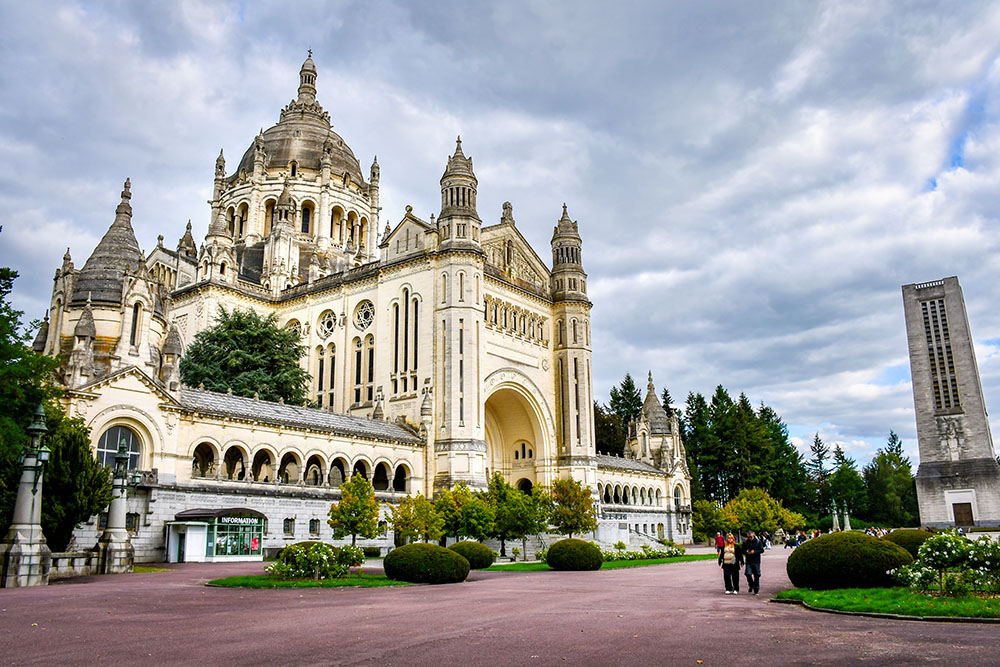
The monumental Basilica of Saint-Thérèse in Lisieux © French Moments
But one of the things I would recommend when visiting Lisieux is not to stop there.
Down in the historic centre stands the Cathedral of Saint-Pierre, which offers an extraordinary contrast with the basilica. It is one of the earliest Gothic cathedrals in Normandy, with construction beginning in the 12th century as the new Gothic style was spreading from the Île-de-France.
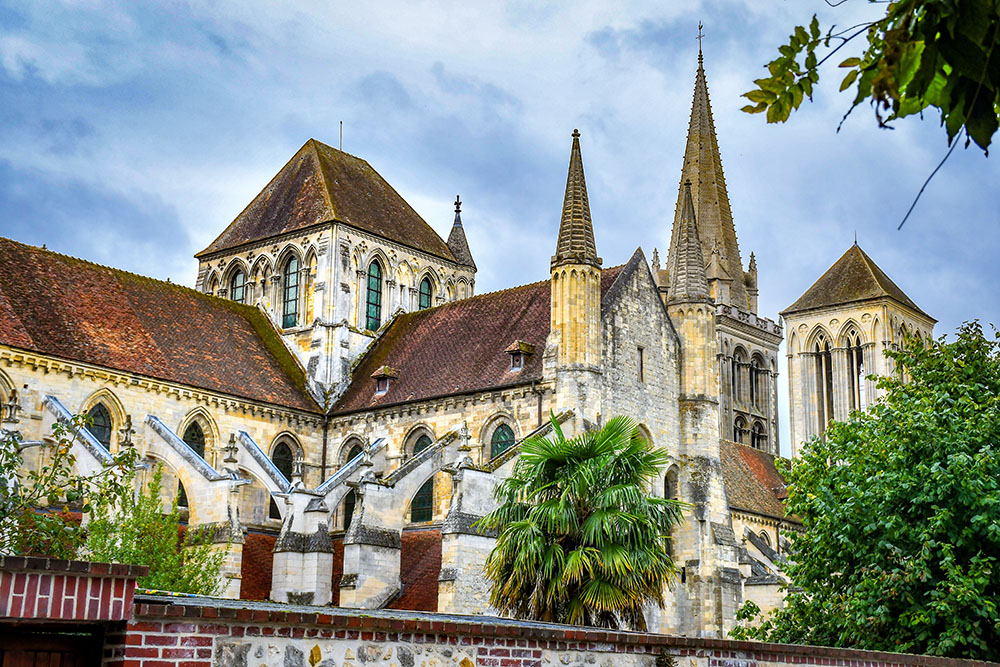
Lisieux Cathedral © French Moments
This was also Sainte-Thérèse’s parish church before she entered the Carmelite convent, adding another link between the medieval city and the story for which Lisieux later became famous.
I found the cathedral particularly interesting precisely because it feels overshadowed by the much more prominent basilica.
Lisieux itself also deserves a little exploration on foot. Although large parts of the town were destroyed during the fighting in 1944, several historic buildings survived, including old houses and private mansions alongside the post-war reconstruction.
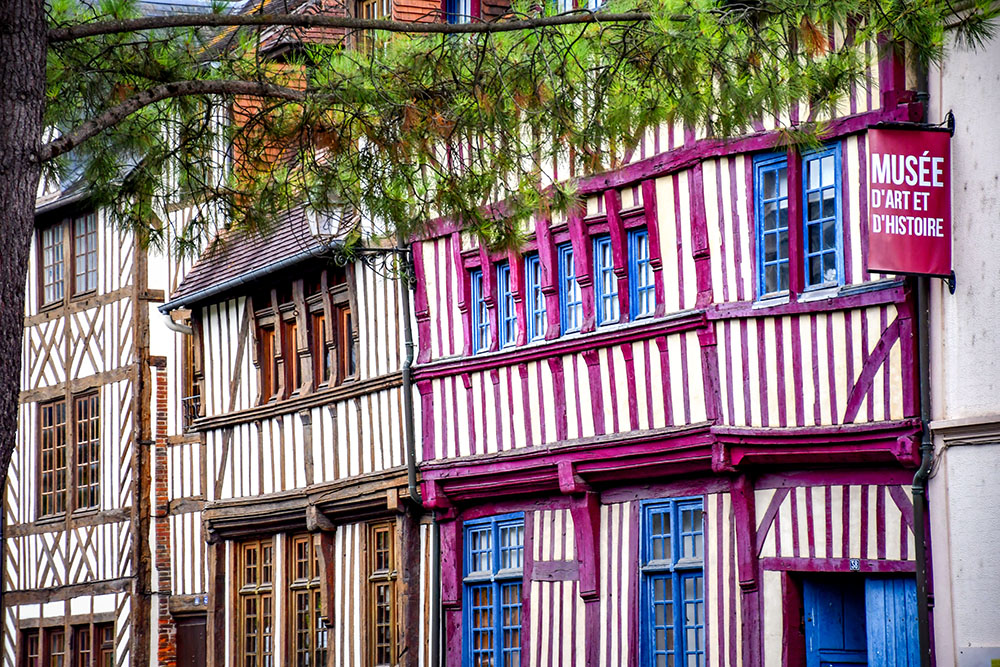
One of the few half-timbered houses left standing in the centre of Lisieux © French Moments
So even if you are not visiting Lisieux for religious reasons, I would still include it in a tour of the Pays d’Auge.
Come for the striking contrast between its two great churches — one medieval and Gothic, the other monumental and 20th-century — but allow some time to look beyond them as well.
3. Wander Through Beuvron-en-Auge and Beaumont-en-Auge
If you are looking for the postcard image of the Pays d’Auge, Beuvron-en-Auge is one of the most obvious places to start.
The village is officially listed among the Plus Beaux Villages de France, and its central square is surrounded by beautifully restored half-timbered houses dating mainly from the 17th and 18th centuries. A 16th-century manor house and the former Auberge de la Boule d’Or add to the remarkably preserved ensemble.
It is undeniably beautiful.
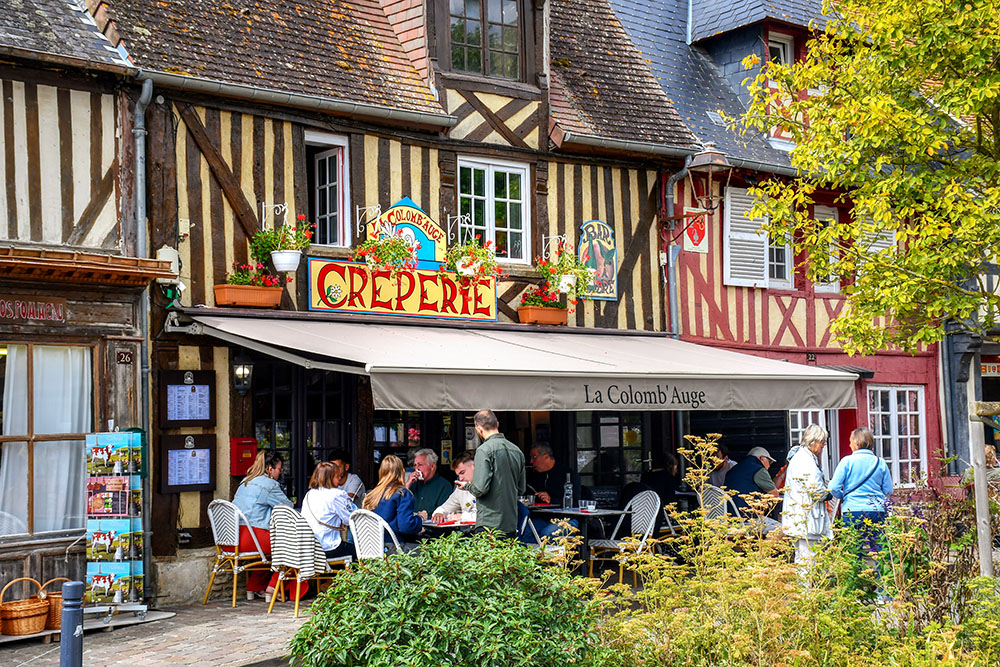
The market square of Beuvron-en-Auge © French Moments
The timber framing, flower-filled façades and old market hall create exactly the kind of Norman scene many visitors come to the region hoping to find. Beuvron-en-Auge is also one of the villages crossed by the Route du Cidre, which we will come back to shortly.
But I would not stop with Beuvron.
A short drive away, Beaumont-en-Auge offers a different atmosphere.
Its small centre is also lined with colourful half-timbered houses, but the village stands much higher, overlooking the Touques valley.
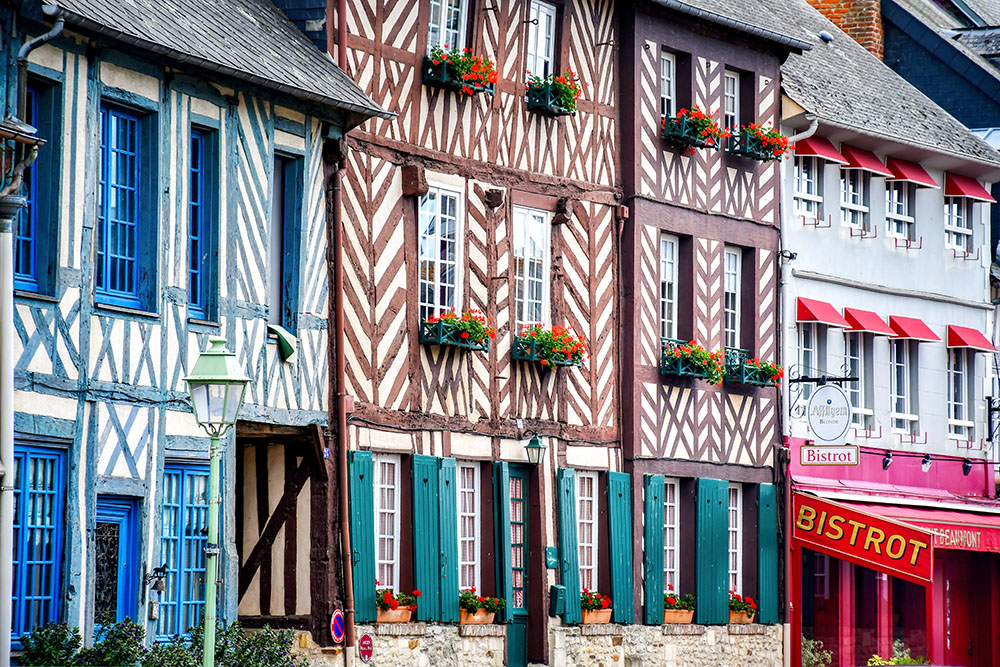
Lovely half-timbered houses in Beaumont-en-Auge © French Moments
From the viewpoint, some 90 metres above the valley, the landscape opens out dramatically and, in clear weather, you may even see towards the coast.
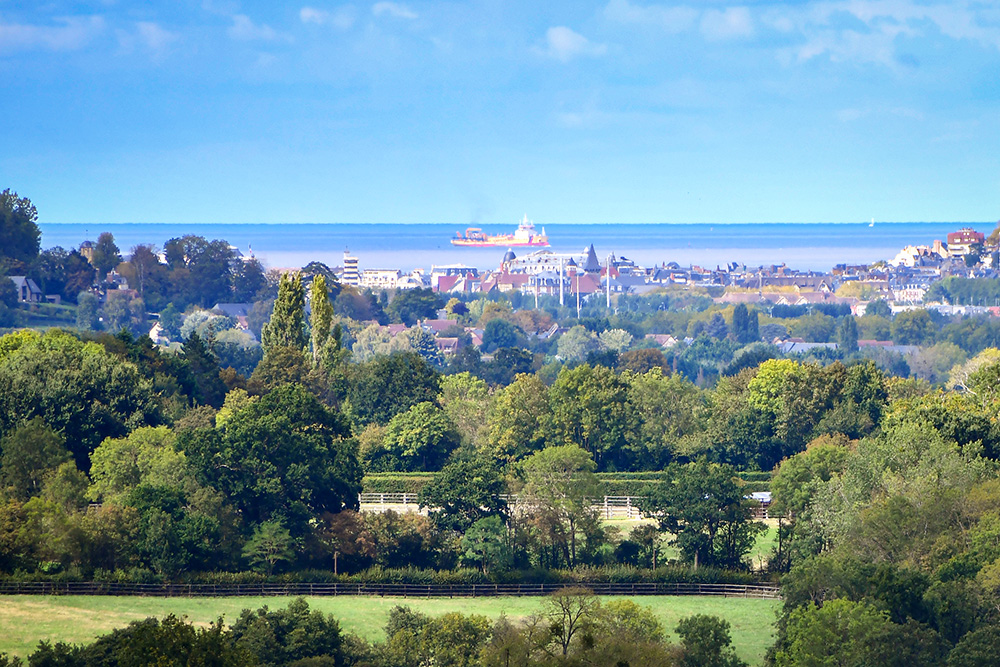
The viewpoint of Beaumont-en-Auge overlooking the Touques Valley, Deauville, Trouville and the English Channel © French Moments
Beaumont also has some interesting historical details. The Church of Saint-Sauveur has its origins in an 11th-century Benedictine priory, while the village was the birthplace of mathematician and astronomer Pierre-Simon Laplace.
The two villages therefore complement each other rather well.
Beuvron-en-Auge feels more like the carefully preserved showcase of traditional Norman architecture, while Beaumont-en-Auge combines attractive streets with one of the loveliest elevated views we found in this part of the Pays d’Auge.
If you have time, I would visit both rather than choosing between them.
4. Follow the Route du Cidre Around Cambremer
If you want to understand the rural character of the Pays d’Auge, driving the Route du Cidre is one of the best ways to do it.
The signposted route forms a roughly 40-kilometre circuit through the countryside around Cambremer, linking villages, orchards and producers of cider, Calvados and Pommeau.
But the route is about much more than tasting apple-based drinks.
What stayed with me most was the landscape itself.
The roads twist between hedgerows, orchards and pastures, passing half-timbered farms, manor houses and small villages that seem almost to appear out of nowhere. In places, the countryside feels remarkably intimate: narrow lanes, high banks, grazing cattle and old farm buildings hidden behind apple trees.
Cambremer makes a natural starting point.
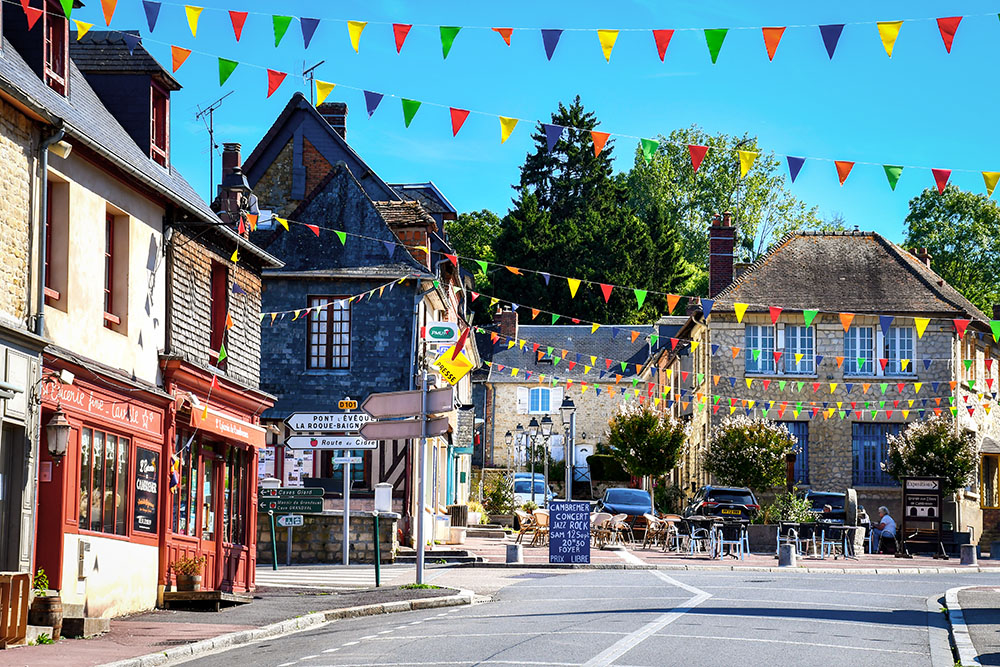
Cambremer © French Moments
This attractive village lies right in the heart of the cider-producing area and has a number of traditional half-timbered buildings of its own. From here, you can head towards Beuvron-en-Auge, Grandouet and a succession of hamlets, farms and producers scattered across the surrounding countryside.
We drove through this part of the Pays d’Auge several times during our stay, and I found it one of the best areas for simply slowing down and taking the smaller roads.
There is no need to rush from one official stop to the next.
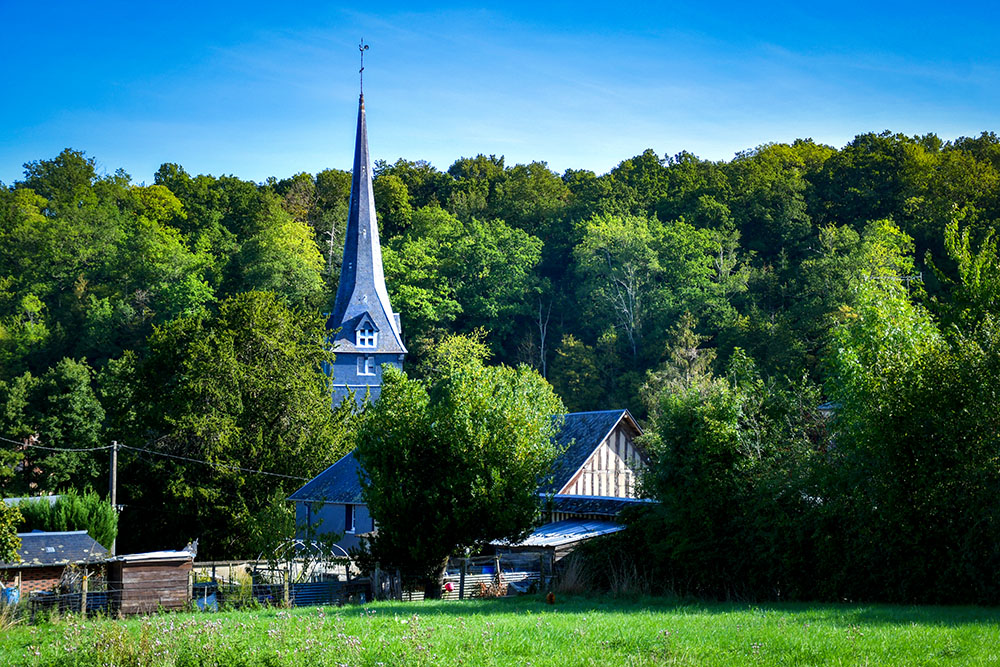
Sainte-Marguerite-des-Loges © French Moments
Part of the pleasure is allowing time for the unexpected: a particularly beautiful farmhouse, an orchard beside the road, a distant church spire or a view across one of the valleys.
While you are in Cambremer, I would also make time for the Jardins du Pays d’Auge.
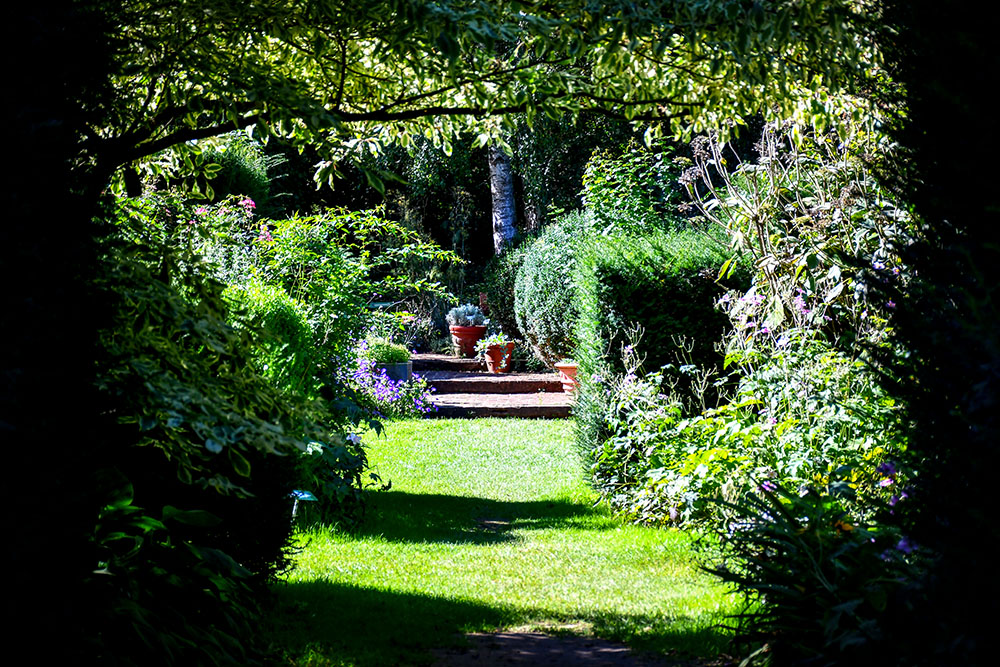
Jardins du Pays d'Auge near Cambremer © French Moments
Set in a gently undulating landscape just outside the village, the gardens combine a series of carefully planted spaces with traditional Norman architecture.
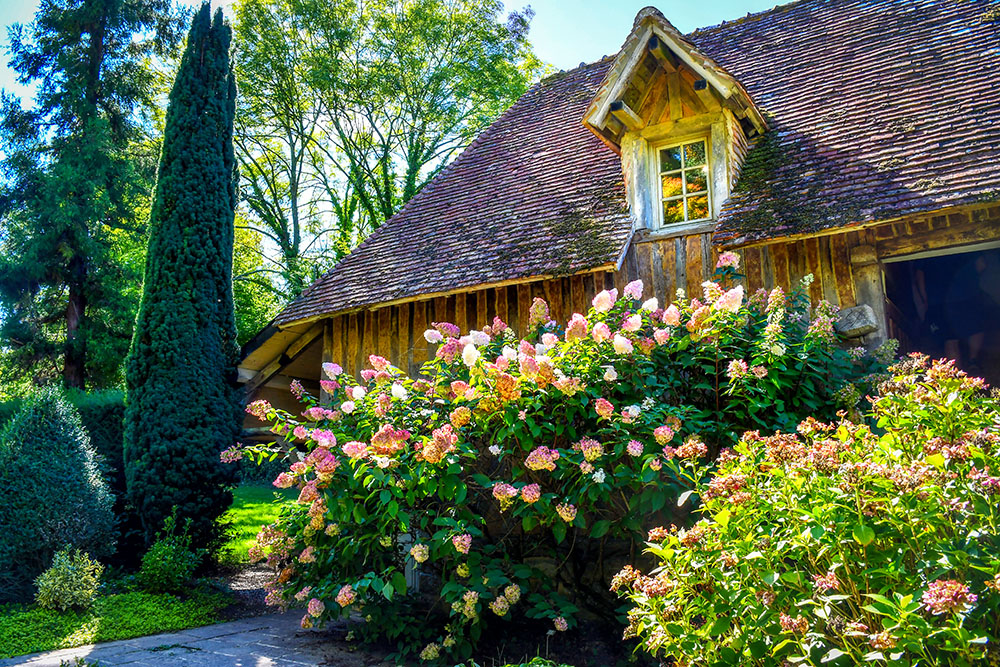
Jardins du Pays d'Auge © French Moments
Around three hectares are divided into different scenes and atmospheres, with flowers, ponds, mature trees and half-timbered buildings appearing throughout the site.
What I particularly enjoyed was the way the buildings and gardens work together.
After seeing so many traditional farms and manor houses on our drives, it was fascinating to find the same architectural language incorporated into a garden, surrounded by flowers and vegetation.
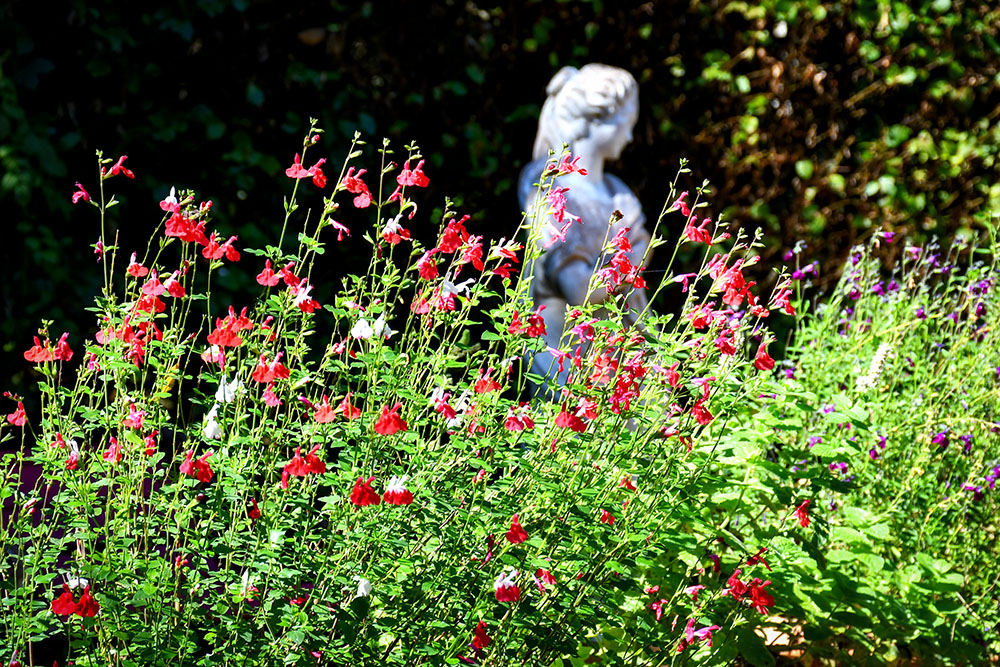
Jardins du Pays d'Auge © French Moments
The gardens are therefore more than an attractive stop along the route. They offer another interpretation of the landscapes and architecture you have been seeing all around you.
And, of course, visiting a cider producer adds yet another dimension to the experience.
We did exactly that at the Manoir de Grandouet, which I will come back to shortly.
But even if you do not drink alcohol, I would still recommend driving at least part of the Route du Cidre.
It is one of the easiest ways to experience the orchards, traditional architecture, quiet villages and agricultural landscape that make this part of Normandy so distinctive.
5. Explore the Historic Town of Pont-l’Évêque
You probably already know the name Pont-l’Évêque because of the cheese.
But the town deserves a visit in its own right.
Pont-l’Évêque has long occupied an important position in the Pays d’Auge. It developed as a place of trade and passage and became an important administrative centre of the Vicomté d’Auge during the Middle Ages.
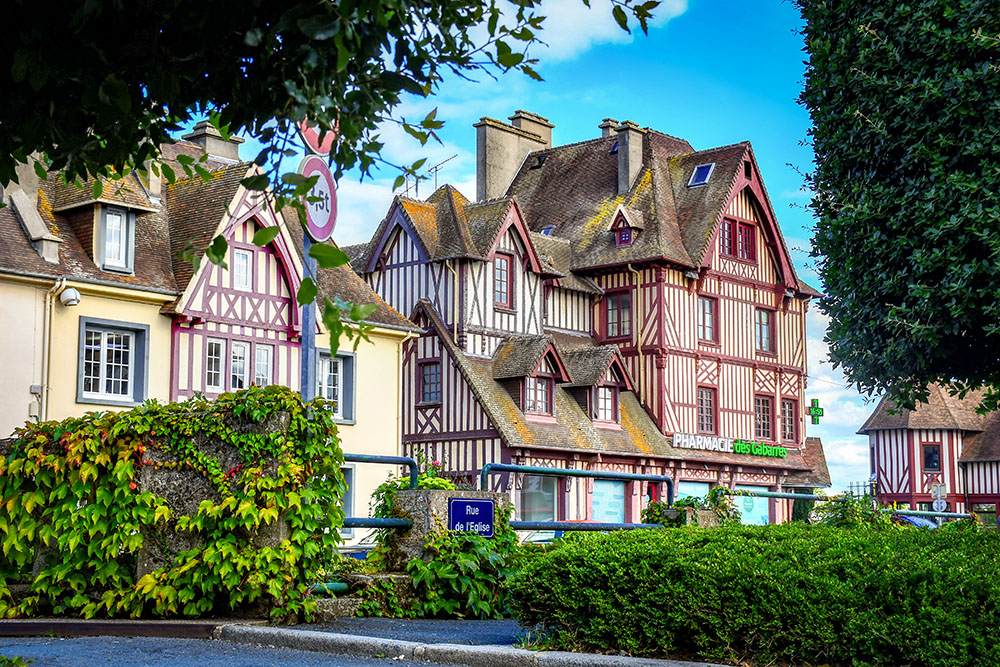
The local pharmacy of Pont-l'Évêque is housed in a beautiful half-timbered house © French Moments
Much of the town was destroyed during the fighting of August 1944 — around 65% according to the local tourist office — but several historic areas survived.
The most attractive is the old quarter around Rue Saint-Michel and Vaucelles, where you can still see colourful half-timbered houses dating mainly from the 17th and 18th centuries.
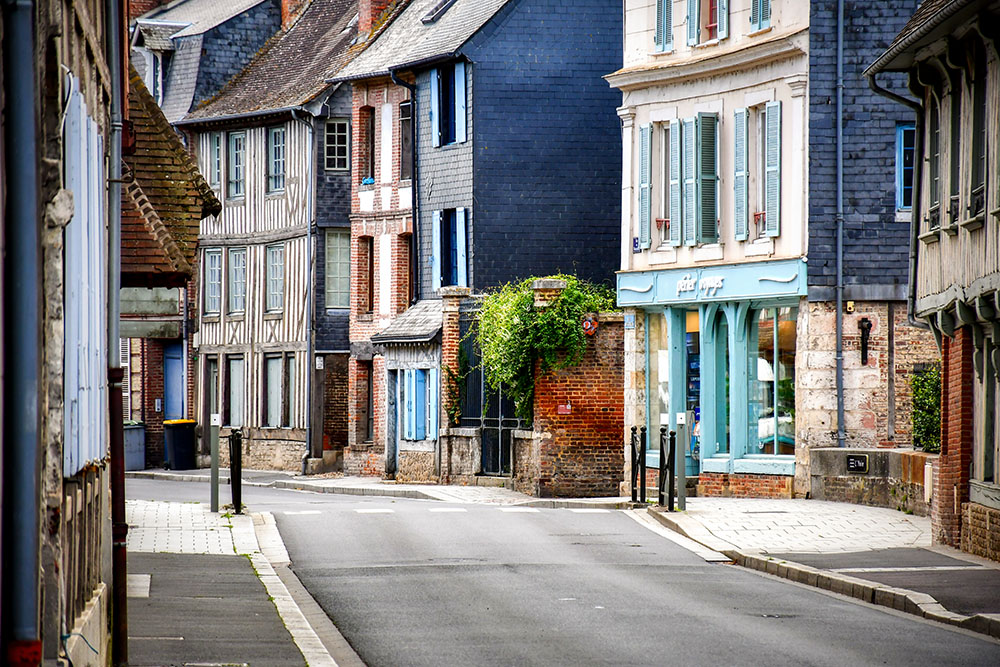
The market town of Pont-l'Évêque © French Moments
Water is another important part of Pont-l’Évêque’s character.
The town stands at the confluence of three rivers — the Touques, Calonne and Yvie — and bridges, waterways and former wash houses appear as you explore the centre.
Do not miss the Church of Saint-Michel either.
Its origins go back to an earlier medieval church, while much of the present building reflects later Gothic reconstruction. Its substantial proportions have earned it the local nickname “the cathedral of the pastures” (la cathédrale des herbages).
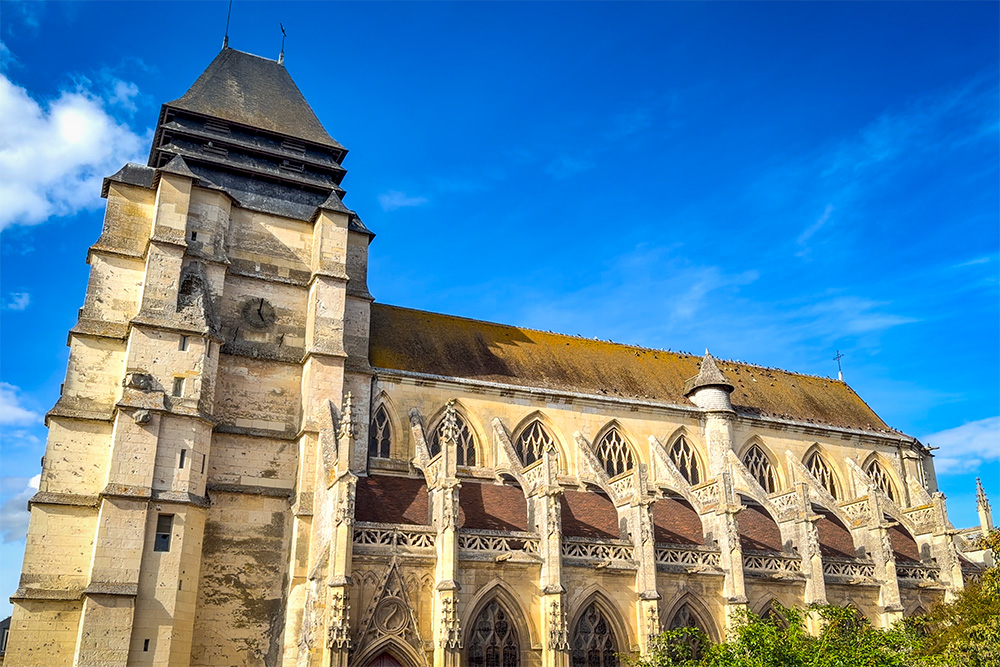
The Gothic church of Saint-Michel in Pont-l'Évêque © French Moments
I found Pont-l’Évêque interesting precisely because it feels different from villages such as Beuvron-en-Auge.
This is not a tiny heritage village preserved primarily for visitors. It is a living small town, with shops, traffic, historic buildings and the scars of wartime destruction all mixed together.
And then, of course, there is the cheese.
Pont-l’Évêque is one of the three great cheeses associated with the Pays d’Auge, alongside Livarot and Camembert. We will return to that story shortly when we follow the region’s cheese trail.
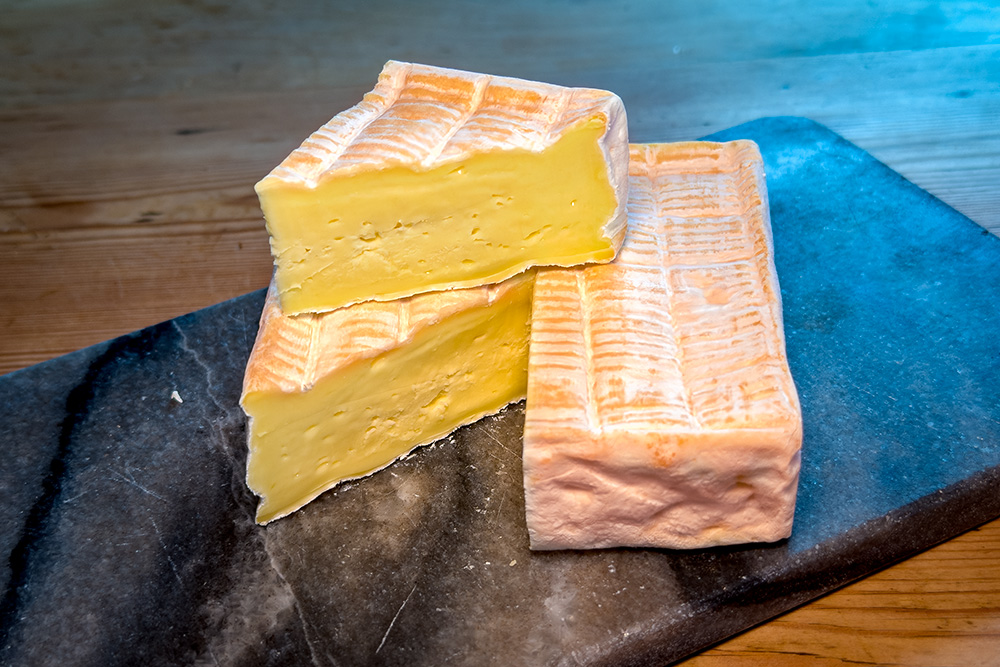
Pont-l'Évêque cheese © French Moments
So do not simply pass through Pont-l’Évêque on your way to the coast.
Take an hour or two to walk around the old quarter, look inside Saint-Michel and follow some of the waterways through the town.
There is much more here than a famous square of cheese.
6. Taste Cider and Calvados at a Traditional Manor
Driving through orchards is one thing. Stopping at a working cider farm is another.
One of the visits that best helped me understand the apple-growing traditions of the Pays d’Auge was the Manoir de Grandouet, just outside Cambremer on the Route du Cidre.
The setting alone is worth the detour.
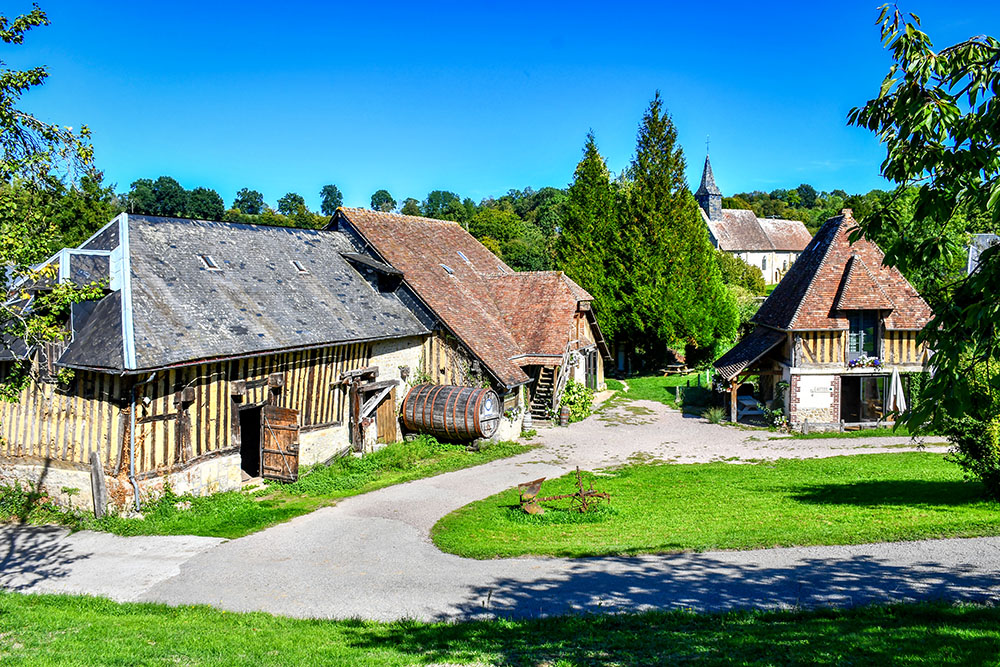
The lovely rural setting of the Manoir de Grandouet © French Moments
At the foot of the tiny 12th-century church of Grandouet stands a beautiful 16th-century half-timbered press house, surrounded by orchards and traditional farm buildings. The Grandval family has been associated with the property since 1856, and cider production has been developed here across several generations.
This is not simply a shop selling bottles to passing tourists.
You can see the old press house, fermentation vats, distillery and cellars where the Calvados and Pommeau are aged. Some of the large wooden barrels are more than a century old, while others used in the production process date back even further.
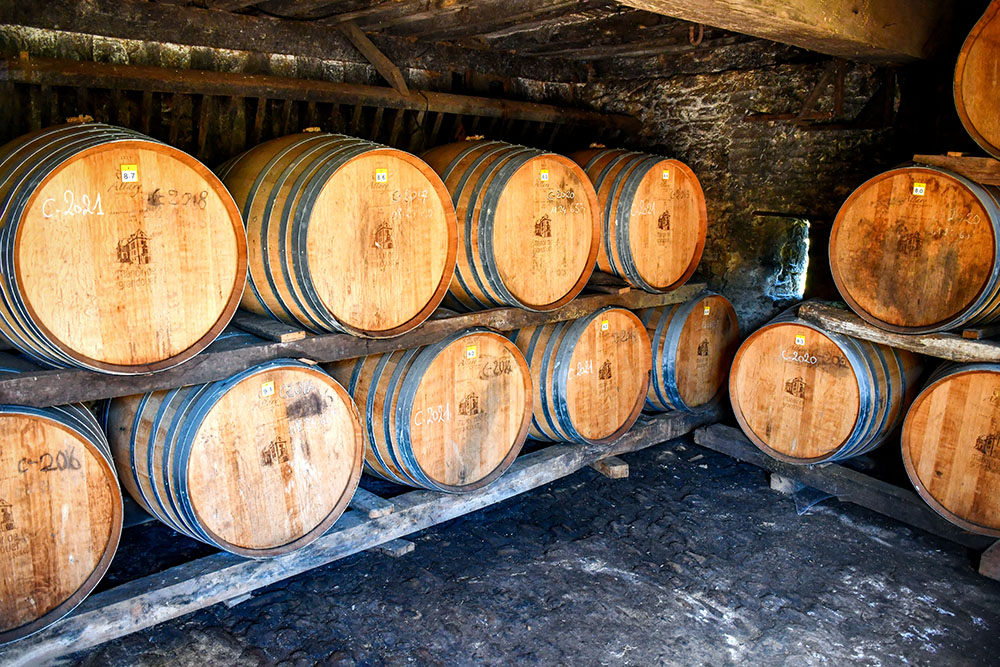
The cellar of the Manoir de Grandouet © French Moments
The farm produces Pays d’Auge cider, Calvados, Pommeau de Normandie, apple juice and perry, using numerous varieties of cider apples grown on the property.
What I particularly liked was being able to connect what we had been seeing all around us — the orchards, old farm buildings and apple trees — with the products that come from that landscape.
After days of driving through the Pays d’Auge, the process suddenly made much more sense.
Grandouet is also a good place to understand the difference between the region’s principal apple-based drinks. Cider is fermented apple juice, Pommeau combines apple juice with Calvados, while Calvados itself is made by distilling cider before ageing the spirit in wooden casks.
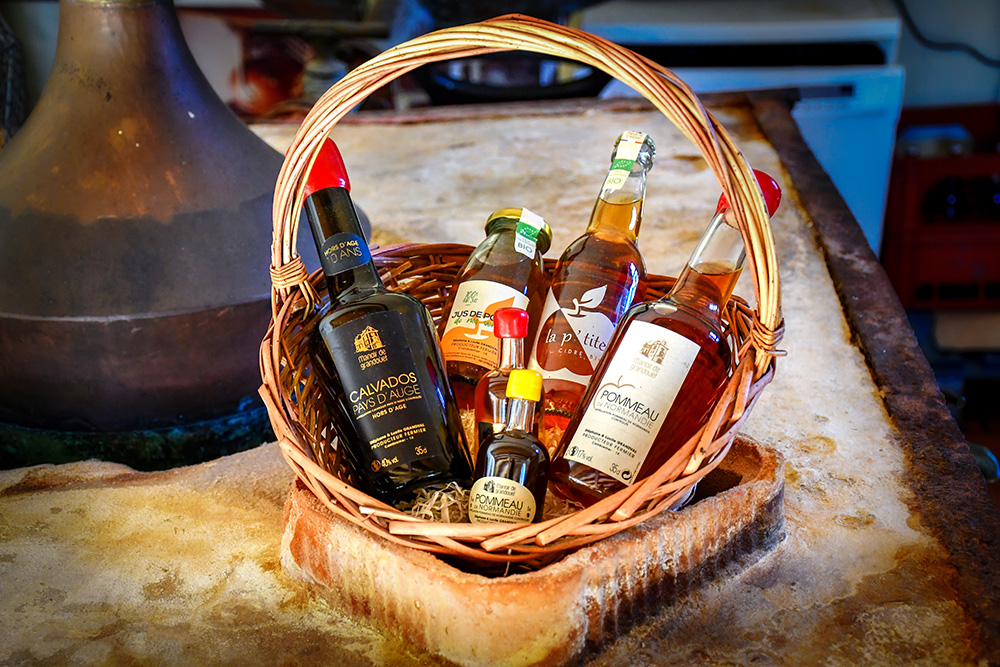
Cider, calvados and apple produce from Manoir de Grandouet © French Moments
And Grandouet was not the only place where we encountered this tradition.
Further south, at the Manoir de Bellou, we found another beautiful historic manor where organic cider and apple juice are produced and sold directly from the farm. The manor itself dates largely from the 15th and 16th centuries and is surrounded by traditional outbuildings and parkland.
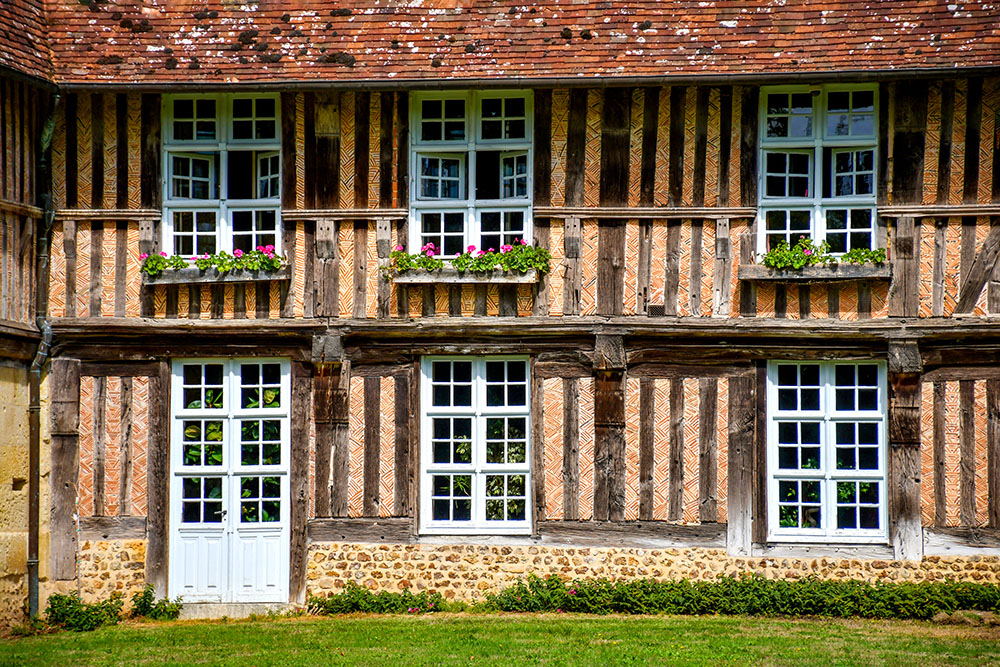
The Manor of Bellou © French Moments
Experiences like these are one of the reasons I would recommend visiting at least one local producer during a stay in the Pays d’Auge.
You are not simply tasting cider.
You are seeing how the apples, landscape, architecture and agricultural traditions of the region all fit together.
7. Follow the Pays d’Auge Cheese Trail
If cider and Calvados define one side of the Pays d’Auge, cheese defines the other.
This part of Normandy is closely associated with three famous soft cheeses: Camembert de Normandie, Livarot and Pont-l’Évêque. All three are protected by PDO status, and their connection with the landscape is easy to understand once you have spent a few days driving past dairy farms and fields full of Norman cattle.
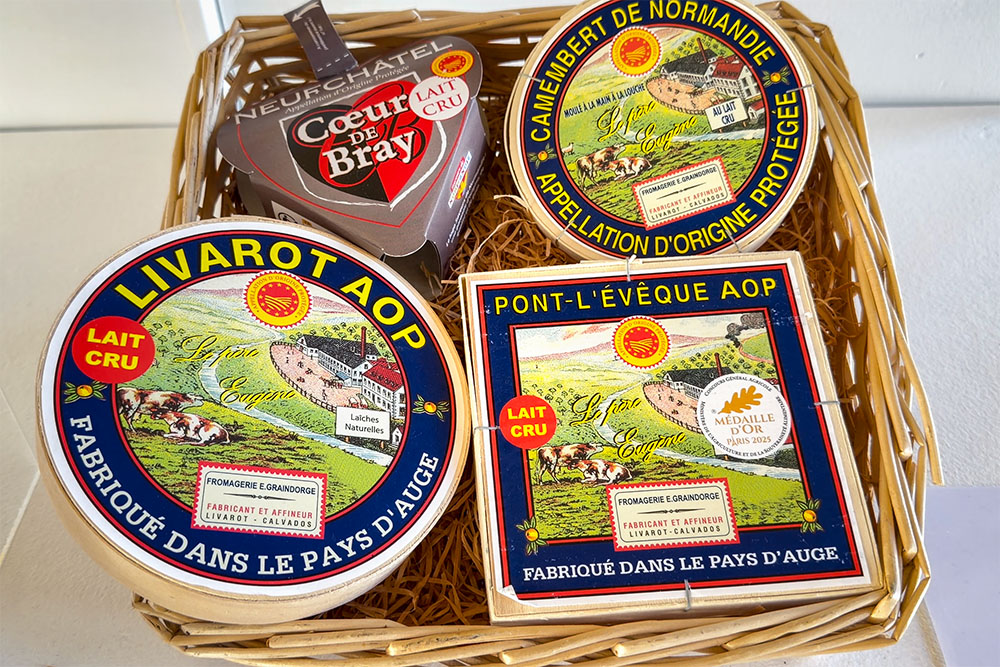
The four AOP (PDO) cheeses of Normandy: Camembert, Livarot, Pont-l'Évêque and Neufchâtel © French Moments
One of the easiest places to begin is Livarot.
At the Village Fromager Graindorge, you can follow the different stages of cheese production from behind glass galleries, from the arrival of the milk through to moulding, ripening and packaging. The dairy has been established in Livarot since 1910 and produces several of Normandy’s PDO cheeses.
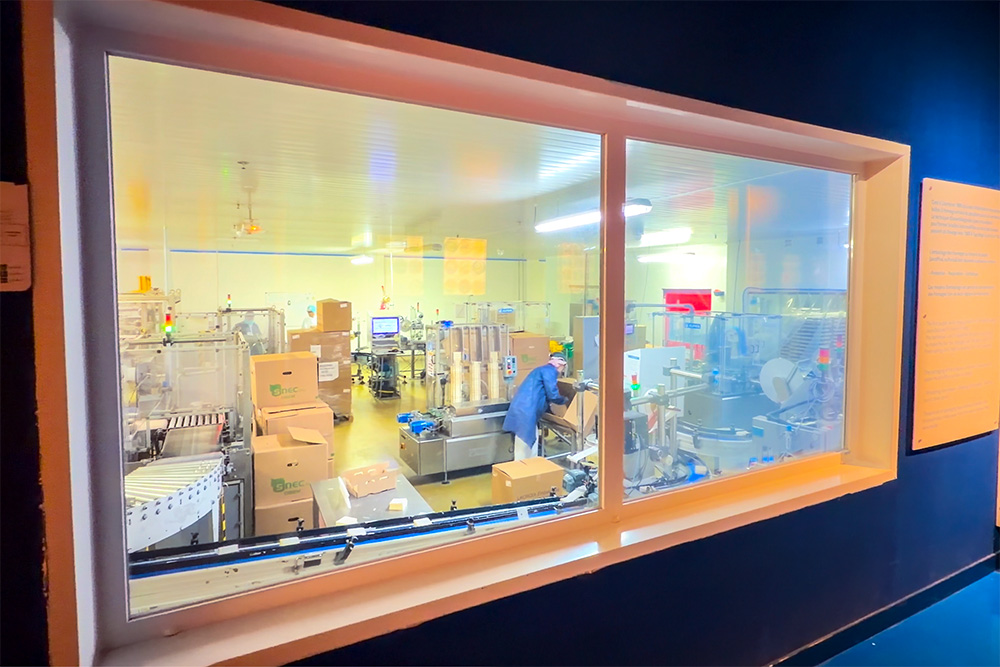
The Graindorge cheese factory in Livarot © French Moments
It is an accessible and informative visit, and a good introduction if you want to understand how cheeses such as Livarot and Pont-l’Évêque are made on a larger scale.
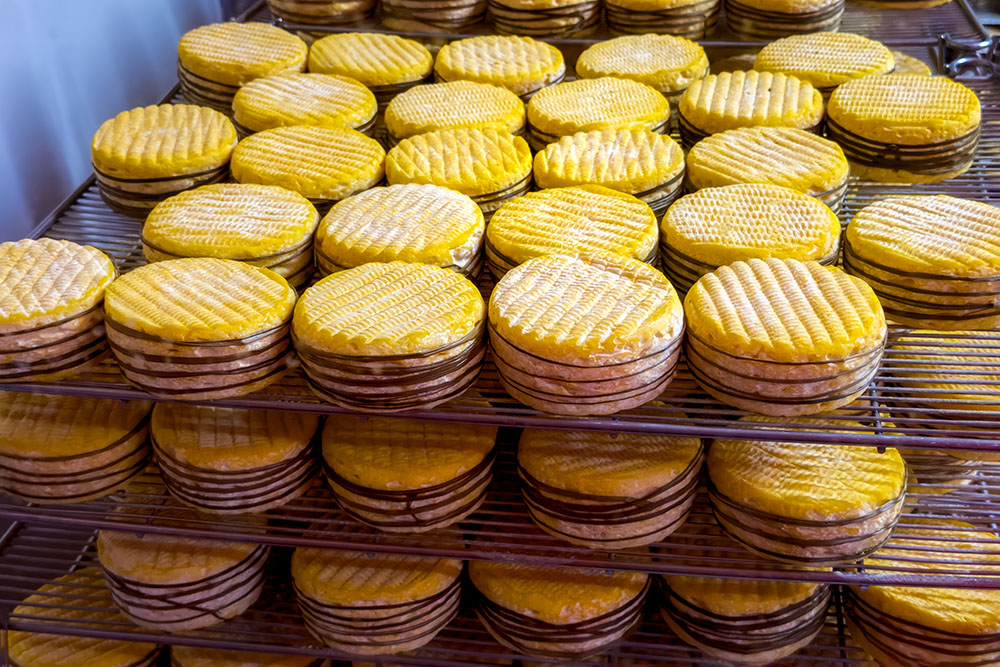
Livarot cheese production from Graindorge in Livarot © French Moments
But our most traditional cheese experience came further south, in the tiny village of Camembert itself.
The Fromagerie Durand is a working farm producing Camembert de Normandie AOP from the raw milk of its own herd of Norman cows. The cheese is still hand-ladled into moulds, and the milk is transformed directly on the farm.
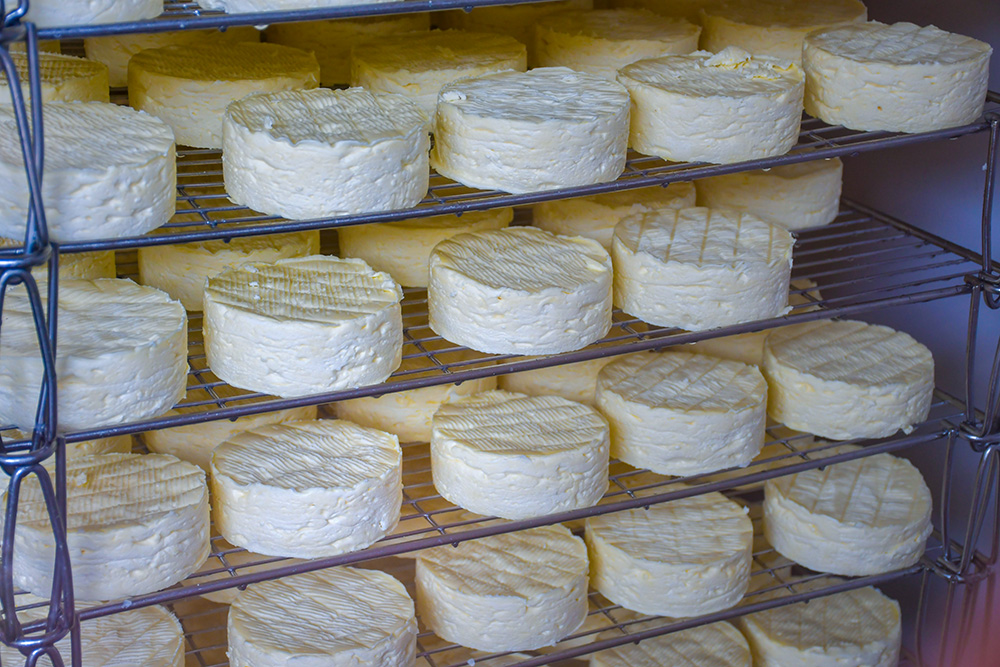
Camembert cheese in making at the Fromagerie Durand in Camembert © French Moments
There is something particularly satisfying about buying Camembert in Camembert, especially when you can see the farm and understand where the milk comes from.
A third experience took us near Orbec, to the Ferme de la Mondière.
This family farm produces raw-milk farmhouse cheeses including Camembert, Livarot and Pont-l’Évêque, along with farm cream and other dairy products.
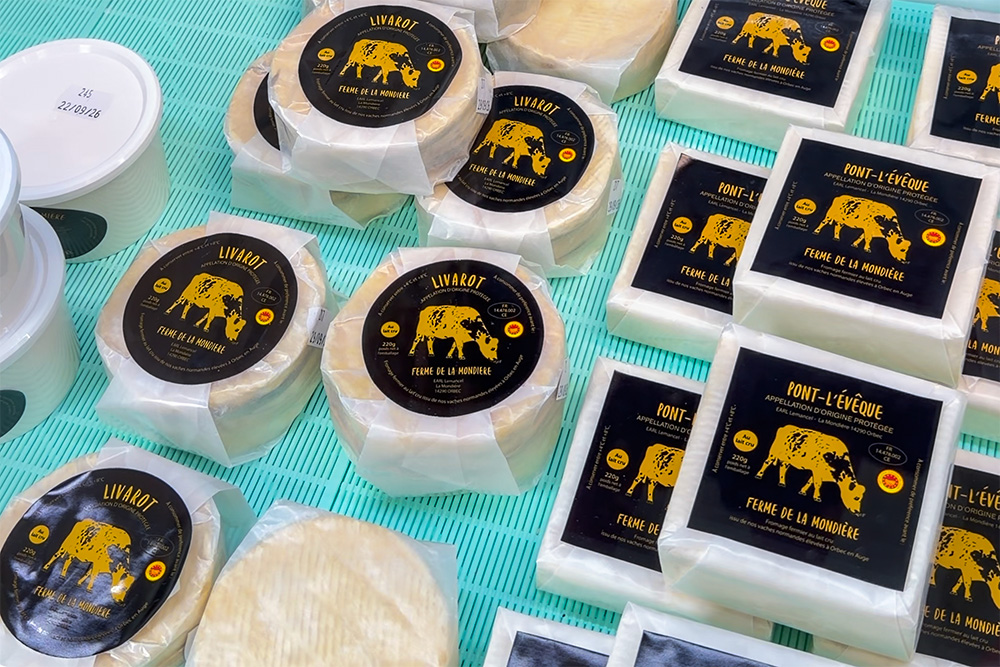
Cheeses of Normandy made by the ferme de la Mondière © French Moments
I liked the contrast between these three places.
Graindorge gives you a clear introduction to the production process. Durand feels closely tied to the village and the traditional image of Camembert. And La Mondière offers the intimacy of buying directly from a small working farm.
If food is part of the reason you travel, I would strongly recommend including at least one cheese producer in your Pays d’Auge itinerary.
Better still, try more than one.
The difference between seeing a cheese on a supermarket shelf and tasting it where it is actually produced is considerable — and in the Pays d’Auge, the landscape around you is part of the story.
8. Step Inside the Châteaux of the Pays d’Auge
The Pays d’Auge is dotted with manor houses and châteaux, but three stood out during our stay because they offer very different experiences.
The first is the Château de Crèvecœur.
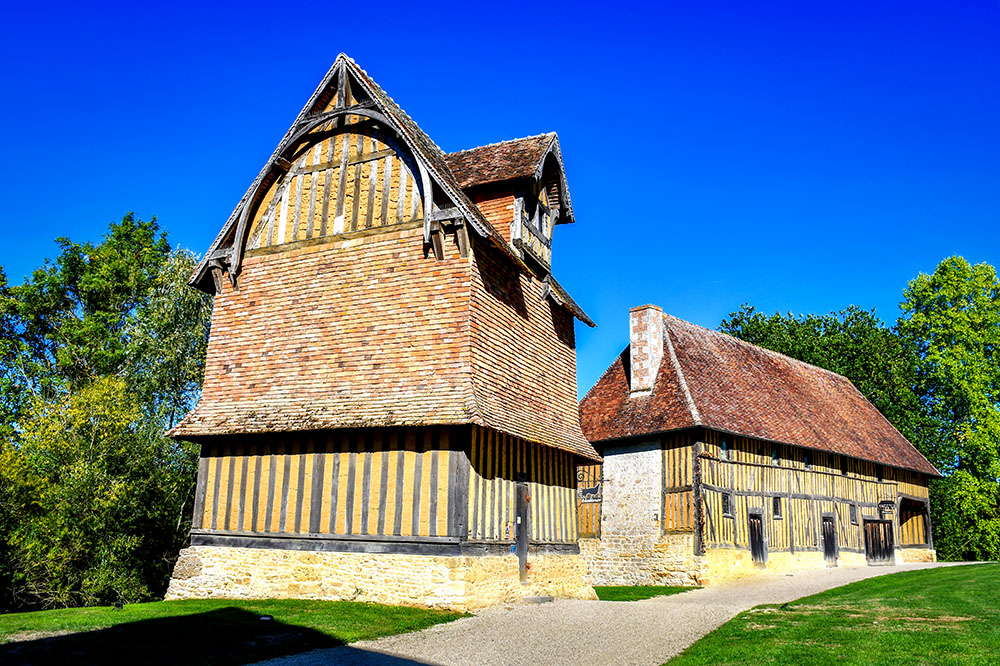
The dovecote and barn of the Crèvecœur Castle © French Moments
This remarkably well-preserved medieval estate is a rare example of a small rural lordship that has survived almost intact. Its layout is divided into two distinct parts: a lower courtyard containing farm buildings, a dovecote, barn and 12th-century chapel, and an upper courtyard protected by a moat and walls, where the lord’s residence stands.
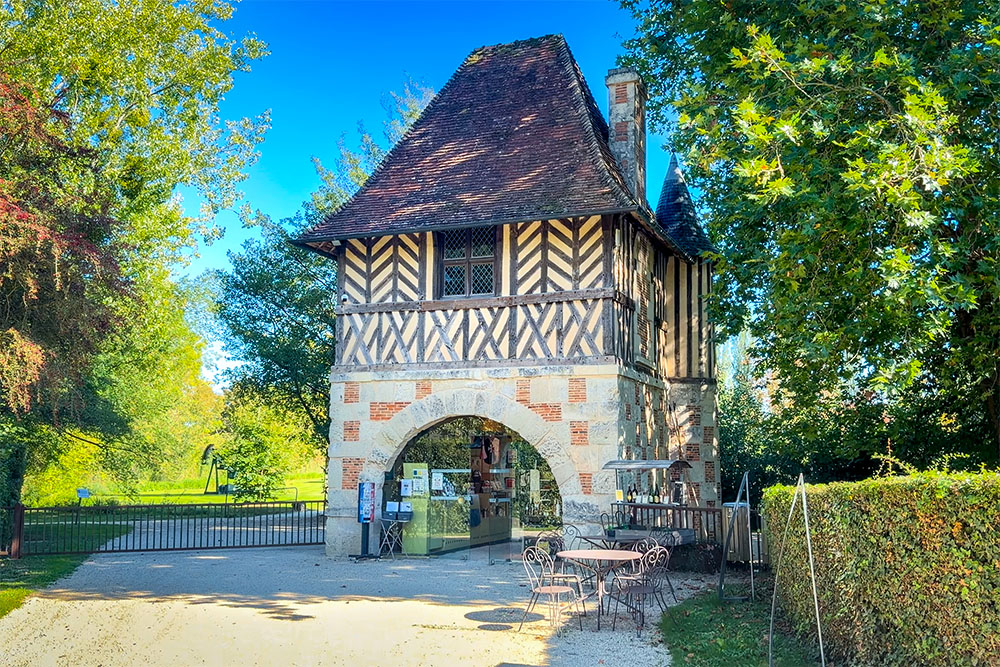
The beautiful gateway of the Crèvecœur Castle © French Moments
What I particularly liked about Crèvecœur was that it does not feel like a grand royal château.
Instead, it gives a much clearer sense of how a medieval rural estate functioned, combining defence, agriculture and everyday life in one compact site.
The Château de Saint-Germain-de-Livet, near Lisieux, could hardly look more different.
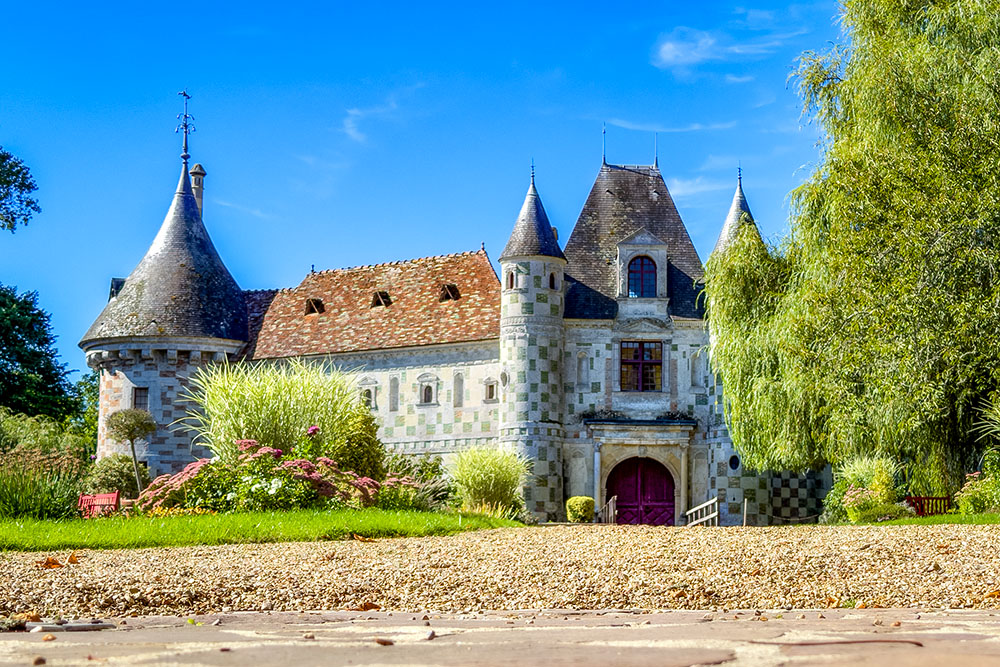
Château de Saint-Germain-de-Livet © French Moments
Surrounded by a moat, it combines a late 15th-century half-timbered manor with an extraordinary late 16th-century building decorated with stone and glazed bricks from the Pré d’Auge arranged in a striking chequerboard pattern.
It is one of the most distinctive châteaux we saw anywhere in the region.
The contrast between timber framing, coloured brickwork, water and formal gardens makes Saint-Germain-de-Livet particularly photogenic, and it also shows how varied the architecture of the Pays d’Auge can be.
Then there is the Château de Boutemont, where the gardens are as important as the château itself.
The present château dates mainly from the 16th century, while the gardens were developed in the early 20th century and combine formal French influences with later landscaped areas. Topiary, themed gardens and a reflecting pool designed by landscape architect Achille Duchêne create a much more refined atmosphere than at Crèvecœur.
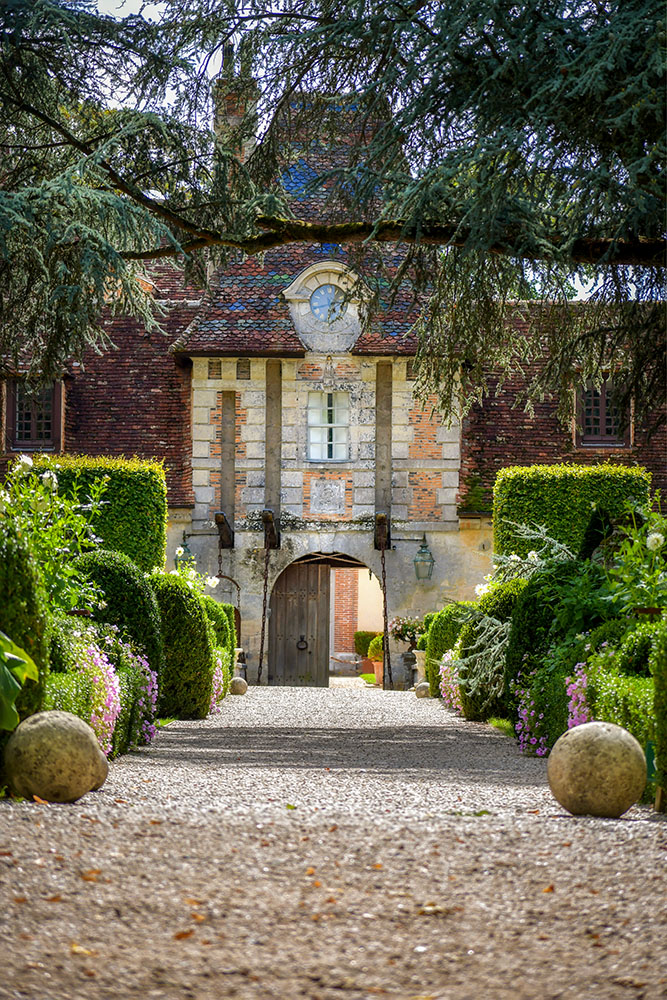
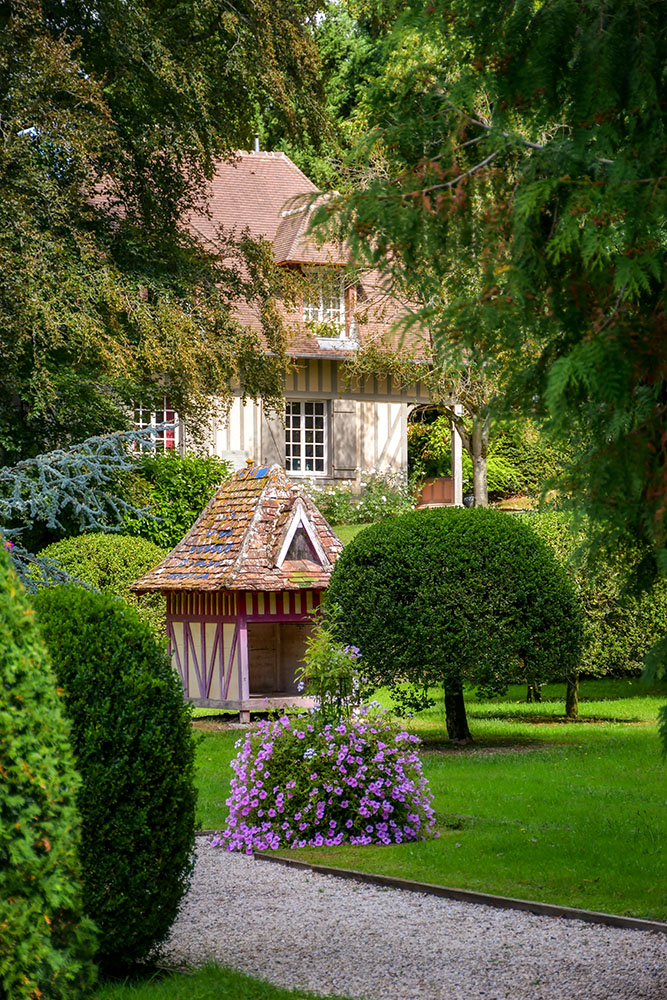
I would not really try to choose a “best” château among the three.
Visit Crèvecœur if you are especially interested in medieval life and rural history; Saint-Germain-de-Livet for its unusual architecture and romantic setting; and Boutemont if gardens and carefully composed landscapes appeal to you as much as historic buildings.
Together, they show just how rich the architectural heritage of the Pays d’Auge really is.
9. Experience Market Day in Saint-Pierre-sur-Dives
Some places are best experienced when something is actually happening there, and Saint-Pierre-sur-Dives is a good example.
The town’s Monday morning market takes place around its impressive medieval market hall, one of the most striking historic buildings in this part of the Pays d’Auge.
The hall is enormous, with a vast timber roof resting on heavy wooden posts, and it has been used for trade for centuries. Seeing it filled with market stalls makes much more sense than visiting it empty.
This is where the building comes back to life.
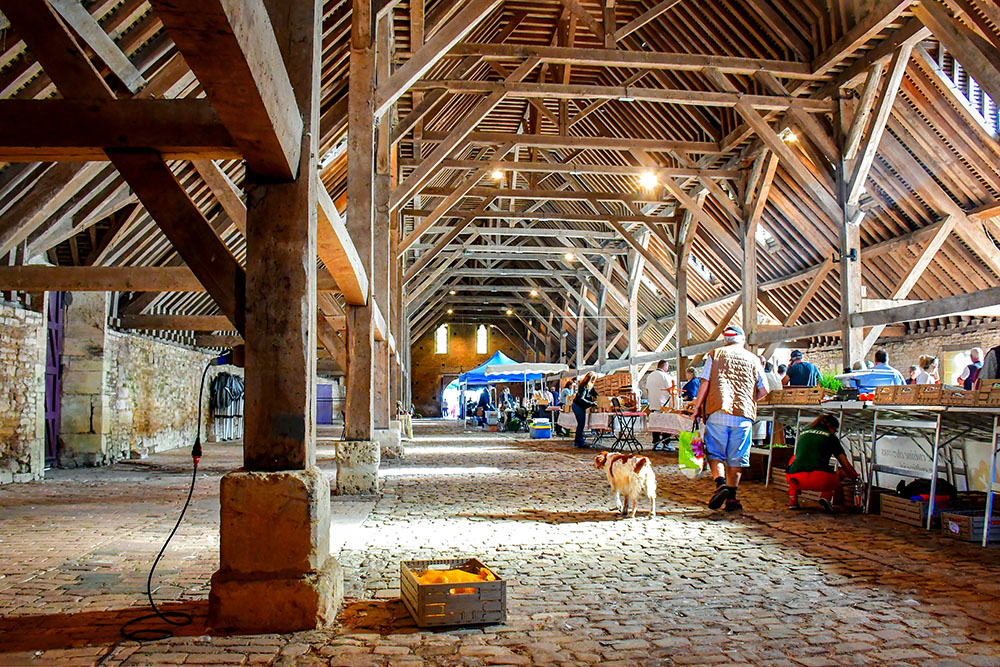
The medieval hall of Saint-Pierre-sur-Dives © French Moments
Local producers sell fruit, vegetables, cheeses, meat, bread and other regional products, while shoppers move between the stalls beneath the old timber structure. It is a simple experience, but one that connects the town’s history with everyday life in a way I really enjoyed.
Saint-Pierre-sur-Dives is also worth exploring beyond the market.
The abbey church rises just beside the historic centre and gives the town a surprisingly monumental feel. Together with the former monastic buildings and the market hall, it forms one of the most impressive historic ensembles we came across in the southern Pays d’Auge.
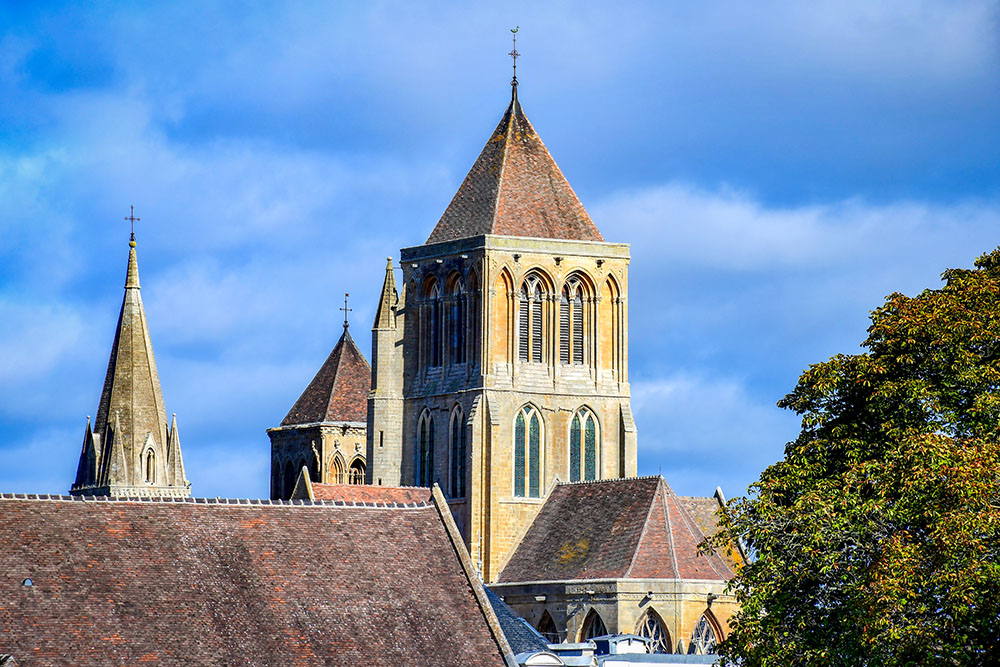
The abbey church of Saint-Pierre-sur-Dives © French Moments
If your itinerary allows it, I would therefore try to visit Saint-Pierre-sur-Dives on a Monday morning.
You can browse the market, look inside the church and then wander through the surrounding streets while the town is at its liveliest.
It is a very different experience from visiting a perfectly preserved tourist village — and that is precisely why I think it belongs in this list.
10. Discover the Quieter Side of the Côte Fleurie in Villerville
The Côte Fleurie is often associated with elegant seaside resorts such as Deauville, Trouville-sur-Mer and Cabourg.
But Villerville offers a much quieter version of the Normandy coast.
This small seaside village lies between Honfleur and Trouville, with narrow streets descending towards the sea and old houses clustered above the shoreline.
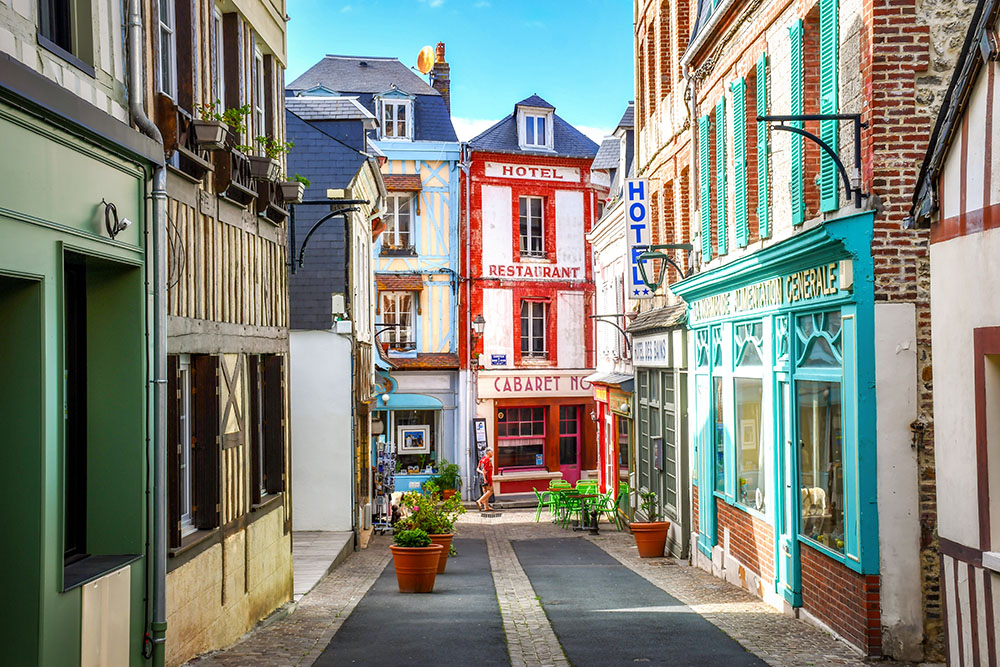
The centre of Villerville © French Moments
What I liked most was its scale.
Villerville feels compact and lived-in rather than grand. There are no enormous promenades or rows of monumental Belle Époque villas dominating the seafront. Instead, you find small streets, modest viewpoints and a more intimate relationship with the coast.
The village also has a strong connection with French cinema. Villerville was used as the setting for Henri Verneuil’s 1962 film A Monkey in Winter (Un singe en hiver), starring Jean Gabin and Jean-Paul Belmondo, and this connection is still celebrated locally.
But even if you know nothing about the film, Villerville is worth visiting for its atmosphere.
A walk through the village quickly takes you from the church and old streets down towards the sea, with views across the Seine estuary and along the coastline.
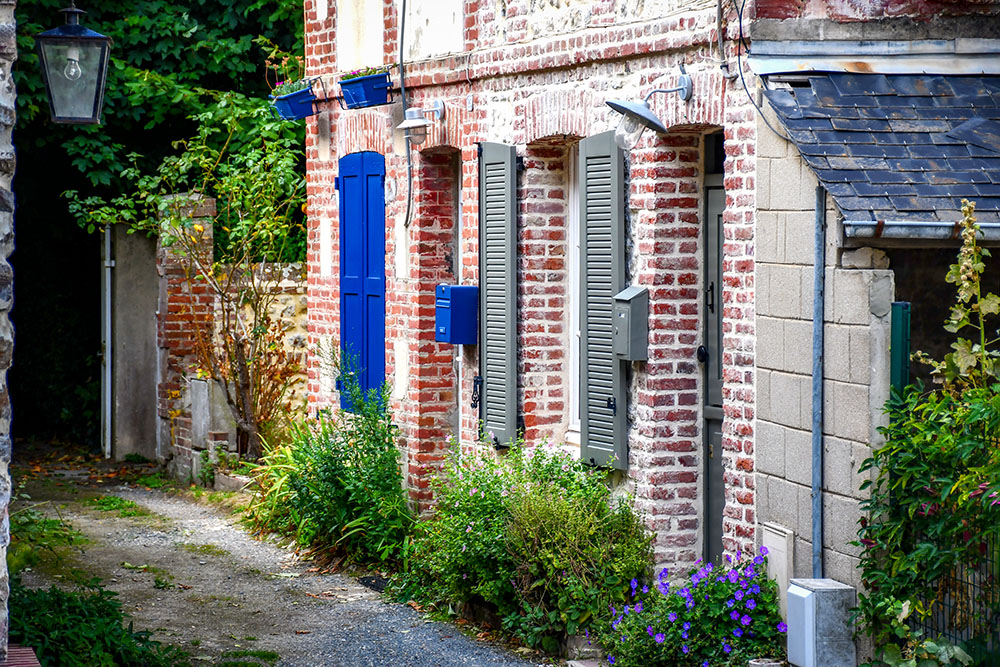
Villerville © French Moments
For me, Villerville was a useful reminder that the Côte Fleurie is not only about famous resorts.
If you want to experience a smaller and quieter coastal village before heading inland into the rural Pays d’Auge, it makes a very pleasant stop.
11. Seek Out the Lesser-Known Villages and Small Towns of the Pays d’Auge
Beuvron-en-Auge may be the village that appears most often in guidebooks, but some of my favourite discoveries in the Pays d’Auge were places I knew very little about before our trip.
Blangy-le-Château was one of the most memorable.
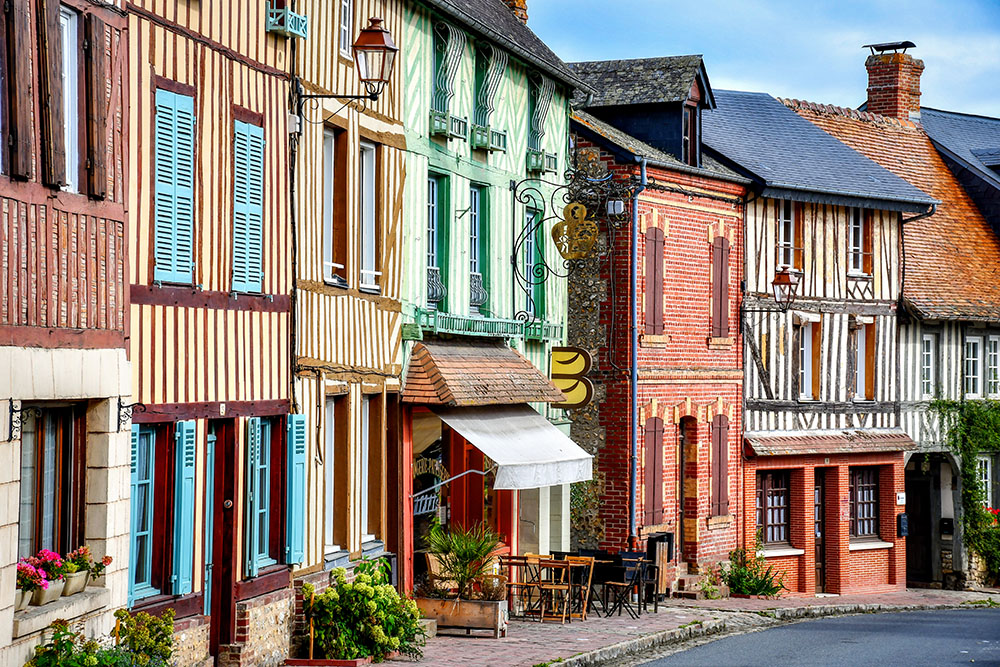
The high street of Blangy-le-Château © French Moments
Set in the Chaussey valley between wooded hills, the village has a wonderfully attractive centre of colourful half-timbered and brick houses, with water appearing repeatedly as you walk through the streets. It was officially admitted to the Plus Beaux Villages de France in 2024, and I can understand why.
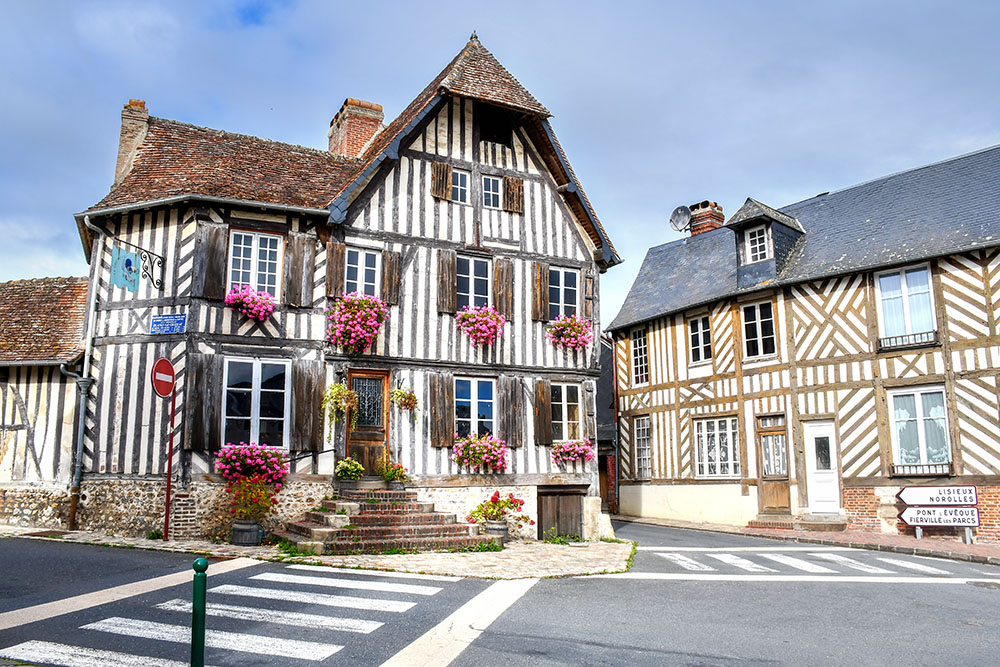
The old Coq-Hardi Inn in Blangy-le-Château © French Moments
I particularly liked how beautifully the village was planted with flowers when we visited. Combined with the old houses and little waterways, it created some of the prettiest scenes I photographed during our stay.
Further east, Cormeilles has a different character.
It is more of a small country town than a village, built along the Calonne and lined with historic half-timbered houses, some dating from the 16th and 17th centuries.
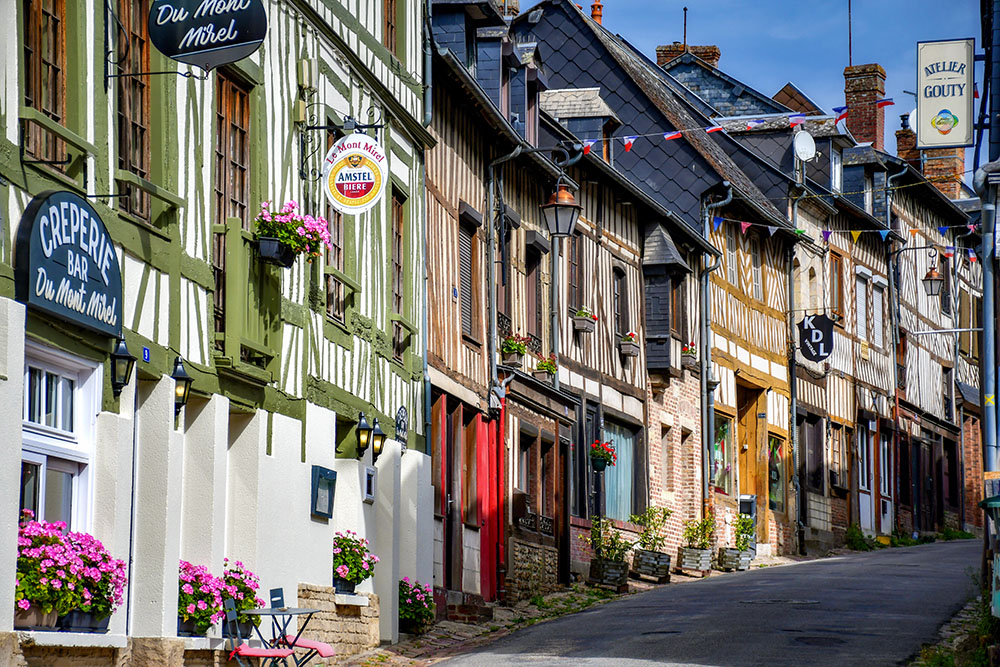
Half-timbered houses in Cormeilles © French Moments
There are shops, cafés and a little more everyday activity here, which makes it feel less like a preserved showcase and more like a place where people actually live and work.
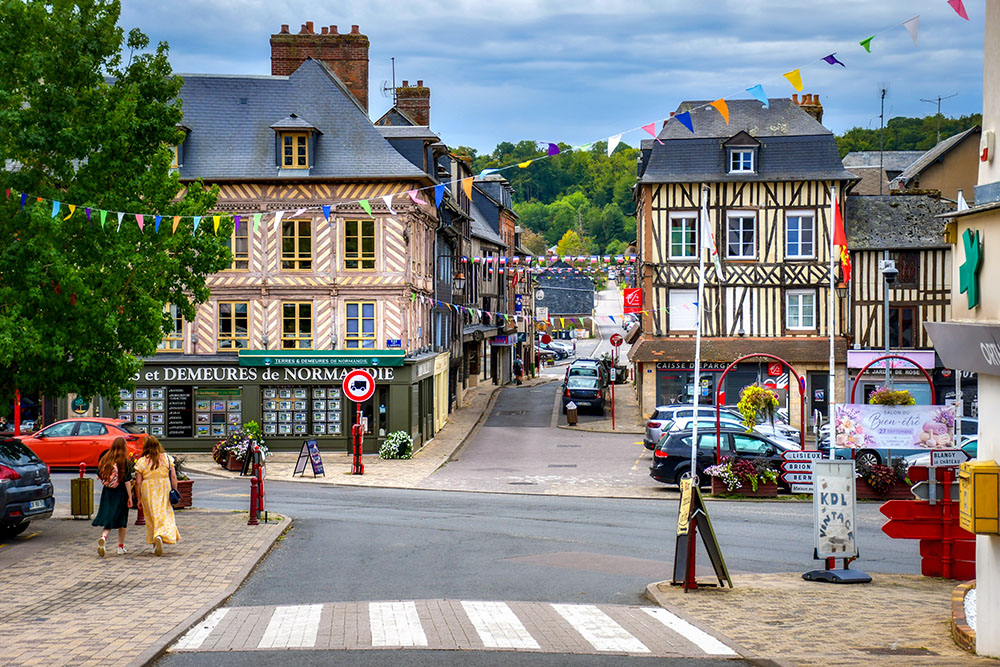
The centre of Cormeilles © French Moments
Its Church of Sainte-Croix also hides one of the strangest architectural details we encountered during the trip — but I will come back to that shortly.
Then there are places that are much smaller.
Pierrefitte-en-Auge, Vieux-Pont-en-Auge, Le Mesnil-sous-Blangy and Fervaques are the kind of stops that help make a road trip through the Pays d’Auge so enjoyable.
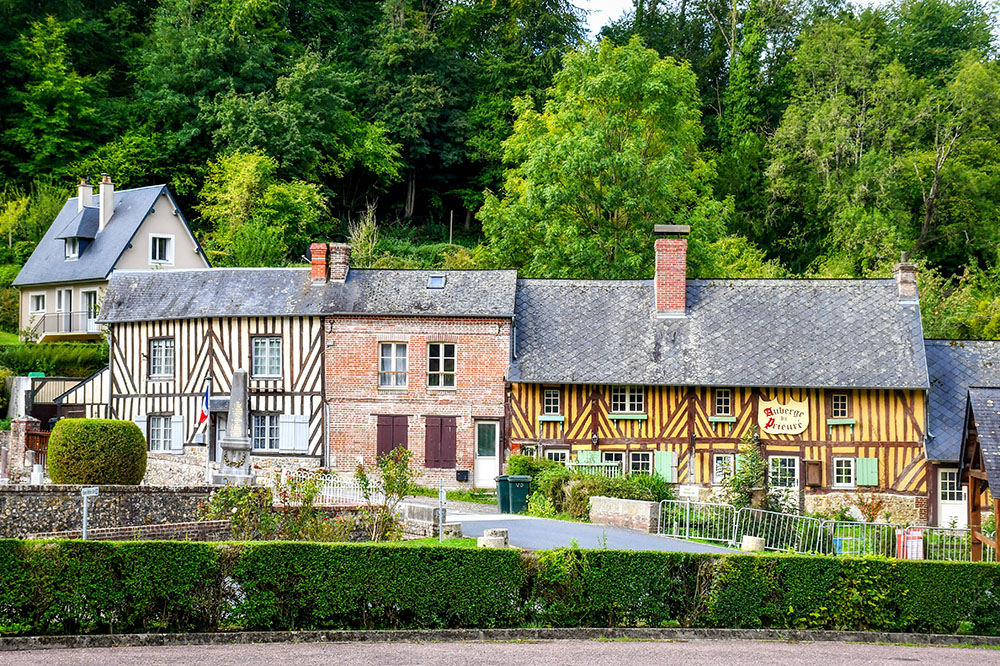
Saint-Hymer
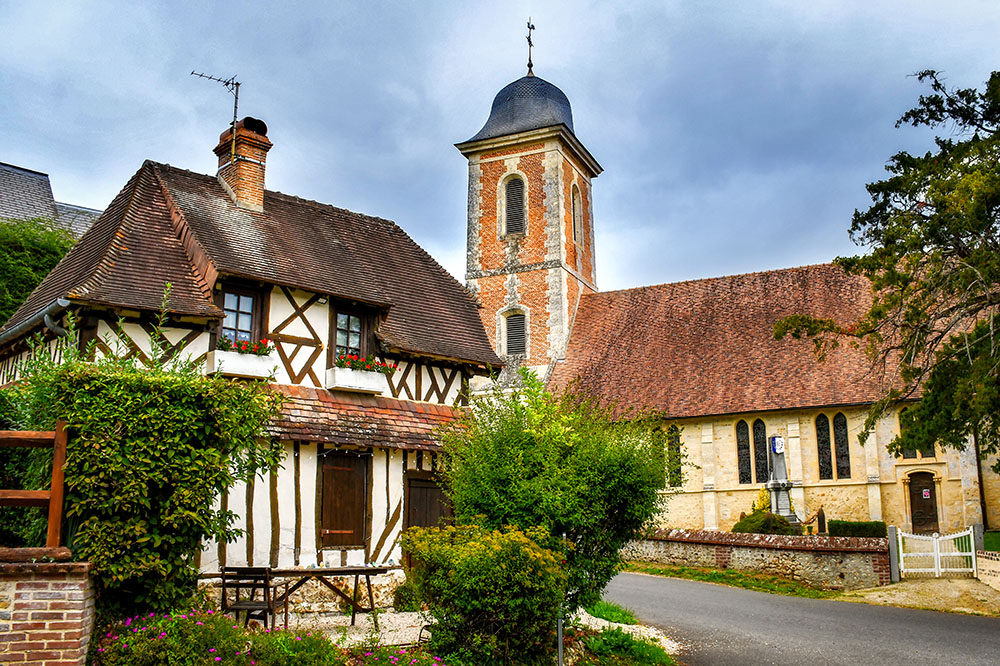
Le Mesnil-sur-Blangy
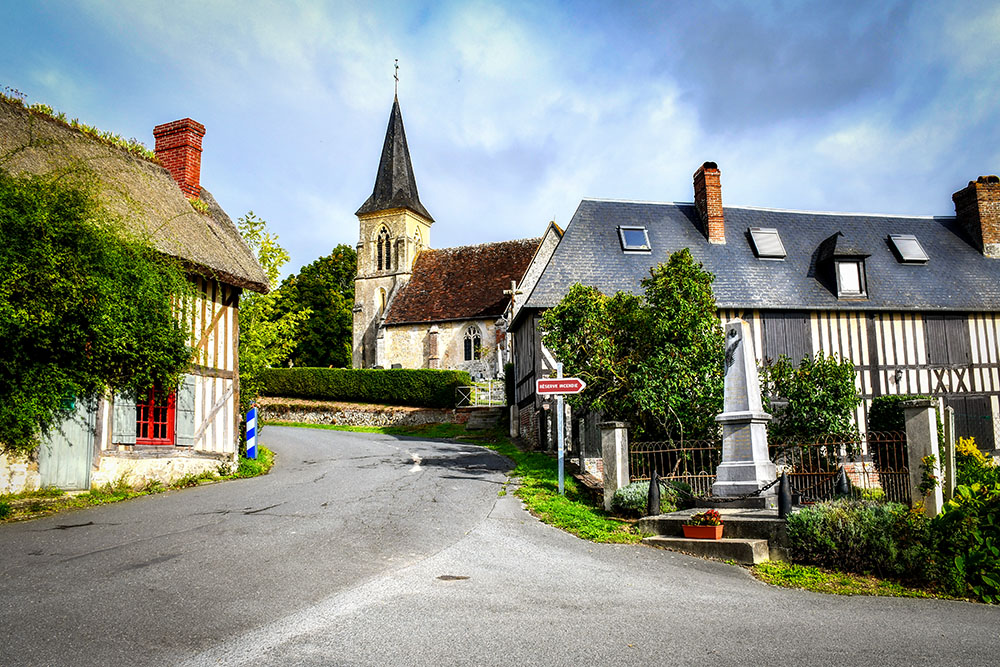
Pierrefitte-en-Auge
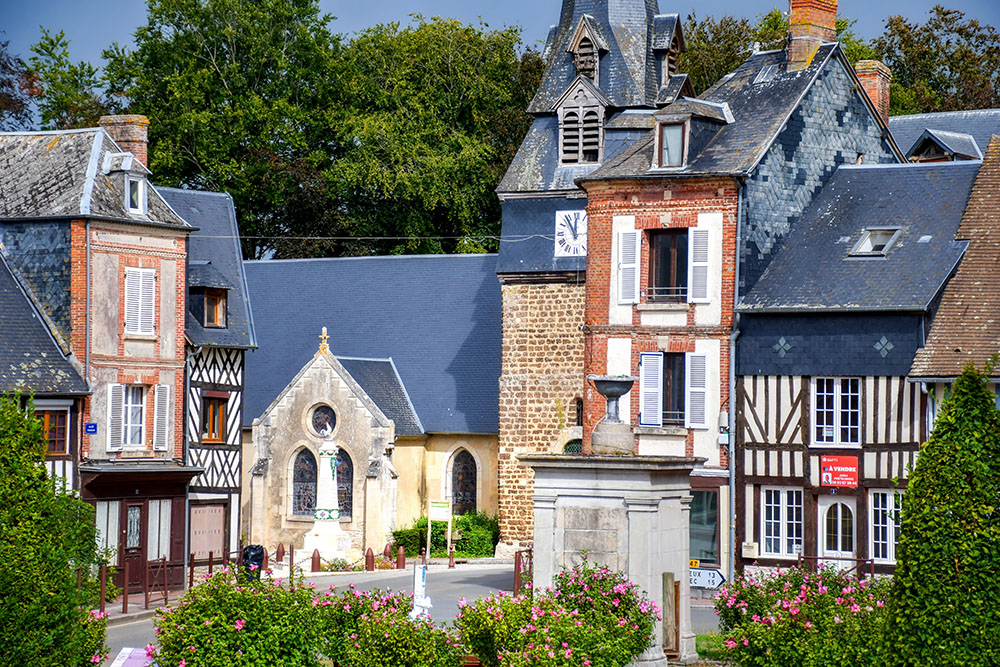
Fervaques
You may spend only a short time there, but together they build up a much richer picture of the region than you would get by visiting only its famous attractions.
We also stopped at Saint-Julien-le-Faucon, another small town that most overseas visitors are unlikely to have on their itinerary.
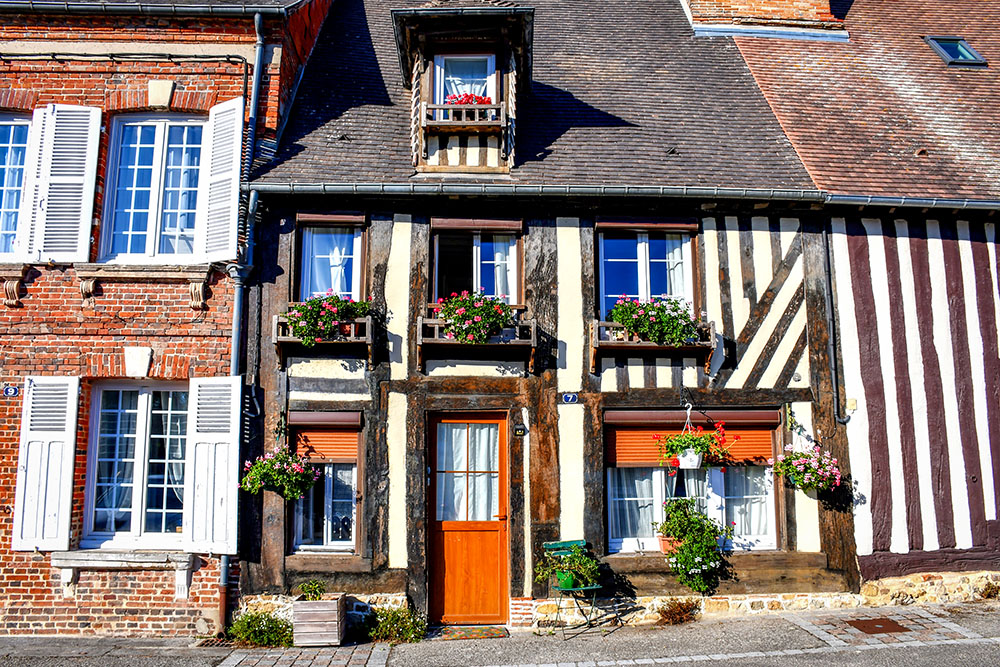
Saint-Julien-le-Faucon © French Moments
Not every one of these places needs half a day.
Sometimes twenty minutes wandering around a church, crossing a little bridge or photographing an old timber-framed house is enough.
That is precisely why I would resist planning every hour of a Pays d’Auge road trip in advance.
Leave space for the villages whose names you have never heard of.
You may find that they become some of the places you remember most.
12. Look Out for the Pays d’Auge’s Unusual Churches
One of the things I enjoyed most during our stay was discovering just how many unusual churches are hidden in the Pays d’Auge.
Even before stepping inside, many of them have a distinctive regional character. In this part of Normandy, church towers are often built not in stone but in timber framing, reflecting the same building traditions seen in local farmhouses and manor houses. Because good building stone was less readily available here, wood became the natural material of choice.
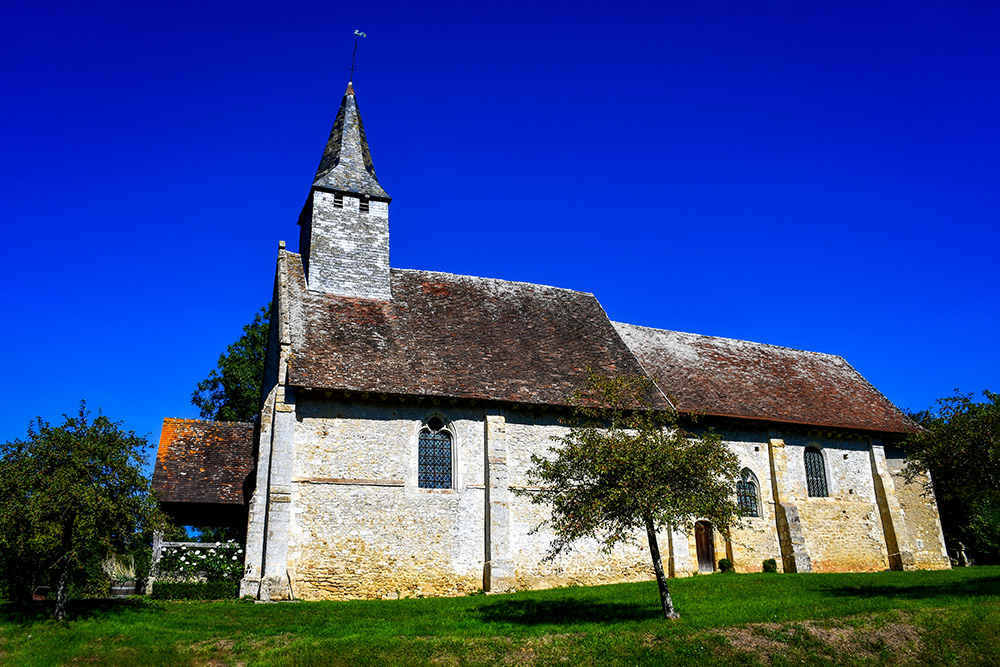
The church of Grandrouet near Cambremer is typical of the Pays d'Auge © French Moments
These bell towers are often covered with wooden shingles and crowned with slender octagonal spires, giving them a silhouette that feels entirely at home in the bocage landscape.
Some churches look fairly conventional at first, only to reveal an unexpected detail once you enter.
The Church of Sainte-Croix in Cormeilles is a perfect example.
Built originally in the 11th century and altered in later centuries, it has a feature said to be unique in Normandy: the nave rises gently uphill towards the altar.
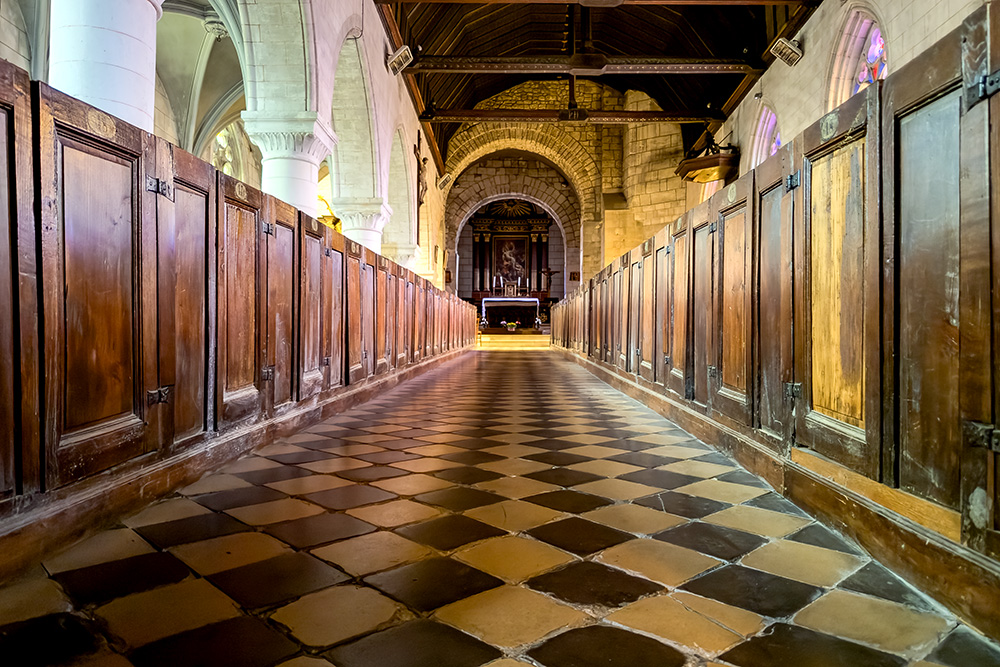
Inside the church of Cormeilles © French Moments
You really notice the slope once you are inside. The church also retains enclosed wooden pews and a timber roof shaped like an upturned boat hull.
Then there is Moyaux, where the Church of Saint-Germain is immediately recognisable because of its twisted spire.
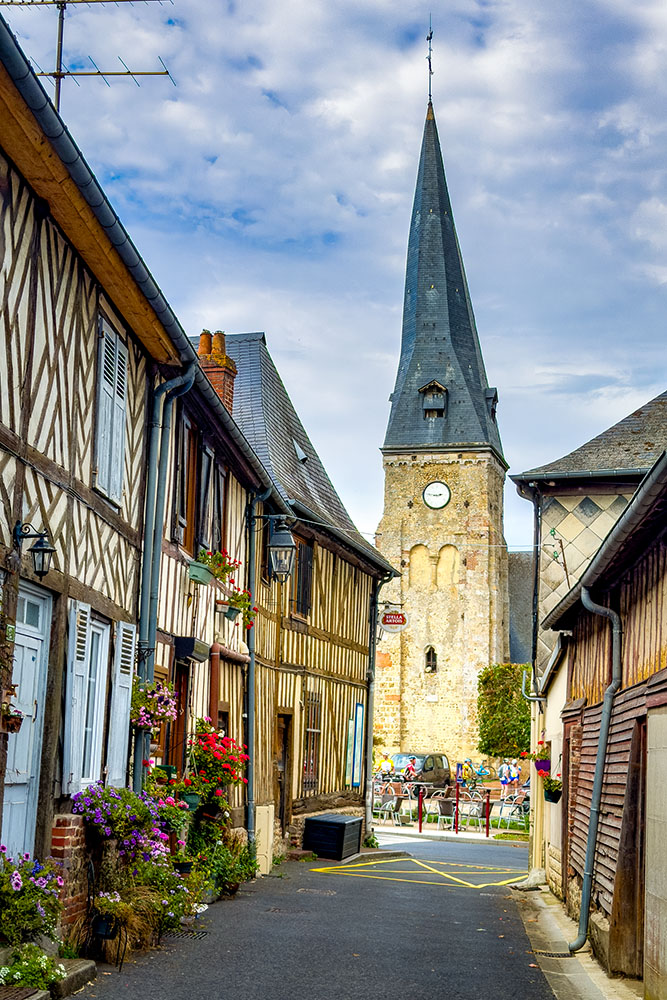
The twisted spire of Moyaux Church © French Moments
It is one of those details that makes you stop and look twice. The village itself is attractive, but the leaning, spiralling silhouette of the church tower is what gives Moyaux much of its personality.
Perhaps the most intriguing name belongs to Ouville-la-Bien-Tournée.
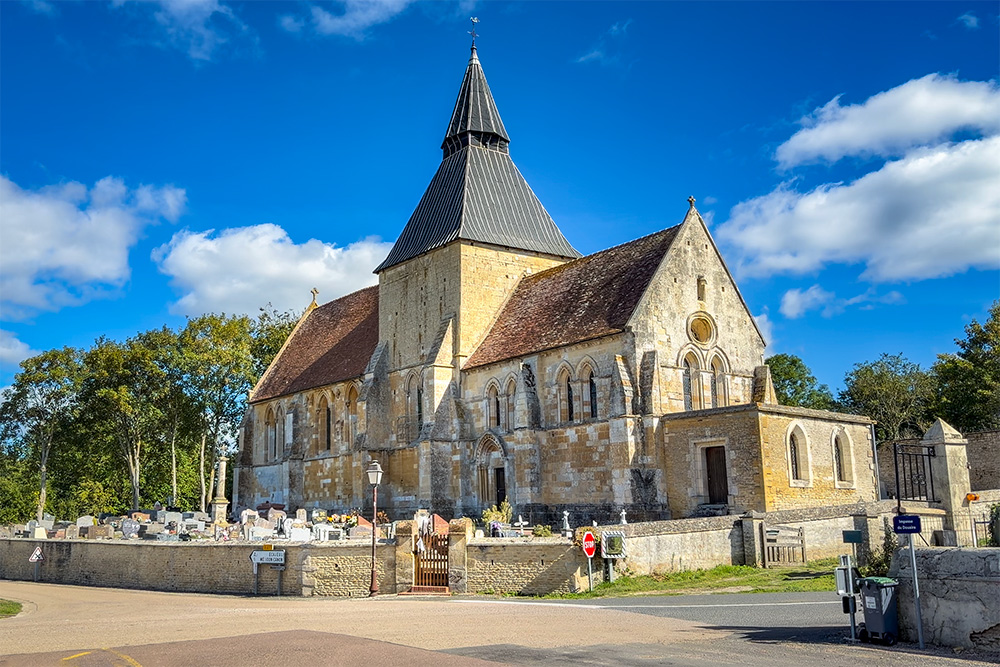
The church of Ouville-la-Bien-Tournée © French Moments
Its Church of Notre-Dame is unusual because it is aligned on a north–south axis rather than the usual east–west one, probably because of the slope of the land. Even the village name recalls this peculiarity, referring to a church that was once considered mal tournée before becoming bien tournée.
These are exactly the kinds of small discoveries that make exploring the Pays d’Auge rewarding.
You do not need to be an expert in church architecture to enjoy them.
Sometimes it is simply the pleasure of opening a church door and finding something you did not expect.
13. Explore Orbec — Above and Below Ground
Orbec was one of the more intriguing stops of our trip, partly because it left me with mixed feelings.
On paper, the town has everything I usually enjoy: half-timbered houses, narrow streets, an old church, a former manor house and plenty of historic character. The local tourist office describes Orbec as a small medieval town with a well-preserved traditional heritage, and there are certainly some beautiful buildings to discover.
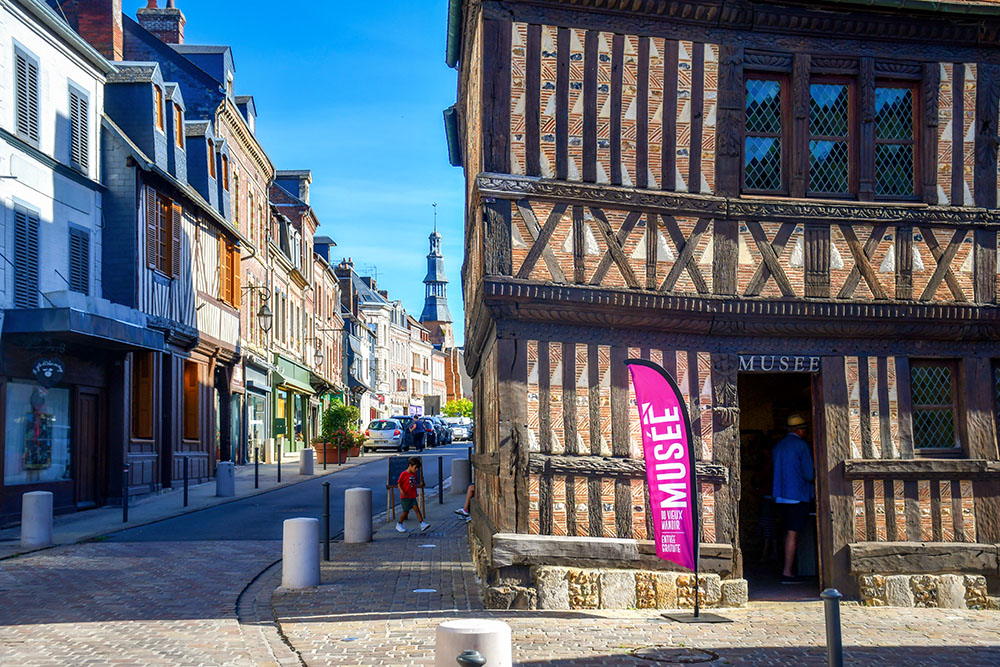
The high street of Orbec © French Moments
But when we visited, I also noticed a number of deteriorating façades, empty shopfronts and historic buildings that looked as though they could do with more care.
That does not mean Orbec is not worth visiting.
Quite the opposite: I came away thinking that the town has enormous potential.
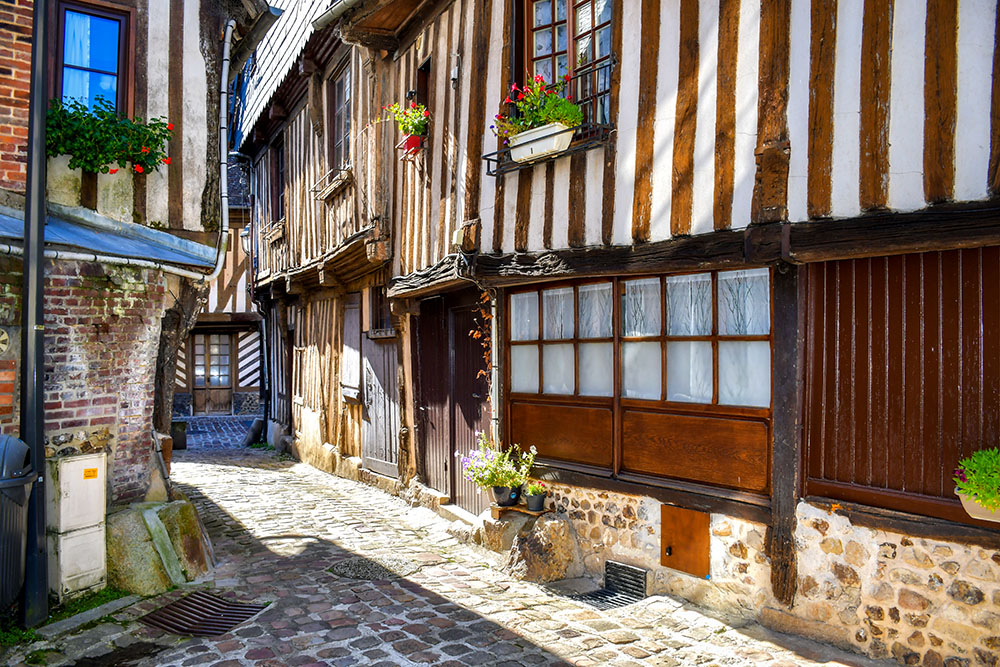
Rue des Osiers: an old narrow street in Orbec © French Moments
Just go with realistic expectations rather than imagining a perfectly restored village such as Beuvron-en-Auge.
And then there is what lies beneath the ground.
Just outside the centre, the Champignonnière d’Orbec occupies an old limestone quarry that was worked from the Middle Ages until the 19th century. Stone extracted here was used to construct some of Orbec’s most important buildings.
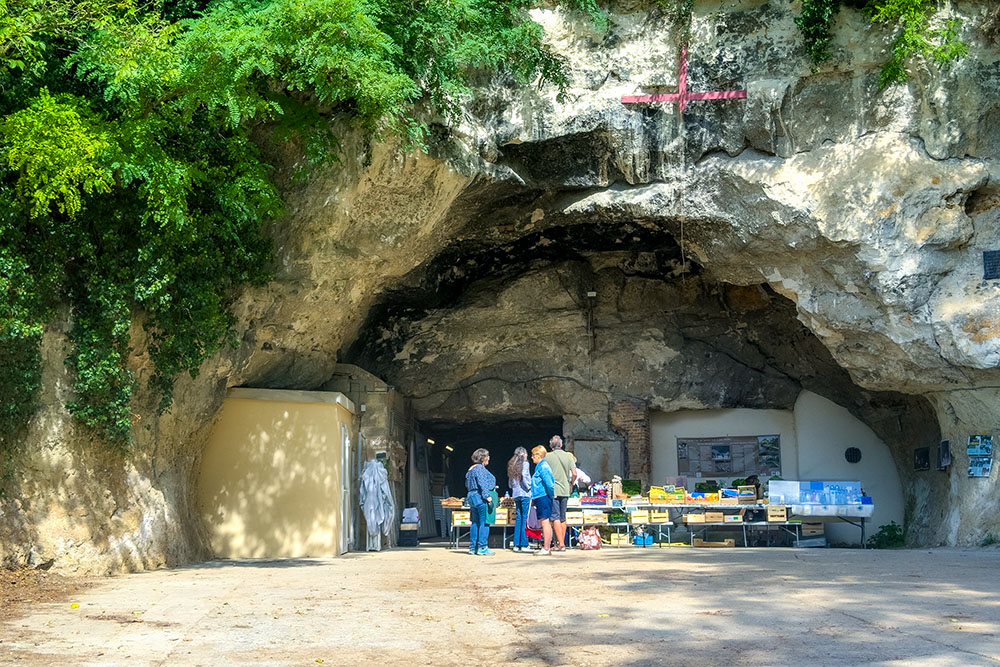
The entrance to the quarry of Orbec © French Moments
Once quarrying ended, the underground galleries found a new use: mushroom growing.
Today, button mushrooms, oyster mushrooms and shiitake are cultivated inside the tunnels, where the temperature remains around 13°C. Guided visits take you underground to learn how the mushrooms are grown and harvested.
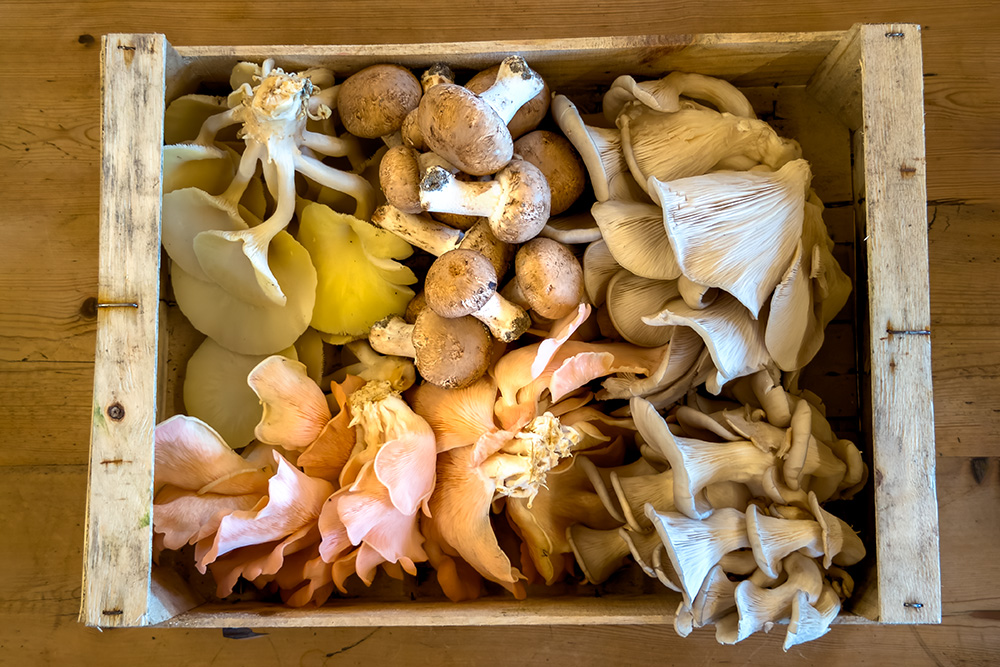
A crate of Orbec Mushrooms © French Moments
We found the visit fascinating precisely because it was so different from everything else we had been doing.
After days of churches, manor houses and timber-framed villages, suddenly we were walking through a dark former quarry learning about oyster mushrooms.
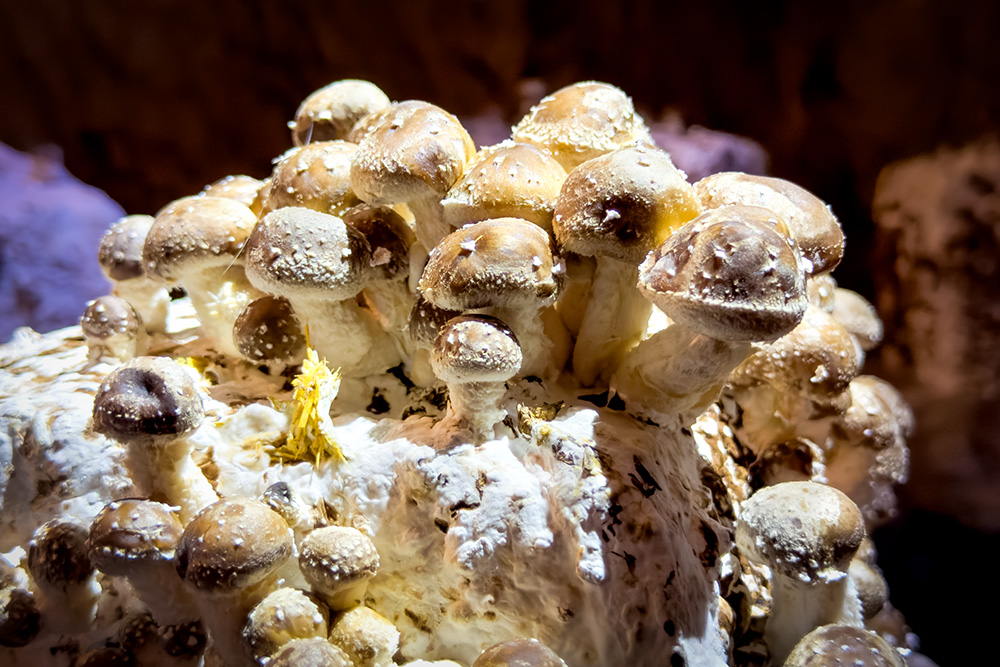
Mushrooms growing in the old quarry of Orbec © French Moments
There is also a remarkable historical detail: during the fighting in August 1944, around 2,000 inhabitants of Orbec sheltered in these galleries before the town was liberated.
Orbec therefore works particularly well as a two-part visit.
Explore the historic town above ground, then head underground for one of the most unusual experiences we found anywhere in the Pays d’Auge.
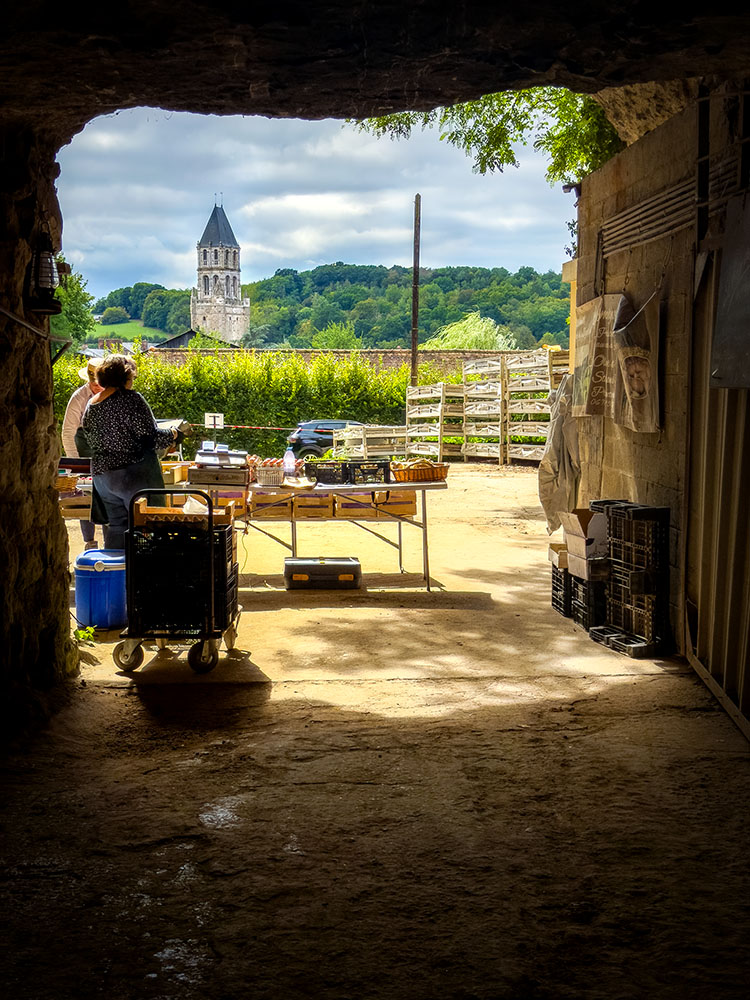
On our way out from the old quarry of Orbec © French Moments
14. Discover a Vineyard Where You Might Not Expect One
A vineyard is probably not the first thing you expect to find in the Pays d’Auge.
This is, after all, a landscape of apple orchards, cider and Calvados.
And yet, near Marolles, just a few miles from Lisieux, Claire and Sébastien Fricker have created the Domaine des Déserts, a new vineyard on the slopes of the Courtonne valley.
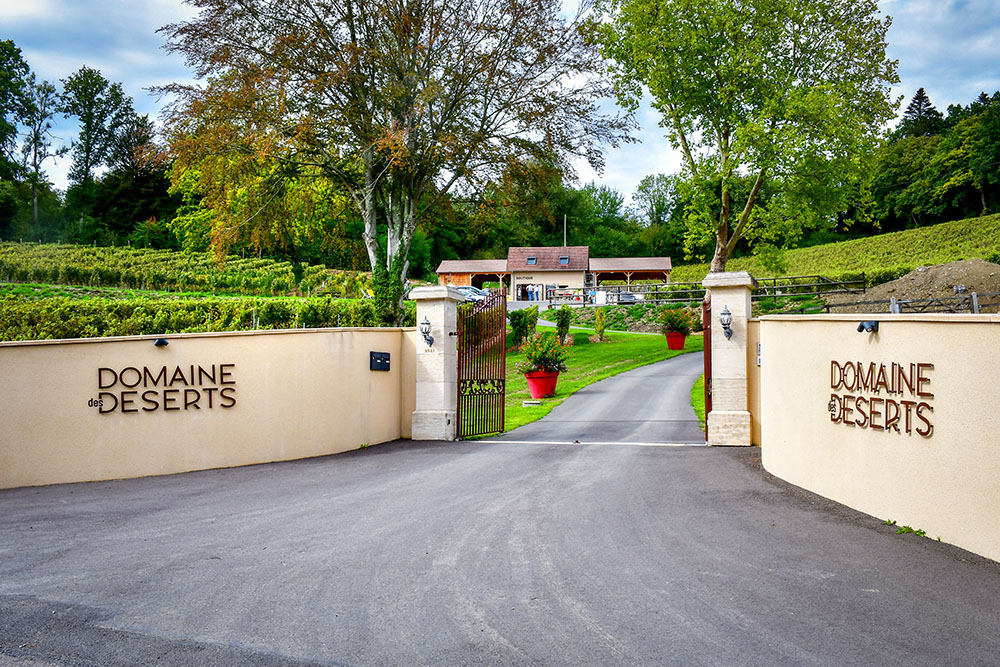
The vineyards of Le Domaine des Déserts
The project began with the purchase of the property in 2021, followed by the planting of around 4.5 hectares of vines in 2023. The varieties include Chenin Blanc, Chardonnay, Cabernet Franc and Cabernet Sauvignon. The first Normandy harvest took place in 2025.
We visited the vineyard during our stay, and I found the whole idea fascinating.
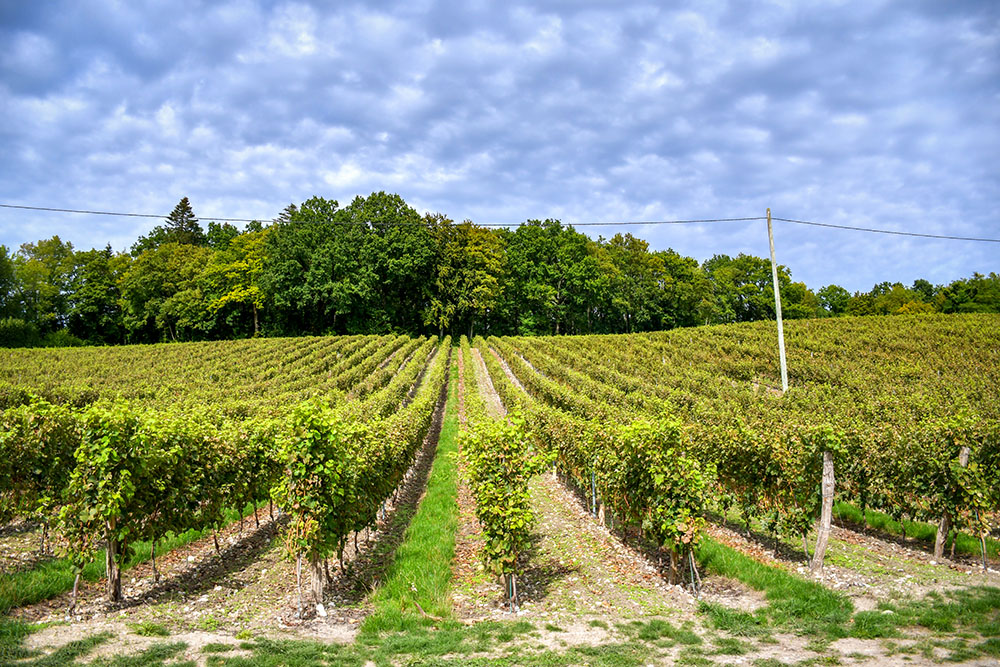
The vineyards of Le Domaine des Déserts © French Moments
The rows of vines climbing the hillside look almost unexpected in this corner of Normandy, especially after days spent driving past apple trees and grazing cattle.
But the location was carefully chosen.
The vineyard occupies a south-facing slope with clay-limestone soils, conditions that Sébastien Fricker considered well-suited to growing grapes and producing wines with structure and minerality.
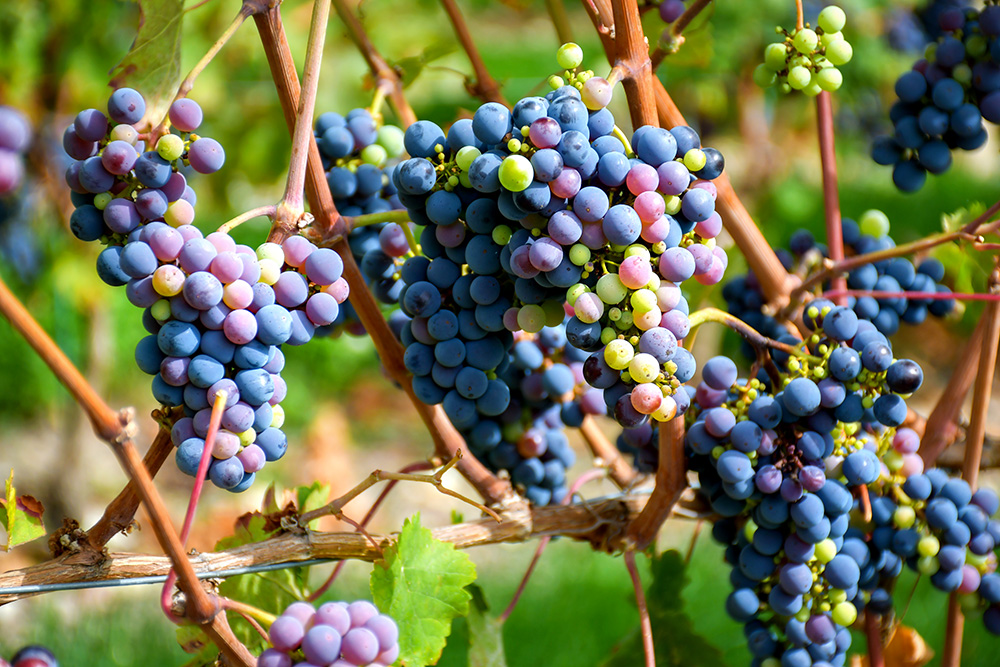
Grapes from the vineyards of Le Domaine des Déserts © French Moments
The story behind the vineyard is equally interesting.
Sébastien comes from a wine-growing family in the Loire Valley, while Claire has agricultural roots in Normandy and experience in Burgundy. Together, they decided to bring vine growing to a part of France far better known for cider and dairy farming.
The estate can be visited, and there is a shop and tasting space among the vines. At the time of our visit, the project still felt very young — which was actually part of its appeal.
You are not visiting a centuries-old wine estate with generations of history already written.
You are watching a new chapter of Normandy agriculture being created almost from scratch.
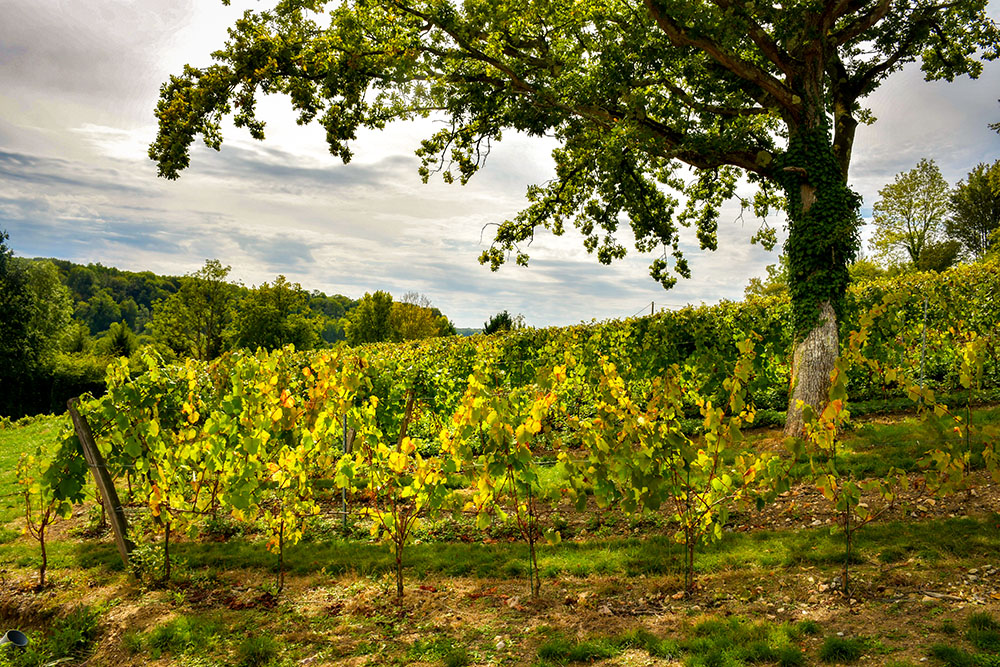
Le Domaine des Déserts © French Moments
For me, the Domaine des Déserts was one of the most unexpected discoveries of our 16 days in the Pays d’Auge.
It is also a reminder that this region is not frozen in the past.
Traditions matter enormously here, but new ideas are still finding their place among the orchards, pastures and half-timbered farms.
15. Leave the Main Roads and Explore the Countryside
If there is one piece of advice I would give after driving around 1,000 kilometres in the Pays d’Auge, it is this: do not spend all your time travelling from one famous sight to the next.
Take the smaller roads.
Some of the most memorable moments of our trip happened when we were not heading for anywhere particularly important.
A narrow lane would open onto a valley filled with cattle. A half-timbered farmhouse would appear behind a hedge. We would pass an old manor house, a tiny church or an orchard stretching across a hillside.
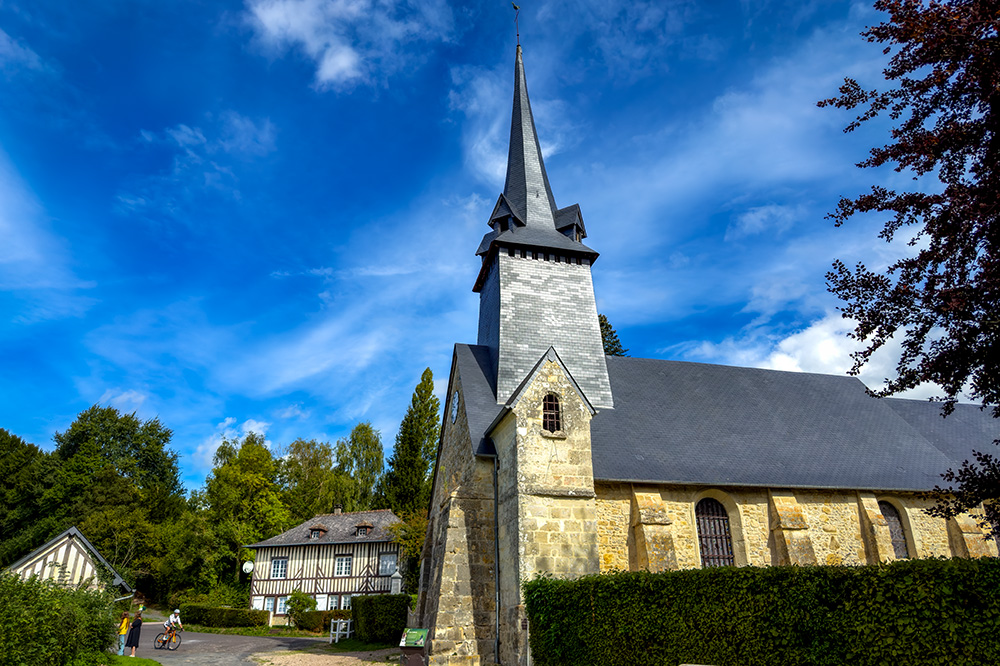
The church of La Roque-Baignard © French Moments
Sometimes we stopped. Sometimes we simply slowed down.
That is how we discovered places such as the Cascade de Prêtreville, tucked away in the countryside near Lisieux, as well as countless farms, hamlets and viewpoints that never appeared on our original list.
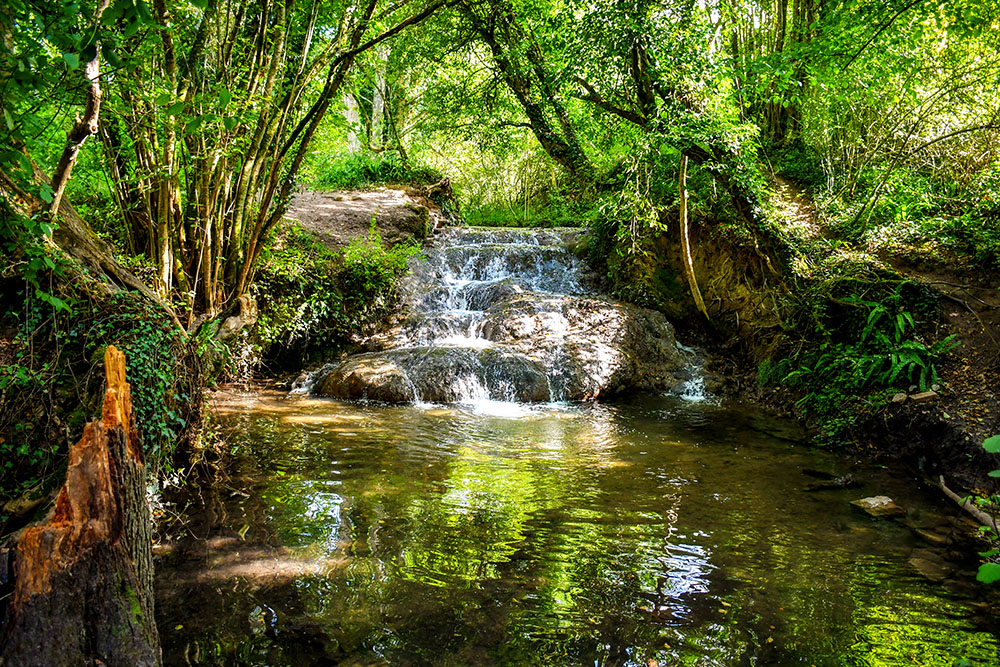
The Cascade de Prêtreville © French Moments
The Pays d’Auge is a landscape built for slow exploration.
Its beauty is not dramatic in the way of the Alps or the Mediterranean coast. It is softer and more intimate: green fields, wooded valleys, apple trees, grazing cattle and old buildings that seem to belong naturally to the land around them.
Driving also gives you a much better sense of how the different parts of the region connect.
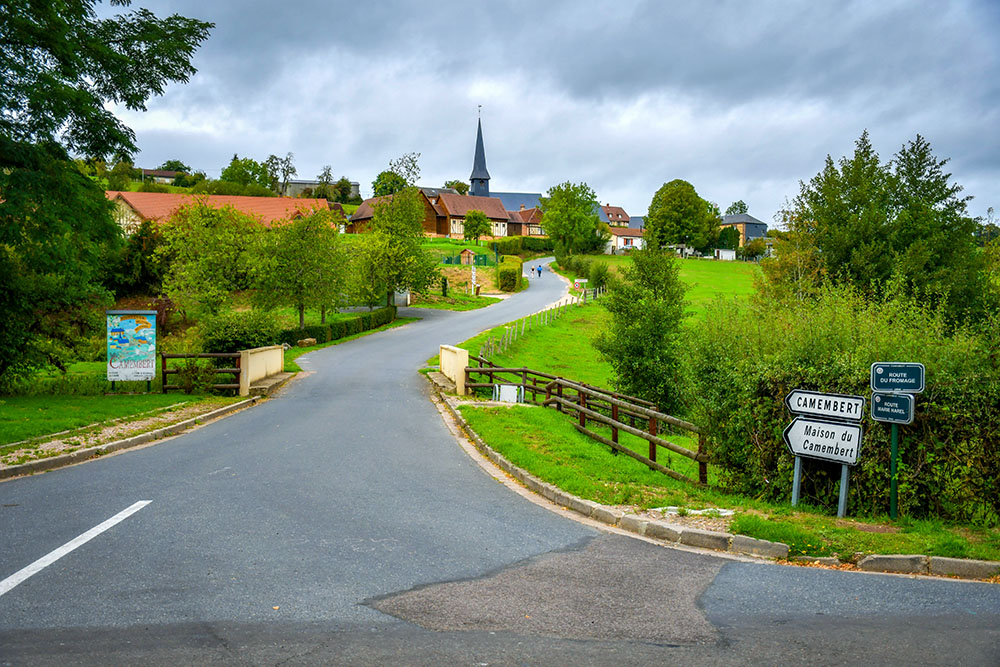
The road leading to the village of Camembert © French Moments
The cider farms around Cambremer, the dairy country around Livarot and Camembert, the villages hidden in the valleys, and the more open landscapes towards the coast all feel different, yet they are linked by the same architectural and agricultural traditions.
I also found that some of the best photographs came from these unplanned moments.
Not from the places marked with a star in a guidebook, but from a bend in the road, a farmhouse caught in the right light or a church tower rising above a line of trees.
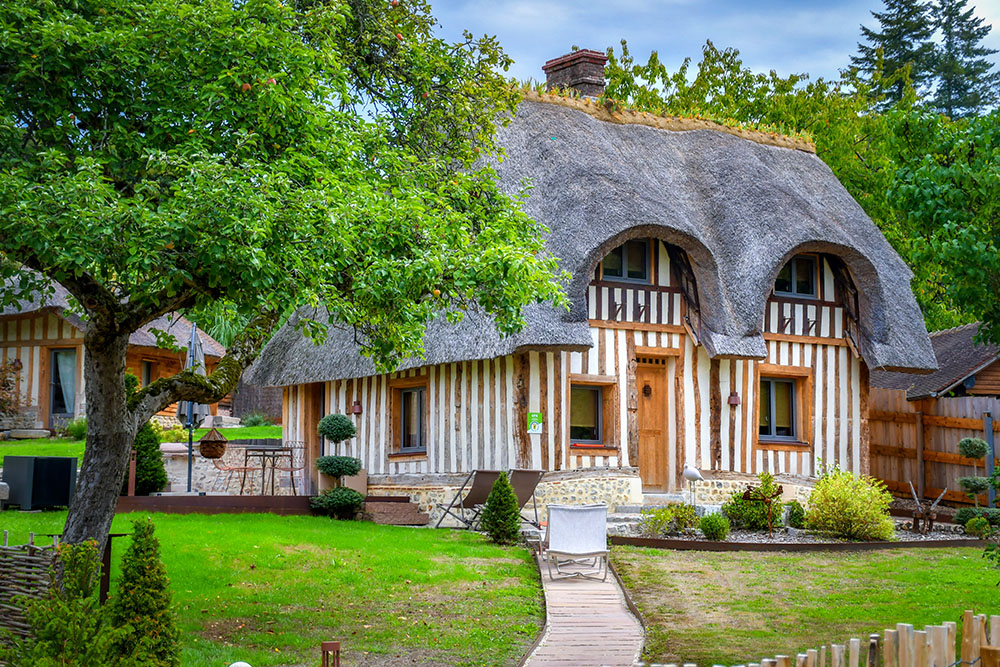
A half-timbered thatched cottage in Hermival-les-Vaux © French Moments
So yes, visit Honfleur, Beuvron-en-Auge, Lisieux and Camembert.
But leave room in your itinerary for the places you do not yet know.
In the Pays d’Auge, some of the most beautiful things you will see may not have been on your list at all.
Other Places to See in the Pays d’Auge
Our 16 days in the Pays d’Auge allowed us to explore a large part of the region, but this is by no means an exhaustive list.
There were several well-known places that we deliberately left for another time.
The most obvious omissions are along the Côte Fleurie. We did not visit Deauville, Trouville-sur-Mer, Villers-sur-Mer, Houlgate, Dives-sur-Mer or Cabourg during this particular trip.
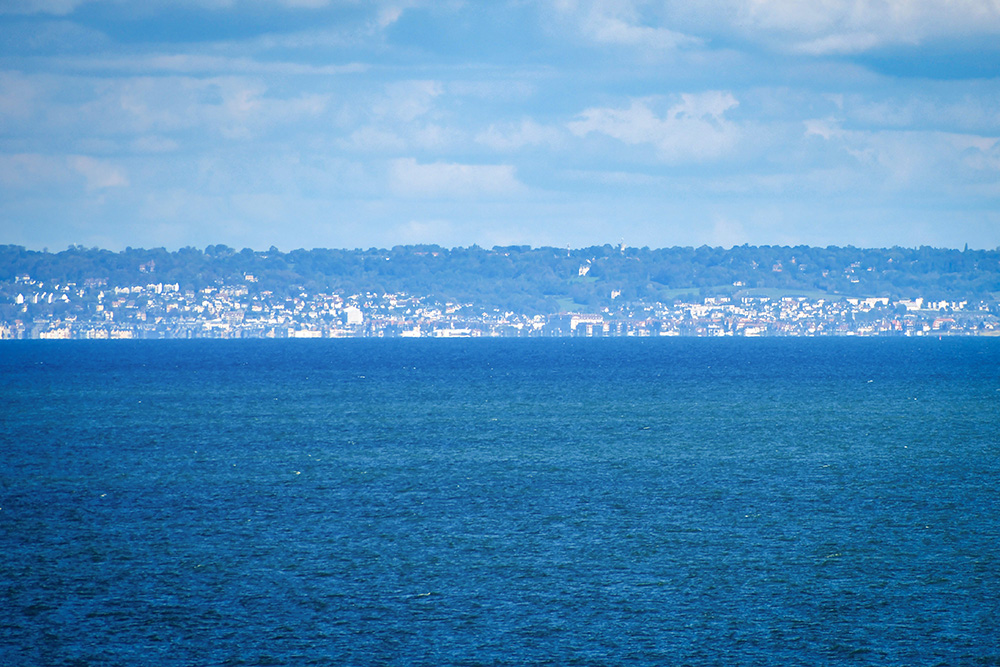
Côte Fleurie and Deauville-Trouville seen from the sea © French Moments
That means you will not find them among my 15 recommendations above — not because I think they are uninteresting, but simply because I wanted this guide to be based primarily on places we actually experienced during these 16 days.
The Côte Fleurie certainly deserves further exploration. Deauville and Trouville are among Normandy’s most famous seaside resorts, while Villers-sur-Mer, Houlgate and Cabourg are particularly known for their seaside architecture and Belle Époque heritage.
On our way back from Honfleur, we crossed Touques but did not stop, despite its interesting history. In the Middle Ages, it was an important port and one of the principal centres of the Pays d’Auge, long before neighbouring Deauville developed into a fashionable resort.
There are several attractions inland that remain on my list too, including the Manoir des Évêques de Lisieux at Canapville, the Cerza Safari Park, and the Prieuré Saint-Michel at Crouttes.
And I am sure there are many more.
That is perhaps one of the lessons I took from spending more than two weeks here: the Pays d’Auge is difficult to “finish”.
Even after driving around 1,000 kilometres, there were still roads we had not taken, villages we had not explored and places we had marked on the map for another visit.
So consider the 15 experiences in this guide as a starting point rather than a definitive checklist.
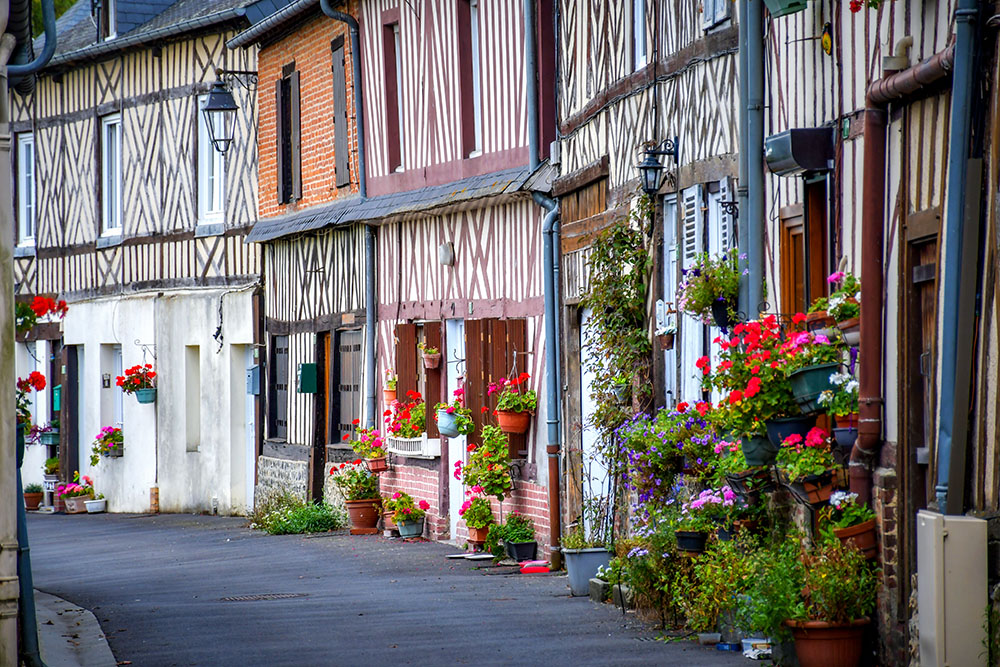
Half-timbered houses in Moyaux © French Moments
How Many Days Do You Need in the Pays d’Auge?
You can get a taste of the Pays d’Auge in two or three days, but I would recommend staying longer if you really want to explore the region beyond its best-known sights.
We spent 16 days here, which is obviously much more than most visitors will have available. But even after driving around 1,000 kilometres, there were still villages, roads and attractions we had not explored.
That gives you some idea of how much there is to discover.
One day in the Pays d’Auge
If you only have one day, concentrate on one part of the region rather than trying to cover too much ground.
You could, for example, combine Honfleur with the countryside around Pont-l’Évêque, or explore Beuvron-en-Auge, Cambremer and part of the Route du Cidre.
Another possibility would be to focus on Livarot and Camembert if food and cheese are your main interests.
One day will give you an introduction, but little opportunity for spontaneous detours.
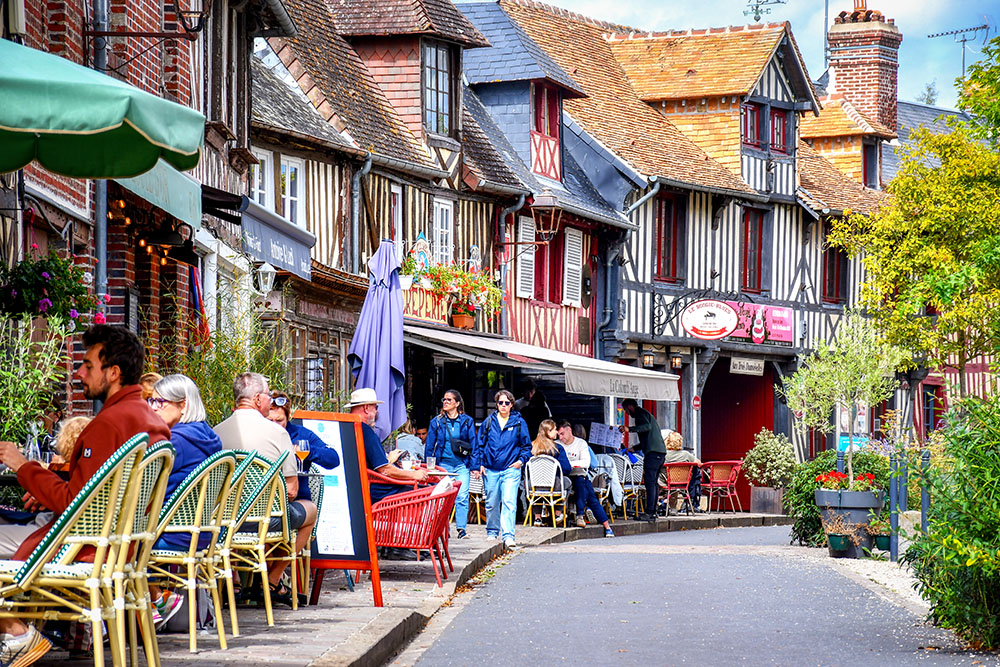
Beuvron-en-Auge, one of France's most beautiful villages © French Moments
Two or three days
A long weekend is enough to experience several different sides of the Pays d’Auge.
You could combine the coast, one or two historic towns, the Route du Cidre, a château and some of the famous cheese-producing areas.
Three days also gives you a little more time to leave the main roads and discover some smaller villages.
For a first visit, I think this is the minimum amount of time I would recommend if you want to understand why the region is special rather than simply ticking off one or two famous places.
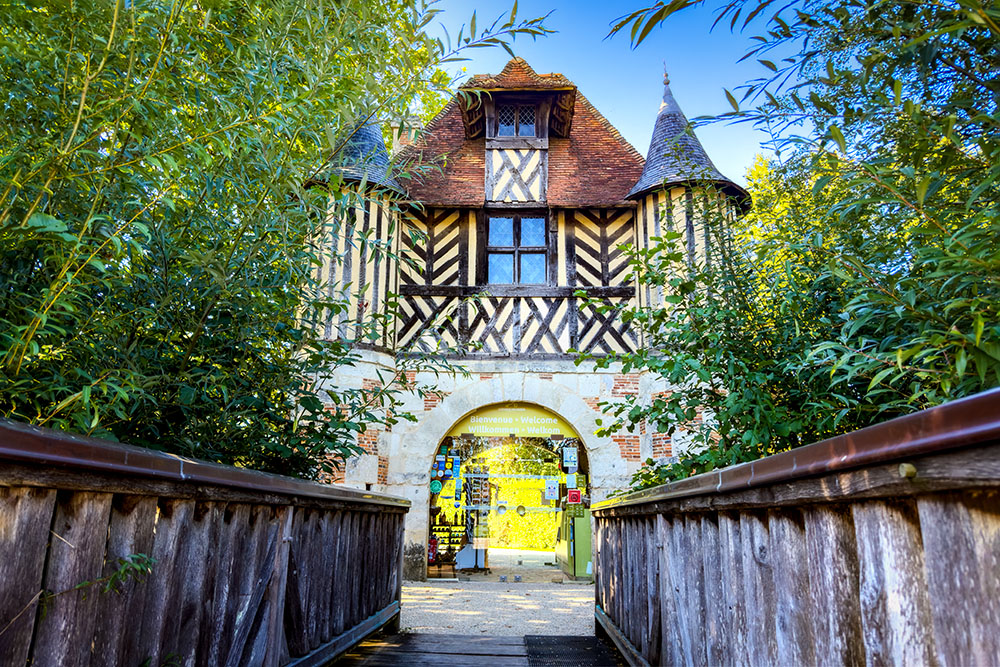
The beautiful gateway of the Crèvecœur Castle © French Moments
Four or five days
With four or five days, the pace becomes much more enjoyable.
You can spend time around Honfleur and the Côte Fleurie, explore Lisieux and the countryside around Cambremer, head south towards Livarot and Camembert, and still have room for châteaux, gardens, producers and unexpected stops along the way.
This is probably the amount of time I would suggest to most people planning a dedicated Pays d’Auge road trip.
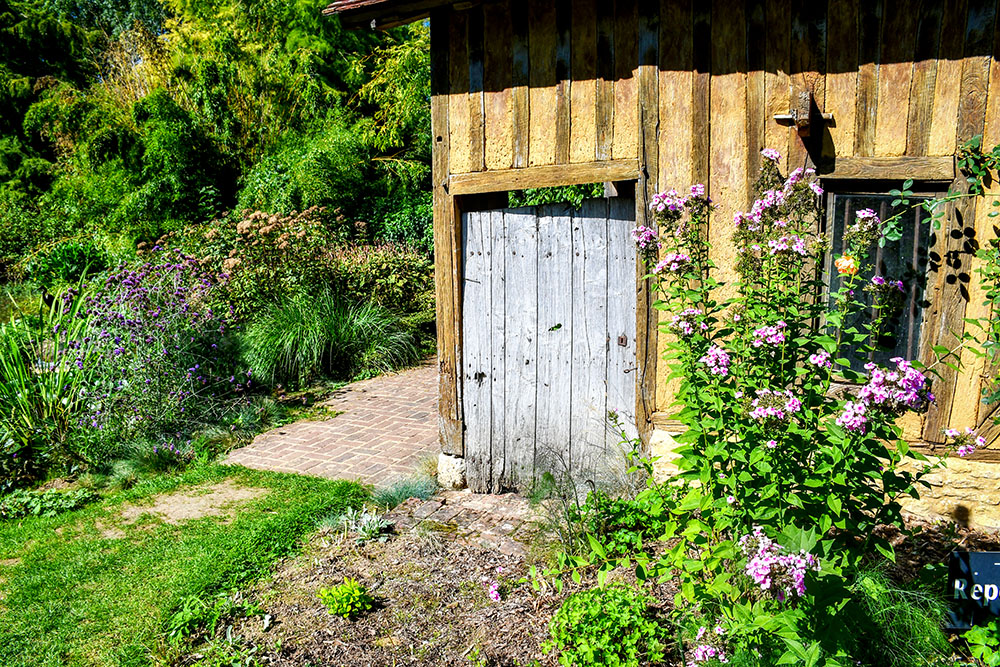
Jardins du Pays d'Auge near Cambremer © French Moments
A week or more
If you enjoy slow travel, photography, historic villages and rural landscapes, you could easily spend a week here.
You can take smaller roads without worrying about the clock, visit markets and producers on the appropriate days, and explore places such as Orbec, Cormeilles or Blangy-le-Château that often disappear from shorter itineraries.
Our own 16-day stay allowed us to explore the region at exactly this kind of pace.
And that was when the Pays d’Auge became most interesting to me.
The longer we stayed, the less the trip became about individual attractions and the more it became about the landscape connecting them.
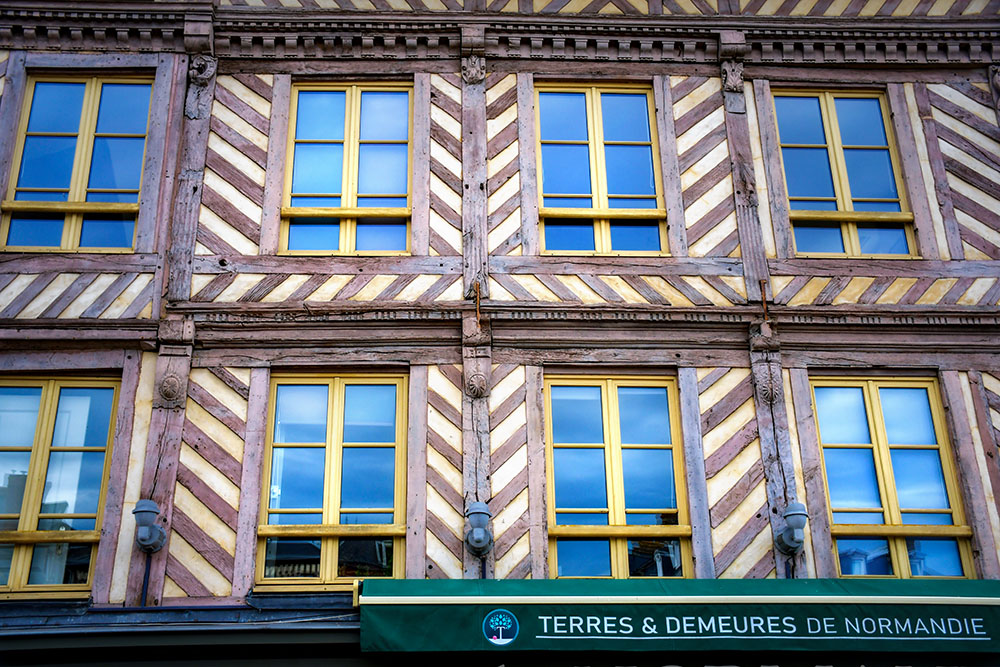
Fine half-timbered house in Cormeilles © French Moments
Do You Need a Car to Explore the Pays d’Auge?
If you really want to explore the rural Pays d’Auge, I strongly recommend having a car.
Some towns can be reached by train or bus, but many of the places that make this region special are scattered across the countryside: small villages, cider farms, cheese producers, manor houses, gardens and tiny churches.
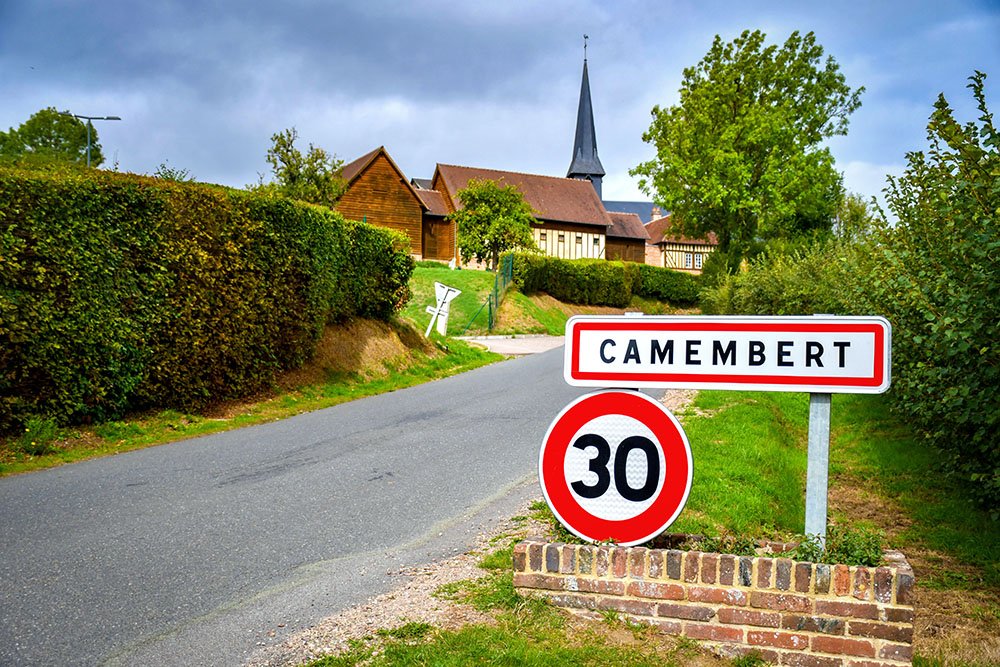
Arriving in the village of Camembert by car © French Moments
A car gives you the freedom to connect them without building your day around limited public transport.
It also changes the way you experience the region.
During our 16-day stay, we drove around 1,000 kilometres, often using narrow country roads rather than the fastest route from one attraction to another. That is where we found some of our favourite views and unexpected stops.
Without a car, you can certainly visit places such as Lisieux or parts of the Côte Fleurie. But once you want to reach villages like Vieux-Pont-en-Auge, producers around Cambremer, farms near Orbec or the countryside around Livarot and Camembert, things become much less straightforward.
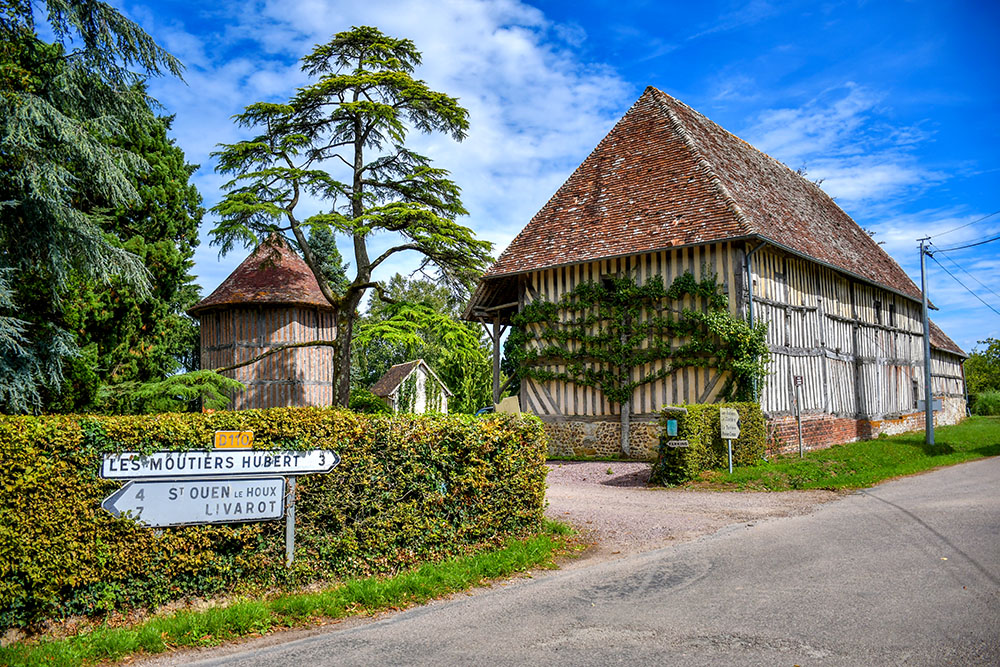
Pays d'Auge, Normandy © French Moments
Driving also makes it easier to travel at the right pace.
You can stop when a view catches your eye, change plans if the weather shifts, or spend longer somewhere you enjoy without worrying about the next connection.
One thing to bear in mind is that some rural roads are very narrow, especially around farms and small villages. They are perfectly manageable, but you may need to slow down and be prepared to pull over when another vehicle approaches.
For me, that is part of the experience rather than a drawback.
The Pays d’Auge rewards travellers who are willing to take the slower road.
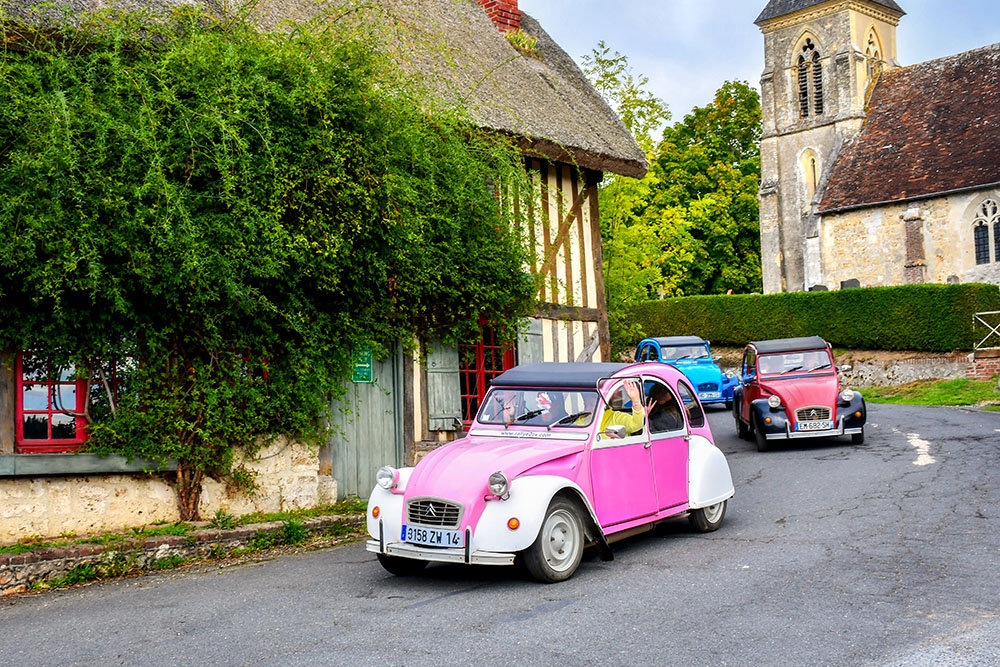
A rally of Citroen 2CV in the Pays d'Auge © French Moments
Where to Stay in the Pays d’Auge
Choosing where to stay in the Pays d’Auge depends largely on what you want to see.
The region is spread out, and there is no single base that is perfect for everything. Staying near the coast will suit a very different trip from spending a week deep in the countryside around Livarot.
For our 16-day stay, we chose a rural base in the Livarot area.
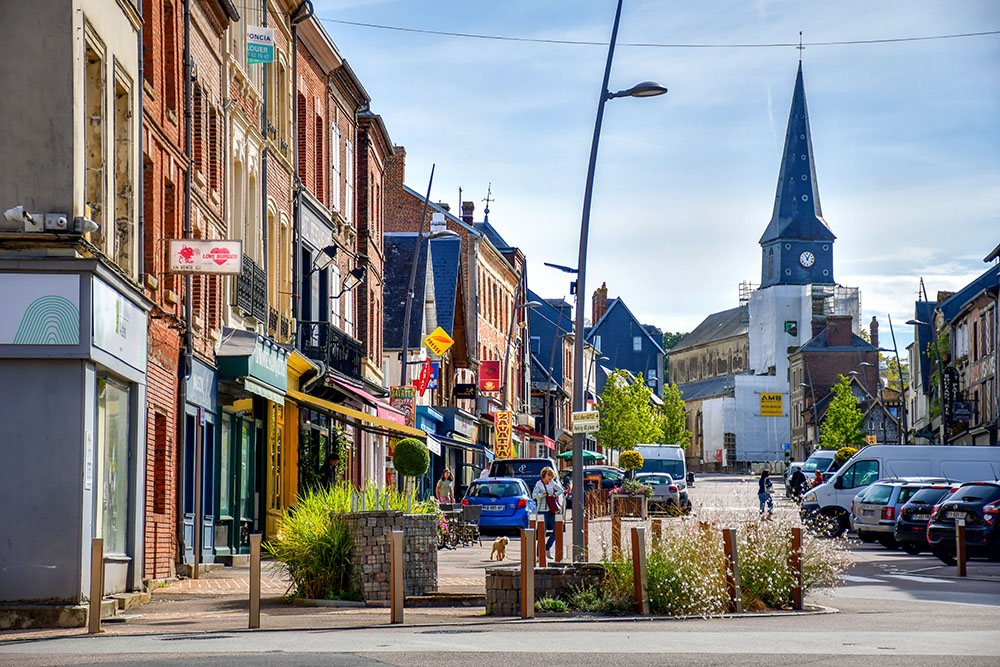
The village centre of Livarot, our base for our 16-day trip © French Moments
That worked particularly well for us because we wanted to explore the interior of the Pays d’Auge rather than concentrate on the coast. From there, we could easily head towards Camembert and Vimoutiers, explore the countryside around Saint-Pierre-sur-Dives and Orbec, or travel north towards Lisieux, Cambremer and Pont-l’Évêque.
It also meant returning each evening to the kind of peaceful rural landscape we had come to the Pays d’Auge to experience.
But other bases may suit you better.
Honfleur and the Côte Fleurie
Stay near Honfleur or the Côte Fleurie if the coast is a major part of your trip.
This makes sense if you want to combine the Pays d’Auge countryside with seaside towns such as Honfleur, Trouville-sur-Mer, Deauville or Villerville.
The trade-off is that you will be further from the southern Pays d’Auge around Livarot, Vimoutiers and Camembert.
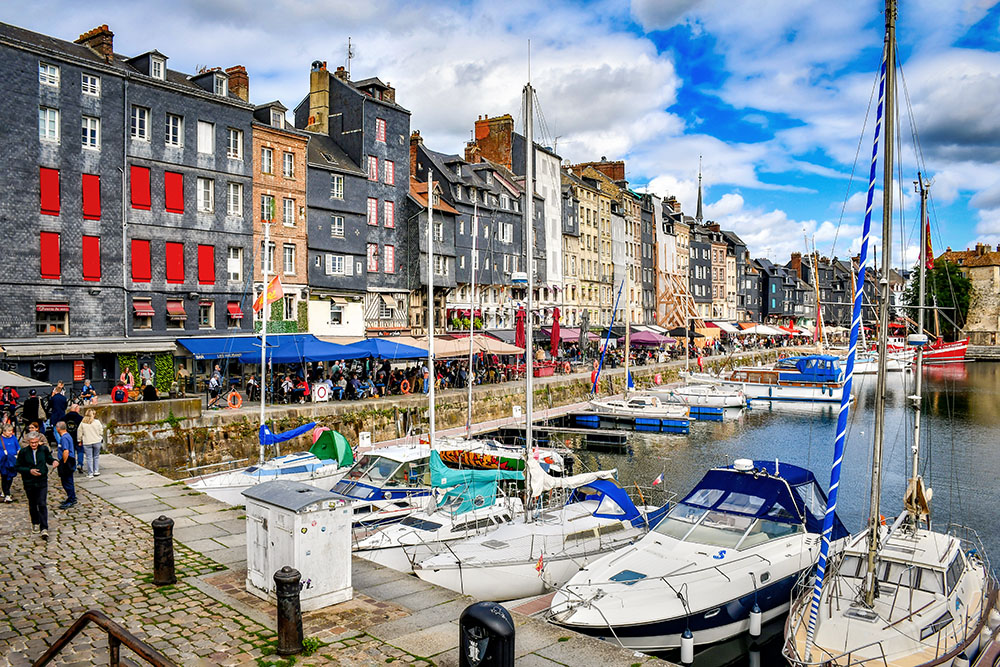
Honfleur © French Moments
Pont-l’Évêque or Cambremer
For a good balance between coast and countryside, I would consider Pont-l’Évêque or Cambremer.
Cambremer puts you right in the heart of the Route du Cidre, surrounded by orchards, producers and some of the classic landscapes of the Pays d’Auge.
Pont-l’Évêque gives you relatively easy access both to this countryside and to the Côte Fleurie.
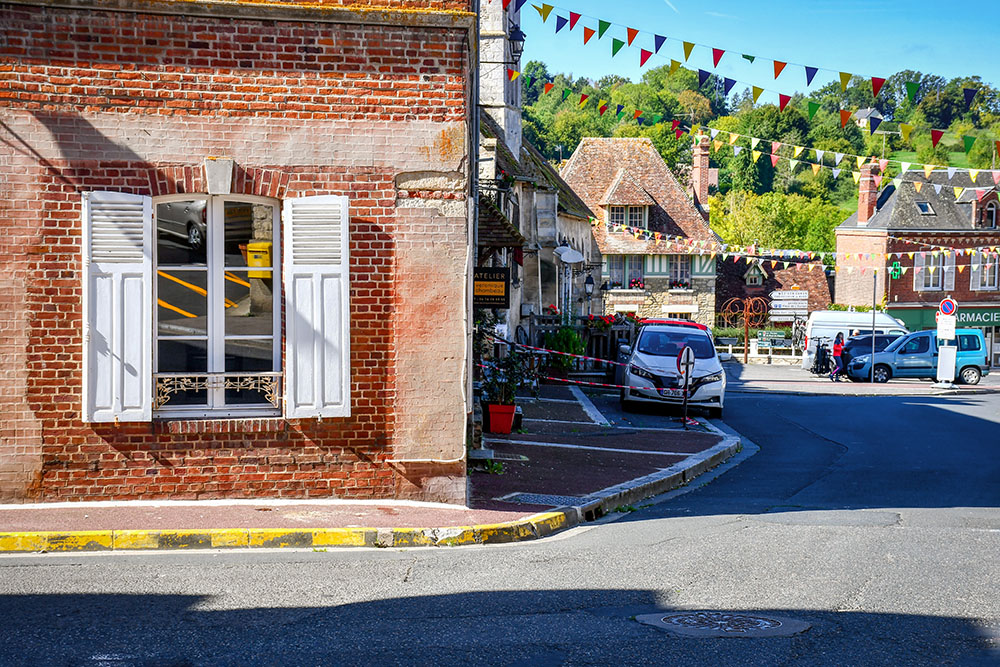
Cambremer © French Moments
Lisieux
Lisieux is perhaps the most practical central base.
It is the main town in the Pays d’Auge and sits between many of the areas covered in this guide. The local tourist office describes Lisieux Normandie as being around 30 minutes from the coast, including Honfleur, Deauville, Trouville and Cabourg.
Staying here also gives you more choice of shops, restaurants and services than you will find in a small rural village.
The compromise is atmosphere: if your idea of a Normandy holiday involves waking up among orchards and half-timbered farms, I would personally look outside the town itself.
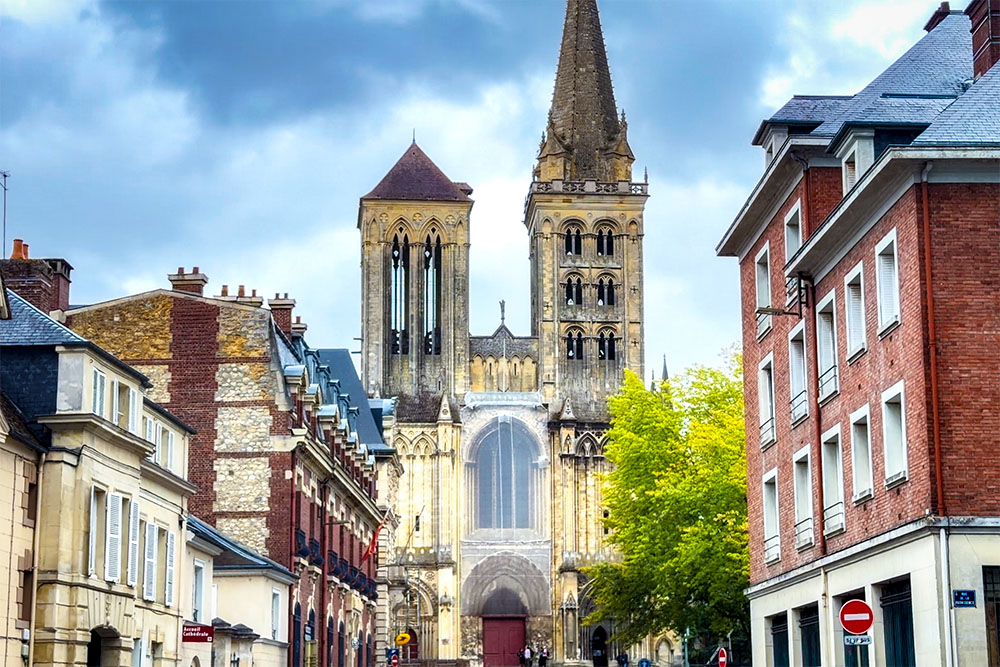
Lisieux Cathedral © French Moments
Livarot and the southern Pays d’Auge
Choose Livarot and its surrounding countryside if rural Normandy is your priority.
This area works particularly well for Camembert, Vimoutiers, Saint-Pierre-sur-Dives and the cheese-producing heart of the Pays d’Auge. The countryside around Livarot is characterised by green bocage, manor houses, traditional churches and local producers.
It is the option I would favour for a slower stay of several days — especially if you have a car and are happy to drive further when you want to reach the coast.
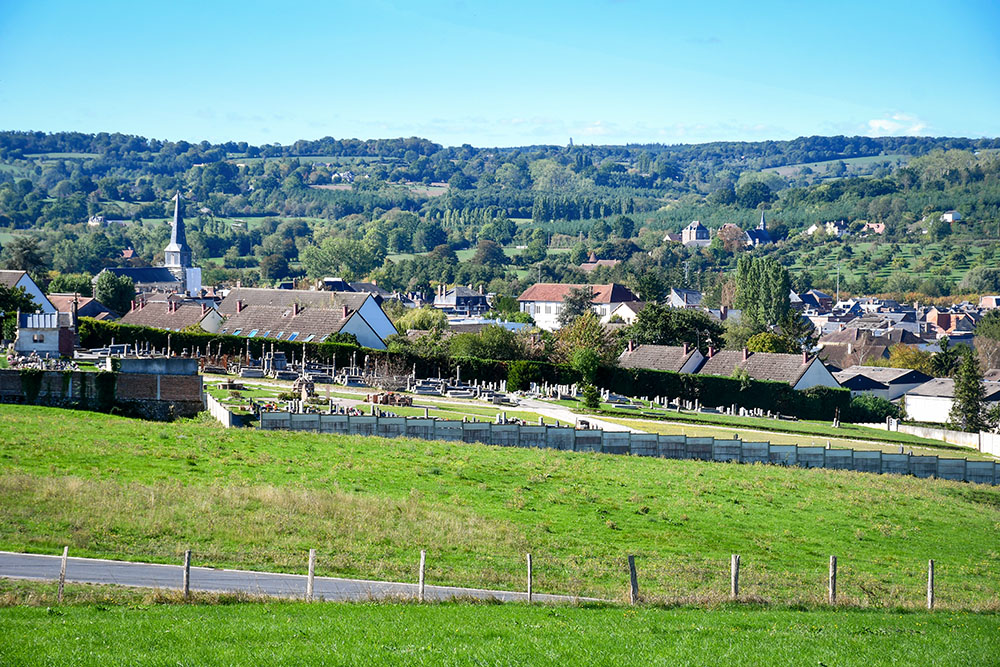
A general view of Livarot © French Moments
Vimoutiers and Camembert
Staying around Vimoutiers or Camembert takes you even further into the quiet southern Pays d’Auge.
This would suit travellers particularly interested in cheese, countryside and a more secluded rural experience.
It is less convenient if Honfleur and the Côte Fleurie are high on your list, but that may not matter if your aim is to slow down and explore the back roads.
So, where would I choose?
For a first visit of three or four days, I would probably look around Lisieux, Pont-l’Évêque or Cambremer, depending on whether you favour convenience, the coast or the Route du Cidre.
For a longer stay focused on the countryside, I would happily choose the Livarot area again.
Our location encouraged us to explore places we might otherwise have overlooked — and after 16 days there, it felt much more like living in the Pays d’Auge than simply passing through it.
When is the Best Time to Visit the Pays d’Auge?
The Pays d’Auge can be visited throughout much of the year, but spring and early autumn are particularly attractive if you want to experience its countryside at its best.
We visited at the end of August and beginning of September, and I thought it was an excellent time to be there.
The landscape was still wonderfully green, gardens were full of colour, villages were lively without feeling overwhelmingly busy, and the first hints of the approaching apple harvest were beginning to appear.
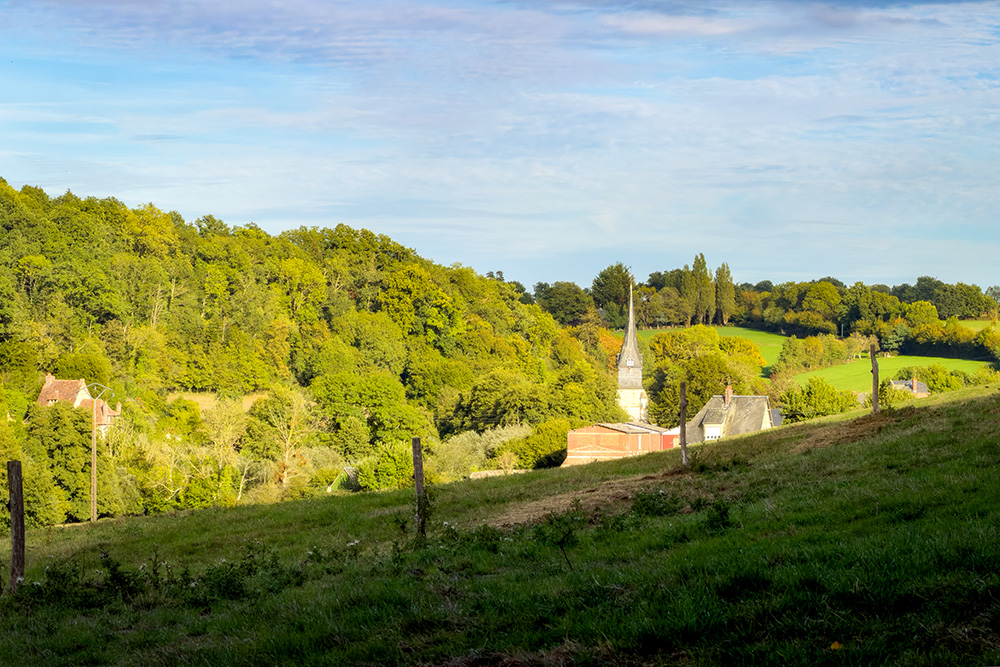
September in the countryside of the Pays d'Auge near Livarot © French Moments
Spring: for blossom and fresh green landscapes
Spring is one of the most beautiful times to explore the Pays d’Auge.
Apple trees come into blossom, the countryside turns intensely green and gardens across the region begin to fill with colour. Normandy Tourism particularly recommends spring for seeing orchards in bloom, while the floral season becomes increasingly spectacular through May and June.
This would probably be my choice if photography and landscapes were the main purpose of the trip.
The only drawback is that spring weather in Normandy can, of course, be changeable.
Summer: long days and everything open
Summer gives you long daylight hours and generally the widest choice of places to visit.
Gardens, châteaux and tourist attractions are operating at full pace, and the countryside remains lush. The main disadvantage is that famous places — particularly Honfleur, the Côte Fleurie and villages such as Beuvron-en-Auge — can naturally be busier.
If travelling in July or August, I would make even greater use of the early morning and late afternoon.
Late August and September: a particularly good compromise
This is when we visited, and I would happily choose the same period again.
You still have much of the greenery and colour of summer, but the region is gradually moving towards apple season.
For us, early September also felt well suited to driving, photography and visiting villages without needing to structure every day around peak summer crowds.
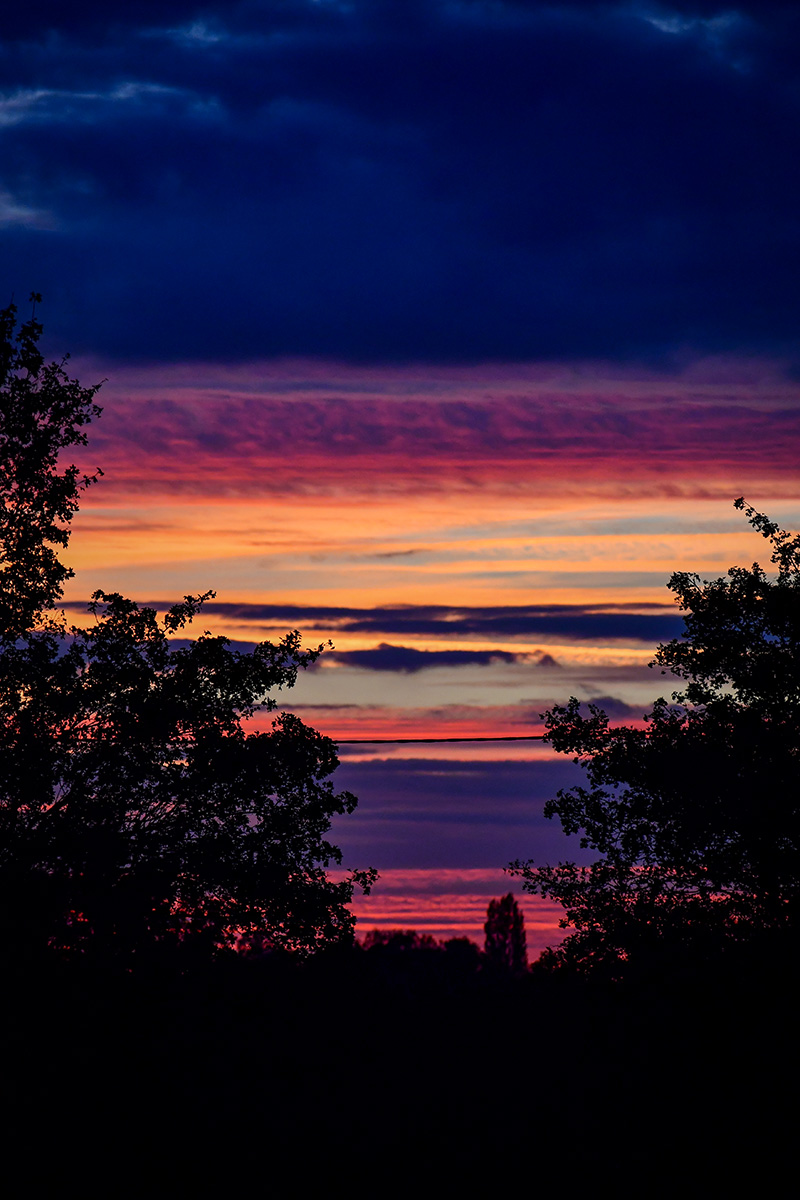
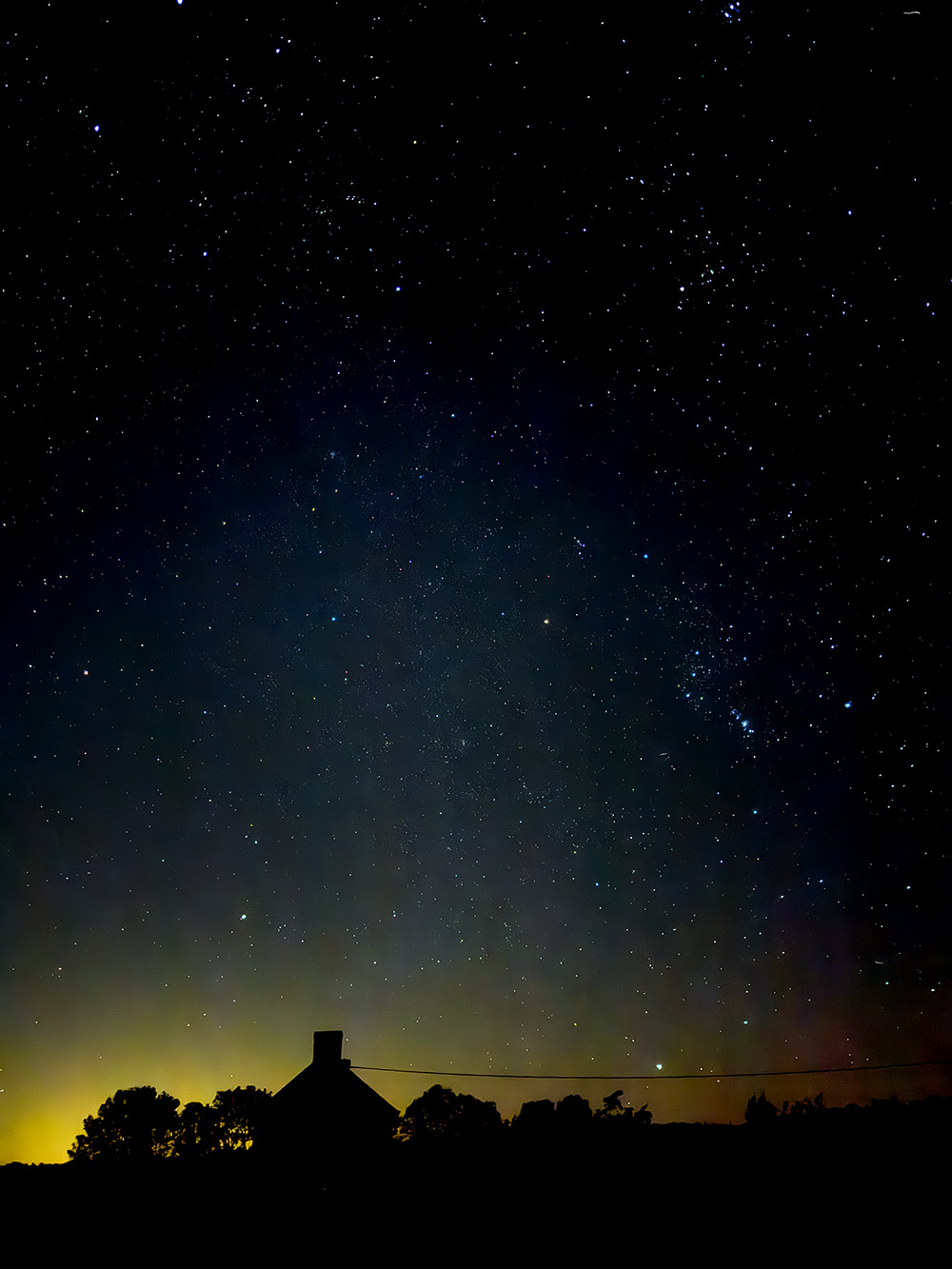
Autumn: for apples, cider and seasonal colour
If the food and cider traditions of the Pays d’Auge particularly interest you, autumn has a strong appeal.
Apples typically reach peak ripeness between September and December, and the Route du Cidre takes on a different character during harvest season. Normandy tourism material specifically highlights both spring blossom and the smell of apples during the autumn harvest.
Autumn also brings warmer colours to the bocage, orchards and wooded valleys.
It may therefore be the most atmospheric time to visit if you want your trip to revolve around apples, cider and Calvados.
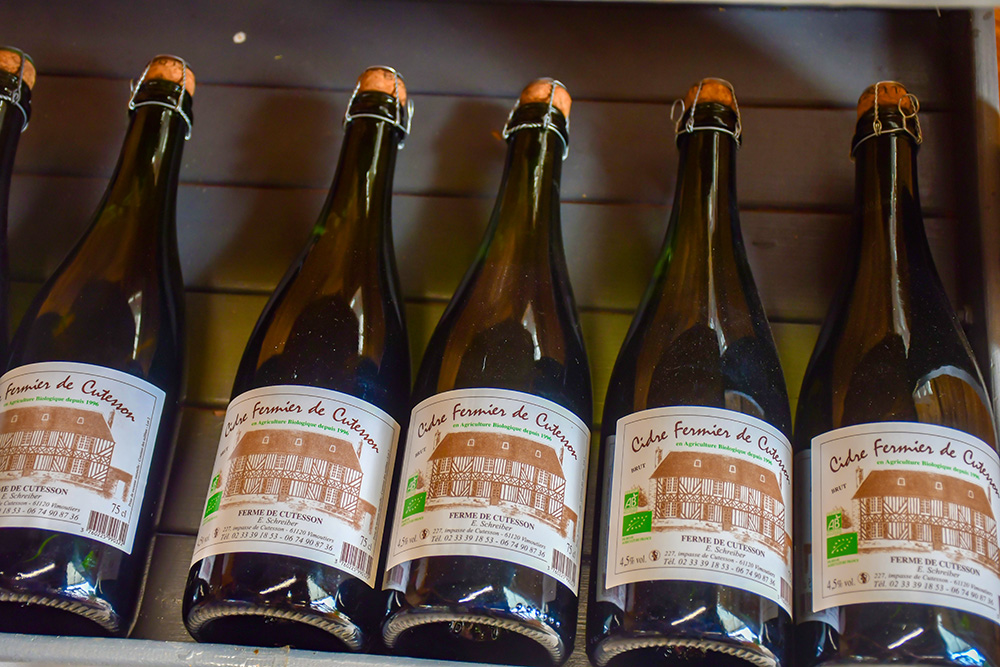
Cidre fermier © French Moments
So, when would I go?
For landscapes and blossom, I would choose May or early June.
For longer days and the greatest choice of attractions, summer works well.
And for a balance of green countryside, fewer peak-season crowds and the beginning of apple season, I found late August and September particularly rewarding.
Whichever season you choose, I would check opening days before setting out. Smaller gardens, producers and heritage sites in rural Normandy do not necessarily operate every day throughout the year.
Is the Pays d’Auge Worth Visiting?
Yes — especially if you enjoy historic villages, rural landscapes, traditional food and places that reward slow travel.
After 16 days and around 1,000 kilometres on the roads of the Pays d’Auge, I came away with the feeling that this is a region best discovered gradually.
Of course, there are famous places you can visit in a day or two: Honfleur, Beuvron-en-Auge, Lisieux, Camembert.
But the real character of the Pays d’Auge lies in the way everything fits together.
The half-timbered farms, apple orchards, dairy pastures, cider producers, manor houses, churches and small villages all belong to the same landscape. The more time you spend here, the more those connections become obvious.
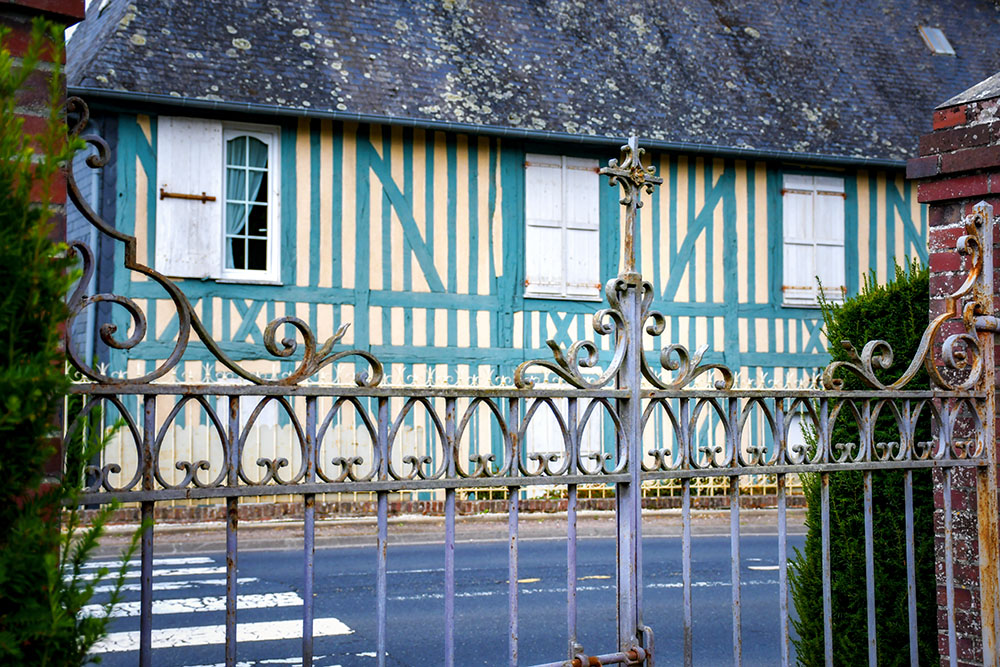
Half-timbered house in Hermival-les-Vaux © French Moments
That is what I enjoyed most about our stay.
We visited beautiful places, but some of my strongest memories came from the moments in between: a quiet road through the bocage, an old farmhouse behind a hedge, a church we had not planned to visit, or a village where we stopped simply because it looked interesting.
If you come only for the famous sights, you will still see some wonderful places.
But if you give the Pays d’Auge several days, hire a car and allow yourself to wander, you begin to understand why this corner of Normandy has such a distinctive identity.
And even after 16 days, I still felt there was more to discover.