During our 16-day stay in the Pays d’Auge, our hosts recommended a rather unusual place to us: the Orbec Mushroom Farm.
A mushroom farm.
It was certainly a change from the half-timbered villages, churches, gardens and châteaux we had been exploring across this beautiful part of Normandy.
But why not?
So, one Friday afternoon in September 2026, we headed to the Champignonnière d’Orbec, just outside the little town of Orbec.
We arrived at around 3 pm, during the weekly direct sale. This was where we met Olivier Perrel.
And it didn't take us long to realise that we had found much more than a place to buy mushrooms.
There was an article here.
Actually, there were several stories to tell.
Watch the video of our visit to Orbec Mushroom Farm:
Discovering the Orbec Mushroom Farm
The first unusual thing about the Orbec Mushroom Farm is obvious as soon as you arrive.
The mushrooms grow underground.
Not in a modern agricultural building, but inside an old stone quarry whose galleries disappear into the hillside at La Vespière, only a short distance from the centre of Orbec.
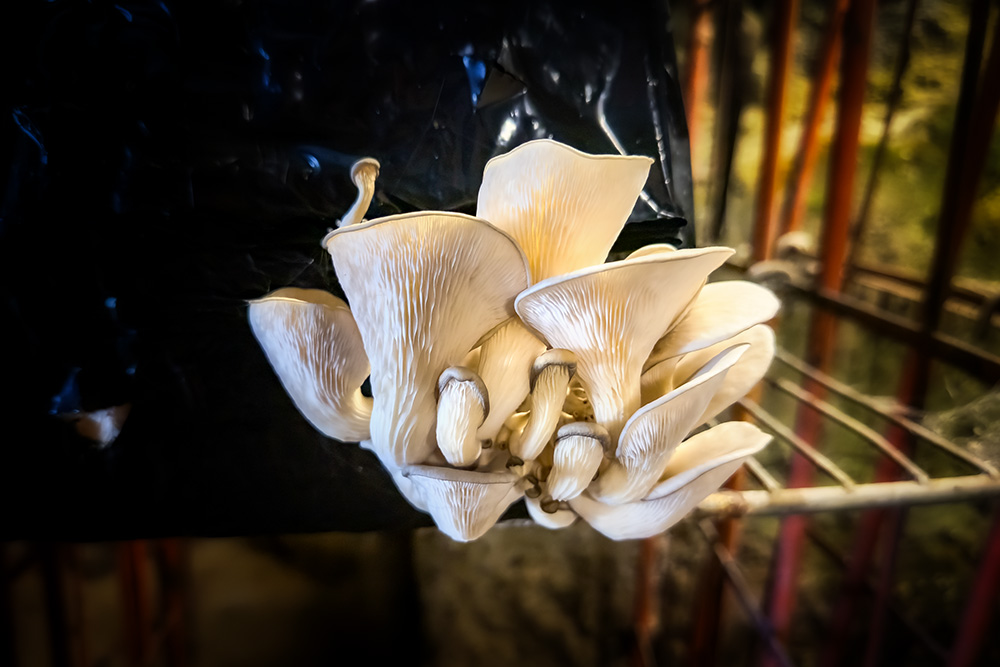
Pleurotes (oyster mushrooms) © French Moments
Stéphanie and Olivier Perrel have been growing mushrooms here for around ten years. Along with their team, they produce three varieties: champignons de Paris — button mushrooms — oyster mushrooms and shiitakes. The familiar button mushroom represents about 90% of their production.
It is also the last mushroom farm operating in an underground quarry in the Calvados département.
But mushrooms are only the latest chapter in the story of this place.
Before they appeared, men came down here for something entirely different.
Stone.
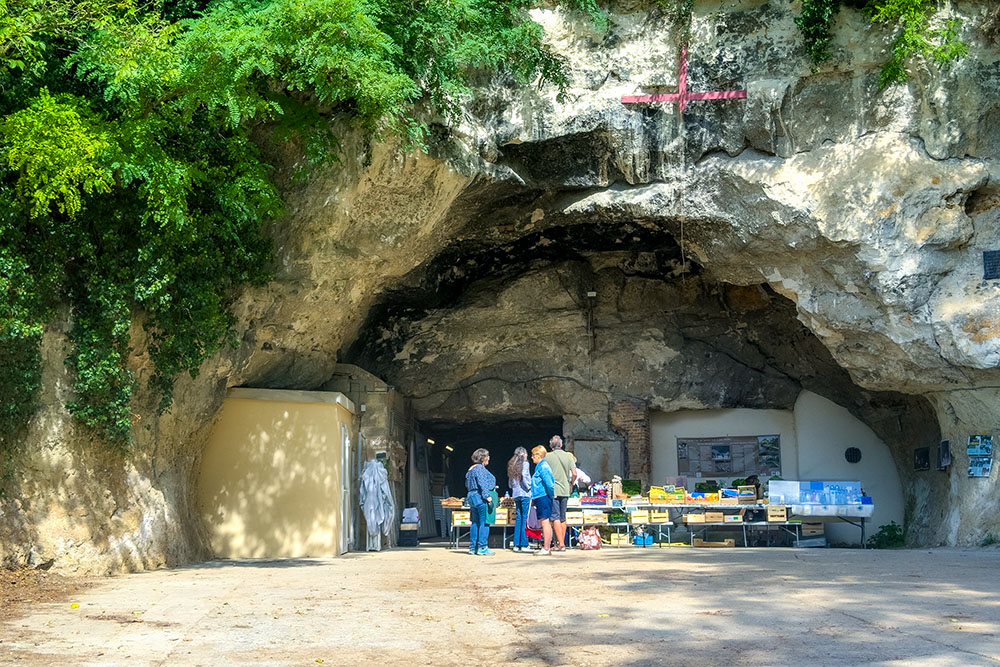
The entrance to the quarry of Orbec © French Moments
Before the Orbec Mushroom Farm: an old stone quarry
There is something quite moving about entering these underground passages.
Look at the walls and ceiling and you can still imagine the work involved in extracting the stone.
The quarry was exploited from the Middle Ages until the 19th century. Stone taken from here was used for buildings in Orbec, including old houses in the town centre and parts of the Church of Notre-Dame.
And there is a lovely visual connection between the two places.
From the quarry, you can see the church tower rising above the trees.
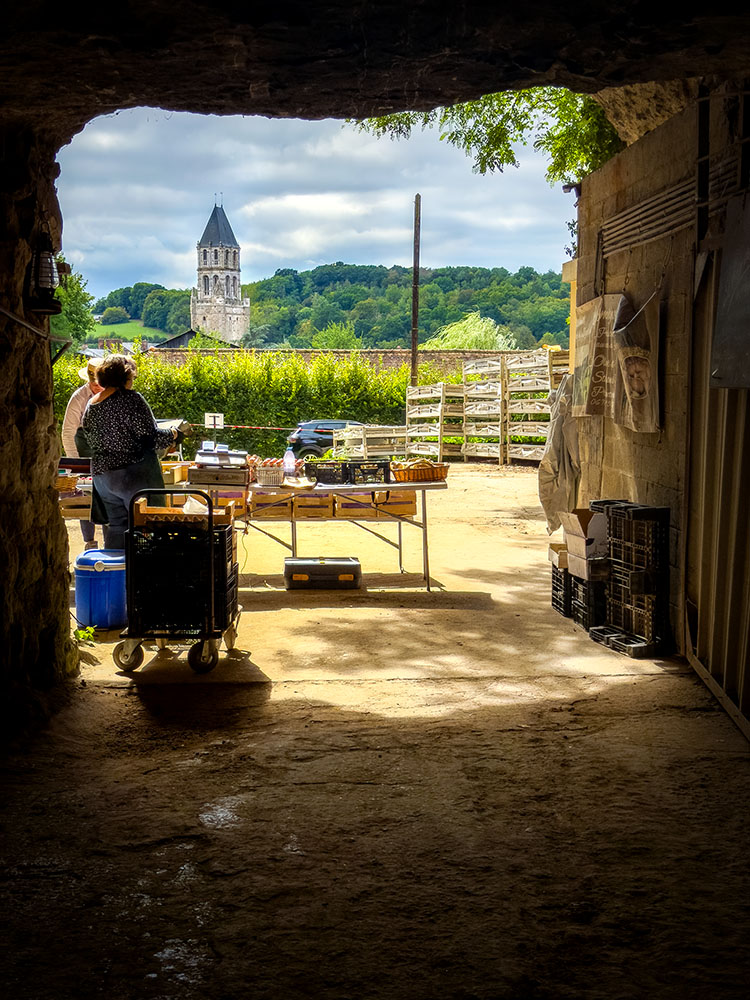
On our way out from the old quarry of Orbec © French Moments
We often admire an old church without thinking much about where all those tonnes of stone came from.
Here, the answer is almost in front of you.
Or rather, underneath you.
It is quite something to think that men once entered these galleries with their tools and cut out the stone that helped shape the town we see today.
From the 20th century onwards, mushroom growing gradually replaced stone extraction.
But between the quarrymen and the mushrooms came another extraordinary chapter.
The Orbec Mushroom Farm during the Second World War
This was the part of the visit that particularly interested us.
Olivier clearly has a passion for the history of the quarry, and as we moved further underground, he told us what had happened here during the summer of 1944.
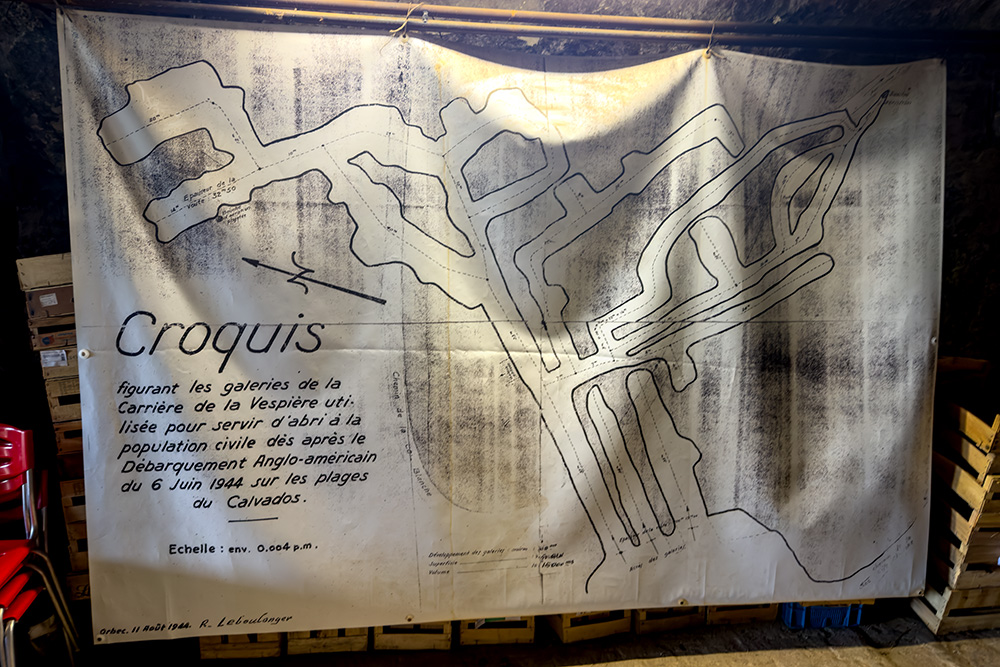
The Map so you won't get lost! © French Moments
The story begins immediately after the D-Day landings of 6 June.
Normandy had become a battlefield and Orbec was exposed to bombing.
The old quarry had already been identified before the war as a possible air-raid shelter.
Then the bombs came.
Thousands of local people began moving underground with mattresses, belongings and even their toilet buckets.
Eventually, more than 2,000 people were sheltering inside the quarry. One contemporary account gives a figure of around 2,200 refugees.
Try to imagine it.
Today, you walk through the galleries looking at mushrooms.
In 1944, entire families were living here.
A kind of underground village developed.
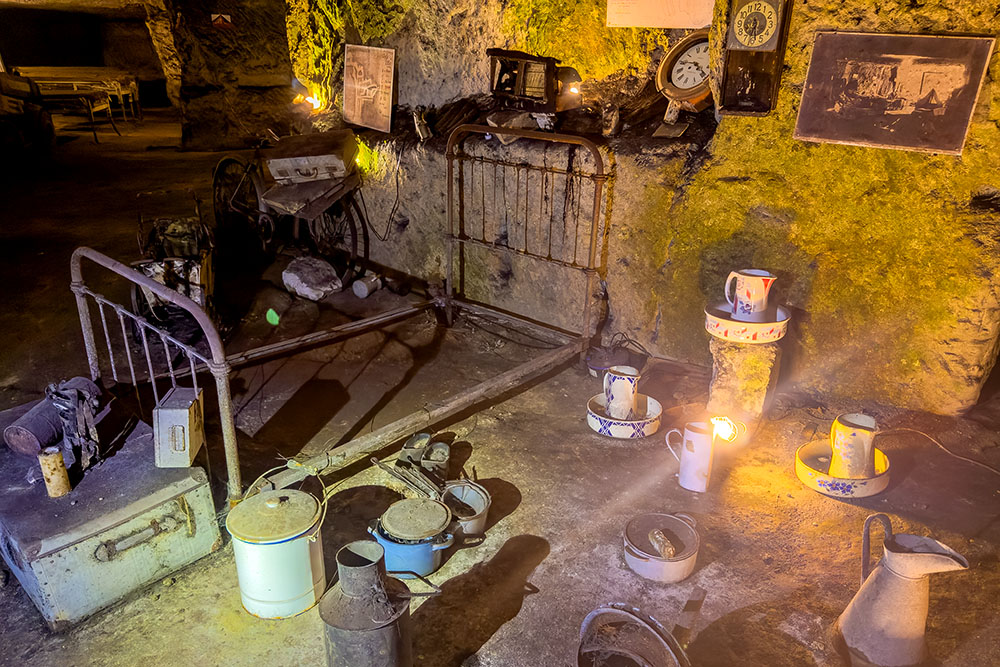
Remains from 1944 - where people of Orbec used to take shelter © French Moments
There were sleeping areas. Responsibilities were allocated. People went outside during the day when possible to milk cows or wash in the River Orbiquet.
Food had to be prepared on an extraordinary scale.
On some days, the makeshift kitchens produced as many as 4,000 meals.
And babies were born underground too.
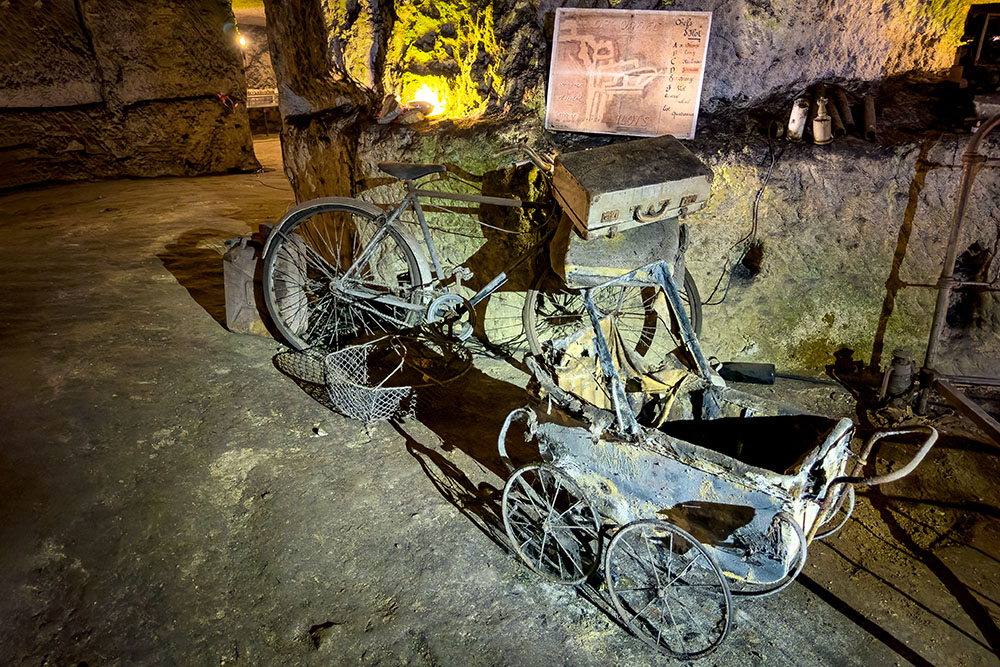
Items used by the people of Orbec who took shelter here in 1944 © French Moments
The episode lasted for weeks, until Canadian soldiers liberated Orbec in August 1944. Patrimoine Normand records 77 days underground before the Canadians came to announce the liberation of the town on 22 August. (Source: Normandy Heritage Magazine)
Walking through the quarry today, it is difficult not to think about all those people.
The mushroom farm has even recreated some of the living spaces to help visitors understand what life underground was like.
Quite a story for a place we had originally come to visit because of mushrooms.
How mushrooms grow at the Orbec Mushroom Farm
Which brings us back to the mushrooms.
Because I realised during our visit that although I eat them regularly, I knew very little about how they actually grow.
The quarry provides naturally favourable conditions.
The temperature and humidity underground remain much more stable than outside, creating a good environment for mushroom cultivation. No phytosanitary products are used in the production, and the mushrooms are harvested entirely by hand.
But not every mushroom grows in quite the same way.
Oyster mushrooms underground
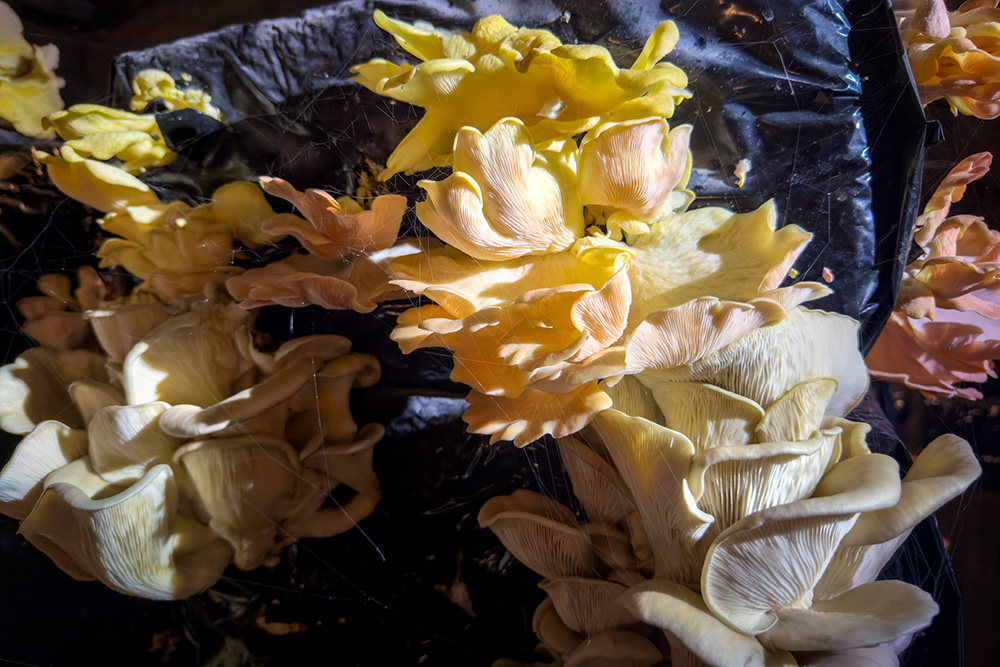
Oyster mushrooms © French Moments
The oyster mushrooms (in French, pleurotes) grow from prepared blocks.
It is quite strange to see them emerging in clusters underground.
If, like me, your normal contact with an oyster mushroom begins with a supermarket shelf, seeing the actual production is much more interesting.
Suddenly, what appears on your plate has a context.
Shiitakes in Normandy
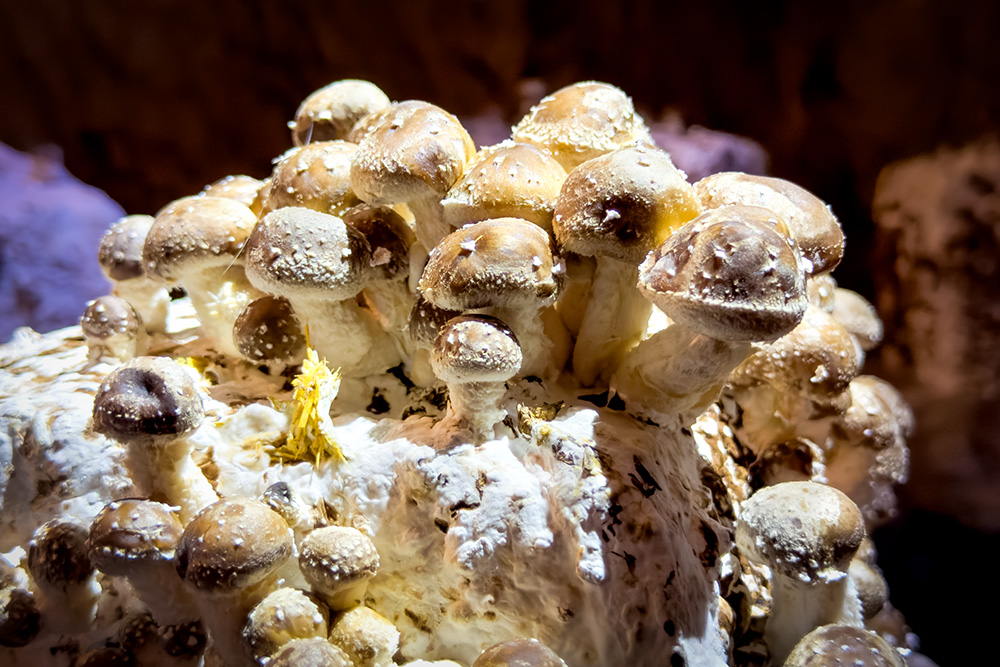
Shiitakes growing in the old quarry of Orbec © French Moments
Then there are the shiitakes (in French, Shiitaké).
Asian mushrooms.
Growing underground.
In Normandy.
Why not?
They are very different in appearance from button mushrooms and have a much stronger flavour.
The farm recommends cooking them and using the cap, while the tougher stalk can be used after being finely ground, for example in soup.
The champignon de Paris at the Orbec Mushroom Farm
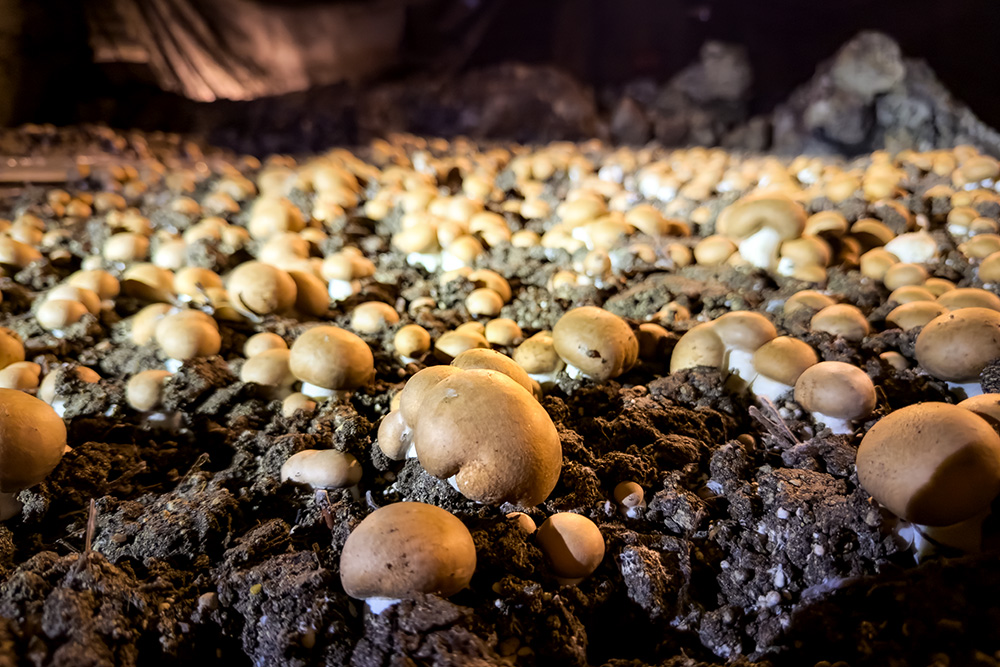
The Champignons de Paris © French Moments
And finally, the star of the show.
The champignon de Paris.
Despite its name, there is nothing particularly Parisian about the ones growing underneath Orbec!
Button mushrooms account for around 90% of the farm's production.
Rows of them grow underground in conditions that seem a world away from the brightly lit vegetable aisle of a supermarket.
And Olivier gave us a useful piece of advice.
Don't peel them.
Brush off any soil, cut away the earthy tip of the stalk and use the rest.
Everything is edible.
We would put that advice into practice later.
A small-scale family business
One of the things I liked about our visit was the scale of the operation.
This isn't an anonymous industrial mushroom factory.
Olivier works in the quarry with Matt, taking care of production, maintaining the growing tables and harvesting the mushrooms. Stéphanie Perrel and Emma then take over much of the selling, both at the farm and on local markets.
There is also an effort to make use of what would otherwise become waste.
Once the mushroom compost is exhausted, it is taken out of the quarry and given a second life. Some is made available for gardens, while the farm also reuses it to grow vegetables that are then sold according to the season.
Short supply chains make particular sense here.
And there is something rather satisfying about buying mushrooms only a few metres from where they have been picked.
Which is exactly what we did.
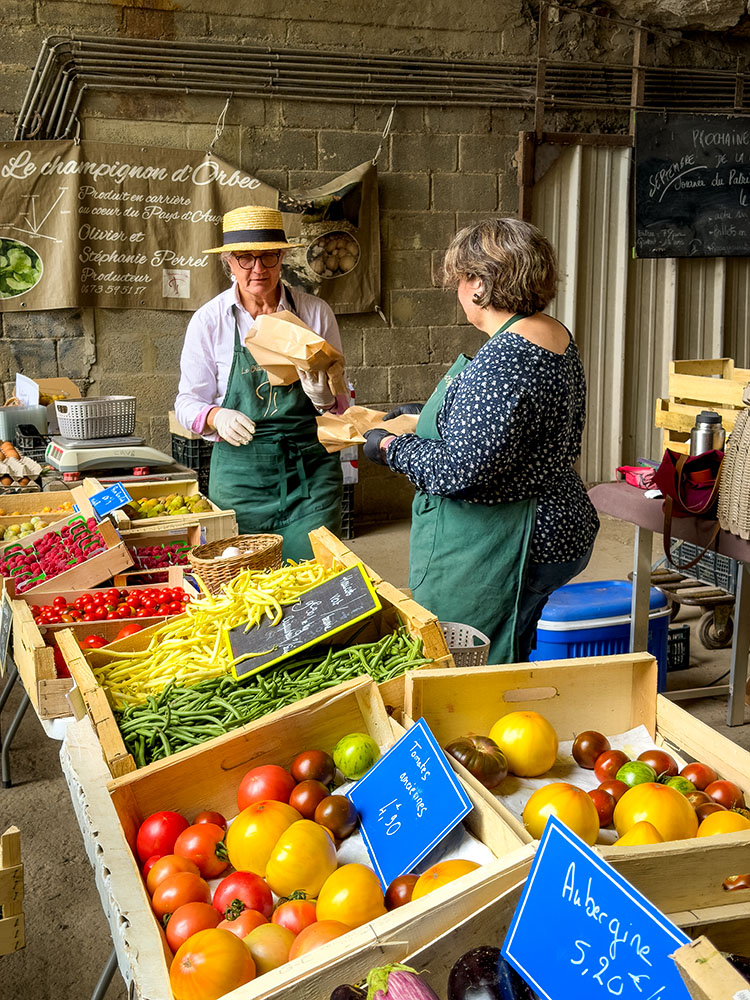
Market stall at the Orbec Mushroom Farm © French Moments
Where to buy produce from the Orbec Mushroom Farm
You don't necessarily have to visit the quarry to taste the mushrooms.
At the time of writing, produce from the Orbec Mushroom Farm can be found at four Norman markets:
- Saint-Pierre-sur-Dives – Monday morning, Place du Marché
- Lisieux – Thursday morning in Hauteville and Saturday morning on Place de la République
- Pont-Audemer – Friday morning, Rue de la République
- Rouen – Sunday morning, Place Saint-Marc
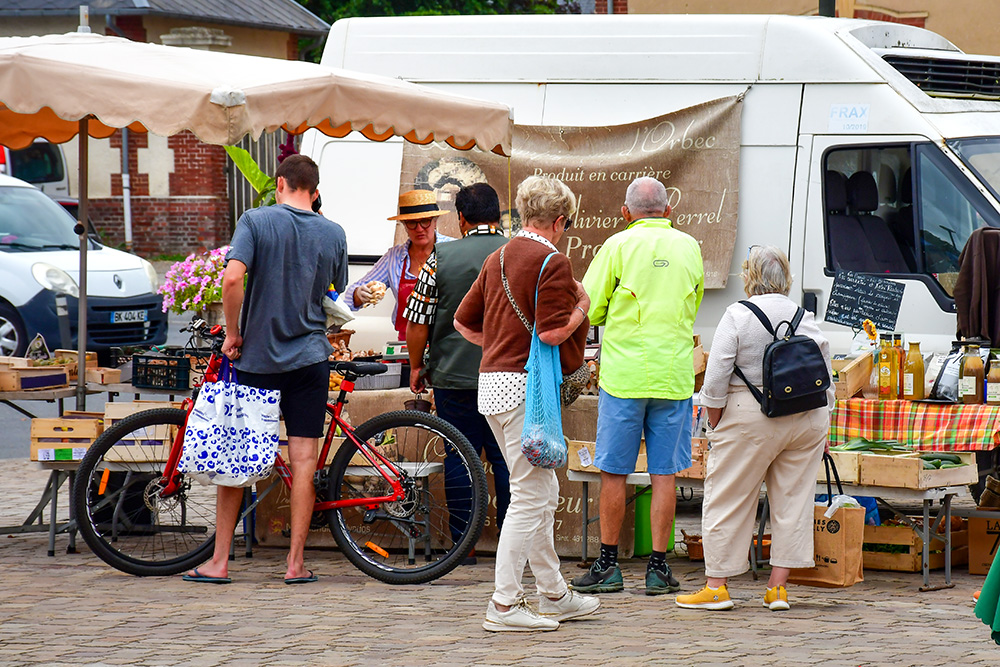
Market stall at the Saint-Pierre-de-Dives market on Monday morning
The farm also sells directly on site on Friday afternoons from 2 pm to 4 pm. The municipality notes that this Friday sale does not operate in July and August, so better check out the dates before your visit!
We happened to arrive during that Friday afternoon slot.
Very convenient.
From the Orbec Mushroom Farm to our kitchen
We certainly didn't leave empty-handed.
Back at our gîte in the Pays d'Auge, we cooked some of the mushrooms we had bought.
Fresh mushrooms.
Very fresh mushrooms.
And they were delicious.
We had brought quite a lot, so we still had plenty left afterwards.
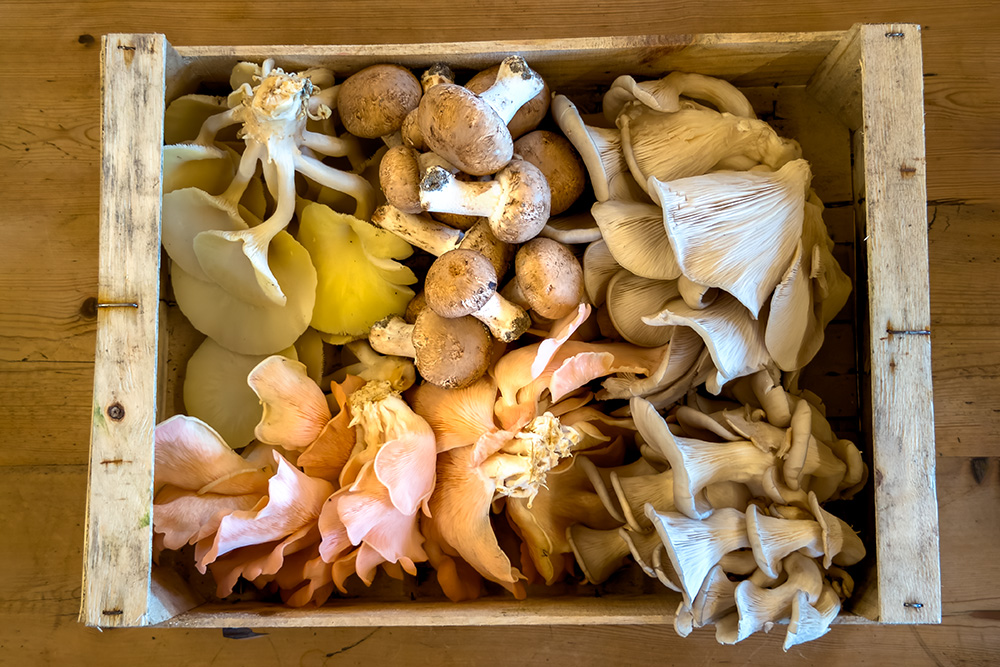
A crate of champignons from the Orbec Mushroom Farm © French Moments
Fortunately, we already had another local ingredient waiting for us.
During our stay in Orbec, we had discovered Les Comptoirs de Pierre, a local family business with an épicerie fine and its own poultry operation. The company raises poultry on its family land and also sells regional products from its shop in Orbec.
We had bought a farm chicken there.
So there we were in our Norman gîte with a local chicken from Orbec and mushrooms grown underground only a short distance away.
There was really only one sensible thing to do.
Cook them together.
Chicken and mushrooms.
Simple.
But very good.
And somehow, knowing where both ingredients had come from made the meal even better.
One of our unexpected discoveries in the Pays d’Auge
Before our hosts mentioned it, the mushroom farm wasn't on our list of places to visit.
I'm glad they did.
We went there because we were curious about the mushrooms.
We left thinking about quarrymen, the church of Orbec, families sheltering underground during the summer of 1944, Olivier's passion for the site...
...and what we were going to cook for dinner.
Quite a lot for one mushroom farm.
But that is precisely what I enjoy about places like this.
You arrive expecting one thing.
Then you discover something else entirely.
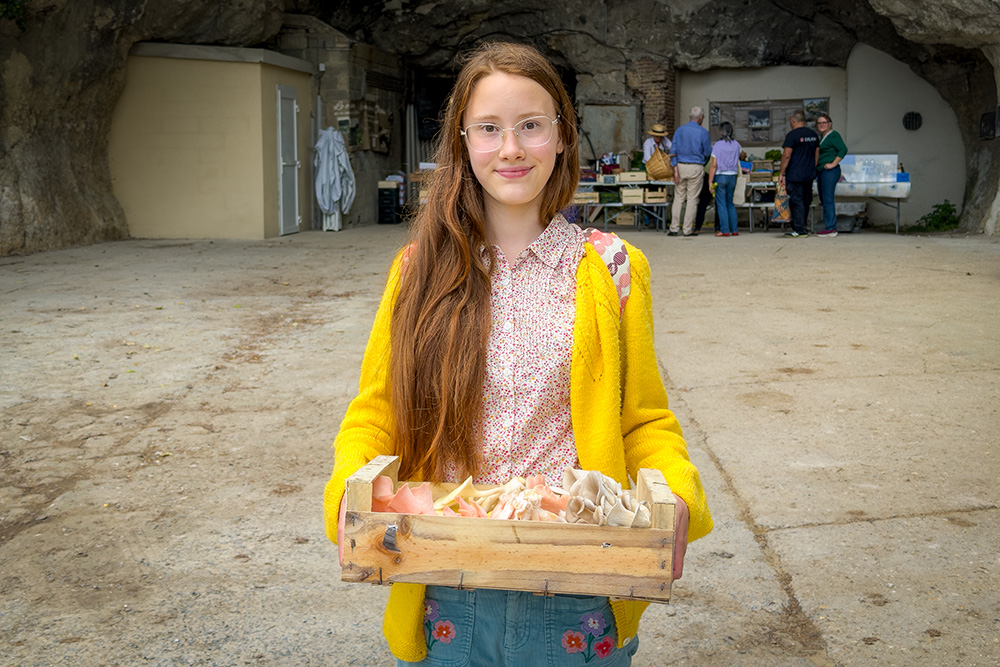
Our daughter Aimée with a crate full of champignons © French Moments
Planning a visit to the Orbec Mushroom Farm
The Orbec Mushroom Farm — Champignonnière d'Orbec in French — is at La Vespière-Friardel, very close to the centre of Orbec.
Guided visits last about 1 hour 15 minutes, and booking is required. The farm recommends comfortable shoes because of the earthen floor and warm clothing for the underground temperature. Find out more on the Official Site of the Mairie d'Orbec.
Visits are organised throughout the year, but dates and times can vary, so I strongly recommend checking the official website before making a special journey. Here's the website of Le Champignon d'Orbec.
And if you happen to be there on a Friday afternoon, you may also be able to go home with some mushrooms.
Just make sure you have an idea for dinner.