
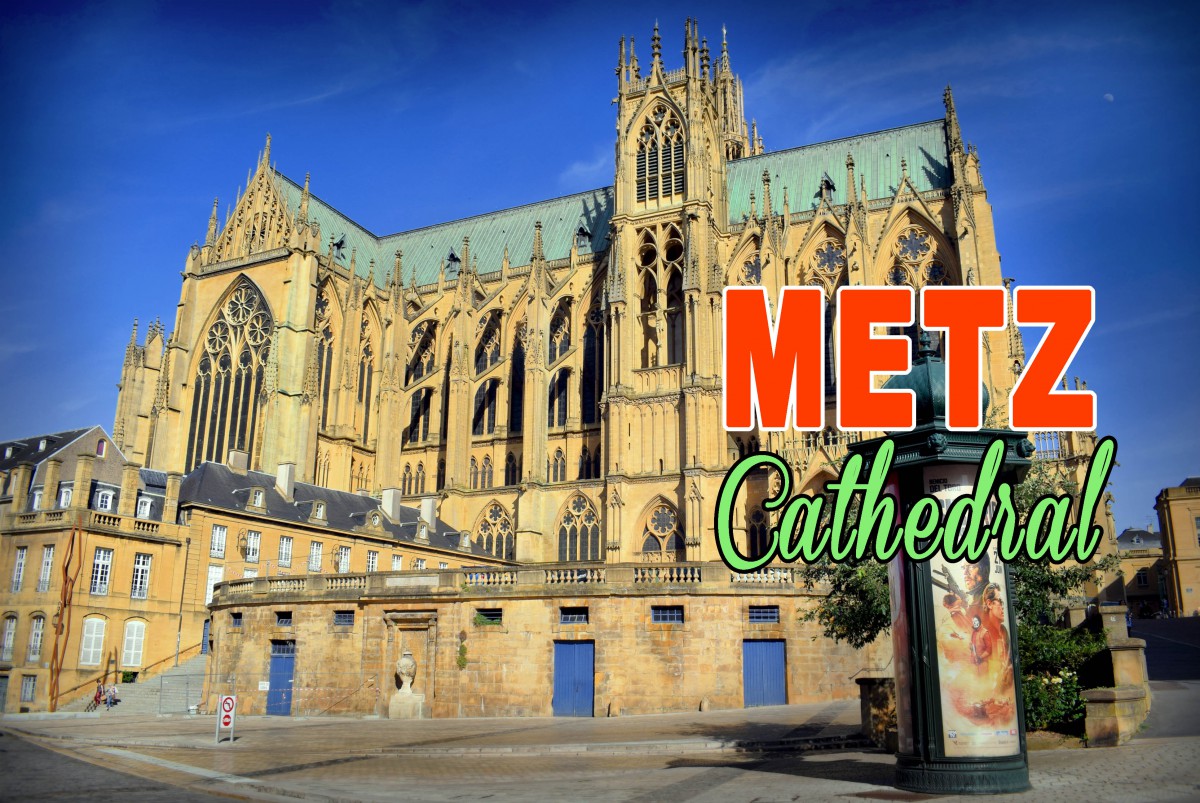


Metz Cathedral is one of those places I never seem to tire of visiting. I have been inside many times over the years, and when I returned at the end of May 2026, the same thing happened again: I walked through the door, looked up, and was reminded just how extraordinarily high and bright this cathedral feels.
Officially known as Saint Stephen's Cathedral (Cathédrale Saint-Étienne de Metz), it rises above the historic centre of Metz in Lorraine, its warm golden stone making it easy to recognise from viewpoints across the city.
But it is inside that Metz Cathedral really comes into its own.
The nave soars to more than 41 metres, while around 6,500 square metres of stained glass flood the building with coloured light. The windows span several centuries and include works by medieval and Renaissance masters as well as modern artists such as Jacques Villon, Roger Bissière and Marc Chagall.
That abundance of glass explains the cathedral's famous nickname: the Lantern of God (La Lanterne du Bon Dieu).
And there is much more to look for once you start paying attention. The cathedral has an unusual architectural history, curious carvings hidden high above your head, an enormous bell that once warned the citizens of Metz of danger, and several details that tell the complicated story of a city that has passed between French and German rule.
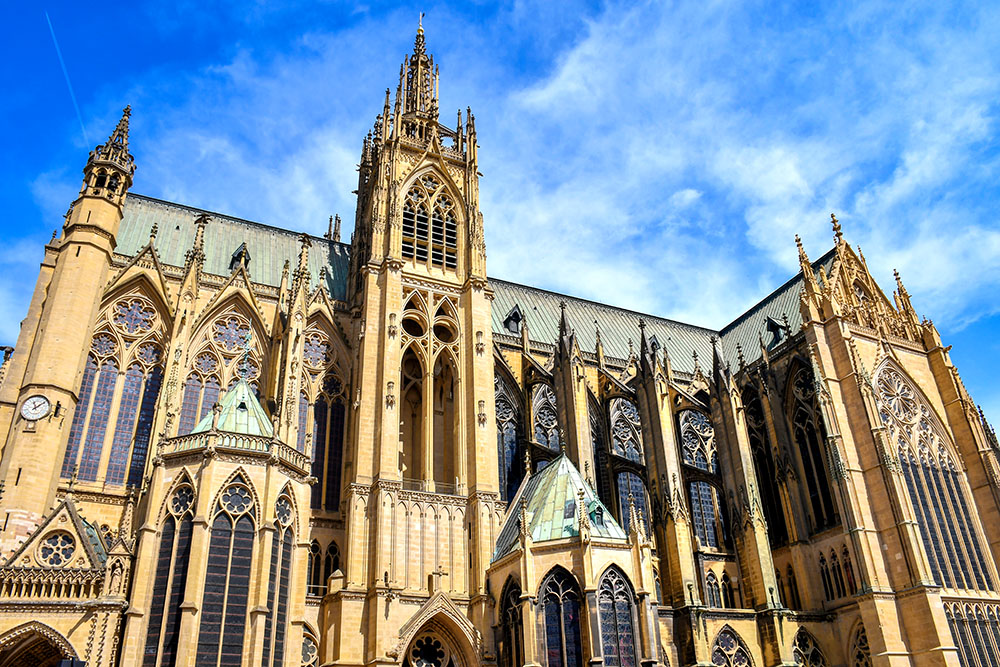
Metz Cathedral, Place d'Armes © French Moments
If you are visiting Metz for the first time, this is the monument I would put at the top of your list.
In this guide, I'll show you what makes Metz Cathedral special, what to look for inside and outside, where to find its most famous stained-glass windows, and what you need to know before visiting.
Metz Cathedral at a Glance
Official name
English name
Location
Architectural style
Main construction period
Nave height
Stained-glass area
Famous stained-glass artists
Nickname
Building stone
Admission to the cathedral
2026 opening hours
Allow for your visit
Cathédrale Saint-Étienne de Metz
St Stephen's Cathedral
Place d'Armes, Metz, Lorraine, France
Gothic
13th–16th centuries
41.41 metres (136 ft)
Approximately 6,500 m² (70,000 sq ft)
Hermann de Münster, Valentin Bousch, Jacques Villon, Roger Bissière and Marc Chagall
Lanterne du Bon Dieu — Lantern of God
Jaumont limestone, responsible for its warm golden colour
Free
Daily, 8 am-7 pm (April-October), 8 am–6 pm (rest of the year)
Around 45–60 minutes for a first visit
Pope Leo XIV's 2026 Visit to Metz Cathedral
On 28 September 2026, Pope Leo XIV visited Metz Cathedral during his Apostolic Journey to France.
After addressing European leaders at the Robert Schuman Congress Centre and travelling through Metz in the Popemobile, he celebrated Mass at Saint Stephen's Cathedral at 4 pm.
Why is Metz Cathedral famous?
Metz Cathedral is famous above all for its extraordinary height and the amount of stained glass that fills its walls. Together, they give the interior a sense of light and space that is difficult to appreciate from the outside.
The nave rises to 41.41 metres (136 feet) beneath the vaults, placing it among the tallest Gothic naves in France. Yet what struck me again on my latest visit was not simply the height. It was how little solid wall there seems to be once you look upwards.
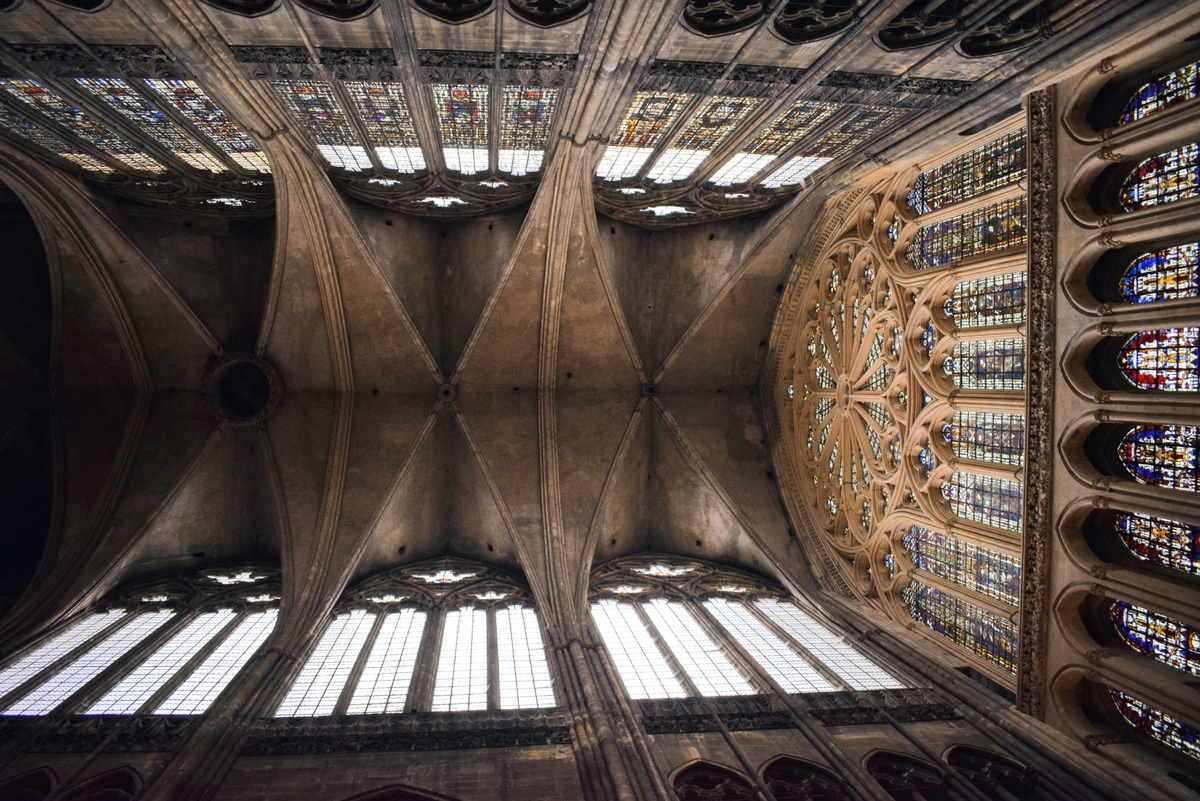
The vaults of Metz Cathedral © French Moments
Around 6,500 square metres (70,000 sq ft) of stained glass fill the cathedral, the largest surface of stained glass in any cathedral in France. Some windows date from the Middle Ages, while others were created centuries later. You can therefore see the work of artists ranging from Hermann de Münster and Valentin Bousch to Jacques Villon, Roger Bissière and Marc Chagall within the same building.
This remarkable abundance of glass gave Metz Cathedral its enduring nickname, La Lanterne du Bon Dieu — the Lantern of God.
The cathedral is distinctive outside too. Instead of the grey stone associated with many Gothic churches, it was largely built from Jaumont limestone, quarried near Metz. Its iron content gives the stone a warm yellow-gold colour that you will notice on historic buildings throughout the city.
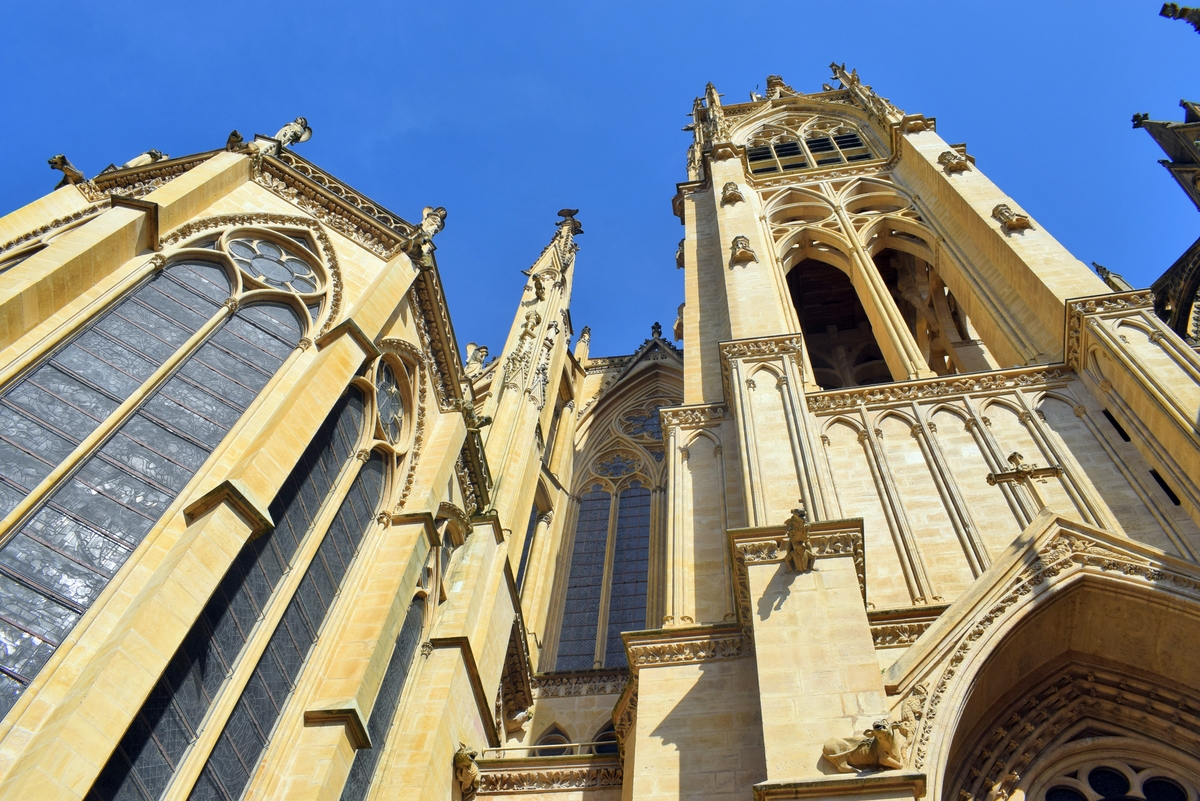
Tour de la Mutte © French Moments
There is another reason why Metz Cathedral looks rather different from famous Gothic cathedrals such as Notre-Dame de Paris or Reims. Its unusual silhouette is partly the result of its history: the present building developed from two neighbouring churches that were gradually brought together into a single cathedral.
That complicated story helps explain some of its architectural quirks — and it is where our story of Metz Cathedral really begins.
A Brief History of Metz Cathedral
The history of Metz Cathedral is more complicated than its Gothic appearance might suggest. What we see today was not built in a single campaign, nor did it begin with an empty site and a single architect's grand plan.
Instead, the cathedral grew over several centuries, absorbing an older church, surviving fires and changing fashions, and undergoing major alterations when Metz was under both French and German rule.
From an early sanctuary to a Gothic cathedral
The religious history of this site reaches back much further than the present building. A sanctuary dedicated to Saint Stephen existed here in the early Middle Ages, and a Romanesque cathedral was consecrated in 1040.
The decisive change came in the 13th century.
In 1220, Bishop Conrad of Scharfenberg set in motion the project that would eventually create the Gothic cathedral. Pope Honorius III authorised him to raise funds for major building work, and construction continued, in different phases, for generations.
This is worth remembering when you stand beneath the vaults. Medieval cathedrals were rarely the work of one architect or even one lifetime. The people who began Metz Cathedral knew they would never see it finished.
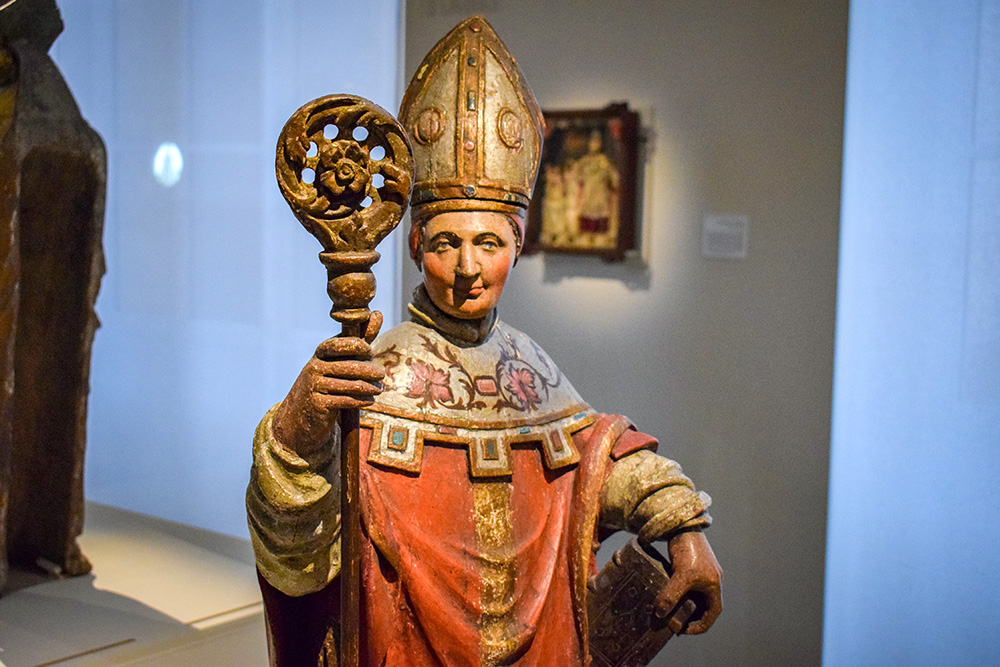
Bishop of Metz © French Moments
Two churches joined into one
Metz Cathedral has another unusual feature: it developed from two separate churches standing next to each other.
Alongside the older cathedral of Saint Stephen stood the collegiate church of Notre-Dame-la-Ronde, founded in the 12th century. As the new Gothic cathedral expanded, the two buildings were gradually incorporated into a single structure.
There was one awkward problem. Their floors were not at the same level.
The floor of Notre-Dame-la-Ronde had to be lowered by around 80 centimetres to connect the two spaces. Some of its pillars were altered in the process, and you can still spot the difference in their bases today.
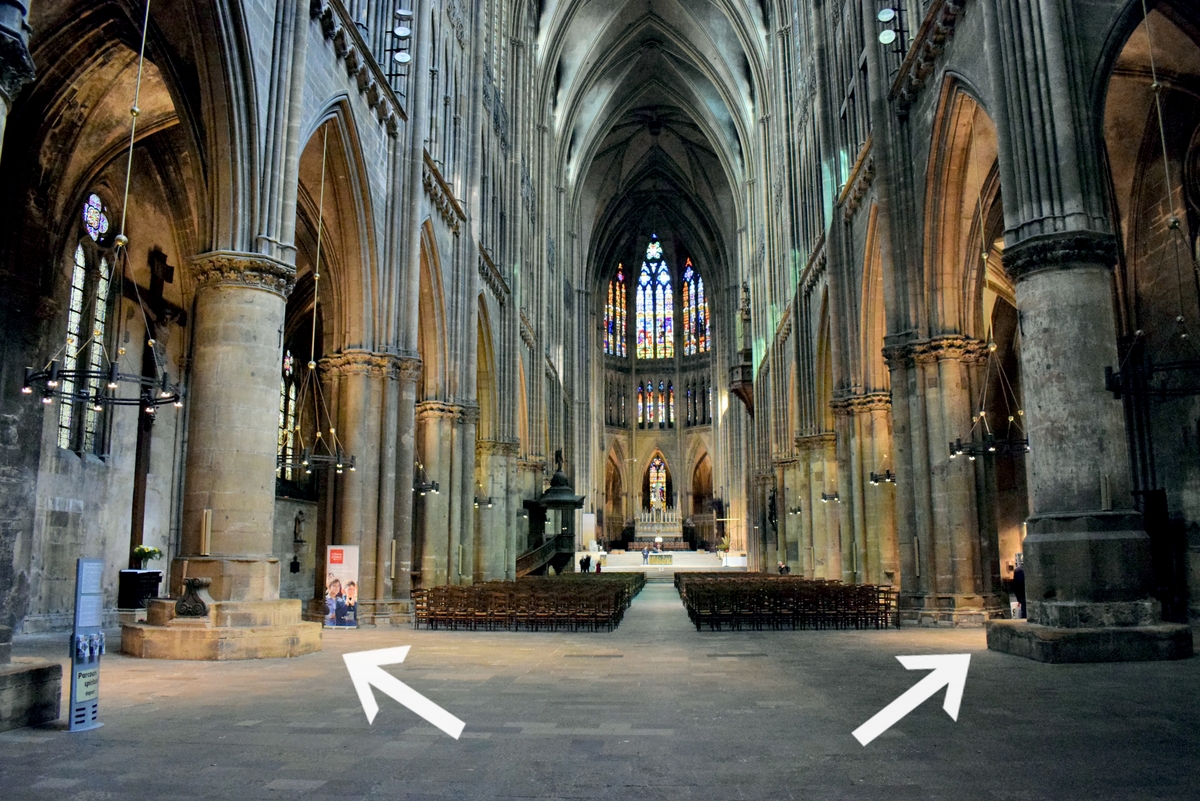
The nave © French Moments
It is a small architectural detail, but one I like because it makes this complicated medieval history suddenly visible. You are not simply reading about two churches being joined together — you can actually look for the evidence while walking through the cathedral.
A cathedral built over three centuries
Work on the Gothic cathedral continued through much of the later Middle Ages and into the Renaissance.
By the 14th century, builders were tackling the extraordinary height that still defines the interior today. At the same time, Metz began acquiring the vast stained-glass windows for which it would become famous.
The west window was created by Hermann de Münster in the late 14th century, while Valentin Bousch produced some of the cathedral's great Renaissance glazing in the early 16th century.
By the middle of the 16th century, the main medieval building campaign was effectively complete.
But the cathedral's appearance was far from fixed.
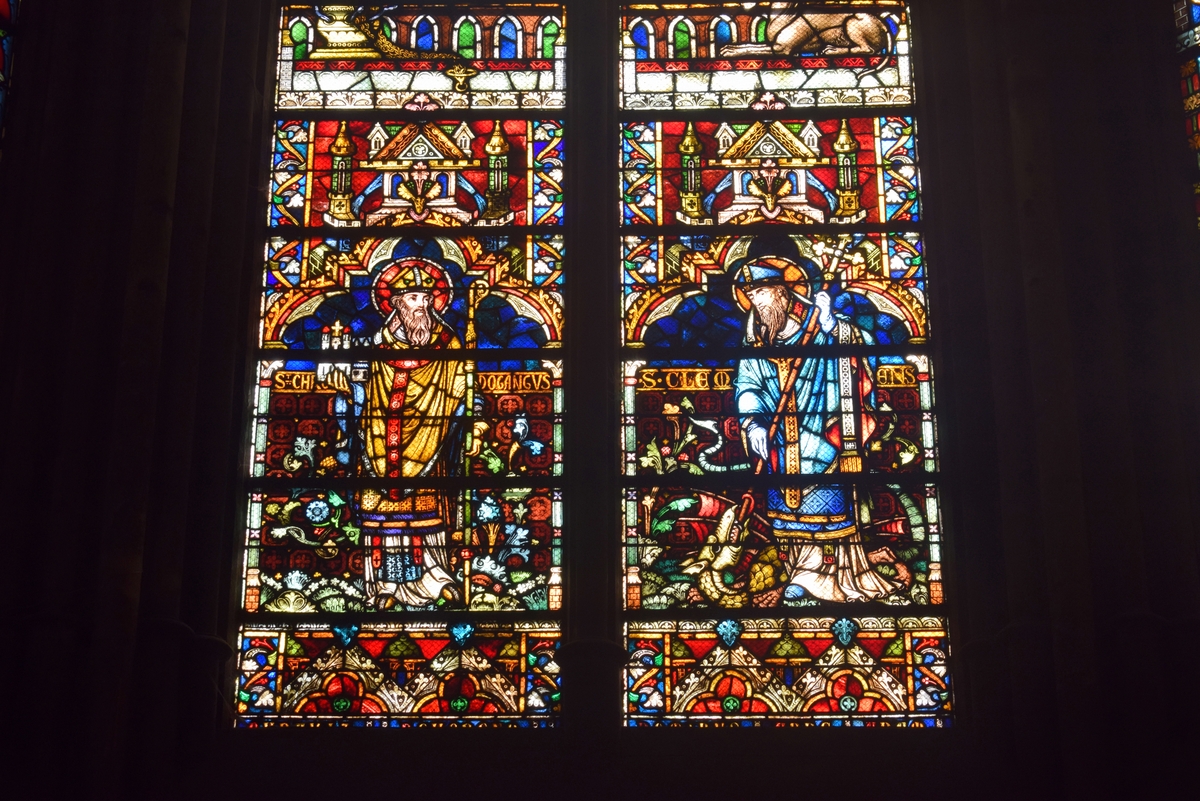
Details of stained-glass windows © French Moments
When Gothic went out of fashion
One of the most dramatic changes came in the 18th century, when medieval Gothic architecture was no longer universally admired.
From 1754, architect Jacques-François Blondel was involved in the creation of a new ceremonial urban setting around the cathedral, including today's Place d'Armes.
To make the medieval church fit more comfortably into this Classical ensemble, its western end was altered. In 1764, a large Classical portal was added to the west façade.
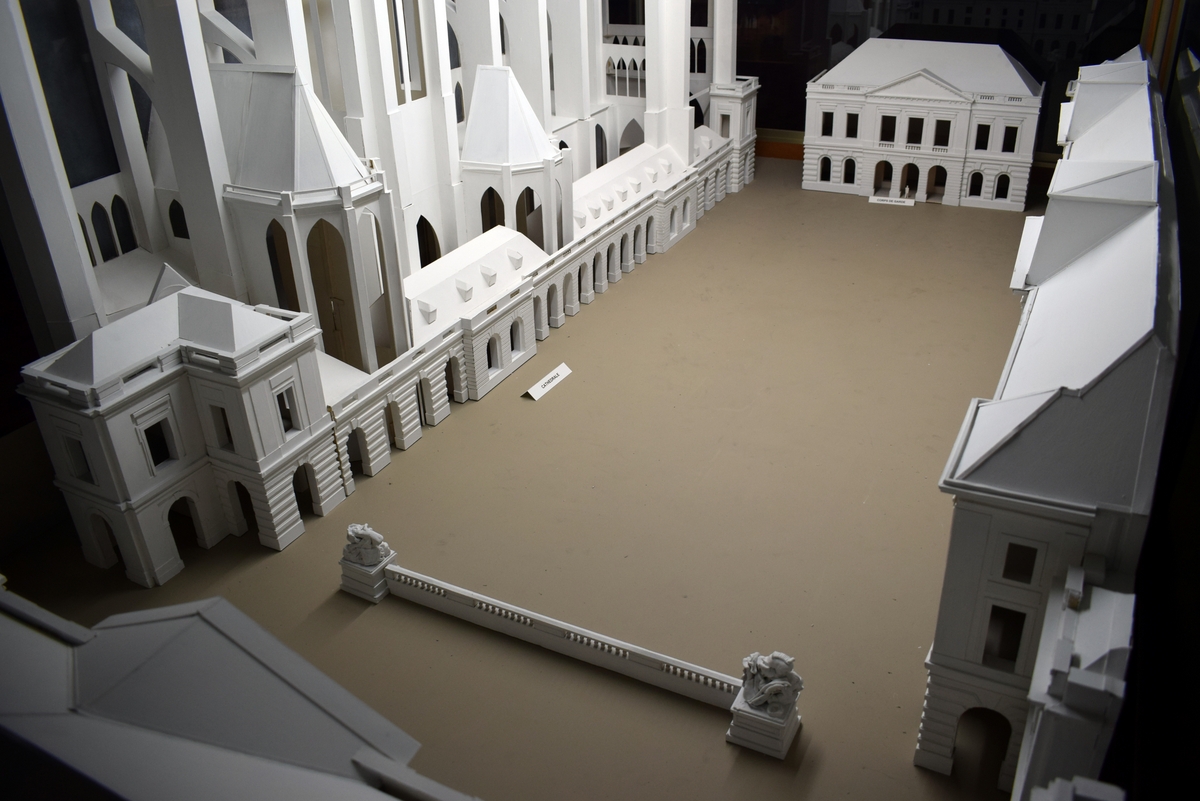
Place d'Armes in Metz
Today, the idea of placing a Classical façade onto a Gothic cathedral may seem rather strange. At the time, however, it reflected contemporary taste.
A century later, tastes had changed again.
The Gothic Revival was in full swing, and Blondel's addition was increasingly regarded as an unfortunate intrusion. Calls grew for the cathedral to recover what people considered a more authentically medieval appearance.
Then came an event that would change the building once more.
The Great Fire of 1877
On 6 May 1877, Emperor Wilhelm I visited Metz, which had become part of the German Empire following the Franco-Prussian War.
Fireworks were launched from the roof of the cathedral that evening in honour of the imperial visit.
Several hours later, in the early morning of 7 May, the roof was on fire.
The medieval oak roof structure was destroyed, although the stone vaults prevented the flames from spreading into the main body of the cathedral.
The story has an unfortunate irony to it: a celebration organised for an imperial visit resulted in one of the cathedral's most serious disasters.
The fire also opened the way for a far wider restoration campaign.
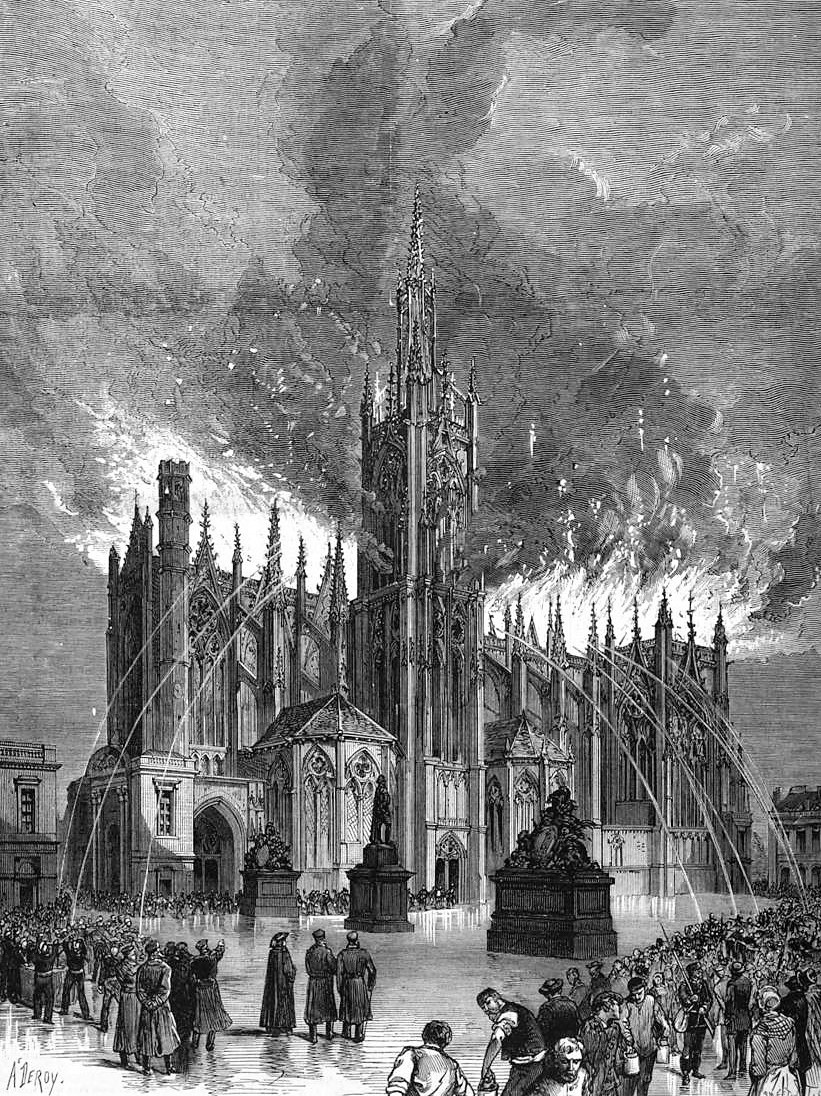
The great fire of 7 May 1877
Paul Tornow and the German restoration
By this point, Metz was part of Alsace-Lorraine within the German Empire, and responsibility for the restoration fell largely to the Prussian architect Paul Tornow.
The roof was rebuilt with a metal structure and given a steeper profile, changing the silhouette of the cathedral.
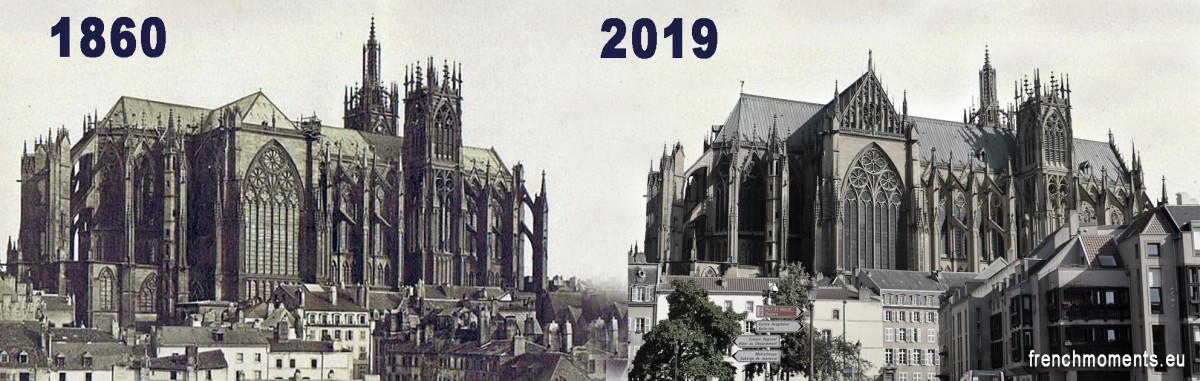
But Tornow went much further.
Working with the French sculptor Auguste Dujardin, he restored the Portal of the Virgin and eventually replaced Blondel's Classical west portal with the elaborate Neo-Gothic façade you see today.
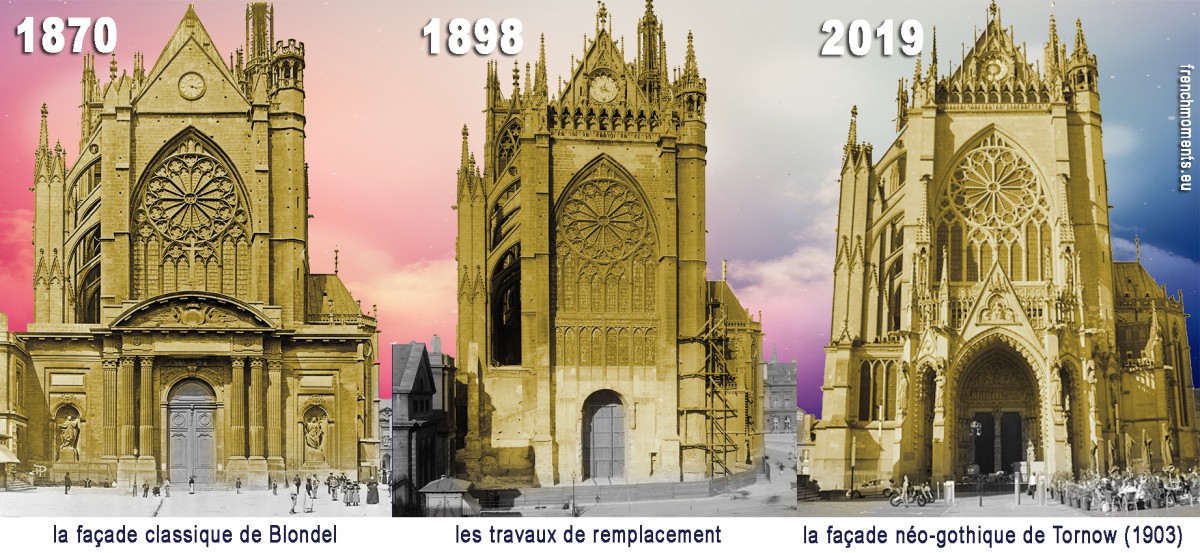
The Western façade (left: by Blondel in the 18th C - centre: during the restoration works - right: as it looks today) © French Moments
Tornow and Dujardin travelled through France studying medieval churches and cathedrals before finalising their design. The result is an interesting twist in Metz's complicated Franco-German history: a German architect working for the German authorities created a Neo-Gothic façade partly inspired by medieval architecture in France.
The new western portal was inaugurated in 1903 in the presence of Emperor Wilhelm II.
And if you look carefully at the sculptures around it, the Kaiser himself may still be there.
One figure representing the prophet Daniel was given Wilhelm II's features. His famous moustache, however, did not survive Metz's return to France after the First World War.
We'll take a closer look at that curious detail when we explore the outside of the cathedral.
What to See Outside Metz Cathedral
Before heading inside, take some time to walk around Metz Cathedral. It is worth seeing from several angles, because its exterior tells almost as much of the story as the interior.
And the first thing you are likely to notice is the colour.
The golden stone of Metz
Metz Cathedral was largely built from Jaumont limestone, quarried to the north of the city. The stone contains iron oxides that give it a distinctive warm, yellow-gold colour.
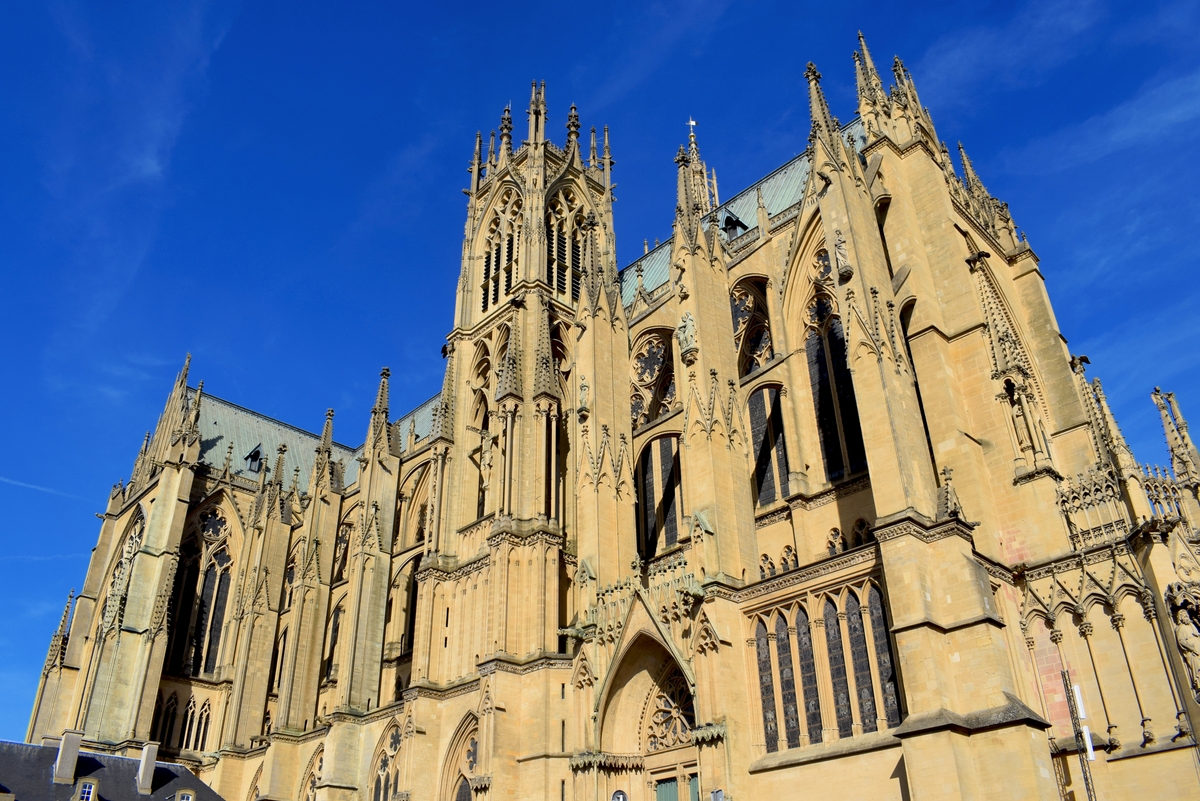
Metz Cathedral © French Moments
You will see the same stone throughout old Metz, but on the cathedral the effect is particularly striking. Its appearance changes with the weather and the time of day: pale yellow under a cloudy sky, warmer in sunshine, and almost golden when the low sun catches the façade.
This is one of those details that helps give Metz its own visual identity. Strasbourg has its pink sandstone cathedral; Clermont-Ferrand has its dark volcanic stone; Metz has the golden stone of Jaumont.
Why doesn't Metz Cathedral have two towers at the front?
If you are used to the great Gothic cathedrals of Paris or Reims, you may notice something odd about Metz.
There is no pair of symmetrical towers framing the western façade.
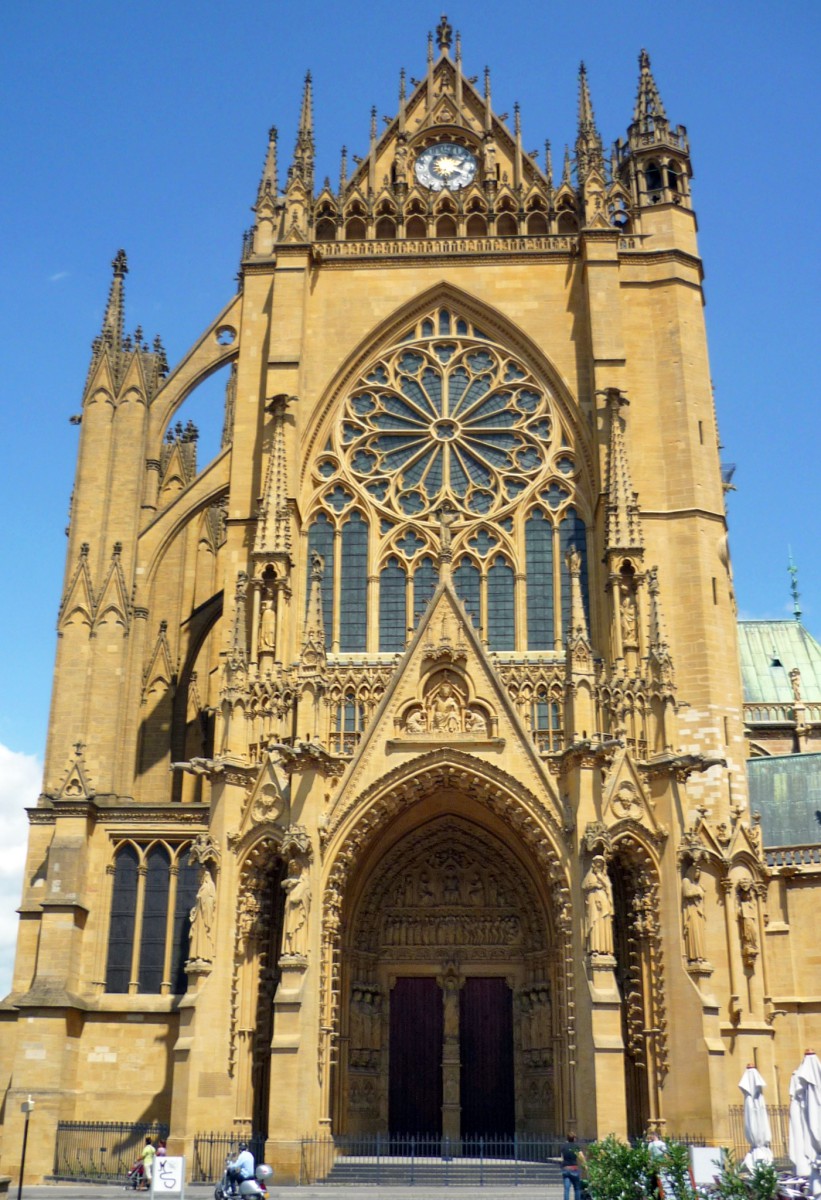
The west front, Metz Cathedral © French Moments
The reason goes back to the cathedral's unusual origins.
The towers were built farther east because the western end of the present cathedral was originally occupied by the collegiate church of Notre-Dame-la-Ronde. When the two churches were eventually joined, the towers found themselves set back from the façade.
That absence of western towers had an unexpected advantage: it left an enormous amount of space for glass.
High above the main portal is the great western window created by Hermann de Münster in 1384. The whole composition, with its rose and tall lancet windows, dominates the façade rather than a pair of bell towers.
It is a good example of how one of Metz Cathedral's architectural peculiarities ultimately contributed to its greatest characteristic: light.
The western façade is not as medieval as it looks
At first glance, the western façade looks convincingly medieval.
It isn't.
The elaborate portal you see today dates mainly from the late 19th and early 20th centuries, when Metz was part of the German Empire.
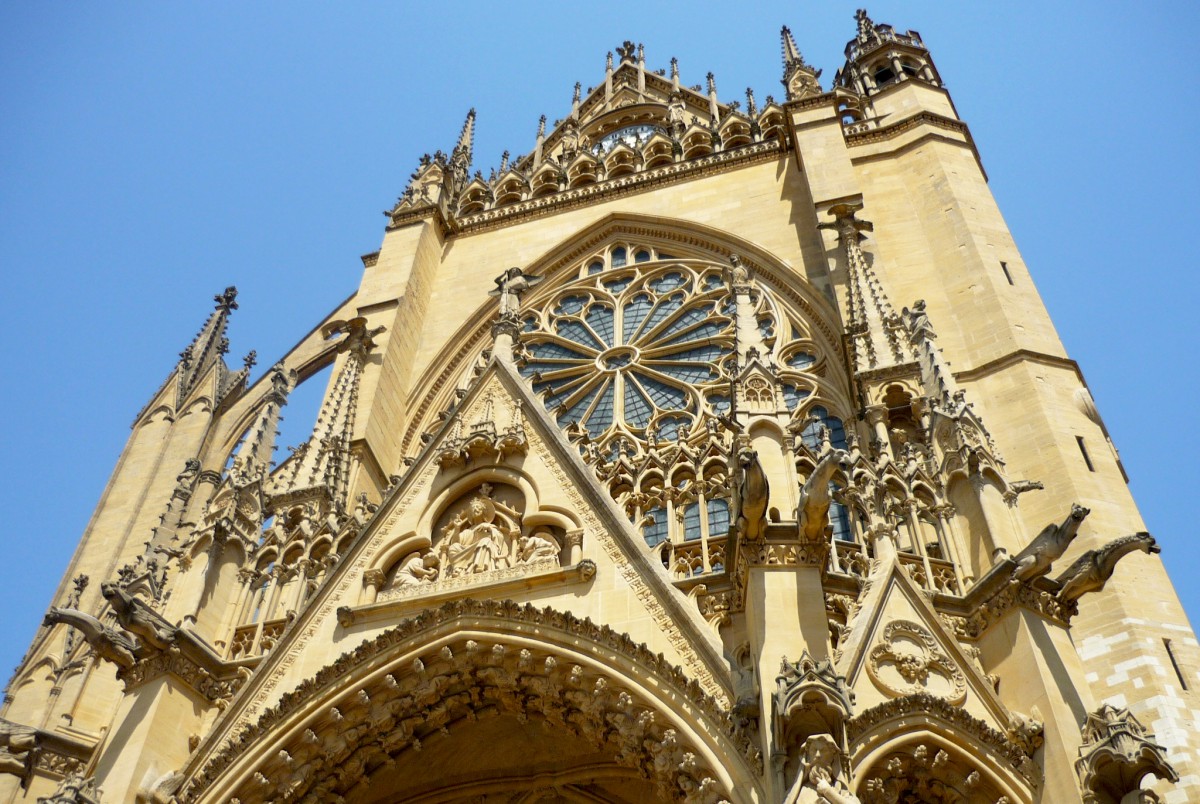
The west front, Metz Cathedral © French Moments
As we saw earlier, an 18th-century Classical portal by Jacques-François Blondel once stood here. It was dismantled in 1898 and replaced by the Neo-Gothic creation of architect Paul Tornow and French sculptor Auguste Dujardin.
Their design was not simply invented from scratch.
Tornow and Dujardin travelled through France in 1891 and 1895, studying Gothic churches and cathedrals. Among the buildings that influenced the new Metz portal were Notre-Dame in Dijon, the church at Semur-en-Auxois and Saint-Père-sous-Vézelay.
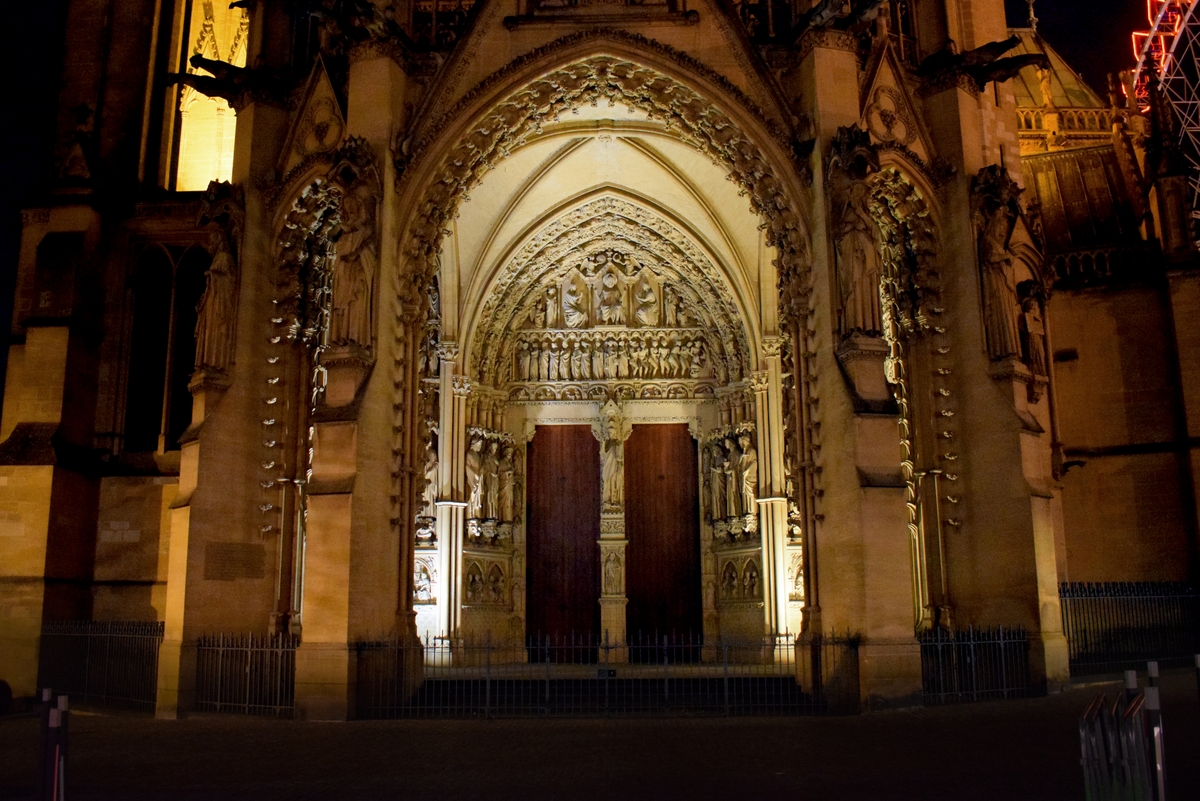
The western portal of Metz Cathedral © French Moments
The result was inaugurated by Emperor Wilhelm II on 14 May 1903.
It looks old enough to fool you — which, I suppose, means Tornow and Dujardin did their job rather well.
Look closely at the Portal of Christ
The great western entrance is usually known as the Portal of Christ (Portail du Christ).
Its tympanum depicts the Last Judgement, a subject familiar from medieval cathedral portals elsewhere in France. Christ appears at the centre of an elaborate sculptural composition surrounded by biblical figures.
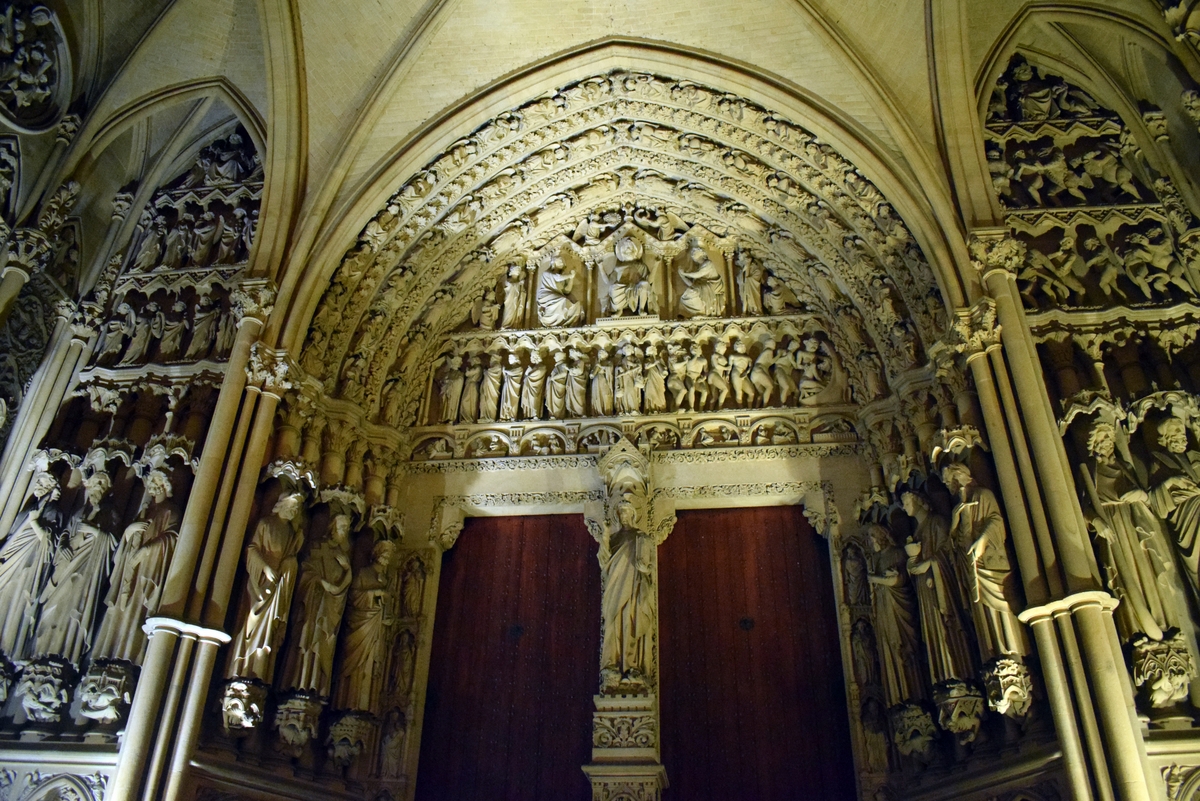
The portail of the western façade © French Moments
There is so much decoration here that it is easy to stand back, admire the whole thing and move on.
Don't.
Come closer and spend a few minutes looking at the individual statues and smaller details. Many date from the restoration led by Dujardin's team and are far more recent than they first appear.
There is also a particularly entertaining historical detail hiding among them.
Can you spot Emperor Wilhelm II?
Look at the figures on the right-hand side of the western portal and find the Old Testament prophet Daniel.
His face has a rather unusual story.
The sculpture was given the features of Kaiser Wilhelm II, the German emperor who took a close interest in the restoration of Metz Cathedral and attended the inauguration of the new portal in 1903.
Originally, Daniel even had Wilhelm's unmistakable imperial moustache.
After Metz returned to France following the First World War, the moustache disappeared. According to the traditional account, it was removed from the statue because it made the resemblance to the German emperor rather too obvious.
The face, however, remained.
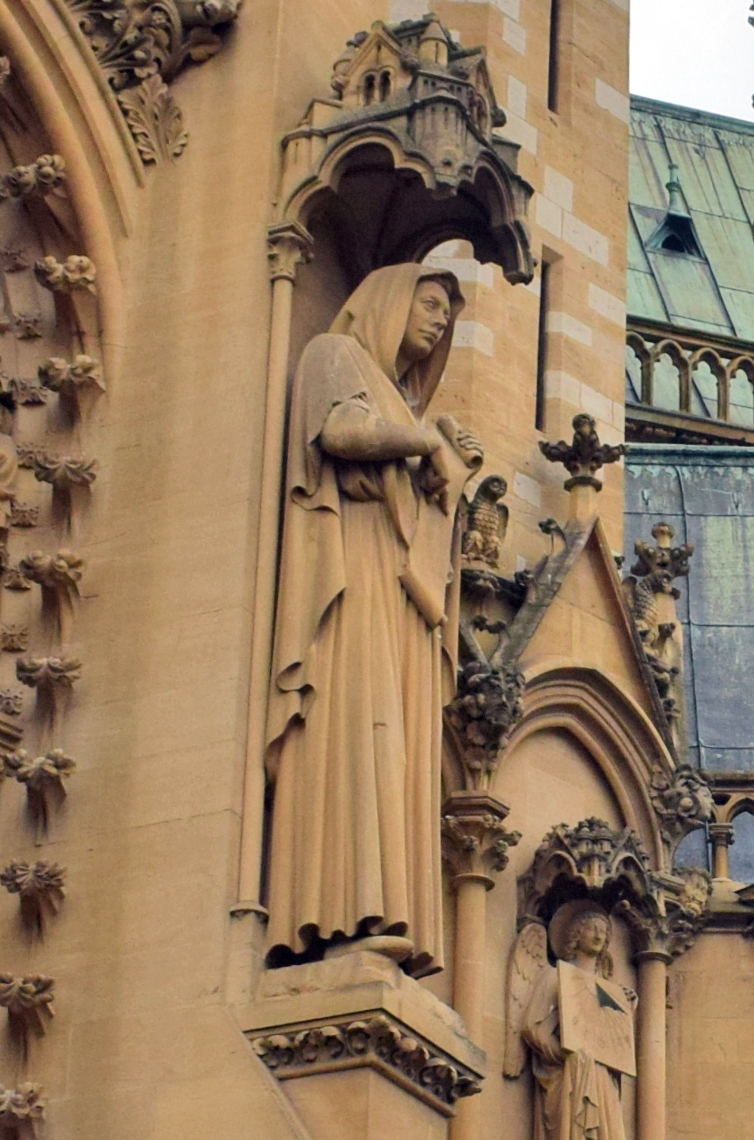
Statue of Daniel aka the Kaiser! © French Moments
Once you know what you are looking for, it is difficult not to see the Kaiser staring down from the cathedral.
For me, this is one of those small details that sums up Metz rather well. French and German history is not confined to museums here. Sometimes it is carved directly into the buildings.
The Portal of the Virgin
Now walk around to the side facing Place d'Armes and look for the Portal of the Virgin (Portail de la Vierge).
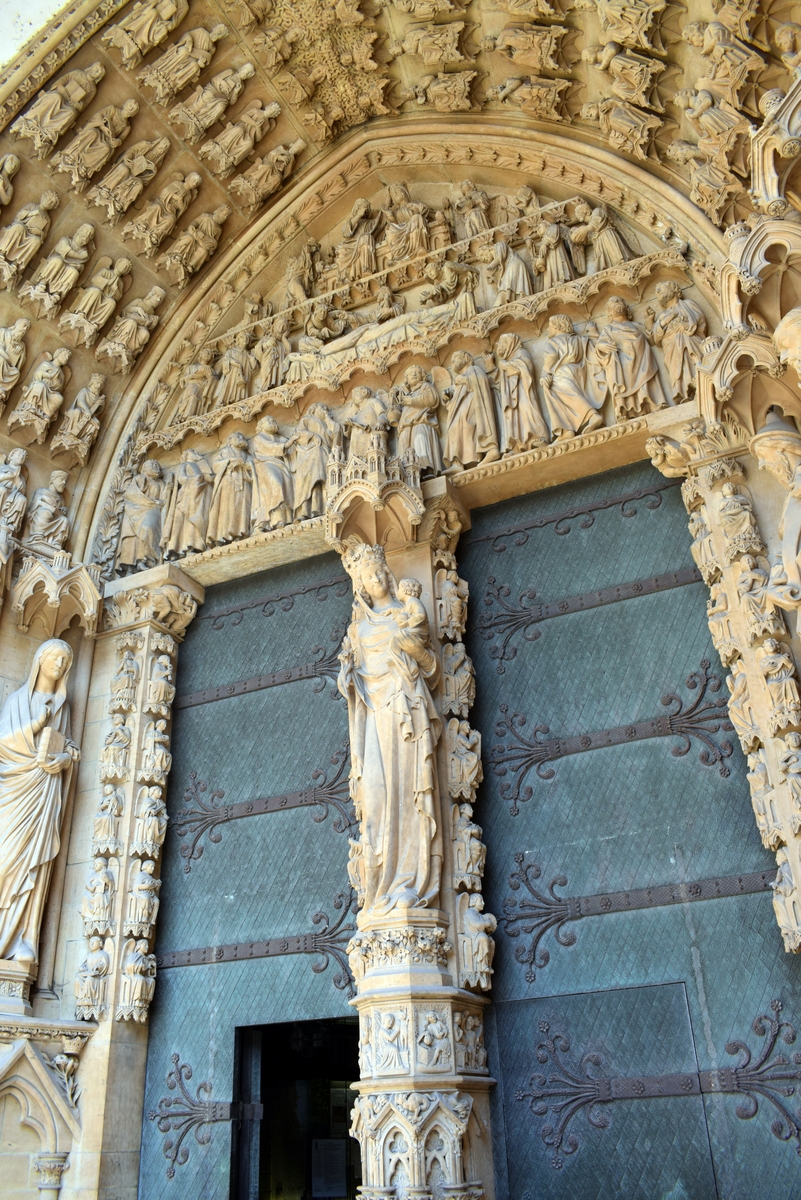
Portal of the Virgin © French Moments
Its story takes us back to Notre-Dame-la-Ronde, the second church that once stood beside Saint Stephen's Cathedral. This portal originally provided access to that collegiate church before the two buildings were united.
It nearly disappeared.
During Blondel's 18th-century redevelopment of the area around Place d'Armes, buildings and arcades were constructed against this side of the cathedral. The medieval portal was hidden and damaged in the process.
From 1854, Bishop Paul Dupont des Loges began acquiring and demolishing the buildings that concealed it. The portal gradually re-emerged and was restored from 1880 by Paul Tornow and Auguste Dujardin.
Much of the sculpture you see today therefore dates from that restoration, although important parts of the medieval tympan survived.
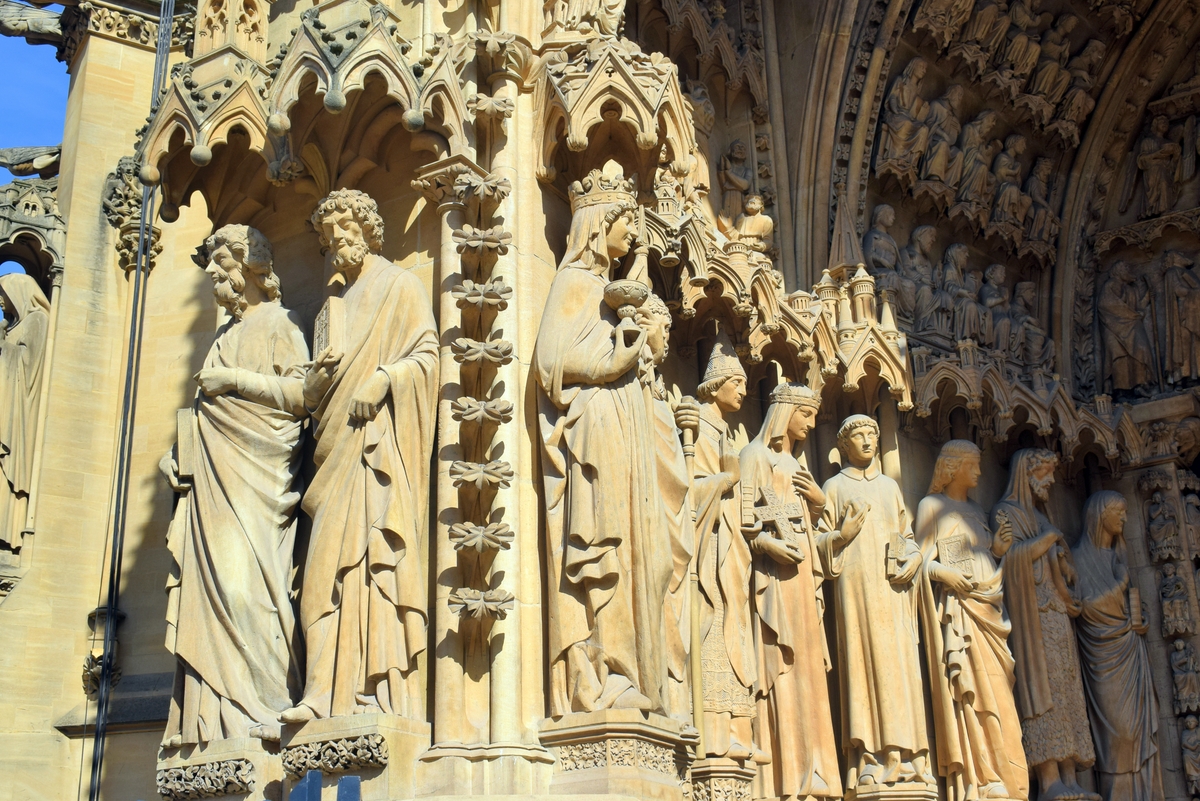
Jaumont Stone at the cathedral of Metz © French Moments
Look closely at the scenes above the doorway. They include the Dormition of the Virgin and, higher up, the Coronation of the Virgin.
The portal is also particularly useful for understanding the cathedral's strange architectural history. What looks today like a side entrance was once the entrance to a different church.
Don't just look up
Cathedrals have a habit of making us stare towards the towers, pinnacles and roofline.
At Metz, it is worth looking lower down too.
Around the portals and buttresses you will find carved figures, foliage and fantastic creatures. Some elements are genuinely medieval; others belong to the extensive restorations of the 19th century.
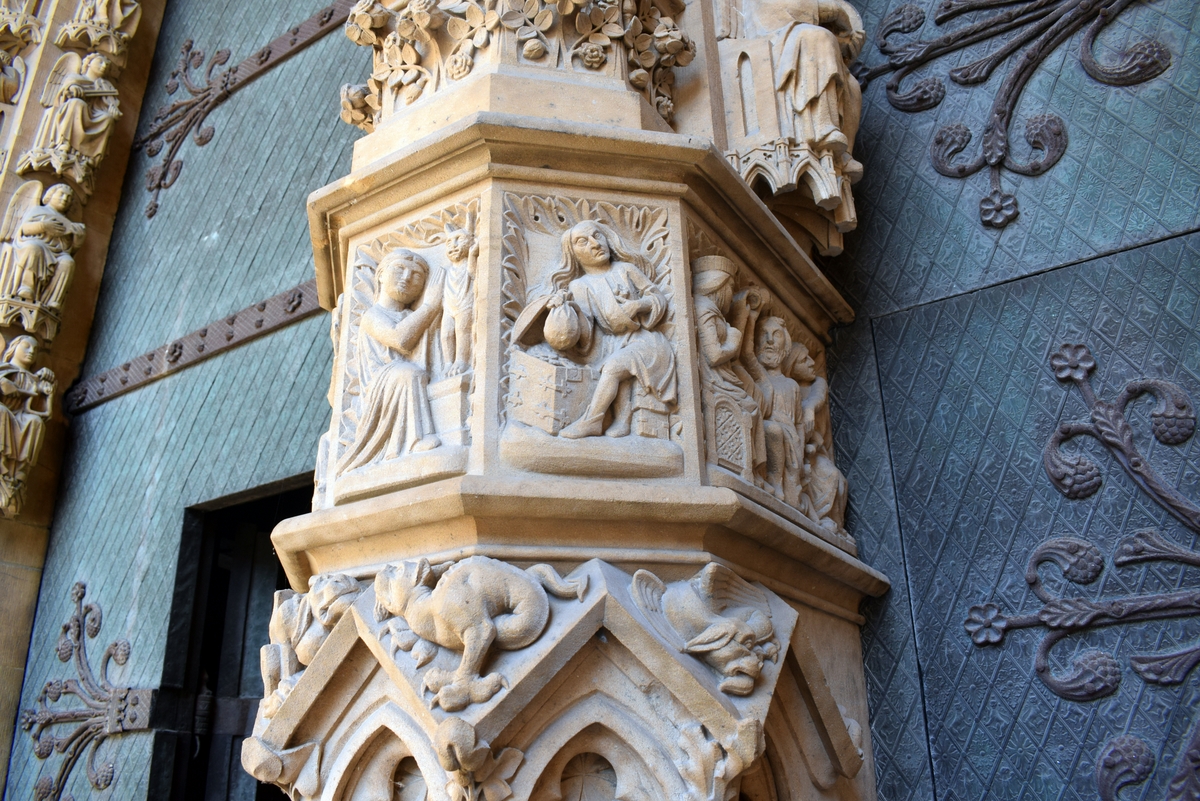
Metz Cathedral © French Moments
That mixture is part of the interest.
Metz Cathedral is not a building frozen in the Middle Ages. Every generation has repaired it, altered it, interpreted it and occasionally tried to make it look more medieval than it actually was.
Once you have walked around the exterior, step inside.
The change is immediate. The golden stone remains, but your attention is drawn upwards — towards a nave more than 41 metres high and walls that seem to dissolve into stained glass.
Inside Metz Cathedral: What Should You Look For?
Stepping inside Metz Cathedral after walking around its golden exterior is quite a change of atmosphere.
The first thing I usually do is simply look up.
There is plenty to discover at ground level, but the architecture was designed to draw your eyes towards the vaults and the light above them. The effect is particularly strong in Metz because the central nave is unusually tall in relation to the side aisles.
The soaring Gothic nave
The vaults of the nave rise to 41.41 metres (136 feet) above the floor. Only Beauvais and Amiens have higher cathedral vaults in France.
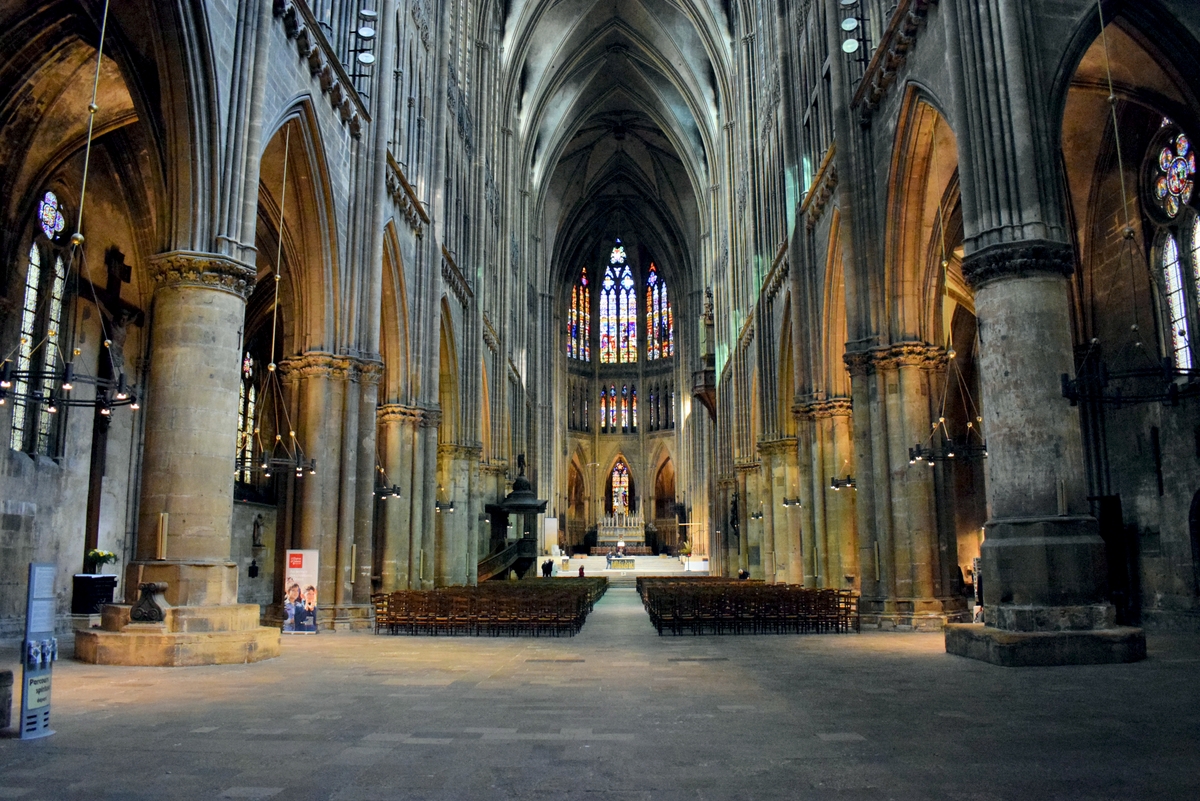
The nave © French Moments
Numbers do not really convey what that means when you are standing underneath them.
The nave is relatively narrow, which makes its vertical proportions feel even more pronounced. The columns rise almost continuously towards the ribbed vaults, while the much lower side aisles emphasise the height of the central space.
This is one reason why Metz Cathedral feels so different from a broad, heavy church interior. Everything seems to be pulling your gaze upwards.
When I returned in May 2026, I found myself doing exactly what I have done on previous visits: stopping shortly after entering and looking straight up before going any farther.
Give yourself a moment to do the same.
Look back towards the great west window
Once you have walked a little way along the nave, turn around.
Above the western entrance is one of the cathedral's great medieval treasures: the enormous window created by Hermann de Münster in the 14th century.
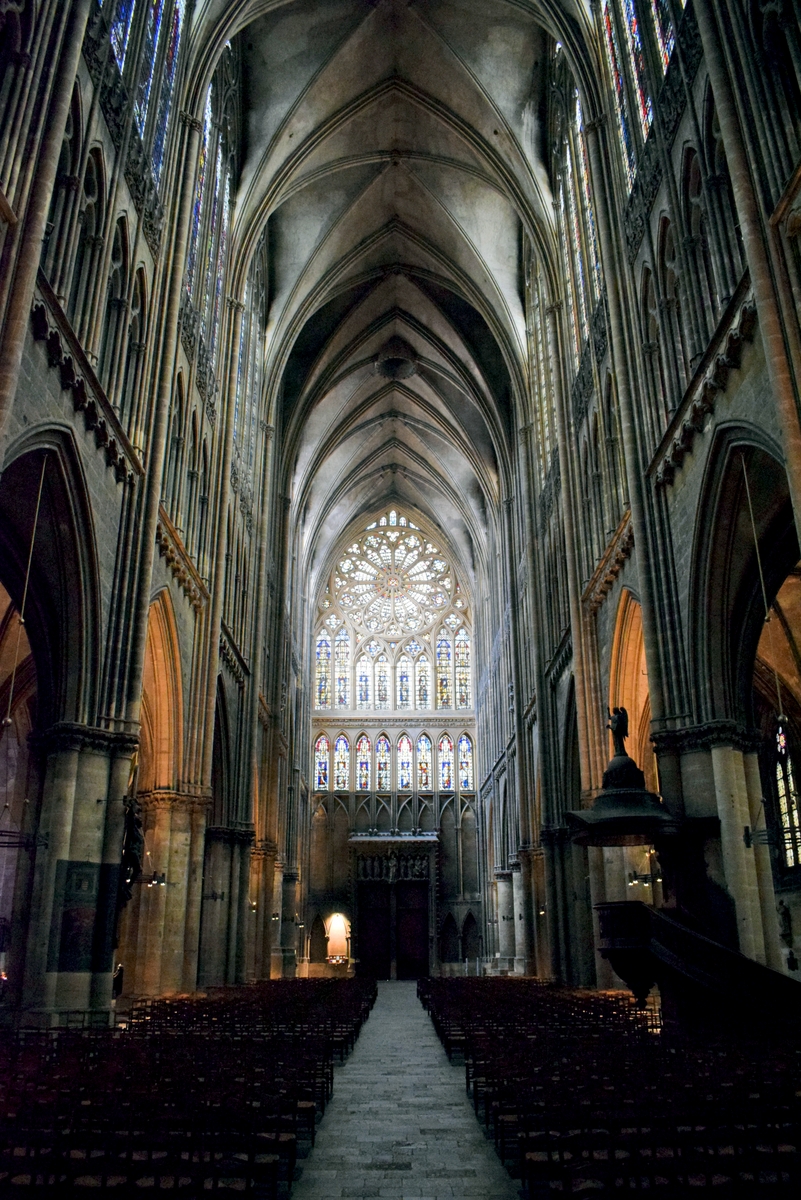
The nave and the Hermann de Münster window © French Moments
From outside, you see its stone tracery. From inside, you understand why the window matters.
It occupies such a large part of the western wall that the architecture almost seems to disappear around it. On a bright day, the upper end of the nave becomes a wall of coloured light.
We will look more closely at Hermann de Münster and the other stained-glass artists in a moment. For now, it is worth stepping back far enough to appreciate the window as part of the architecture rather than concentrating immediately on individual scenes.
A cathedral built around light
The extraordinary quantity of glass changes the atmosphere throughout the building.
In many Gothic churches, stained glass appears as a series of colourful windows set into substantial stone walls. Metz can feel different. In parts of the cathedral — especially around the transept — the walls seem to give way to glass.
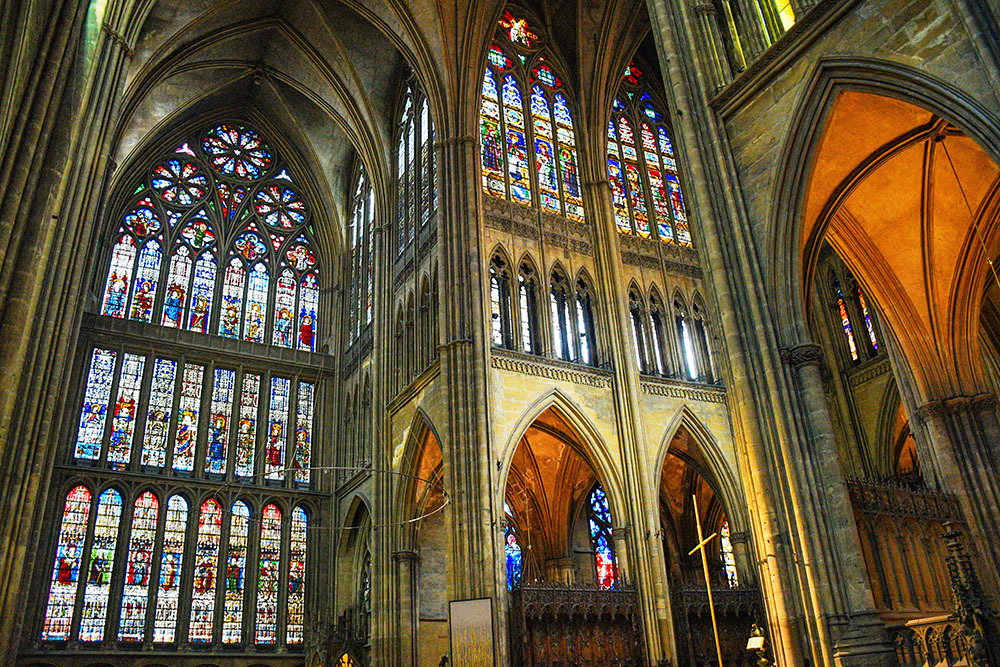
North Transept Stained Glass © French Moments
The effect also changes as you move around.
Sometimes the golden Jaumont stone dominates. Elsewhere, the interior takes on the colours of the windows. And because daylight is constantly changing, the cathedral never looks quite the same from one visit to the next.
That is probably the best way to understand the nickname “Lantern of God”. It is not simply a reference to the number of windows. It describes the way light becomes part of the architecture.
Walk towards the transept and choir
Don't stop at the nave.
Continue towards the crossing, where the nave meets the transept. The proportions change again here, and the vaults of the transept rise even higher than those of the nave.
This is also where some of the cathedral's largest expanses of stained glass come into view.
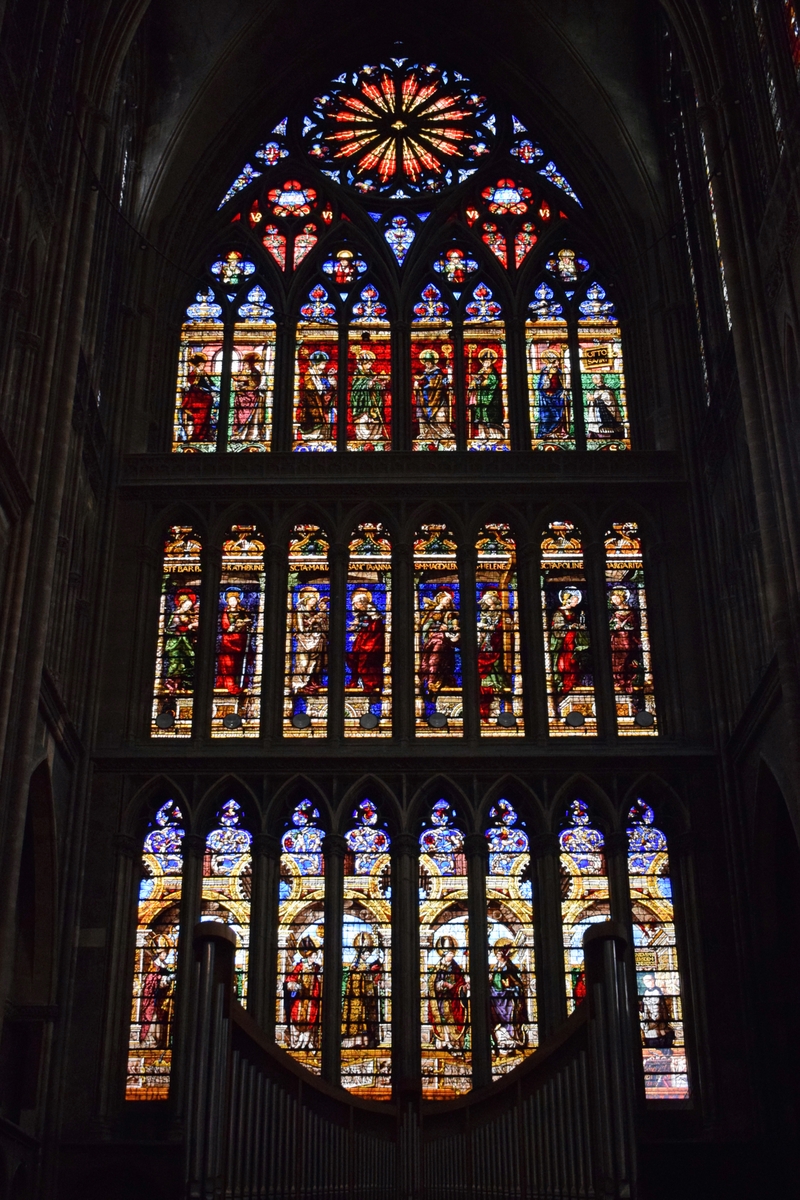
Stained-glass in the South transept © French Moments
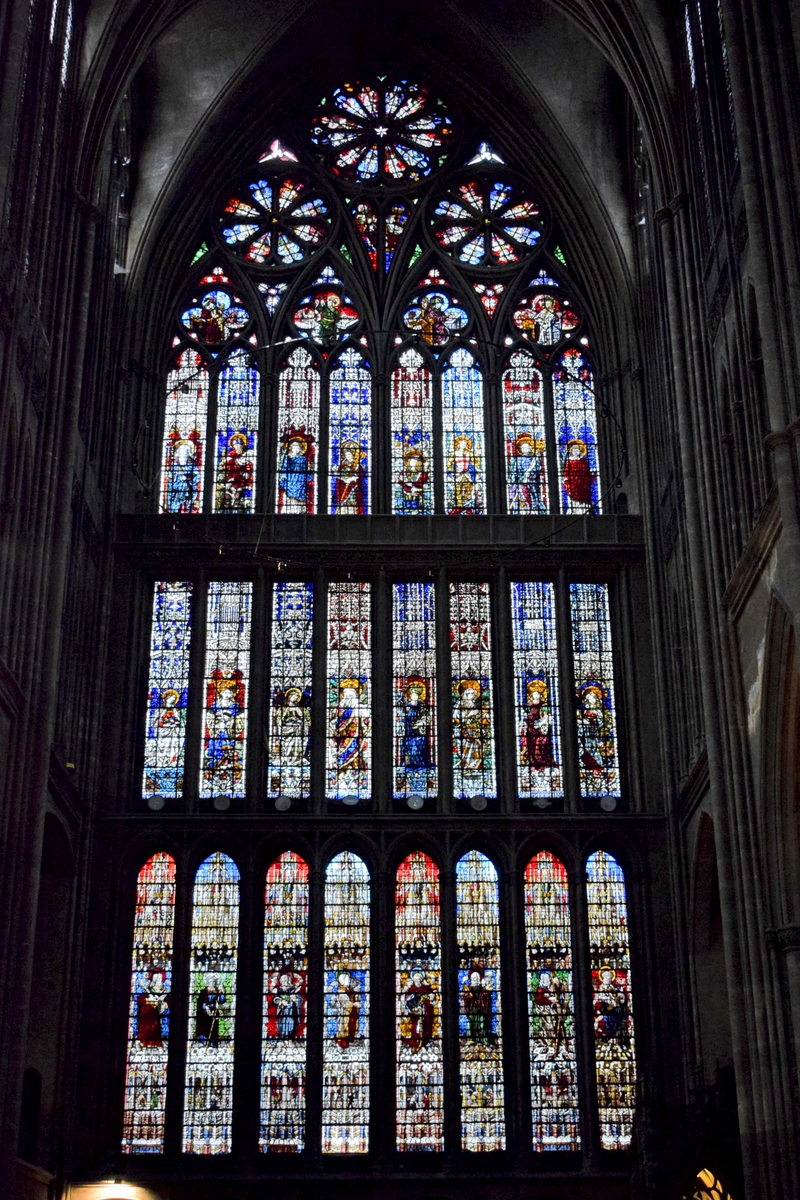
Stained-glass in the North transept © French Moments
From the crossing, take time to look in several directions rather than heading immediately towards the choir. Looking back along the nave gives you one of the best impressions of its length and height, while turning towards the transepts reveals just how much glass the medieval builders managed to incorporate into the structure.
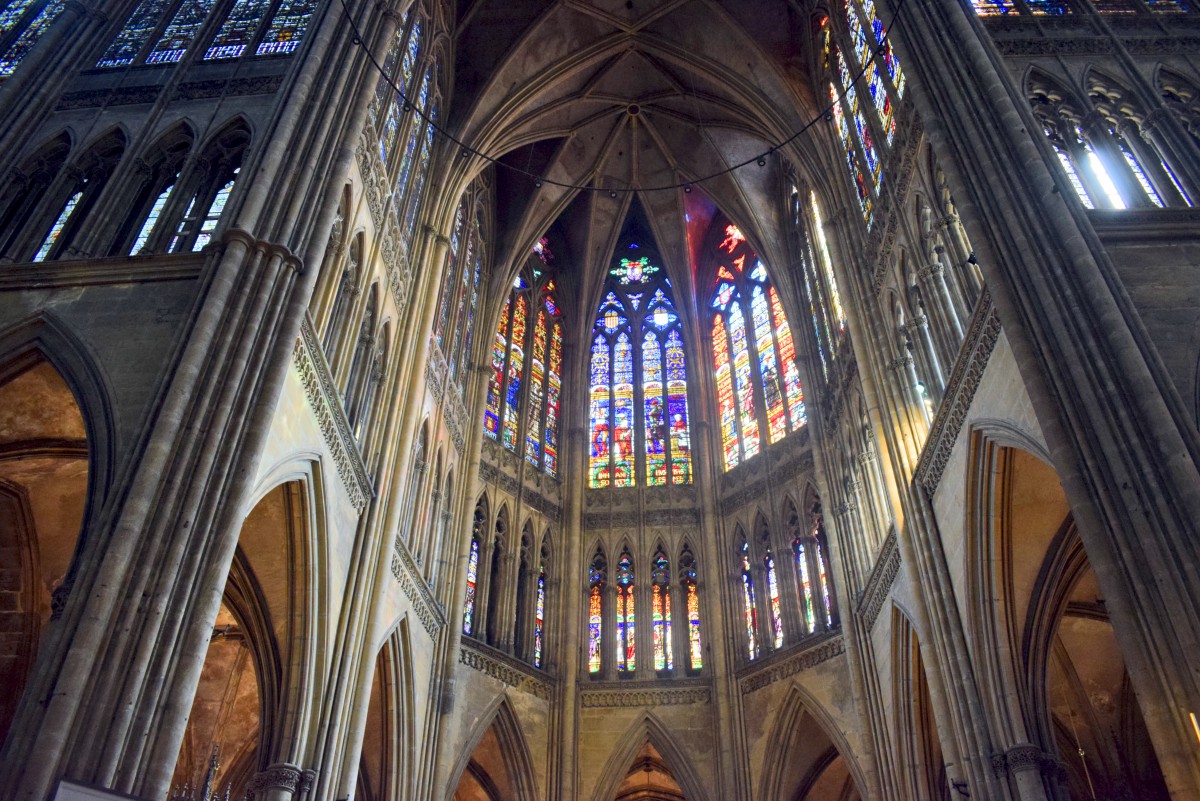
The choir of Metz Cathedral © French Moments
The choir, at the eastern end, brings together yet another period of the cathedral's long construction history. Its architecture is later than much of the nave, but the transition feels remarkably harmonious considering that generations of builders worked on the cathedral over several centuries.
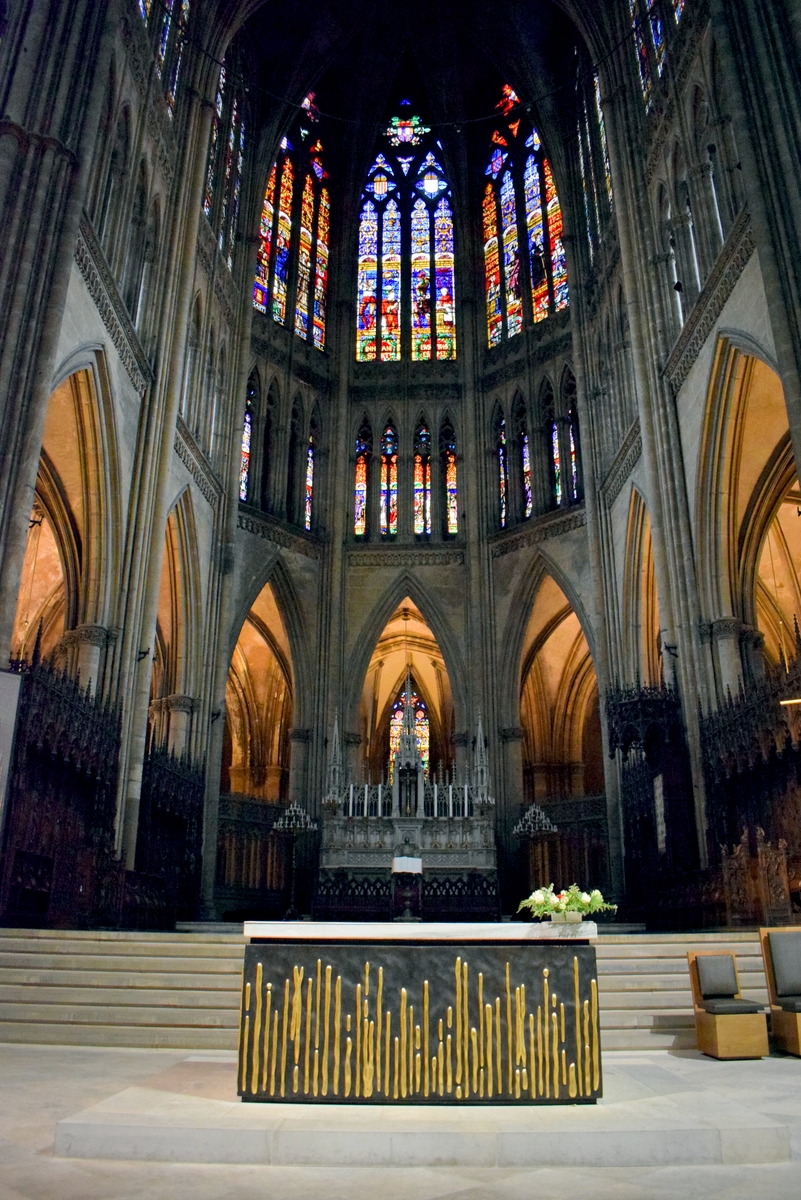
The choir © French Moments
Take your time before looking for individual masterpieces
It is tempting to enter Metz Cathedral with a checklist.
Find Chagall. Photograph the great windows. See the organ. Move on.
I think that would be a mistake.
Before searching for individual works of art, spend a few minutes simply walking through the nave, transept and choir and getting a sense of the building as a whole.
Only then start looking more closely at the windows.
Because the stained glass of Metz Cathedral is not the work of one period or one artist. It tells a story spanning more than six centuries — from medieval master glaziers to some of the best-known artists of the 20th and 21st centuries.
And that deserves a section of its own.
The Stained Glass of Metz Cathedral
If there is one thing that sets Metz Cathedral apart, it is its stained glass.
There are around 6,500 square metres (70,000 sq ft) of it, giving Metz the largest area of stained glass of any cathedral in France. But the numbers tell only part of the story.
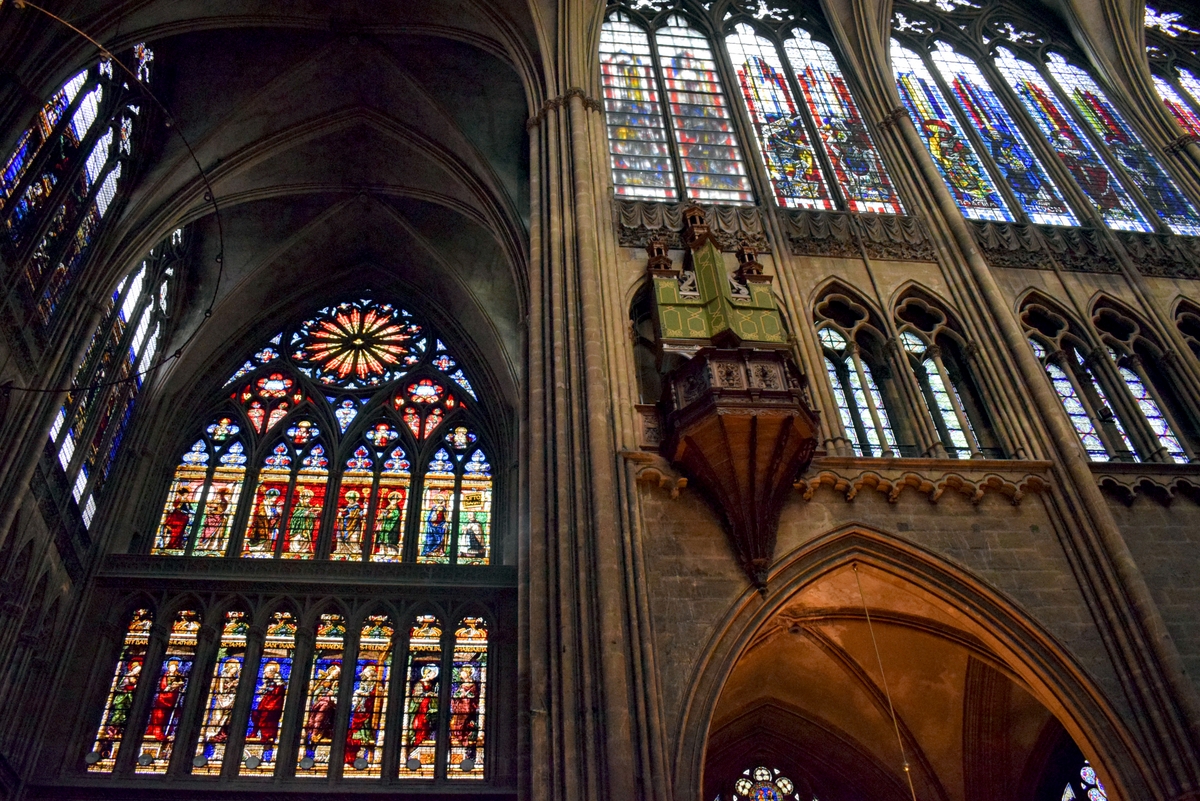
Stained glass windows © French Moments
What makes the collection particularly interesting is its range.
The windows were not created during one short period. They span several centuries, from medieval glass to Renaissance masterpieces and works by major 20th-century artists. Even in the 21st century, new stained glass has continued to be added.
So rather than thinking of Metz Cathedral as a place with one famous set of windows, it is better to see it as a kind of history of stained-glass art written in light.
Why is Metz Cathedral called the Lantern of God?
The sheer amount of glass explains the cathedral's nickname, La Lanterne du Bon Dieu, usually translated as the Lantern of God.
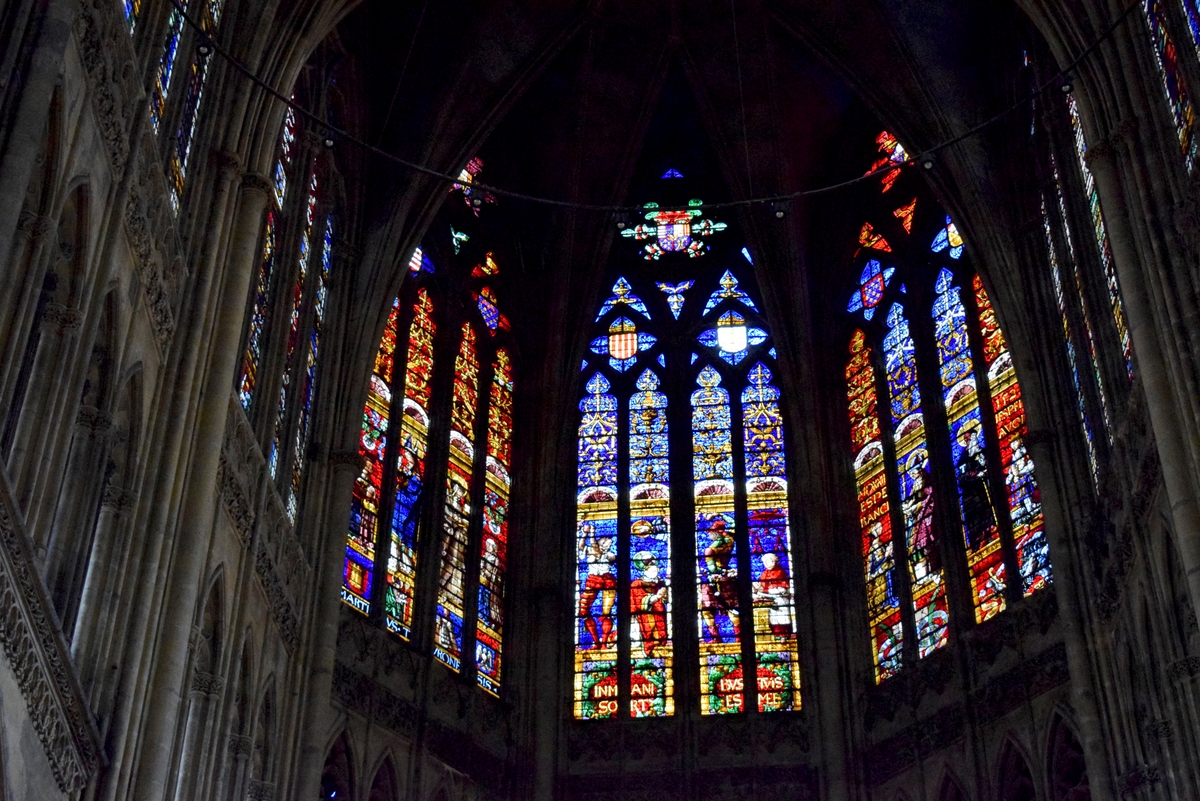
The stained-glass in the choir © French Moments
Around the nave, transept and choir, huge windows replace areas that might otherwise have been solid masonry. Light therefore enters the building from almost every direction.
The effect changes throughout the day.
Some windows become dramatically brighter when the sun reaches them, while others remain cooler and more subdued. On a grey day, the colours can seem deeper. In direct sunshine, patches of blue, red and gold sometimes fall across the stonework.
This is one reason I would not rush through the cathedral simply looking for Chagall. The older windows deserve just as much attention.
In fact, you can follow almost the entire development of stained glass in Lorraine simply by walking around the building.
The oldest stained glass
Some of the oldest surviving glass in Metz Cathedral dates from the 13th century.
Fragments can be found in the area associated with the former church of Notre-Dame-la-Ronde, as well as in small rose windows in the side aisles.
They are relatively easy to overlook because the cathedral contains much larger and more spectacular windows elsewhere.
But they are important for one simple reason: they take us back almost to the beginning of the Gothic building itself.
From there, the story moves forward to one of the cathedral's first great named master glassmakers.
Hermann de Münster and the great west window
If you turn towards the western end of the nave, you cannot miss the enormous window by Hermann de Münster.
Originally from Westphalia, Hermann was working at Metz Cathedral from at least 1381. He created the great western window and rose, known historically as the Grand O.
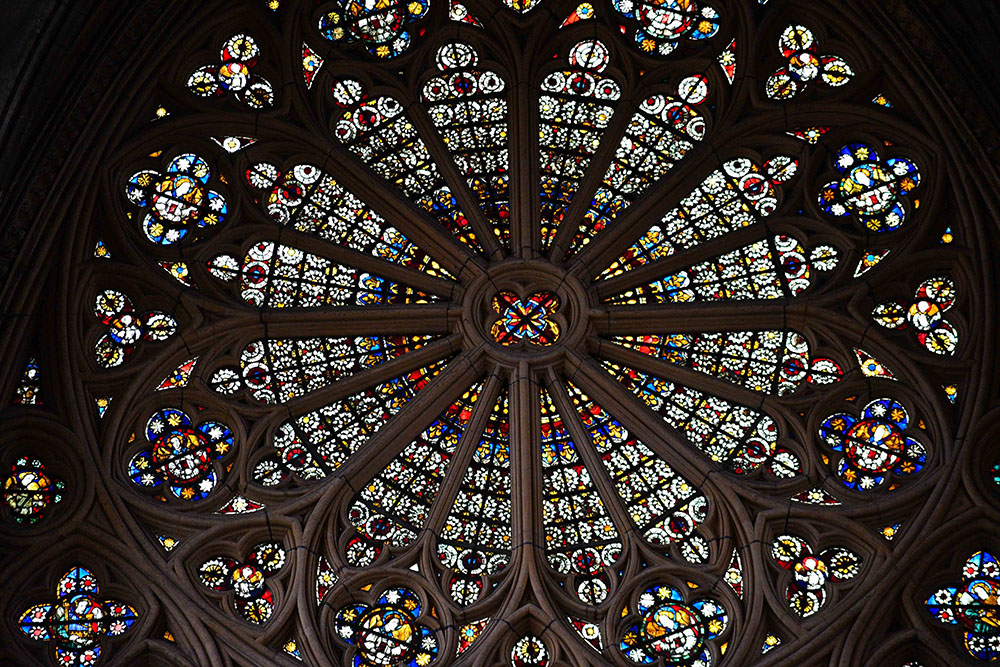
Great rose window from Hermann de Münster © French Moments
The scale is impressive enough from the nave, but there is a small detail about Hermann that I particularly like.
He was evidently held in such high regard that, when he died in Metz in 1392, he was allowed to be buried inside the cathedral, close to his work.
His epitaph still recalls him as the master glassmaker responsible for the great rose.
So when you look up at the western window, you are not only seeing a work of medieval art. Somewhere beneath you lies the man who made it.
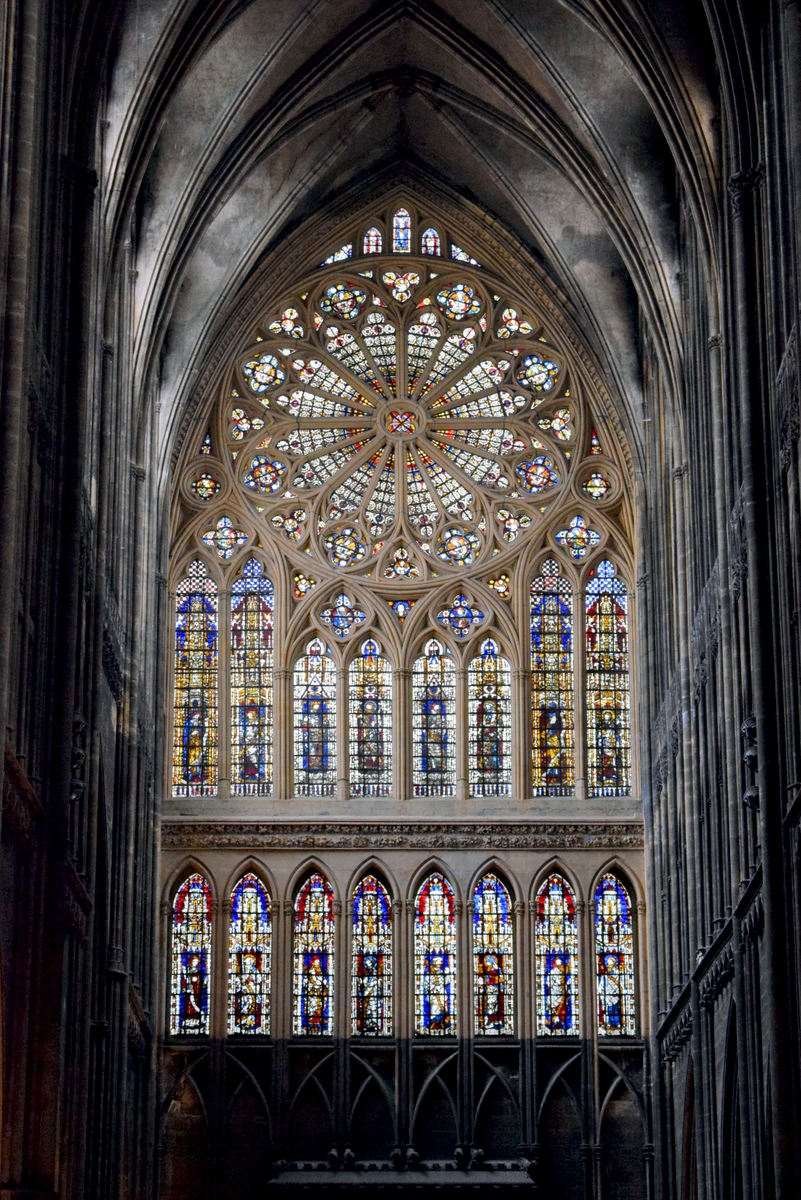
The stained-glass windows from Hermann de Münster © French Moments
Theobald de Lixheim and the north transept
Now head towards the north transept.
Here you will find another monumental window, completed in 1504 and associated with Theobald de Lixheim, named after the small Lorraine town of Lixheim near Sarrebourg.
The scale of this window helps explain why the transept feels so luminous. Standing beneath it, it is difficult to think of the wall as a wall at all.
Then turn around.
Opposite it, in the south transept, is one of the great masterpieces of Renaissance stained glass in Lorraine.
Valentin Bousch and the Renaissance windows
The great windows of the south transept were created by Valentin Bousch, one of the most important stained-glass artists working in the region during the Renaissance.
Bousch, originally from Alsace, became closely associated with Metz Cathedral in the early 16th century. He and his workshop created a substantial proportion of the cathedral's surviving Renaissance glass, including windows in the transept and choir.
The large south-transept ensemble was completed in the early 1520s.
Look at the difference between these windows and the medieval glass you have already seen.
By Bousch's time, stained-glass artists were increasingly treating a window almost like a monumental painting. Figures became more naturalistic, compositions more ambitious and the effects of perspective more sophisticated.
This was one of the great periods of stained-glass production in Lorraine, and an unusually large proportion of Metz Cathedral's historic glass dates from the Renaissance.
But the story does not stop there.
One of the things I find most fascinating about Metz Cathedral is that modern artists were not kept at a respectful distance from the medieval building. They were invited in.
Laurent-Charles Maréchal and the 19th-century revival
The story of stained glass at Metz Cathedral did not stop with the Renaissance.
During the 19th century, Lorraine experienced a major revival of stained-glass art, and one of its leading figures was the Metz-born artist Laurent-Charles Maréchal. Between 1842 and 1872, his workshop restored several of the cathedral's historic windows and also created new stained glass for the choir and the Bishops' Chapel.
Maréchal was one of the best-known French glass painters of his generation, and his work helped reconnect the cathedral with the stained-glass tradition that had made Metz famous centuries earlier.
His contribution also forms an important bridge in the story of the building: after the medieval and Renaissance masters came the 19th-century revival, followed in the next century by artists such as Jacques Villon, Roger Bissière and Marc Chagall.
Jacques Villon and the Chapel of the Blessed Sacrament
The first major modern intervention to look for is in the Chapel of the Blessed Sacrament, on the south side of the nave.
The windows here were designed by Jacques Villon and installed in 1957.
Villon was the artistic name of Gaston Duchamp, the elder brother of Marcel Duchamp. His work looks immediately different from the medieval and Renaissance windows elsewhere in the cathedral.
The colours are bold and the forms increasingly simplified, yet the subjects remain connected with Christian imagery and the Eucharist.
If you happen to walk around the cathedral towards dusk, these windows are also worth looking at from outside. When the interior is illuminated, their colours can be particularly striking.
Roger Bissière: two windows, two atmospheres
Another modern artist represented in the cathedral is Roger Bissière.
His abstract windows were installed in 1959 above two of the side entrances.
They are very different from Chagall's more recognisable figures and biblical scenes. Instead, Bissière used coloured shapes that resemble a mosaic.
There is also a clever relationship with their position in the building.
On one side you will see cooler, predominantly blue tones; on the other, warmer orange and golden colours.
They are easy to pass beneath without noticing, so remember to look up when approaching the side doors.
Where can you find Marc Chagall's windows in Metz Cathedral?
For many visitors, Marc Chagall's stained-glass windows are the most famous modern works inside Metz Cathedral.
You will find them primarily in the north transept and the ambulatory around the choir.
Chagall worked on the Metz windows during the 1960s, and the surviving ensembles were installed principally between 1962 and 1969.
Their subjects are drawn largely from the Old Testament.
Among the biblical stories represented are Creation and the Garden of Eden, Abraham, Moses and other episodes that recur throughout Chagall's work.
But even if you know nothing about the subjects, you will probably recognise his visual language immediately.
There are intense blues, flashes of red, floating figures and animals, and scenes that seem to exist somewhere between a biblical narrative and a dream.
That makes Chagall's windows particularly interesting in this setting.
They are unmistakably modern, yet they do not feel detached from the medieval cathedral around them. Light provides the connection.
My advice for finding the Chagall windows
Don't expect all the Chagall glass to be grouped together in one obvious chapel with a large sign saying “Chagall”.
Walk towards the choir and explore the north side of the ambulatory and north transept carefully.
And give your eyes time to adjust.
On my visits, I have found that looking at stained glass through a camera first is often the worst way to see it. Stand back, look at the complete window and let your eyes follow the colours before trying to identify individual figures.
Only afterwards move closer to the details.
Chagall may be the name that brings many visitors to this part of the cathedral, but his work makes more sense when you have already seen Hermann de Münster and Valentin Bousch. You begin to realise that Chagall is simply the latest chapter in a much longer story.
Or rather, he was one of the latest chapters.
Because Metz Cathedral has continued adding contemporary glass.
Kimsooja and the stained glass of the 21st century
The most recent major addition is the work of the South Korean artist Kimsooja.
Her new stained-glass windows were commissioned as part of the celebrations marking the 800th anniversary of the Gothic cathedral and were inaugurated in September 2022.
Her windows occupy part of the triforium in the Saint-Nicolas Chapel, in the south transept.
Unlike the biblical scenes of Chagall or the figurative Renaissance windows of Bousch, Kimsooja's work is completely abstract.
The windows combine traditional coloured blown glass with dichroic glass, a modern material that reflects and transmits different colours according to the angle of the light and the position of the viewer.
This means the effect is never entirely fixed.
Move a few steps, or return at another time of day, and the colours change.
I like the idea that a cathedral whose identity has been shaped by light for centuries is still experimenting with what stained glass can do today.
Eight centuries of light
It would be easy to describe Metz Cathedral simply as the cathedral with 6,500 square metres of stained glass.
But I think that misses what makes the windows so interesting.
You can stand in one building and see glass from the Middle Ages, the Renaissance, the 19th and 20th centuries, and the 21st century.
Hermann de Münster worked here in the 14th century. Valentin Bousch followed during the Renaissance. Jacques Villon, Roger Bissière and Marc Chagall brought modern art into the cathedral after the Second World War. Kimsooja continued the story in our own century.
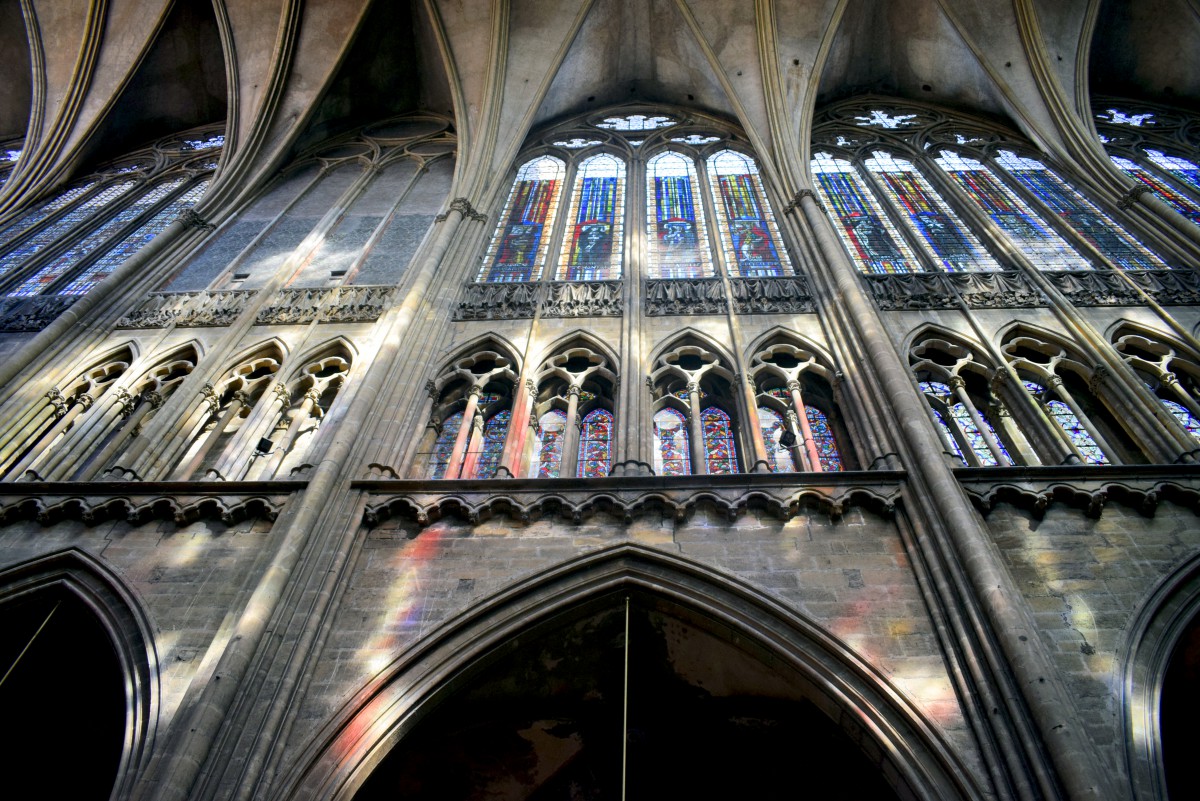
Looking up! © French Moments
Few places allow you to see such a long history of stained glass without leaving the building.
And once you have finished looking at the windows, remember to bring your eyes back down to ground level.
There are several other details inside Metz Cathedral that are remarkably easy to miss.
Other Details You Shouldn't Miss Inside
Once you have spent time looking at the stained glass, bring your eyes back down.
Metz Cathedral contains several smaller details that are easy to miss, yet some are among the most unusual things in the building.
The Renaissance organ in the triforium
One of my favourites is the small swallow's-nest organ suspended high in the triforium.
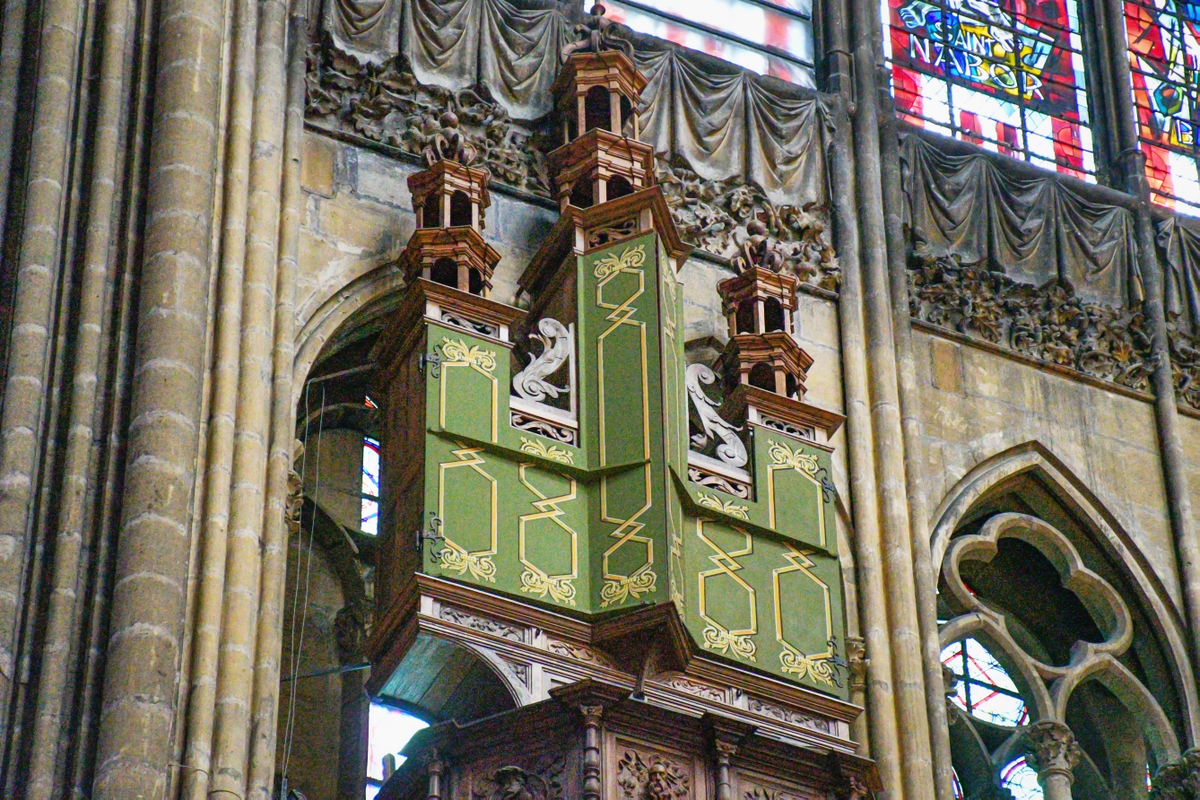
Detail of the Renaissance organ © French Moments
Its position dates back to 1537, when an organ was installed here by Jehan de Trèves. The present instrument was completely reconstructed in 1981 by Marc Garnier, in the style of a Flemish organ from the end of the Renaissance.
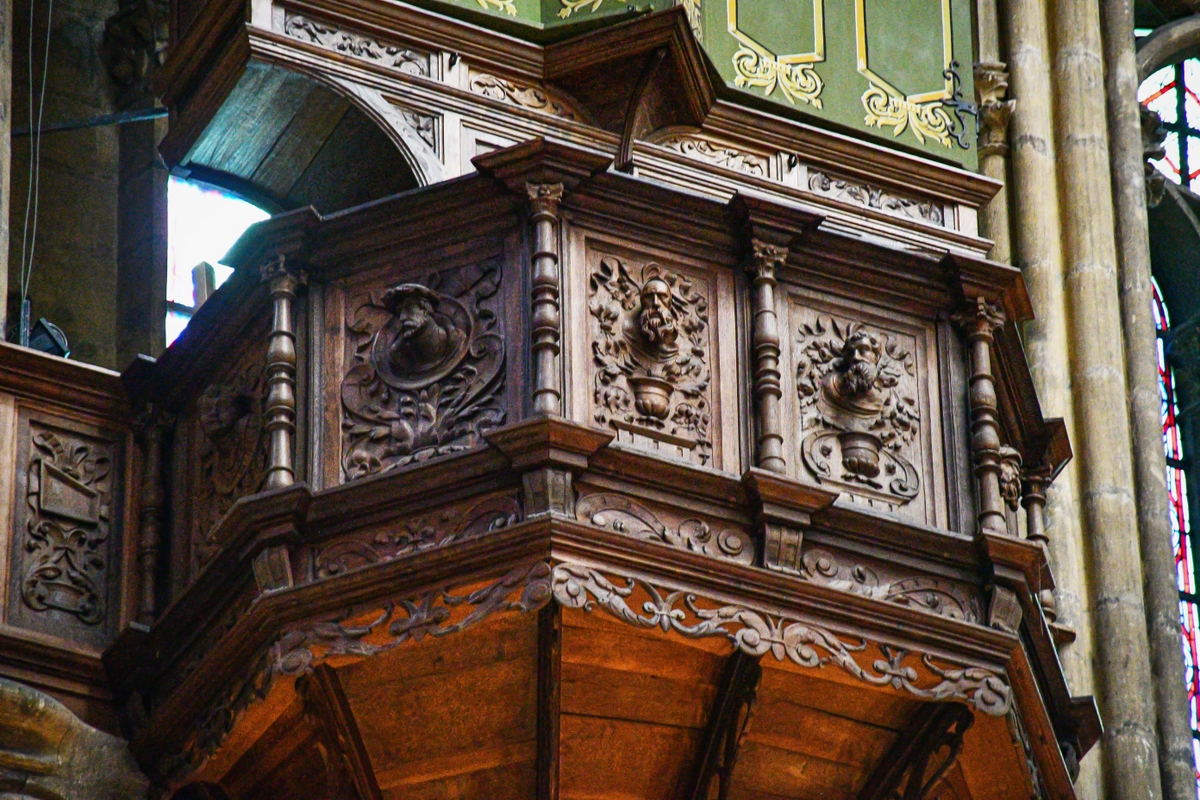
The wooden panels of the Renaissance organ © French Moments
It looks almost like a piece of furniture attached to the wall rather than the kind of monumental organ most people expect to see in a cathedral.
And Metz actually has four organs today: the Renaissance-style instrument in the triforium, an organ behind the high altar incorporating work by Aristide Cavaillé-Coll, another in the south transept, and a small organ in the crypt.
Still, the triforium organ is the one I would make a point of looking for.
It is high enough above the floor that many visitors simply walk underneath it without noticing.
An ancient Roman bath turned into a baptismal font
Near the entrance is something even older than the cathedral itself.
The huge baptismal font is made from an ancient porphyry basin traditionally identified as a Roman bath.
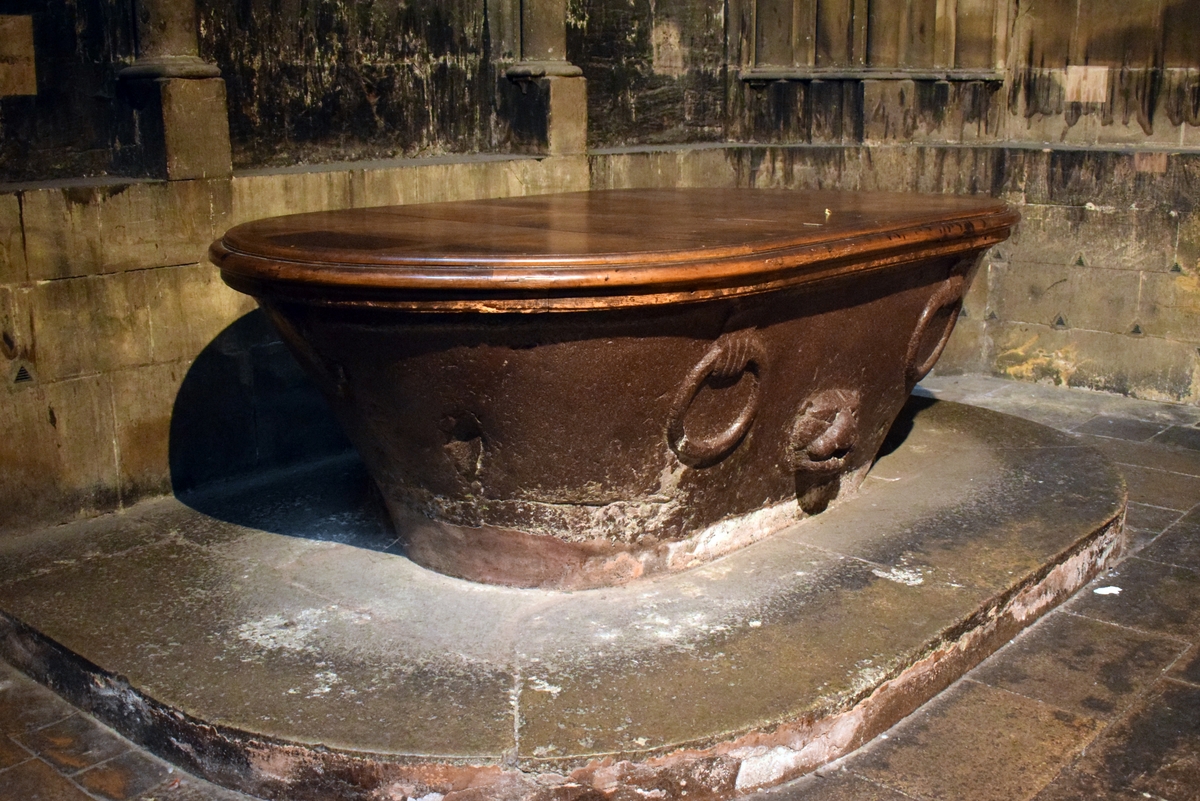
The baptismal font © French Moments
The stone came from Egypt, and the basin dates from Antiquity, centuries before the Gothic cathedral was built.
At some point, it was given a completely different purpose and transformed into a Christian baptismal font.
I find that contrast fascinating.
You are standing inside a medieval cathedral, looking at an object that had already existed for many centuries before the first Gothic stones were laid.
It is also surprisingly large. If you walk past it assuming it is simply another piece of church furniture, you can easily miss just how unusual it is.
Look for the strange culs-de-lampe
Now look upwards again — but not all the way to the vaults.
Just below the triforium are roughly 180 carved culs-de-lampe, or corbels, supporting architectural elements around the interior.
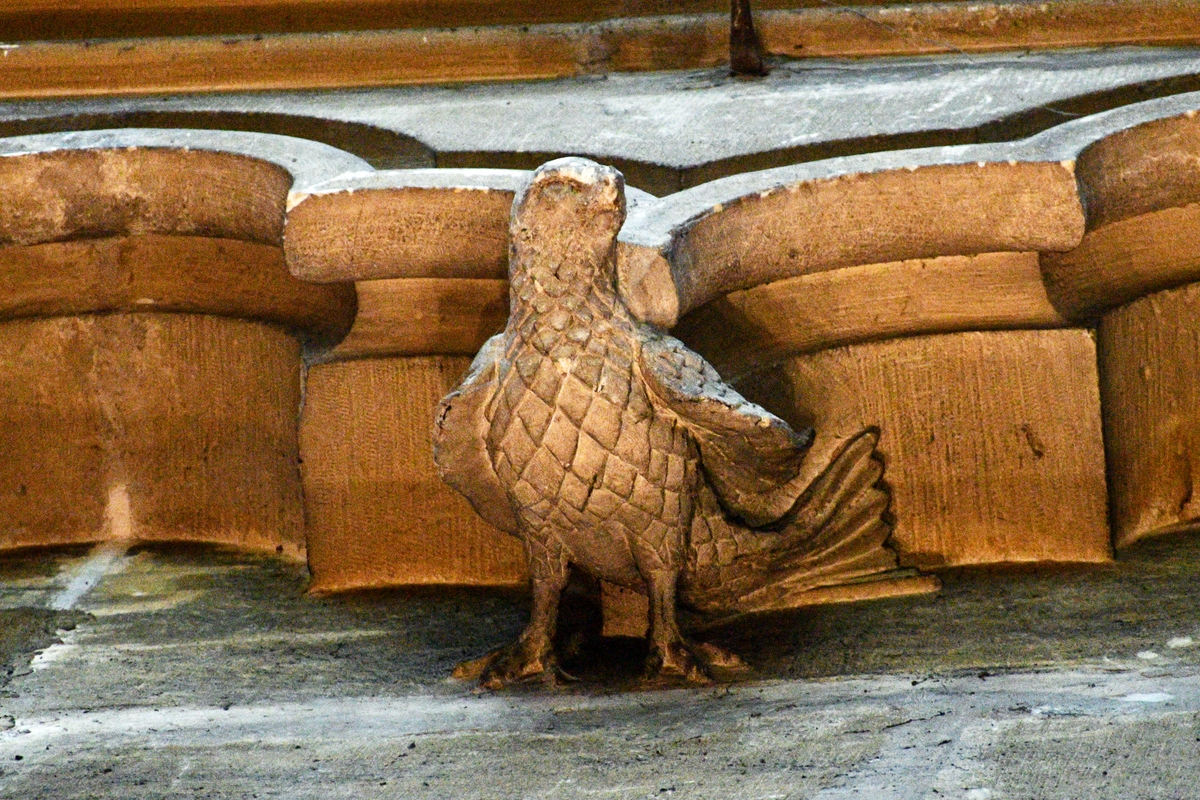
An eagle (cul-de-lampe) © French Moments
This is where the medieval and later sculptors seem to have had some fun.
You will find human faces, people praying or crouching, animals, foliage, imaginary creatures and demons.
Some are solemn.
Others are not.
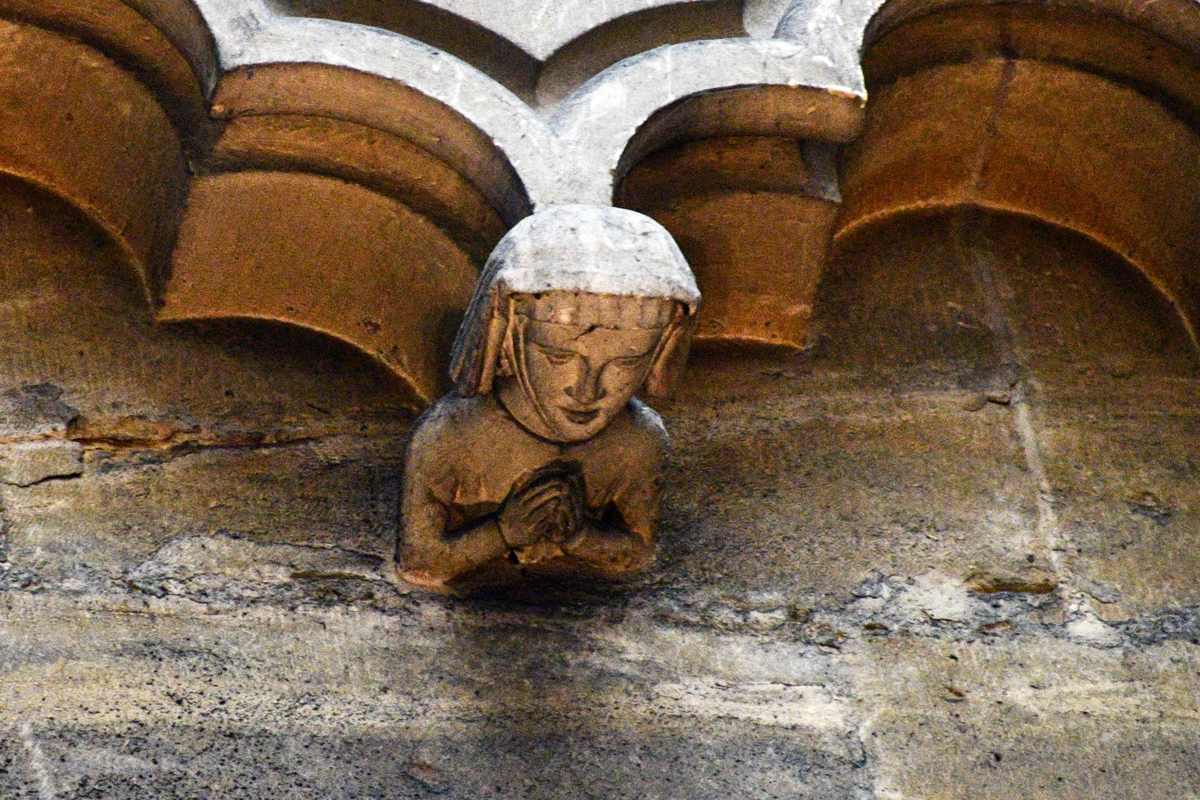
A woman in prayer (cul-de-lampe)
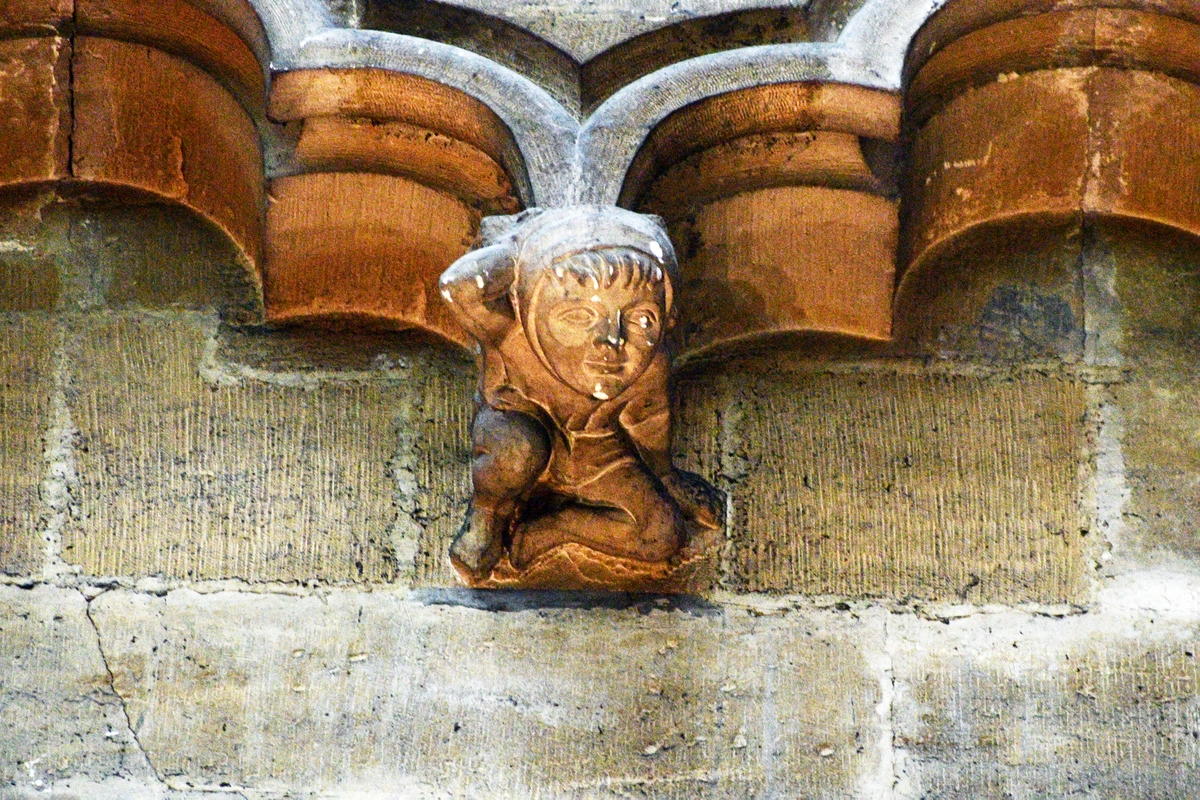
A man in crouching position (cul-de-lampe)
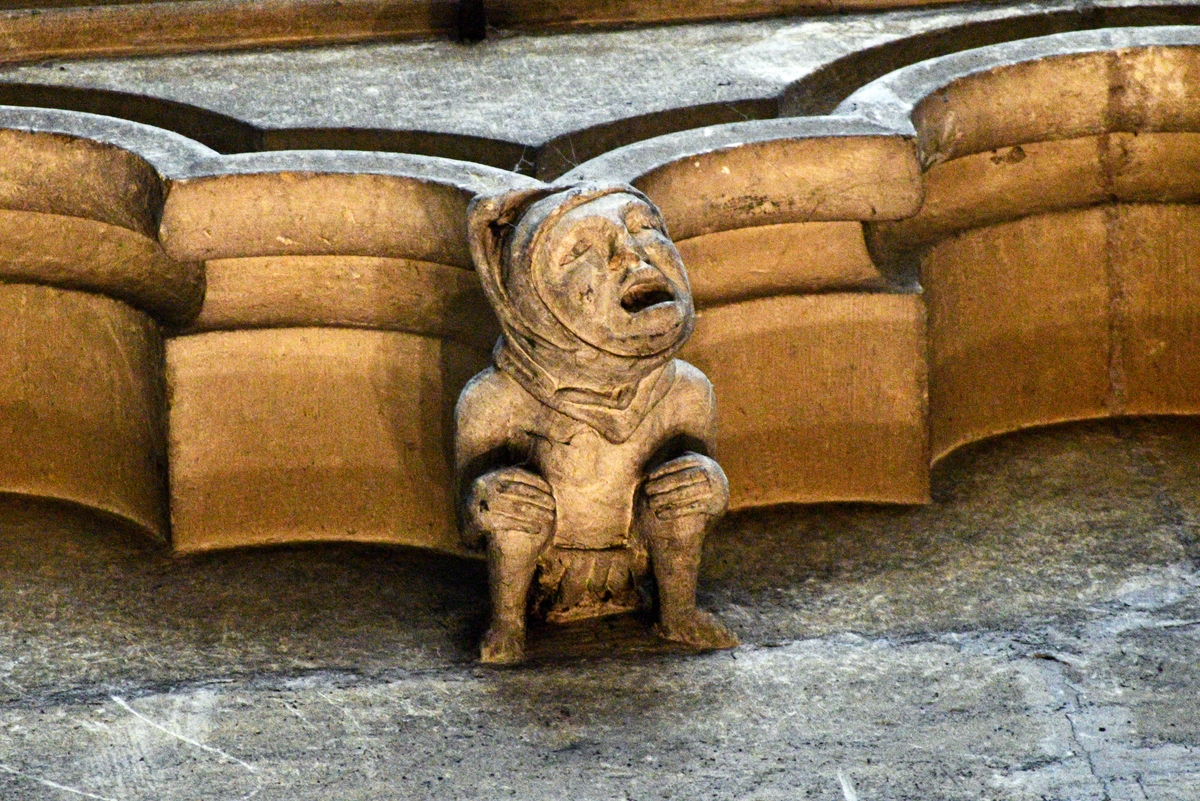
A singing (or crying?) fellow (cul-de-lampe)
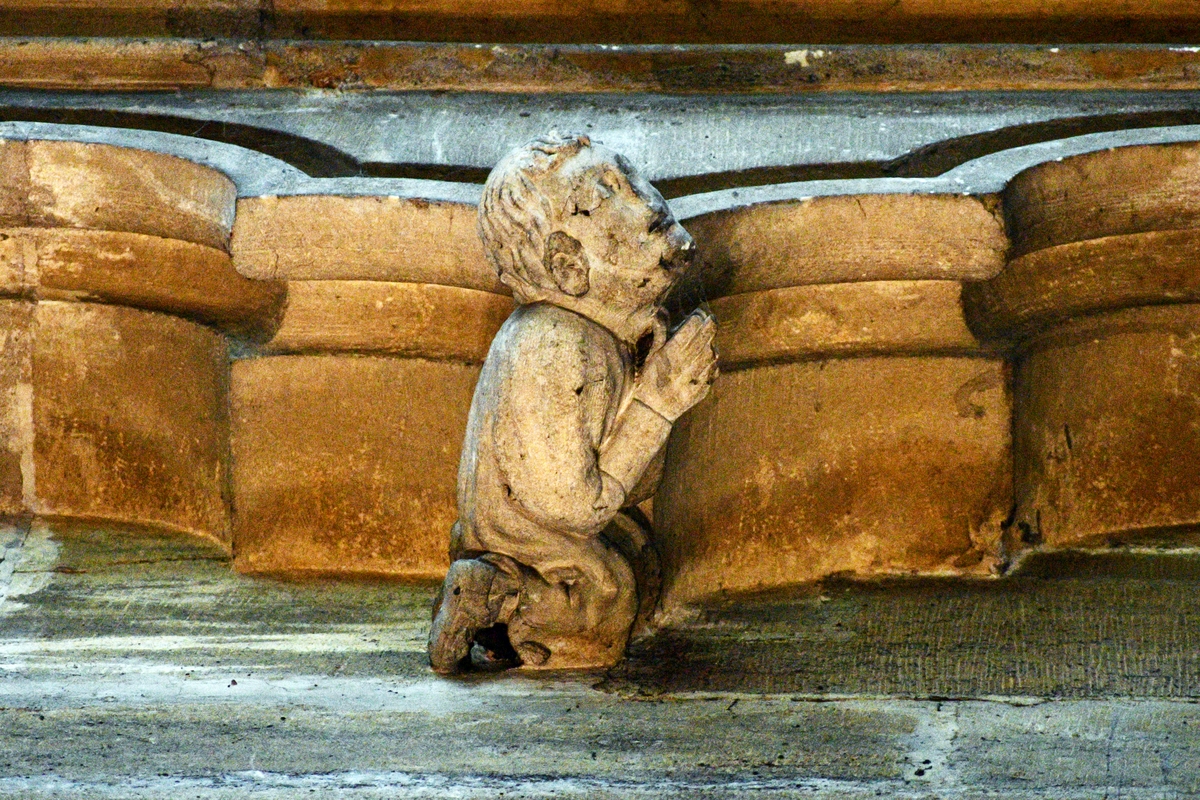
A praying man (cul-de-lampe)
One particularly cheeky figure near the bishop's seat is shown turning his backside towards the viewer.
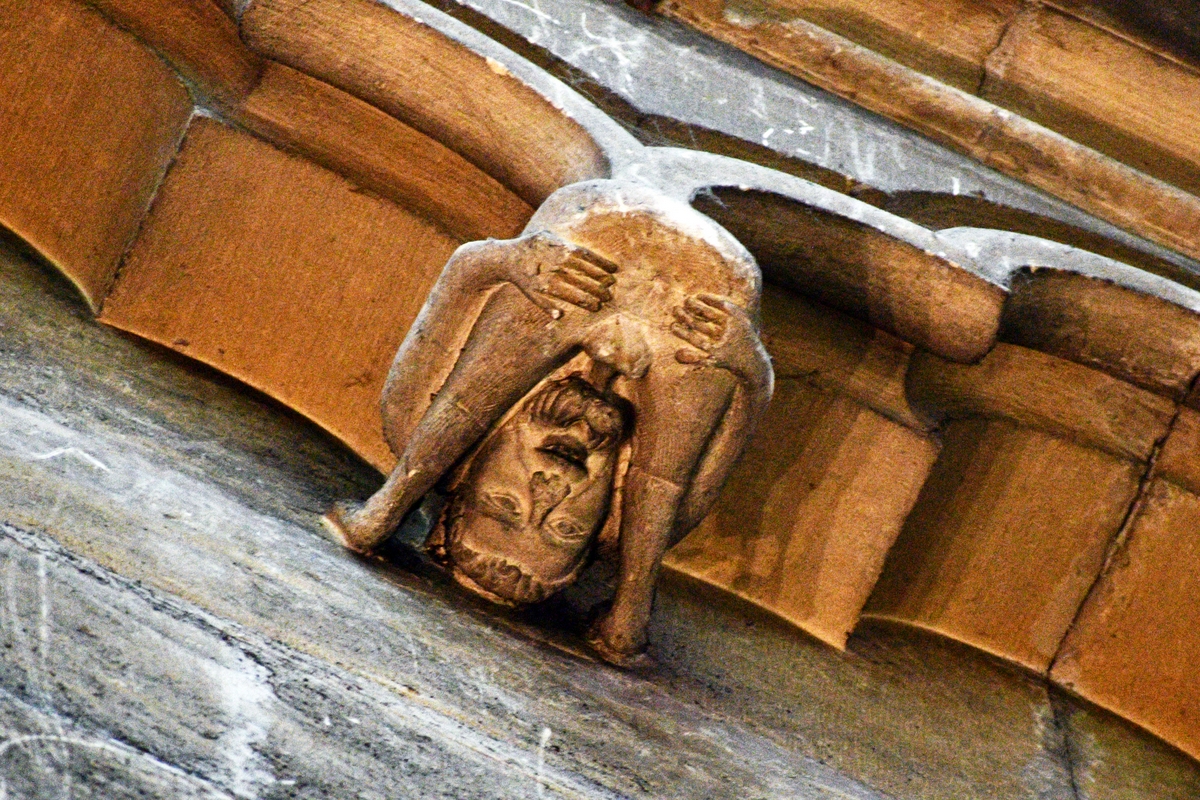
A man showing his bottom (cul-de-lampe) © French Moments
It is the sort of detail that surprises people who imagine medieval churches as places filled exclusively with dignified saints and angels.
In reality, medieval religious buildings often contain an extraordinary mixture of the sacred, the everyday, the grotesque and the humorous.
Once you start looking for these small sculptures, walking through the cathedral becomes rather addictive.
The choir stalls
The wooden choir stalls are another detail worth examining if access allows.
Their carved decoration includes figures, animals and ornamental motifs, and they form part of the rich liturgical furnishings around the choir.
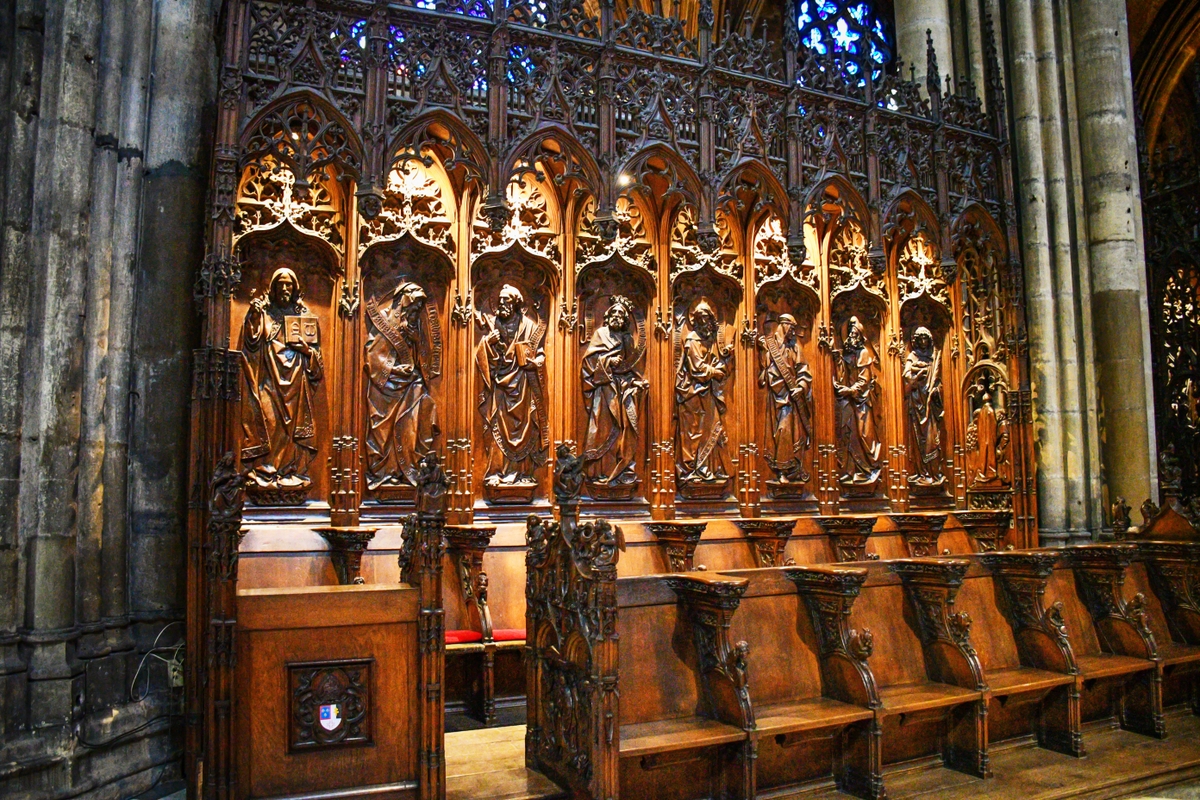
A section of the choir stalls © French Moments
Access to this area can be restricted, so you may not always be able to walk close to them during an ordinary visit. Guided tours sometimes provide a better opportunity to see this part of the cathedral.
If the choir is closed, you can still look towards the stalls from the accessible areas around the crossing and ambulatory.
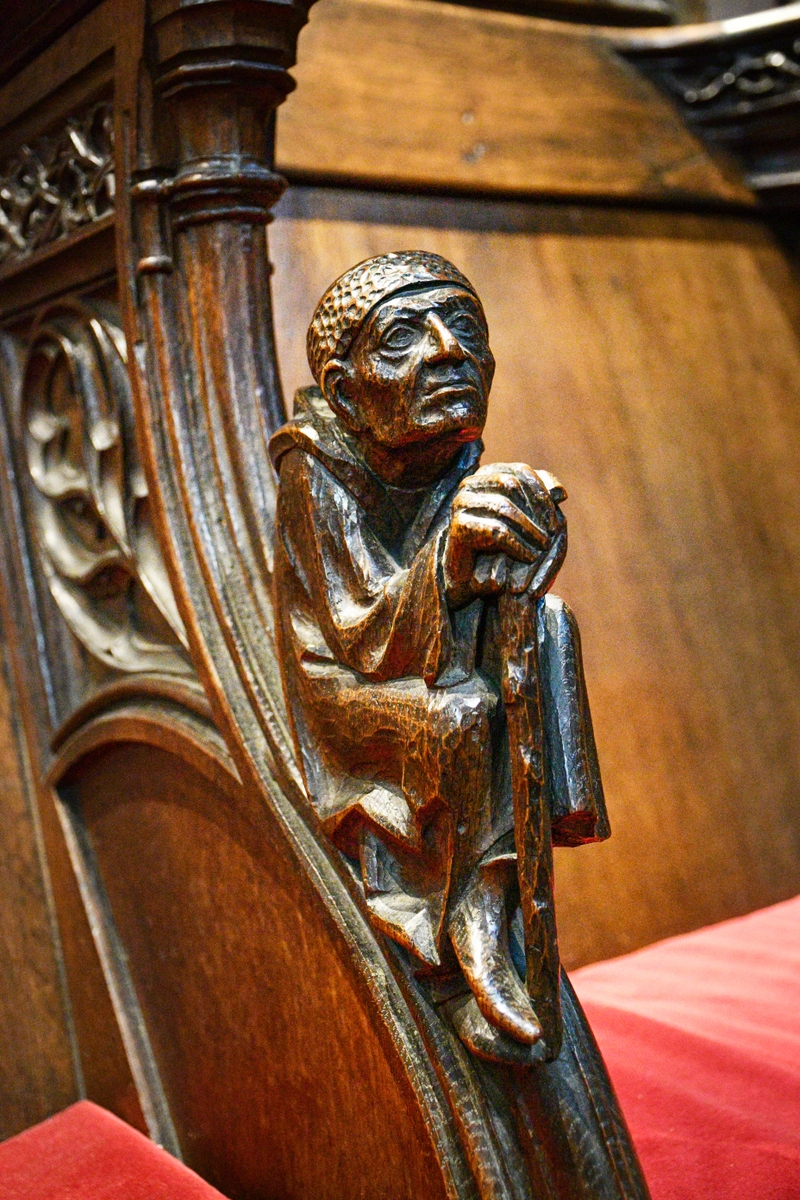
A monk, Choir stalls

This one looks very bored! Choir stalls
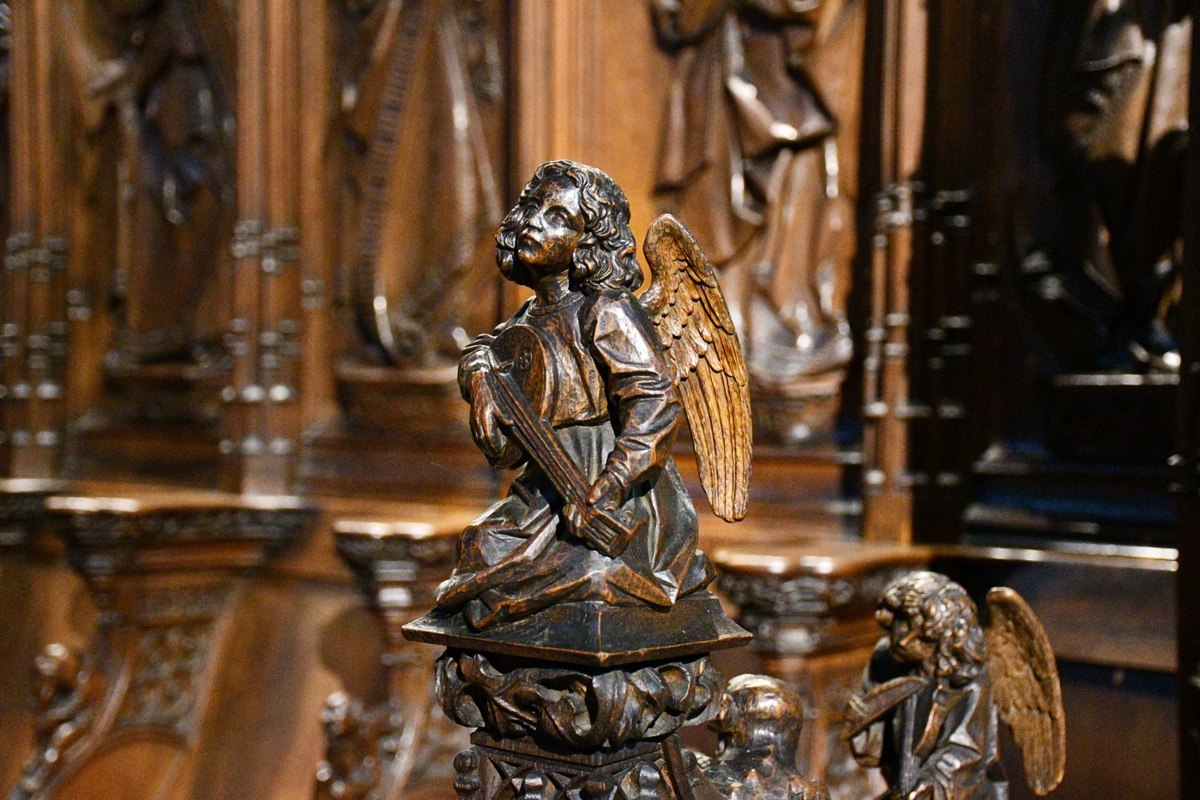
An angel, Choir stalls
The choir stalls may look medieval, but they are actually Neo-Gothic and much more recent. They were created by the Colmar woodcarver Théophile Klem, who worked on them in 1913–1914, and were finally installed in the cathedral in 1922–1923.
Look up in the radiating chapels
Continue around the ambulatory, the passage that runs behind the choir.
In the radiating chapels, look at the points where the ribs of the vaults meet.
The bosses are brightly decorated and include a number of coats of arms.
Among them you can spot the arms of the Duchy of Lorraine, a useful reminder that although Metz developed for centuries as a politically independent city, the cathedral also stands within the wider historical landscape of Lorraine.
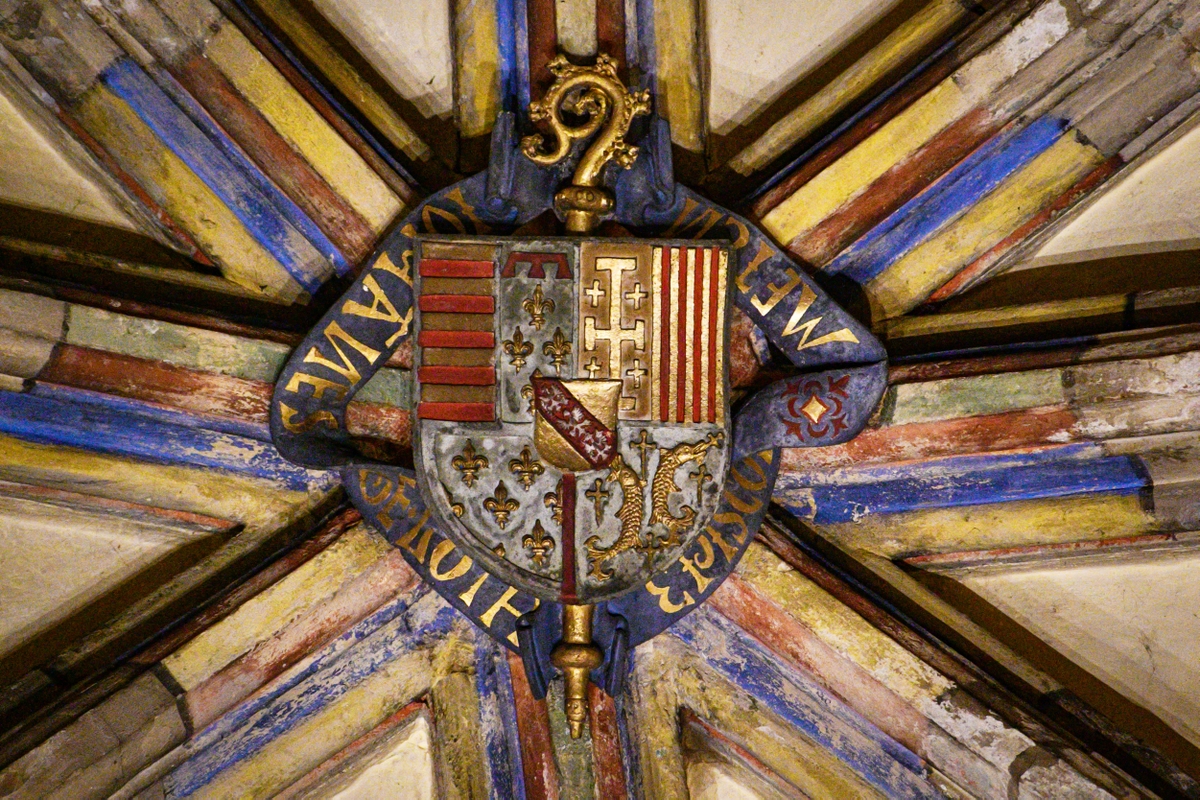
The coat of arms of the Dukes of Lorraine, radiant chapel in Metz Cathedral © French Moments
These ceiling details are easy to overlook because most visitors are concentrating on the windows at eye level.
Don't try to see everything in five minutes
This is probably the point where Metz Cathedral rewards a slower visit.
The famous features — the height, the stained glass and the Chagall windows — catch your attention immediately.
The smaller things take longer.
A face beneath the triforium. An ancient porphyry basin near the entrance. A carved figure behaving rather badly. A tiny coat of arms high in a chapel vault.
They may not be what brought you to Metz Cathedral in the first place, but they are often the details you remember afterwards.
And there is still another part of the building to explore below ground.
The crypt and treasury contain some of the cathedral's oldest objects — as well as Metz's most famous dragon.
The Crypt and Cathedral Treasury
Beneath Metz Cathedral lies another part of the building that is easy to overlook: the crypt and treasury.
This is where some of the cathedral's most unusual objects are kept, including precious liturgical pieces, episcopal artefacts and one creature that has become inseparable from the identity of Metz.
The cathedral treasury
The treasury brings together objects accumulated over many centuries of religious life at Saint Stephen's Cathedral.
Among them are chalices, episcopal croziers, vestments and other objects used in worship, as well as pieces associated with important figures in the history of the Church in Metz.
One of the best-known is the so-called Cope of Charlemagne.
The name is certainly memorable, but it should not be taken to mean that Charlemagne himself wore it. The traditional name reflects the long history and prestige attached to the object rather than a securely documented connection with the emperor.
Another important piece is the ring associated with Saint Arnoul, bishop of Metz in the 7th century and an ancestor of the Carolingian dynasty.
These objects help tell a different story from the architecture upstairs. The nave and stained glass show how the cathedral was built and transformed; the treasury reflects centuries of worship, bishops and religious tradition.
The bishops of Metz
The crypt also contains monuments and memorials connected with former bishops of Metz.
Among the important figures associated with the cathedral are Cardinal Robert de Lenoncourt, Cardinal Claude de Givry and Bishop Paul Dupont des Loges, who played a major role in the restoration of the cathedral during the 19th century.
Their presence is a reminder that Saint Stephen's is not simply a historic monument. It has remained the seat of the bishops of Metz for centuries and continues to function as a living cathedral today.
But there is one resident of the crypt who is considerably less ecclesiastical.
Meet the Graoully, Metz's legendary dragon
Look upwards and you may come face to face with the Graoully.
This dragon-like creature is one of the great symbols of Metz.

The Graoully, the dragon of Metz © French Moments
According to the traditional legend, when Saint Clement, the first bishop of Metz, arrived to convert the city to Christianity, the Roman amphitheatre had become the haunt of poisonous snakes and a terrifying dragon known as the Graoully.
Clement confronted the monster, subdued it and led it away from the city.
Whether or not you believe the story is beside the point. For centuries, the Graoully became part of Metz's religious and civic traditions.
An effigy of the creature was once carried through the streets during processions. The historic representation now associated with the cathedral was eventually placed in the crypt in 1973.
The dragon escaped the crypt long ago in another sense: you will find the Graoully all over Metz today, on sculptures, signs, souvenirs and the city's visual identity.
So if you notice dragons appearing elsewhere while exploring the old town, you now know where the story comes from.
A crypt being renewed in 2026
There is an important practical point if you are visiting in 2026.
The crypt and treasury have been undergoing a major redevelopment designed to improve the presentation of the collections, visitor access and conservation conditions.
If seeing the treasury and the Graoully is important to you, check the current visiting arrangements before your trip.
The main cathedral, however, has plenty more to discover above ground.
And before leaving, there is one part of Metz Cathedral we still need to look at from the outside and, when visits are possible, from the inside too: its towers and bells.
The Towers of Metz Cathedral
Metz Cathedral does not have the familiar pair of towers standing on either side of its western façade.
Instead, its two main towers rise from the sides of the nave: the Tour de la Mutte to the south and the Tour du Chapitre to the north.
They may look like two cathedral bell towers, but historically they had very different jobs.
One belonged above all to the city.
The other belonged to the cathedral.
The Tour de la Mutte: a civic belfry inside a cathedral
The most distinctive is the Tour de la Mutte, whose slender Gothic spire rises to around 90 metres (295 ft).
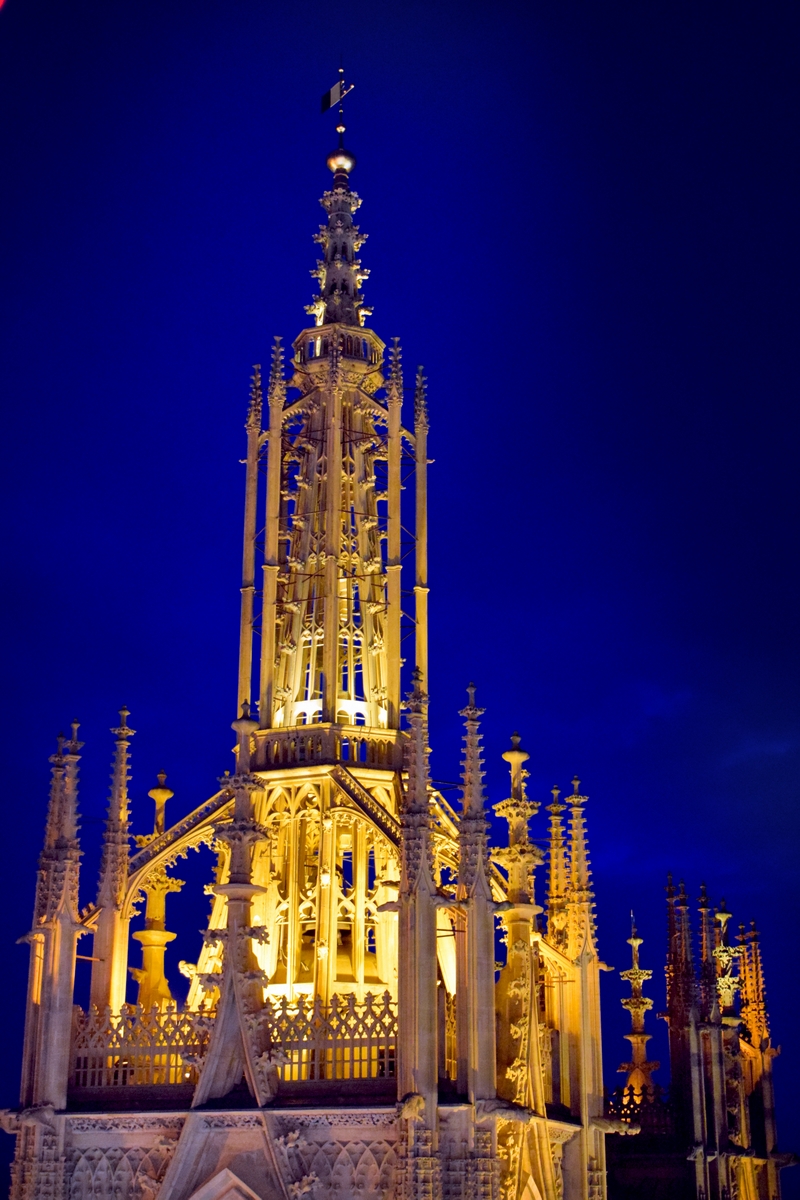
The spire of Metz Cathedral © French Moments
What makes it unusual is that it was not simply a church bell tower.
For centuries, it functioned as the municipal belfry of Metz, closely connected with the civic life of the city.
That distinction matters.
During the Middle Ages, Metz developed into a powerful self-governing city within the Holy Roman Empire. The Mutte was therefore not primarily there to call people to Mass. Its bells could summon the citizens, warn them of danger and mark important events in the life of the city.
Even though the tower forms part of the cathedral, it represented civic rather than ecclesiastical power.
Once you know that, its place in the building becomes much more interesting.
The enormous Mutte bell
The tower takes its name from its most famous bell, La Mutte.
A civic bell was already being used in Metz by the early 14th century. The present Mutte was cast in 1605, following several earlier versions.
For generations, you may have read that this enormous bell weighed 11 tonnes.
There is now a more precise answer.
When the bell was removed during the major restoration of the tower in the 2010s, it was actually weighed. Together with its fittings, it came to 8.7 tonnes.
So the traditional figure of 11 tonnes — repeated in many older books and guides — turned out to be an exaggeration.
Eight-point-seven tonnes is still quite a bell.
Its voice once carried across Metz to mark major civic occasions. It could warn of an attack, celebrate a victory or call the population together.
The bell was even struck at regular intervals on election days to remind the citizens of Metz to vote.
This was very much the voice of the city.
Why was the Mutte silent for so long?
The Mutte was traditionally swung when it rang, but moving several tonnes of bronze generates enormous forces within a medieval tower.
Concerns about the structure eventually made ringing it in this way too dangerous.
After sounding on 28 June 1919, when the Treaty of Versailles was signed, the Mutte fell silent for decades.
A major restoration of the tower between 2009 and 2015 included detailed structural studies, repairs to the bell frame and work on the bells themselves.
The Mutte was finally heard again in June 2015.
Modern restrictions mean that its movement can now be carefully controlled to protect the structure.
There is something rather wonderful about hearing a bell that has been part of the civic history of Metz for centuries — especially when you remember that its purpose was once to alert an entire city.
Look for the black-and-white weather vane
There is another clue to the civic identity of the Tour de la Mutte right at the top.
Its weather vane displays black and white, the traditional colours of Metz.
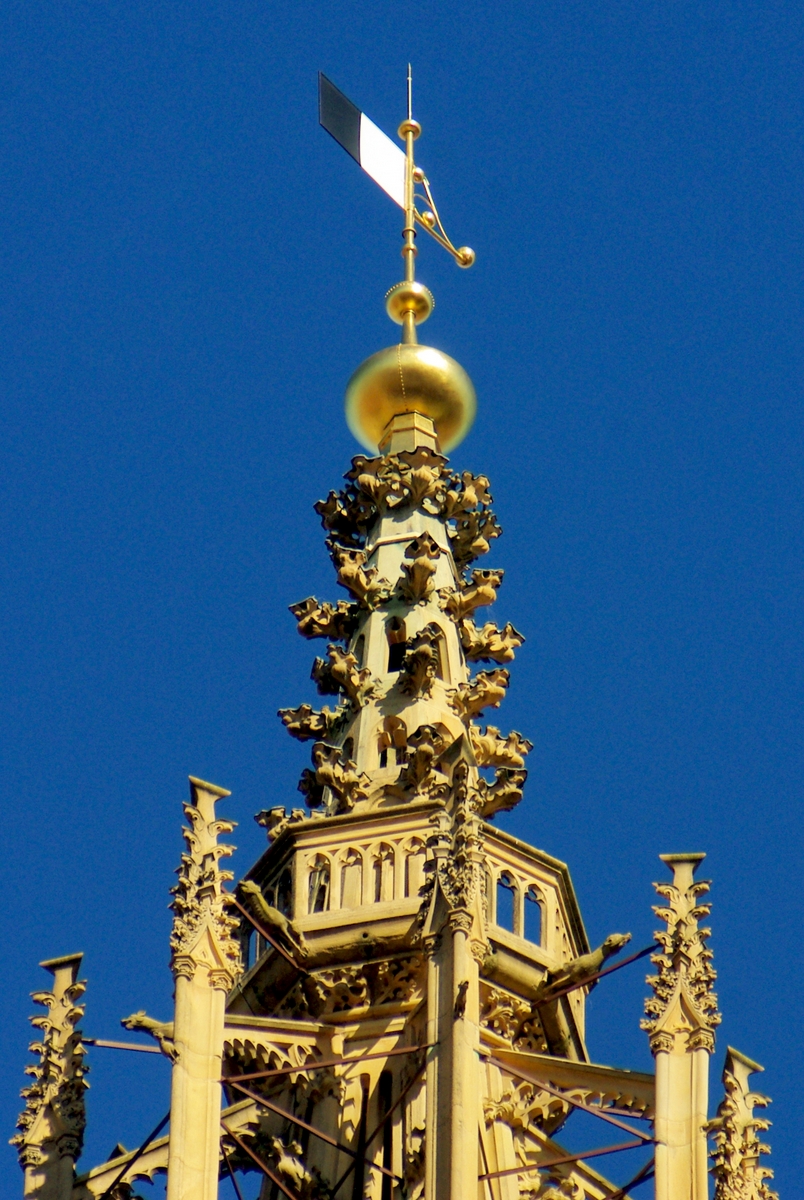
The top of the Tour de la Mutte © French Moments
The tower also once housed a watchman whose job was to survey the city from high above the rooftops.
From there, he could spot fires or other dangers and raise the alarm.
Two stone knights beneath the spire, dressed in armour and carrying weapons, further reinforce the tower's connection with the military and civic power of medieval Metz.
This makes the Tour de la Mutte an unusual combination: a municipal belfry physically incorporated into one of France's great Gothic cathedrals.
The Tour du Chapitre
On the opposite, northern side of the cathedral stands the Tour du Chapitre.
It rises to 69 metres (226 ft) and looks noticeably lower than the Tour de la Mutte because it has no spire.
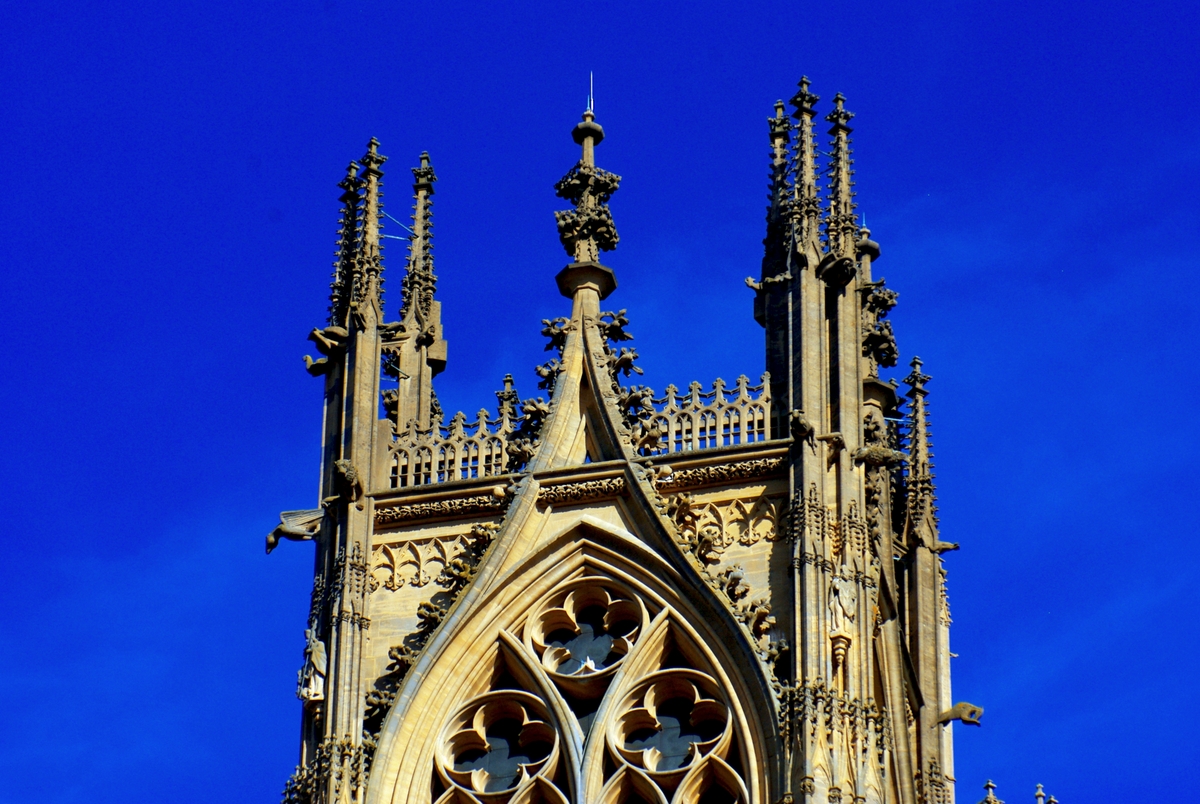
Tour du chapitre © French Moments
This is the tower that performs the more conventional role of a cathedral bell tower.
Its lower levels date from the Middle Ages, while the upper section was completed between 1840 and 1843.
At one stage, there were plans to make it much taller.
In the early 20th century, Paul Tornow proposed adding a Neo-Gothic spire that would have created a more balanced silhouette with the Tour de la Mutte. The project was never carried out.
How many bells are in the Tour du Chapitre?
The Tour du Chapitre now contains six bells.
They include the historic Marie and Catherine, alongside Clément, Marie-Immaculée and Étienne.
A sixth bell, named Paul, was added in 2020 as part of the celebrations marking 800 years since the beginning of the cathedral project.
Paul weighs a little over 500 kg and joined the five existing bells in the tower.
This gives us another useful distinction when looking at the cathedral:
The bells in the Tour du Chapitre belong principally to the religious life of Saint Stephen's Cathedral, while the Mutte developed from the civic traditions of Metz.
Two hidden towers at the east end
And then there are two more.
They are much smaller and so discreet that many visitors never realise they are towers at all.
Walk around the eastern end of the cathedral and look at either side of the ambulatory.
There you will find two small octagonal turrets: the Tour Charlemagne on the south side and the Tour de la Boule d'Or on the north.
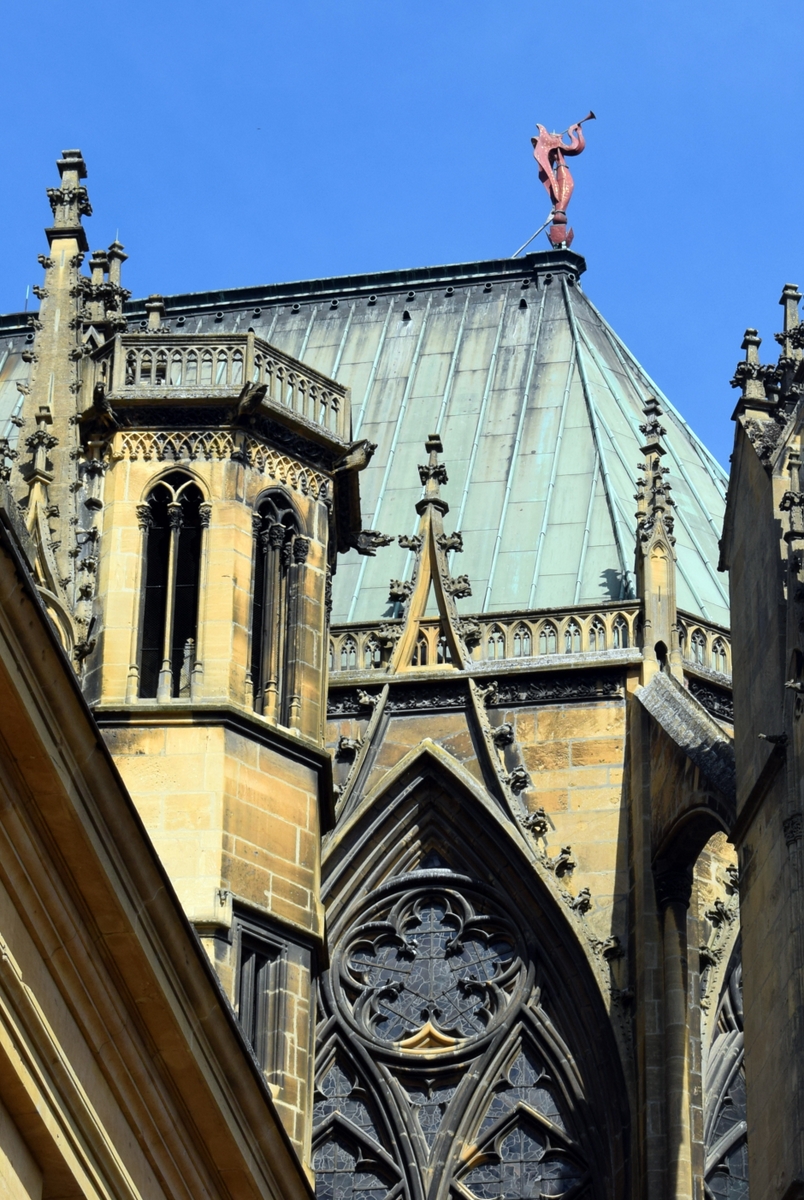
Tour Charlemagne © French Moments
They act partly as buttresses around the east end of the cathedral.
Their form also recalls an older regional architectural tradition found in Lorraine and the Rhineland, where church choirs were sometimes framed by towers.
The Tour de la Boule d'Or — the Tower of the Golden Ball — takes its curious name from the small gilded dome that once crowned it during the Renaissance. That feature has long since disappeared and was replaced by a Gothic-style spire.
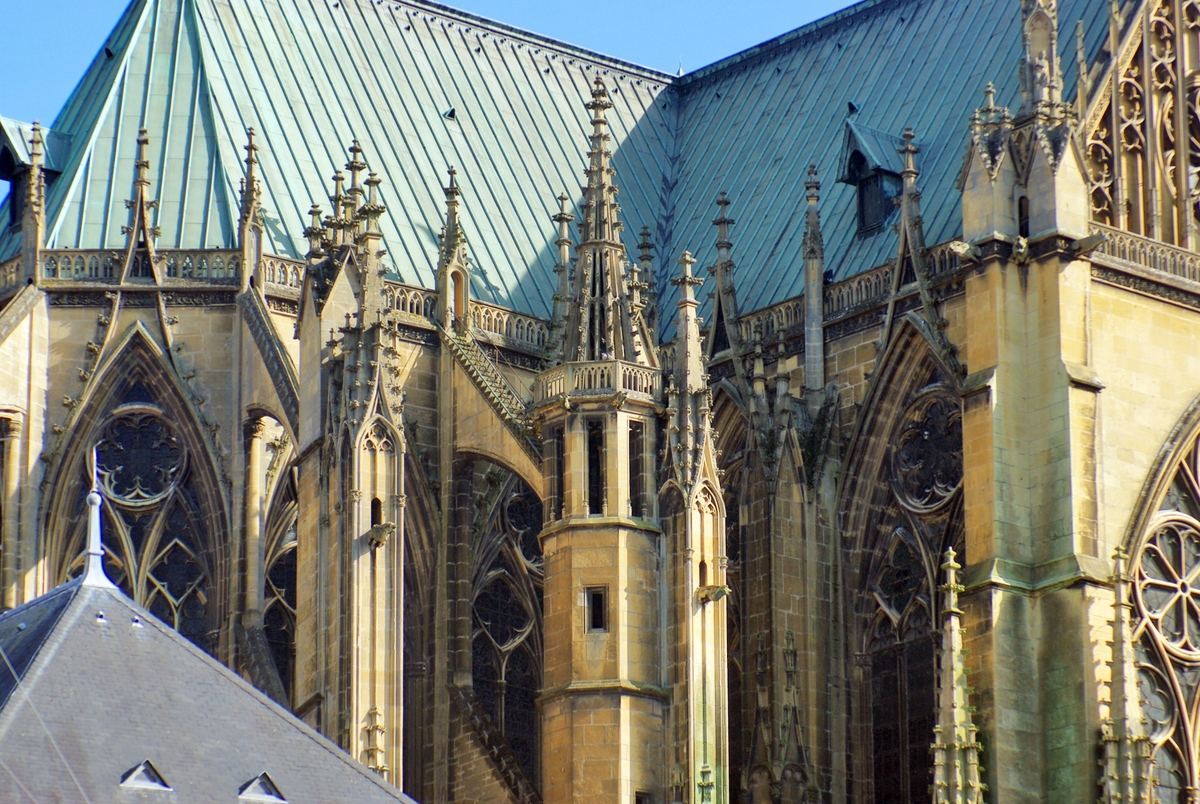
Tour de la Boule d'Or © French Moments
These are not towers that dominate the skyline like the Mutte.
You have to go looking for them.
Which, in a cathedral full of things that reward a second look, seems entirely appropriate.
Visiting Metz Cathedral: Practical Information
Metz Cathedral stands right in the historic centre of the city, on Place d'Armes, so it is very easy to include in a walking tour of old Metz.
Here are the main things to know before you go.
What are Metz Cathedral's opening hours?
In 2026, Metz Cathedral is open daily from 8 am to 6 pm, including Sundays.
These are the general opening hours for the cathedral itself. As this is an active place of worship, access for sightseeing can be restricted during Masses, funerals and other religious services.
I would therefore avoid planning your visit too close to a major service, particularly if seeing the stained glass and exploring the cathedral in detail are priorities.
Opening arrangements can also change for exceptional events. This will be particularly important around Pope Leo XIV's visit on 28 September 2026.
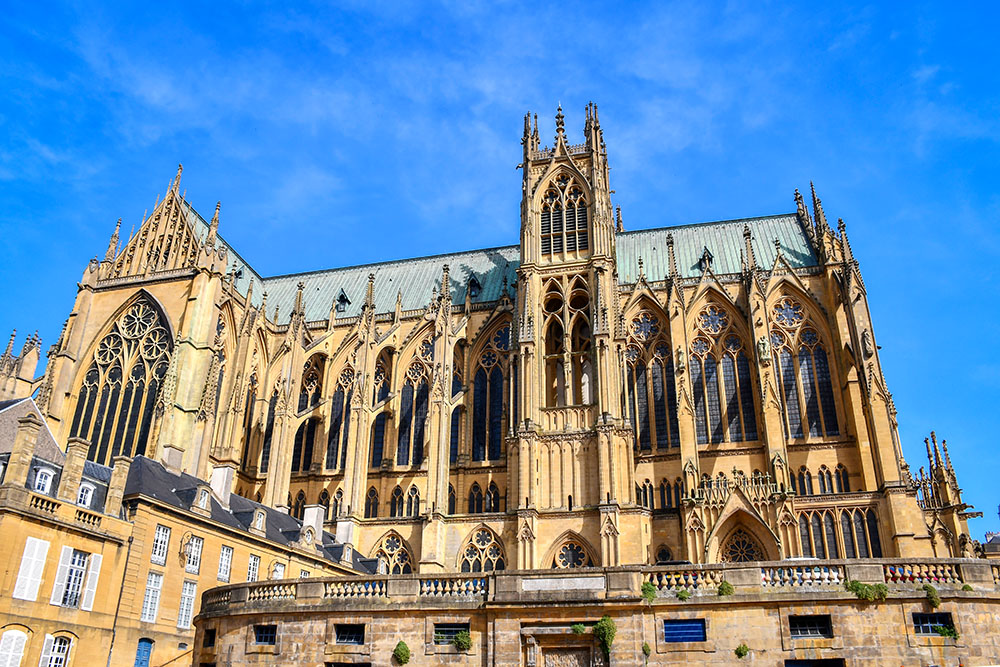
Metz Cathedral seen from Place de Chambre © French Moments
Is Metz Cathedral free to visit?
Yes. Admission to the main cathedral is free.
You do not need a ticket simply to enter, walk through the nave and see the main stained-glass windows.
This makes the cathedral particularly easy to incorporate into a day exploring Metz. You can also return later if the light is better — something worth considering if you are especially interested in the stained glass.
The crypt and treasury are different and may require a paid visit or a guided tour.
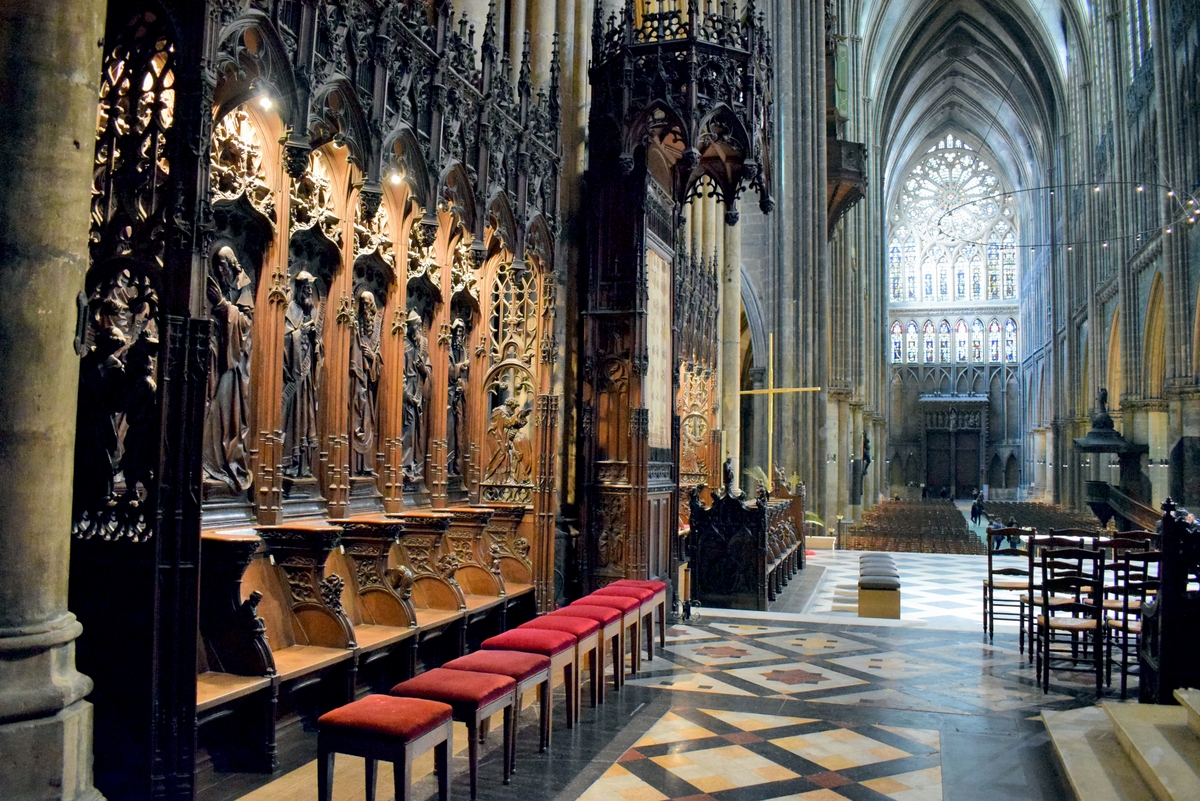
The stalls in the choir © French Moments
Can you visit Metz Cathedral during a religious service?
Metz Cathedral is first and foremost an active Roman Catholic cathedral.
Tourist visits are not permitted during liturgical celebrations, and religious services always take priority over sightseeing.
If a service is about to begin, you may therefore find parts of the cathedral closed to visitors or be asked to wait before continuing your visit.
Of course, those wishing to attend a service for worship rather than sightseeing may do so according to the cathedral's current programme.
Is Metz Cathedral accessible?
The main cathedral is listed as partially accessible to visitors with disabilities, with assistance where necessary.
The situation is more complicated in some historic areas of the building. The crypt and treasury, for example, have their own accessibility arrangements, and the towers involve stairs and are not part of the normal accessible visitor route.
If you have specific mobility requirements, I would check the latest information with the cathedral or Metz Tourist Office before your visit.
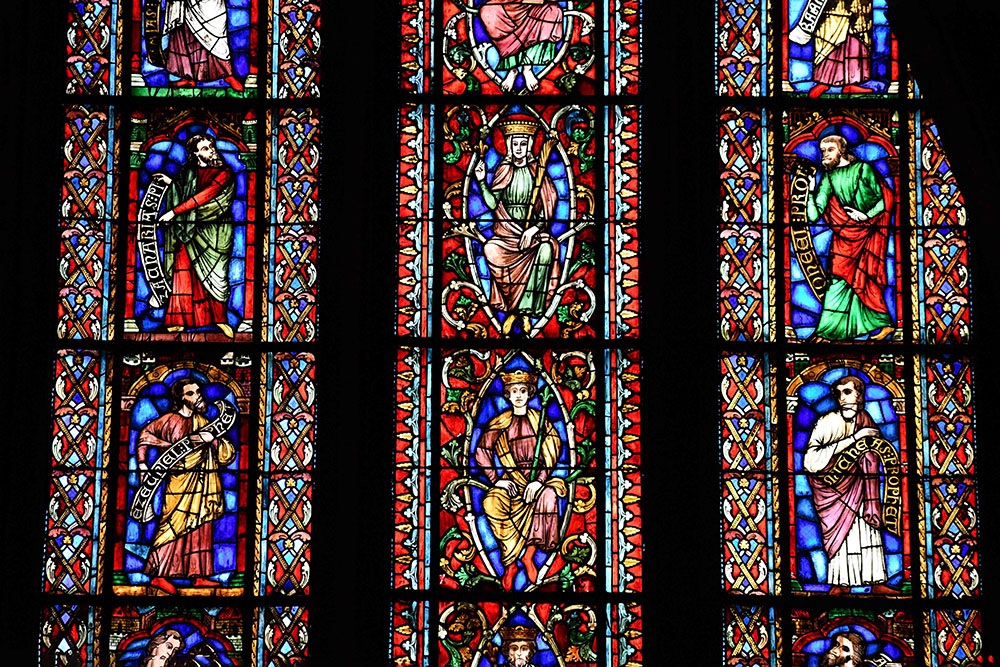
Stained-glass from the 19th century © French Moments
Are guided tours available?
Yes.
Metz Tourist Office organises guided visits that include the cathedral, while visits specifically devoted to Saint Stephen's Cathedral and its treasures are also offered at certain times.
Some tours require advance booking and are paid.
A guided visit can be particularly worthwhile if you want to understand the stained glass, because it is surprisingly easy to walk past an important window without realising who created it or what you are looking at.
The Tourist Office is conveniently located on Place d'Armes, immediately beside the cathedral.
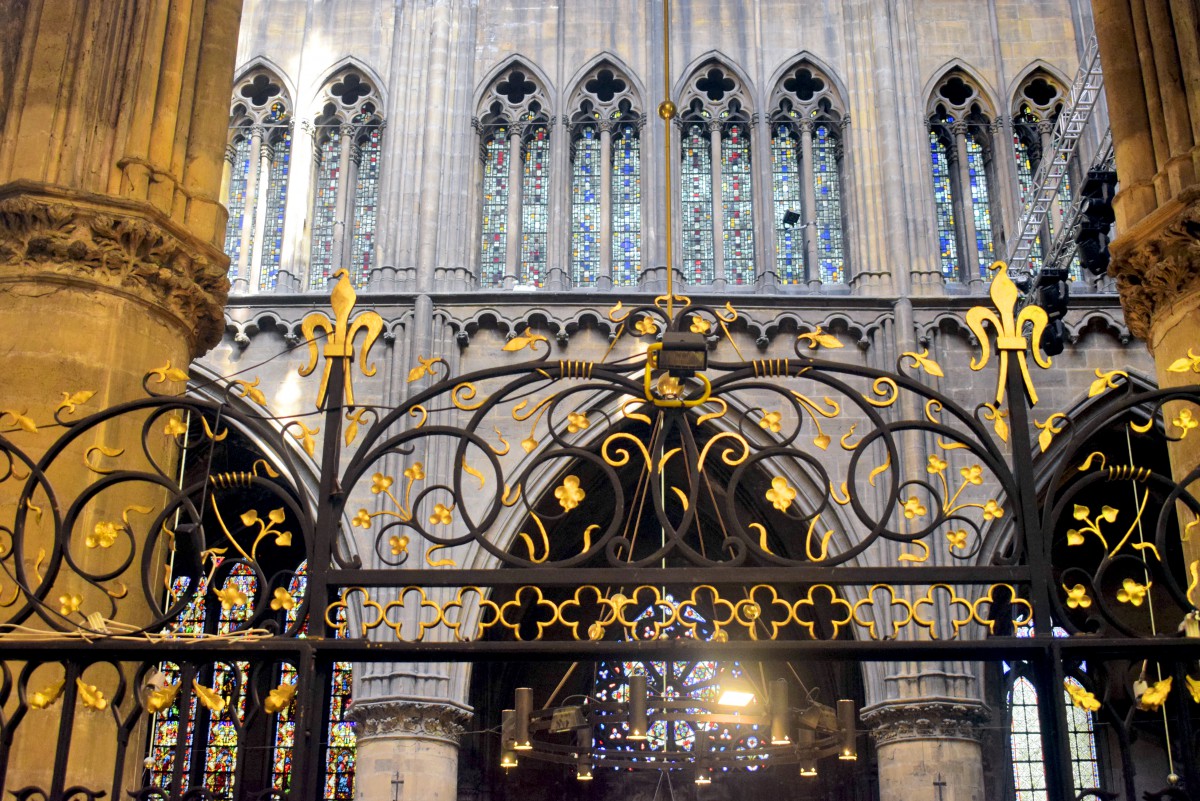
Inside Metz Cathedral © French Moments
Can you visit the crypt and treasury?
The crypt and treasury do not operate in quite the same way as the main cathedral.
They contain objects such as the so-called Cope of Charlemagne, Saint Arnoul's ring and the famous Graoully, but access may be through a separate paid or guided visit.
In 2026, the crypt has also been undergoing a major redevelopment, with the renewed visitor space reopening in September 2026.
For that reason, I would check the current arrangements shortly before visiting rather than assuming that access to the cathedral automatically includes the crypt and treasury.
Can you climb the towers of Metz Cathedral?
Do not plan on climbing the Tour de la Mutte or Tour du Chapitre as part of an ordinary self-guided visit.
Access to the towers is exceptional and has historically been offered only on certain guided visits or special heritage occasions.
If a tower visit is available during your stay, it should therefore be regarded as a bonus rather than part of the standard cathedral experience.

The Tour de la Mutte © French Moments
Can you take photographs inside Metz Cathedral?
Yes, photography and video for private use are permitted outside religious services.
Be respectful of worshippers and other visitors, particularly when services or private prayer are taking place.
The cathedral's visitor regulations do not allow tripods. Commercial, scientific and media photography requires prior authorisation.
And one practical suggestion: don't experience all those stained-glass windows through your phone.
Take the photograph — then put the camera down and look at them properly.

The vaults of Metz Cathedral © French Moments
Visiting in September 2026?
If your trip falls around 28 September 2026, normal visiting arrangements are likely to be heavily disrupted by the visit of Pope Leo XIV.
Large numbers of pilgrims and visitors are expected in Metz, alongside special security measures and changes to access in the historic centre.
For those particular dates, check official information shortly before travelling rather than relying solely on the normal opening hours given above.
How Long Do You Need to Visit Metz Cathedral?
For a first visit, I would allow around 45 minutes to one hour inside Metz Cathedral.
You can certainly walk through the main nave, see the most famous stained-glass windows and take a few photographs in 20 or 30 minutes. But that feels rushed to me.
An hour gives you enough time to look properly at the great west window, explore the transept and ambulatory, find the Chagall windows and notice some of the smaller details that are easy to miss.
If you are particularly interested in Gothic architecture or stained glass, you could easily spend longer.
And remember that this does not include a guided visit, the crypt and treasury, or any exceptional access to the towers.
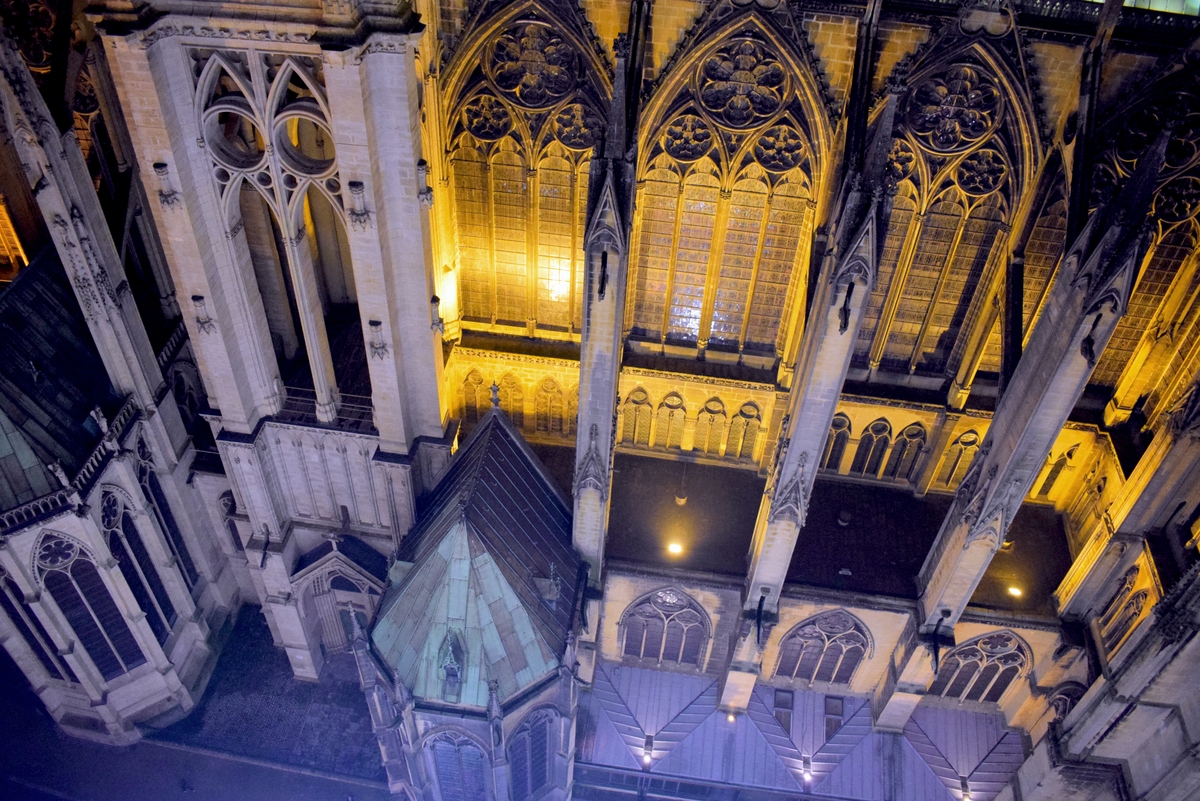
The illuminated façade © French Moments
When is the Best Time to Visit Metz Cathedral?
There is no single perfect time to visit Metz Cathedral, because the light changes constantly throughout the day.
That is part of its appeal.
If you want a quieter visit, I would generally favour the morning, particularly soon after opening. The cathedral tends to become busier as tour groups and day visitors arrive in the historic centre.
For the stained glass, however, I would not worry too much about finding one exact hour. Different parts of the cathedral catch the light at different times, and even an overcast day can bring out rich colours in the windows.
On my visits, I have found that the best approach is simply to slow down and move around. A window that looks rather dark from one part of the cathedral can appear completely different when you return a few minutes later.
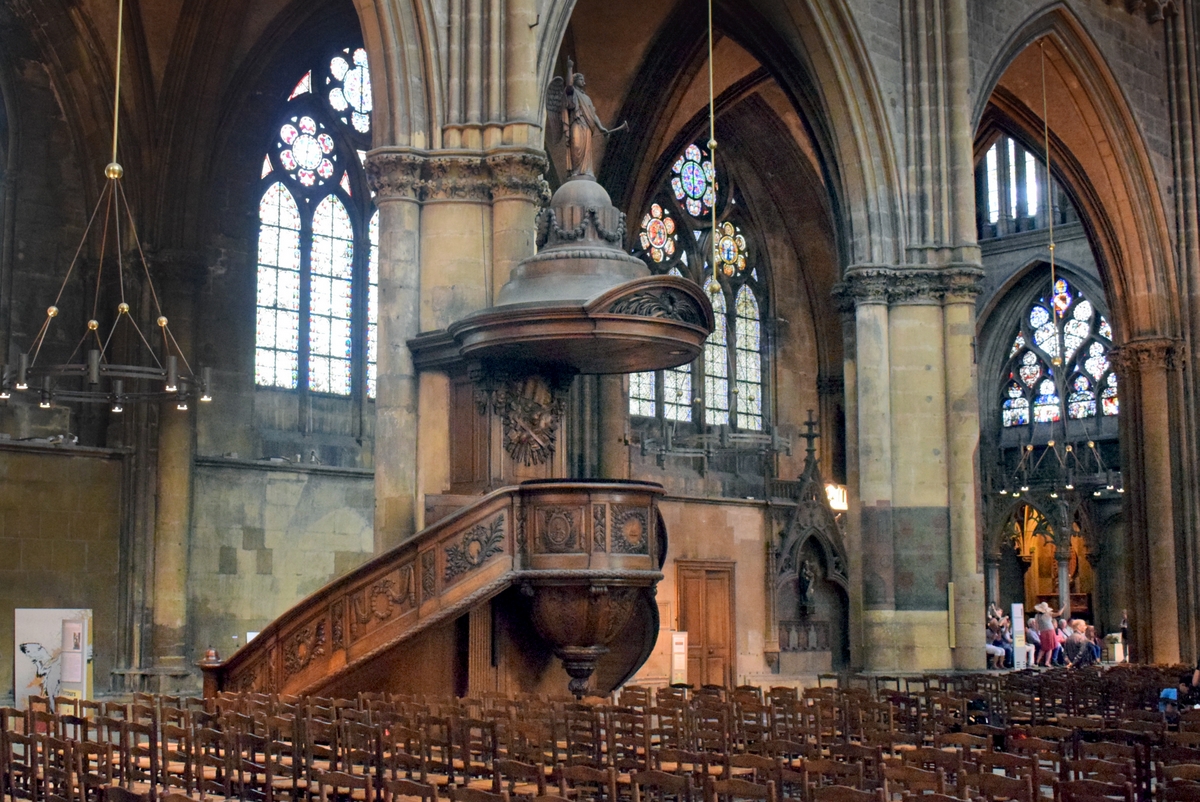
The pulpit © French Moments
If you are staying in Metz overnight, there is another advantage: you can come back.
Because admission is free, it is easy to visit once during the day and return later if the weather or light changes.
I would also avoid arriving immediately before a major religious service if your aim is sightseeing, as parts of the cathedral may become inaccessible to visitors.
And if you are travelling to Metz around 28 September 2026, the usual advice does not really apply. Pope Leo XIV's visit will make the cathedral and surrounding streets exceptionally busy.
My Tips for Visiting Metz Cathedral
Having visited Metz Cathedral many times over the years, there are a few things I would recommend that can make a real difference to your visit.
Don't head straight for Chagall
Marc Chagall's windows are understandably one of the cathedral's highlights, but I would resist the temptation to make them your first destination.
Start with the nave instead.
Walk a little way inside, stop and look upwards. Then turn around to see Hermann de Münster's great west window before continuing towards the transept and choir.
Once you have understood the scale of the building and seen some of the older stained glass, Chagall's windows make much more sense as part of a story that stretches across several centuries.
Walk around the outside first
If the weather is reasonable, I also recommend making a circuit of the cathedral before going inside.
This helps you understand its unusual shape and gives you a chance to see the Portal of the Virgin, the Tour de la Mutte and the east end of the building.
It also makes the contrast when you enter much more striking. Outside, your attention is drawn to the golden Jaumont stone. Inside, it is suddenly all about height and coloured light.
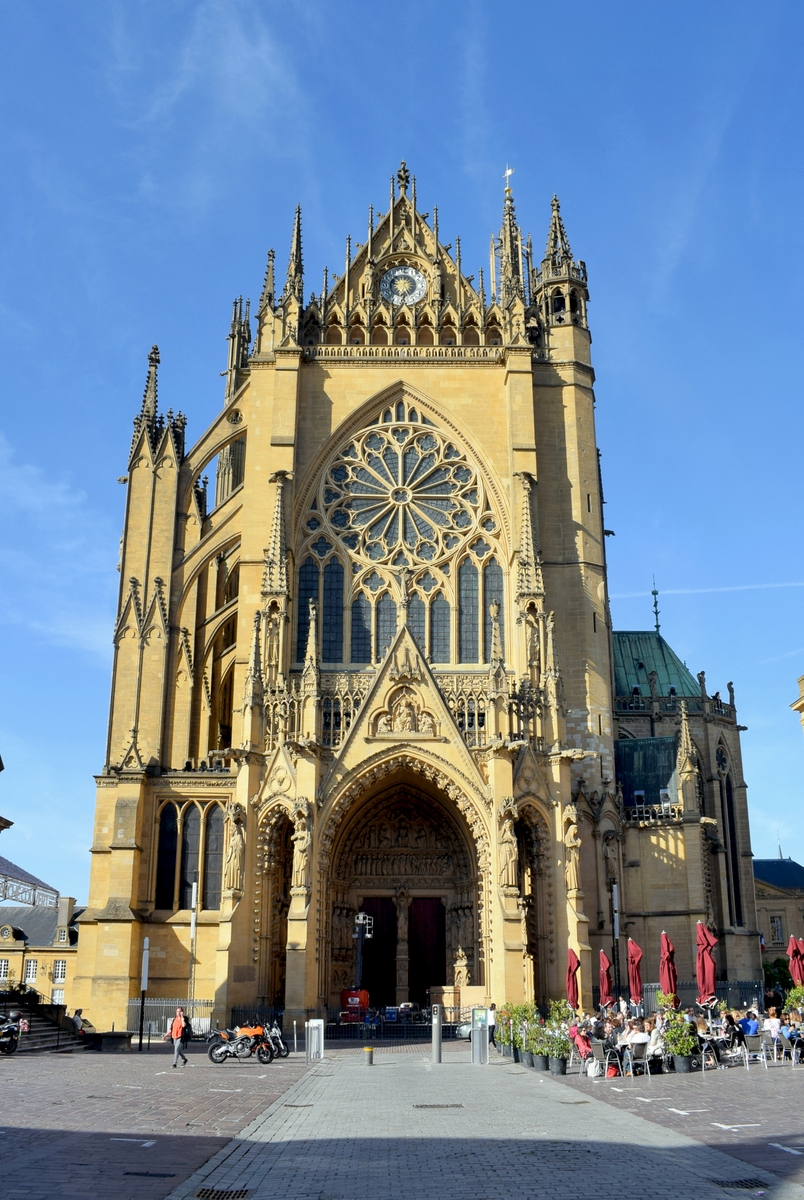
The Western Façade © French Moments
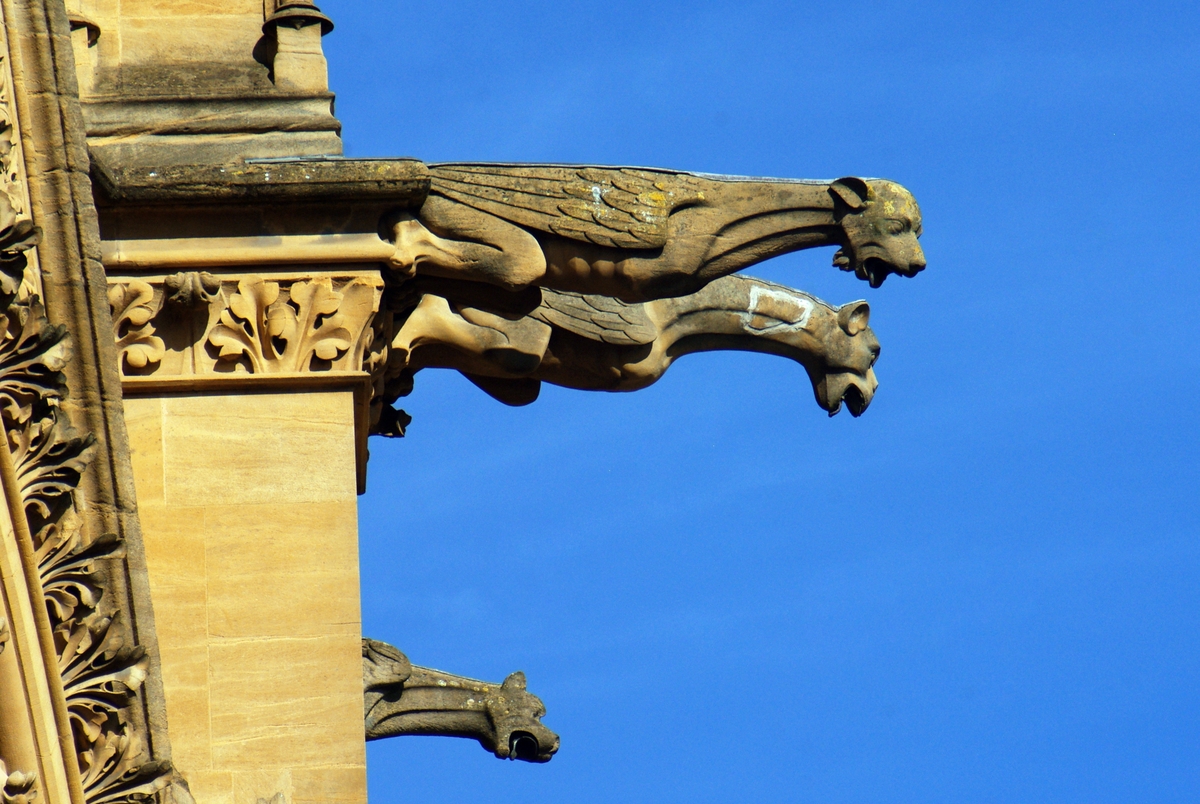
Gargoyles © French Moments
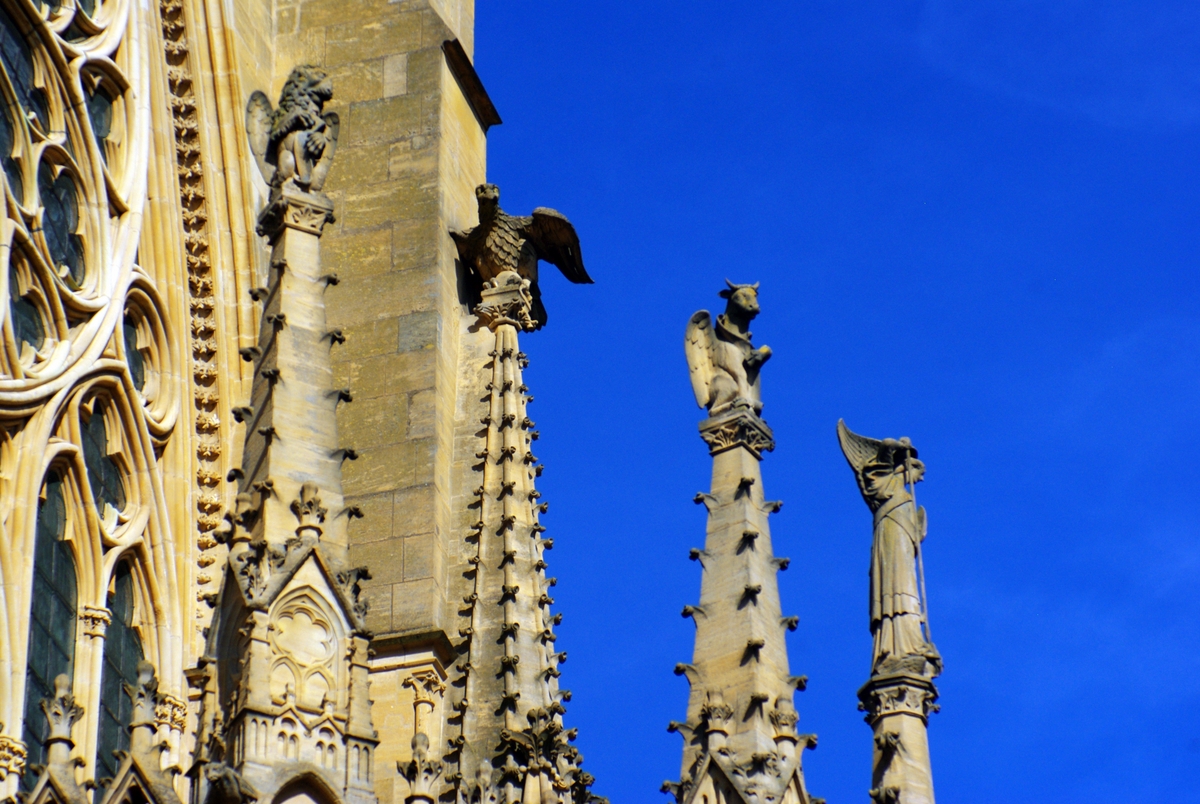
Gothic pinnacles in Metz Cathedral © French Moments
Look behind you
This may sound obvious, but it is surprisingly easy to forget.
When visiting a cathedral, we naturally tend to keep moving towards the choir. At Metz, some of the best views appear when you turn around.
The great west window is the obvious example, but looking back along the nave from the crossing also gives you one of the best impressions of just how tall and narrow the interior is.
Bring binoculars — or use your camera zoom
There are details high above the floor that are almost impossible to appreciate with the naked eye.
The carved culs-de-lampe, coats of arms, stained-glass figures and architectural details become much more interesting when you can see them properly.
A small pair of binoculars can be surprisingly useful in a Gothic cathedral. Otherwise, the zoom on your phone or camera can help you identify details before looking at them again without the screen.
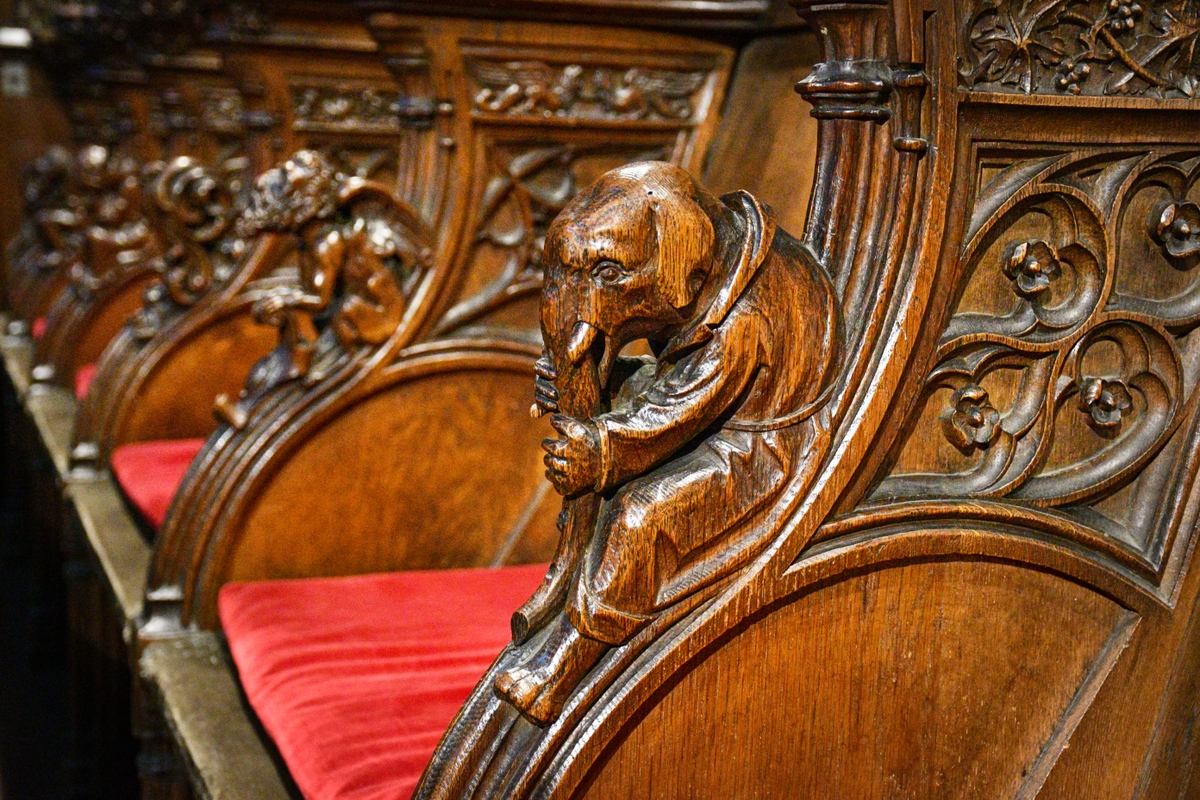
An elephant playing the flute with his trunk, Choir stalls © French Moments
Give the stained glass time
My most important advice is probably the simplest: don't rush the windows.
When I returned to the cathedral at the end of May 2026, I was reminded how much their appearance depends on where you stand and what the light is doing at that particular moment.
Some windows reveal themselves immediately. Others need a little patience.
Stand back first and look at the whole composition. Then move closer.
And occasionally put the camera away altogether.
Don't forget the small details
The scale of Metz Cathedral can easily distract you from what is happening closer to ground level.
Look for the ancient porphyry baptismal font, the Renaissance-style organ high in the triforium and the strange little carved figures beneath the galleries.
These are often the things that make one cathedral feel different from another.
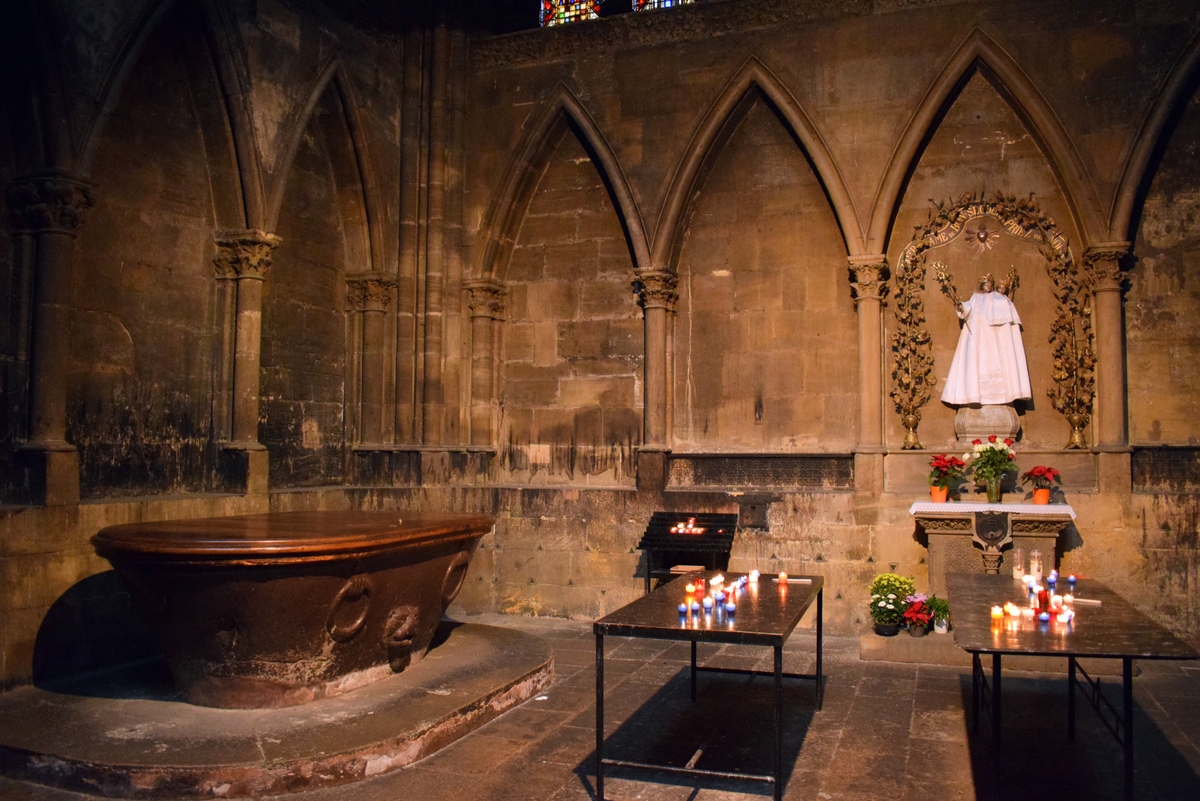
The baptismal font © French Moments
Come back after dark
Finally, if you are staying in Metz overnight, return to Place d'Armes after sunset.
The illuminated cathedral takes on a completely different character once the crowds have gone and the golden stone is picked out against the night sky.
You may not be able to go inside, depending on the time, but the exterior alone is worth the short detour.
In fact, seeing the cathedral after dark deserves a few words of its own.
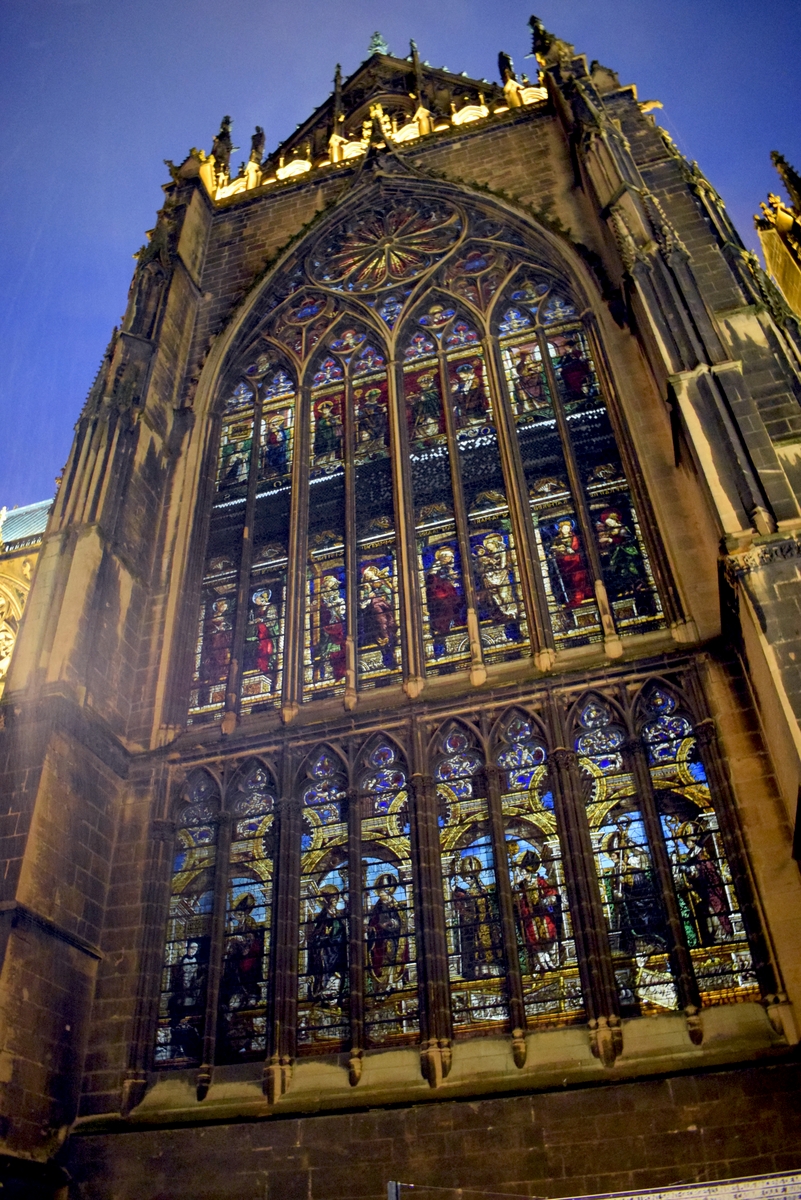
The transept stained-glass seen from the exterior © French Moments
Metz Cathedral at Night
Metz Cathedral is worth seeing again after dark.
Once the daylight has gone, the building loses some of the softness created by its stained glass and takes on a much more dramatic appearance from outside.
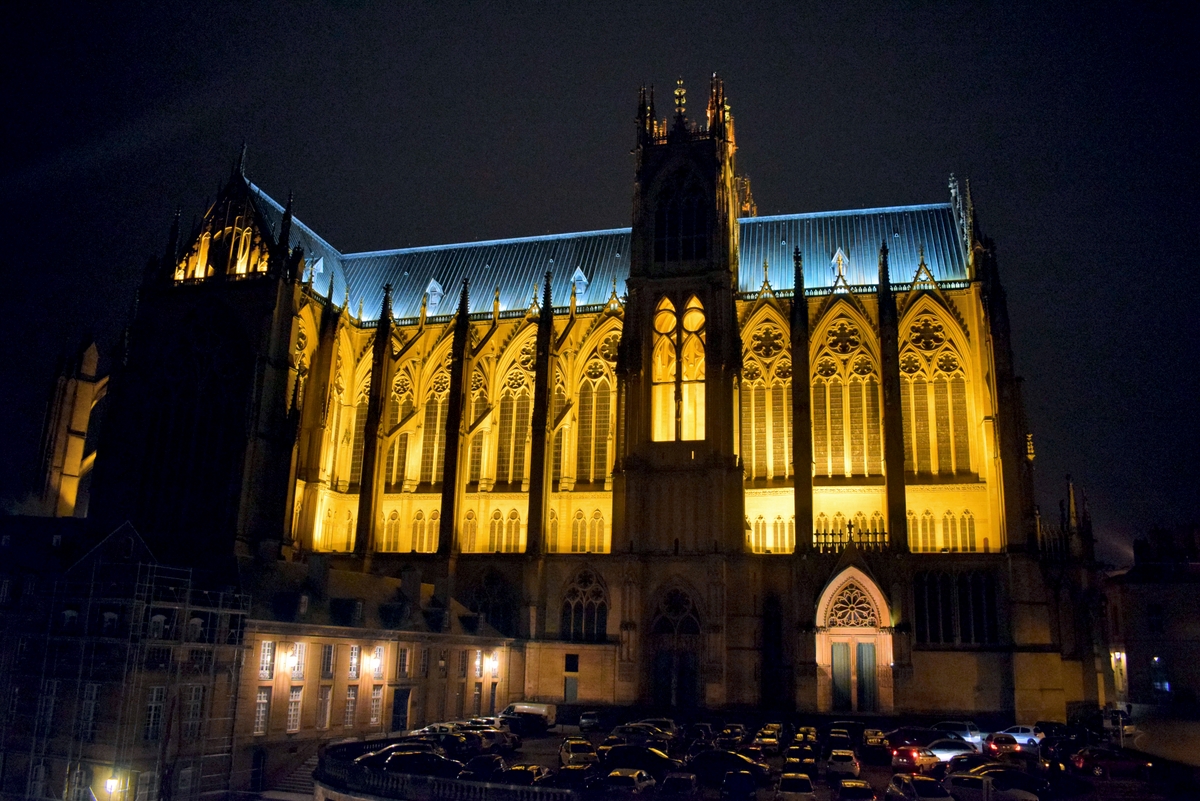
View of the cathedral of Metz by night © French Moments
The Jaumont limestone responds particularly well to artificial light. Its yellow-gold colour becomes warmer, while the towers, buttresses and sculpted details stand out more clearly against the night sky.
Place d'Armes is one of the best places to appreciate the effect.
From here, you can step back far enough to take in a large part of the cathedral façade, while the surrounding 18th-century buildings create a completely different atmosphere from the busy daytime square.
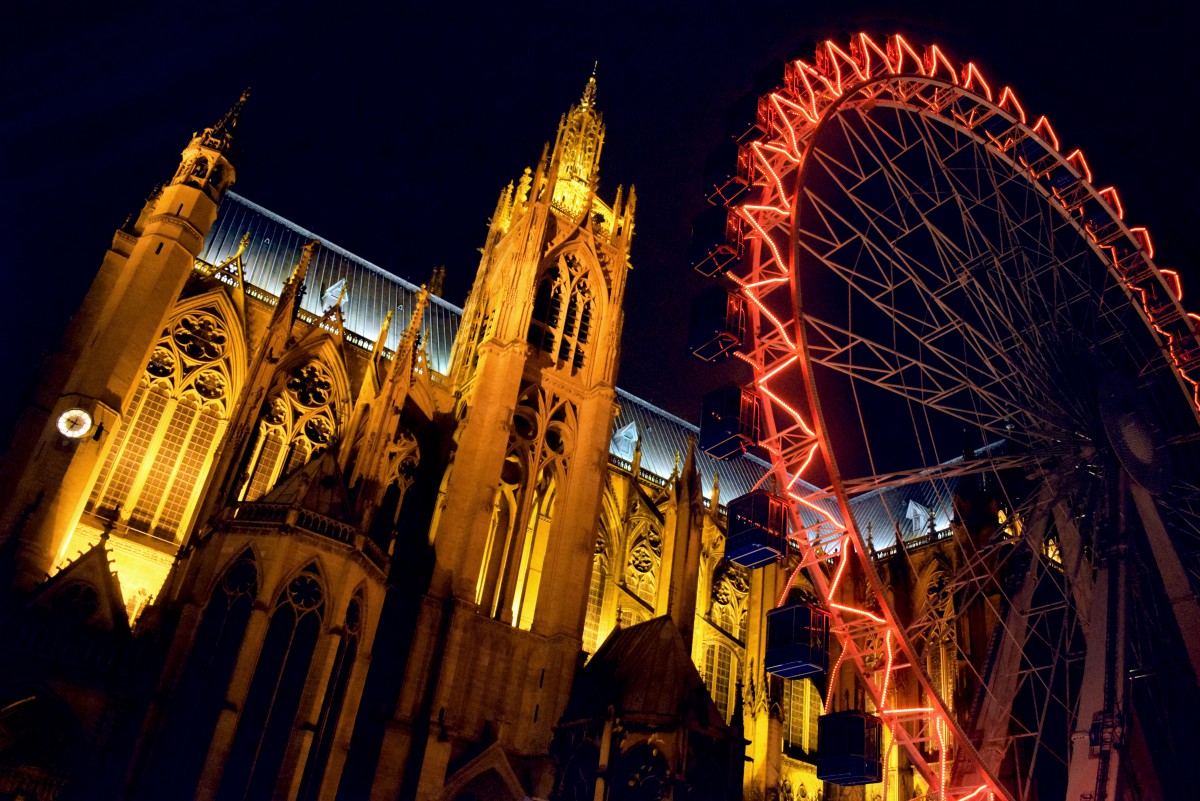
Metz Cathedral © French Moments
I also like walking around the cathedral after dark rather than viewing it from just one spot. The Tour de la Mutte, the Portal of the Virgin and the east end all look different once the surrounding streets become quieter.
And if you are interested in photography, this is a good reason to stay in Metz rather than visiting only as a day trip.
Even if you have already spent an hour exploring the interior, the illuminated cathedral feels like a second visit.
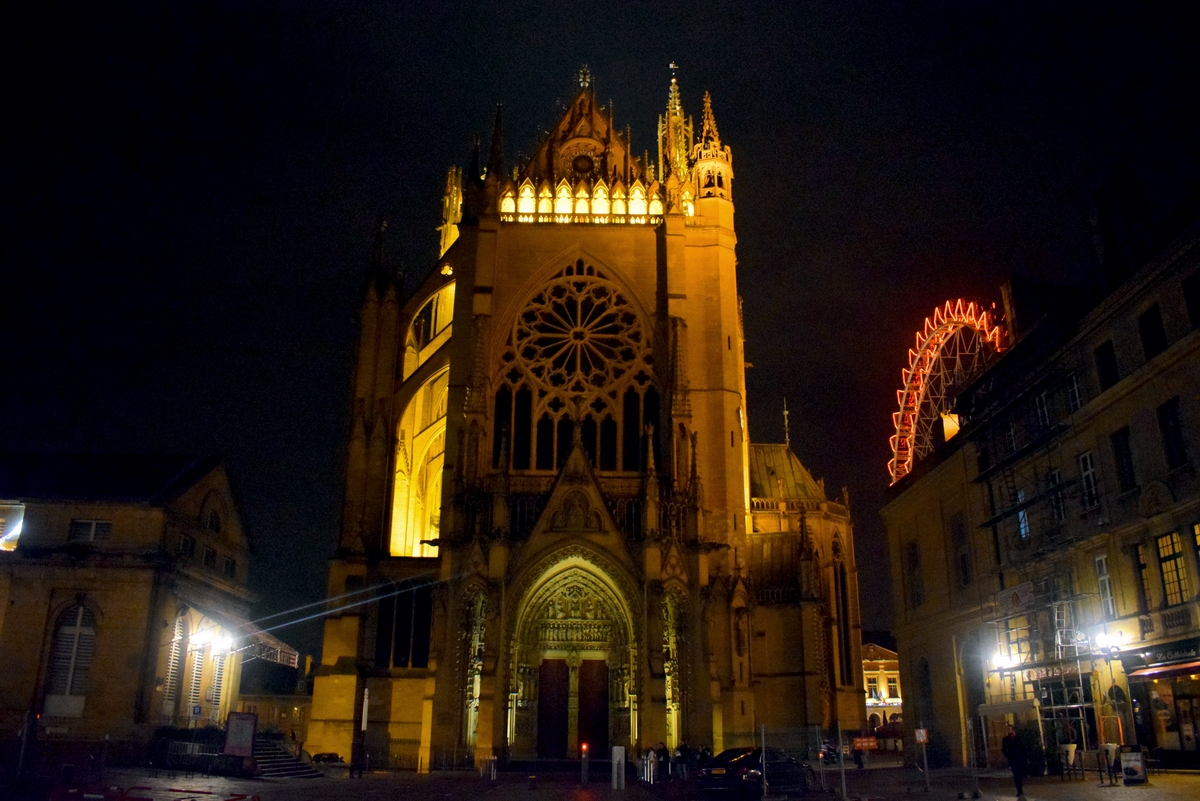
The Western façade of Metz Cathedral © French Moments
FAQ About Metz Cathedral
1. Why is Metz Cathedral famous?
Metz Cathedral is famous for its exceptionally high Gothic nave and around 6,500 square metres of stained glass. Its windows span several centuries and include works by Hermann de Münster, Valentin Bousch, Jacques Villon, Roger Bissière and Marc Chagall. This abundance of glass gave the cathedral its nickname, the Lantern of God.
2. How tall is Metz Cathedral?
The vaults of the main nave rise to 41.41 metres (136 feet), making Metz one of the tallest Gothic cathedrals in France.
The Tour de la Mutte reaches roughly 90 metres (295 feet) above the city.
3. How much stained glass is there in Metz Cathedral?
Metz Cathedral contains approximately 6,500 square metres (70,000 sq ft) of stained glass, the largest surface of stained glass in any cathedral in France.
The collection ranges from medieval and Renaissance windows to major modern works by artists including Marc Chagall.
4. Where are Marc Chagall's windows in Metz Cathedral?
Marc Chagall's stained-glass windows are mainly found in the north transept and the ambulatory around the choir.
They were installed principally between 1962 and 1969 and depict biblical subjects, especially scenes from the Old Testament.
5. Is Metz Cathedral free to visit?
Yes. Entry to the main cathedral is free.
Separate arrangements may apply to the crypt, treasury, guided tours and any exceptional access to areas normally closed to visitors.
6. What are Metz Cathedral's opening hours?
In 2026, the cathedral is generally open daily from 8 am to 6 pm.
Because Saint Stephen's is an active place of worship, sightseeing may be restricted during Masses, funerals and other religious services. Opening arrangements can also change for major events.
7. How long should I spend at Metz Cathedral?
I recommend allowing 45 minutes to one hour for a first visit.
That gives you enough time to appreciate the nave, stained glass and main architectural details without rushing. If you are especially interested in Gothic architecture or stained glass, allow longer.
8. Why is Metz Cathedral called the Lantern of God?
The nickname La Lanterne du Bon Dieu — the Lantern of God refers to the extraordinary amount of stained glass filling the cathedral.
With huge windows throughout the nave, transept and choir, coloured light plays an unusually important role in the character of the interior.
9. When did Pope Leo XIV visit Metz Cathedral?
Pope Leo XIV visited Metz Cathedral on Monday, 28 September 2026.
He celebrated Mass at Saint Stephen's Cathedral at 4 pm.
What Else Should You See Near Metz Cathedral?
One of the advantages of visiting Metz Cathedral is its location.
You are already in the heart of the historic city, and several of Metz's most interesting sights are within easy walking distance. I would certainly not visit the cathedral and then head straight back to the station.
Start with Place d'Armes
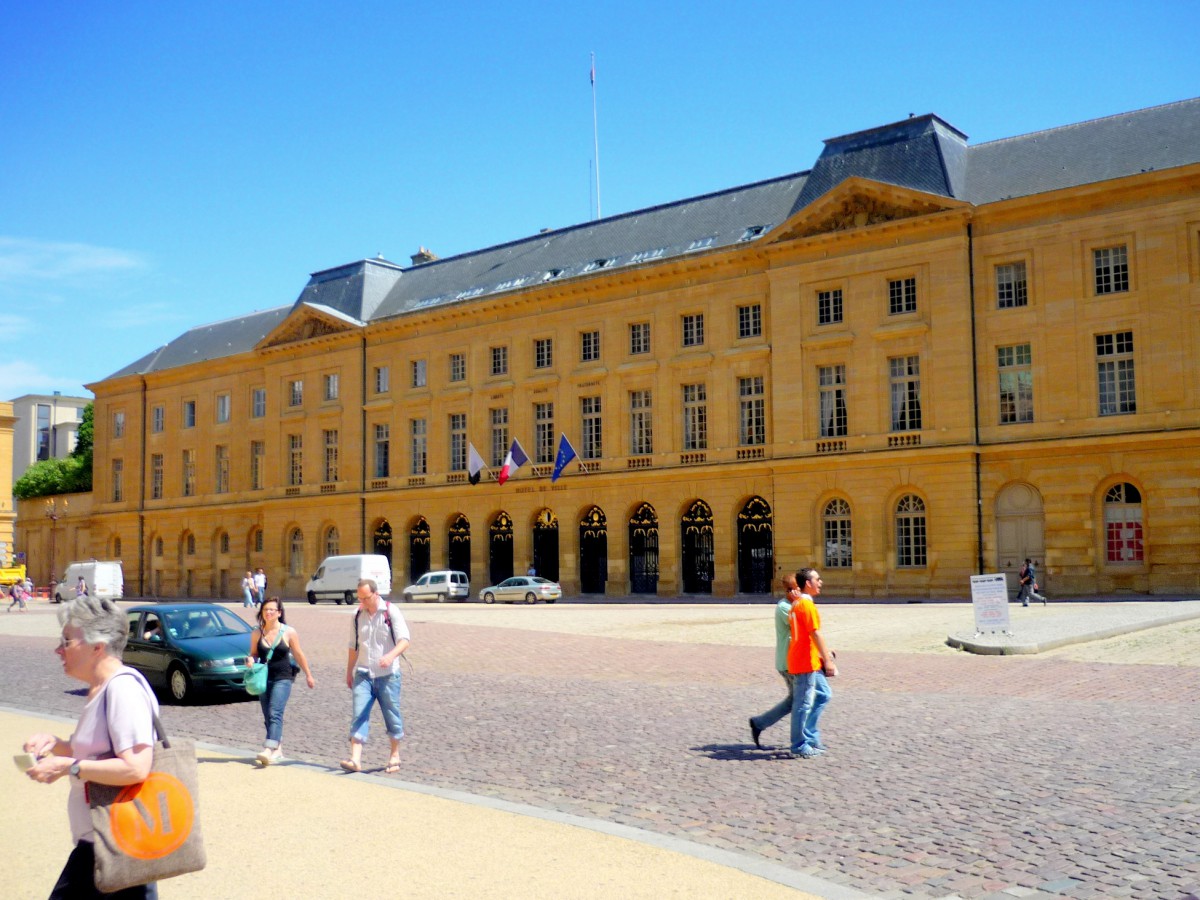
City-Hall - Place d'Armes, Metz © French Moments
You hardly need to go anywhere for the first stop.
Place d'Armes stretches alongside the cathedral and is one of the best places to understand how Metz changed during the 18th century.
The square was laid out as part of Jacques-François Blondel's grand Classical redevelopment of the area. The contrast is striking: on one side stands the soaring Gothic cathedral, while the surrounding buildings belong to a much more orderly Classical world.
It is also where you will find the Metz Tourist Office, useful if you want information about guided tours or temporary events.
Visit the Musée de La Cour d'Or
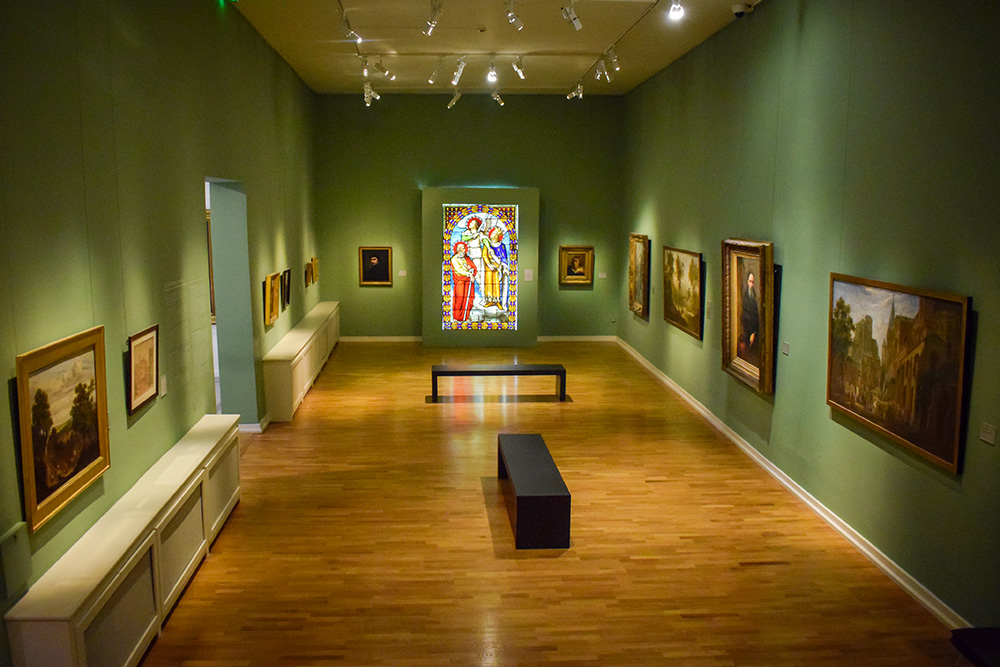
Musée de la Cour d'Or in Metz © French Moments
Just behind the cathedral is the Musée de La Cour d'Or.
If you want to understand Metz beyond the cathedral, this is one of the most useful places you can visit. Its collections take you back through the city's long history, including its important Gallo-Roman past and the Middle Ages.
That matters because the cathedral did not appear in isolation. Metz was already an important city many centuries before Gothic builders began work on Saint Stephen's.
If history is one of your main interests, I would allow enough time to visit both the cathedral and the museum rather than trying to squeeze them into a hurried hour.
Walk down to Place de Chambre
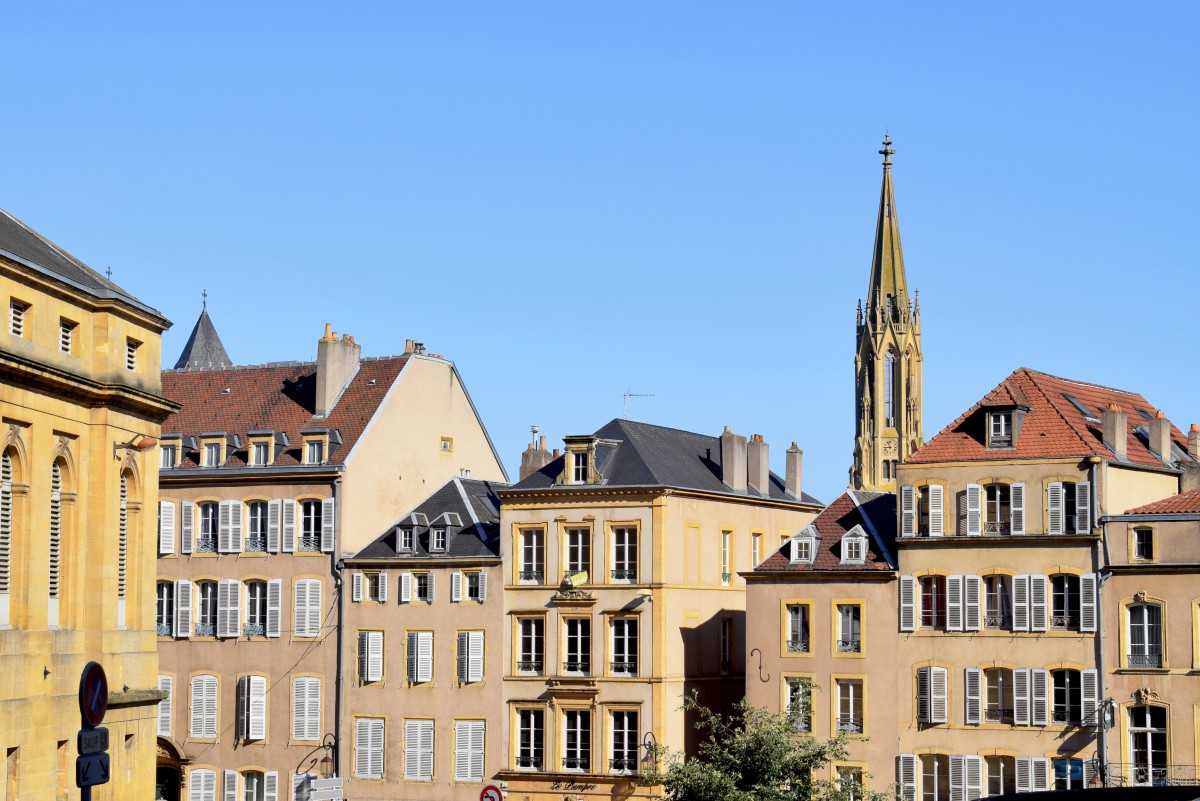
Place de Chambre and the spire of the Garrison church © French Moments
On the other side of the cathedral, Place de Chambre leads you towards the lower town and the Moselle.
This part of Metz has a more intimate feel than monumental Place d'Armes, with restaurants and old façades gathered beneath the cathedral.
From here, continue towards the river.
Cross to the Temple Neuf
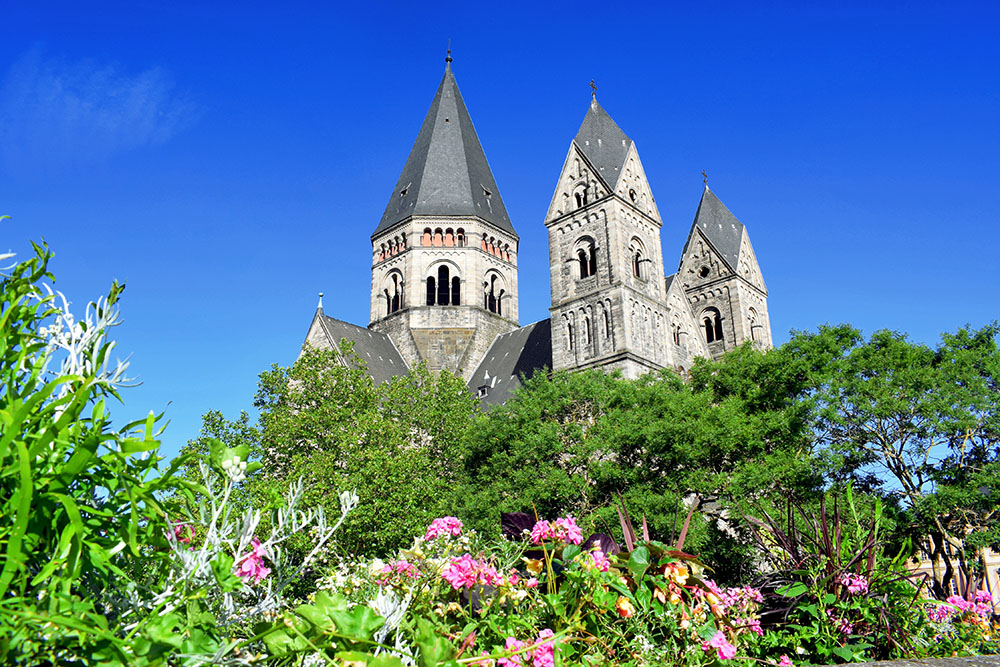
Temple-Neuf, Metz © French Moments
A short walk brings you to Place de la Comédie, one of my favourite corners of central Metz.
The square itself dates from the 18th century and is dominated by the Opéra-Théâtre. But what catches most visitors' attention today is the Temple Neuf, standing at the tip of an island in the Moselle.
Built between 1901 and 1904, when Metz formed part of the German Empire, this Protestant church looks completely different from the golden cathedral you have just left behind.
Its dark grey stone and Neo-Romanesque architecture create one of the most recognisable views in Metz.
Come back after dark if you can. The illuminated Temple Neuf reflected in the Moselle is one of the city's loveliest evening views.
Wander through the old streets to Place Saint-Louis
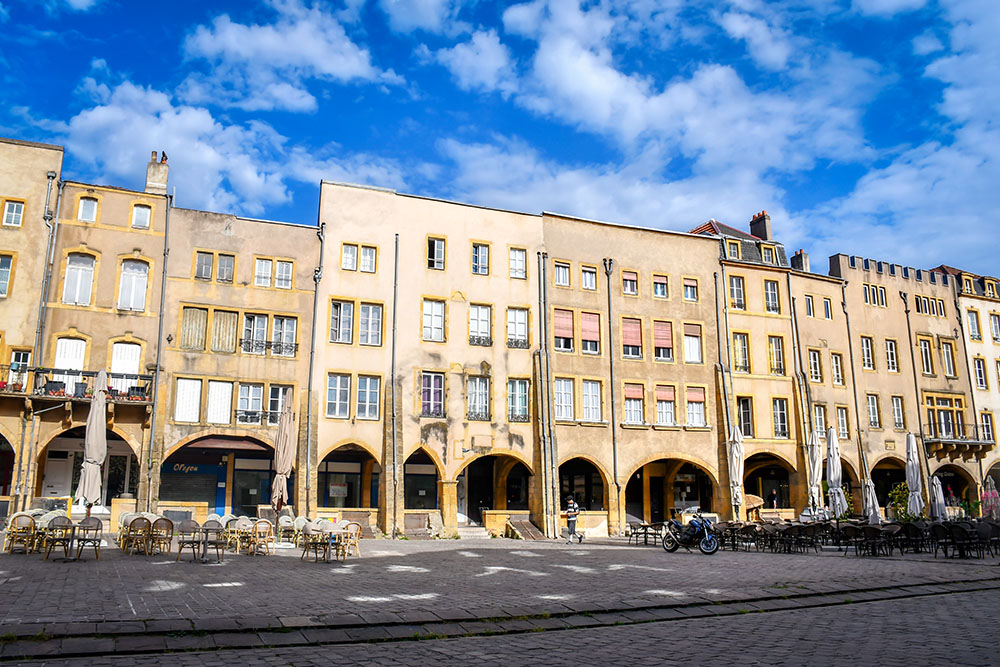
Place Saint-Louis © French Moments
From the cathedral, you can also head south through the old centre towards Place Saint-Louis.
This long medieval square is lined with houses built above arcades and is another good place to see Metz's golden Jaumont stone.
It once formed part of the commercial heart of the medieval city, and its atmosphere is completely different from the formal architecture of Place d'Armes.
Rather than taking the most direct route, I would simply wander through the surrounding streets.
Central Metz is compact enough for detours.
Continue to the Porte des Allemands
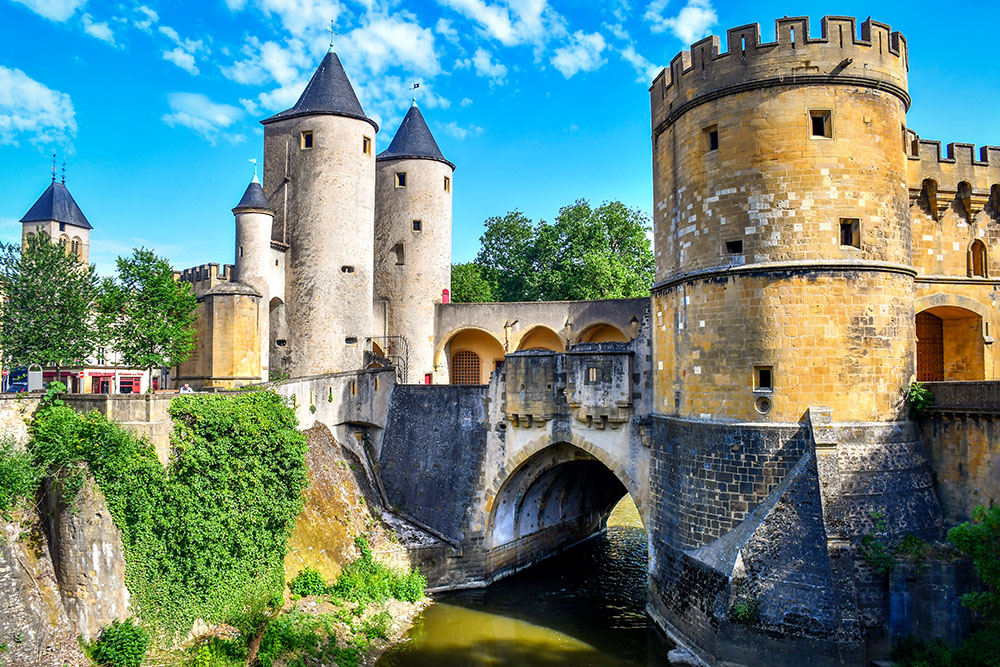
Porte des Allemands spanning the River Seille © French Moments
If you have more time, keep walking towards the Porte des Allemands.
This remarkable medieval gate spans the River Seille and is the most impressive surviving section of Metz's old fortifications. With towers, walls and a bridge incorporated into the same structure, it looks more like a small castle than a city gate.
It is a little farther from the cathedral than the other places mentioned here, but still easily reachable on foot through the historic centre.
And it provides yet another side to Metz.
Within one walk, you can go from a Gothic cathedral to an 18th-century Classical square, a German Imperial church and a medieval fortified gate.
That mixture is one of the reasons I find Metz such an interesting city to explore on foot.
Where to Stay Near Metz Cathedral
If you want to stay right in the historic centre, Hôtel de la Cathédrale has one obvious advantage: it is directly opposite the cathedral on Place de Chambre.
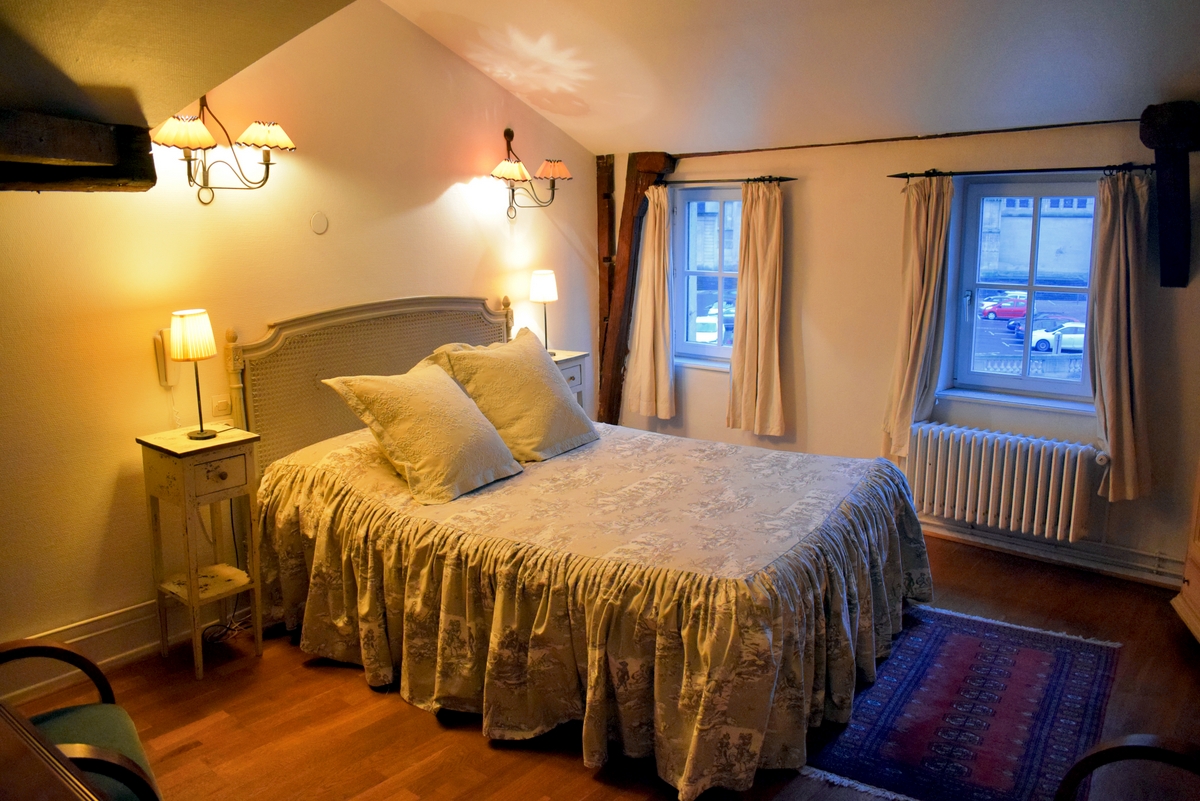
Hôtel de la Cathédrale, Metz © French Moments
I stayed there during one of my visits to Metz, when I was hosted by the local tourist board, and my room had a wonderful view of Saint Stephen's Cathedral.
The hotel occupies a historic building and has plenty of character, with traditional interiors and antique-style furnishings. Be aware, however, that there is no lift, which may be important if you have heavy luggage or limited mobility.
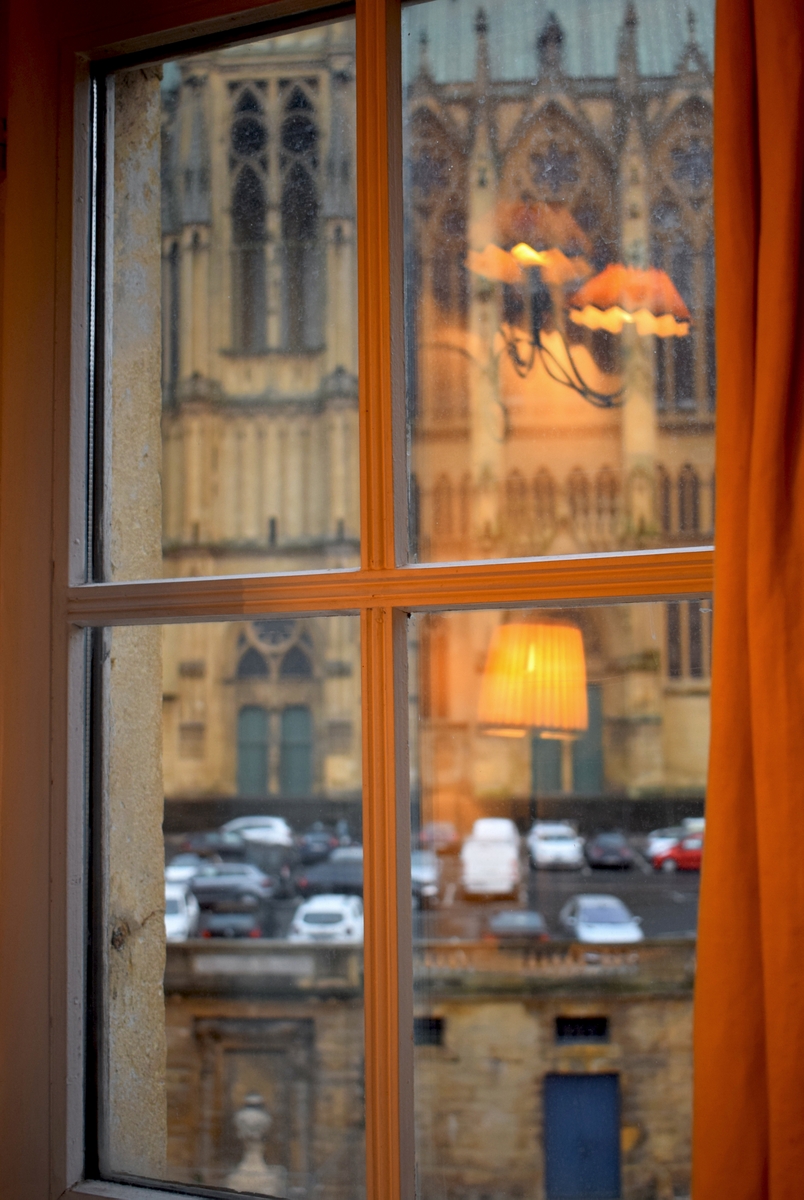
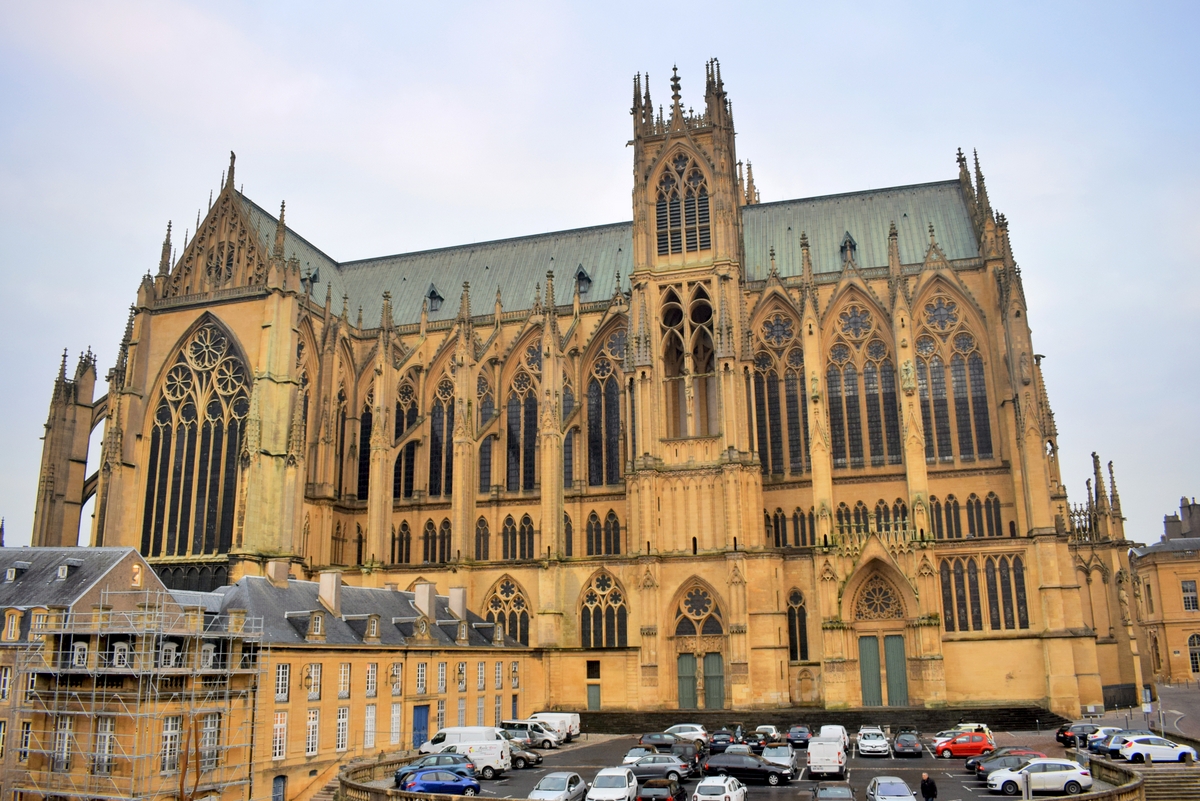
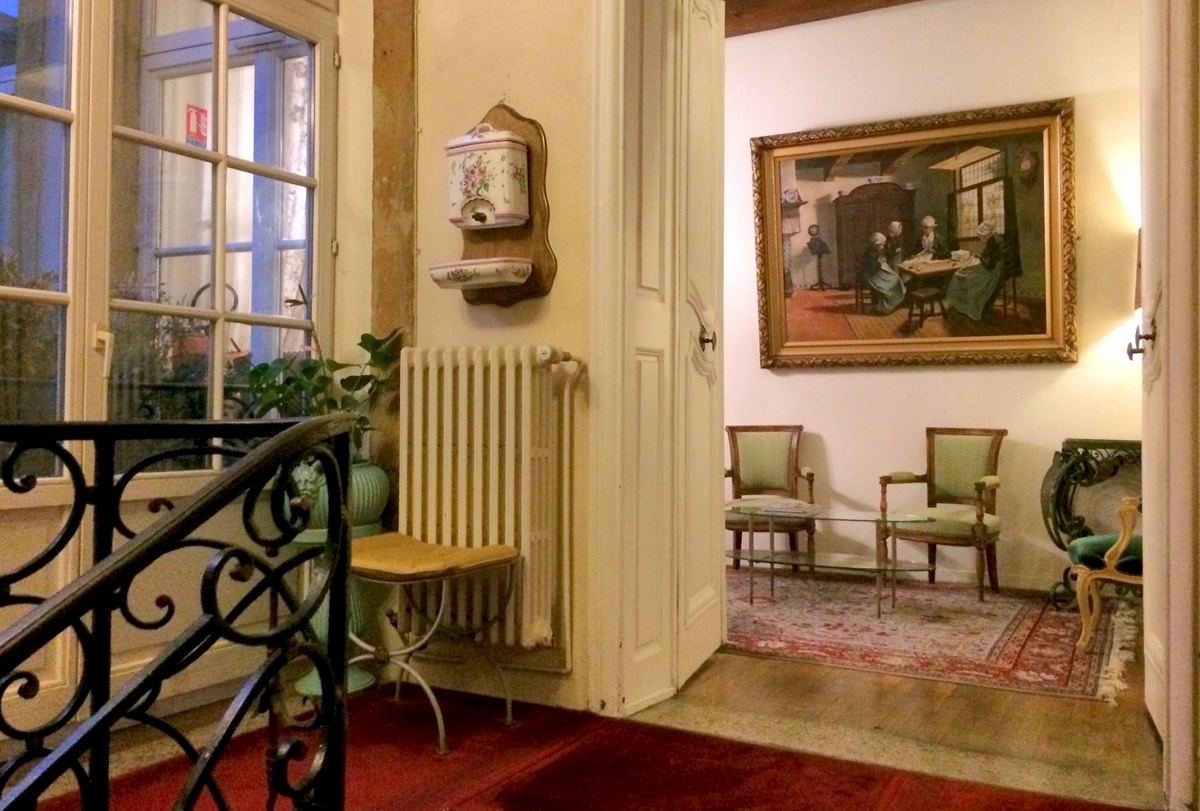
Its location is hard to beat if your priority is exploring old Metz on foot. The cathedral is across the road, while Place d'Armes, the Musée de La Cour d'Or, Place de la Comédie and the Moselle are all within a short walk.
If you prefer a more modern hotel or want to stay closer to Metz railway station, there are plenty of other options between the station and the historic centre.
For a wider selection, take a look at my 2-day Metz itinerary, where I suggest other convenient bases for exploring the city.
Further Information and Official Sources
Opening hours, access conditions and guided visits can change, particularly during religious celebrations and major events.
For the latest information before your visit, I recommend checking these official sources:
- Œuvre de la cathédrale de Metz – cathedral history, religious services, visitor information and news
- Metz Tourist Office – current opening hours, guided tours and practical visitor information
You can also continue exploring the city with my other guides to Metz Old Town, the Porte des Allemands, Metz's German Imperial Quarter and my 2 Days in Metz itinerary.
Metz Cathedral may be the city's most spectacular monument, but it makes much more sense once you have explored the streets and neighbourhoods that grew around it.
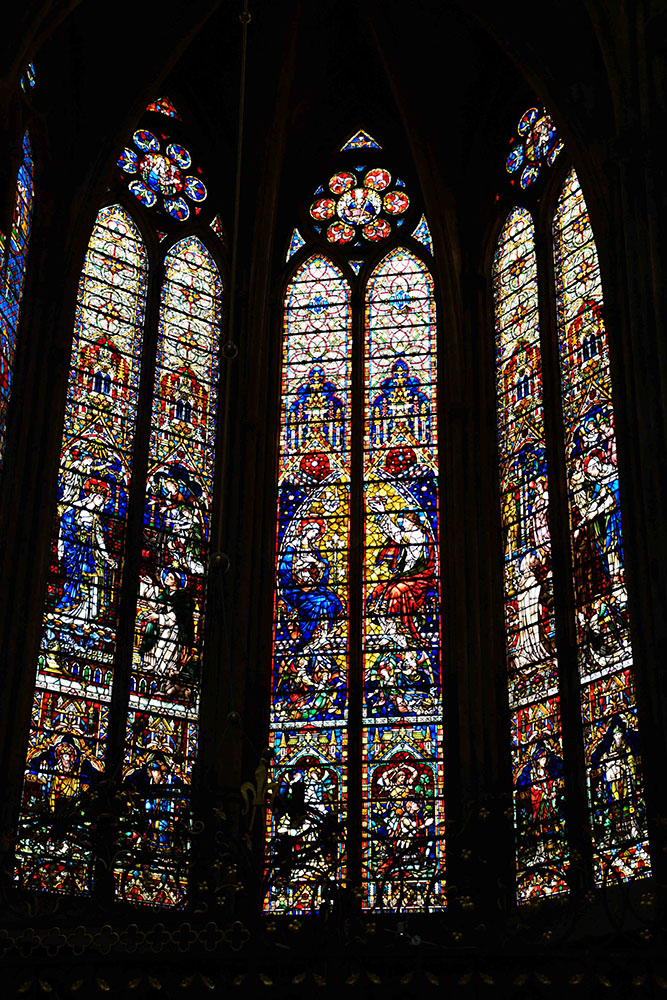
Stained-glass from the 19th century in Notre-Dame de la Ronde © French Moments
What an amazing cathedral! Your photos are beautiful, Pierre and it’s now definitely on my “must-see” list!
Thank you Ellen! It is indeed a remarkable church. And on my last visit there I also discovered many other historic churches in Metz with amazing stained-glass windows, some dating back to the Middle-Ages. Bon dimanche ! 👋