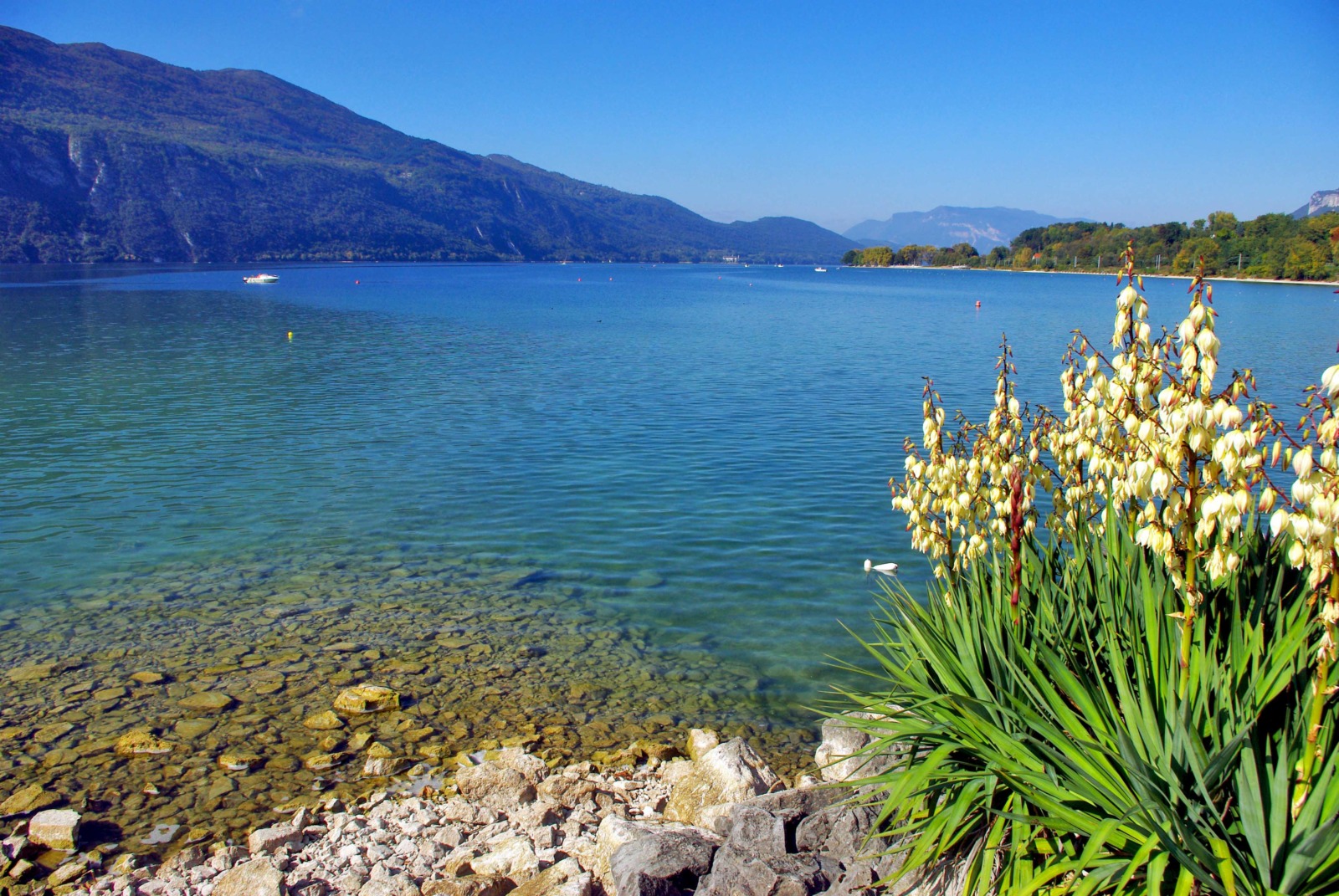


Lake Bourget (in French, Lac du Bourget) is one of the great natural jewels of Savoie, but it deserves far more than a simple postcard of blue water, mountains and boats.
It is often known as the great lake of Aix-les-Bains, the lake of summer beaches, cruises, viewpoints and sunsets. And yet Lake Bourget is also a territory of history, geology, poetry, spa heritage, villages, abbeys, harbours and mountains.
It is the largest natural lake of glacial origin located entirely in France.
With its 18 kilometres in length, its sometimes turquoise waters and its spectacular setting, it forms one of the most appealing landscapes in Savoie. The Aix-les-Bains Riviera des Alpes tourist website also presents it as the largest natural lake in France by volume.
But what makes Lake Bourget so interesting is not only its size. It is its diversity. Around its shores and in the mountains that surround it, you will find a great spa town, a royal abbey, beaches, harbours, reedbeds, châteaux, vertiginous viewpoints and charming villages.
In this article, I invite you to discover Lake Bourget through its geography, its history and 10 must-see places around the lake and in its immediate surroundings.
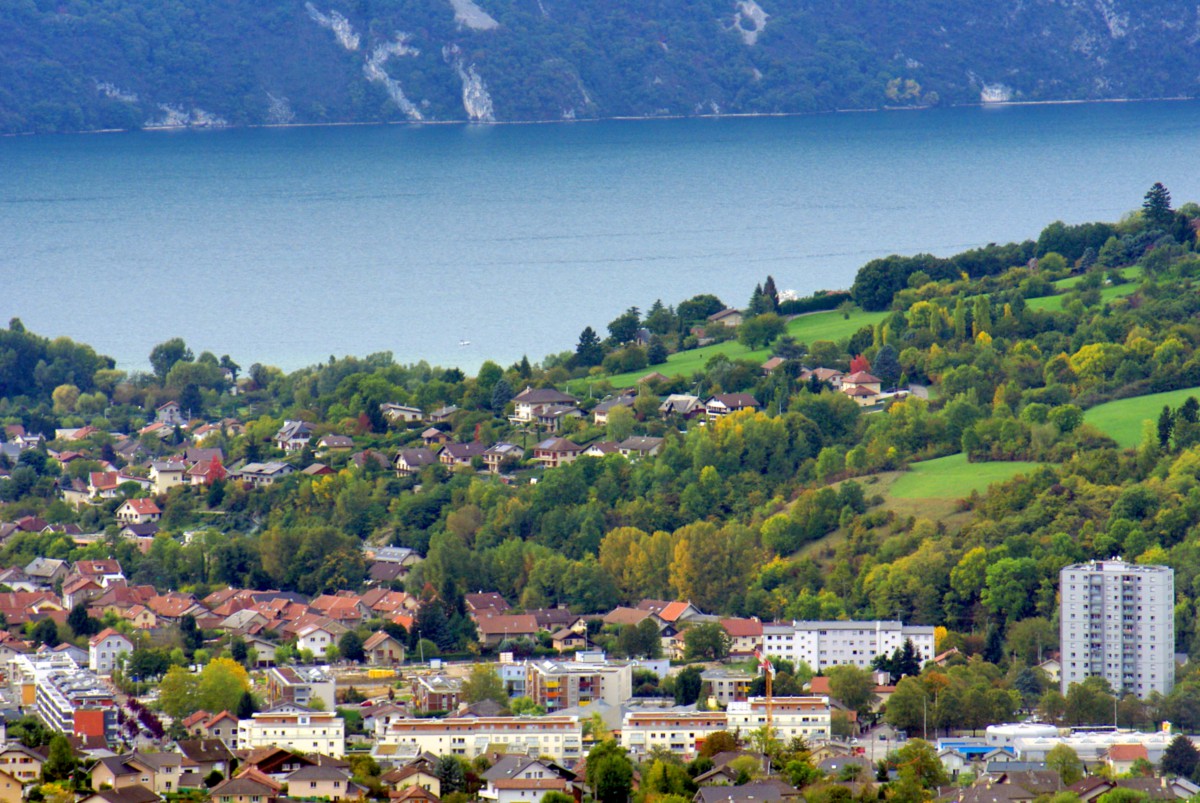
Aix-les-Bains and Lake Bourget © French Moments
Where Is Lake Bourget?
Lake Bourget is located in Savoie, north of Chambéry and beside Aix-les-Bains. It stretches along a long natural corridor between the Jura reliefs and the first Alpine massifs.
Its eastern shore, on the side of Aix-les-Bains, Brison-Saint-Innocent and Chindrieux, is the easiest to access. This is where you will find harbours, beaches, the greenway, landscaped promenades and a large part of the lake’s tourist life.
The western shore, dominated by the Mont du Chat, is wilder, steeper and more spectacular. The slopes sometimes drop sharply towards the water, giving the lake the look of a Savoyard fjord — even if, geologically speaking, specialists might raise an eyebrow at the comparison.
To the south, the lake opens towards Le Bourget-du-Lac, Les Mottets, wetlands and Chambéry. To the north, it extends towards Chindrieux, Châtillon, Conjux, Chanaz and the Canal de Savières, which links the lake to the Rhône.
In other words, Lake Bourget is not simply a lake “near Aix-les-Bains”. It is a complete territory, at the meeting point of Alpine Savoy, the Savoyard foreland, the Bauges, the Chautagne and the Jura reliefs.
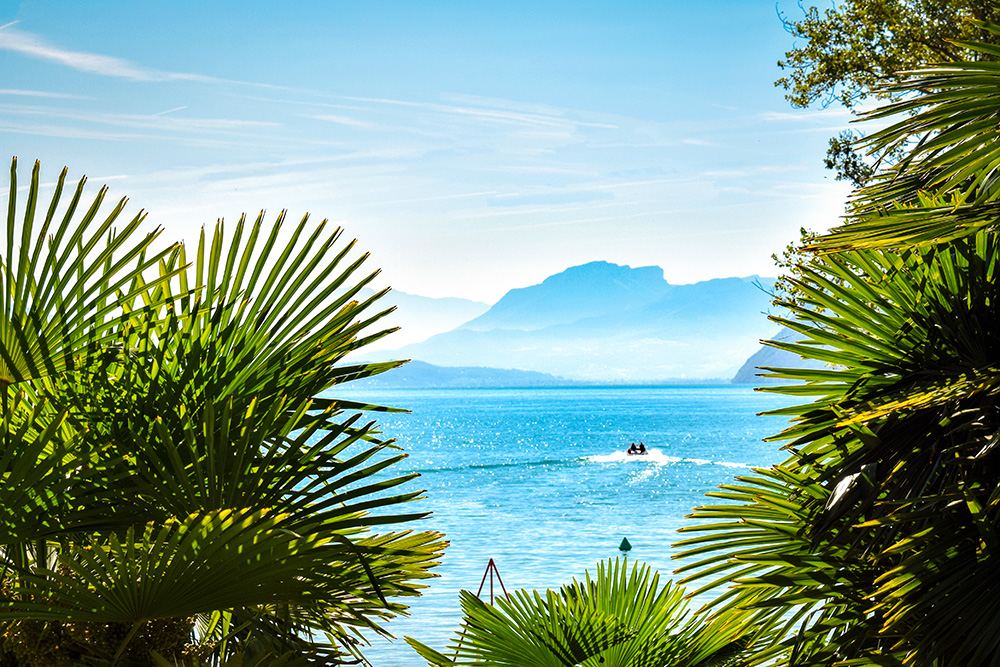
The lake seen from Châtillon, Chindrieux © French Moments
Geography of Lake Bourget: A Lake Shaped by Glaciers
To understand Lake Bourget, you have to go a very long way back in time.
The present lake is the heir to a vast glacial landscape. Documents from Patrimoines de Savoie explain that Lake Bourget is the remnant of a much larger ancient lake, linked to the melting of the Würm glaciers. At the time, the great primitive lake may have reached around 47 kilometres in length and almost 200 square kilometres, before gradually filling in.
The lake we see today is therefore a memory of water and ice. Glaciers carved, rivers filled in, mountains framed the landscape, and time did the rest — with its usual patience, meaning several thousand years, which puts our irritation with summer traffic jams into some perspective.
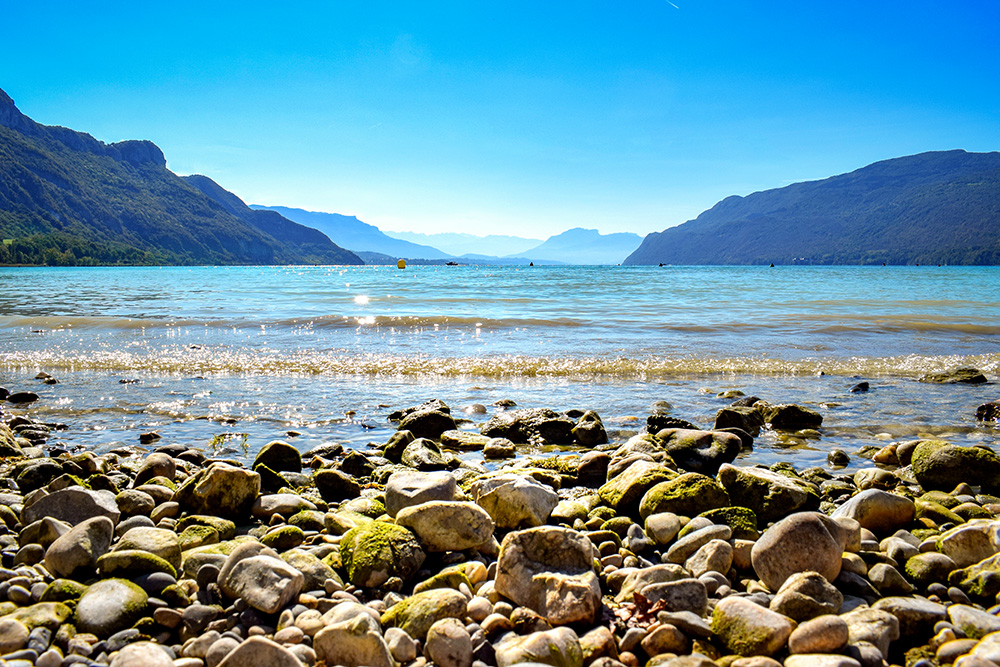
Lac du Bourget in Châtillon © French Moments
The lake is fed in particular by the Leysse, the Tillet and the Sierroz, while the Canal de Savières provides a hydraulic link with the Rhône. This geography explains the ecological richness of the site: reedbeds, wetlands, deltas, aquatic environments and more or less urbanised shores all respond to one another around the lake.
It is this combination of grand scenery and natural environments that gives Lake Bourget its character. You can come here to swim, of course, but also to understand how water, mountains, forests, towns and villages together form a Savoyard territory in its own right.
A Brief History of Lake Bourget
Lake Bourget has been inhabited and frequented for a very long time. Its shores have revealed traces of ancient occupation, including pile-dwelling sites linked to prehistoric lakeside settlements.
But its visible history, the one you can still sense today when visiting the area, can be read above all through several major chapters.
First, there is the religious and dynastic history, with Hautecombe Abbey, one of the great sites of the House of Savoy.
Then there is the spa and social history of Aix-les-Bains, which became a major 19th-century spa town frequented by the European elite.
There is also the literary history, especially with Lamartine, whose famous poem “Le Lac” remains associated with Aix-les-Bains and Lake Bourget.
The lake is therefore natural, historic and poetic all at once. You can approach it through geology, hiking, beaches, architecture, boats or literature. That is what makes it so rich: everyone can find their own way in.
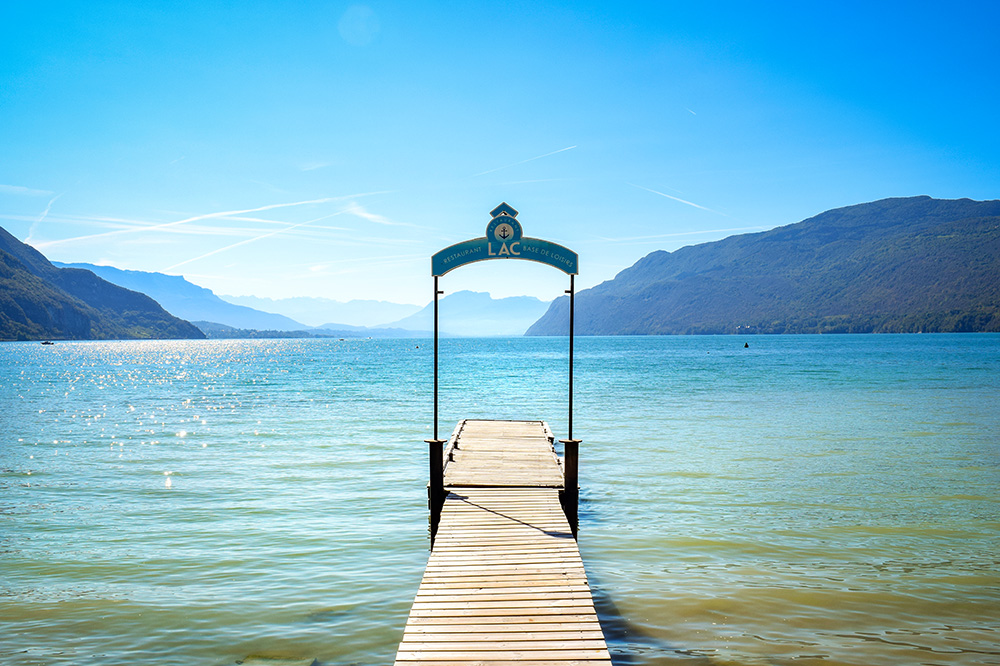
Lake Bourget © French Moments
Lake Bourget or Lake Châtillon?
A small toponymic anecdote: in the Middle Ages, Lake Bourget was not yet called by its current name.
It was known as Lake Châtillon, in reference to the château and lordship of Châtillon at the northern end of the lake.
The name “lac du Bourget” only became established from the 13th century onwards, when the Bourget Castle gained importance and became one of the residences of the Counts of Savoy. As so often in history, the landscape preserves the memory of the powers that once dominated it.
This also explains why the lake was never called “Lake Aix-les-Bains”, even if some tourists, for convenience, sometimes dare to call it that. Lake Bourget carries an older name, linked to the history of the area and to the importance of Bourget Castle.
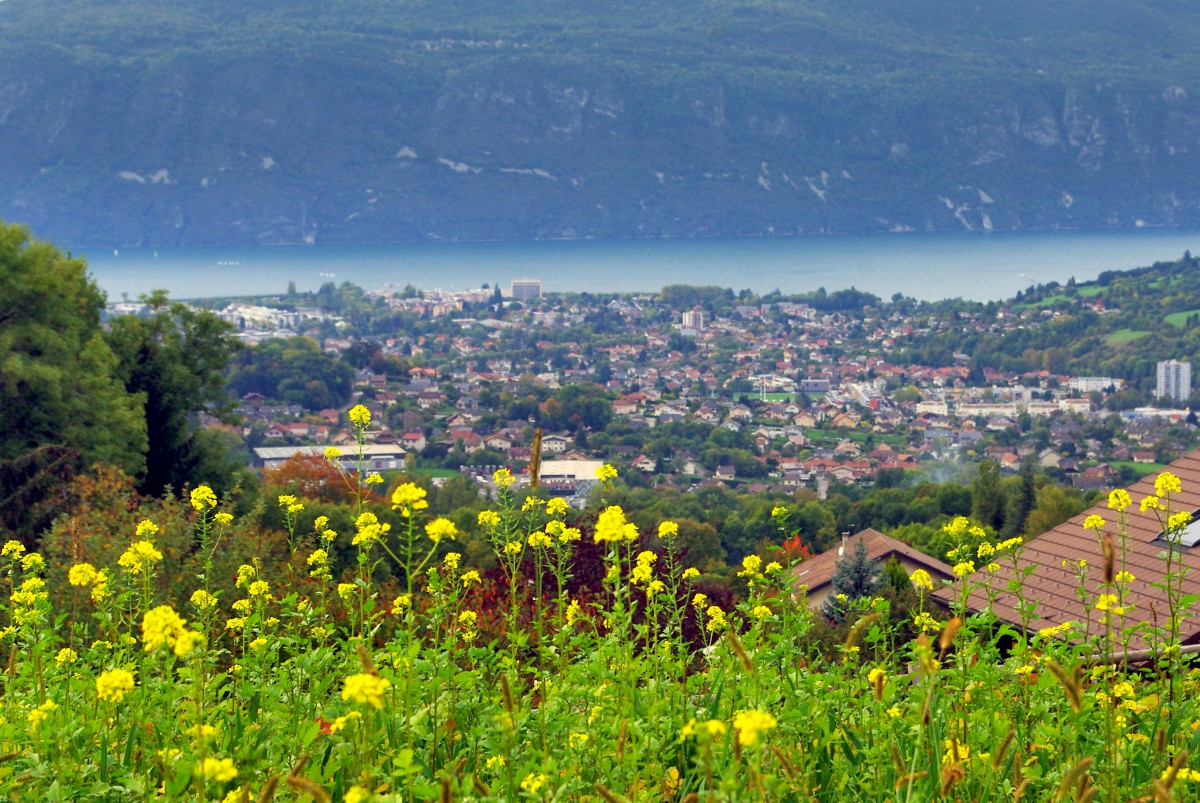
Lake Bourget and Aix-les-Bains © French Moments
Lake Bourget: 10 Must-See Places to Visit
The following places are not all located directly on the immediate shore of the lake.
Some take you up into the heights, such as Le Revard or the Dent du Chat. Chanaz, meanwhile, naturally extends the discovery towards the Canal de Savières.
Together, these 10 places allow you to understand Lake Bourget in all its diversity.
1. Aix-les-Bains, the Great Spa Town of Lake Bourget
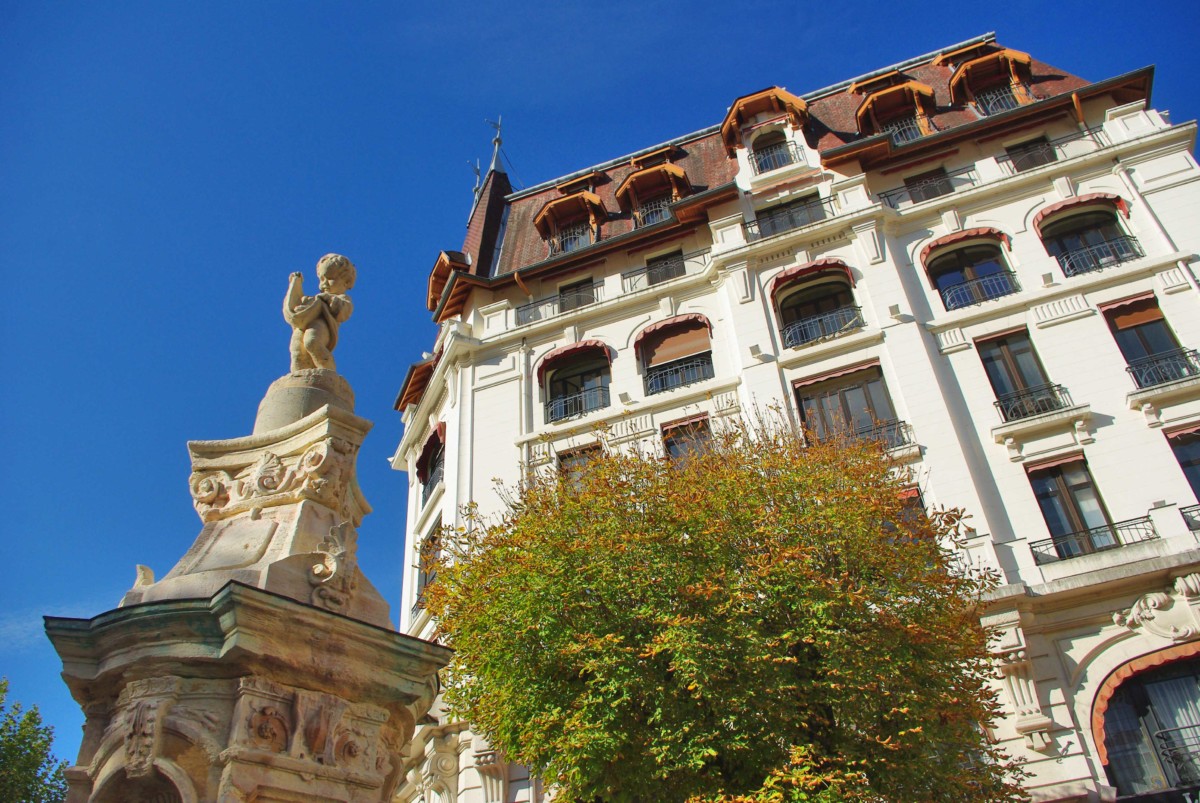
In the spa resort of Aix-les-Bains © French Moments
Aix-les-Bains is the most obvious gateway for discovering Lake Bourget.
The town combines the charm of a spa resort, the atmosphere of a lakeside town and the heritage of a Belle Époque destination. Here you will find the town centre, the thermal baths, former palace hotels, the Casino Grand Cercle, the Grand Port, the Petit Port and the Esplanade du Lac.
Aix-les-Bains also allows you to enjoy the lake without completely leaving the town. You can walk by the water, watch the boats, head to the beaches, have a drink on a terrace or simply admire the Dent du Chat outlined on the horizon.
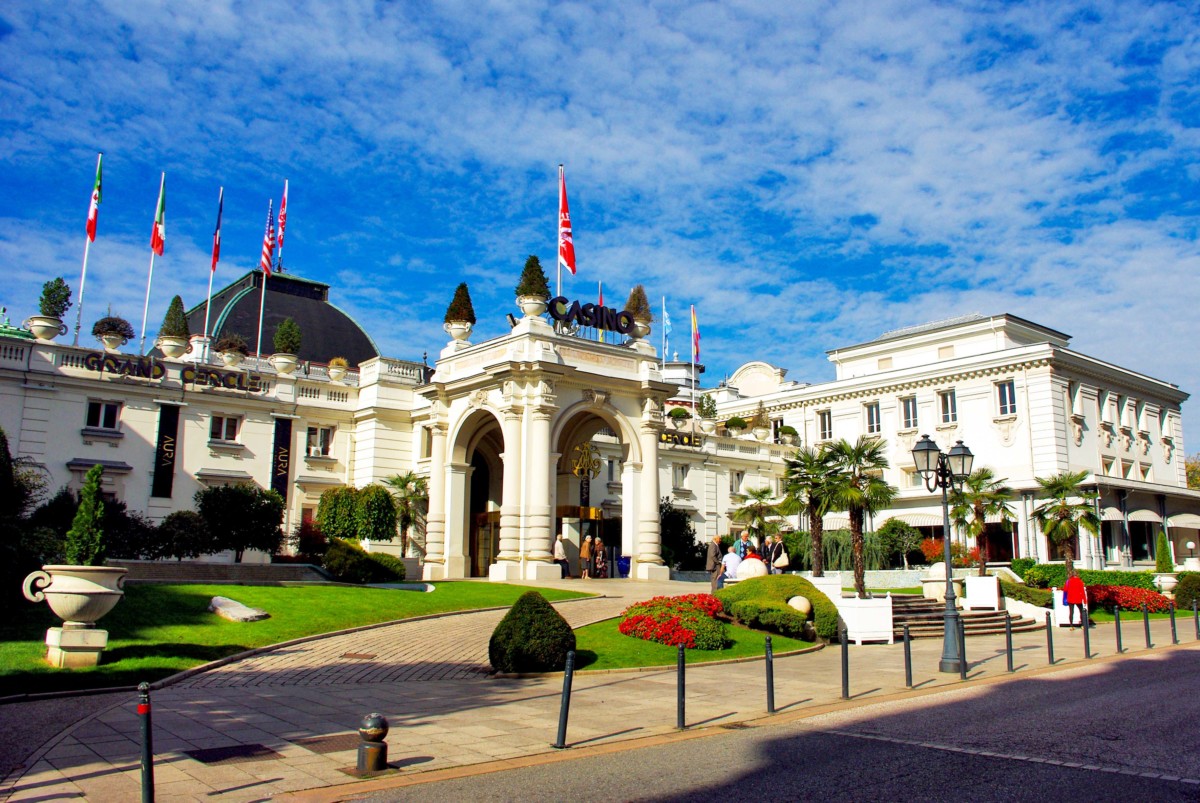
The casino of Aix-les-Bains © French Moments
It is probably the most practical place for a first encounter with Lake Bourget. It is not necessarily the wildest, but it is the easiest, the liveliest, and the one that best reveals the link between the lake, the spa town and the Savoyard art of living.
2. Châtillon: Beach, Harbour and Château at the Northern End of the Lake
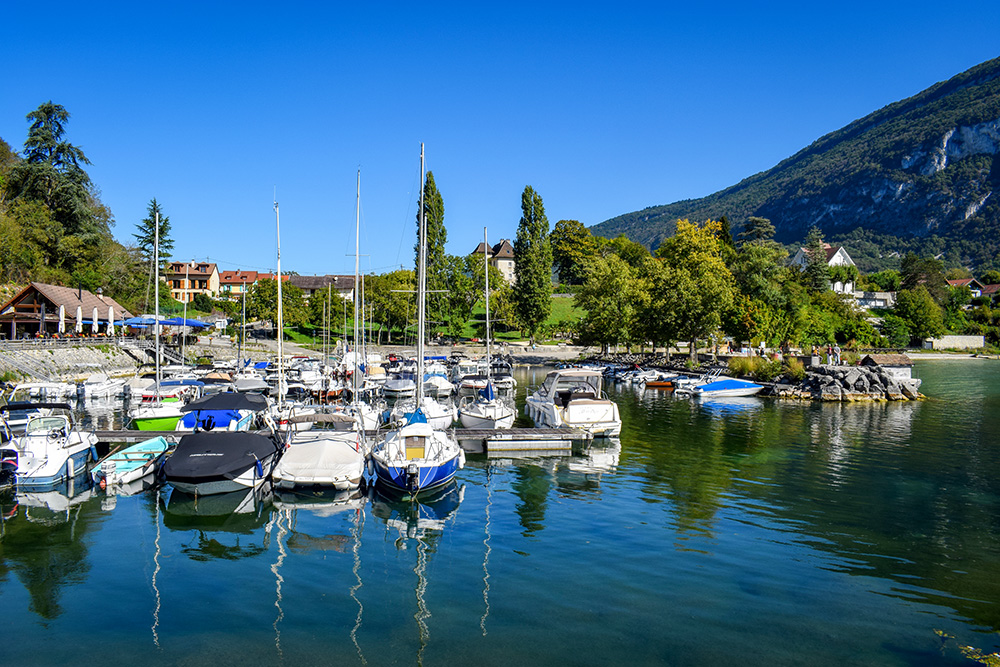
The little harbour of Châtillon © French Moments
At the northern end of the lake, Châtillon offers a very different atmosphere from Aix-les-Bains.
Located in the commune of Chindrieux, the site brings together a beach, a marina and a castle visible in the landscape. Châtillon beach is one of the lake’s popular beaches, with free access and paid parking during the summer season.
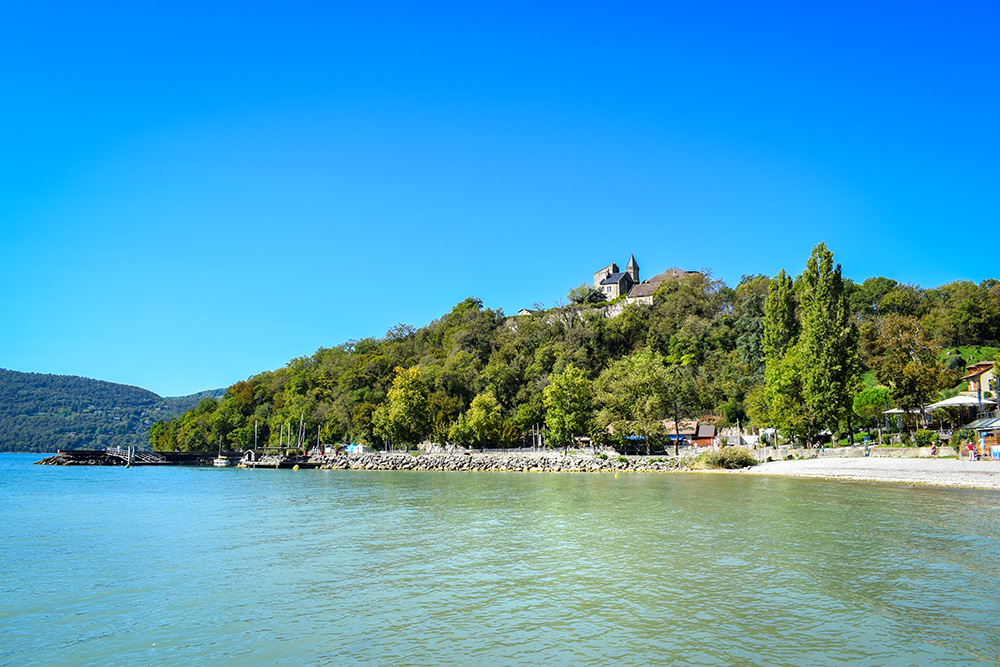
Châtillon at the northern end of the lake © French Moments
Châtillon also has an ancient history. Local visits evoke its château, its harbour and an underwater pile-dwelling site dating from the Bronze Age.
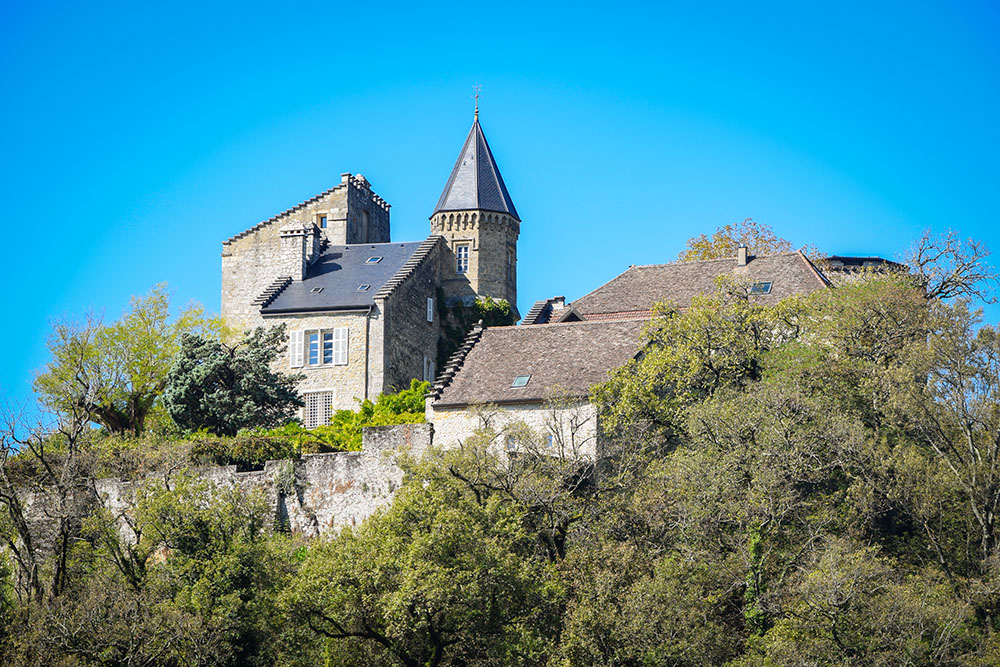
Château de Châtillon, Savoie © French Moments
It is an interesting place because it shows another side of Lake Bourget: less spa-focused, less urban, more connected to the Chautagne, the ports at the northern end of the lake and the open landscapes towards the Rhône.
3. Hautecombe Abbey, a Historic Jewel of Savoie
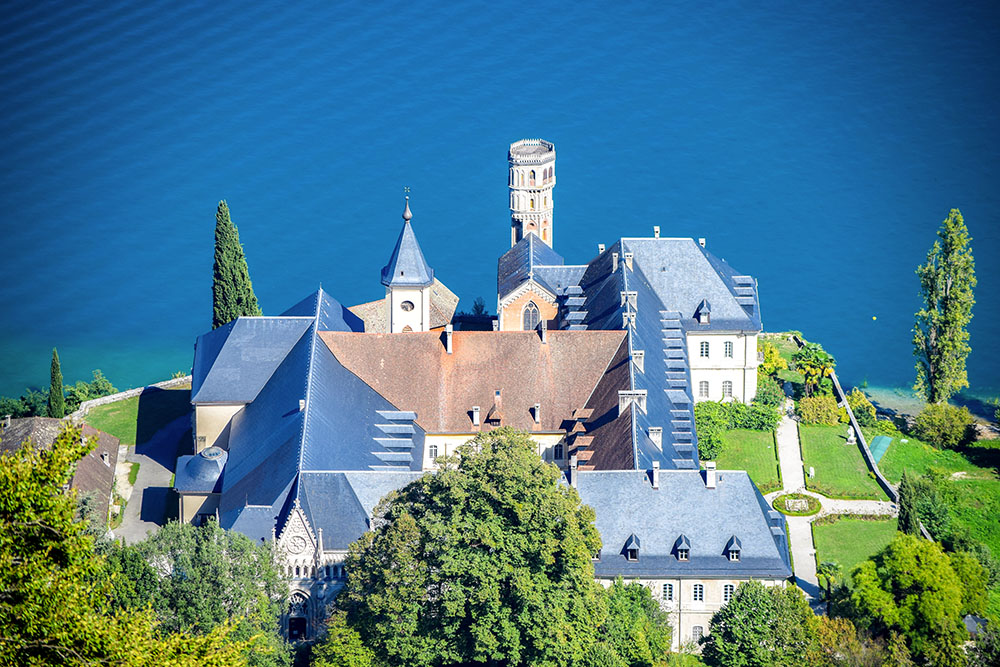
Hautecombe Abbey seen from the Ontex viewpoint © French Moments
Hautecombe Abbey is undoubtedly the great heritage monument of Lake Bourget.
Standing on the western shore, in a spectacular setting, it seems almost placed between forest, mountain and water. The royal abbey contains the tombs of the Counts of Savoy as well as several of the last kings and queens of Italy.
It is at once a religious, dynastic and scenic site. Visitors come for its architecture, its history, its connection with the House of Savoy, but also for the emotion of the setting. Few monuments around the lake give such a strong impression of having been built to converse with the landscape.
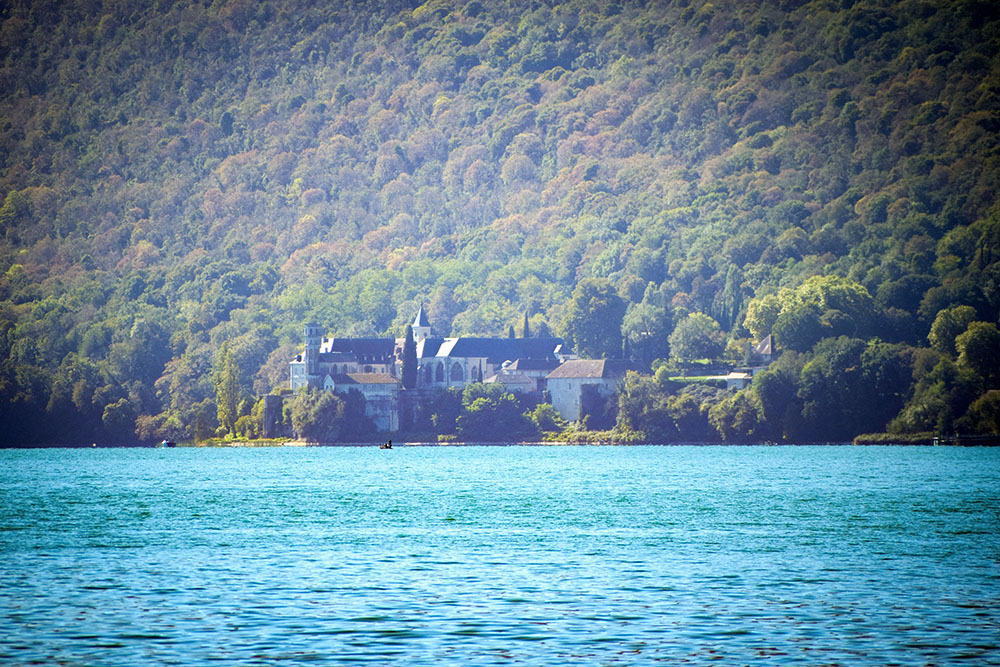
Hautecombe Abbey seen from Châtillon © French Moments
You can reach Hautecombe by car, but arriving by boat from Aix-les-Bains offers a different experience. Seeing the abbey appear from the lake helps you understand why this site has left such a mark on the Savoyard imagination.
4. The Ontex Viewpoint, a Wild View over Hautecombe and the Lake
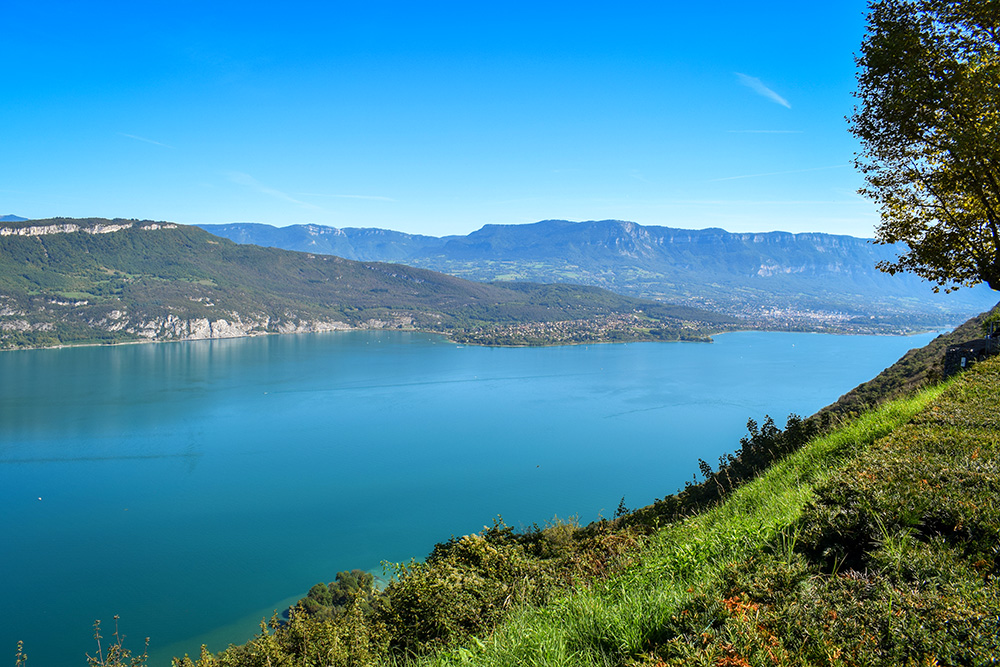
Belvédère d'Ontex, Savoie © French Moments
Above Hautecombe Abbey, the Ontex viewpoint — also known as the Grumeau viewpoint — offers one of the most beautiful views over Lake Bourget.
During my first visit to the site, I was struck by the spectacular plunging view over Hautecombe Abbey and the lake.
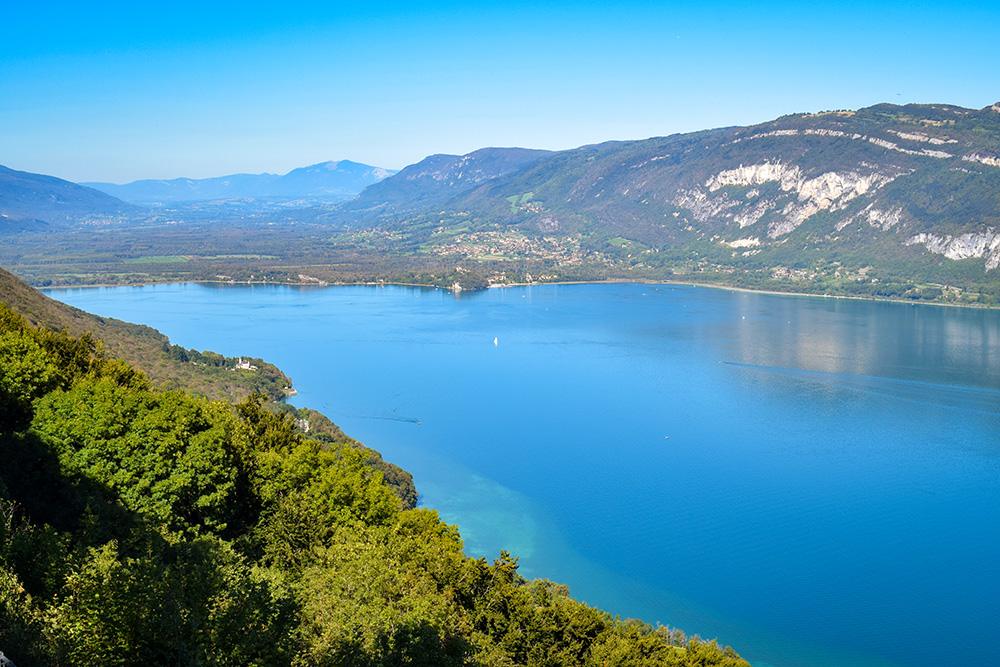
The northern part of the lake seen from the Ontex viewpoint © French Moments
It is an excellent place to gain height without necessarily setting off on a major hike. The eye takes in the wild shore, the wooded slopes, the abbey and the expanse of the lake. From up here, you better understand the difference between the more developed eastern shore and the steeper western shore.
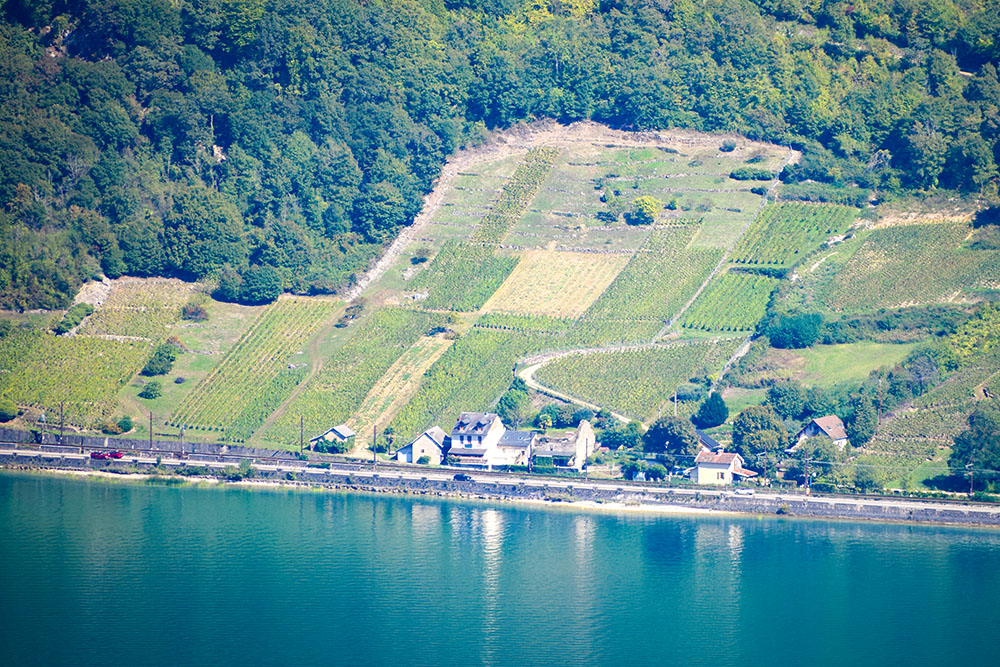
The vineyards of Lake Bourget seen from the Ontex viewpoint © French Moments
The Ontex viewpoint also has the advantage of being less famous than some of the better-known panoramas. It therefore retains a slightly confidential feel, which is never unpleasant when you enjoy views without the crowds.
5. Notre-Dame de l’Étoile and its viewpoint
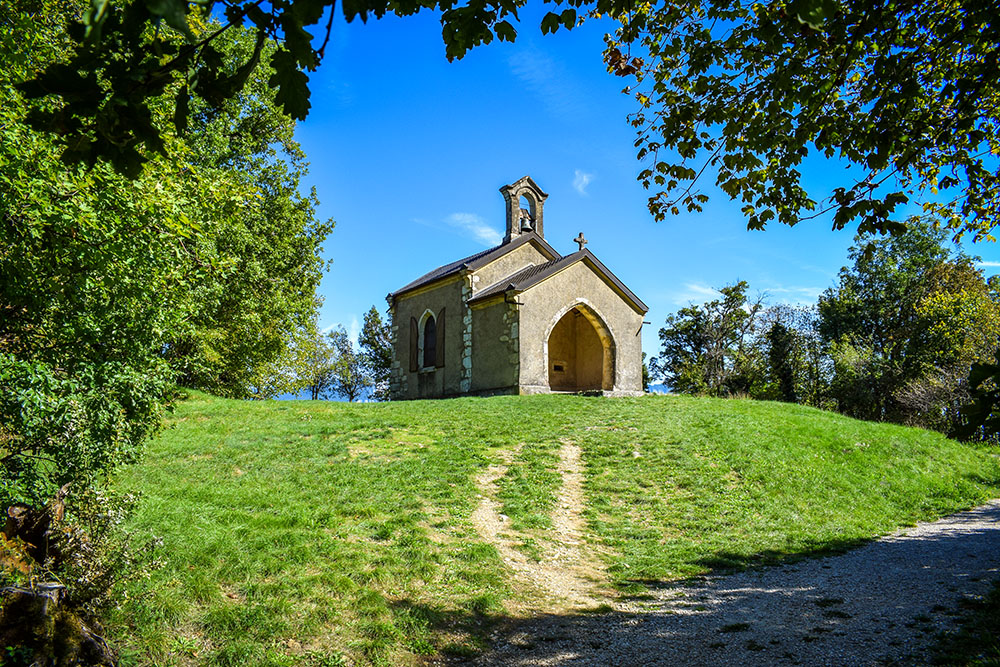
Chapelle Notre-Dame de l'Étoile © French Moments
La Chapelle-du-Mont-du-Chat offers another remarkable panorama over Lake Bourget and Aix-les-Bains, which appears just opposite.
Around the chapel of Notre-Dame de l’Étoile, three balcony viewpoints allow you to contemplate the landscape in a calm, almost meditative atmosphere.
This site feels more intimate than the major tourist viewpoints. You come for the view, of course, but also for the silence, the light and that impression of being suspended above the lake.
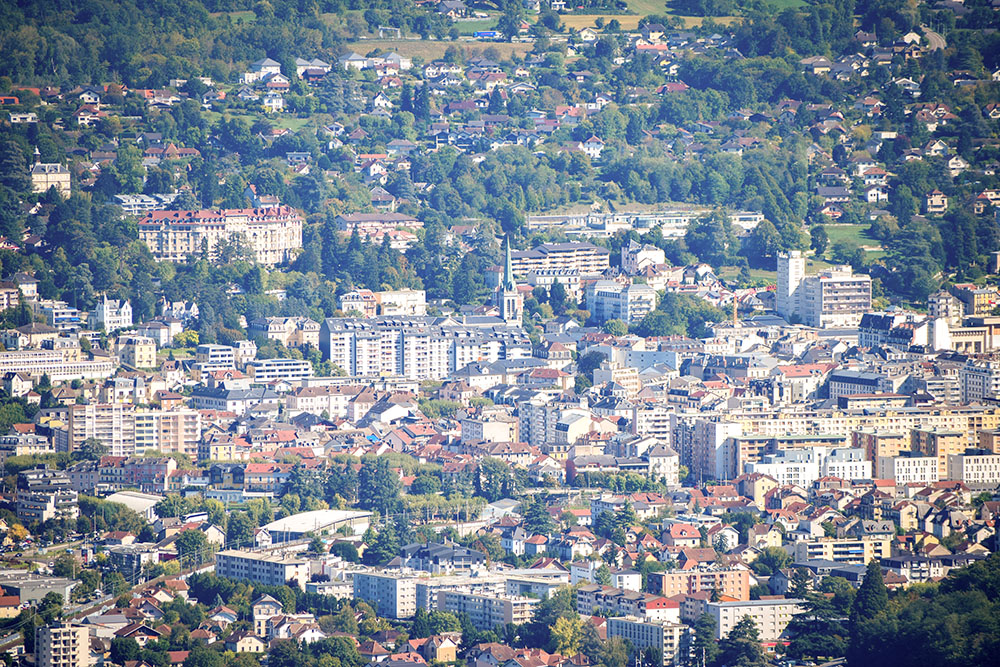
Aix-les-Bains seen from Notre-Dame de l’Étoile Chapel © French Moments
It is the kind of place that reminds you Lake Bourget is not only discovered at water level. The heights are part of its identity. They completely change your perspective: from the shores, the lake seems vast; from the viewpoints, it becomes a great sheet of water framed by reliefs.
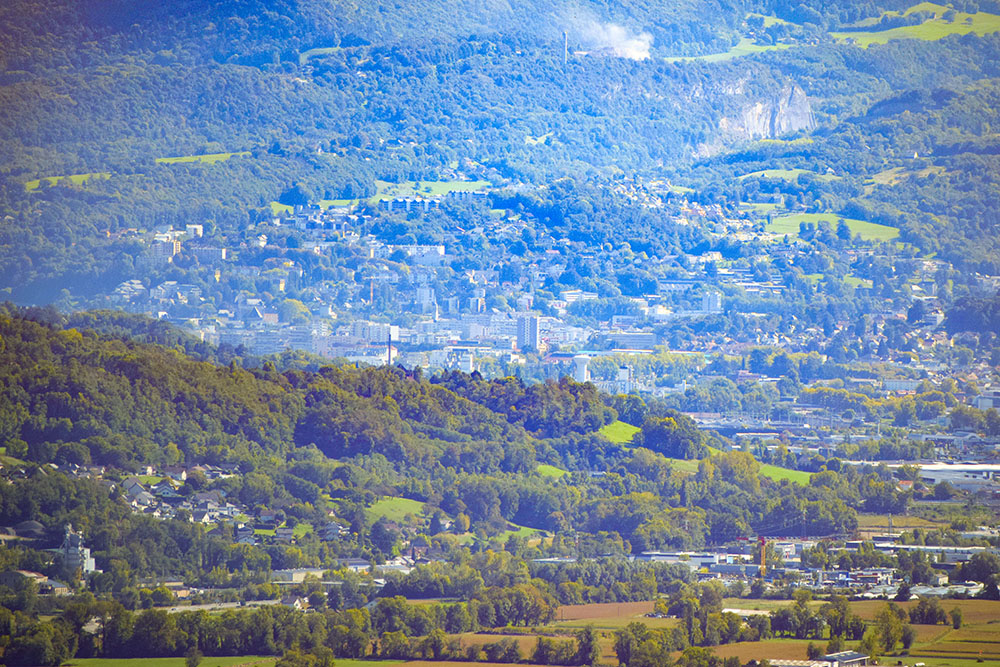
Chambéry seen from Notre-Dame de l’Étoile Chapel © French Moments
6. The Bout du Lac: Les Mottets, Étang des Aigrettes and the Château de Thomas II
At the southern end of the lake, the Bout du Lac area offers a very interesting mixture of nature, leisure and heritage.
![Bout du Lake Bourget © Florian Pépellin - licence [CC BY-SA 4.0] from Wikimedia Commons](https://frenchmoments.eu/wp-content/uploads/2026/07/Bout-du-Lac-du-Bourget-©-Florian-Pepellin-licence-CC-BY-SA-4.0-from-Wikimedia-Commons.jpg "Bout du Lac du Bourget © Florian Pépellin - licence [CC BY-SA 4.0] from Wikimedia Commons")
Aerial view of the southern end of the lake © Florian Pépellin - licence [CC BY-SA 4.0] from Wikimedia Commons
Les Mottets
The Les Mottets leisure base, located in the commune of Viviers-du-Lac, is a family-friendly area with beaches and landscaped spaces.
Les Aigrettes
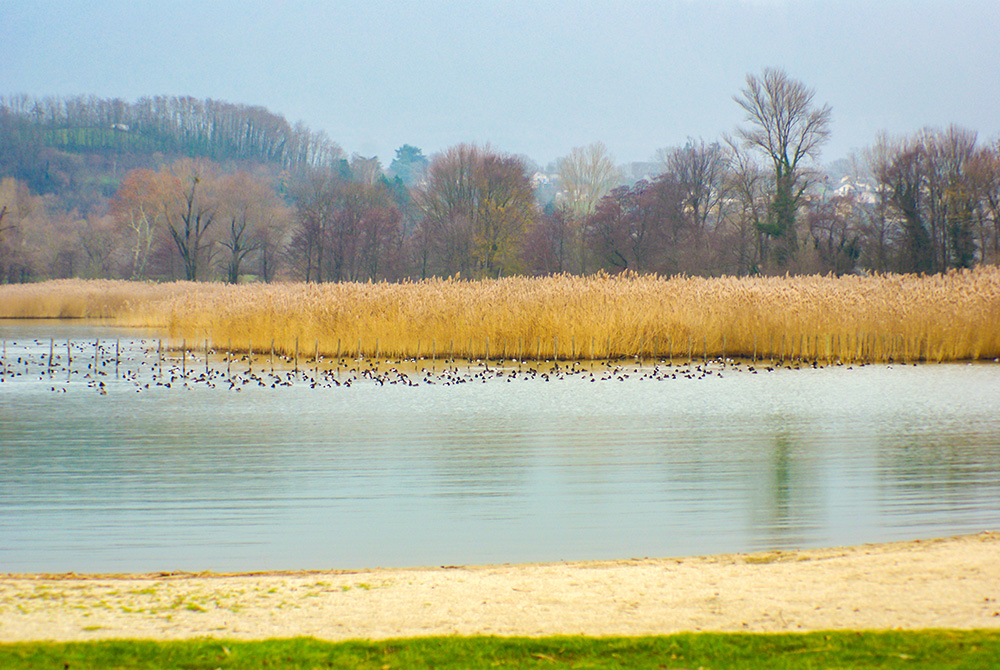
The reedbeds at the southern end of the lake © French Moments
Not far away, the protected areas of the southern shore, the Étang des Aigrettes and the reedbeds (roselières) recall the ecological importance of the lake.
A document from Le Bourget-du-Lac explains that the protected area of the southern shore extends between the Leysse and the Les Mottets leisure base, over more than one hundred hectares, with ponds, pools, meadows, wet woodlands, reedbeds and aquatic vegetation.
Bourget Castle
![Châteaux de Savoie : Bourget © Florian Pépellin - licence [CC BY-SA 4.0] from Wikimedia Commons](https://frenchmoments.eu/wp-content/uploads/2026/07/Chateau-du-Bourget-©-Florian-Pepellin-licence-CC-BY-SA-4.0-from-Wikimedia-Commons.jpg "Château du Bourget © Florian Pépellin - licence [CC BY-SA 4.0] from Wikimedia Commons")
Bourget Castle © Florian Pépellin - licence [CC BY-SA 4.0] from Wikimedia Commons
Thomas II Castle, sometimes called the Château du Bourget, adds a historical dimension to this discovery. Built on land acquired in 1248 by Thomas II of Savoy, brother of Count Amadeus IV, it is a unique building in the region and today hosts a museum trail devoted in particular to fauna, flora and the preservation of natural spaces.
The Bout du Lac is therefore a perfect area for understanding that Lake Bourget is not merely a holiday backdrop. It is also a fragile, living environment, inhabited by birds, plants, walkers, families… and a few medieval remains, because in Savoie, even wetlands often have their château.
7. The Chambotte Viewpoint, One of the Finest Panoramas over the Lake
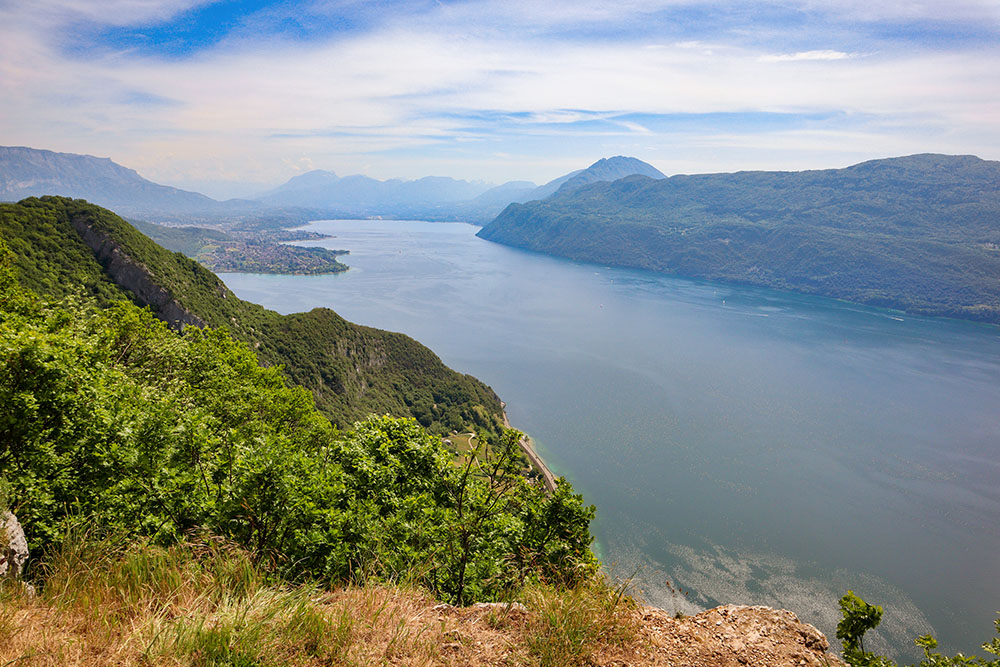
The view from the Chambotte viewpoint © Francis Guernier - French Moments
The Chambotte viewpoint, in Brison-Saint-Innocent, is one of the great classics around Lake Bourget.
It offers a spectacular view over the lake, especially because it allows you to grasp its length and both ends. It is surely the finest panorama on the eastern shore of the lake.
From the Chambotte, the lake appears in all its breadth. You can see Aix-les-Bains, the mountains, the shores, the villages and the long line of water that structures the whole landscape.
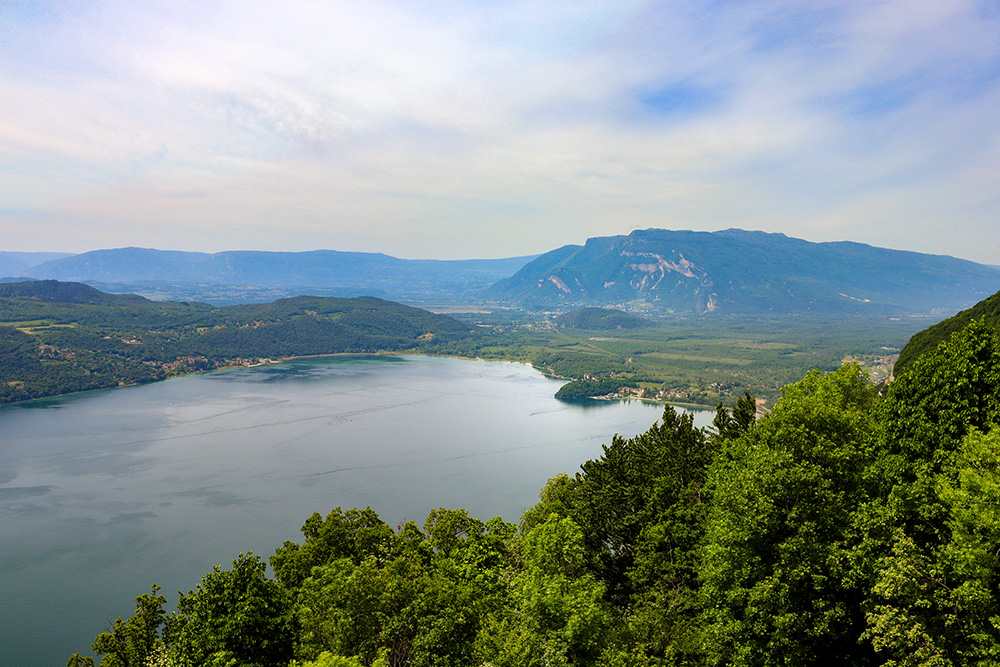
The view from the Chambotte viewpoint © Francis Guernier - French Moments
It is probably one of the best places to become aware of the beauty of Lake Bourget. The view is wide, clear, almost educational. Even if you have already seen the lake from its shores, the Chambotte offers another reading of the place.
8. Le Revard, the Bauges Balcony over Lake Bourget
![Mont Revard Lake Bourget © Florian Pépellin - licence [CC BY-SA 4.0] from Wikimedia Commons](https://frenchmoments.eu/wp-content/uploads/2026/07/Mont-Revard-©-Florian-Pepellin-licence-CC-BY-SA-4.0-from-Wikimedia-Commons.jpg "Mont Revard © Florian Pépellin - licence [CC BY-SA 4.0] from Wikimedia Commons")
The view from Mont Revard over the lake © Florian Pépellin - licence [CC BY-SA 3.0] from Wikimedia Commons
Mont Revard is not on the shore of the lake, but it would be a pity to talk about the great sites around Lake Bourget without mentioning it.
Located in the Bauges massif, above Aix-les-Bains, the Revard viewpoint offers a 360-degree view over Lake Bourget, the neighbouring massifs and, in clear weather, Mont Blanc.
The site is known for its panoramic walkways, including a glass-floored platform that gives a rather striking impression above the void.
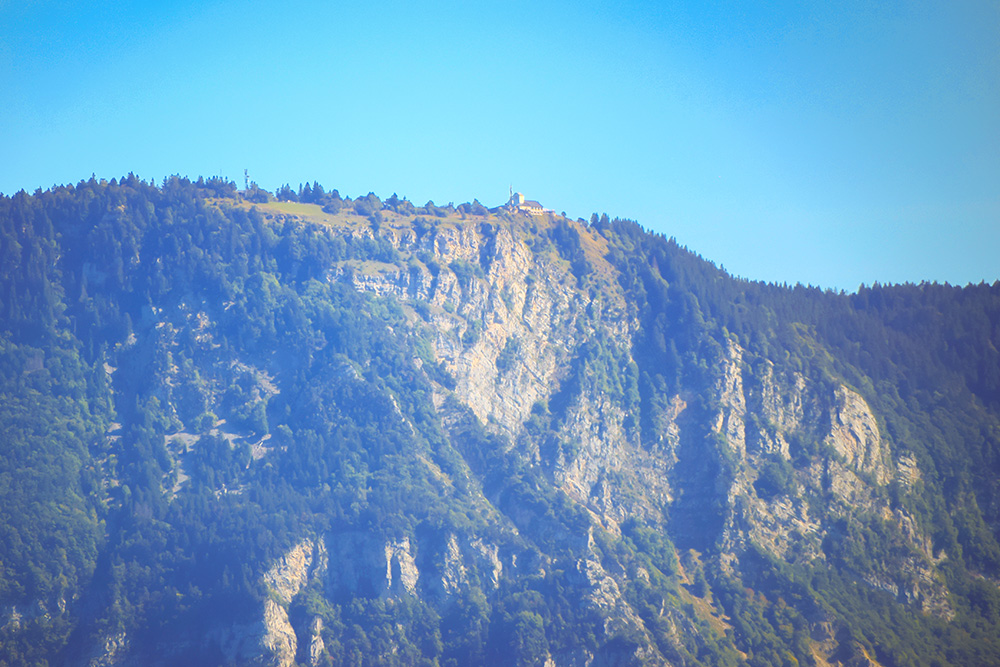
The summit of Mont Revard seen from the western side of the lake © French Moments
Le Revard allows you to understand the lake from an entirely different level. Up there, Aix-les-Bains seems tiny, the lake becomes a great blue sheet, and the mountains form an immense backdrop.
It is also a good idea if you want to combine the lake with a more mountainous atmosphere. In winter, Le Revard belongs to the Savoie Grand Revard Nordic area; in summer, it is a place for walking, hiking and panoramas.
9. The Dent du Chat, the Emblematic Mountain of the Lake
![Lake Bourget Dent du Chat du Molard Noir © Florian Pépellin - licence [CC BY-SA 3.0] from Wikimedia Commons](https://frenchmoments.eu/wp-content/uploads/2026/07/Dent-du-Chat-du-Molard-Noir-©-Florian-Pepellin-licence-CC-BY-SA-3.0-from-Wikimedia-Commons.jpg "Dent du Chat du Molard Noir © Florian Pépellin - licence [CC BY-SA 3.0] from Wikimedia Commons")
The Dent du Chat seen from Molard Noir © Florian Pépellin - licence [CC BY-SA 3.0] from Wikimedia Commons
On the western shore, the Dent du Chat (Cat's Tooth) is one of the most recognisable silhouettes of Lake Bourget.
It dominates the landscape with its characteristic shape and gives the lake a wilder, more mineral dimension. For many visitors, it soon becomes the visual landmark of the lake: you look for it, photograph it, and recognise it from one viewpoint to the next.
The area can be reached by car, but if you want to climb to the actual summit, be aware that the hike to the Dent du Chat is demanding. The route from the Col du Chat is described as very difficult, with around 7.8 kilometres return, 815 metres of elevation gain and a walking time of about 5 hours.
In other words, this is not the little digestive stroll after an ice cream in Aix-les-Bains. The Dent du Chat has to be earned, especially on the final section, which can be vertiginous.
For a more accessible approach, the Molard Noir already offers a superb panorama over the Dent du Chat, Lake Bourget and the Savoyard foreland. The more courageous can then continue towards the Dent du Chat, but take care: the final climb requires a sure mountain foot.
10. Chanaz, the charm of the Canal de Savières
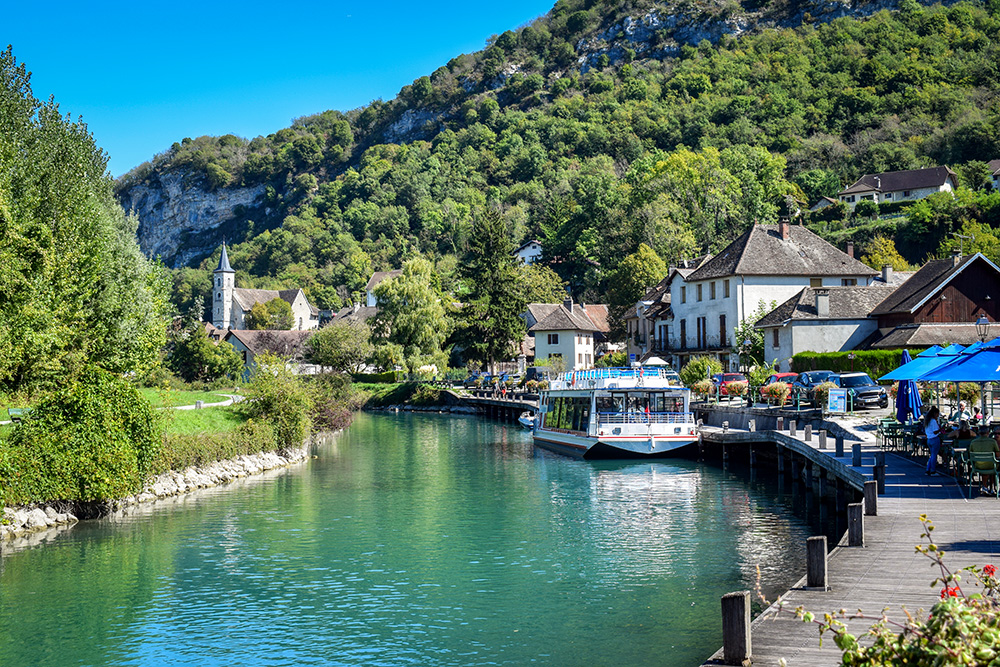
Chanaz, Savoie © French Moments
Chanaz is not located directly on the shores of Lake Bourget, but the village naturally extends the discovery of the lake towards the Canal de Savières and the Rhône.
Nicknamed the “little Venice of Savoie”, Chanaz stands beside the Canal de Savières, in a setting of old houses, water, narrow streets, craftspeople and small boats.
The Canal de Savières winds for almost 4 kilometres between the Portout area and Chanaz, where a lock allows navigation towards the Upper Rhône.
Chanaz offers a very different conclusion to a discovery of Lake Bourget. After the great views, beaches, mountains and abbeys, here you find the atmosphere of a water village, softer and almost river-like.
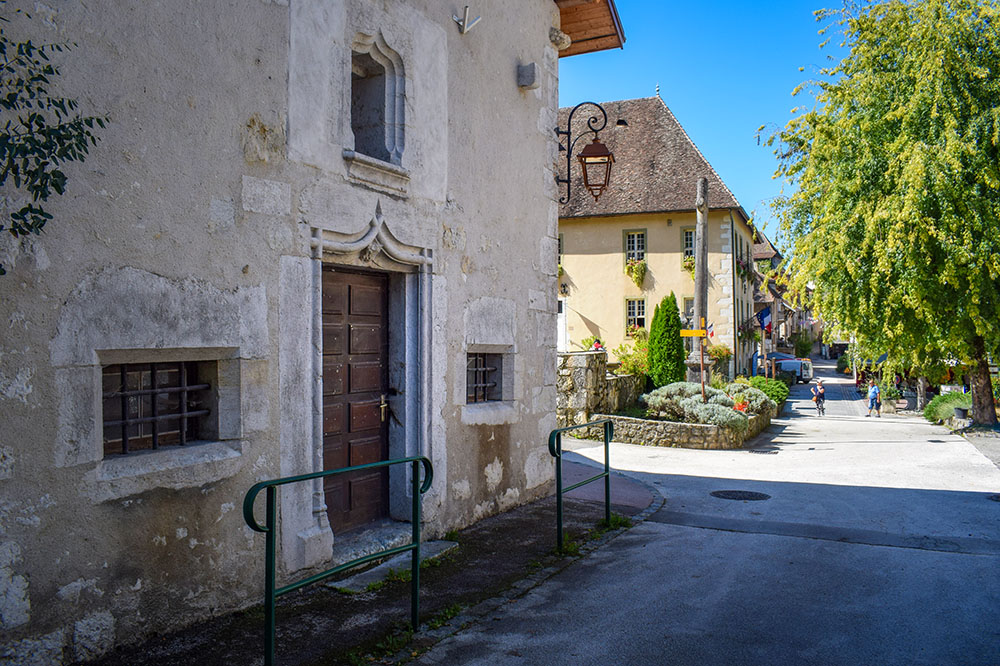
Chanaz © French Moments
It is a lovely way to understand that the lake is not isolated. It communicates with other landscapes, other waters and other stories. And, incidentally, Chanaz is the kind of place where it is very easy to decide you will “just have a ten-minute stroll” before spending a good part of the afternoon there.
Practical Tips for Visiting Lake Bourget
How to Get to Lake Bourget
Lake Bourget is easy to reach from Chambéry, Aix-les-Bains, Annecy, Lyon or Geneva.
Aix-les-Bains is generally the most practical gateway, especially if you arrive by train. The town has a conveniently located station and allows easy access to the centre, the thermal baths, the harbour and the lakeside promenades.
By car, access is also straightforward thanks to the main roads around Chambéry and Aix-les-Bains. A car remains useful if you want to tour the lake, reach the viewpoints, go up to Le Revard or explore the western shore.
For certain sites, such as Hautecombe Abbey, a boat cruise can be a beautiful alternative in season. The lake can be understood very well from the road, but it is felt even more strongly from the water.
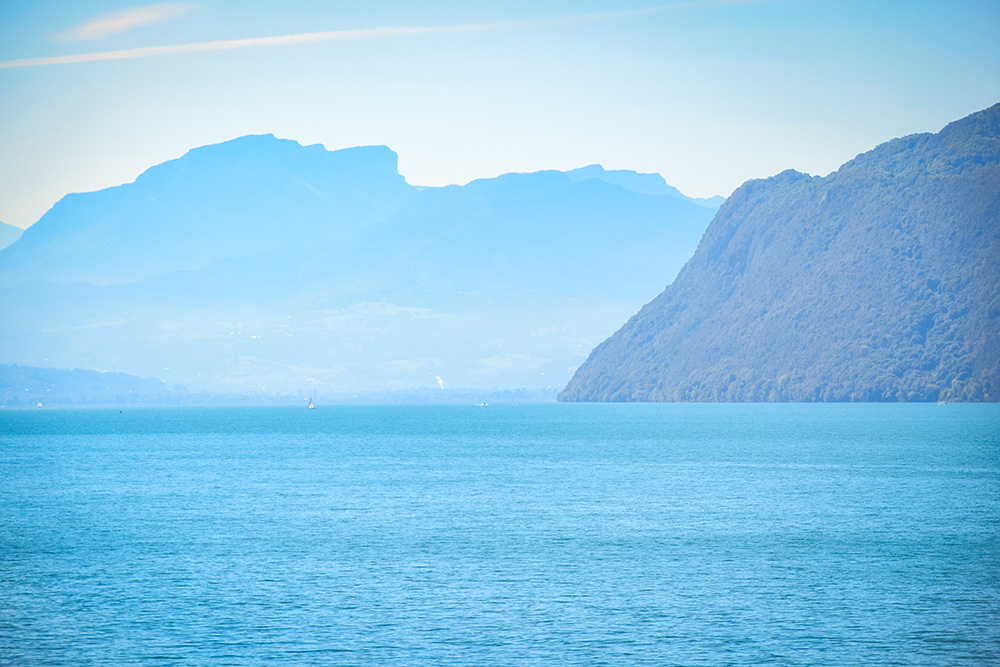
View of the lake from Châtillon © French Moments
When to Visit Lake Bourget
Lake Bourget can be visited all year round, but the experience changes greatly with the season.
Spring is ideal for walks, viewpoints and the first days by the water. The landscapes are green, the temperatures are pleasant and visitor numbers are still reasonable.
Summer is the season for beaches, water sports, cruises and long evenings by the lake. It is also the busiest season. If you do not like crowds, avoid sunny weekends in July and August, especially around the most accessible beaches such as Aix-les-Bains, Les Mottets or Châtillon. Châtillon beach, for example, has compulsory paid parking during the summer season, a sign that visitor numbers can be high.
Autumn is a magnificent season for colours, softer light and panoramic walks. The lake becomes quieter, the mountains take on warmer tones, and the viewpoints develop an almost romantic atmosphere.
Winter offers a different, quieter mood. In clear weather, the views over the lake and the mountains can be superb, especially from the heights of Le Revard or the Mont du Chat. You simply need to adapt your visits to the weather conditions and to road or site openings.
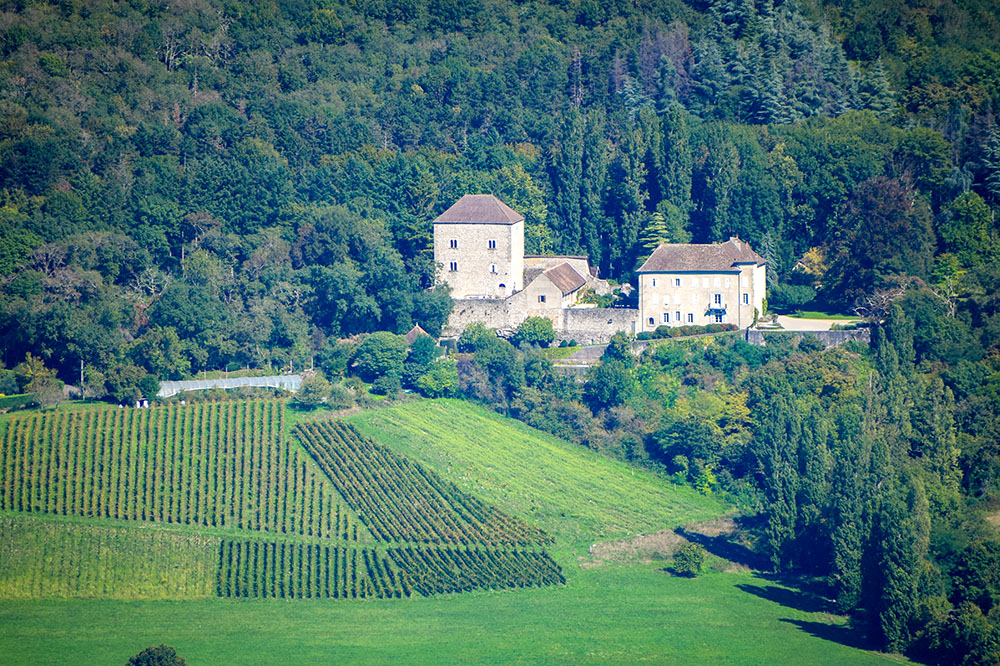
Château de Saint-Innocent © French Moments
Where to Stay Around Lake Bourget
Lake Bourget offers several accommodation options depending on the type of stay you are looking for.
Aix-les-Bains is the most practical base if you want to enjoy restaurants, the thermal baths, the station, the harbours and the lakeside promenades. It is also the best choice if you want to limit car journeys.
Le Bourget-du-Lac works well for a quieter atmosphere at the southern end of the lake, with easy access to Les Mottets, the Château de Thomas II, the natural areas and Chambéry.
Brison-Saint-Innocent, Chindrieux or the villages on the northern shore allow you to be closer to quieter landscapes, the Chambotte, Châtillon and the Chautagne.
Chambéry can also be a good option if you want to combine your discovery of the lake with a visit to the city, the Bauges massif or the Savoie valley.
Browse the map below to compare available accommodation around Lake Bourget.
Is Lake Bourget Worth Visiting?
Yes, without hesitation.
Lake Bourget is worth visiting because it cannot be reduced to a single image. It is at once a great natural lake, a glacial landscape, a Savoyard territory, a bathing place, a space of memory, a spa destination, a romantic setting and a hiking area.
It is less immediately famous than Lake Annecy for some international visitors, but it has a different kind of depth — both literally and figuratively.
Behind its blue reflections lie vanished glaciers, abbeys, poets, harbours, villages, châteaux, reedbeds, viewpoints and mountains.
Lake Bourget is not content simply to be beautiful. It tells a story. And perhaps that is why it deserves the time it takes to go properly around it.
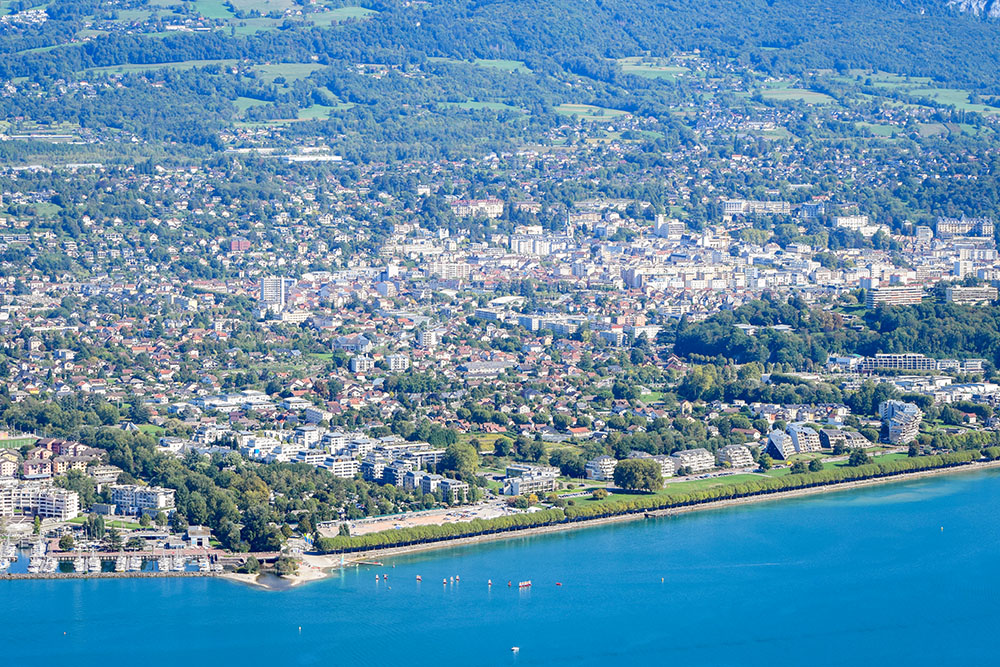
Aix-les-Bains seen from Notre-Dame de l’Étoile Chapel © French Moments