My relationship with Dijon began long before I ever stepped off a train there.
The first time I visited the city, I was a teenager travelling with my parents.
We were staying in Semur-en-Auxois, and one day we decided to take a trip to Dijon, simply to see the regional capital we had heard so much about.
I remember the colours of the rooftops, the tall houses, and the feeling of walking through a place that seemed both historic and alive.
It was only a brief visit, but it left an impression.
Years later, I passed through Dijon again and again by train, travelling between Paris and the east of France.
Each time, I caught just a glimpse: a tower, a roof, a curve of streets seen from the window.
Enough to spark curiosity, but never enough to really understand the city.
And then, following an invitation from the local tourism board, we finally stopped for real.
Not for an hour between trains, but for a proper stay — a family visit, with time to walk, explore, and rediscover the city I had first seen as a teenager.
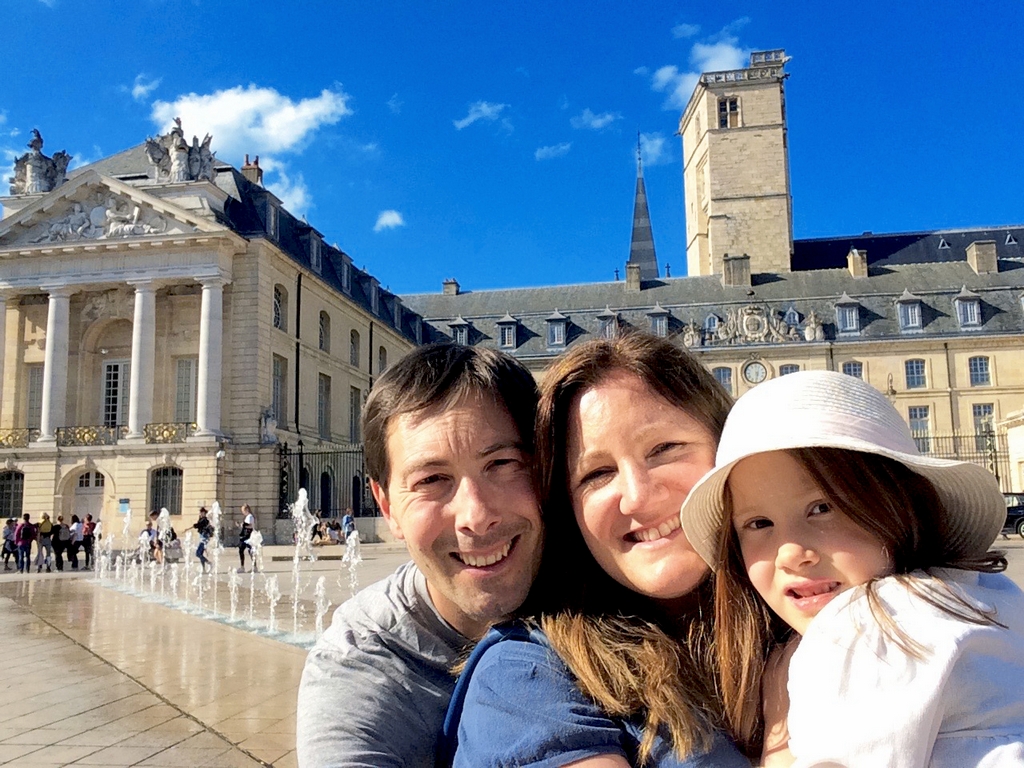
Our family in Dijon! © French Moments
We spent several days crossing the historic centre, visiting museums, climbing towers, tasting local dishes, and enjoying the quiet rhythm of Dijon's streets and squares.
I took hundreds of photos to remember every detail: the patterns on the glazed roofs, the medieval timber-framed houses, the cafés bathed in soft light.
This article is the result of that trip — a complete guide to what makes Dijon such a special place to discover.
Where to Stay in Dijon: My Recommended Hotels
Here is a curated selection of five hotels and aparthotels that I can confidently recommend. All of them are well located, comfortable, and offer a good base for discovering the city’s squares, museums, markets, and restaurants.
You’ll find a mix of styles: design hotels, classic French elegance, and practical options for families or longer stays.
Mama Shelter Dijon ****
8 rue du Docteur Maret
Bold design, playful interiors, and a lively atmosphere make Mama Shelter one of Dijon’s most modern hotel choices.
Its central location is perfect for exploring the old town on foot. Rooms are stylish and comfortable, and the restaurant and rooftop bar bring a fun, contemporary energy to the city.
Alfred Suites – Appart-Hôtel
19 rue du Bourg
This is an excellent option if you prefer an apartment-style stay.
The suites are spacious, well-equipped, and ideal for families or travellers staying several nights. Situated close to the historic streets around Rue de la Liberté, Alfred Suites offers independence without sacrificing location or comfort.
Chapeau Rouge par William Frachot ****
5 rue Michelet
Chapeau Rouge is one of Dijon’s most refined hotels, combining modern elegance with a warm, intimate atmosphere.
It is also home to a two-star Michelin restaurant by William Frachot, making it a top choice for food lovers.
The hotel is only a short walk from the Cathedral and the Palais des Ducs.
Hôtel des Ducs ***
5 rue Lamonnoye
A reliable, comfortable, and well-priced hotel in the heart of the historic centre.
Hôtel des Ducs offers clean, modern rooms and a friendly atmosphere, within easy reach of the main landmarks and the Museum of Fine Arts.
A great option for travellers seeking value without compromising on location.
Hôtel du Palais
23 rue du Palais
A small, charming hotel with a warm and personal feel.
Located just steps from the Palais des Ducs and the Place de la Libération, it is perfectly positioned for a weekend focused on museums, architecture, and quiet walks through the old town.
Rooms are cosy and full of character.
More places?
To plan your accommodation in Dijon, click on this link for more hotels and places to stay.
Discovering the Historic Heart of Dijon
Dijon is the former capital of the powerful Duchy of Burgundy, and its historic centre reflects that long, rich history.
It is also part of the UNESCO World Heritage Site known as Les Climats du vignoble de Bourgogne, which links the city to the vineyard landscapes stretching toward Beaune.
This recognition highlights how architecture, culture, and the Burgundian wine tradition have shaped the identity of the region.
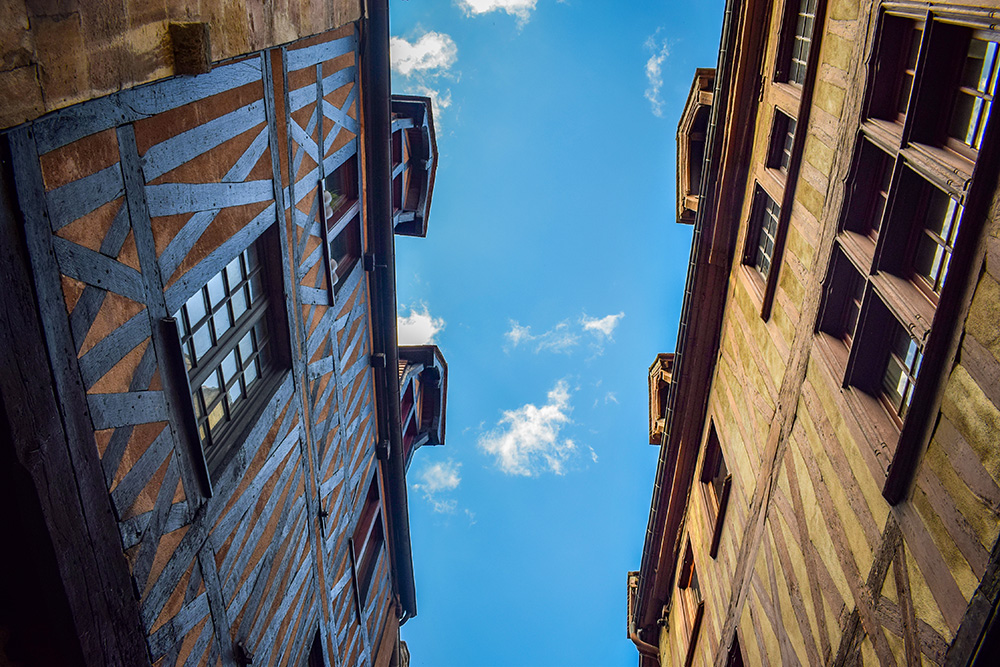
Rue Verrerie, Dijon © French Moments
But the city itself also holds UNESCO status. Since 2015, the city centre of Dijon has been recognised for its remarkable historic urban fabric — a rare distinction among French cities.
Why visit Dijon today? The answer becomes clear as soon as you arrive.
Easy to reach from Paris
Dijon is one of the most accessible destinations in eastern France.
The TGV from Paris takes about 1 hour and 40 minutes, with frequent trains arriving directly at the edge of the historic centre.
It’s an easy city-break option when you want a change of scene without a long journey.
Getting from the Station to Your Hotel
Dijon’s train station is only a short distance from the historic centre, and reaching your hotel is very easy.
You can take a taxi, hop on the tram, or use the free “City” shuttle.
The city has two tram lines, T1 and T2, which share a central section between the train station and Place de la République. They run frequently and are convenient if your hotel is near the main boulevards.
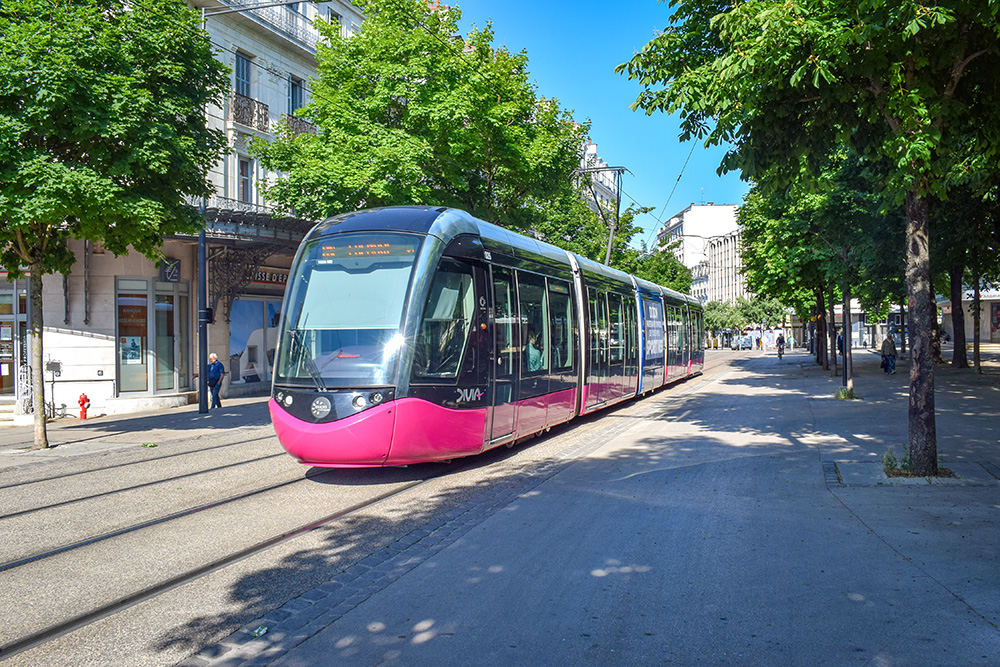
Tram of Dijon © French Moments
For the old town, the City shuttle is often the best option. It’s a free electric bus that loops around the historic centre from Monday to Saturday, 8 am to 7.30 pm, stopping close to many museums, squares, and hotels.
A manageable, walkable historic city
The old town is compact and easy to explore on foot.
It is enclosed by a ring of Haussmann-style boulevards, built in the nineteenth century to replace the old city walls.
These wide, elegant avenues form a natural frame around the medieval core.
The boulevards connect six major squares, giving the centre a clear structure:
- Place Darcy
- Place Saint-Bernard
- Place de la République
- Place du Trente-Octobre
- Place Wilson
- Place du Premier-Mai
Inside this frame lies a dense network of medieval lanes, Renaissance façades, classical mansions, and peaceful courtyards.
You can cross the city in minutes, but you will often stop to admire details, colours, or unexpected architectural features.
Discover Dijon through the Owl Trail
One of the best ways to explore the historic centre is to follow the Parcours de la Chouette, Dijon’s famous self-guided walking trail.
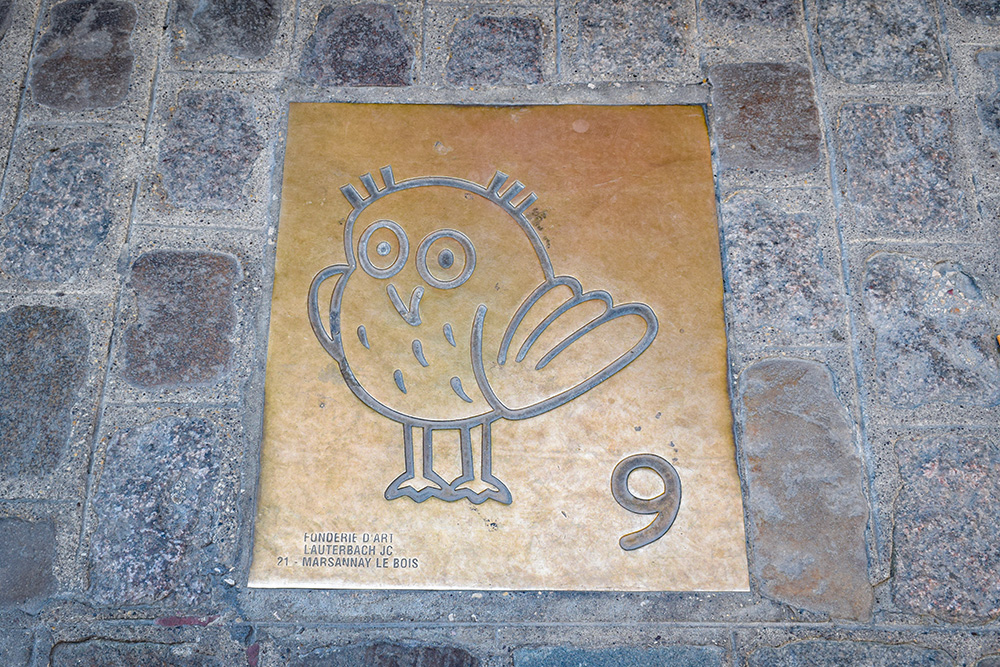
Trail of the Owl © French Moments
It is marked by small brass plaques set into the pavement, each one showing a small owl.
The route includes 22 steps that lead you through the most beautiful streets, squares, and buildings of the old town.
Along the way, you will see medieval houses, elegant mansions, churches, and viewpoints that you might otherwise miss.
The trail is simple, fun, and perfect for discovering the city at your own rhythm.
Whether you follow it with the official booklet or simply look for the owl markers, it is one of the most enjoyable introductions to Dijon.
Extraordinary heritage — without the crowds
Dijon has one of the most complete historic centres in France.
It was one of the first French cities to create a protected historic sector, long before heritage preservation became a national priority.
This early decision has shaped the city we see today.
The municipality has spent decades focusing on:
- pedestrian areas
- the preservation of old buildings
- the restoration of monuments
- the careful renovation of public spaces and façades
The result is a city centre that feels both authentic and well cared for.
Once you step away from the main shopping streets, you will often find yourself alone in medieval alleys, surrounded by centuries of history but without tourist crowds.
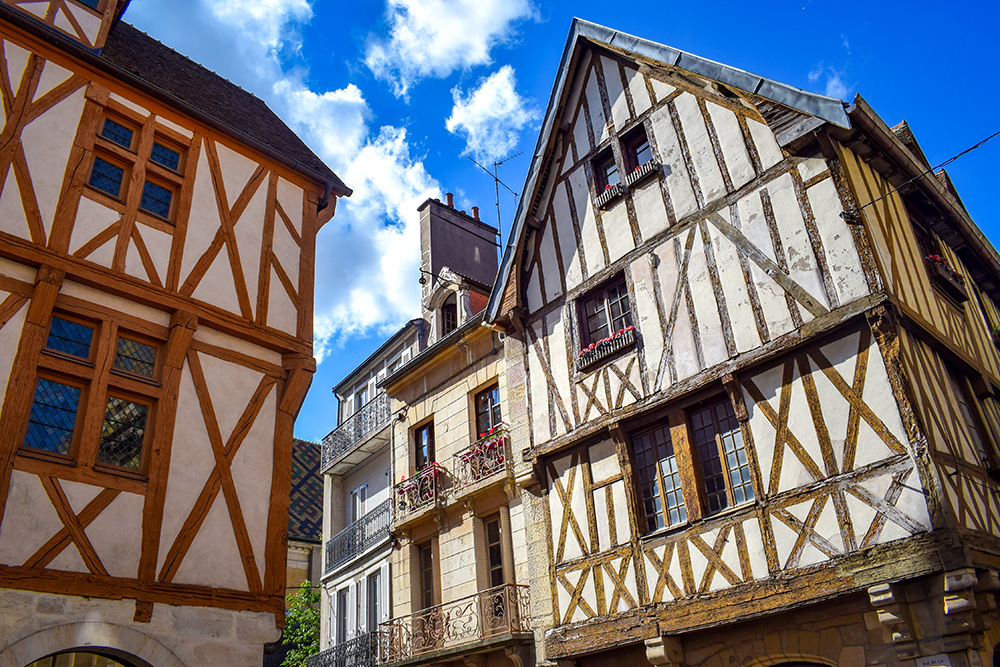
Rue de la Chouette © French Moments
One of the best gastronomic destinations in France
Dijon is home to some of the most famous flavours in the country: mustard, crème de cassis, gingerbread, and, of course, the wines of Burgundy.
The Cité Internationale de la Gastronomie et du Vin brings together exhibitions, tastings, workshops, and restaurants, offering a complete introduction to French culinary heritage.
The covered market, the local restaurants, and traditional shops add to this strong identity.
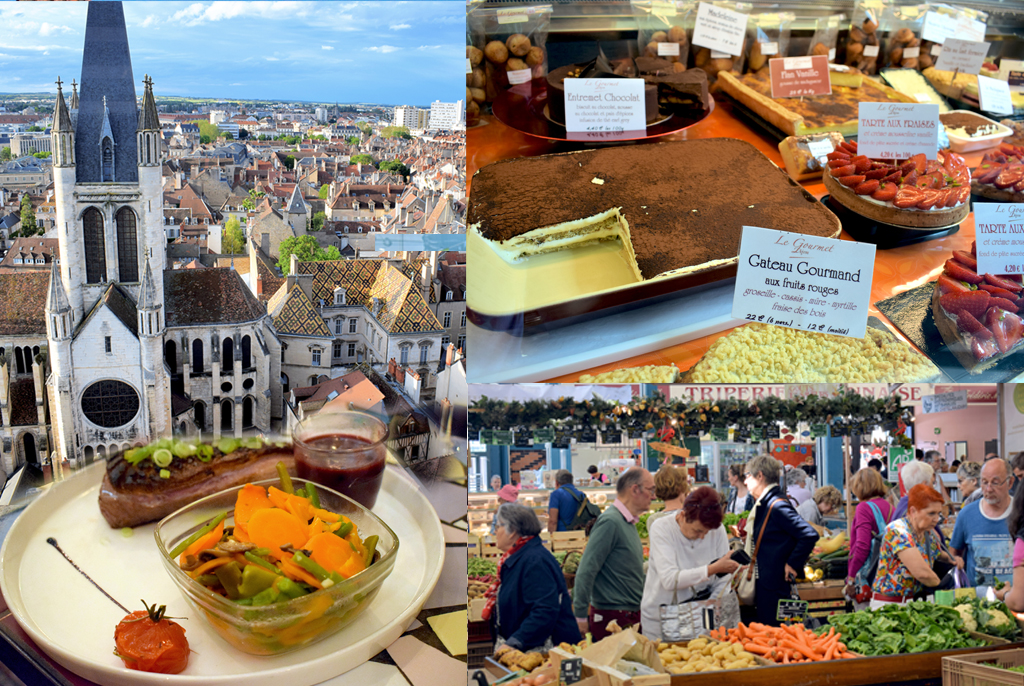
Discover Dijon Gastronomy © French Moments
A city that’s perfect year-round
Dijon is beautiful in every season.
In spring, café terraces come alive.
In summer, the colours of the glazed roofs shine in the sunlight.
In autumn, the surrounding vineyards turn gold.
In winter, the narrow streets and museums feel warm and intimate.
A perfect blend of the France you already love… and the France you don’t know yet
Dijon combines the elegance of Parisian architecture with the calm rhythm of provincial life.
It offers world-class heritage, excellent food, and a human scale that makes exploration easy and enjoyable.
It is familiar and surprising at the same time — a city where you rediscover France while discovering something entirely new.

Rue de la Chouette and church of Notre-Dame, Dijon © French Moments
Discovering the Best Architecture in Dijon
Dijon is one of the most beautiful historic cities in France.
Its medieval streets, grand mansions, and famous Burgundian glazed roofs make it a perfect destination for travellers who love architecture, culture, and history.
In this guide, you’ll explore three iconic features of Dijon architecture:
👉 timber-framed houses
👉 17th–18th-century mansions
👉 multicoloured Burgundian roofs
Timber-Framed Houses in Dijon
Timber-framed houses are one strong visual symbol of Dijon.
Most of them were built between the 14th and 16th centuries, a period of great prosperity for the city.
They give the old town a warm and authentic medieval feeling.
They also make the historic centre one of the most atmospheric in France.
Where to Find the Best Timber-Framed Houses in Dijon
Rue Verrerie
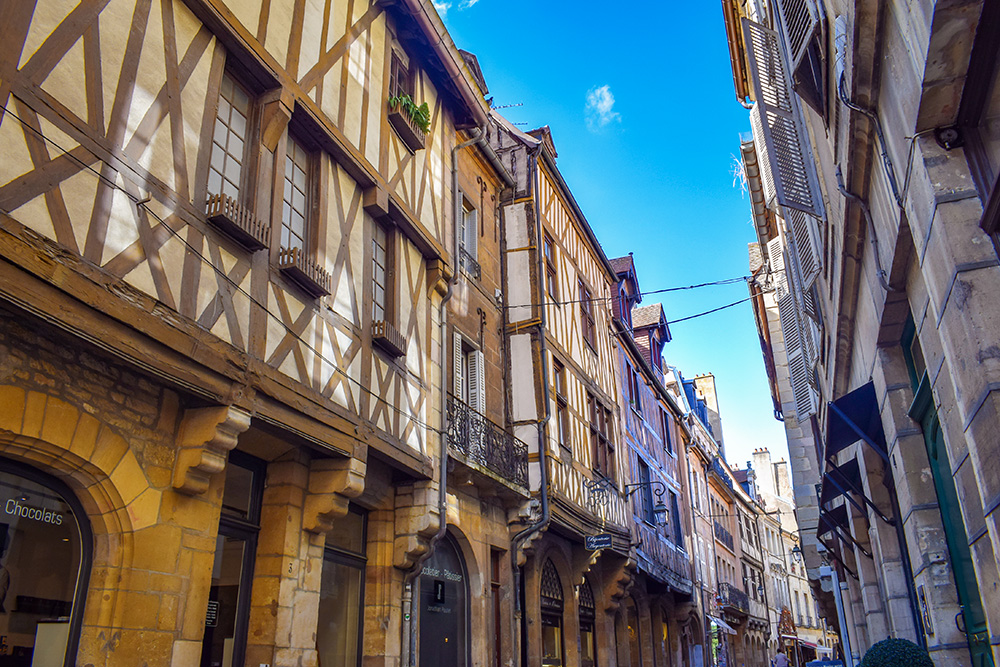
Rue Verrerie, Dijon © French Moments
One of the most beautiful medieval streets in the city.
Tall, narrow houses with deep overhanging upper floors line the street.
Place François-Rude (Place du Bareuzai)
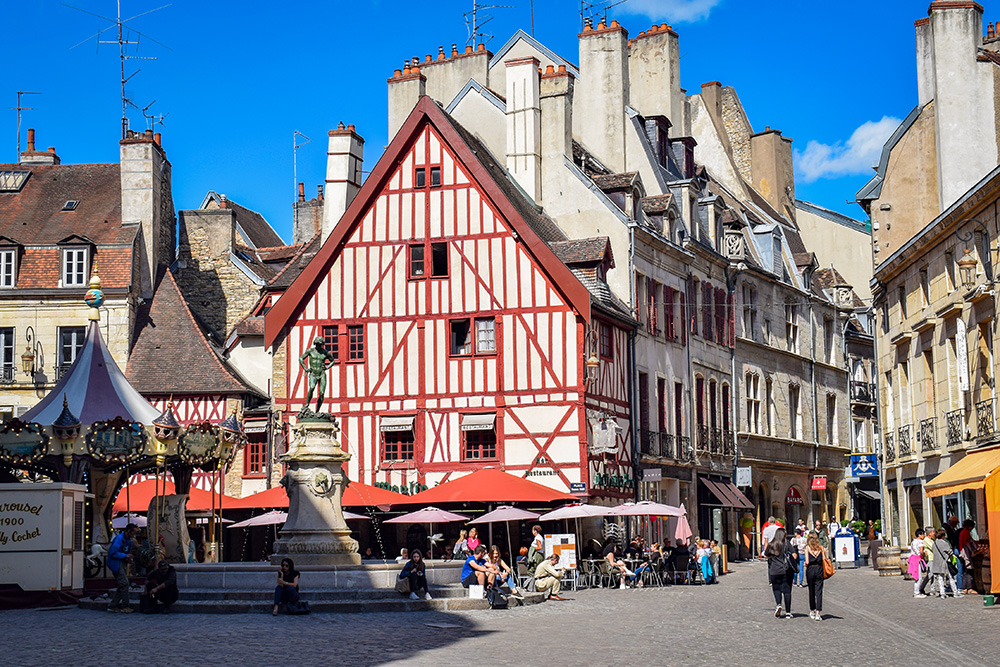
Place François Rude, Dijon © French Moments
A lively square surrounded by colourful timber-framed façades.
The famous statue of the grape treader (“Bareuzai”) stands in the centre.
Rue de la Chouette
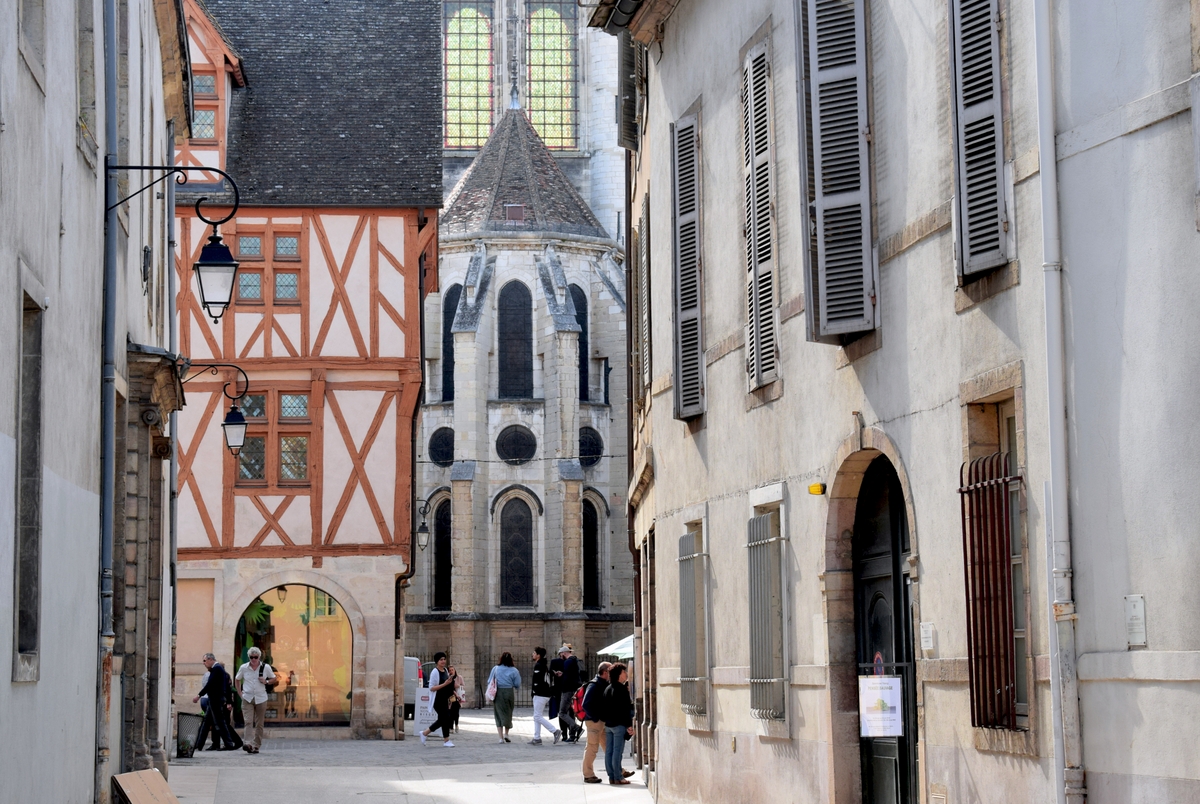
Rue de la Chouette and Notre-Dame church, Dijon © French Moments
A charming lane near Notre-Dame.
Home to small medieval houses and part of the Owl Trail.
Rue de la Liberté
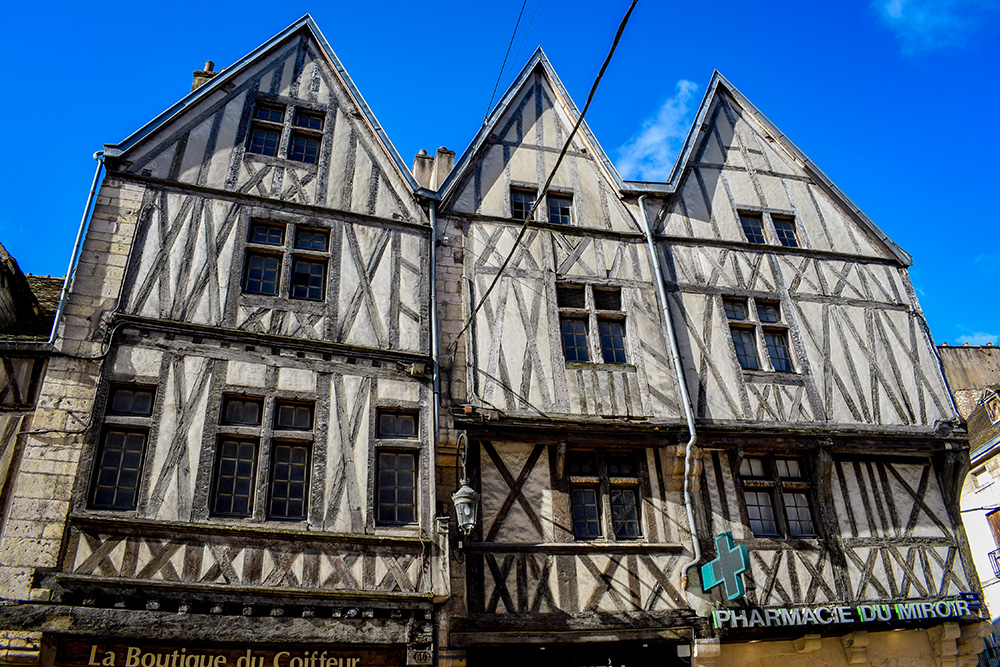
Rue de la Liberté, Dijon © French Moments
Dijon’s main shopping street.
Medieval houses appear unexpectedly between more modern façades.
Rue de l’Amiral-Roussin
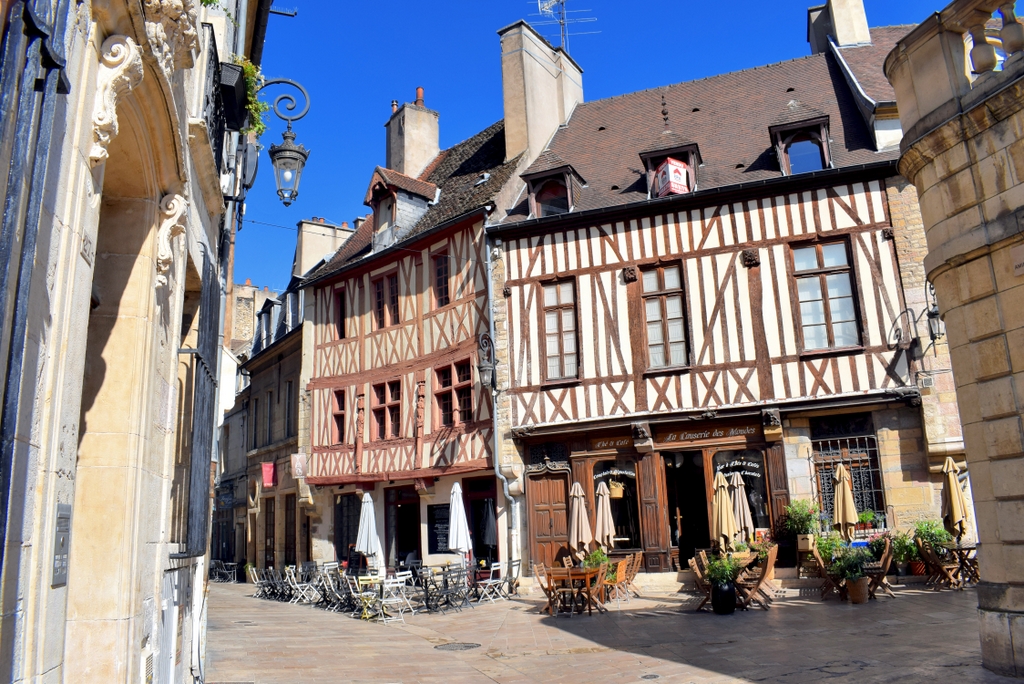
Fine half-timbered houses in Rue Amiral Roussin, Dijon © French Moments
A quieter street with a mix of timber-framed houses and Renaissance details.
A Highlight: Maison Millière (1483)
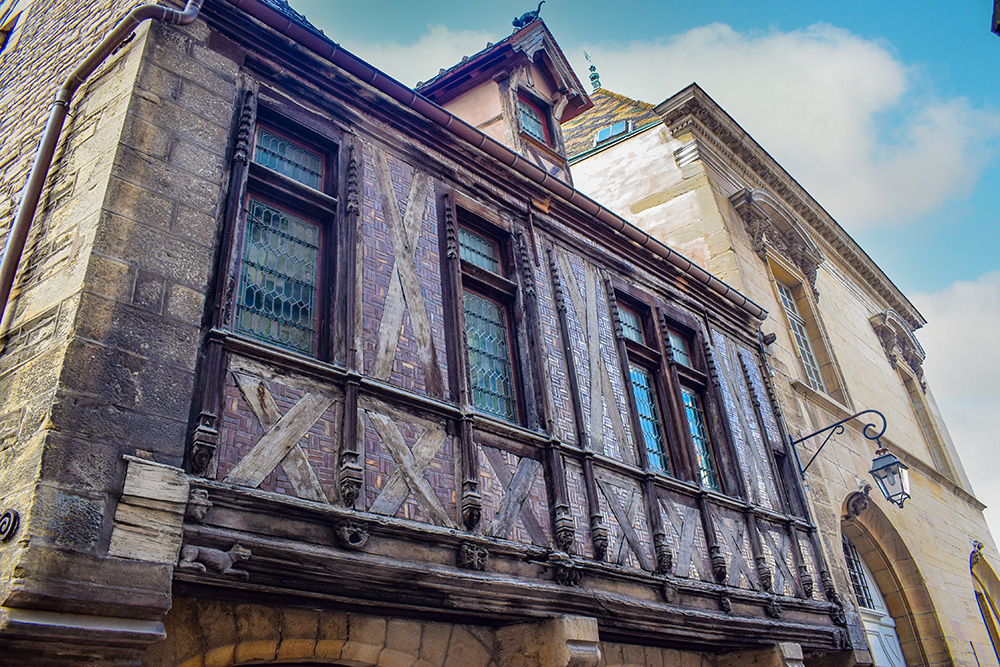
Maison Millière, Dijon © French Moments
Probably the most iconic timber-framed house in Dijon.
It has carved beams, a steep roof, and a classic late medieval look.
Elegant Mansions: Dijon’s 17th–18th Century Architectural Heritage
From the 1600s to the 1700s, Dijon became a major centre of political and intellectual life.
Rich families and magistrates built hôtels particuliers — grand private mansions designed “between courtyard and garden”.
These buildings give Dijon its elegant, classical appearance.
Hôtel de Vogüé (1614)
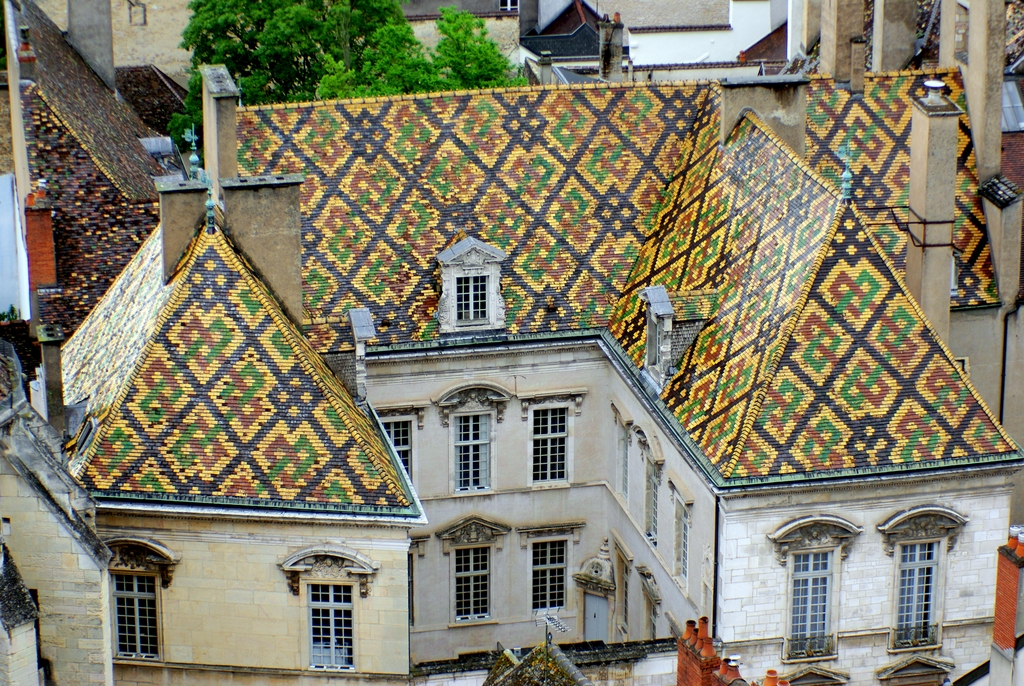
The glazed roof of Hôtel de Vogüe, Dijon © French Moments
One of the most beautiful mansions in Burgundy.
The carved portal, the courtyard, and the architectural decoration show the influence of Italian design.
Its colourful glazed roof is a masterpiece.
Hôtel Aubriot
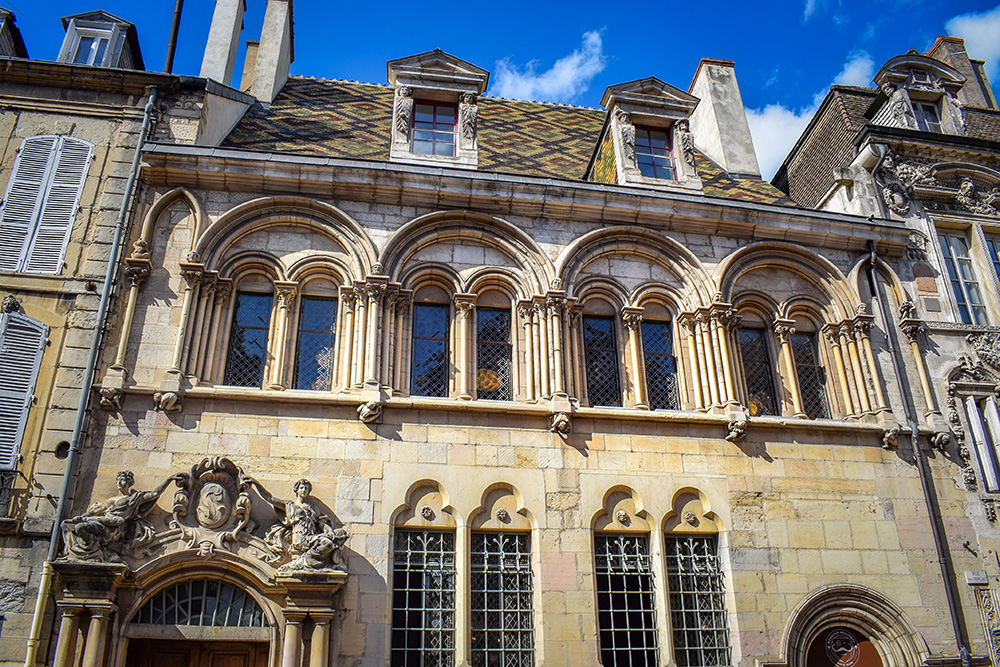
Hôtel Aubriot, Dijon © French Moments
One of the oldest noble houses in Dijon (13th century).
Medieval architecture with towers, arches, and pointed windows.
It offers a strong contrast with the later classical mansions.
Hôtel Lantin (Magnin Museum)
A refined 17th-century mansion, today home to the Musée Magnin.
Its rooms and collections show how the Dijon elite lived and decorated their homes.
Other Notable Mansions in Dijon
- Hôtel Chambellan (famous Gothic sculptures)
- Hôtel Fyot-de-Mimeure
- Hôtel Maleteste
- Hôtel Bouhier
Dijon has more than 50 historical mansions — one of the richest collections in France.
Burgundian Glazed Roofs: Colourful Tiles and Geometric Patterns
No architectural feature says “Burgundy” more clearly than a glazed tile roof.
These roofs use brightly coloured, varnished terracotta tiles arranged in geometric patterns.
Red, yellow, green, and black tiles form diamonds, zigzags, and lattice shapes.
They sparkle in the sunlight and immediately catch the eye.
These roofs appeared in the late Middle Ages and became popular in the following centuries.
They were expensive, so they often showed the wealth and pride of the owner.
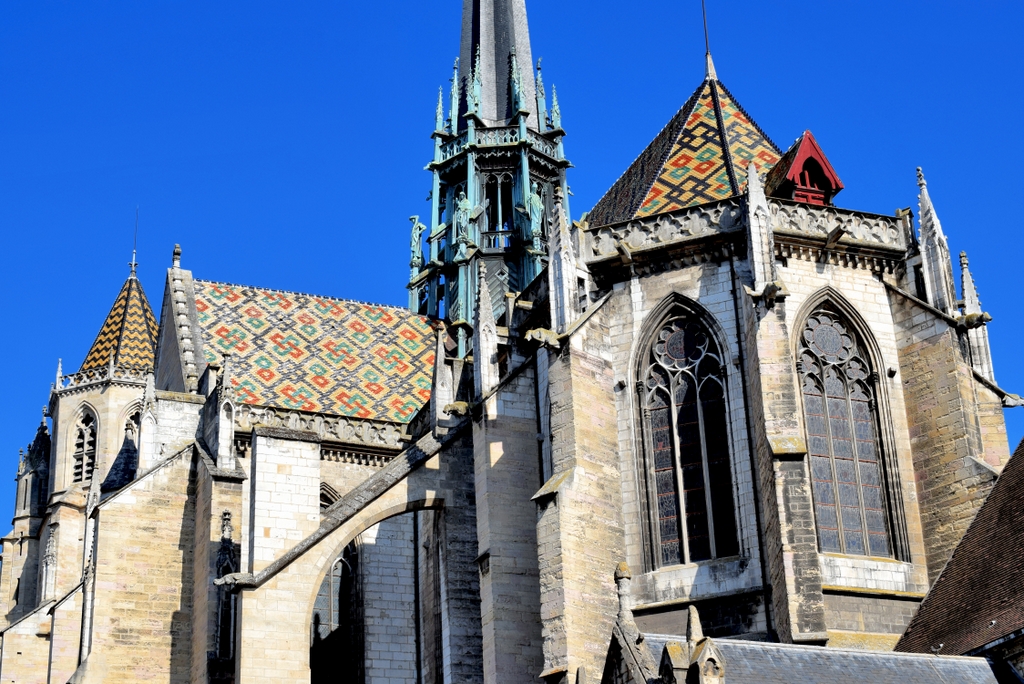
The chevet of Dijon cathedral © French Moments
Where to See Glazed Roofs in Dijon
Hôtel de Vogüé
Its roof is one of the most beautiful in the city, with striking colours and precise patterns.
Saint-Bénigne Cathedral
Some wings and annexes display coloured tiles, adding brightness to the cathedral complex.
Other Locations
Several private houses and civic buildings also feature glazed roofs.
They often appear unexpectedly as you explore the old town.
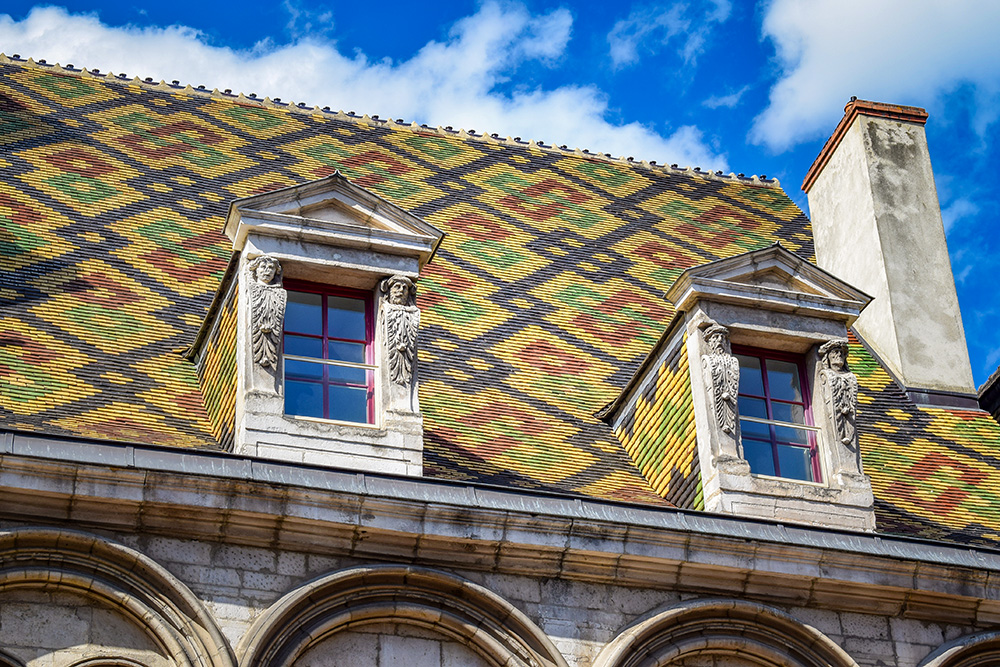
The glazed tile roof of Hôtel Aubriot, Dijon © French Moments
The Churches of Dijon
Dijon is known for its palaces, museums, and elegant squares, but its churches form one of the most fascinating parts of the city’s heritage.
They span nearly a thousand years of history, from Romanesque Burgundy to the late Gothic period and the French Renaissance.
Exploring these buildings is one of the best ways to understand how Dijon developed, how it expressed its faith, and how it shaped its identity.
This guide presents the main churches and religious sites in Dijon, all of which are important for travellers interested in architecture, history, or culture.
Église Notre-Dame de Dijon
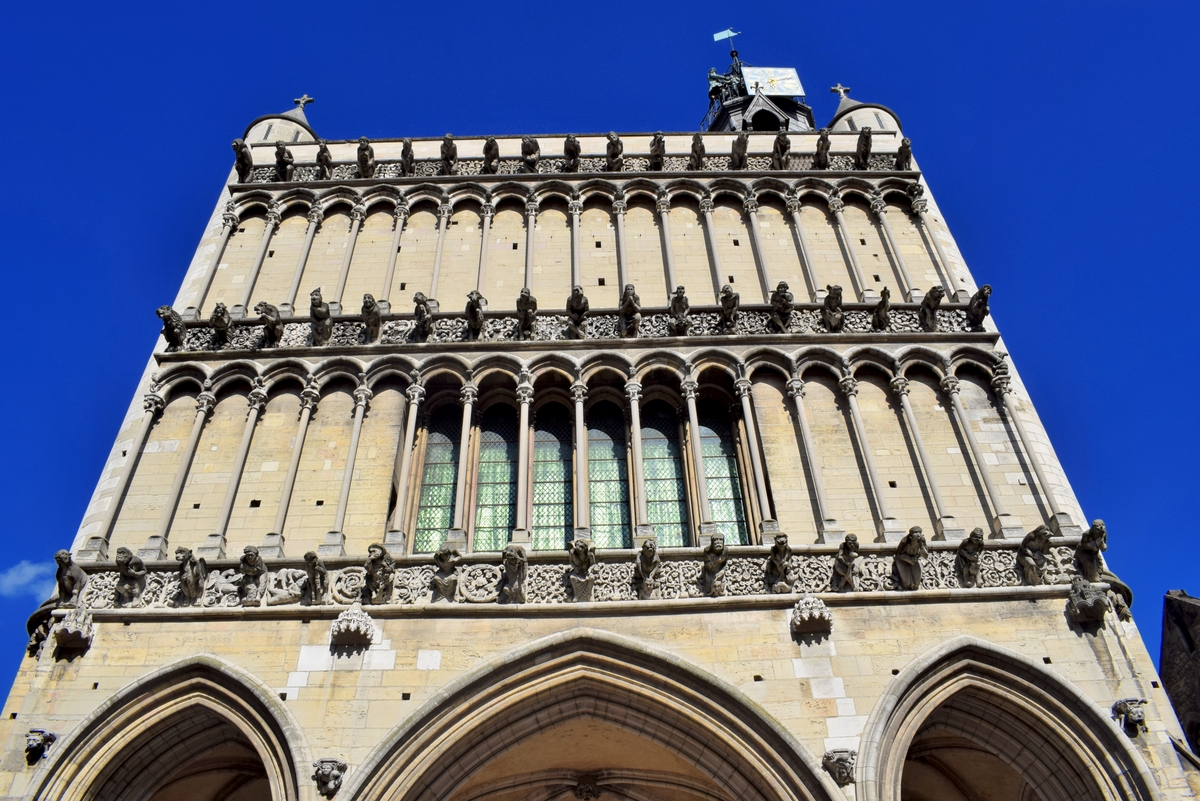
The striking façade of Notre-Dame church, Dijon © French Moments
The Church of Notre-Dame is one of the most iconic monuments in Dijon.
Built in the thirteenth century, it is a powerful example of Burgundian Gothic architecture.
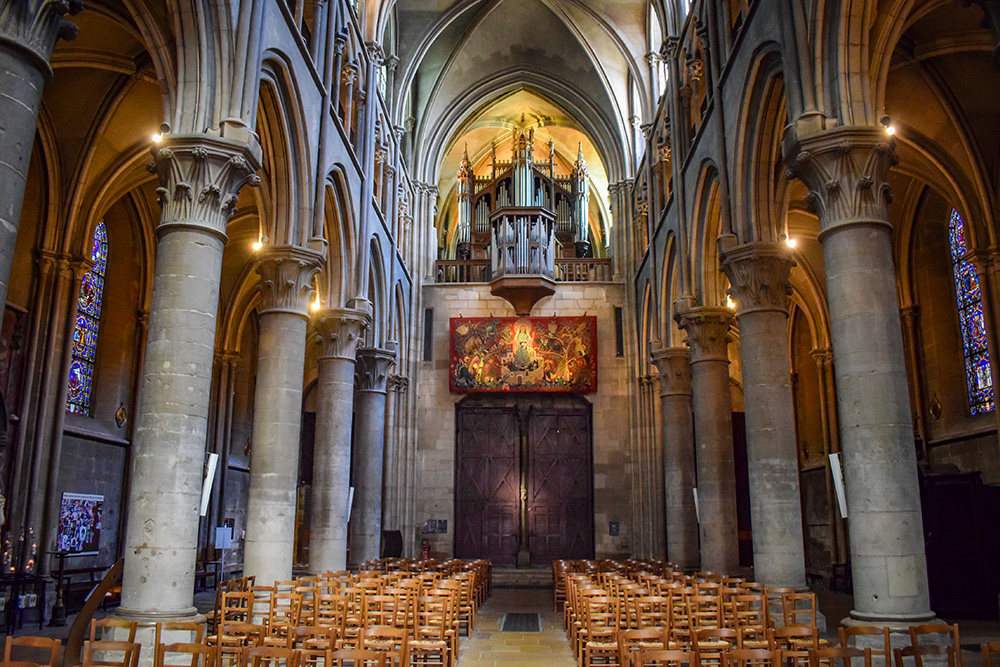
The nave of Eglise Notre-Dame, Dijon © French Moments
The façade is striking: three levels of arcades and a series of 51 false gargoyles that give the building its distinctive look.
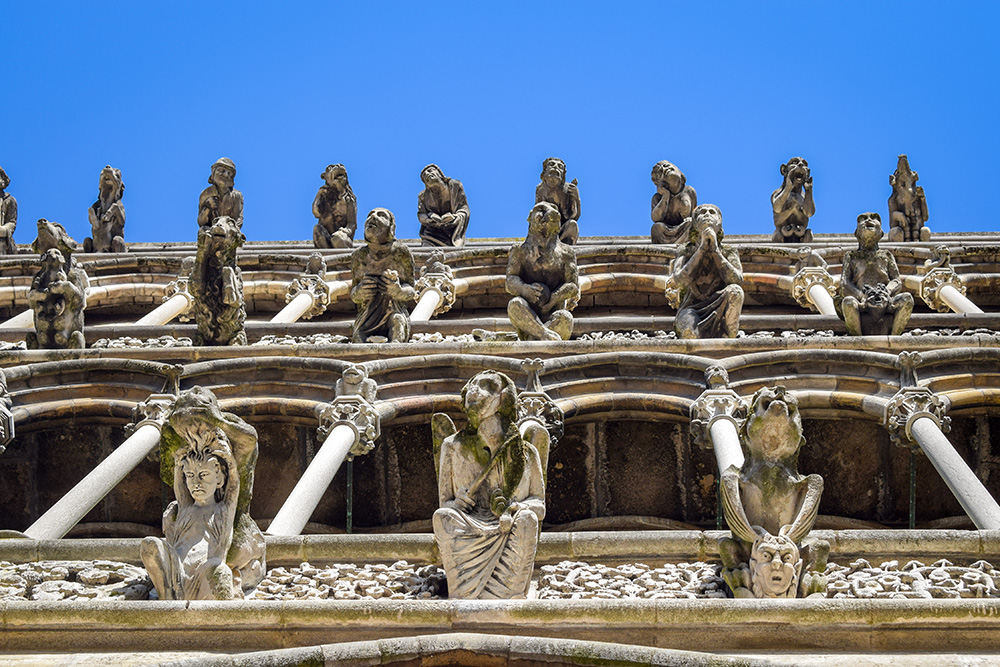
The gargoyles of Eglise Notre-Dame, Dijon © French Moments
On the north side, a small carved owl has become a famous symbol of the city.
Walking the Parcours de la Chouette (the Owl Trail) brings visitors directly to this spot.
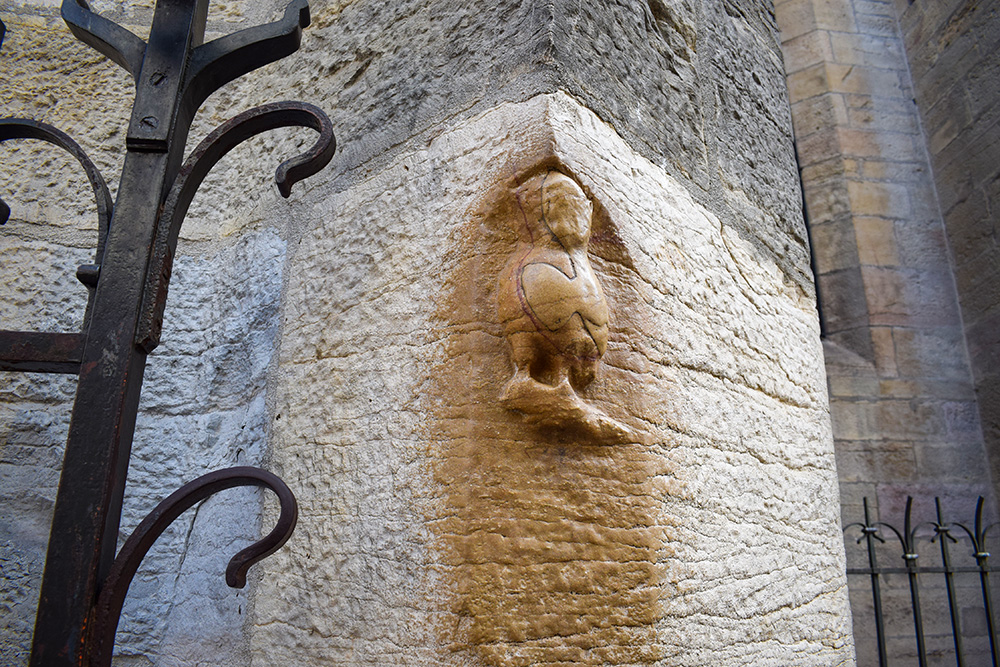
The owl of Dijon © French Moments
The Jacquemart Clock Tower
One of the most unusual features of Notre-Dame is the Jacquemart, a historic clock mechanism with four striking figures.
The original automaton was taken from Courtrai (Kortrijk) in Flanders in 1382 after a Burgundian victory and installed on the church tower by Philip the Bold.
Over the centuries, the family of figures grew: Jacquemart was joined by Jacqueline (his wife), and later by their two children, Jacquelinet and Jacquelinette.
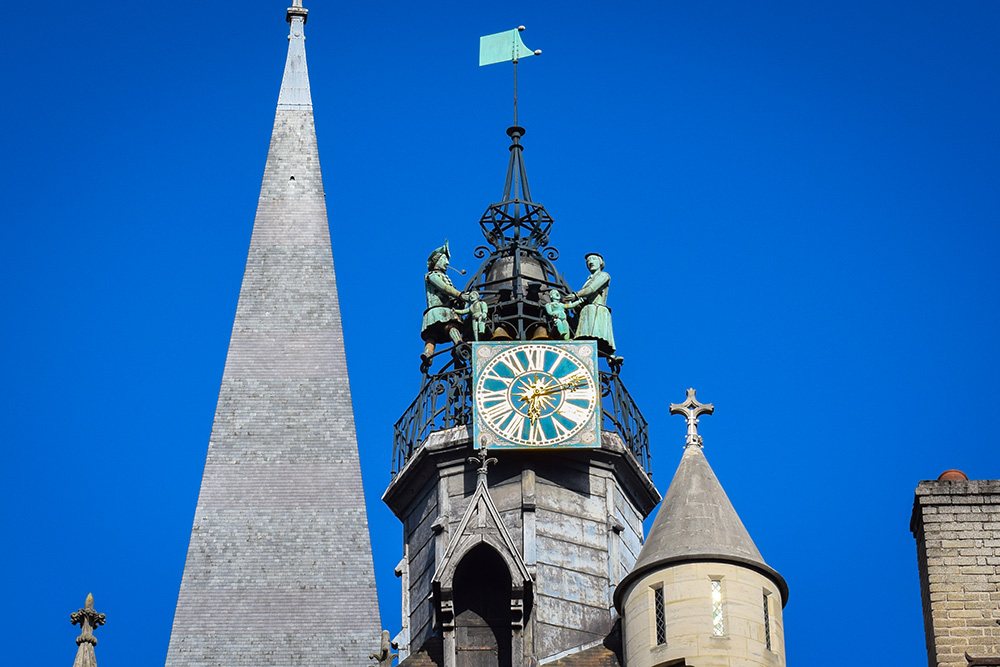
The Jacquemart of Dijon © French Moments
Each figure strikes one of the bells according to the hour or quarter-hour.
The Jacquemart is now one of Dijon’s most recognisable symbols.
It illustrates both the wealth of the dukes of Burgundy and the long-standing technical ingenuity of medieval clockmakers.
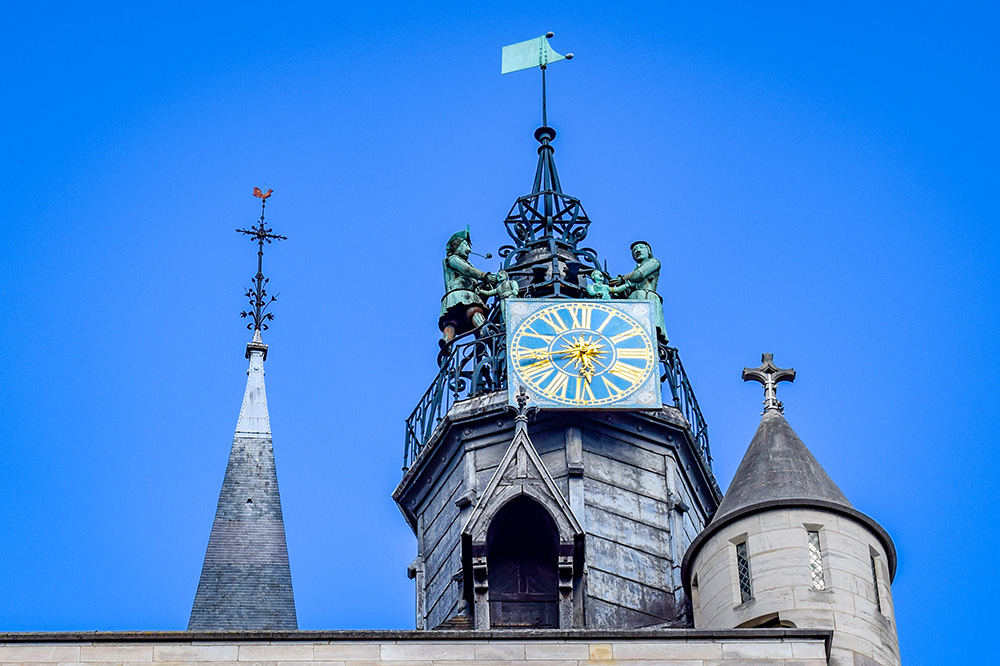
The Jacquemart of Dijon © French Moments
Notre-Dame is a key site for anyone interested in medieval architecture, nineteenth-century restoration work, or the traditions and legends of Dijon’s old town.
Cathédrale Saint-Bénigne
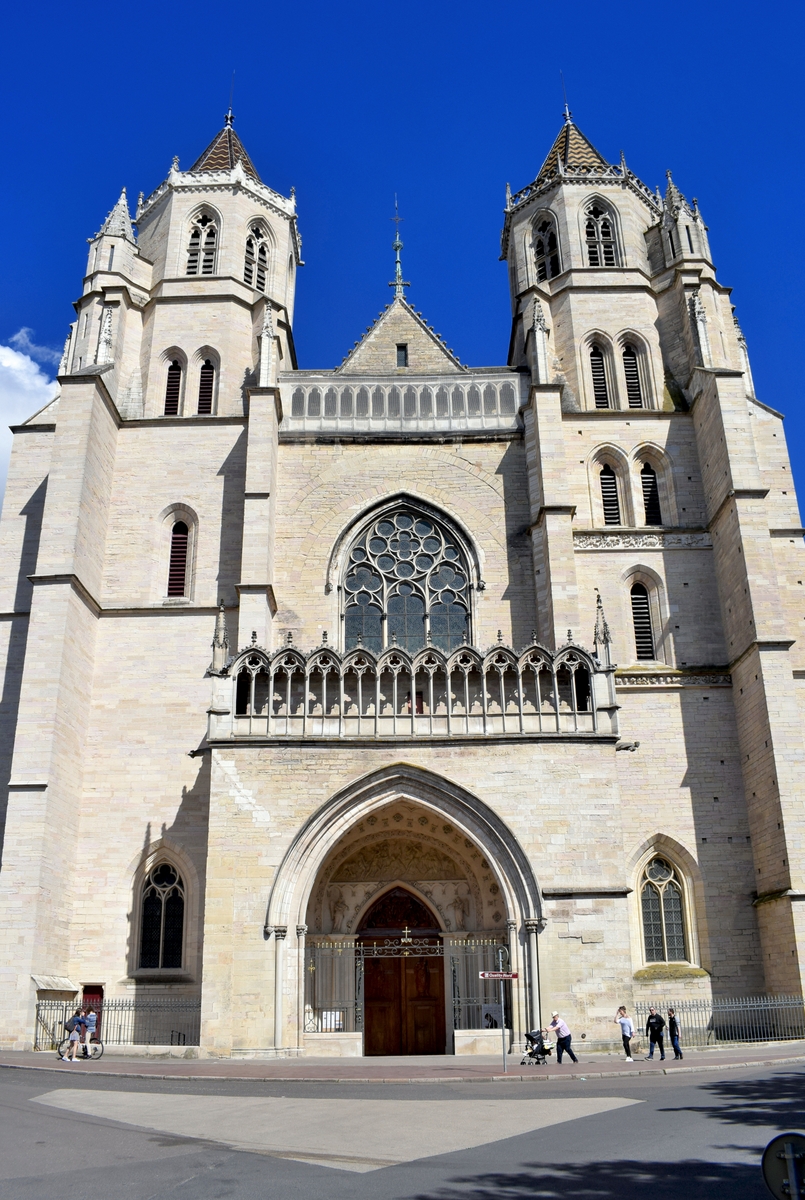
The west front of Dijon cathedral © French Moments
Saint-Bénigne Cathedral stands on a site with deep monastic roots.
Its present form belongs to the late medieval Gothic period, but the history of the place goes back much further.
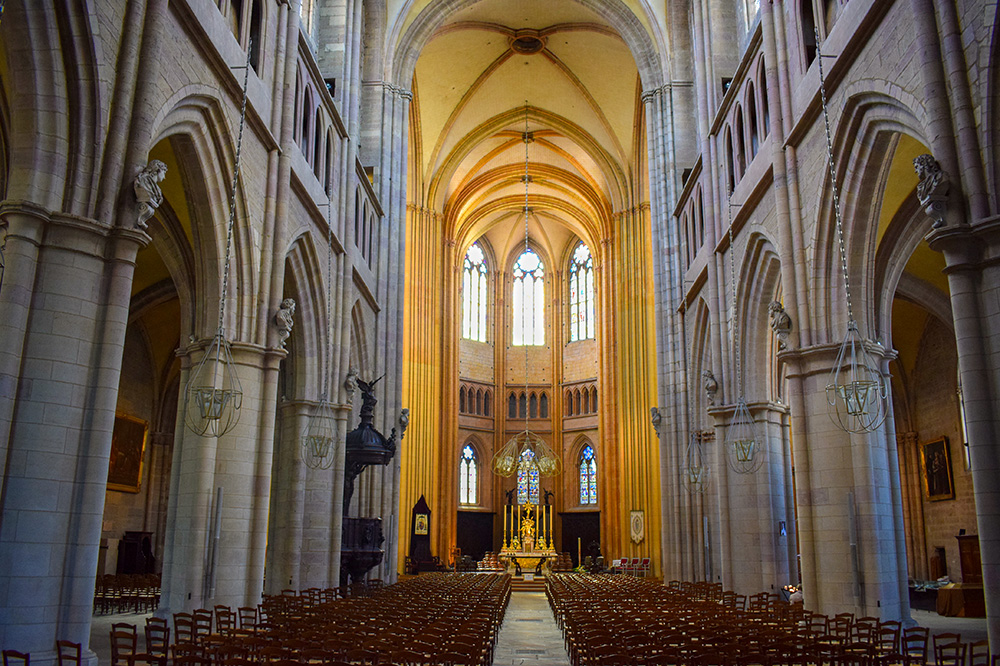
The nave of Dijon Cathedral © French Moments
The most important feature is the large crypt and the remains of the former rotunda.
These underground spaces make Saint-Bénigne one of the most significant archaeological sites in Dijon.
The cathedral is ideal for visitors who want to explore the transition from the monastic world to a cathedral chapter, as well as the layers of history found beneath the modern city.
Église Saint-Michel
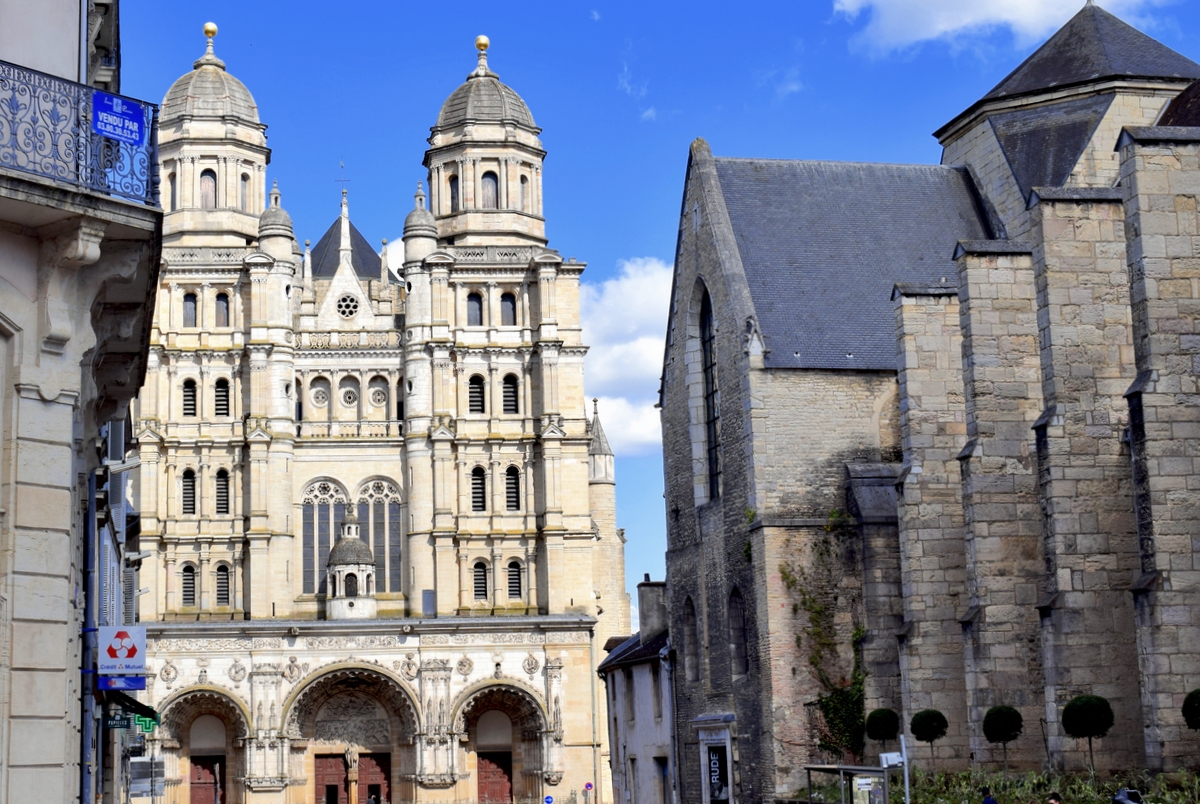
Saint-Michel church, Dijon © French Moments
Saint-Michel is a fascinating church because it combines two styles.
Construction began in the late fifteenth century, in the final phase of the Gothic era, but the façade was completed in the early sixteenth century in a new Renaissance style.
The sculpted portals are especially impressive, with detailed scenes of the Last Judgement and other themes that reflect the artistic transition of the time.
This church is perfect for travellers who want to see how architecture evolved in Dijon during the Renaissance, and how Gothic and classical elements can exist together in a single building.
Église Saint-Philibert
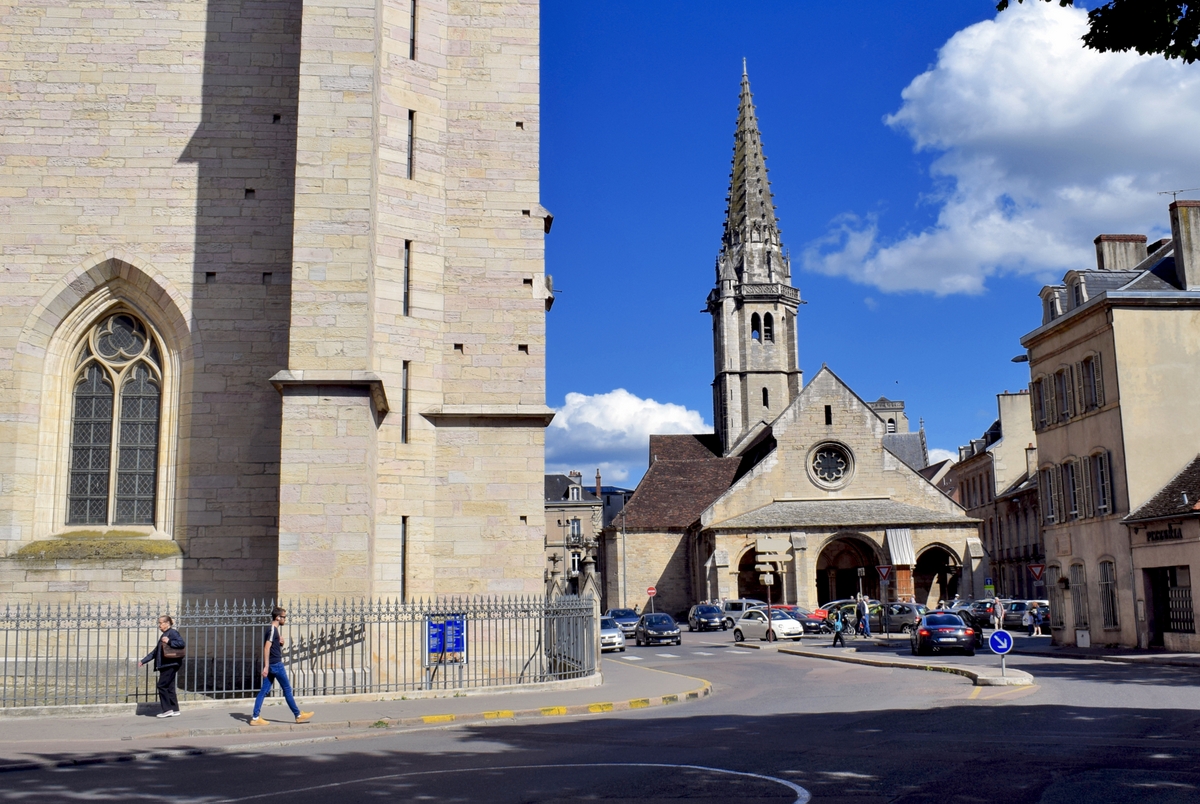
Saint-Philibert church, Dijon © French Moments
Saint-Philibert is unique in Dijon.
It is the only Romanesque church still standing in the historic centre.
Built in the twelfth century, it has massive pillars, rounded arches, and barrel vaults typical of Romanesque Burgundy.
Its compact, powerful structure contrasts strongly with the vertical lines of Gothic churches nearby.
This is an ideal stop for anyone studying early medieval architecture or the few surviving Romanesque buildings inside major French cities.
Église Saint-Jean
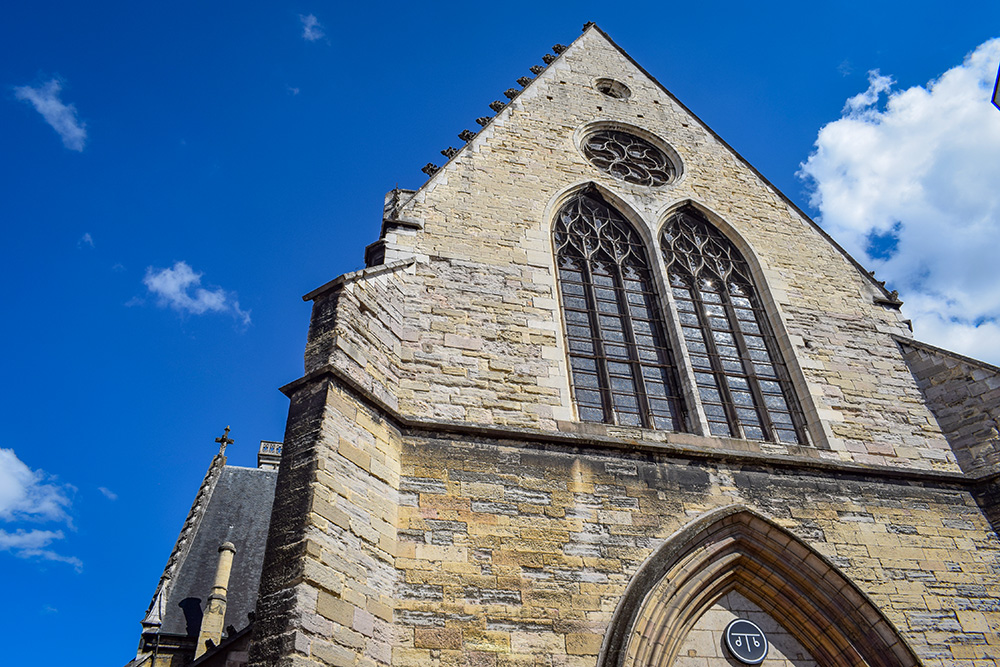
Eglise Saint-Jean, Dijon © French Moments
Saint-Jean dates from the end of the fifteenth century and the beginning of the sixteenth.
Its architecture reflects the transition from late Gothic to Renaissance, a common theme in Dijon.
After the French Revolution, the church was desacralised and eventually transformed into a theatre.
Today, it houses the Théâtre Dijon Bourgogne, an example of how historic religious buildings can find new life through cultural use.
Saint-Jean is a good case study of adaptive reuse and of the changing cultural landscape of Dijon.
Chartreuse de Champmol and the Puits de Moïse
The former Carthusian monastery of Champmol was founded in the fourteenth century by Philip the Bold, one of the great Dukes of Burgundy.
It was designed as a dynastic burial place and became an important centre of artistic creativity.
The Puits de Moïse (Well of Moses), sculpted between 1396 and 1405 by Claus Sluter, is the masterpiece of the site.
The monumental figures are among the finest examples of Gothic sculpture in Europe.
Champmol is essential for understanding ducal patronage, the international Gothic style, and the cultural influence of Burgundy in the late Middle Ages.
The Grand Civil and Historic Monuments of Dijon
Dijon is not only rich in churches and religious sites.
It also offers an exceptional collection of civil and urban monuments that reflect centuries of political power, economic wealth, and architectural ambition.
Walking through the city centre reveals Gothic towers, classical mansions, covered markets, triumphal arches, and public buildings that shaped the daily life of Dijon’s inhabitants.
This guide presents the most important civil monuments, all essential for understanding the history and identity of Dijon.
Palais des ducs et des États de Bourgogne
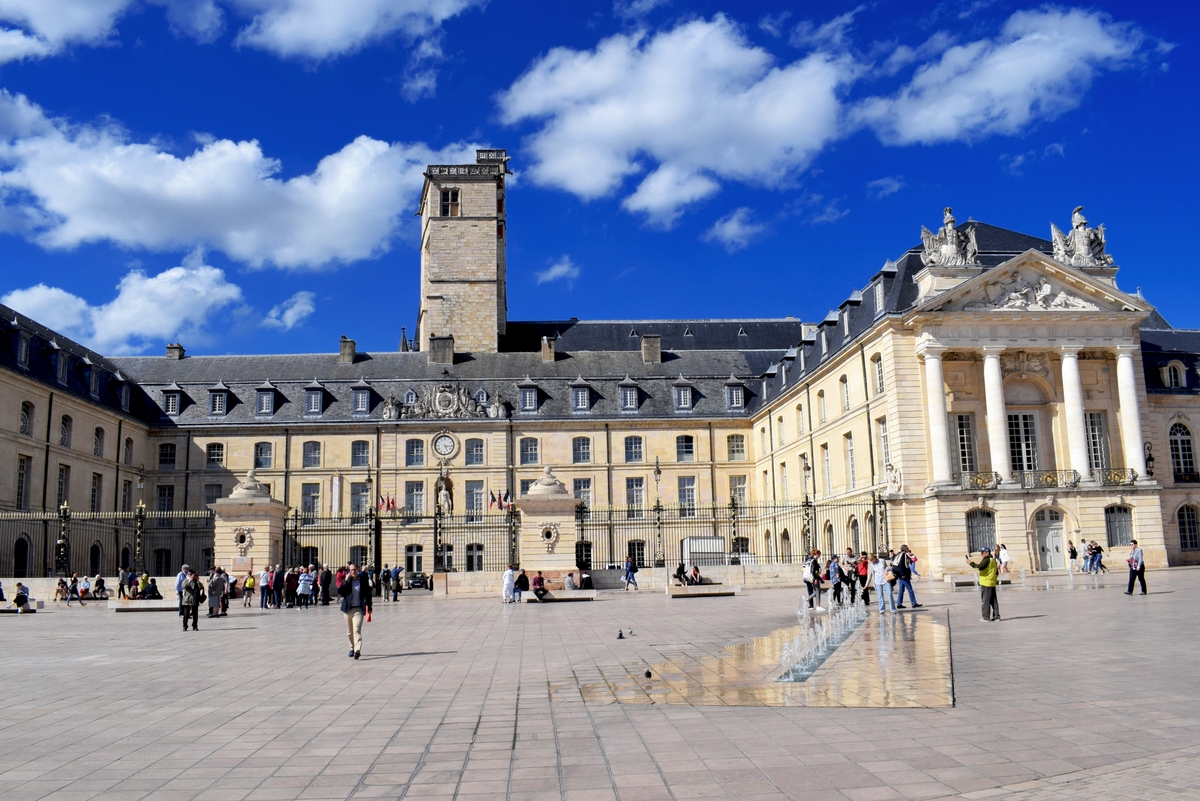
Place de la Libération and the Ducal Palace of Dijon © French Moments
The Palace of the Dukes and the Estates of Burgundy is the political heart of the city.
Its oldest parts date from the fourteenth and fifteenth centuries, when the powerful Dukes of Burgundy ruled one of the richest courts in Europe.
Later, in the seventeenth and eighteenth centuries, the palace was expanded and redesigned with classical façades.
Today, the building houses both the City Hall and the Museum of Fine Arts.
It remains one of the most important administrative and cultural landmarks in Dijon.
The palace is a key site for anyone interested in political architecture, ducal power, and the transformation of medieval complexes into classical urban spaces.
Tour Philippe le Bon
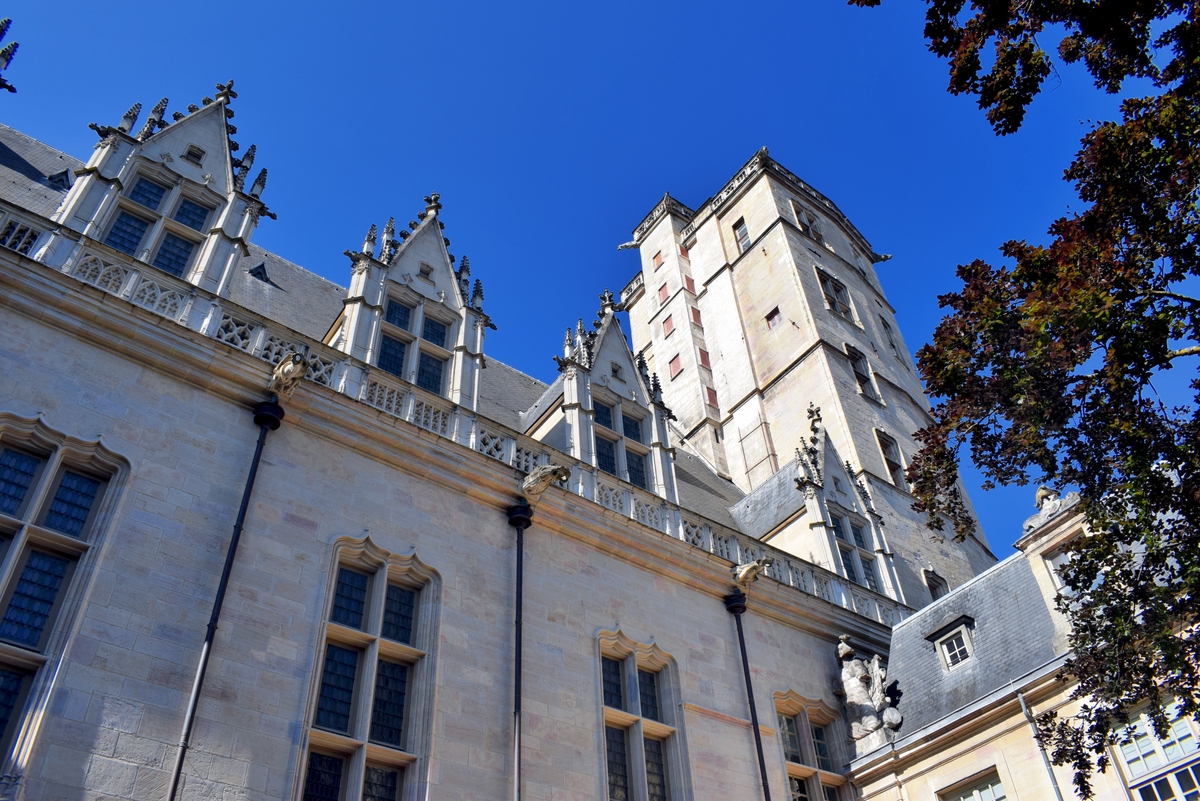
The Tower of Philip the Good in Dijon © French Moments
Rising above the palace complex, the Tower of Philip the Good is one of the city’s strongest symbols.
Built between 1450 and 1460, it served as a tower of prestige for the ducal court.
The structure is 46 metres high and can be climbed via 316 steps.
The panoramic view from the top offers a complete 360-degree perspective of the historic centre and the rooftops of Dijon.
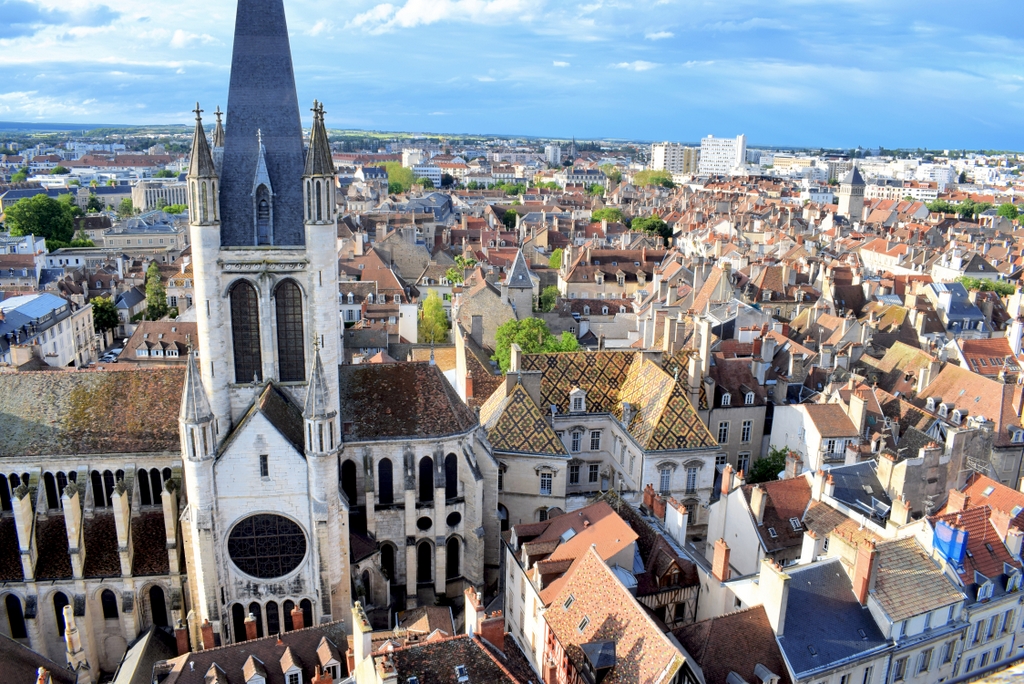
The view from the tower © French Moments
This tower is essential for understanding Burgundian political authority and for appreciating how the city developed over time.
Salle des Tombeaux des ducs de Bourgogne
Inside the Palace of the Dukes, the Tomb Room contains some of the most remarkable medieval sculptures in France.
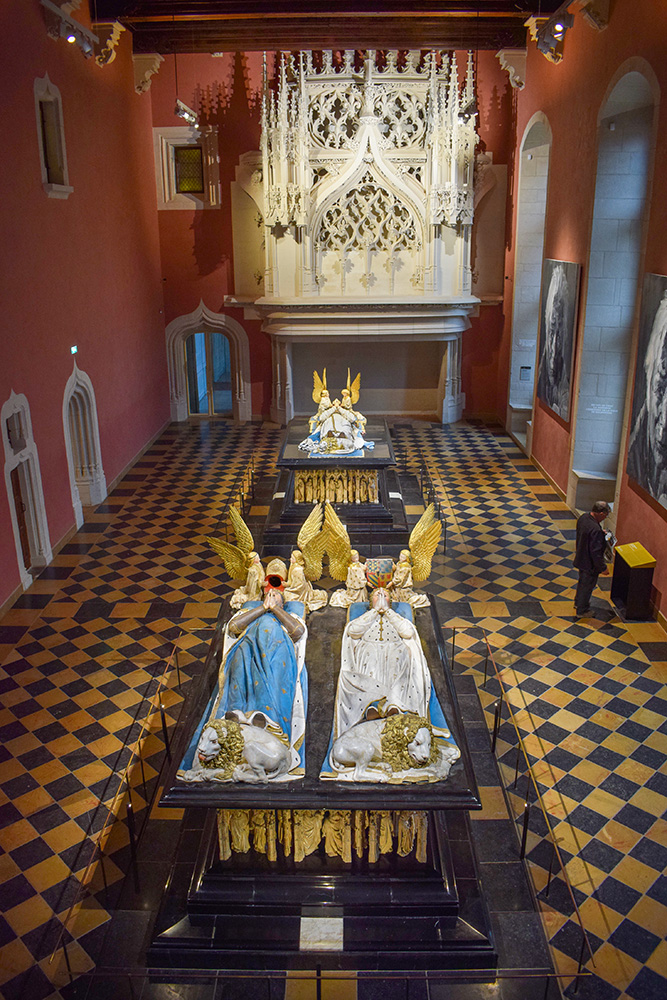
Tombs of the Dukes of Burgundy © French Moments
The tombs of Philip the Bold and John the Fearless are displayed here, accompanied by a procession of 82 mourners carved in great detail.
These figures, known as pleurants, are masterpieces of late medieval funerary art.
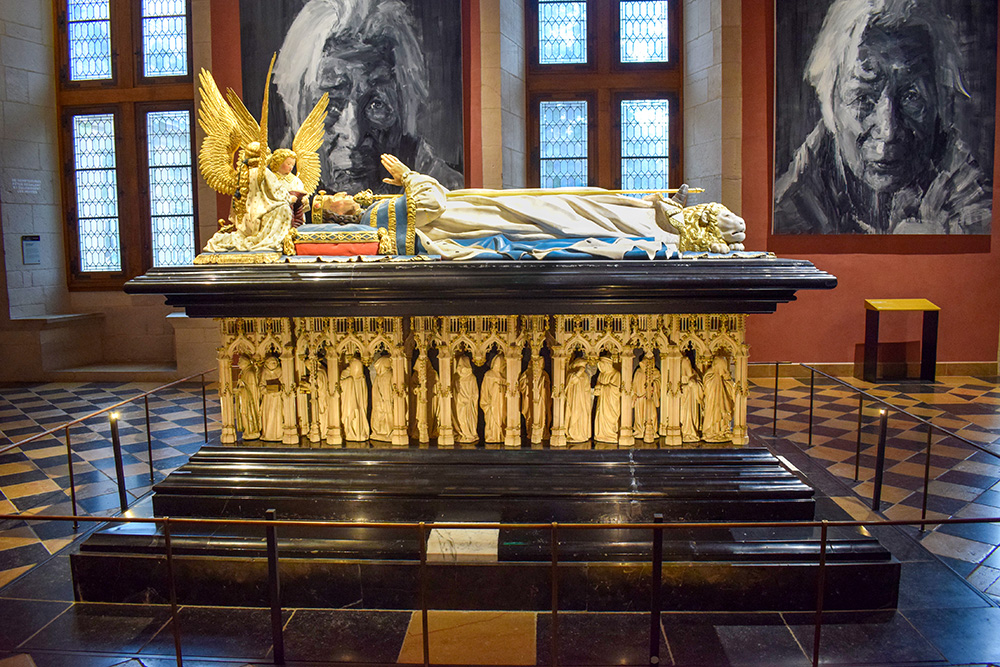
The mourners (pleurants) © French Moments
They express the political ambition of the Burgundian dynasty and its desire to leave a lasting mark on European culture.
The Tomb Room is an essential site for anyone studying medieval art, dynastic memory, or the history of ducal Burgundy.
Hôtel de Vogüé
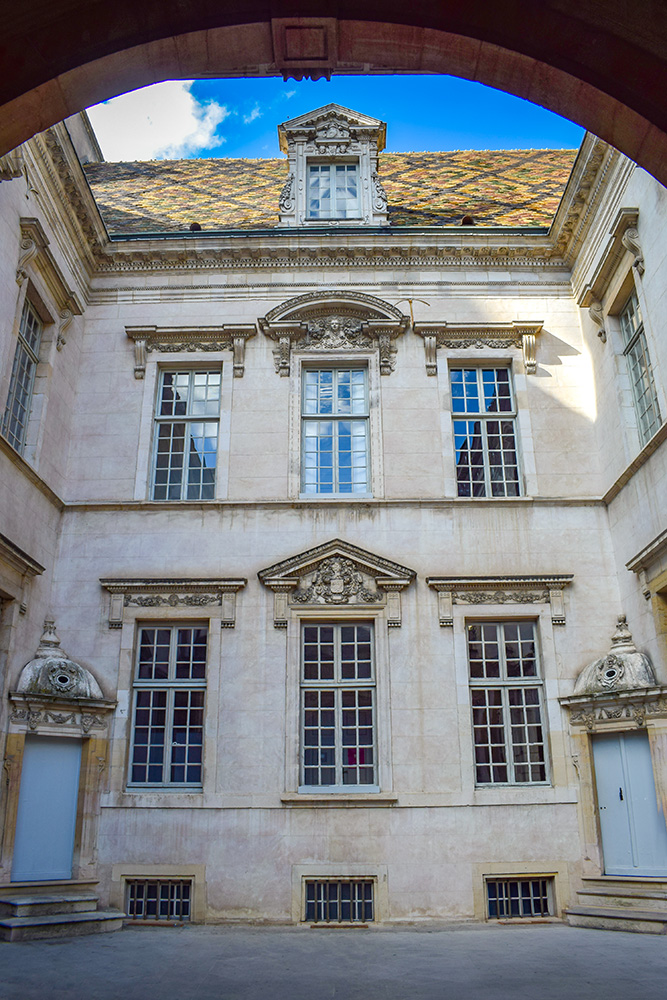
Hôtel de Vogüe, Dijon © French Moments
Built in 1614, the Hôtel de Vogüé is one of the most elegant classical mansions in Dijon.
It was originally the residence of a prominent parliamentary family.
The building is known for its monumental portal, sculpted decoration, and harmonious courtyard.
Its glazed roof, decorated with colourful Burgundian tiles, is one of the most beautiful in the city.
This mansion is a perfect example of seventeenth-century civil architecture and of the influence of the Parliament of Burgundy on the urban landscape.
Hôtel Aubriot
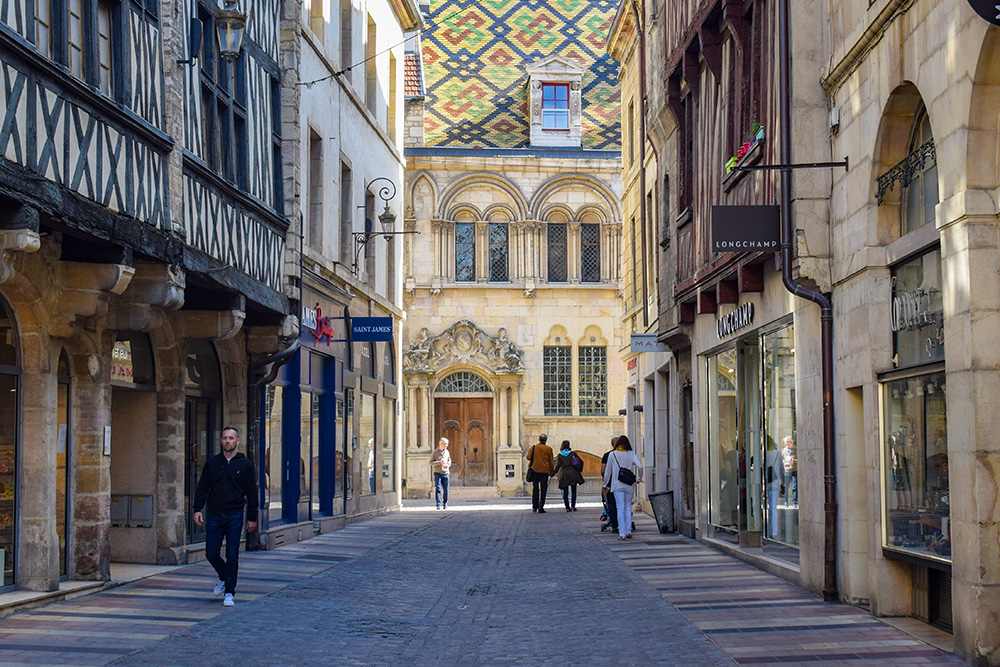
Hôtel Aubriot, Dijon © French Moments
The Hôtel Aubriot is one of the oldest noble houses in Dijon.
Dating from the thirteenth century, it features medieval towers, arched openings, and typical Gothic elements.
Its presence in the historic centre shows how Dijon organised noble housing long before the classical period.
It provides a strong contrast with the later hôtels particuliers of the seventeenth and eighteenth centuries.
This building is ideal for understanding early medieval civil architecture in Dijon.
Palais de Justice
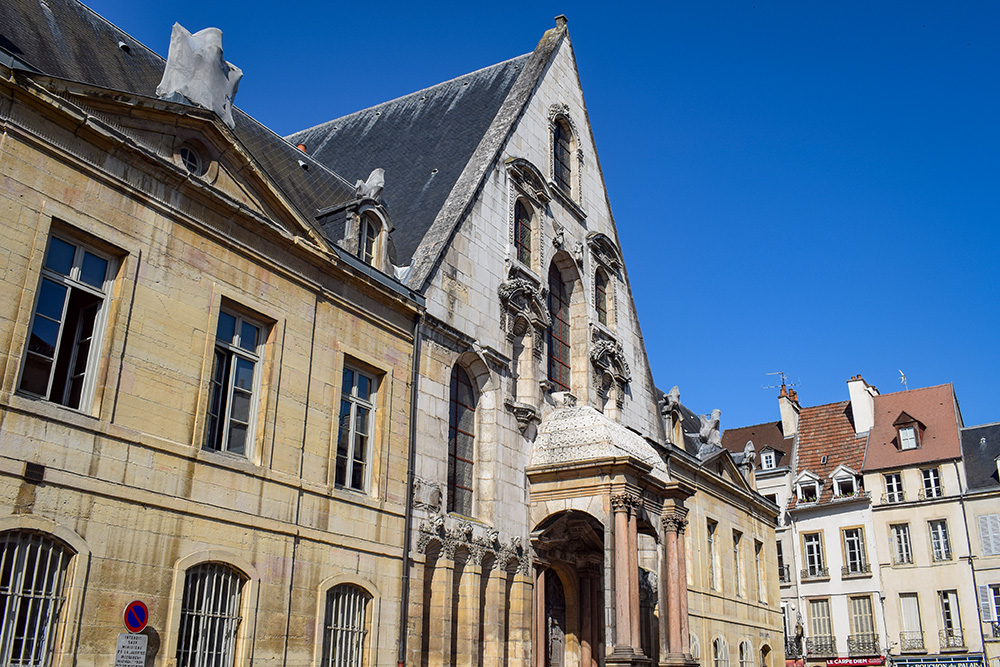
Palais de Justice, Dijon © French Moments
The Palais de Justice occupies several buildings dating from the sixteenth to the eighteenth century.
Its classical architecture reflects the long-standing role of Dijon as a centre of administration and law.
The complex served as the historical seat of the judicial authority in Burgundy.
It represents the institutional power of the city and its importance in the legal structure of the region.
Visitors interested in civil architecture and political history will find this site particularly valuable.
Porte Guillaume
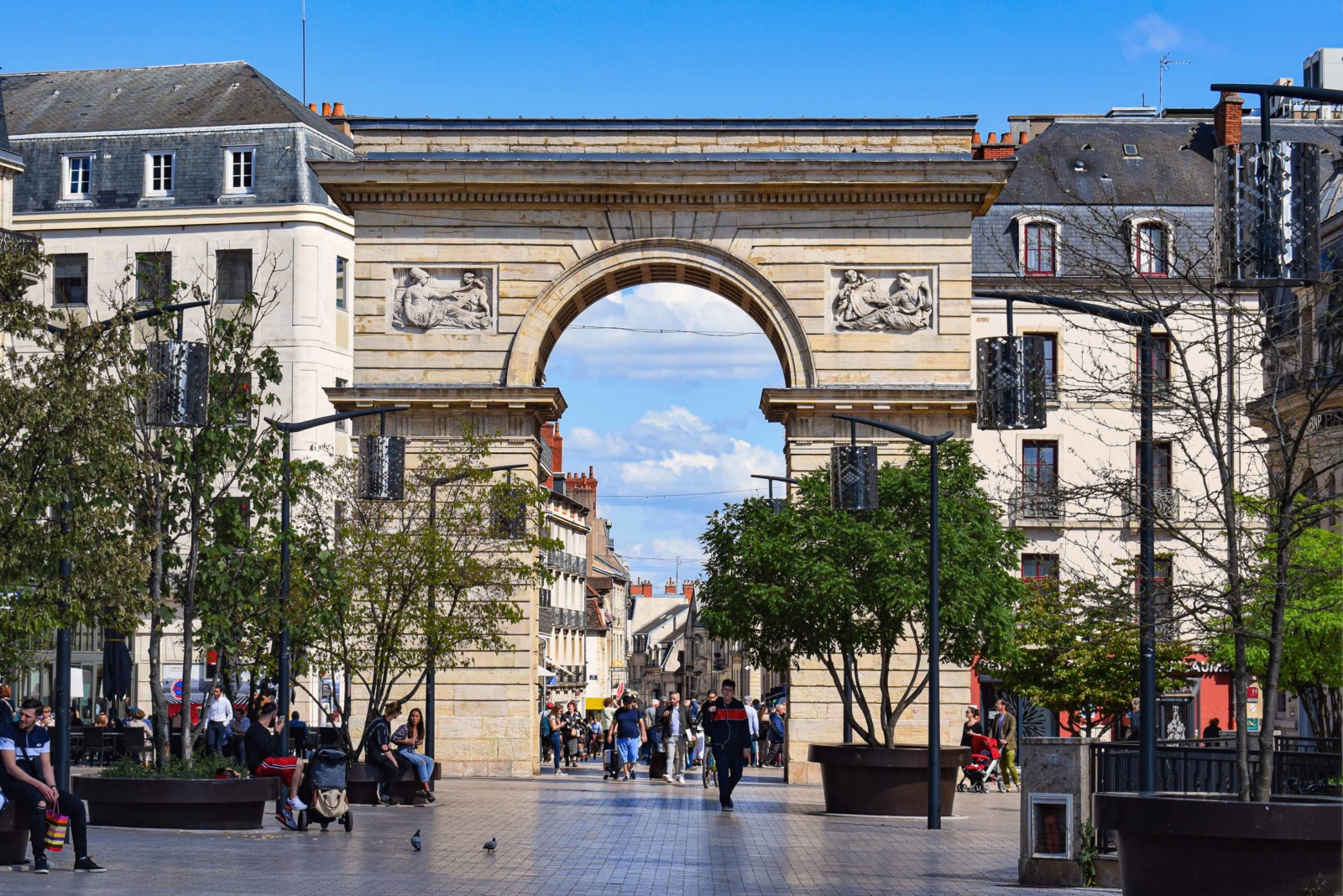
Porte Guillaume, Dijon © French Moments
Standing at the entrance of Place Darcy, the Porte Guillaume is a triumphal arch built between 1786 and 1788.
It replaced an older city gate and marked a new, more monumental approach to the historic centre.
Designed in a clean, neoclassical style, the arch symbolises the transformation of Dijon at the end of the eighteenth century.
It also reflects the city’s desire to present itself as modern, ordered, and impressive.
The Porte Guillaume is a good example of urban symbolism and the architectural vocabulary of the early modern period.
Les Halles de Dijon (Covered Market)
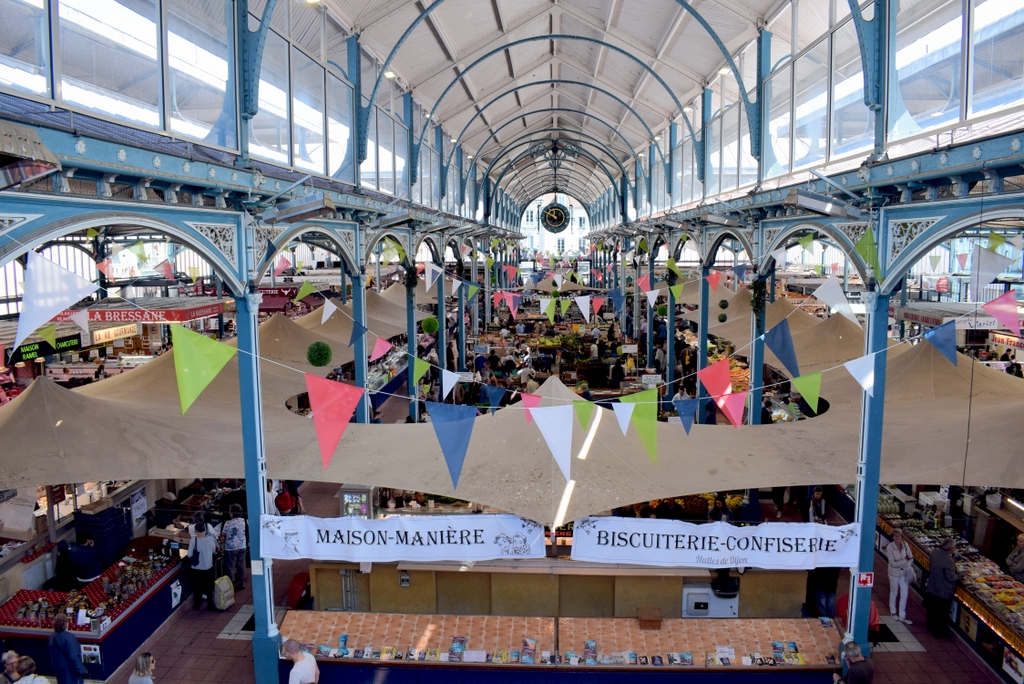
Inside the Halles market in Dijon © French Moments
The Covered Market of Dijon was built between 1873 and 1875.
Its iron and glass structure was inspired by the work of Gustave Eiffel and reflects the engineering confidence of the nineteenth century.
The market quickly became a central part of daily life in Dijon.
It is still used today and remains one of the most atmospheric places to experience the city’s food culture.
This building is an excellent example of industrial heritage and the modernisation of urban services in the nineteenth century.
La Poste Grangier
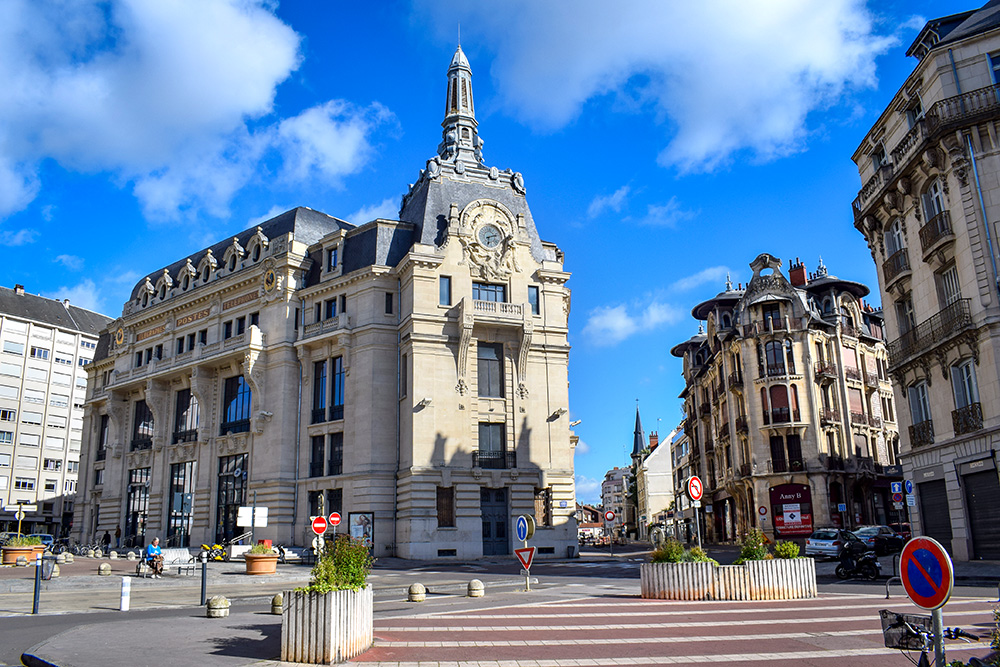
La Poste Grangier, Dijon © French Moments
Built between 1907 and 1909, the Grangier Post Office is one of the finest examples of Beaux-Arts architecture in Dijon.
It stands at the edge of the historic centre and marks the city’s entry into the modern age.
The building reflects the growth of public services, communication, and urban planning in the early twentieth century.
Its monumental façade shows how Dijon combined tradition and modernity at the start of the new century.
This site is important for the study of urban modernisation and public infrastructure.
The Iconic Squares and Urban Spaces of Dijon
Dijon is a city of monuments and museums, but it is also a city of public spaces.
Its squares, streets, and landscaped areas tell the story of how the city grew, how people met, and how power was expressed through urban design.
Some of these places were created to impress. Others developed naturally in the medieval heart of the city.
Together, they shape the rhythm and atmosphere of Dijon.
This guide presents the most emblematic urban spaces in the historic centre.
Place de la Libération
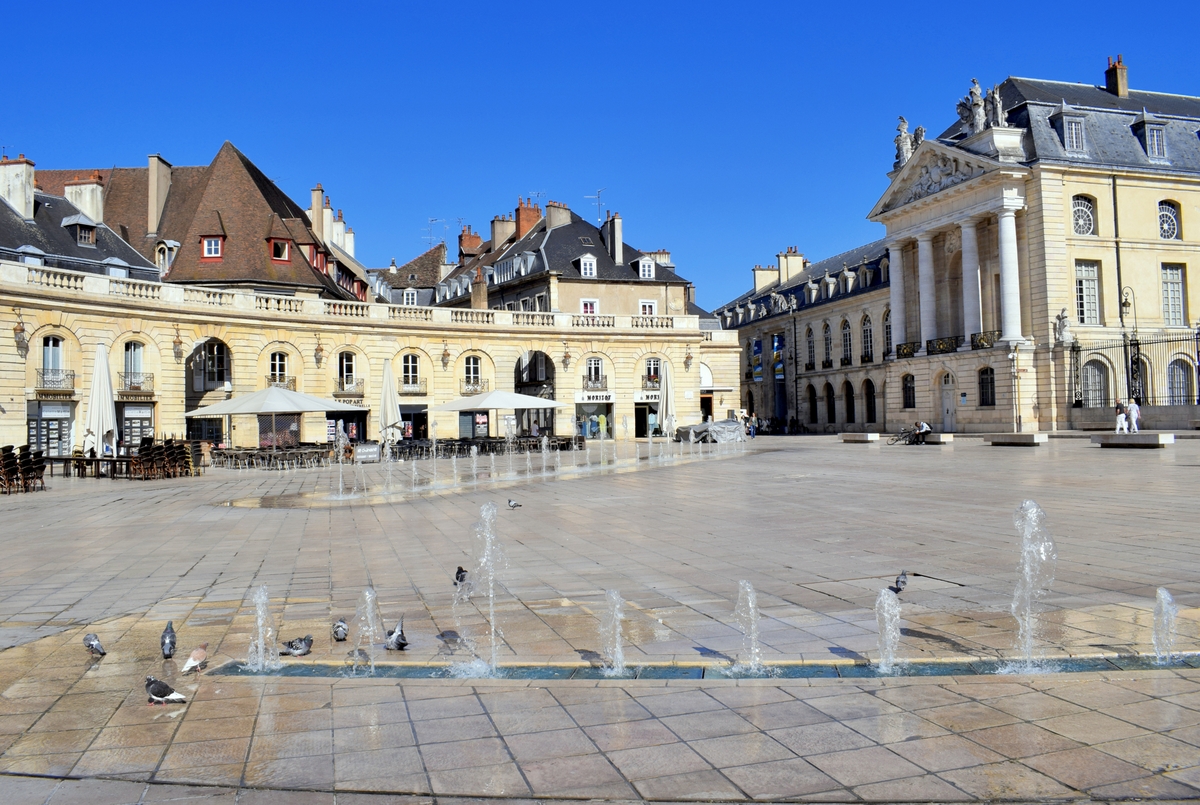
Place de la Libération, Dijon in Burgundy © French Moments
Place de la Libération is one of the most recognisable public spaces in Dijon.
It was created in the seventeenth century by the architect Jules Hardouin-Mansart, who also designed parts of Versailles.
The square was conceived as a grand forecourt for the Palace of the Dukes and the Estates of Burgundy.
The space has a distinctive semi-circular shape that embraces the façade of the palace.
Its classical symmetry and controlled proportions were intended to express political authority and urban harmony.
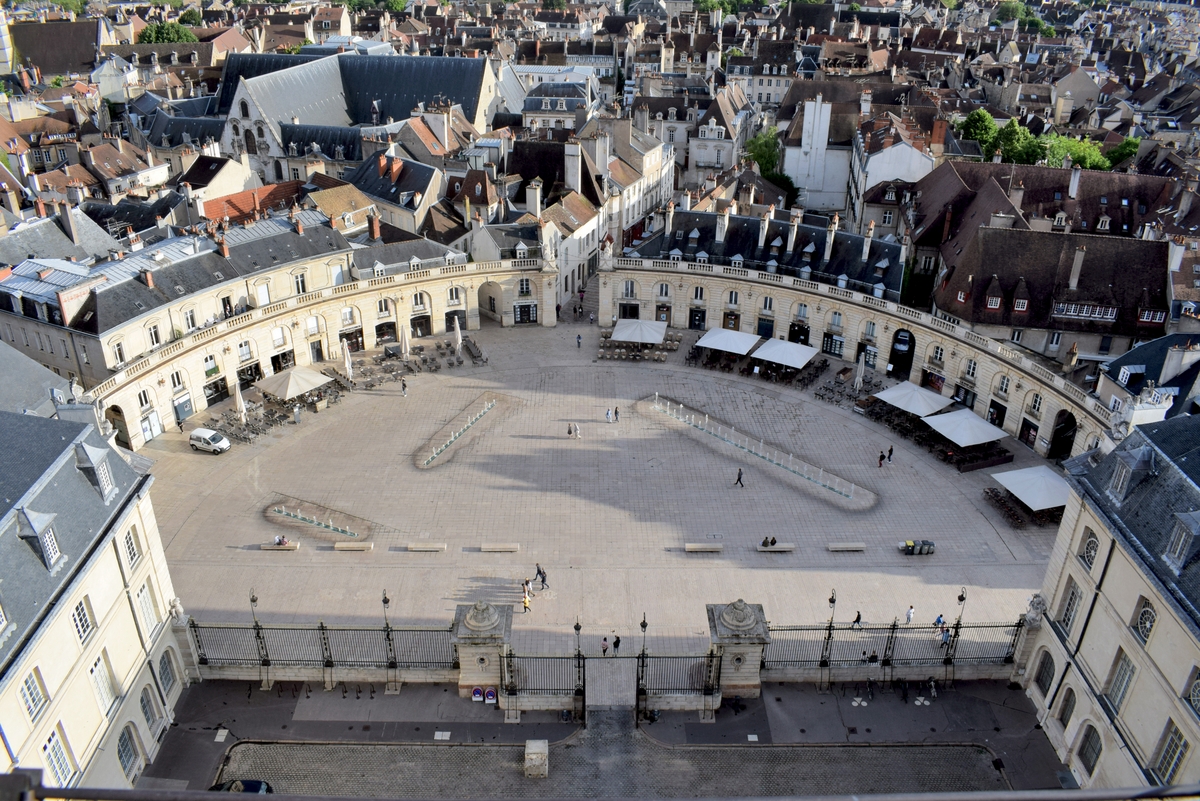
Place de la Libération seen from the tower of Philip the Good, Dijon © French Moments
Place de la Libération remains one of the best examples of classical town planning in France.
It is also the starting point for many walking routes through the historic centre.
Place Darcy
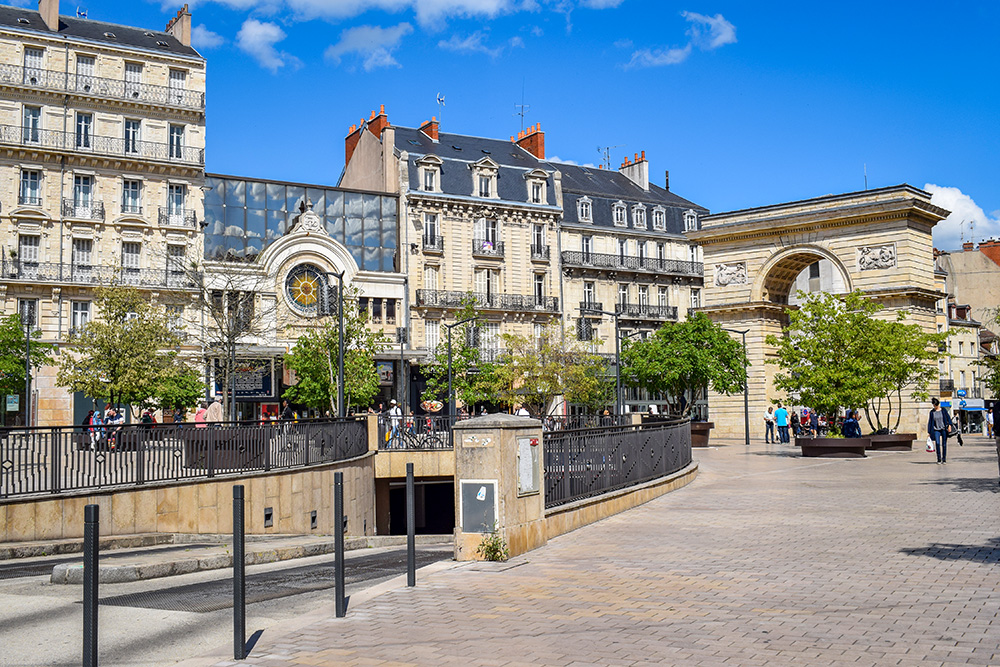
Place Darcy, Dijon © French Moments
Place Darcy is a major nineteenth-century crossroads at the northern entrance to the old town.
It acts as a gateway to the historic centre and connects directly to the Porte Guillaume, the triumphal arch built in the eighteenth century.
From the square, visitors can walk straight into the Jardin Darcy, created in 1880.
This combination of an urban plaza, a monumental arch, and a landscaped garden illustrates how Dijon modernised its public spaces during the nineteenth century.
Place Darcy is important for understanding the city’s expansion, the rise of new transportation routes, and the creation of modern civic spaces.
Jardin Darcy
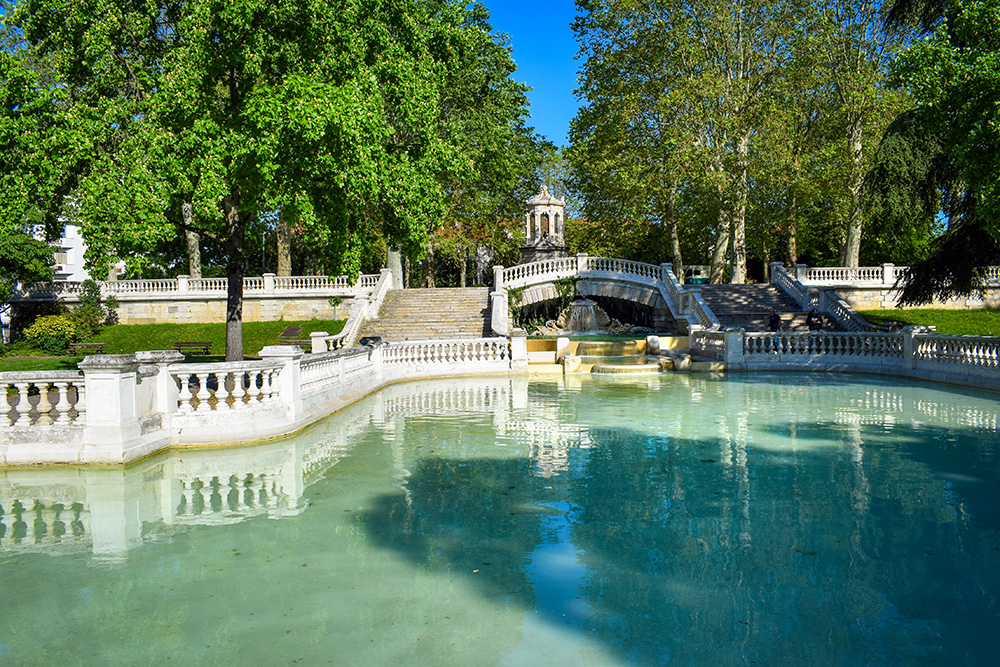
Jardins Darcy, Dijon © French Moments
The Jardin Darcy holds a special place in Dijon’s urban history.
Opened in 1880, it was the first large public park in the city.
The garden covers an impressive water reservoir built to supply the growing population.
Its terraces, stairways, and shaded paths were designed above this underground structure, showing how infrastructure and landscape design can work together.
Today, it is a peaceful place for walking and a good introduction to Dijon’s public gardens.
The park also reflects nineteenth-century concerns with hygiene, urban comfort, and the creation of spaces for leisure.
Place François-Rude (Place du Bareuzai)
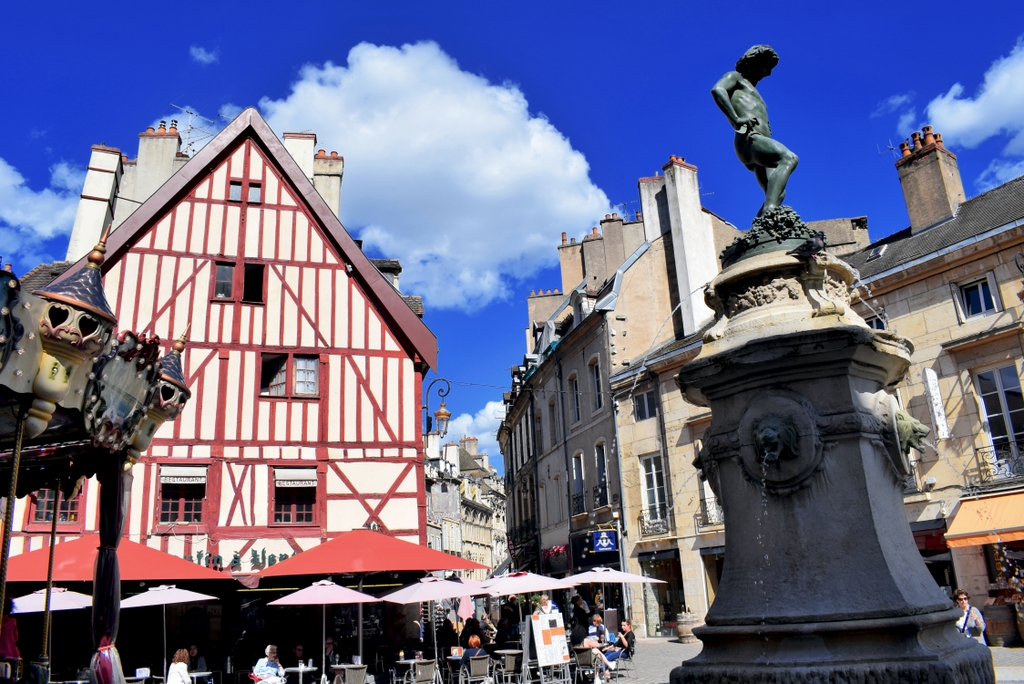
Place F. Rude, Dijon © French Moments
Place François-Rude is one of the most charming squares in Dijon’s medieval centre.
Its uneven ground, timber-framed houses, and small open space create a perfect snapshot of the old city.
At the centre stands the statue of the grape treader, known locally as the “Bareuzai”, a figure closely associated with the traditions of Burgundy and its wine culture.
This square is lively throughout the day, with cafés, small shops, and a constant flow of visitors.
It is an excellent example of living heritage and of how medieval spaces continue to shape modern urban life.
The Museums and Cultural Spaces of Dijon
Dijon is known for its medieval streets and grand monuments, but its museums form an equally important part of the city’s cultural landscape.
They cover everything from archaeology to fine arts, from rural traditions to romantic sculpture.
Together, they offer a complete journey through the history of Burgundy.
This guide introduces the main museums in Dijon, followed by a look at one of the city’s most ambitious cultural developments: the Cité Internationale de la Gastronomie et du Vin.
Musée des Beaux-Arts de Dijon
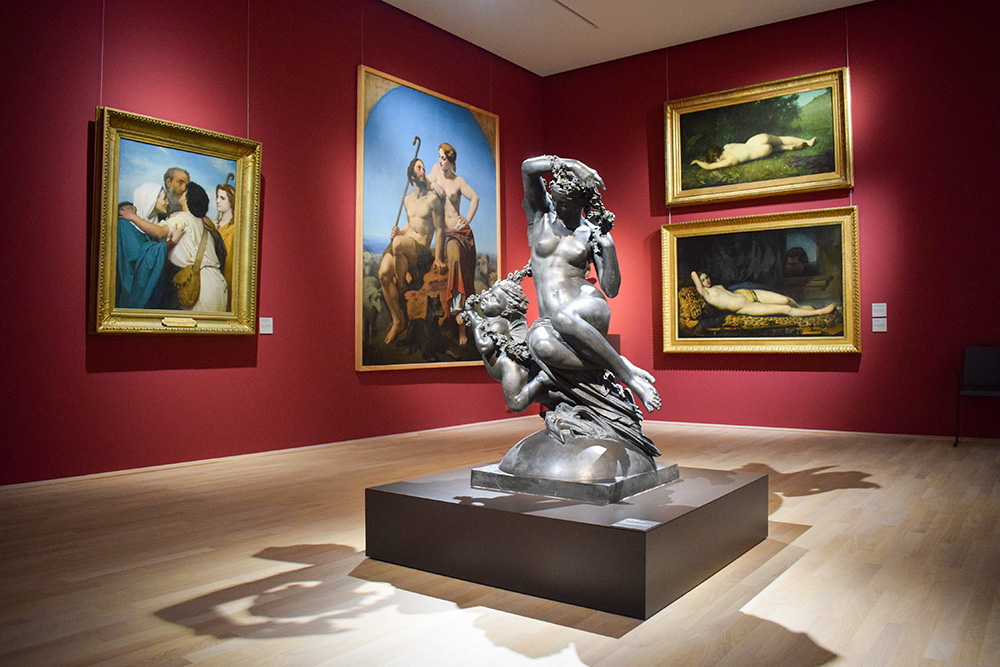
Fine Arts Museum of Dijon © French Moments
The Museum of Fine Arts is one of the oldest and most important museums in France.
It is housed inside the Palace of the Dukes of Burgundy, a setting that already makes the visit exceptional.
The collections span a long period, from the Middle Ages to modern times.
The highlight is the group of ducal tombs, masterpieces of late medieval sculpture that include the famous procession of mourners.
The museum is both an artistic institution and a monument in itself.
It tells the story of Burgundian power, European art, and the evolution of the palace over the centuries.
Musée Archéologique
The Archaeological Museum occupies part of the former Abbey of Saint-Bénigne.
Its collections cover prehistory, antiquity, and the medieval period, making it one of the best places to understand the early history of Dijon and the region.
Visitors can explore the crypt, the remains of the monastic buildings, and the old scriptorium.
The combination of archaeological objects and monastic architecture gives the museum a strong sense of historical continuity.
This site is ideal for anyone interested in archaeology, religious heritage, or the origins of Burgundy.
Musée de la Vie Bourguignonne
Located in the former Bernardine convent, the Museum of Burgundian Life offers a detailed view of everyday life in the region.
The collections include traditional costumes, household objects, tools, and rural artefacts.
One of the most popular sections recreates old Dijon shops, allowing visitors to walk through a pharmacy, a grocery shop, and other historic storefronts.
The museum focuses on intangible heritage and the rhythms of daily life.
It is an excellent introduction to the cultural identity of Burgundy.
Musée Rude
The Rude Museum is housed in the former church of Saint-Étienne, a medieval building reconverted into an exhibition space.
It is dedicated to the work of François Rude, one of the leading French sculptors of the nineteenth century.
The gallery displays plaster casts of his major works, including the famous group commonly known as “La Marseillaise” from the Arc de Triomphe in Paris.
This museum is an important stop for visitors interested in Romantic sculpture and the reuse of historic religious buildings for cultural purposes.
Musée National Magnin
The Magnin Museum is located in the Hôtel Lantin, a refined seventeenth-century mansion.
It houses the private collection of Jeanne and Maurice Magnin, who assembled an impressive ensemble of paintings, furniture, and decorative arts.
The museum has the atmosphere of a collector’s home, where each room reflects personal taste rather than academic classification.
It offers a more intimate experience of French art and domestic architecture.
This site is excellent for those who want to explore the world of private art collections and classical townhouses.
Cité Internationale de la Gastronomie et du Vin
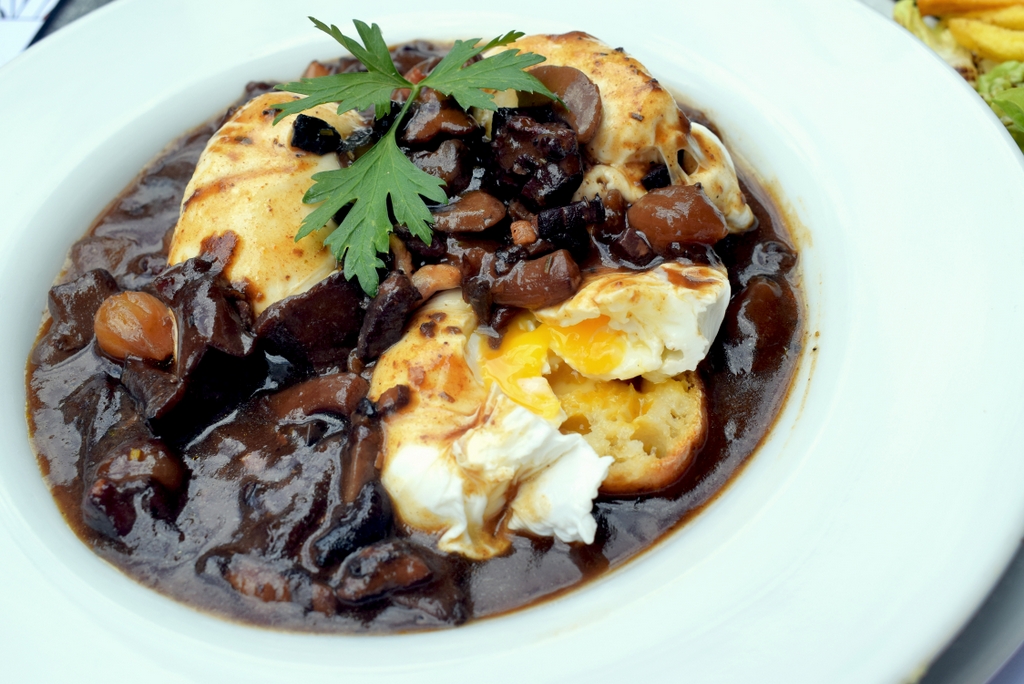
Eggs in meurette, Café de l'Industrie (Dijon) © French Moments
Dijon has long been associated with food and wine, and the Cité Internationale de la Gastronomie et du Vin brings this heritage into a modern cultural centre.
The site combines exhibitions, tasting spaces, boutiques, restaurants, and workshops.
It focuses on the “Gastronomic Meal of the French”, recognised by UNESCO as part of the world’s intangible cultural heritage.
Visitors can learn about culinary traditions, the history of French dining, and the wines of Burgundy.
The Cité is also a gateway to the wider vineyard landscape that surrounds Dijon.
This cultural centre is essential for understanding how food, wine, and identity are intertwined in Burgundy, and why Dijon continues to play an important role in French gastronomy.
Staying in Dijon
To plan your accommodation in Dijon, click on this link to our partner or browse the map below:
Conclusion
Dijon is a city that stays with you long after you leave.
It is large enough to offer museums, monuments, gastronomy, and history, but small enough to explore at your own rhythm.
Its streets feel lived-in, its heritage feels authentic, and its beauty reveals itself slowly, corner after corner.
Walking through Dijon is a journey through time: from medieval timber-framed houses to classical mansions, from Gothic churches to nineteenth-century boulevards, from quiet cloisters to lively markets.
The city has preserved its past with great care, while still feeling open, welcoming, and full of life.
For me, returning to Dijon as an adult — years after that first visit as a teenager — was like rediscovering a place I only half remembered.
This time, I had the chance to wander, to look closely, to appreciate the colours, the textures, the light.
And to experience the joy of exploring a city that remains both familiar and surprising.
Whether you come for a day or a long weekend, for architecture or for food, for history or simply for the pleasure of walking, Dijon rewards curiosity.
It is a city that invites you to slow down, to look up, and to enjoy the quiet richness of its heritage.
And when you leave, you may find yourself wanting to return — just as I did.
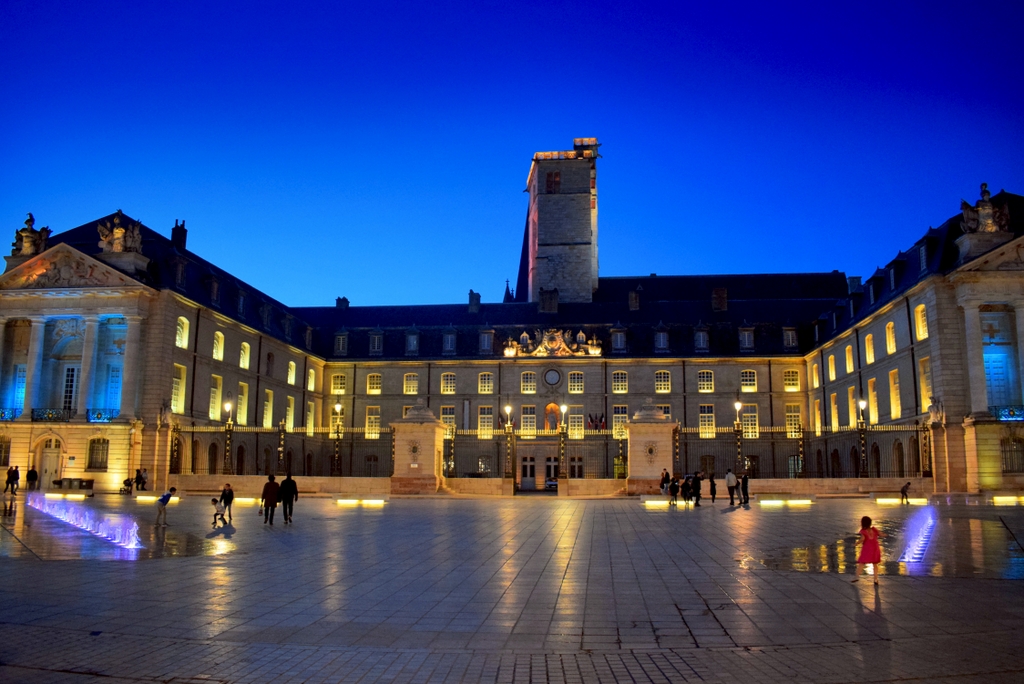
Place de la Libération, Dijon © French Moments
A warm thank you to Destination Dijon and Bourgogne-Tourisme for welcoming us to Dijon in June 2019 and giving us the chance to explore the city in depth.