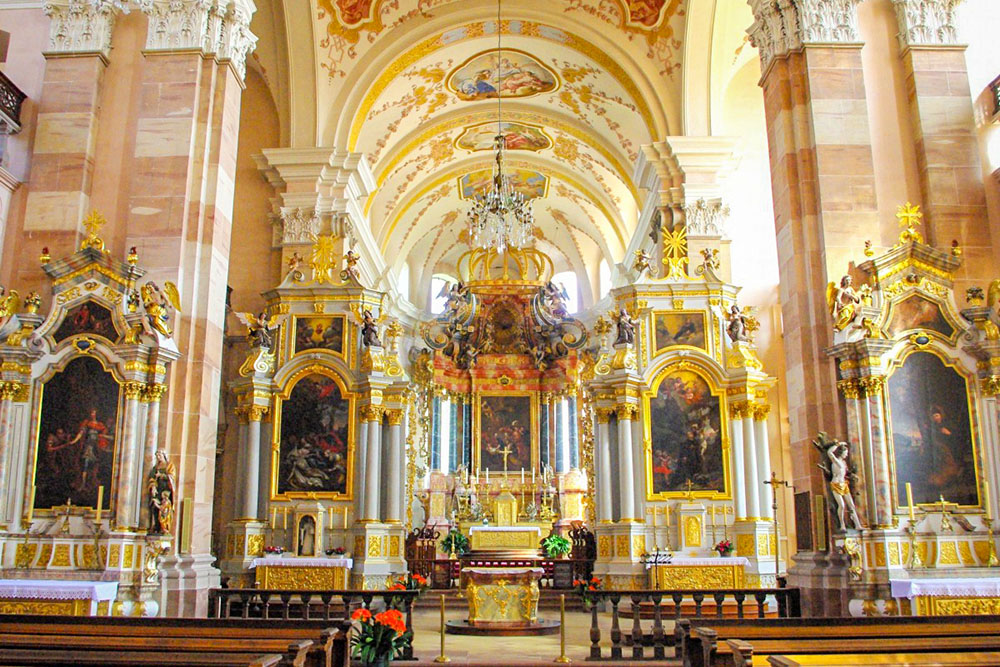


Ebersmunster Abbey Church is one of the most remarkable Baroque churches in Alsace, standing in the quiet village of Ebersmunster near Sélestat.
Rebuilt in the early 18th century in a style inspired by the Austrian Vorarlberg, it is famed for its luminous interior, lavish stucco decoration, painted vaults, and magnificent Silbermann organ.
Ebersmunster Abbey: A bit of History
Ebersmunster Abbey Church was originally the church of a powerful Benedictine abbey established in the heart of Alsace in the early Middle Ages.
The abbey is generally traced back to the mid-7th century, and tradition links its foundation to Saint Deodatus of Nevers.
The first church was dedicated to Saint Maurice, whose relics were said to have been brought here from the Abbey of Saint-Maurice in present-day Switzerland.
The monastery flourished under the protection of Aldaric, also known as Etichon, Duke of Alsace, the father of Saint Odile, the patron saint of Alsace.
Richly endowed by the ducal family, Ebersmunster became one of the region’s important Benedictine houses, with extensive lands and influence across central Alsace.
The troubled period of the 17th century
Like many religious foundations in Alsace, the abbey suffered heavily in times of war.
Its Romanesque church, built in the 12th century, was devastated during the Thirty Years’ War, when Swedish troops burned the abbey and the village in October 1632.
The monks withdrew to Sélestat for a time, and only gradually returned after the Peace of Westphalia.
A New Baroque Church
The church we see today belongs to the great rebuilding campaign of the early 18th century.
Under Abbot Bernard Roethlin, the abbey commissioned the architect Peter Thumb of Vorarlberg, one of the great names of southern Germanic Baroque architecture.
Thumb designed the new church in a style inspired by the Baroque traditions of Austria and south-west Germany.
The first phase was completed in 1712, but the building was struck again by disaster when it was damaged by fire after a lightning strike in 1717.
It was then rebuilt once more, with the present Baroque church taking shape between 1720 and 1726, while the west front reflects two campaigns, with the towers built in 1709–1710 and the nave façade reworked in 1725.
Peter Thumb is especially associated with the Baroque architecture of the Vorarlberg school, and Ebersmunster is often regarded as one of the clearest and most impressive expressions of that artistic current in Alsace.
A statement of the Counter-Reformation
The church is not merely important as a village landmark: it is a major statement of the Counter-Reformation Baroque, conceived to inspire awe through light, movement, colour, and splendour.
The abbey survived the upheavals of the French Revolution better than many monastic foundations, although the Benedictine community itself was dissolved in 1790.
The church later suffered some damage during the fighting of December 1944, but it has since been restored and remains today one of the most remarkable Baroque churches in Alsace.
Exterior of Ebersmunster Abbey Church
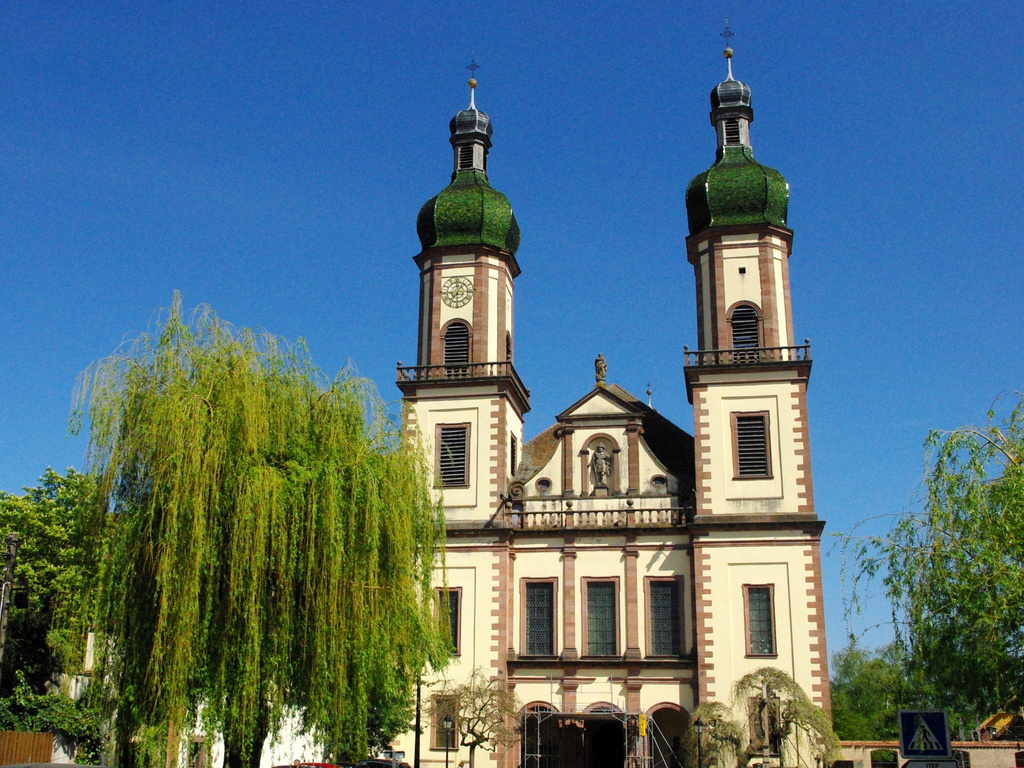
At first glance, Ebersmunster Abbey Church appears surprisingly restrained for such a richly decorated Baroque monument.
Its exterior is much more sober than the dazzling interior, with pale rendered walls set against the pink sandstone of the Vosges, creating a refined contrast of colour and texture.
This relative simplicity makes the church’s elegant proportions stand out all the more clearly.
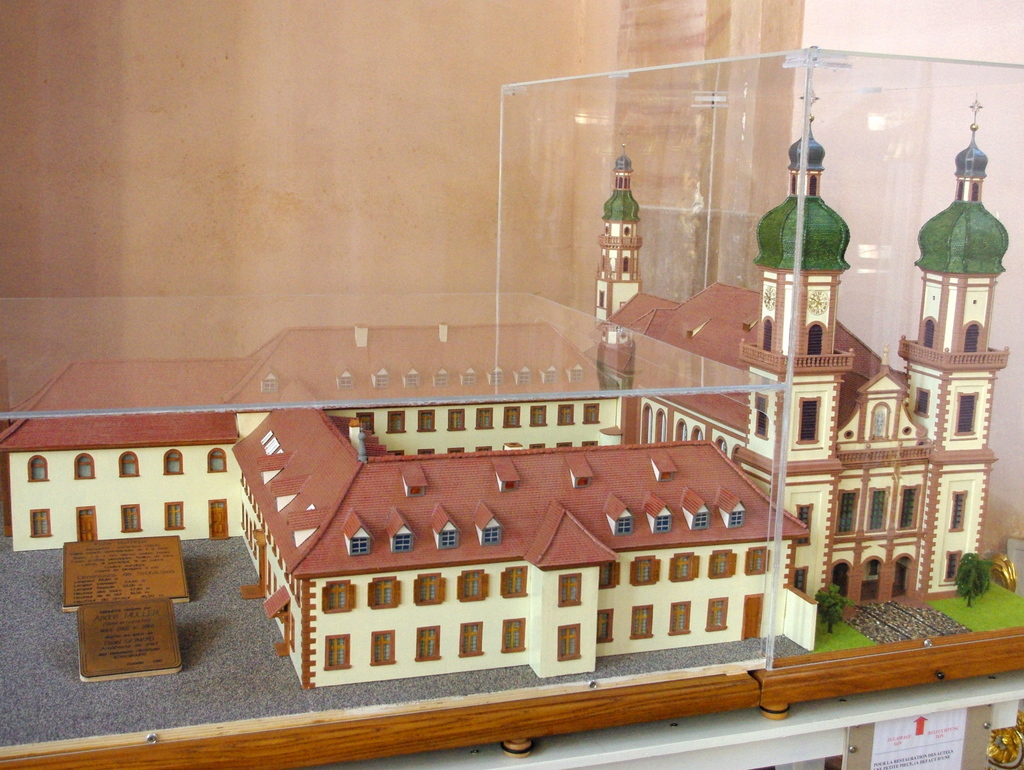
The west front, designed by Peter Thumb, is the result of two distinct building campaigns.
The twin towers were erected in 1709–1710, while the central wall between them was reworked in 1725 during the rebuilding of the nave.
This later intervention created a vaulted porch at ground level and an organ gallery above, giving the façade both dignity and balance.
The two façade towers rise to about 48 metres.
Square at their base and octagonal higher up, they are crowned with tall green-glazed onion domes, a form rarely used in Alsace and one that immediately gives the church its distinctive silhouette above the plain of the Ill.
Between the towers runs a balustraded central section, whose gabled niche contains a statue of Saint Maurice, patron of the church; above it stands a statue of the Virgin Mary.
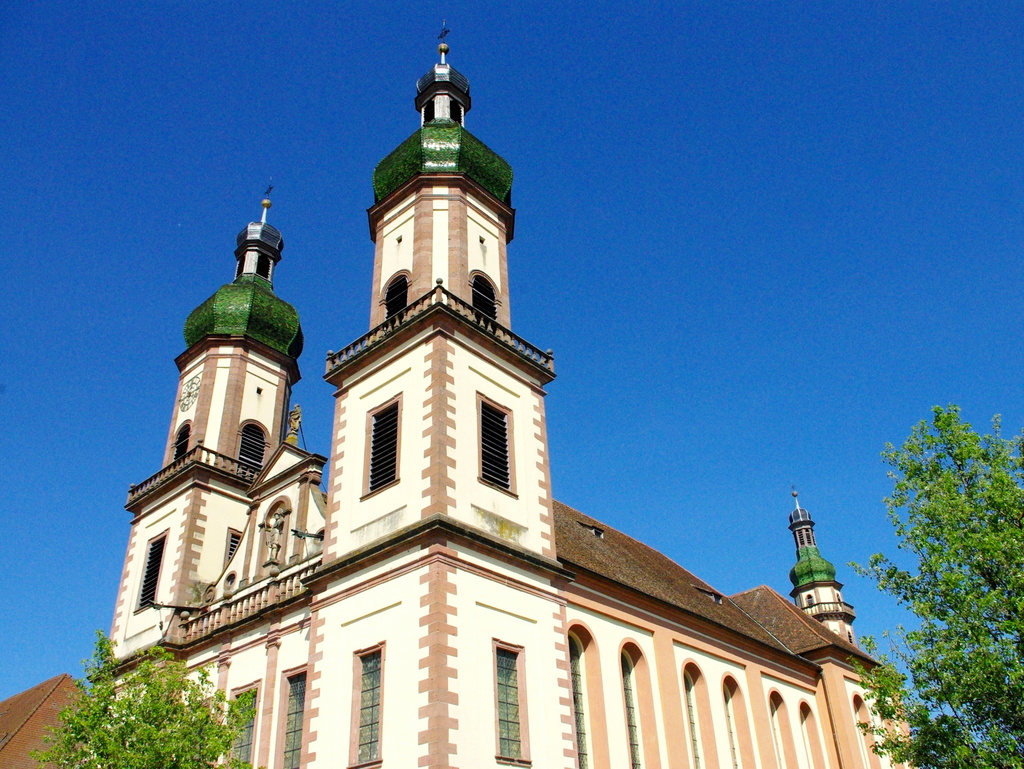
The Heidenturm
At the eastern end of the church, beside the choir, rises a third tower known as the Tour des Païens or Heidenturm.
It reaches about 45 metres and is also topped with a green-glazed onion dome.
Unlike the west front, this tower predates the present Baroque church and dates from about 1670–1680, which makes it an intriguing link between the earlier abbey complex and the great rebuilding campaign of the 18th century.
What makes the exterior especially interesting is this contrast between outward restraint and inward splendour.
From outside, the church already hints at the Baroque world within through its bulbous towers and carefully composed façade, but it still keeps something of a quiet village dignity.
The real theatrical surprise comes only when you step inside.
Interior of Ebersmunster Abbey Church
The interior of Ebersmunster Abbey Church is where the full splendour of the building reveals itself.
If the exterior feels relatively restrained, the inside unfolds as a luminous and exuberant Baroque ensemble, richly decorated with stucco, gilding, painted vaults, carved woodwork, and monumental altarpieces.
Much of this decorative programme was installed from 1727 onwards, creating a harmonious interior in which architecture, painting, sculpture, and light all work together.
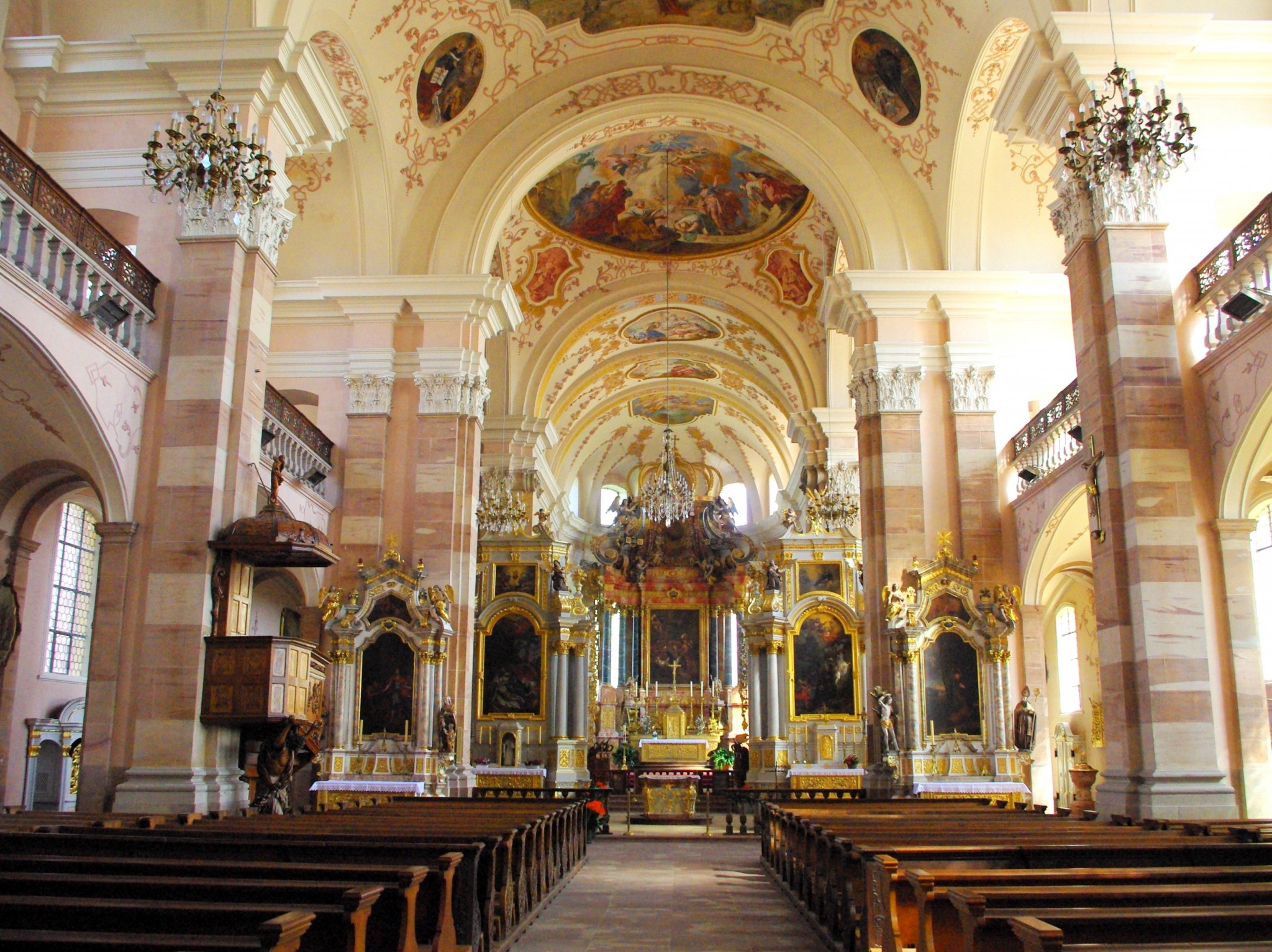
One of the first things that strikes the visitor is the brightness of the church.
The nave was designed to maximise light, with two superimposed windows in each bay, a feature that enhances the airy quality of the space and sets off the white stucco and painted decoration.
This sense of lightness is one of the reasons the church feels so different from a Romanesque or Gothic interior: rather than shadow and mystery, the impression here is one of openness, movement, and theatrical joy.
The painted ceilings
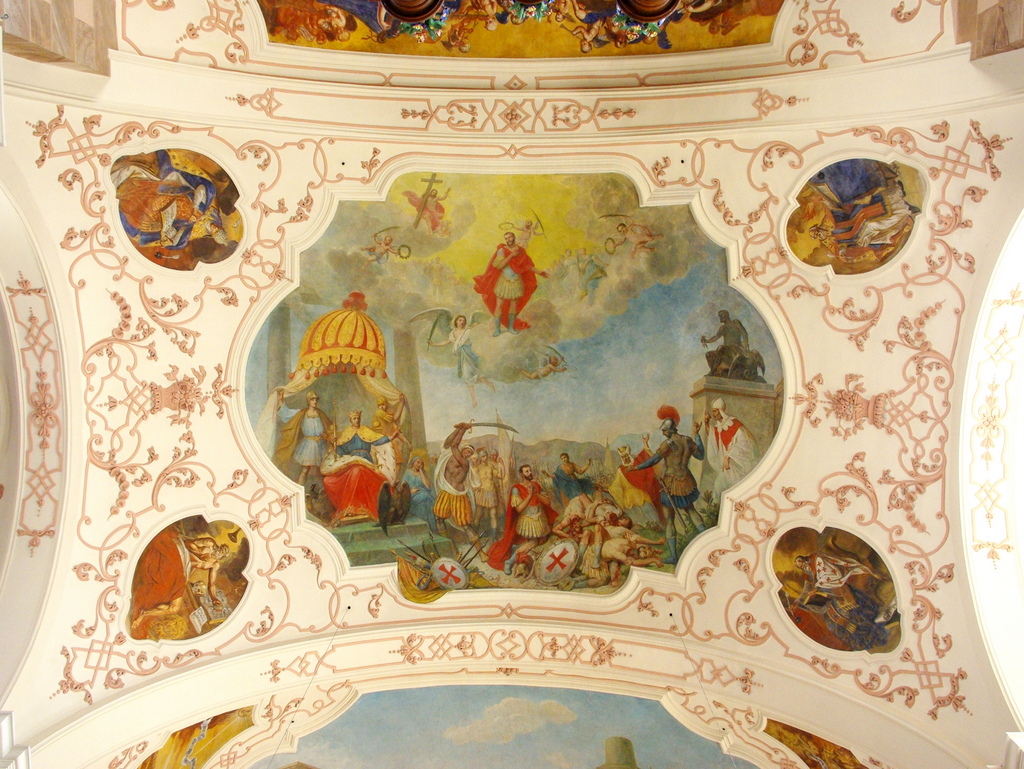
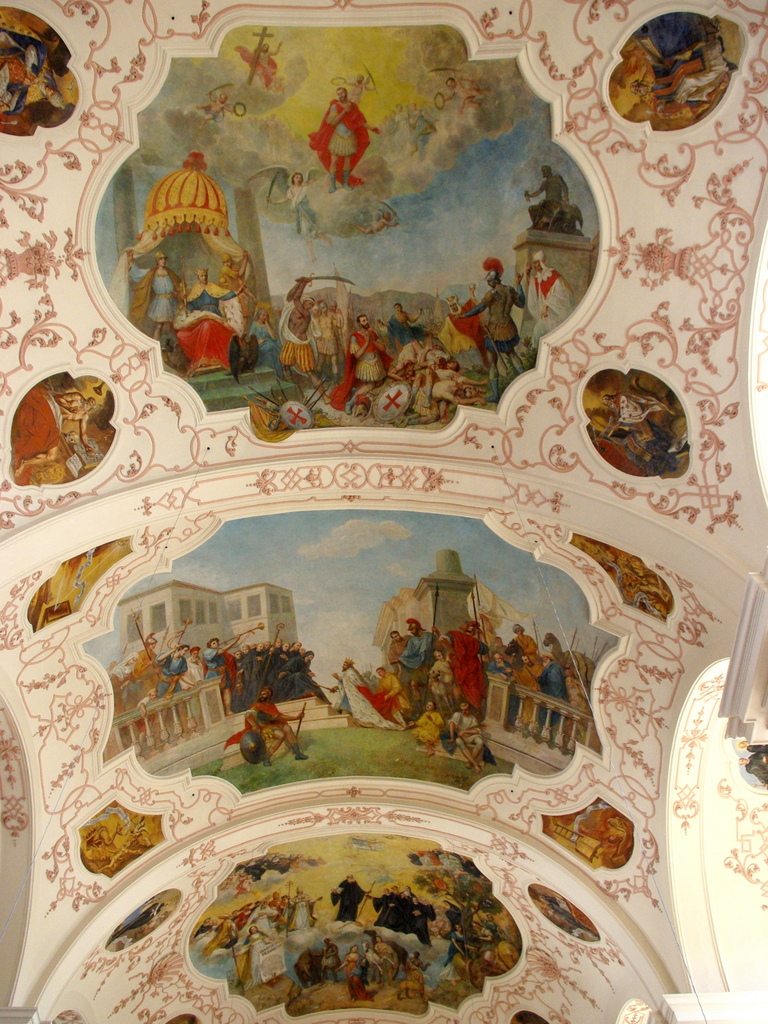
The painted ceilings are among the church’s greatest treasures. In the nave, the frescoes tell episodes from the lives of Saint Maurice and Saint Benedict.
The first bay shows the martyrdom of Saint Maurice and his reception into glory; the second presents Saint Benedict prophesying to Totila; and the third celebrates the glorification of Saint Benedict.
At the crossing rises a striking trompe-l’oeil Assumption of the Virgin, dated 1759, which forms the visual climax of the painted programme.
In the choir, the ceiling frescoes depict Faith, Hope, and Charity, together with the Lamb of the Apocalypse and the Holy Trinity.
The pulpit
The church’s Baroque furnishings are equally remarkable.
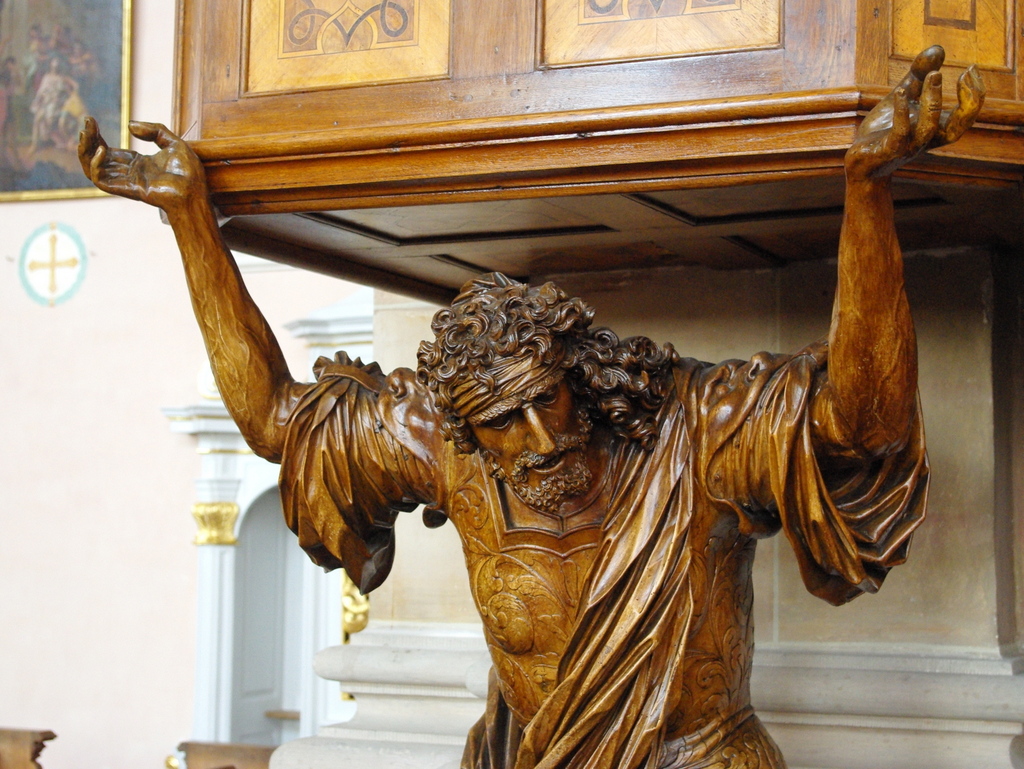
The elegant pulpit is famously supported by the powerful figure of Samson, a theatrical detail that perfectly suits the dramatic language of Baroque art.
The High Altar
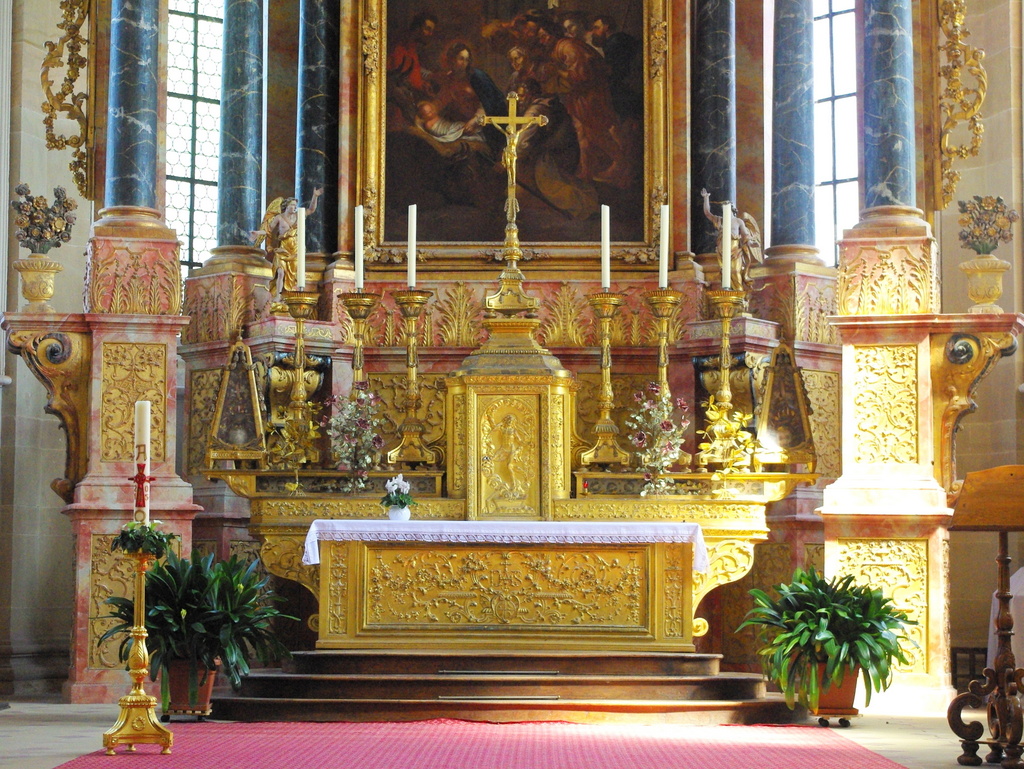
At the far end of the choir stands the magnificent high altar, dating from 1727 and associated with the sculptor Ignatius Meyer of Sélestat.
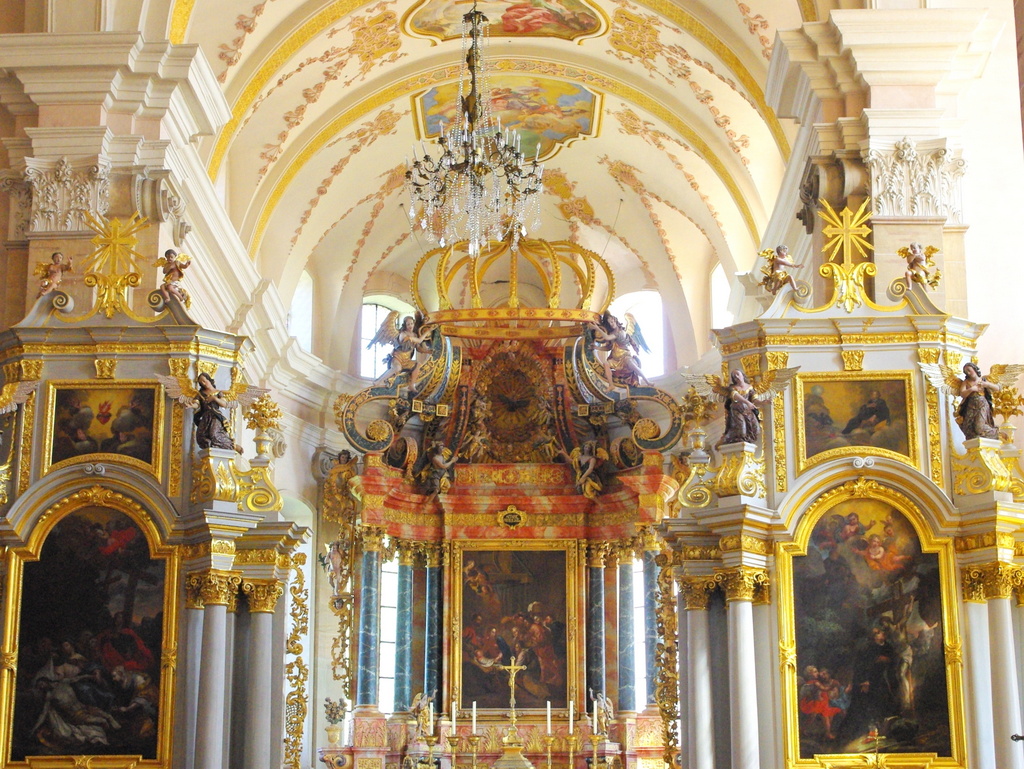
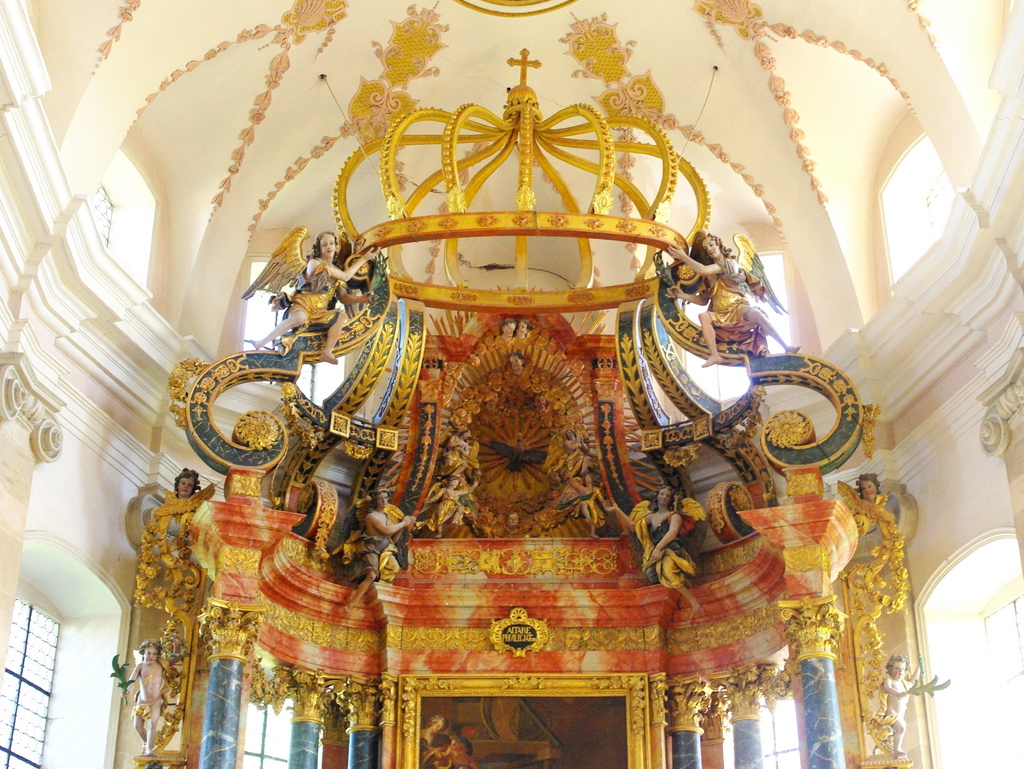
It is crowned by an extraordinary canopy in the form of an imperial crown, a spectacular flourish of gilded sculpture that rises dramatically towards the vault.
This is one of the most memorable features of the church and a perfect expression of Counter-Reformation Baroque, designed to draw the eye irresistibly towards the sanctuary.
The Choir Stalls
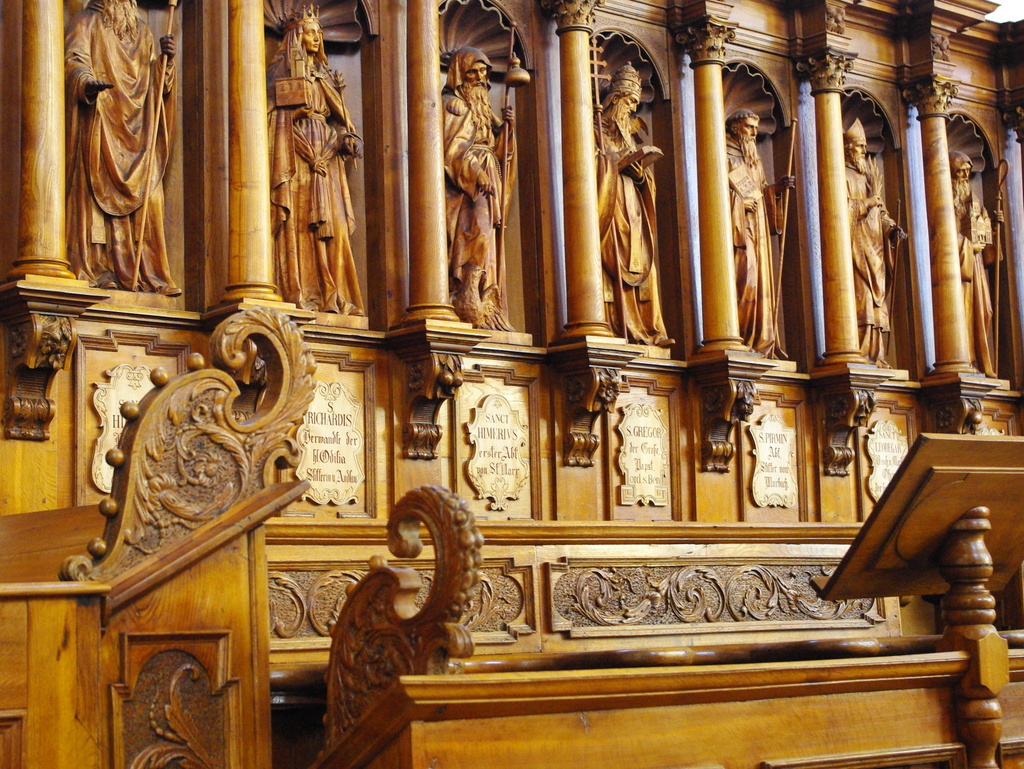
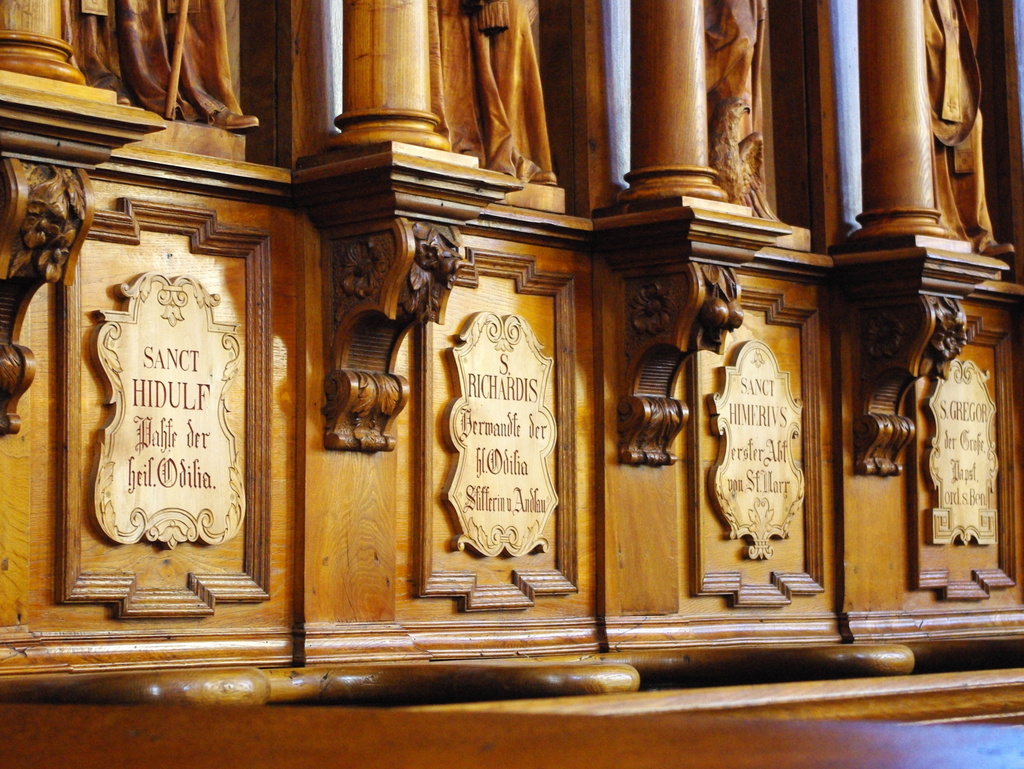
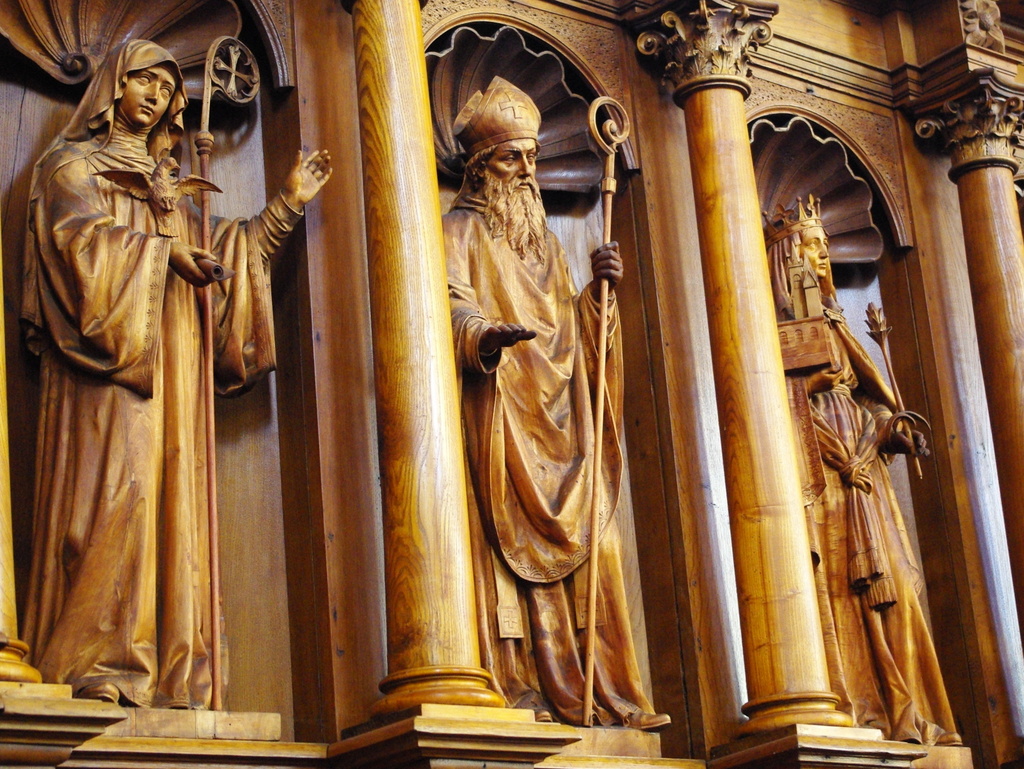
The choir stalls, some of which date from the late 17th and early 18th centuries, add richly carved woodwork to the ensemble, while the saints above them give the choir a solemn and ceremonial dignity.
The Great Organ
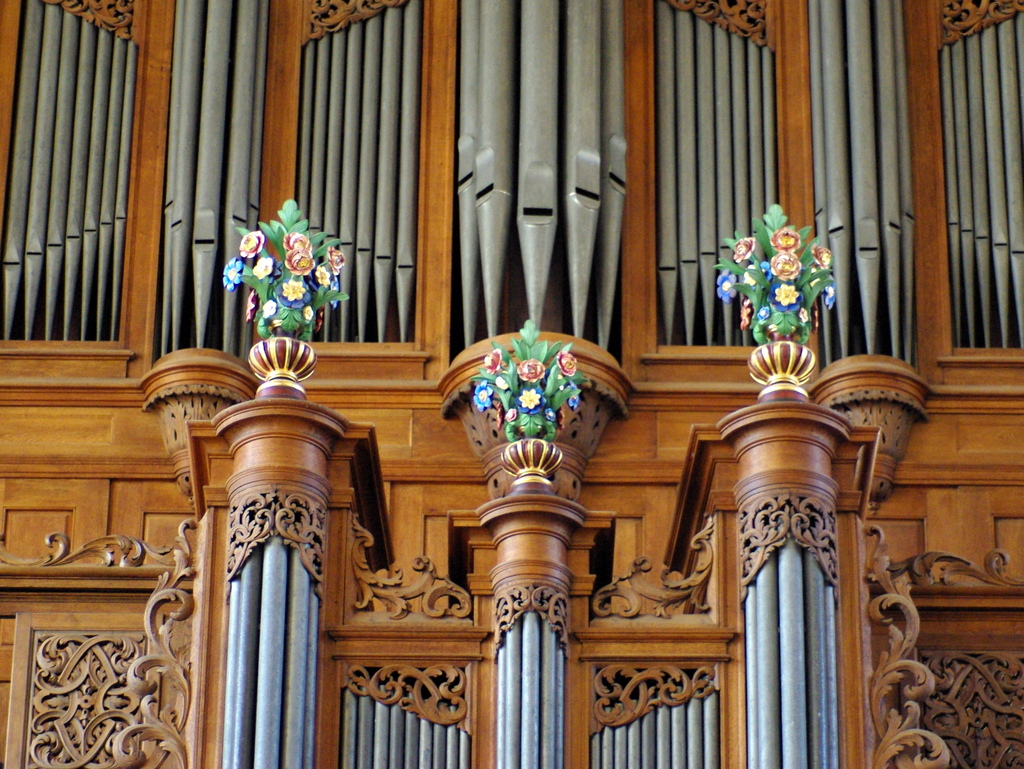
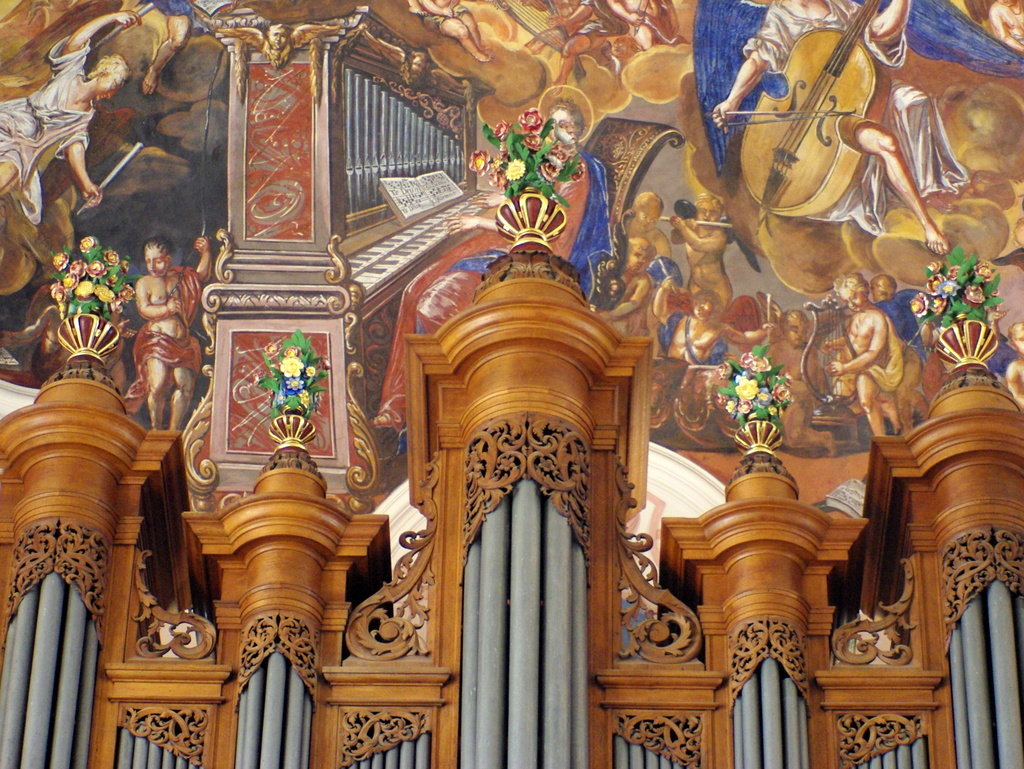
Before leaving, visitors should also take time to admire the great Andreas Silbermann organ, installed in 1730–1731 and regarded as one of the last works of the celebrated organ builder.
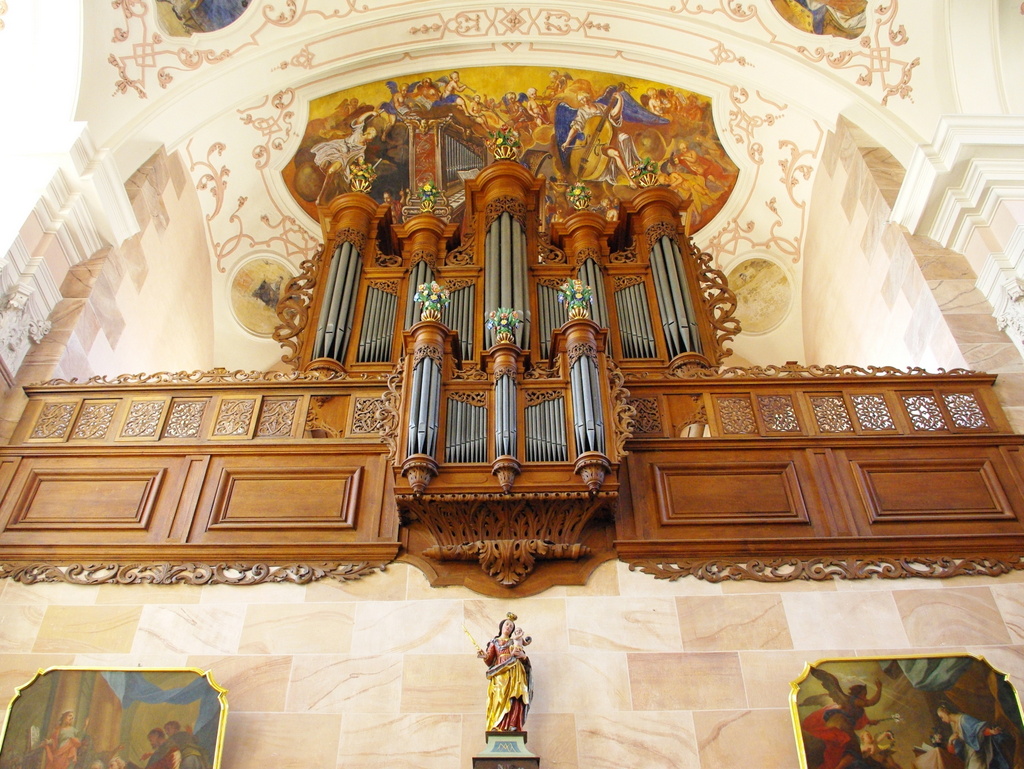
Above the organ gallery, a monumental painting of Saint Cecilia surrounded by musical angels adds yet another layer of richness to the interior.
Taken as a whole, the interior of Ebersmunster Abbey Church is one of the most impressive Baroque ensembles in Alsace.
It is not just lavishly decorated: it is carefully staged, so that light, colour, painting, sculpture, and music all seem to converge in a single vision of sacred magnificence.
Ebersmunster Abbey Church – Conclusion
Ebersmunster Abbey Church is one of those places that quietly exceeds all expectations.
From the outside, it appears elegant and restrained; inside, it unfolds into a dazzling world of light, colour, stucco, gilding, and sacred drama.
In a region better known for its half-timbered villages, vineyards, and Gothic churches, Ebersmunster offers something quite different: a richly theatrical Baroque masterpiece hidden in the heart of Alsace.
What makes the church so memorable is not just the beauty of its decoration, but the harmony of the whole.
The painted ceilings, the imperial-crowned high altar, the carved choir stalls, the pulpit of Samson, and the magnificent Silbermann organ all come together in a single vision of splendour and devotion.
It is a place that feels both intimate and grand, peaceful and exuberant at the same time.
For visitors exploring the area around Sélestat, Ebersmunster Abbey Church is far more than a minor detour.
It is one of Alsace’s true hidden treasures — a church that surprises, delights, and lingers in the memory long after the visit is over.