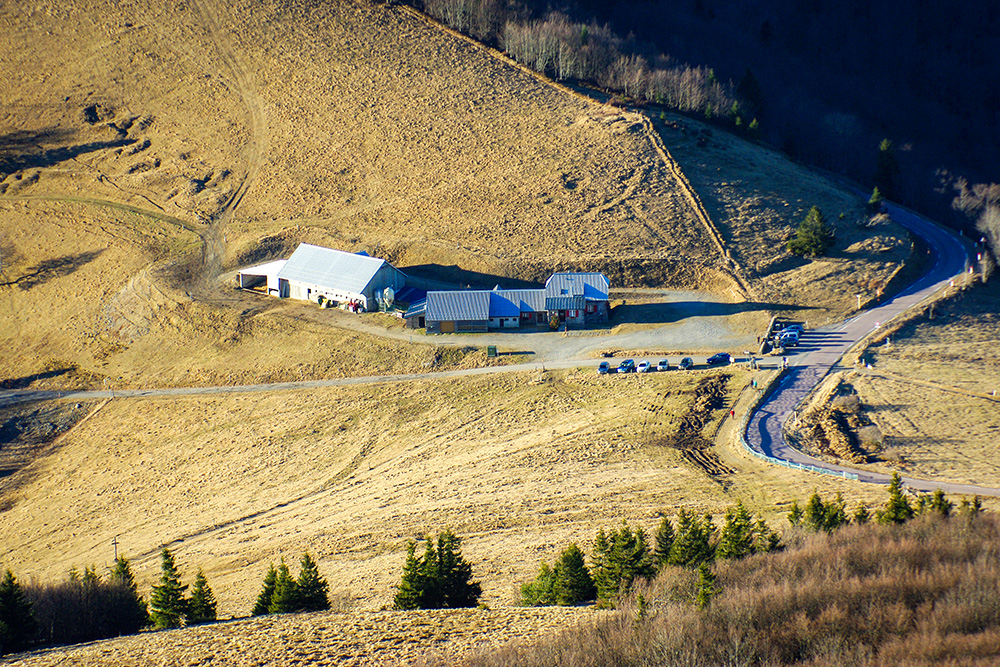


Col du Haag belongs to that category of places in the Vosges that you usually know only if you have already passed through them.
It is not the most famous pass in the massif. It is not the Grand Ballon. It is not the Ballon d’Alsace. It is not even necessarily a name you remember immediately when following the Route des Crêtes.
And yet this small mountain pass, perched at around 1,233 metres above sea level, deserves a closer look.
First, because it lies in a beautiful part of the High Vosges.
Secondly, because it sits at the foot of the Storkenkopf, the second-highest summit in the Vosges Mountains.
And finally, because in 2026, the Tour de France decided to bring it into the spotlight.
As it turns out, even the quiet passes of the Vosges can enjoy their moment of fame.
Where is Col du Haag ?
Col du Haag is located in the Haut-Rhin département, above the Saint-Amarin valley, not far from Geishouse, the Grand Ballon and the Markstein.
This is the heart of the High Vosges of Alsace, a landscape of forests, high pastures and rounded ridges. The Route des Crêtes passes by it, the Grand Ballon dominates the surrounding area, and the Markstein lies only a few kilometres away.
The pass forms a link between the higher parts of the massif and the Alsatian valleys below. From Geishouse, the road climbs towards this upland area in a very Vosges atmosphere: bends, fir trees, meadows, farm inns and, when the weather is kind, lovely openings towards the ridges.
It is not a spectacular place in the obvious sense of the word. There is no grand monument, no viewpoint laid out like the summit of the Grand Ballon, no picture-postcard village.
But that is precisely part of its charm. Col du Haag belongs to that family of simple, authentic places that you often discover on the way to somewhere else.
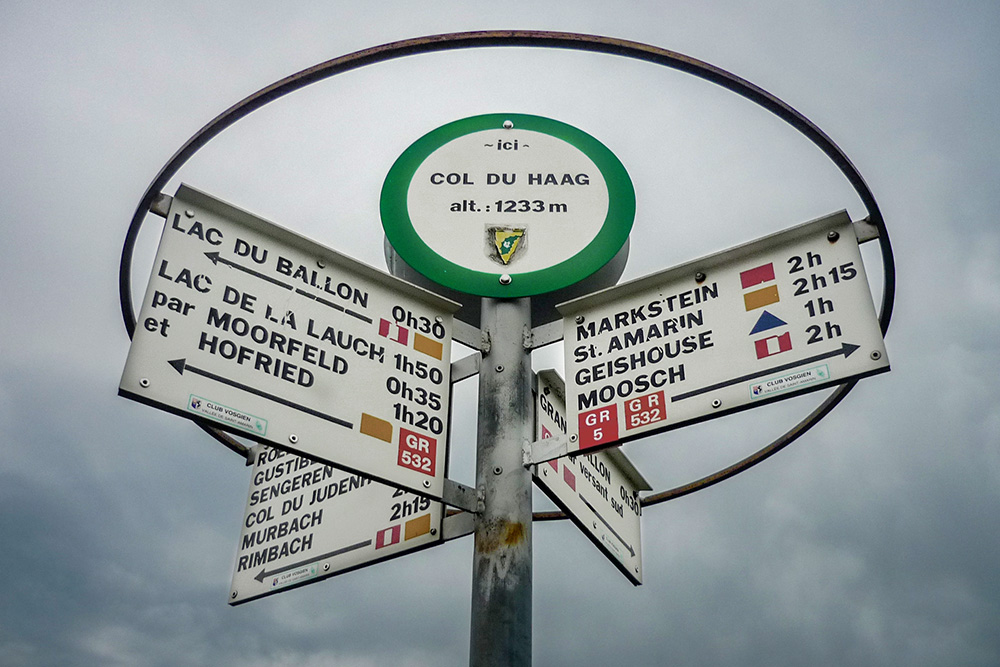
Col du Haag, Vosges © French Moments
At the foot of the Storkenkopf
Col du Haag lies at the foot of the Storkenkopf, which reaches 1,366 metres above sea level.
The name Storkenkopf literally means “stork’s head” in Alsatian. That immediately adds a little poetry to the landscape. It may also make you look up, just to check whether a stork is keeping an eye on your walk.
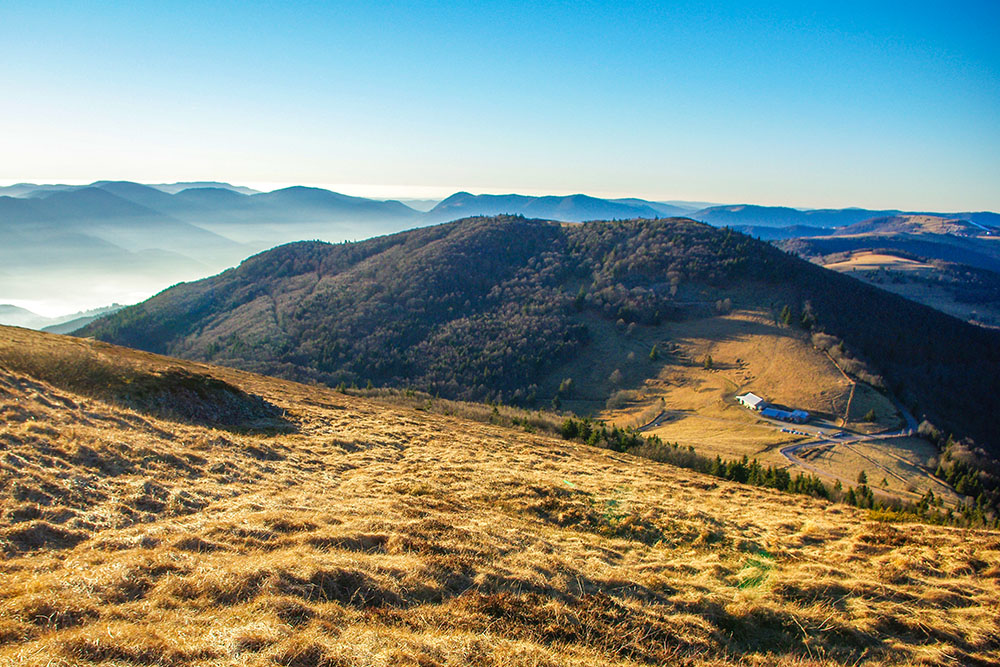
Col du Haag and the Storkenkopf © French Moments
The Storkenkopf is the second-highest summit in the Vosges, just behind the Grand Ballon. And yet it remains far less famous than its larger neighbour.
From Col du Haag, you can reach the summit by a forest track. It is a lovely way to discover a quieter part of the massif, away from the busiest tourist spots.
Here, you find the atmosphere of the High Vosges: deep forests, bright high pastures, upland grazing land, and that feeling of being both in Alsace and already somewhere slightly apart, up on the heights.
The ferme-auberge du Haag
For many visitors, the name Haag mainly brings to mind the ferme-auberge.
And I must admit, that is also the case for me.
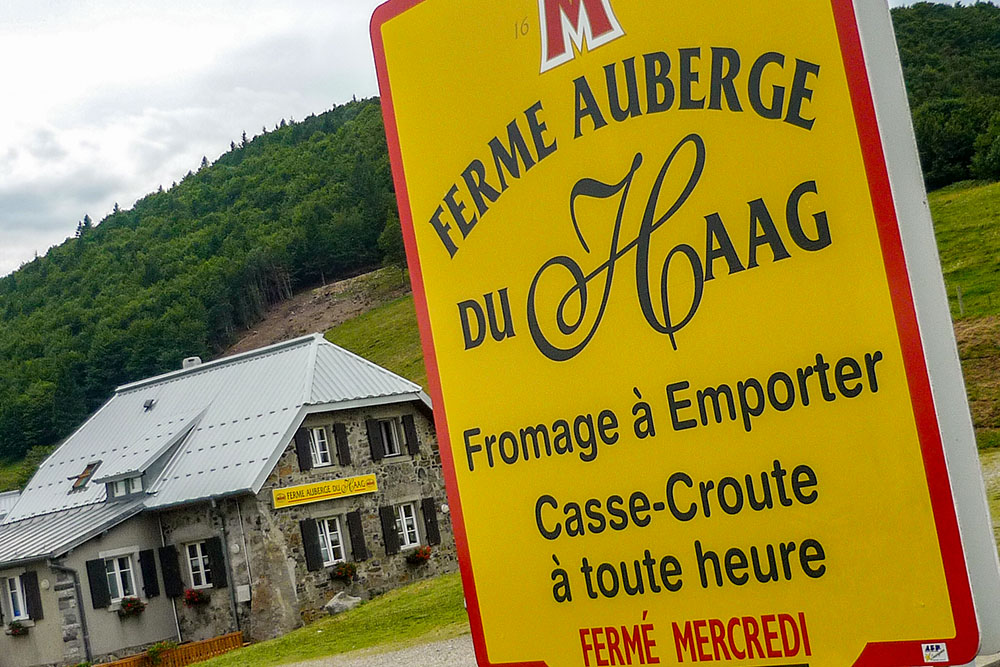
Ferme auberge du Haag © French Moments
I know Col du Haag because I have driven through it several times, but also because I have walked through the area when starting from Geishouse to climb the Grand Ballon.
In my memory, Col du Haag was not simply a point on a map or a road junction in the mountains. It was first and foremost the farm inn that acted as the main attraction.
In the Vosges, a ferme-auberge is never just a detail. It is a landmark, a promise, and sometimes even a motivation.
You set off to walk, of course. You admire the scenery, naturally. But somewhere at the back of your mind, there is always the thought that a good Vosges meal might be waiting for you on the way back.
Perhaps that is the true genius of hiking in the Vosges: you climb for the view, but you rarely return disappointed by the local food.
The Ferme-Auberge du Haag fits perfectly into this tradition. Set in an upland setting, it reminds us that the Vosges are also a land of mountain farms, summer pastures and simple, generous meals.
Cycling up Col du Haag
For cyclists, Col du Haag is a much more serious matter.
From the valley, the climb is demanding. The ascent used by the 2026 Tour de France from the Saint-Amarin area is 11.2 km long, with an average gradient of 7.3%. On paper, that is already enough to calm a few ambitions.
But as so often in the Vosges, the average gradient does not tell the whole story. The climb is irregular, with flatter sections, steeper ramps and stretches through the forest where the road seems to play games with your legs.
The gradient can become severe in places, especially on some of the sharper sections. It may not be the best-known climb in the Vosges, but it has everything needed to command respect: length, shade, gradient and that little “I may not look like much, but you will remember me” quality.
Local cyclists already know it, especially thanks to the L’Alsacienne cycling event. The wider public, however, will probably discover it through the Tour de France.
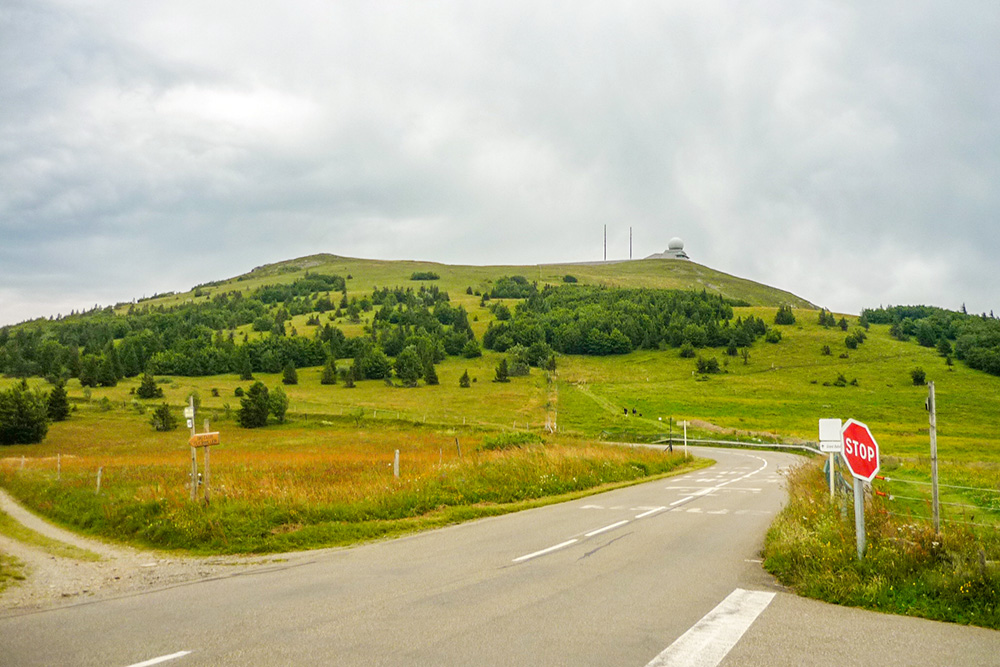
At the Col du Haag © French Moments
Col du Haag and the Tour de France 2026
In 2026, Col du Haag featured in Stage 14 of the Tour de France, between Mulhouse and Le Markstein Fellering.
And it was not placed just anywhere.
It came right at the end of the stage, after several Vosges difficulties, including the Grand Ballon and the Ballon d’Alsace. In other words, by the time the riders reached the foot of Col du Haag, their legs would already have done plenty of work.
The climb was classified as Category 1. It came just before the short final stretch towards the Markstein. This was exactly the kind of climb that could hurt: late in the stage, steep, irregular and positioned just before the finish.
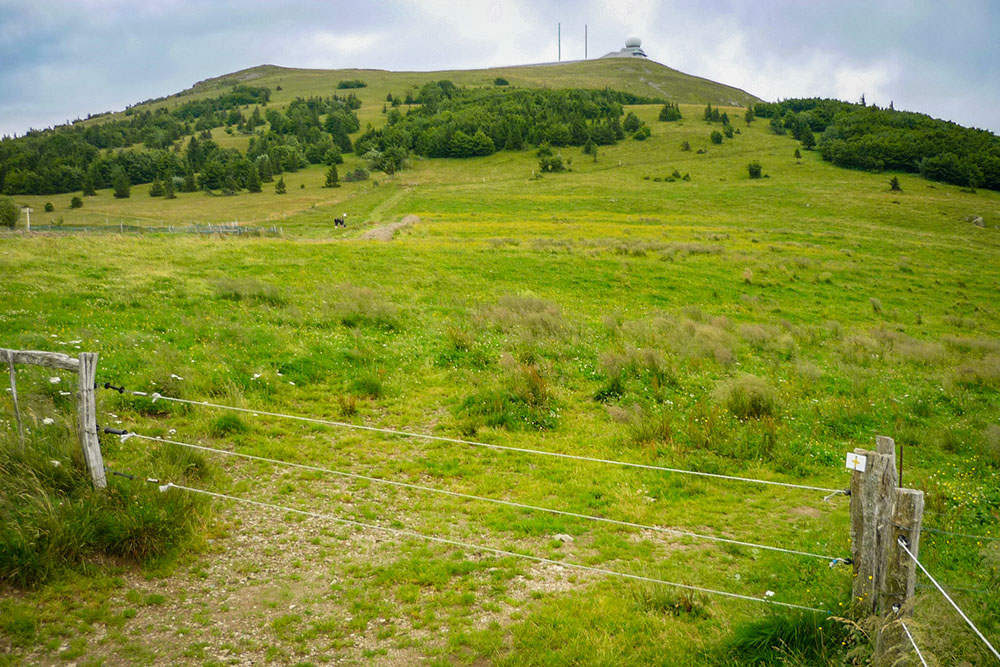
Grand Ballon seen from Col du Haag © French Moments
For television viewers, it may have been a discovery. For the riders, it probably felt like something rather different from a pleasant forest outing.
The Tour de France sometimes enjoys revealing lesser-known roads. Col du Haag fits that category perfectly: a local passage, long and relatively confidential, suddenly transformed into an important actor in a mountain stage.
The Other Side of the Tour de France
The Tour de France’s passage over the Col du Haag gave Geishouse and the high Vosges wonderful visibility.
But it also revealed the other side of the story: the morning after the stage, the Haag climb was found littered with rubbish left behind by some spectators.
According to local press reports, cans, food remains, folding chairs and other items had been abandoned along the route between Le Sattel and the Ferme du Haag.
The municipality, helped by volunteers and the Club Vosgien of the Saint-Amarin Valley, organised an improvised clean-up operation, collecting around one tonne of waste in just one hour along the six-kilometre climb.
It was a useful reminder, beyond the festive atmosphere of the race, that the roads, passes and landscapes of the Vosges are not just beautiful backdrops for television cameras.
They are living, fragile places that deserve to be respected once the crowds have gone.
What to do around Col du Haag ?
Col du Haag can easily be included in several outings.
On foot, you can reach the Storkenkopf, explore the paths around the high pastures or continue towards the Grand Ballon.
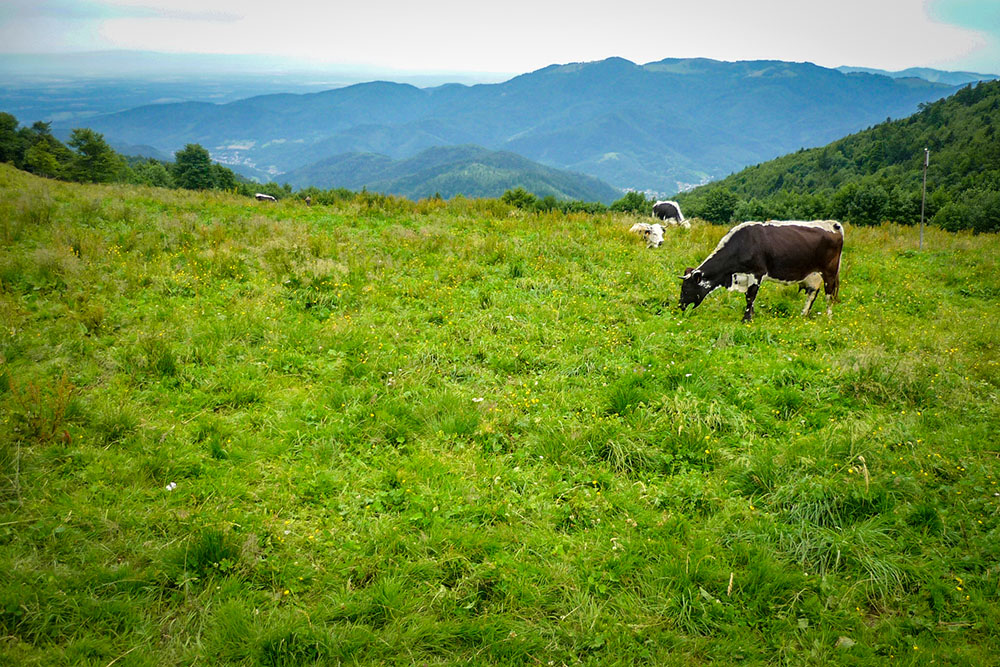
The high pastures at the Col du Haag © French Moments
From Geishouse, the route towards the Haag area and the Grand Ballon offers a fine immersion into the landscapes of the High Vosges.
By car, the pass gives easy access to several major sites in the area: the Grand Ballon, the Markstein, the Route des Crêtes, the Saint-Amarin valley and the Vosges ridges.
And then, of course, there is the farm inn.
That is not just a practical detail. It is almost strategic information.
A quiet but very Vosges mountain pass
Col du Haag does not need to try too hard.
It does not have the fame of the Grand Ballon, nor the historic aura of the Ballon d’Alsace. But it has the charm of many Vosges places of passage: a mixture of forest, altitude, silence, effort and conviviality.
It is a pass you drive through, climb, or reach on foot, sometimes without thinking too much about it. Then, over time, it becomes a landmark.
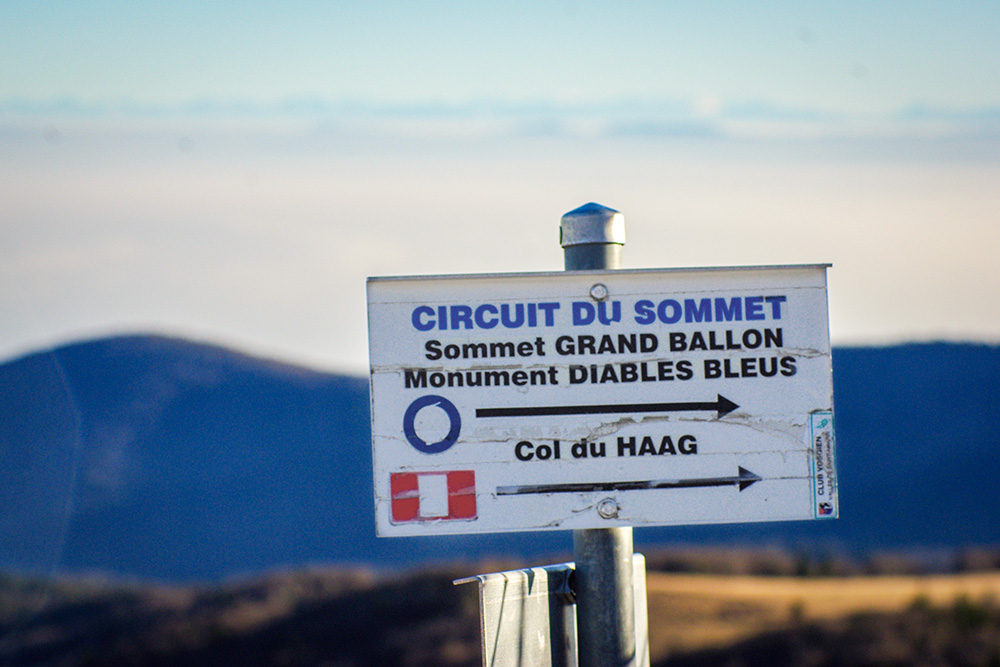
Grand Ballon © French Moments
In 2026, the Tour de France will give it exceptional exposure. But once the riders have passed, Col du Haag will probably return to what it has always been: a simple place, perched above the valley, between the Grand Ballon, the Storkenkopf and the beautiful heights of the Vosges.
And that is perfectly fine.