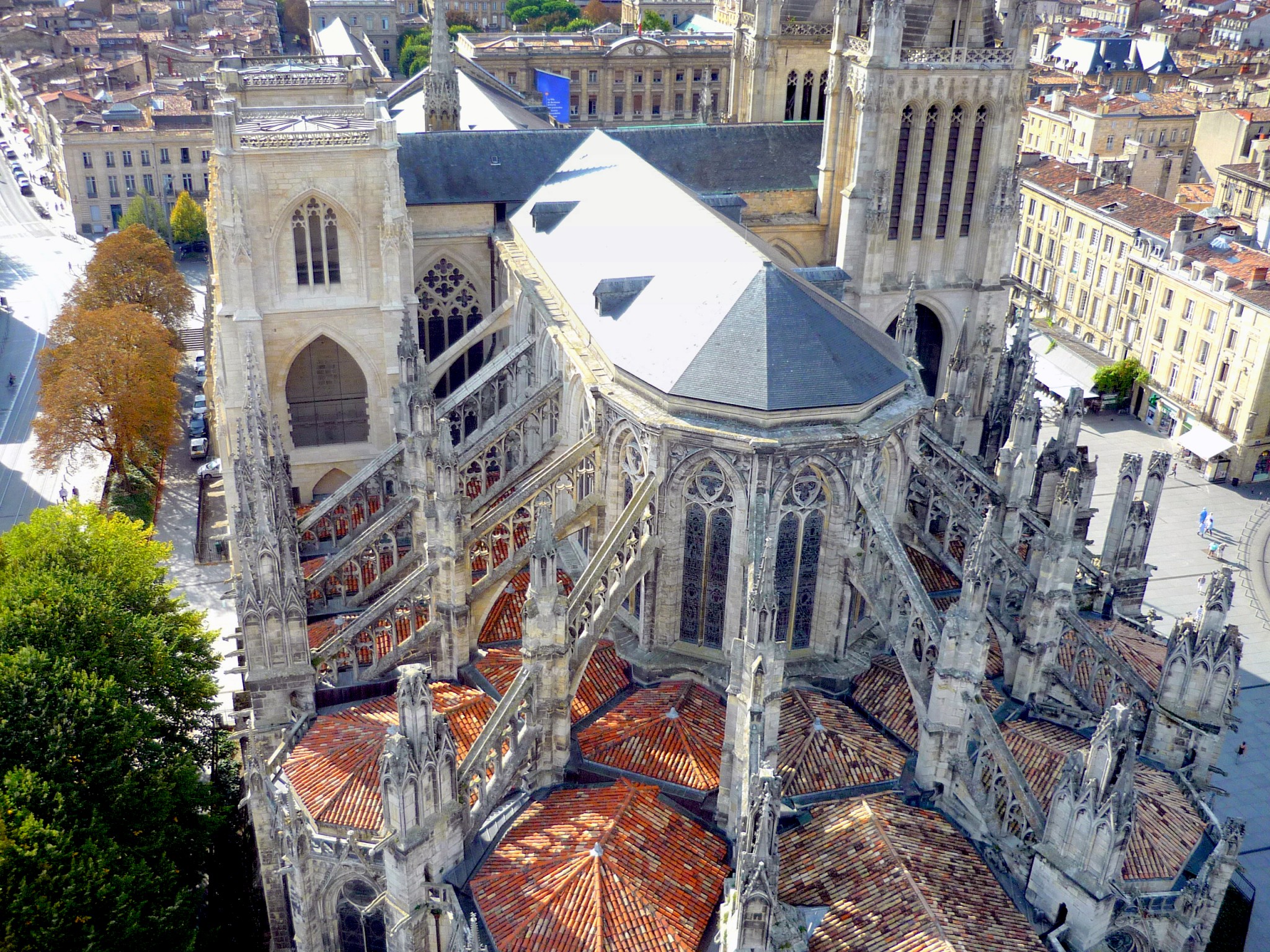


Bordeaux Cathedral stands in the heart of Aquitaine like a stone chronicle of the city’s past—an imposing Gothic landmark whose soaring silhouette has shaped Bordeaux for centuries.
The largest religious monument in the city, Bordeaux Cathedral, has been a UNESCO World Heritage Site since 1998, recognised for both its architectural significance and its deep historical roots.
Historic overview of Bordeaux Cathedral
The story of Bordeaux Cathedral begins as early as 814, when written sources first mention a cathedral complex formed by two churches—Saint-Sauveur and Notre-Dame de la Place.
This early structure may have been destroyed during the Viking raid of 848, a turbulent period that reshaped many towns along the Atlantic coast.
In the 11th century, the cathedral became the resting place of the relics of Saint Macaire (Macarius), the bishop of Bordeaux and an influential evangeliser of Aquitaine.
Not long after, in 1096, a Romanesque cathedral dedicated to Saint-André was consecrated by Pope Urban II.
One of the cathedral’s most famous historical moments came in 1137, when Eleanor of Aquitaine married Louis VII, the future King of France, within its walls—an event that would shape the destiny of Europe.
By the 14th century, the authority of Bordeaux Cathedral extended far beyond the city itself.
Its jurisdiction included the dioceses of Agen, Périgueux, Angoulême, Saintes and Poitiers, marking its prestige as one of the major ecclesiastical centres of the region.
Bordeaux Cathedral: General Facts
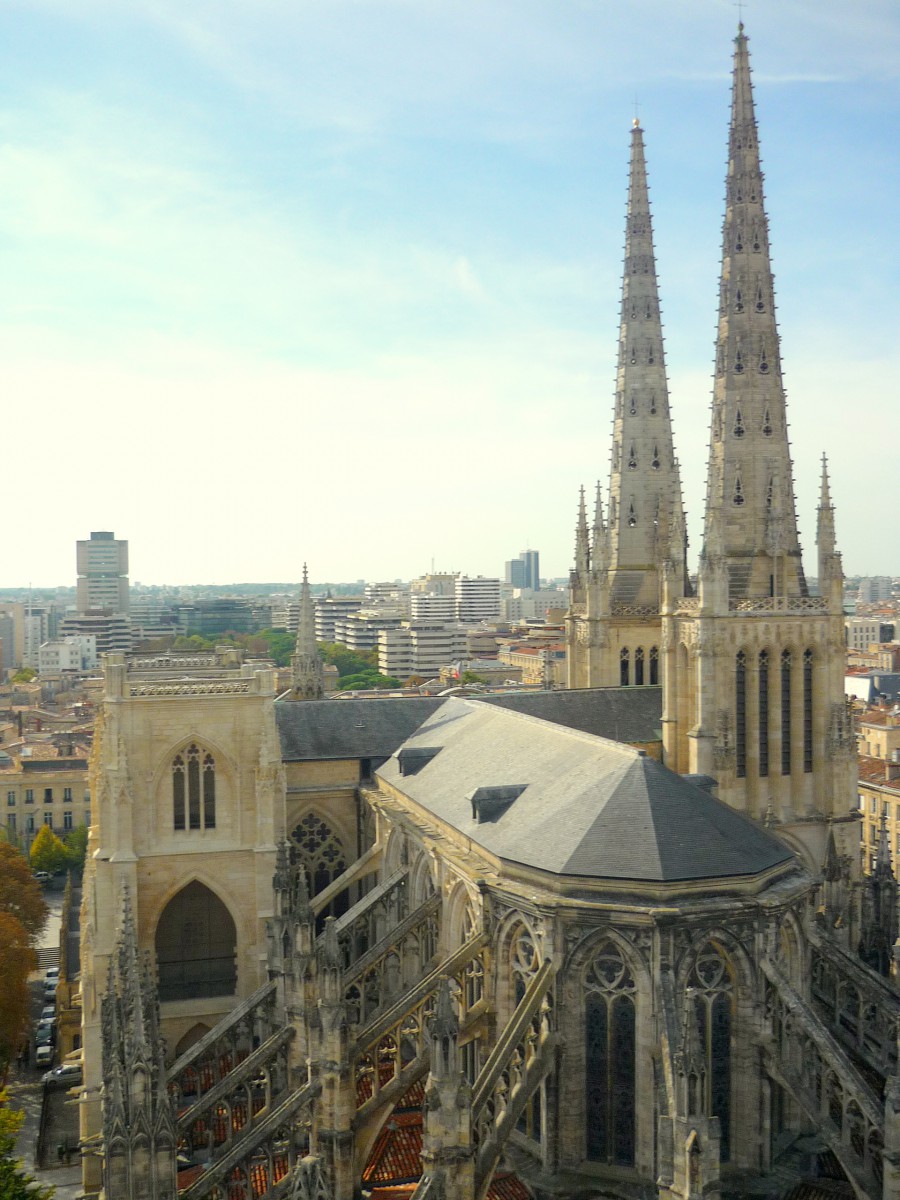
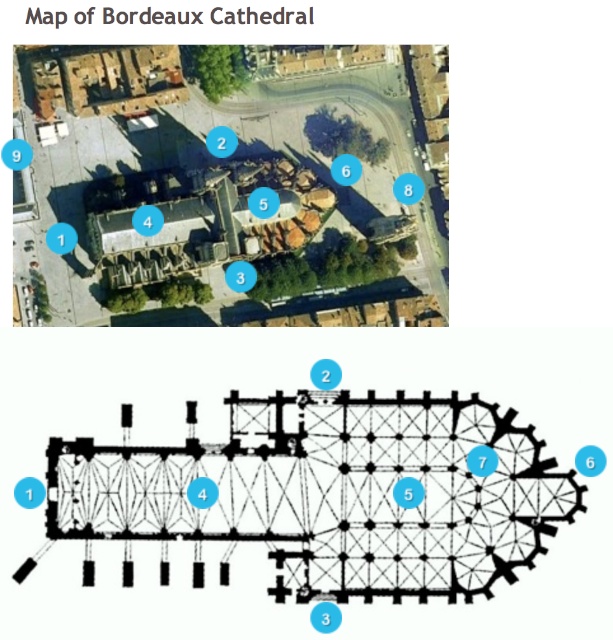
Designed in the shape of a Latin cross, Bordeaux Cathedral stretches along a west–east axis, revealing proportions both elegant and deliberate.
The single nave, composed of seven bays, reaches 124 metres in length and rises 23 metres high—considerably lower than the soaring naves of Metz Cathedral or Amiens Cathedral, which exceed 41 metres.
The transept, longer and higher than the nave, reaches 29 metres above the choir.
Around the long choir runs an ambulatory bordered by two aisles, from which radiate five chapels.
The ground plan of the choir was inspired by Reims Cathedral, likely influenced by Bishop Pierre de Roncevaux’s time in Champagne.
Originally, the cathedral was meant to feature four bell towers, but only two were completed—both on Rue Vital-Carles.
The ambitious plan was abandoned when the ground beneath the structure, a former swampland, proved unable to support the weight of additional towers.
Of the Romanesque cathedral from the 11th century, only the inner walls of the nave survive today.
Between the 12th and 16th centuries, Bordeaux Cathedral was rebuilt entirely in Gothic style.
My book recommendation!
Its name? Simply:
Gothic: Architecture, Sculpture, Painting by Rolf Toman, Publisher: Ullmann
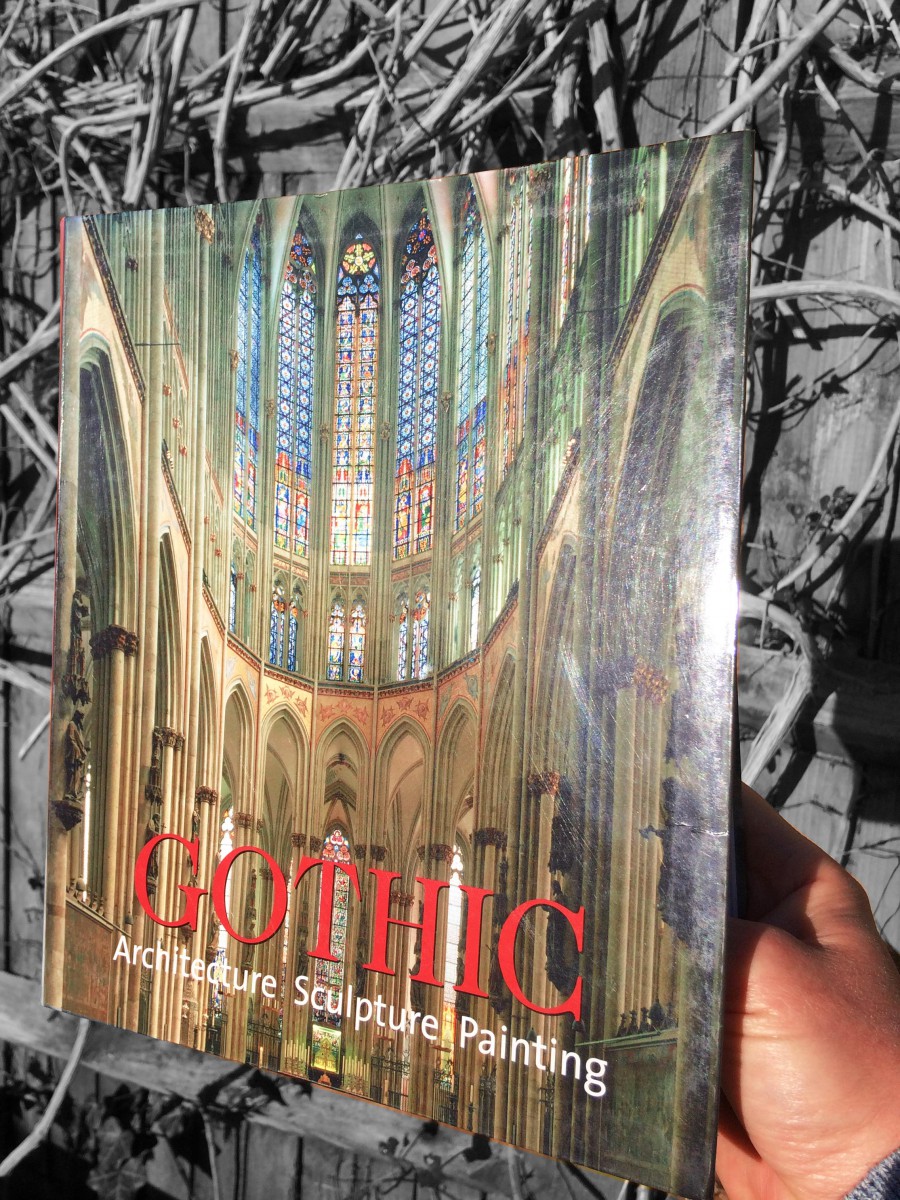
This book has been for me a great resource that helped me better understand the Gothic movement in art from the 12th century to the Renaissance. An architectural style that first originated in France and spread all over Europe.
Over 500 pages, it focuses on the development of Gothic architecture with many illustrations and photographs, but not only.
I’ve also found the in-depth discussion of the most diverse art forms, including painting, sculpture, metalwork and even book illumination!
It also includes specific coverage of the Cathars’ Heresy and the Papal Palace in Avignon. And, of course, it mentions the cathedral of Saint-André de Bordeaux!
This is definitely the book I recommend if, like me, you love everything about Gothic, such as churches, gargoyles, stained glass, flying buttresses, and so much more.
Angevin Gothic Architecture in Bordeaux Cathedral
Architecturally, Bordeaux Cathedral is a striking example of Angevin (Plantagenet) Gothic, a regional variation distinct from the Gothic style of the Île-de-France.
Key differences include:
A relatively dim central nave, illuminated only indirectly.
Domed ribbed vaults known as “dominical vaults”.
Ribbed vaults that are systematically sculpted at each intersection.
A single nave, unlike the three-nave layout typical of northern Gothic cathedrals.
Massive walls—up to 3.9 metres thick—requiring powerful flying buttresses for structural support.
These characteristics give Bordeaux Cathedral its particular atmosphere, at once austere and monumental.
Visit of Bordeaux Cathedral
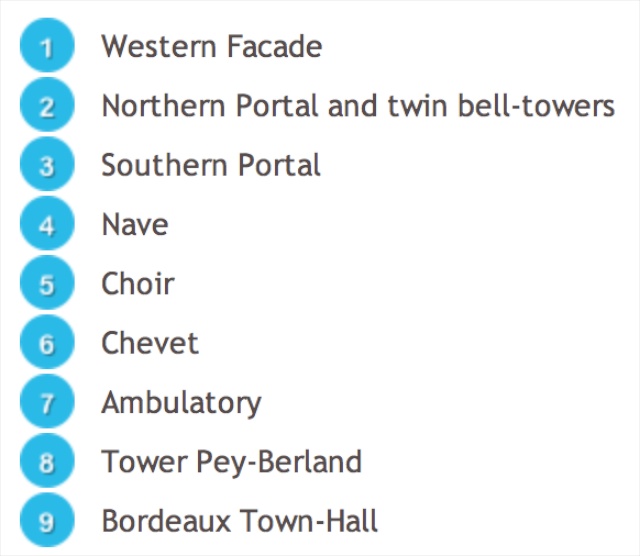
The Western Façade
Compared with the ornate western façades of Strasbourg, Notre-Dame de Paris, or Rouen Cathedral, the west front of Bordeaux Cathedral is unexpectedly plain.
Its simplicity is not due to lack of ambition, but to a series of constraints:
The first church stood within the south-western corner of a Roman castrum, hemmed in by the Peugue and Devèze streams.
Until 1771, the archbishop’s palace adjoined the northern and western sides, preventing the construction of a grand entrance.
The cathedral faces the old medieval town, leaving no expansive square to showcase an elaborate portal.
Recognising the impossibility of a majestic western entrance, medieval architects instead focused their decorative efforts on the transept façades.
After the archbishop’s palace was dismantled in 1776, architect Lartigue suggested rebuilding the façade in Gothic style, but the proposal was never approved.
The Transept Portals and Towers
The north façade of Bordeaux Cathedral is its most visually striking exterior feature, framed by twin towers rising 81 metres high.
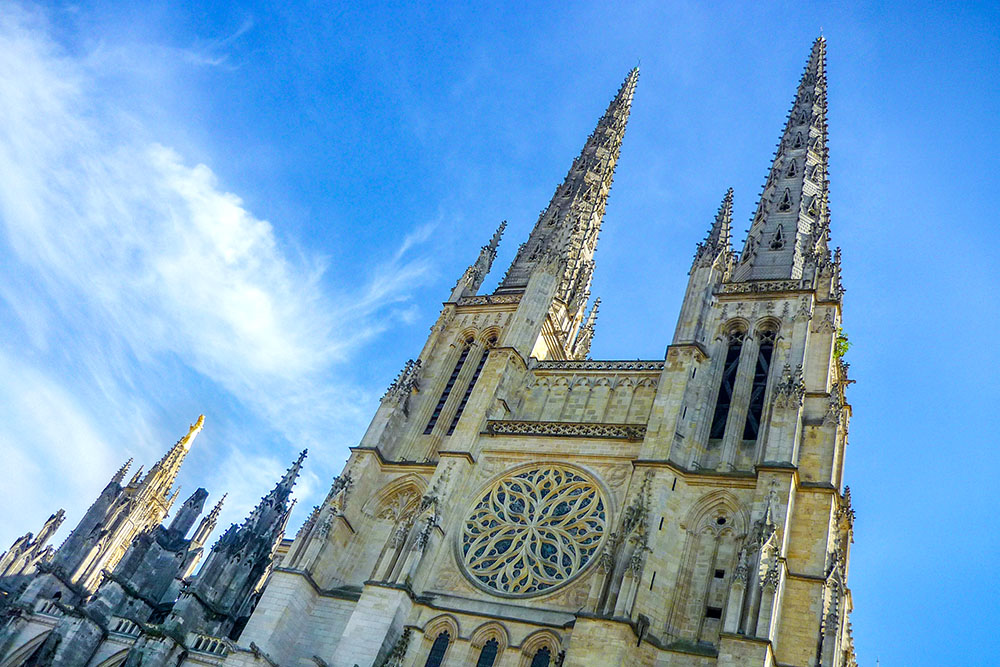
These tall, slender towers evoke the verticality of northern French Gothic, despite their unusual placement on the transept.
The Royal Portal (13th century) showcases beautiful apostle statues and a tympanum depicting the Last Judgement.
The North Portal, from the 14th century, presents three carved registers illustrating the Last Supper, the Ascension, and the Triumph of the Redeemer.
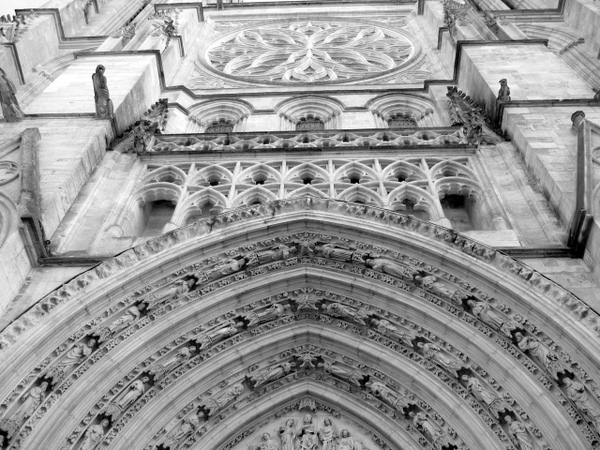
The chevet and the transept façades date from the 14th and 15th centuries.
The twin towers can be reached via two narrow spiral staircases. In the 15th century, additional towers with terrace roofs were added to the south transept.
The cathedral’s flying buttresses, today one of its defining features, were only completed in the 16th century.
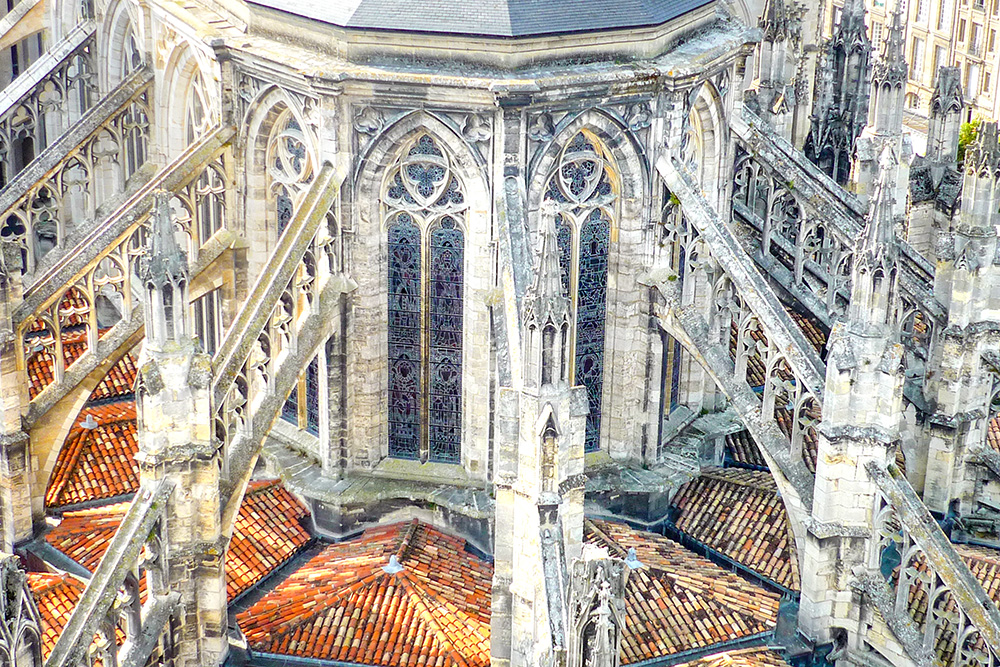
The Nave and the Ambulatory
The nave, built in the 12th century and adjusted in the 13th century, consists of seven bays and is topped with a blind triforium.
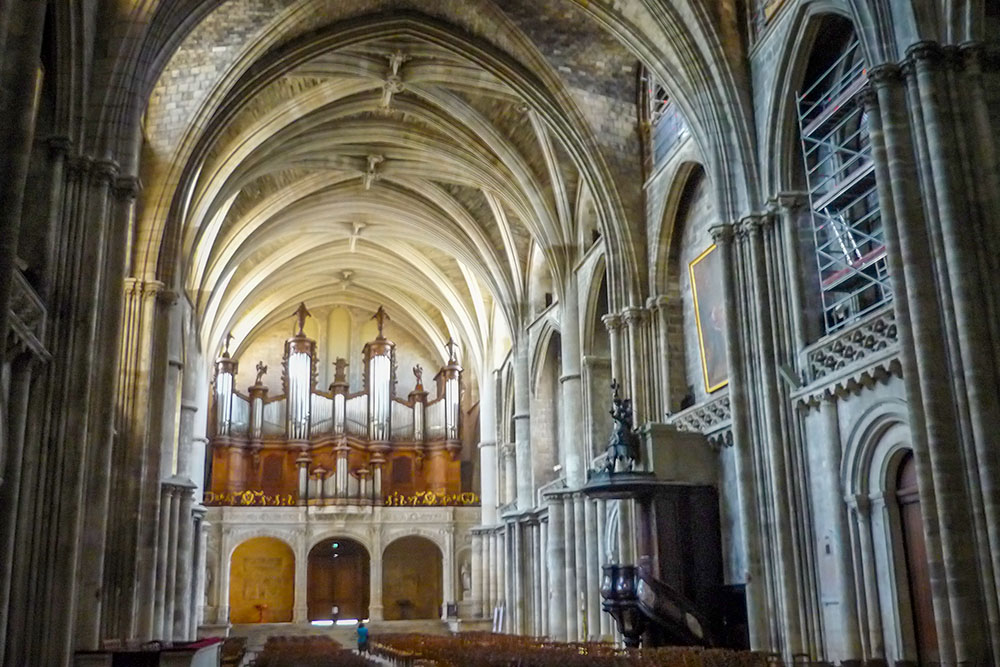
Some visitors describe the interior as rather stark—particularly the nave—but this austerity was by design.
Bishop Geoffroi du Loroux, serving between 1135 and 1158, enforced strict Augustinian principles, influencing the simplicity of the interior space.
The ambulatory, begun in 1280 and linked to the nave around 1330, leads to the choir and apse chapels, both completed in the 14th century along with the north and south transept façades.
The Organs
For centuries, Bordeaux Cathedral was known for possessing one of the most magnificent organs in Christendom.
In 1535, an English chronicler described it as the finest in Europe.
Unfortunately, during later restorations, this historic organ disappeared—its pipes were reportedly melted down for military use.
The current organ, crafted by Danion-Gonzales, was inaugurated in 1982.
In 1998, Bordeaux Cathedral, along with the churches of Basilique Saint-Seurin de Bordeaux and Basilique Saint-Michel de Bordeaux, was officially listed as a UNESCO World Heritage Site.
Tower Pey-Berland
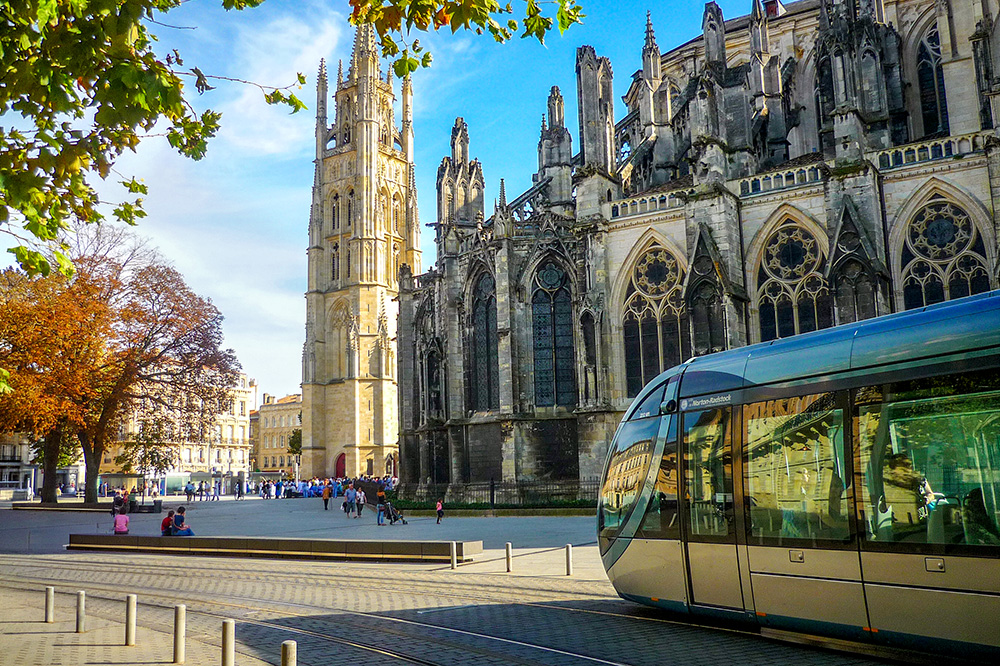
Standing apart from the cathedral yet inseparable from its identity, the Pey-Berland Tower takes its name from Archbishop Pey Berland, founder of Bordeaux’s first university in the 1440s.
A figure loyal to England during the Hundred Years’ War, he resisted the French and is now buried behind the cathedral’s altar.
Built between 1440 and 1450, the tower rises as a freestanding Gothic bell tower, rectangular in plan, reinforced with buttresses, surrounded by an exterior gallery, and crowned with an octagonal spire.
The 1862 statue of Our Lady of Aquitaine that tops it faces the Médoc, Pey-Berland’s homeland.
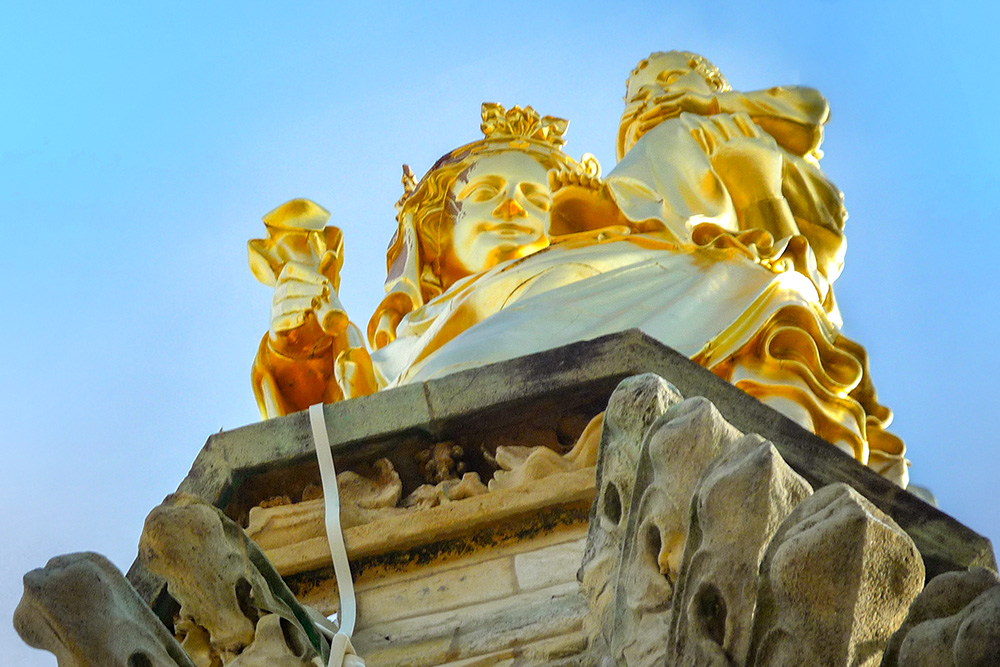
Originally, the spire was taller and lacked a statue, but a violent 18th-century storm destroyed its upper section.
The replacement statue was added later, reducing the spire’s original height.
In Bordeaux and its region, freestanding bell towers are not unusual.
The Saint-Michel Basilica provides another example: its 114-metre bell tower is the tallest in southern France.
In the Middle Ages, the Pey-Berland Tower was connected to the cathedral by a row of cannon houses.
Since the cathedral itself could not bear the weight of large bells, the freestanding tower became the official bell tower.
Its great bell, Ferdinand-André, weighs over eight tonnes.
Classified as a historic monument in 1862, the tower is open to visitors.
A spiral staircase of 231 steps leads to a terrace about 50 metres above the ground.
The entrance is low and narrow—visitors are advised to mind their heads before stepping out onto the panoramic viewing platform overlooking Bordeaux.
Where to stay when you visit Bordeaux?
Choosing the right base can make your trip to Bordeaux Old Town even more enjoyable.
The city is compact and walkable, so staying in or near the historic centre is ideal — especially between the railway station and Place des Quinconces, where you’ll have easy access to restaurants, tram lines, and the main sights.
Below is a curated selection of six hotels, ranging from boutique charm to modern comfort, all perfectly located for exploring the city on foot.
Hôtel Burdigala by Inwood Hotels (★★★★★)
A contemporary five-star stay offering refined comfort, elegant interiors, and a calm atmosphere just a short walk from Mériadeck and the historic centre.
📍 115 rue Georges Bonnac, 33000 Bordeaux
Aparthotel Adagio Bordeaux Centre Gambetta (★★★★)
Modern and practical serviced apartments in a central location, ideal for longer stays or travellers seeking kitchen facilities steps from the city’s main cultural sites.
📍 40 rue Edmond Michelet, 33000 Bordeaux
Radisson Hôtel Bordeaux Saint-Jean (★★★★)
A stylish contemporary hotel near Bordeaux-Saint-Jean station, perfect for visitors arriving by TGV and looking for easy tram access into the historic centre.
📍 13 rue des Gamins, 33800 Bordeaux
Hôtel de Normandie (★★★★)
Classic Bordeaux elegance in a beautifully preserved 18th-century building, ideally located near the Golden Triangle and Place des Quinconces.
📍 7 Cours du 30 Juillet, 33000 Bordeaux
Hôtel Majestic (★★★★)
A refined, traditionally styled hotel in a prime central location, close to Bordeaux’s theatres, upscale shopping streets, and major monuments — ideal for exploring the historic centre on foot.
📍 2 rue de Condé, 33000 Bordeaux
Hôtel Madame (★★★)
A charming boutique hotel set in a quiet street near the cathedral, blending intimate atmosphere, thoughtful design, and excellent access to the historic heart of Bordeaux.
📍 4 rue Bouffard, 33000 Bordeaux
More places in Bordeaux?
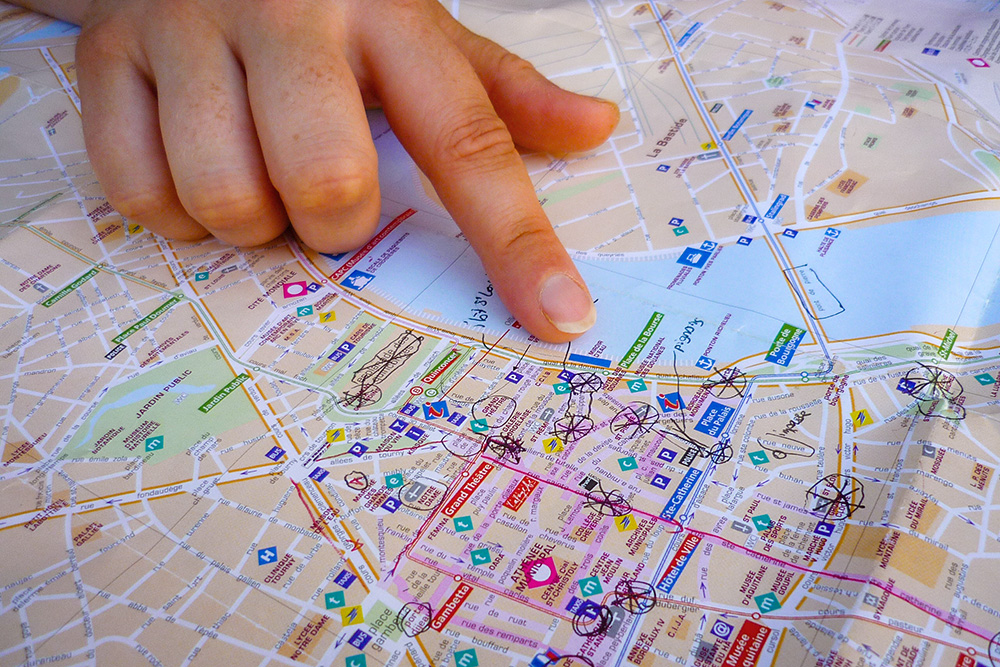
Find your preferred accommodation here or by browsing the map below:
What to do in Bordeaux
Check out the activities and monuments you can visit in Bordeaux: