Bonneville, Haute-Savoie is one of those Arve Valley towns many travellers pass through without realising how much history and mountain scenery surround it.
It is not as famous as Annecy, not as dramatic as Chamonix, and not as postcard-perfect as some lakeside villages. But that is precisely what makes it interesting.
Bonneville is a real Haute-Savoie town: practical, historic, local, and wonderfully placed between river and mountains.
I visited the town itself, but also explored the surrounding area, including the summit of Le Môle and the ruins of the Faucigny castle.
And with the Tour de France 2026 set to pass through Bonneville before the final climb to the Plateau de Solaison, this quiet Arve Valley town may soon catch a little more attention than usual.
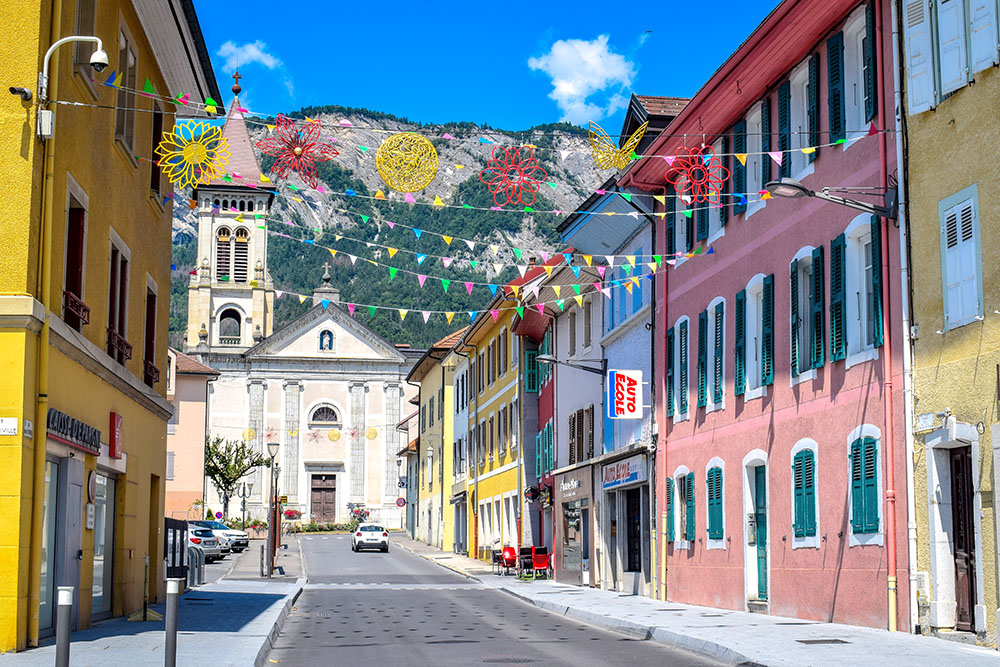
Rue Sainte-Catherine © French Moments
Where Is Bonneville Haute-Savoie?
Bonneville lies in the département of Haute-Savoie, in the French Alps.
It sits in the Arve Valley, between Geneva, La Roche-sur-Foron and Cluses, with the road towards Chamonix and the Mont Blanc region continuing further up the valley.
The town stands along the River Arve, at the foot of Le Môle and close to the Pointe d’Andey.
This setting gives Bonneville its character. It is a valley town, but never far from the mountains. Look up, and the landscape immediately reminds you that you are in Haute-Savoie.
For travellers, Bonneville can be easy to underestimate. You might pass through it on the way to somewhere more famous. But if you slow down, it begins to reveal a different side of the region: less polished, perhaps, but very much alive.
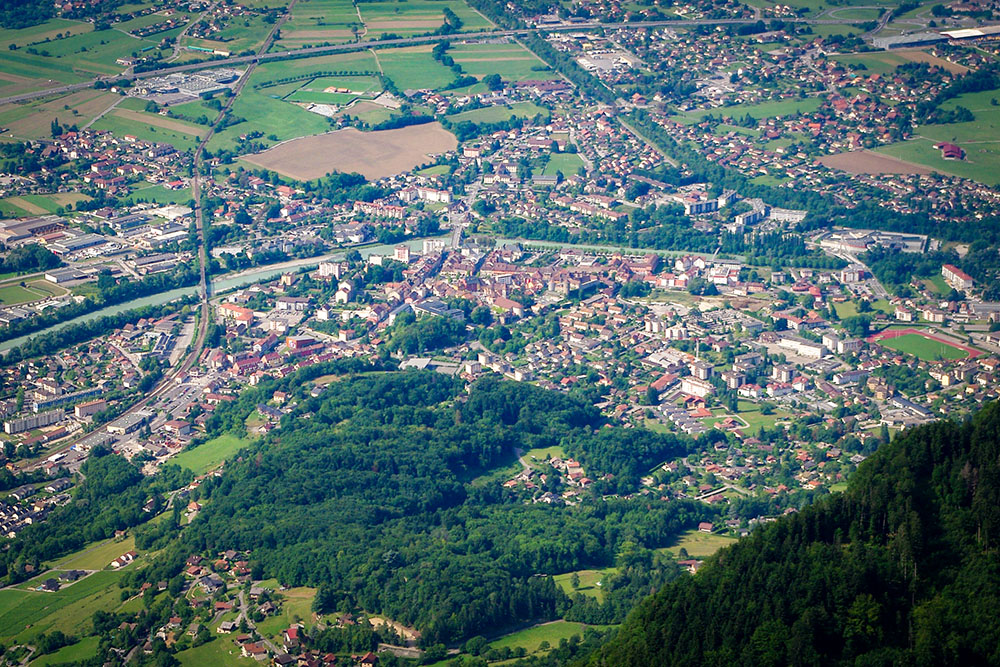
Bonneville seen from Le Môle © French Moments
A Short History of Bonneville and the Faucigny
Bonneville’s history is closely linked to the Faucigny, the historic province that once played an important role in this part of the Alps.
In the 13th century, Count Peter II of Savoy ordered the construction of a fortified site here. A new town developed nearby, first known as Tucinge or Toisinge. Then Béatrice de Faucigny, one of the great medieval figures of the region, gave the settlement the name Bonneville — Bona Villa — in 1283.
The name is charmingly simple: the “good town” or “good village”. And the name stuck.
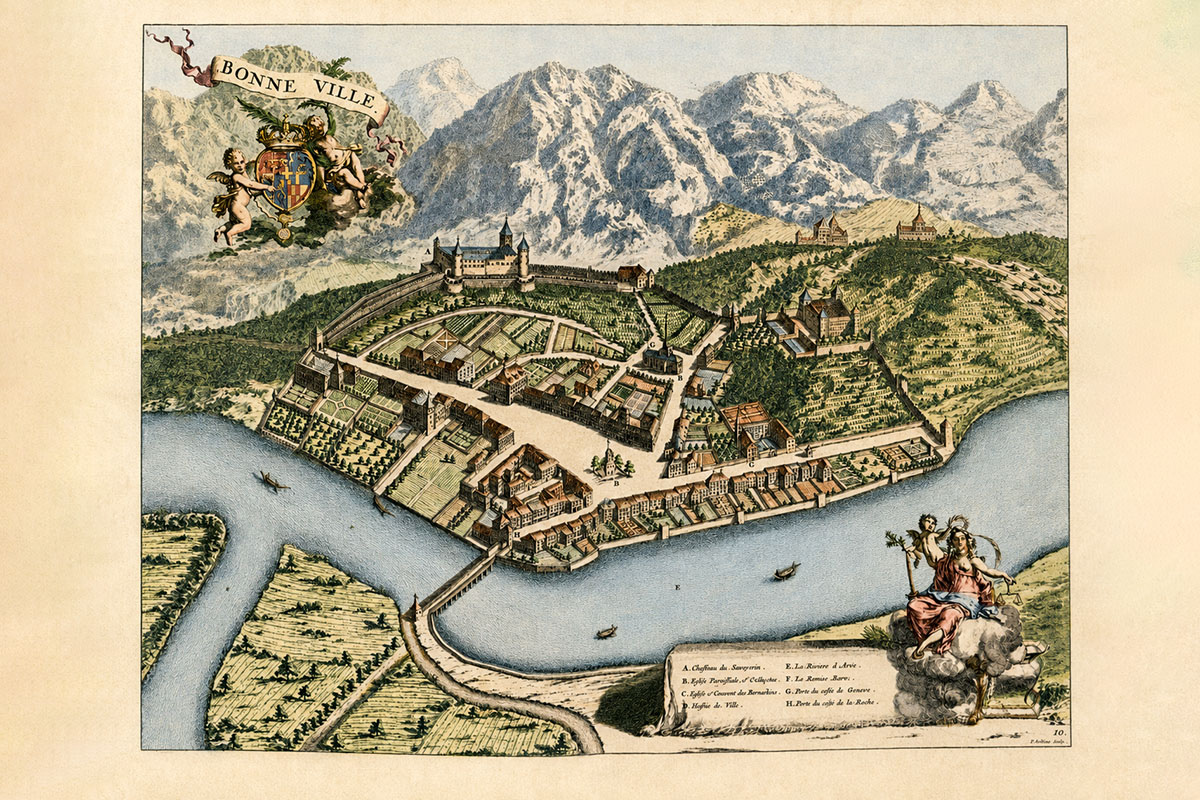
Bonneville circa 1726
Bonneville later became an administrative centre of the Faucigny, giving it a strategic importance beyond its modest size.
Like many old Alpine towns, it also had to deal with floods, fires and political changes. The River Arve, so beautiful when seen from a peaceful riverside walk, was not always a gentle neighbour.
This layered history gives Bonneville a depth that is not immediately obvious at first glance. It is not a museum town, but its past is there if you know where to look.
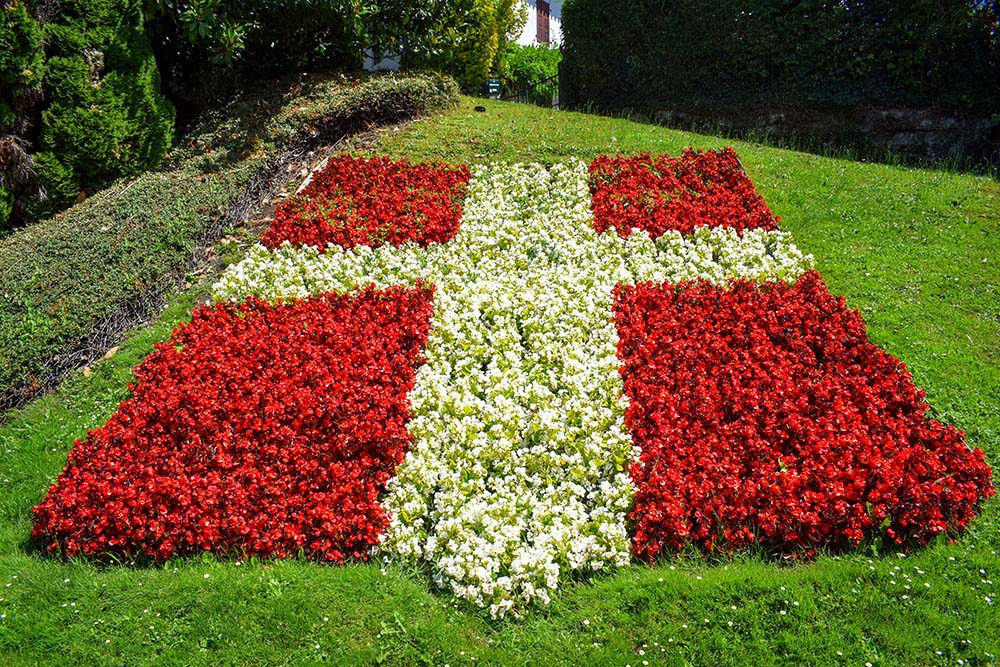
A floral display of the Savoy coat of arms © French Moments
What to See in Bonneville
Bonneville’s centre is compact, but it deserves more than a quick glance.
Around the old town, you will find a mixture of Savoyard history, Sardinian-period architecture, narrow medieval streets and small details that are easy to miss if you are only passing through.
This is not a town that performs for tourists on every street corner. Bonneville feels more discreet than that.
But if you slow down, the centre begins to tell the story of a historic Faucigny town shaped by the Arve, the House of Savoy and the mountains around it.
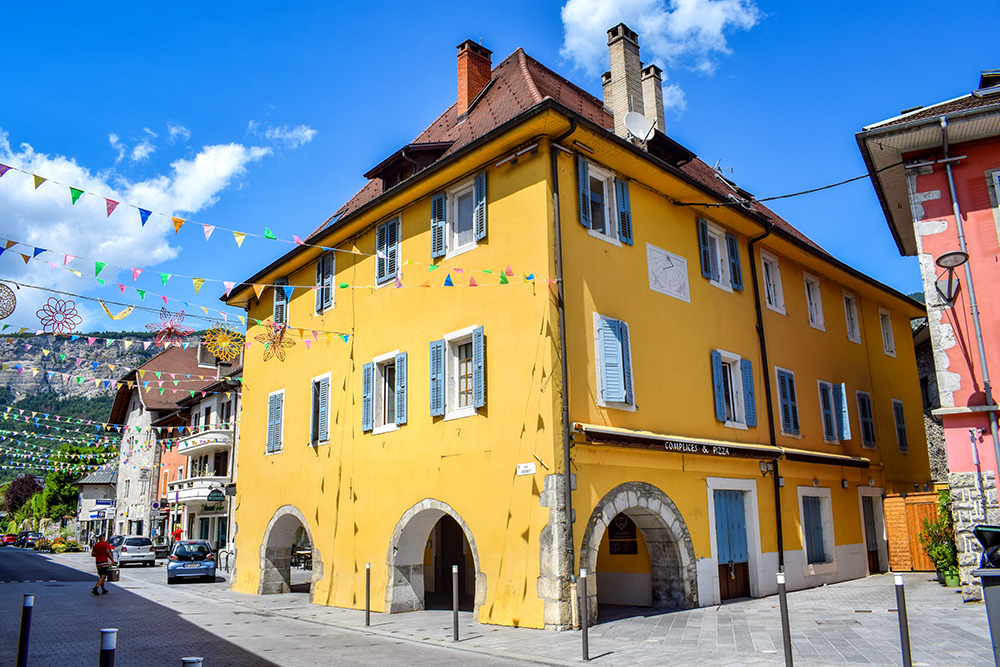
Old house on Rue Décret © French Moments
The Château des Sires de Faucigny
The Château des Sires de Faucigny is one of Bonneville’s most important historic sites.
The medieval castle, also known as the Château de Bonneville or Château de Toisinge, stands as a reminder of the town’s strategic role in the Faucigny.
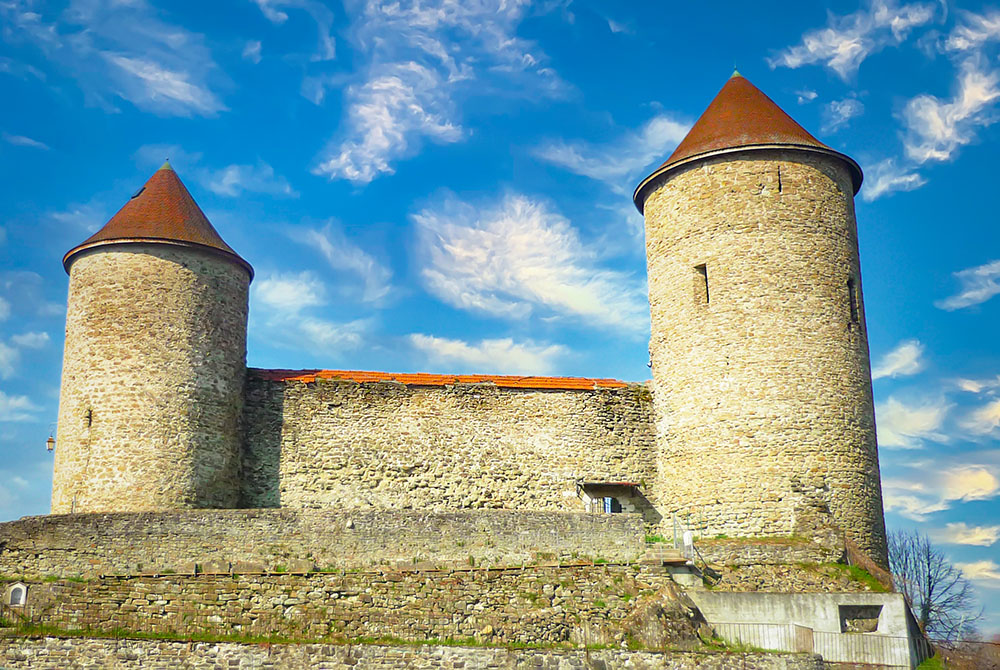
Château des Sires de Faucigny © French Moments
Its story did not end with the Middle Ages. The castle was later transformed into a prison and remained in that role until 1934.
Today, part of the site has been restored, and it has once again become part of the town’s cultural and heritage life.
What makes the castle especially interesting is not only the building itself, but the way it connects the town to the wider story of the region.
Bonneville was not just another settlement in the valley. It was part of a historic network of power, roads, rivers and mountain routes.
For anyone interested in the old Savoyard world, this is where the town becomes much more than a stop on the map.
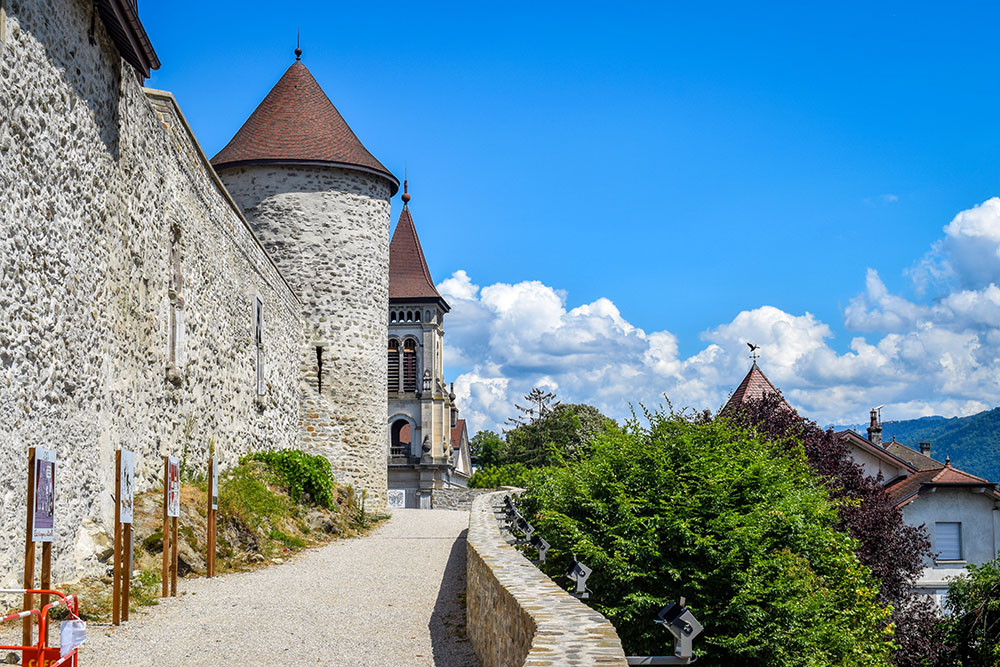
Bonneville Castle, Haute-Savoie © French Moments
Place de l’Hôtel-de-Ville
The Place de l’Hôtel-de-Ville is the natural starting point for exploring Bonneville.
This large triangular square already existed in the Middle Ages, when it was known as the Place du Parquet. The name came from the enclosed area once reserved for the local lord.
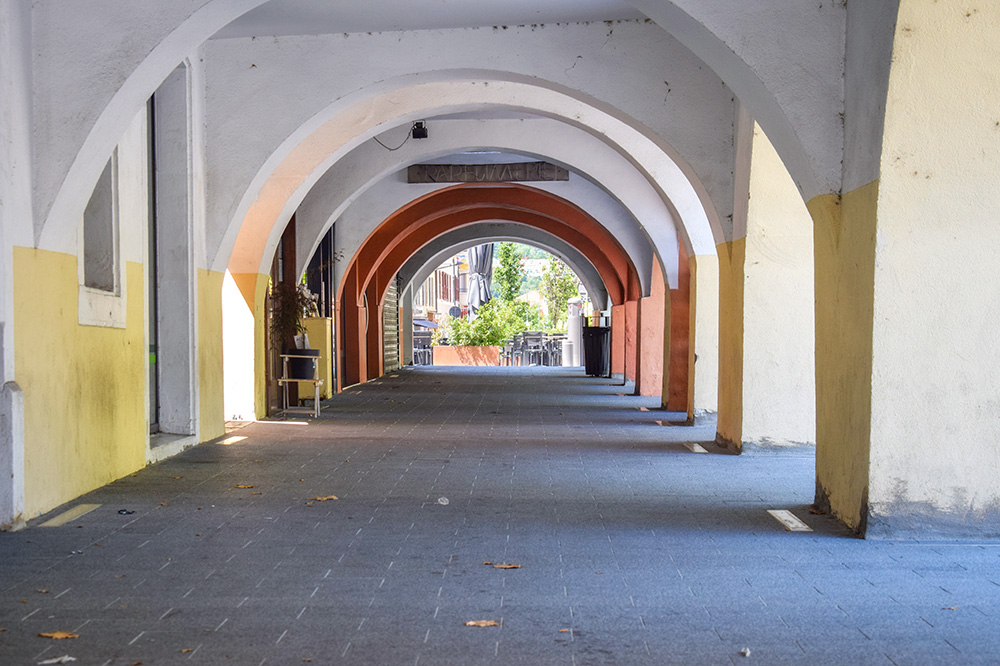
The arcades of Place de l'Hôtel de Ville © French Moments
The square was deeply marked by the great fire of 1737.
After the disaster, the houses around it were rebuilt in dressed stone, with high roofs, stepped firebreaks and more resistant roofing materials replacing the old wooden shingles.
Today, after a major restoration completed in 2013, the square has regained a handsome civic presence. It feels open, elegant and very Savoyard, with the mountains never far from view.
It is not a grand theatrical square like those of larger cities, but it has a quiet dignity that suits Bonneville perfectly.
The Town Hall
The Hôtel de Ville was built in 1853 by Imperatori, a civil engineer, at a time when this part of Savoy still belonged to the Kingdom of Sardinia.
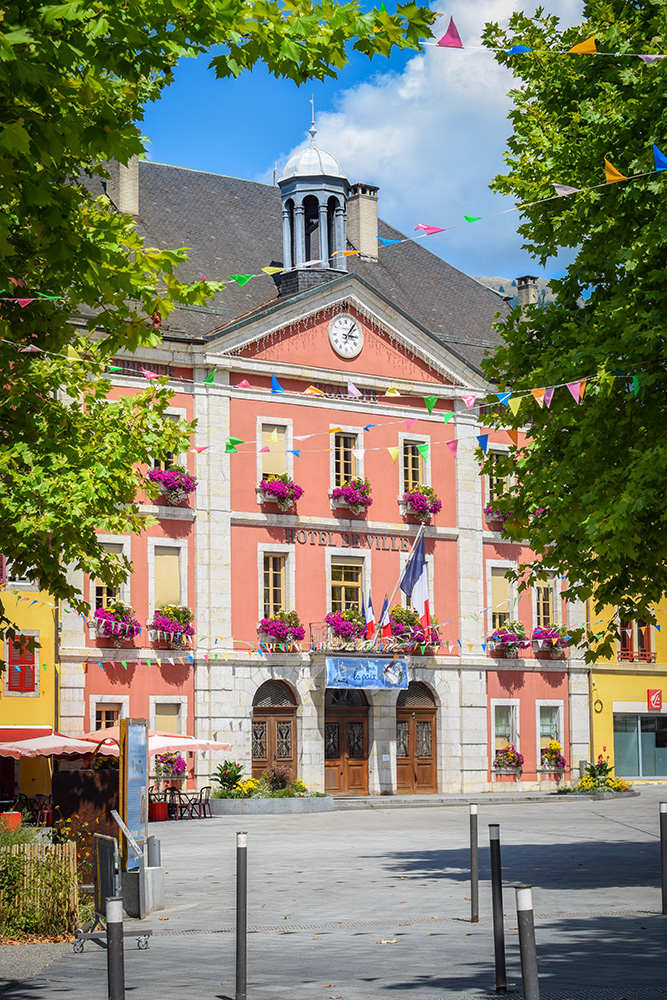
The town hall of Bonneville © French Moments
That historical context gives the building part of its character. Its architecture is sober, balanced and official, more administrative than decorative, but very much in keeping with the Savoyard towns of the period.
It is very similar in style to the town hall of nearby La Roche-sur-Foron.
Inside the building are several fascinating objects linked to local and wider history.
These include a stone from the Bastille in Paris, offered to the district of Cluses in 1793, the original bas-relief from the pedestal of the Charles-Félix column, and a 19th-century drilling machine invented by the Haute-Savoie engineer Germain Sommeiller, whose work was linked to the piercing of the Mont Cenis Tunnel.
The Fountain on Place de l’Hôtel-de-Ville
The fountain on the Place de l’Hôtel-de-Ville was built in 1786 and is now listed as a historic feature. It stands on the site of the former town house, which was demolished when the square was redeveloped.
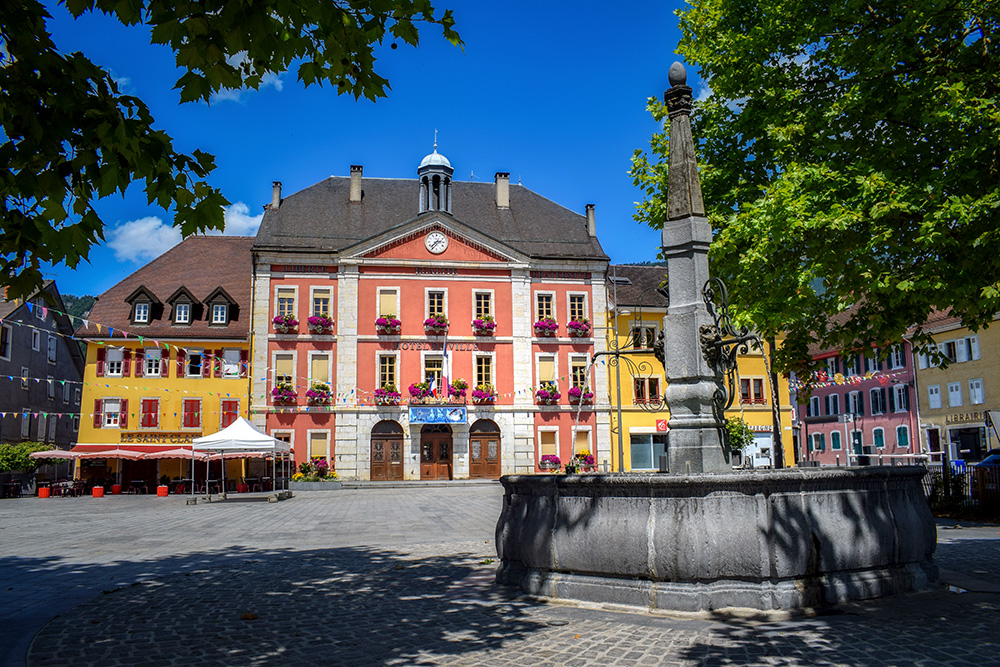
The fountain and town Hall of Bonneville, Haute-Savoie © French Moments
Designed by the architect Vagnat from Samoëns, the fountain has a Baroque style that brings a graceful touch to the square.
During the 2013 restoration of the Place de l’Hôtel-de-Ville, it was entirely dismantled, restored and reinstalled. It now works in a closed water circuit.
It is the kind of monument that quietly anchors a square. You may not cross Haute-Savoie just to see it, but once there, it helps explain the town’s sense of place.
The Maison des Têtes
One of the most curious houses on the square is the Maison des Têtes, at 172 Place de l’Hôtel-de-Ville.
Built or rebuilt in the 1730s by a mason-sculptor named Chauplannaz, it stands on the site of an older building whose 1573 inscription is considered the oldest known in Bonneville.
The façade is the reason to stop and look up. Its Baroque decoration includes expressive sculpted heads around the windows.
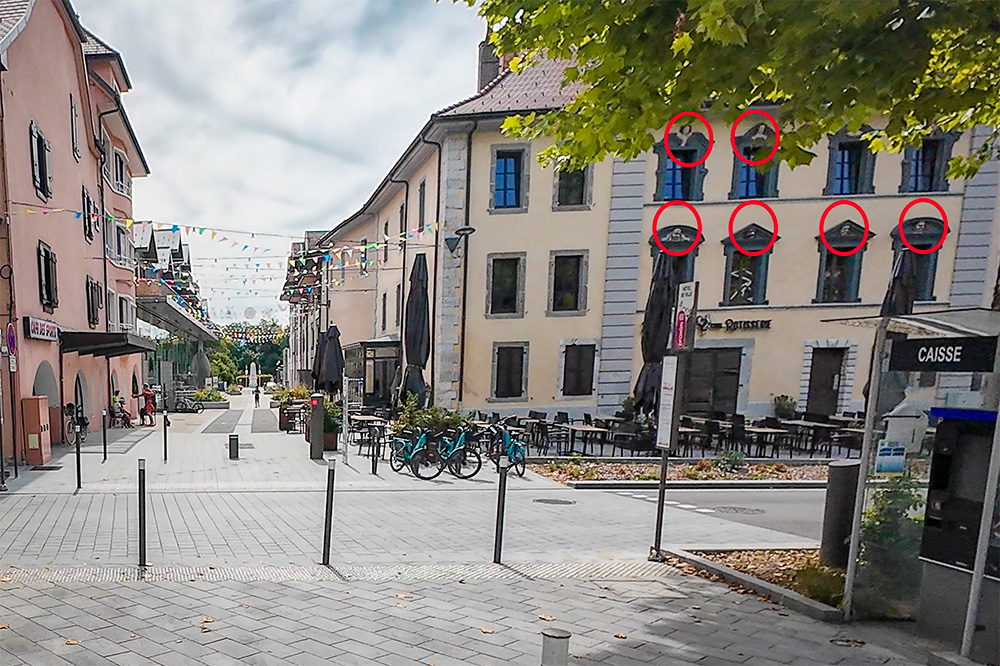
Maison des Têtes © French Moments
Some are comic, some are grotesque, and some appear to be in a mood that suggests they have just read the parking regulations.
The evil-looking masks on the lower level contrast with the more angelic female figures above. It is a theatrical little façade, unexpected and memorable, and one of those details that makes a historic town come alive.
The Maison Royale
Next to the Maison des Têtes, at 154 Place de l’Hôtel-de-Ville, stands the Maison Royale. It served as a resting place for the King of Sardinia during his stays in the Faucigny.
Its most striking feature is its wrought-iron balcony, from which the monarch could address his subjects. This gives the building a strong sense of the old Savoyard world, before the annexation of Savoy to France in 1860.
The house is a useful reminder that Bonneville’s history is not only French in the modern sense. It belongs to a borderland story of Savoy, Sardinia, Geneva, Alpine valleys and shifting political horizons.
Sainte-Catherine Church
Eglise Sainte-Catherine is another important landmark in the centre of Bonneville.
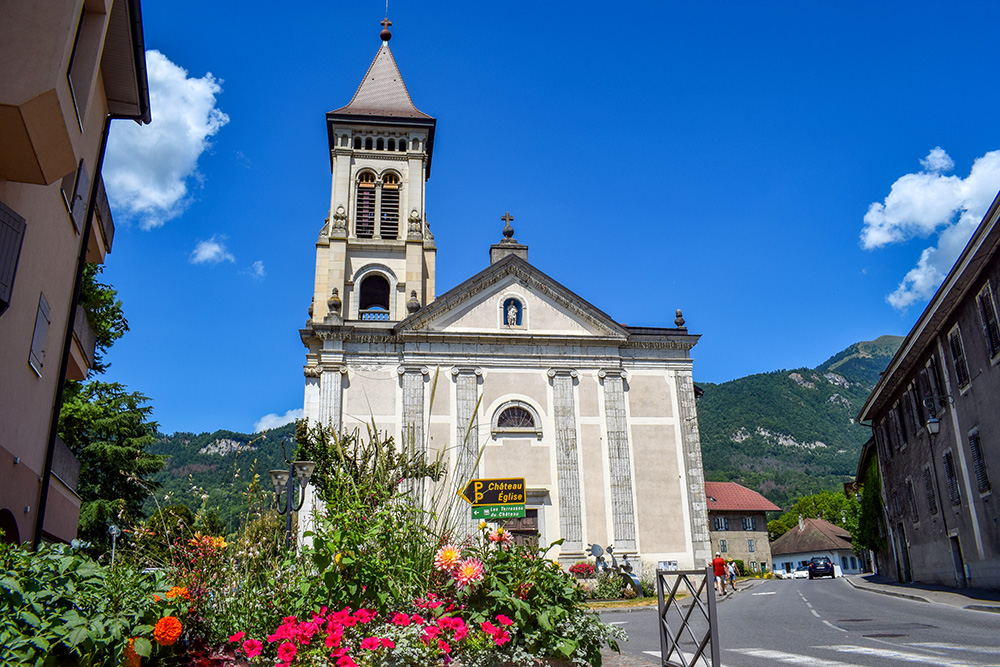
Eglise Sainte-Catherine, Bonneville © French Moments
The present building was constructed between 1838 and 1842, during the same period that shaped much of the town’s 19th-century Savoyard character.
The church is dedicated to Saint Catherine of Alexandria, and its architecture belongs to the neoclassical tradition. It replaced an older church whose origins went back to the Middle Ages, with the first building on the site dating from the 13th century.
Rue des Grandes Chambrettes and Rue des Petites Chambrettes
From the church towards Rue Décret, the Rue des Grandes Chambrettes leads you into one of the oldest parts of Bonneville.
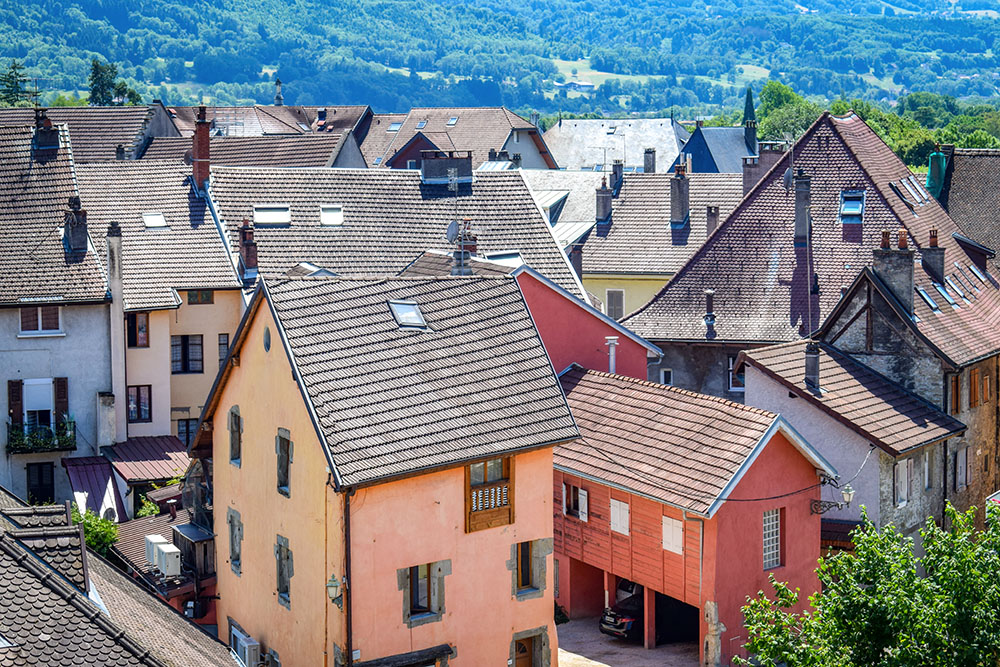
The rooftops of Rue des Grandes Chambrettes © French Moments
The name already existed in 1289, which is rather humbling when you realise that some modern street names struggle to survive a shopping centre renovation.
At the entrance to the street, you can still notice an old well and the entrance to vaulted cellars, remains linked to the former Château de la Rochette.
Nearby, the Rue des Petites Chambrettes is also worth exploring for its picturesque character.
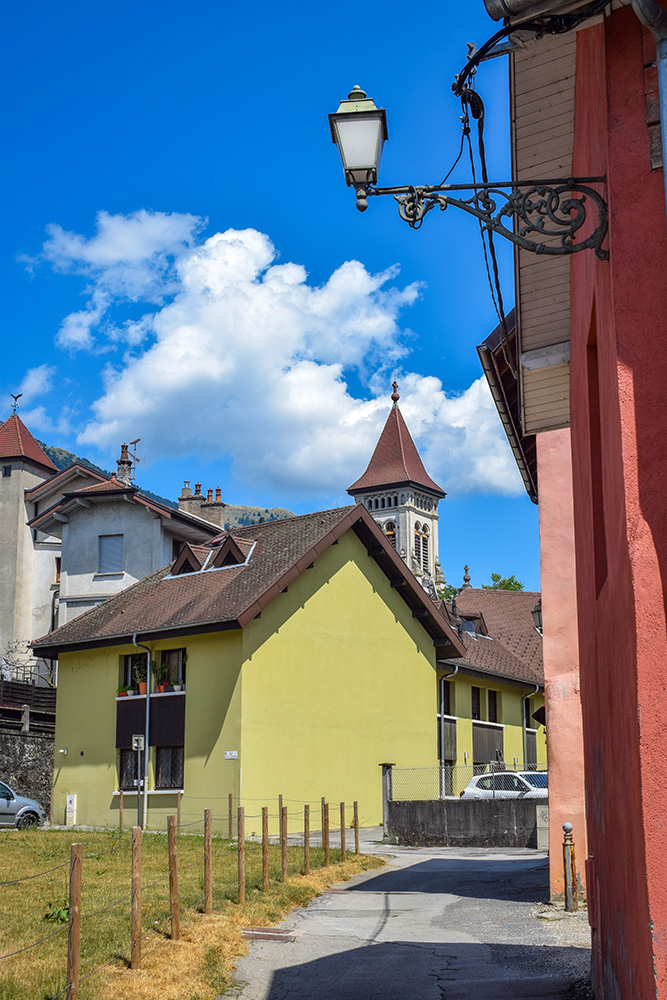
Rue des Petites Chambrettes © French Moments
Rue Brune
Rue Brune is another of Bonneville’s oldest streets. It was once known as Rue Punaise, a less flattering name linked to its dark and enclosed character, when it was closed by a wooden gate.
Today, it opens beneath the large arcades of the Place de l’Hôtel-de-Ville and leads towards the Rue du Pont. It is a short and secret street, but it gives you a sense of the old town’s denser, more intimate layout.
This is the sort of place where Bonneville becomes more interesting on foot than from behind a car window.
The Column of Charles-Félix
Near the bridge over the Arve, the 22-metre-high column of Charles-Félix is one of Bonneville’s most recognisable monuments.
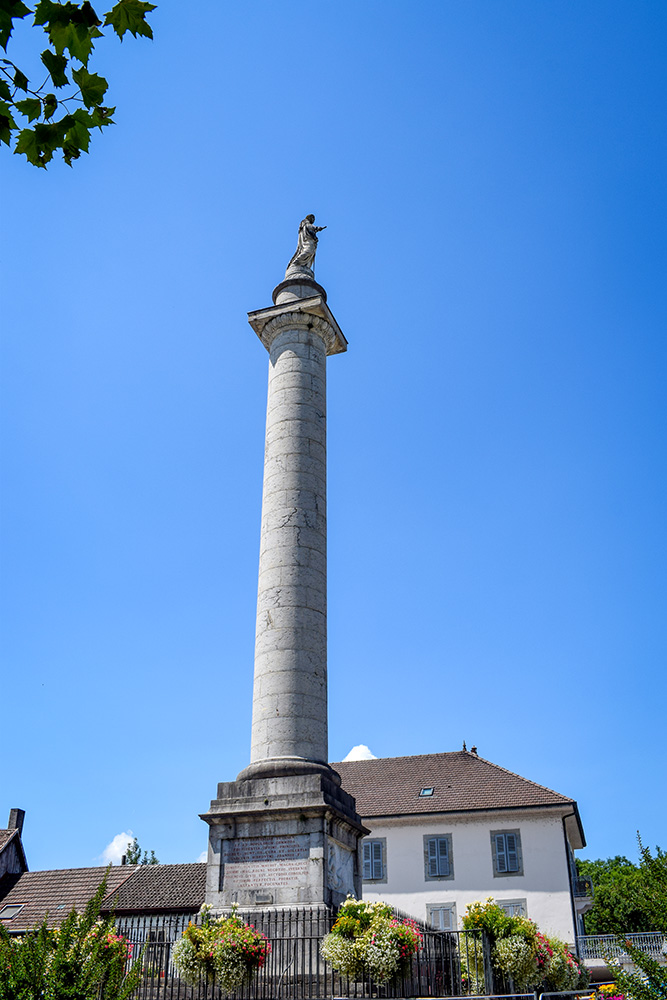
The Column of Charles-Félix © French Moments
The statue honours Charles-Félix, King of Sardinia, Duke of Savoy and Prince of Piedmont, who reigned from 1821 to 1831.
In Bonneville, he is remembered for supporting works to contain the River Arve, whose floods could be destructive and sometimes deadly.
The column is topped by a Carrara marble statue. Its pedestal includes a bas-relief showing a goddess symbolising the Arve, lying among reeds and held in chains. The original bas-relief is now protected inside the town hall, with a copy displayed on the monument.
It is a powerful image: the river personified, restrained and made less dangerous. In Bonneville, geography is never simply scenery. It has always shaped daily life.
The Pont de l’Europe over the Arve
The bridge over the Arve, now known as the Pont de l’Europe, was built between 1862 and 1865, replacing an earlier bridge from 1681. Before that, wooden footbridges allowed people to cross the river.
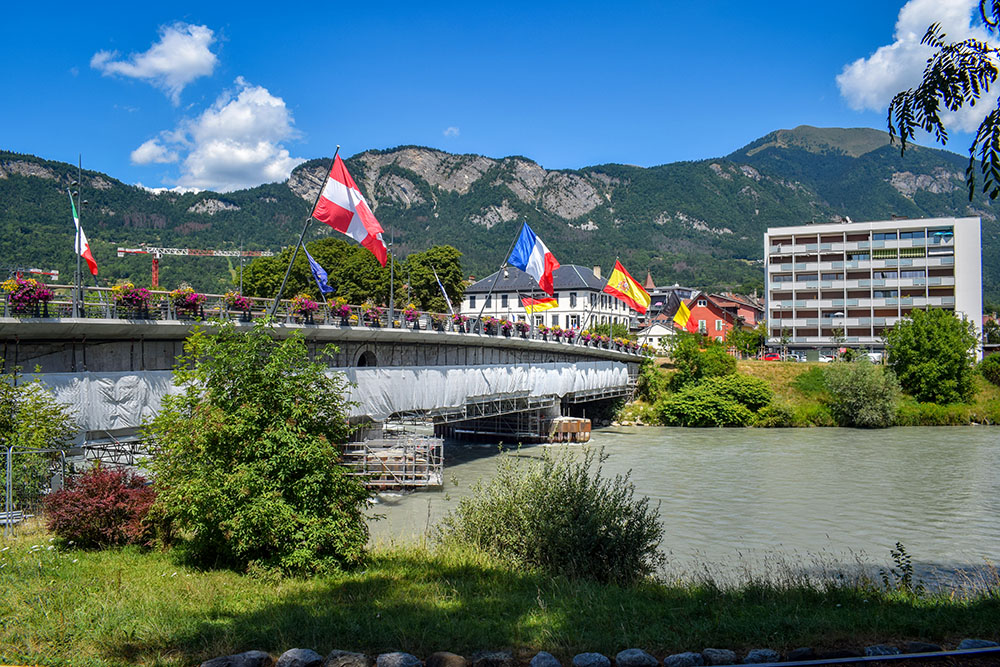
Pont de l'Europe - Bonneville, Haute-Savoie © French Moments
The bridge is more than a practical crossing. It marks the relationship between Bonneville and the Arve — a river that has brought life, movement, danger and identity to the town.
It is also decorated with large flags representing European countries and Savoy, which give the bridge a festive and colourful atmosphere.
Stand near the bridge and you understand Bonneville better: the river below, the town behind, the mountains around, and the road leading deeper into Haute-Savoie.
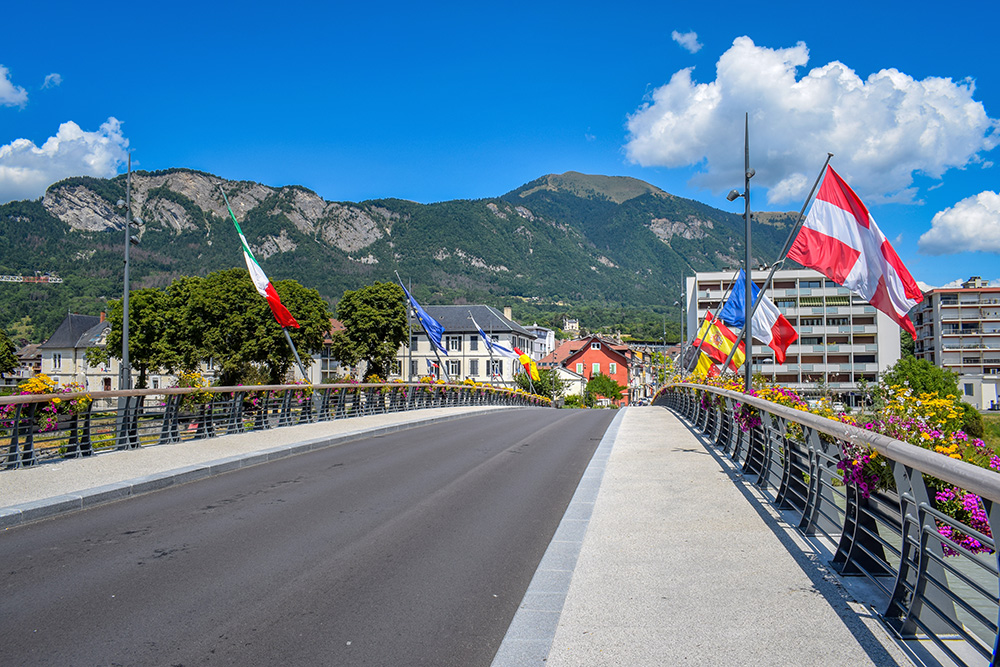
Pont de l'Europe - Bonneville, Haute-Savoie © French Moments
Château des Tours
Just outside Bonneville, on the commune of Ayse, the Château des Tours — also known as Château Blanc — dominates the town and the Arve Valley from its hillside position.
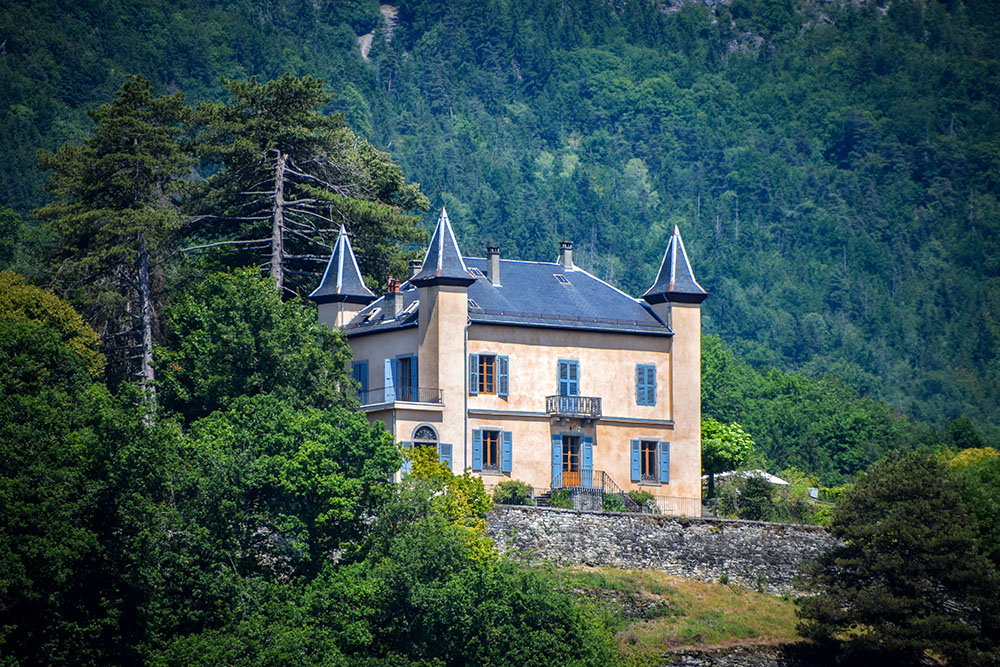
Chateau des Tours © French Moments
The site has medieval origins, although the present appearance is linked to later rebuilding. It is not part of the town centre walk in the same way as the Maison des Têtes or the Place de l’Hôtel-de-Ville, but it belongs to the wider historic landscape around Bonneville.
From the terrace of the Château des Sires de Faucigny, you can admire the Château des Tours in the distance, its silhouette standing out against the mountains and overlooking the valley.
Along the Arve: Bonneville’s Riverside Side
The River Arve is central to Bonneville’s identity. It flows through the valley after descending from the Mont Blanc region, carrying with it both the beauty and the force of the mountains.
Walking along the river gives you one of the gentlest ways to experience the town.
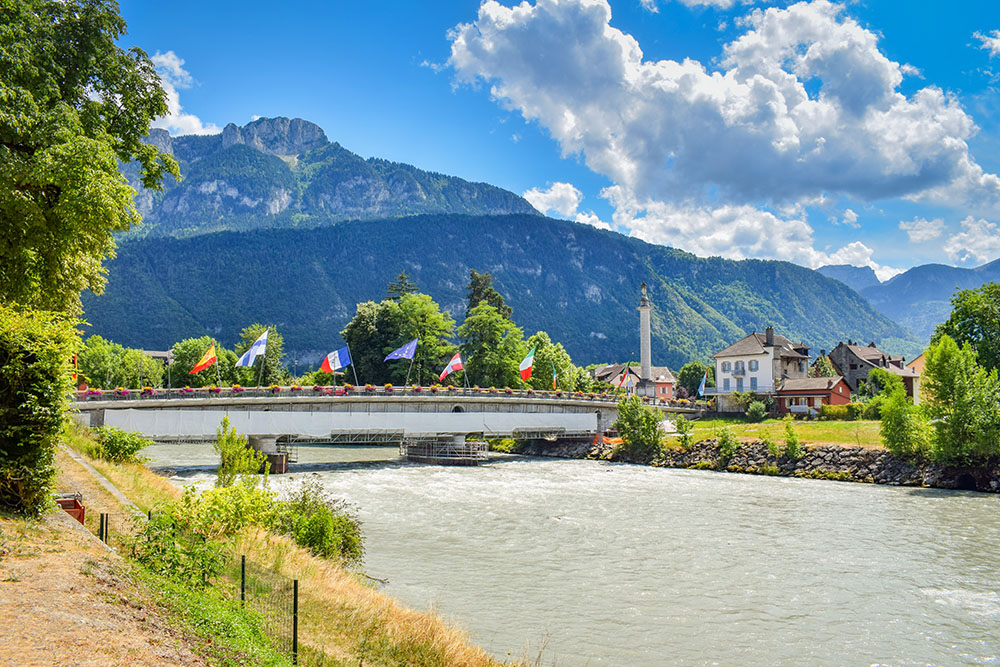
River Arve in Bonneville © French Moments
The Berges de l’Arve offer a pleasant contrast to the busier roads and urban sections of the valley.
Here, Bonneville feels calmer, more open, and more connected to the landscape around it.
It is also a good reminder that the Arve Valley is not only a transport corridor. It is a living landscape, shaped by water, industry, towns, farms and mountain slopes.
Bonneville, Haute-Savoie and the Tour de France 2026
Bonneville is no stranger to the Tour de France, even if it is usually a place the race passes through rather than a headline stage town.
In recent editions, the Tour passed through Bonneville in 2018, during the mountain stage from Annecy to Le Grand-Bornand, again in 2021 on the Oyonnax to Le Grand-Bornand stage, and once more in 2023 between Les Gets and Saint-Gervais Mont-Blanc.
Each time, the town played a familiar Arve Valley role: a gateway between the lower valley roads and the more dramatic Alpine climbs beyond.
Bonneville will appear on the route of Stage 15 of the Tour de France 2026, from Champagnole to the Plateau de Solaison.
The riders will pass through Bonneville late in the stage, about 16 kilometres from the finish, before heading towards Brison and the final ascent to the Plateau de Solaison.
By that point, the race will already have crossed some demanding terrain, including the Salève and the Col de la Croisette.
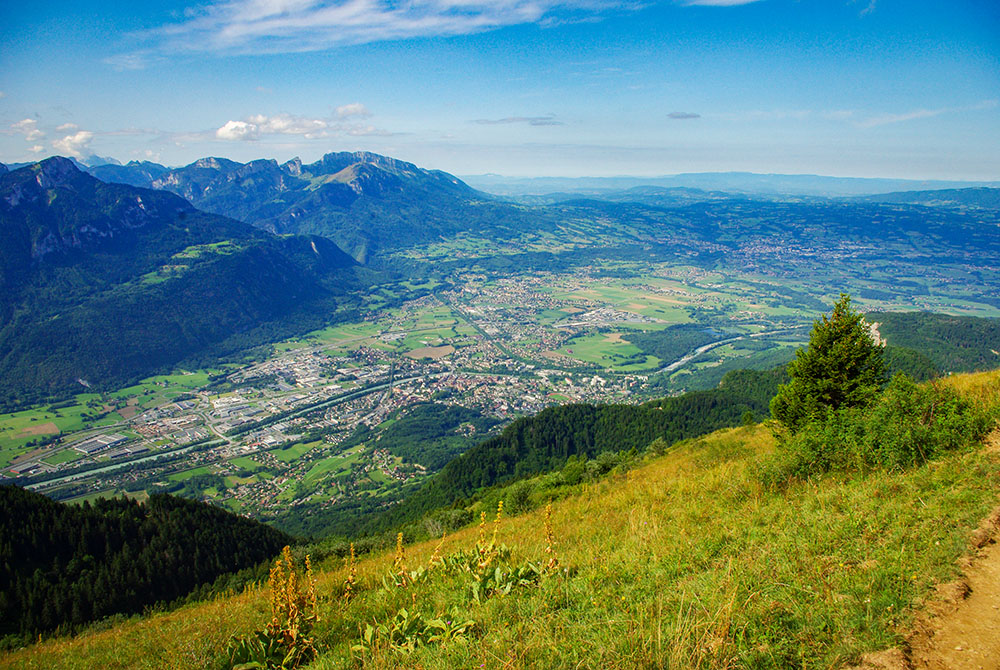
The view from Le Môle - La Roche-sur-Foron to Bonneville © French Moments
For television viewers, Bonneville may appear as a transition point: the town in the valley before the road rises sharply towards the mountains again.
That is exactly why it matters. Bonneville helps set the scene. It is the valley gateway before the final drama of Solaison begins.
What to See Near Bonneville
Bonneville is a useful base for exploring this part of Haute-Savoie.
The Ruins of the Faucigny castle
Another rewarding excursion near Bonneville is the village of Faucigny and the ruins of its castle.
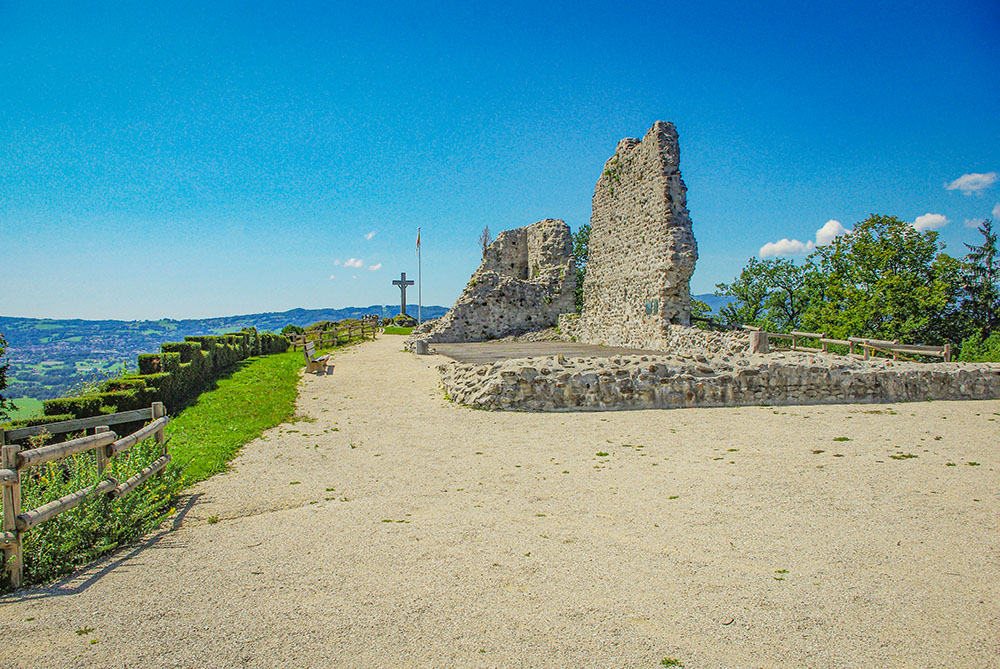
The ruins of the Faucigny Castle © French Moments
These remains are separate from the Château des Sires de Faucigny in Bonneville itself, but they belong to the same historic world.
Visiting the ruins of the Château de Faucigny gives a stronger sense of the old power of the Faucigny lords and their control over the surrounding landscape.
The site also offers lovely views over the countryside and mountains. It is quiet, atmospheric and far removed from the busy tourist trails of Haute-Savoie.
For me, this is exactly the kind of place that makes the region so rewarding. You do not always need a grand attraction. Sometimes a ruined wall, a village, a view and a little imagination are enough to bring history back to life.
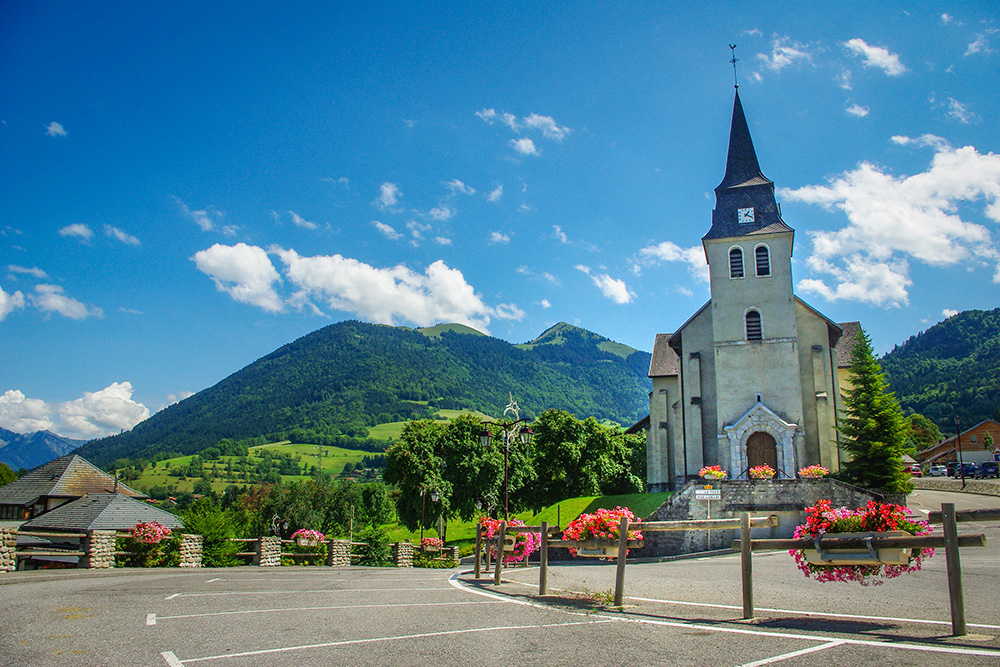
The church of Saint-Jean-de-Tholome © French Moments
Hiking Le Môle Above Bonneville
If Bonneville gives you the valley perspective, Le Môle gives you the view from above.
I climbed to the summit of Le Môle, and it remains one of the best ways to understand the geography of this part of Haute-Savoie.
The mountain rises in a striking, almost isolated shape above the surrounding valleys.
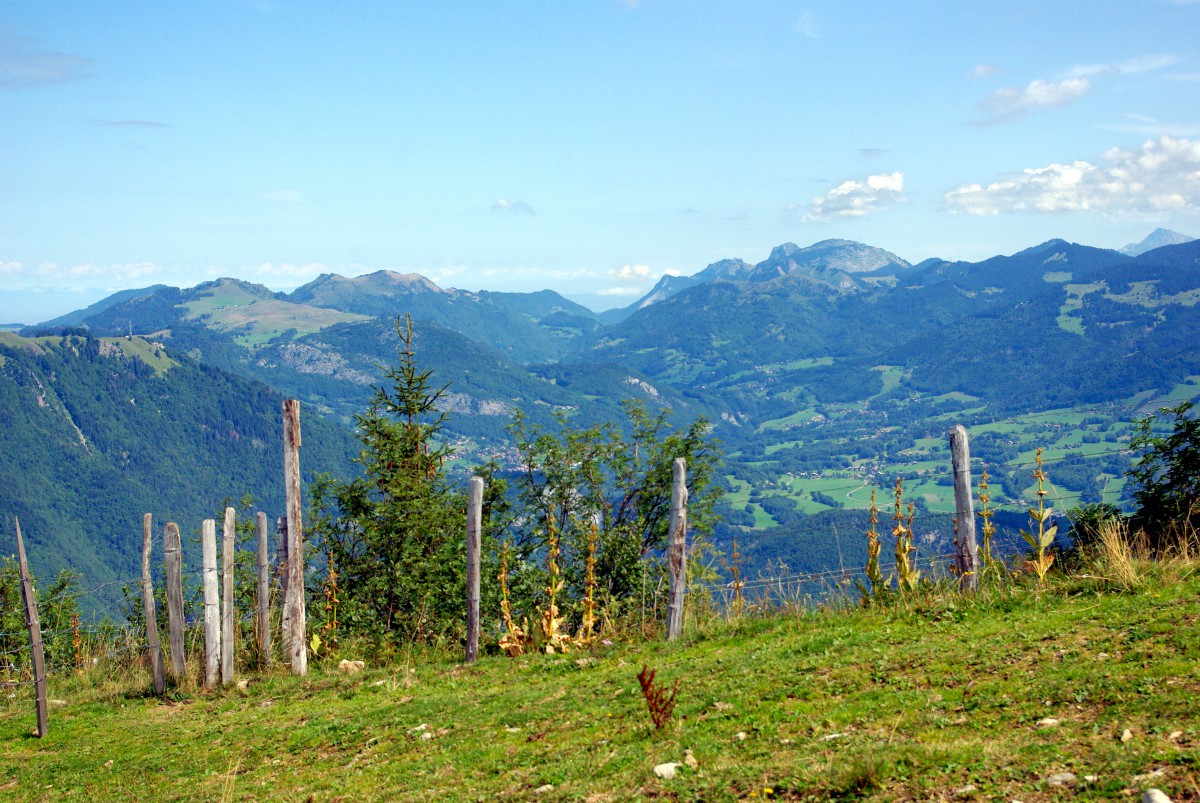
The mountains of Chablais in Haute-Savoie (seen from the Môle) © French Moments
From a distance, it looks like a perfect local landmark. From the path, it feels rather more serious.
The hike rewards the effort with wide views. Depending on the weather, you can look towards the Arve Valley, the Lake Geneva area, the Mont Blanc range, the Bornes and the surrounding Alpine foothills.
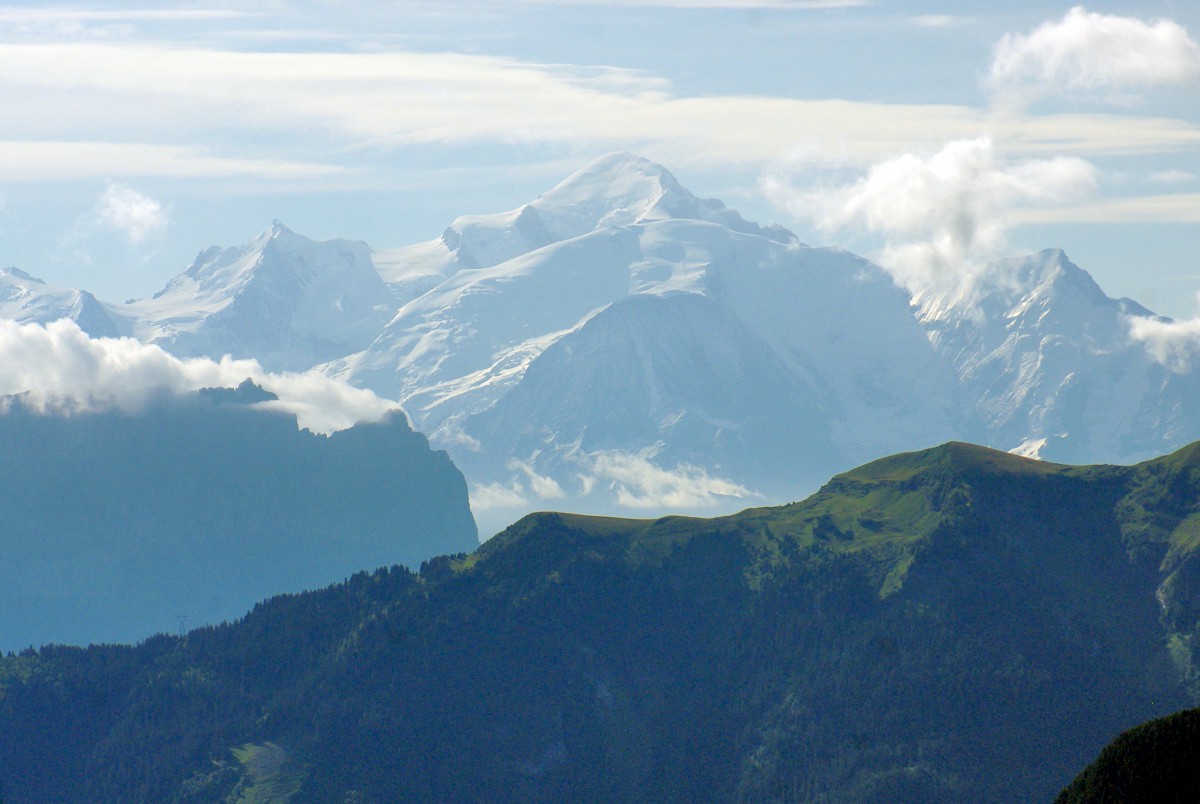
Mont-Blanc from Le Môle © French Moments
Le Môle is not just a background mountain for Bonneville. It is part of the town’s visual identity. Once you have noticed it, you keep seeing it.
And yes, as with many Haute-Savoie hikes, the summit view is best enjoyed after pretending that the steepest part was “not too bad really”.
Other sites
La Roche-sur-Foron, with its old town and medieval atmosphere, is also nearby.
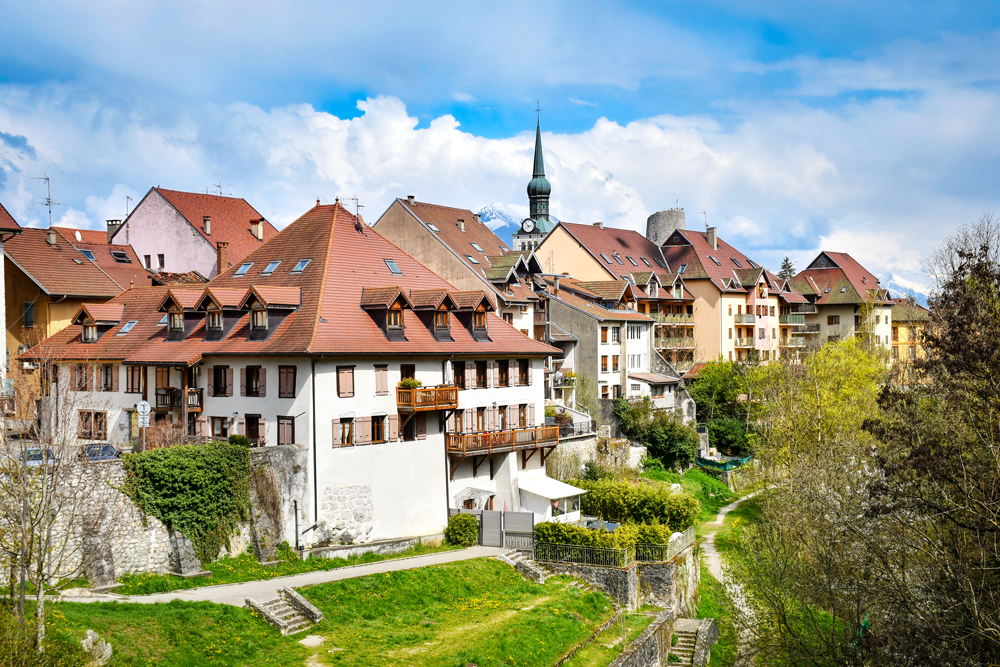
A view of La Roche-sur-Foron © French Moments
Towards the mountains, Mont-Saxonnex, Brison and the Plateau de Solaison offer a more elevated, pastoral side of the region.
You can also use Bonneville as a starting point for discovering the wider Arve Valley, from Geneva and Annemasse towards Cluses, Sallanches and the Mont Blanc road.
It may not be the most glamorous base in Haute-Savoie, but it is well placed, practical and surrounded by rewarding places to explore.
Is Bonneville Haute-Savoie Worth Visiting?
Yes, but with the right expectations.
Bonneville is not a polished showpiece destination. It is not trying to compete with Annecy’s canals or Chamonix’s high-mountain drama.
Its interest lies elsewhere: in its history, its position in the Arve Valley, its connection with the Faucigny, and the mountains that rise around it.
Come for a short visit, a riverside walk, a look at the castle, or as part of a wider day exploring Le Môle, Faucigny and Solaison.
Bonneville may not shout for attention, but between the Arve, the Faucigny and the mountains above, it quietly explains a great deal about Haute-Savoie.
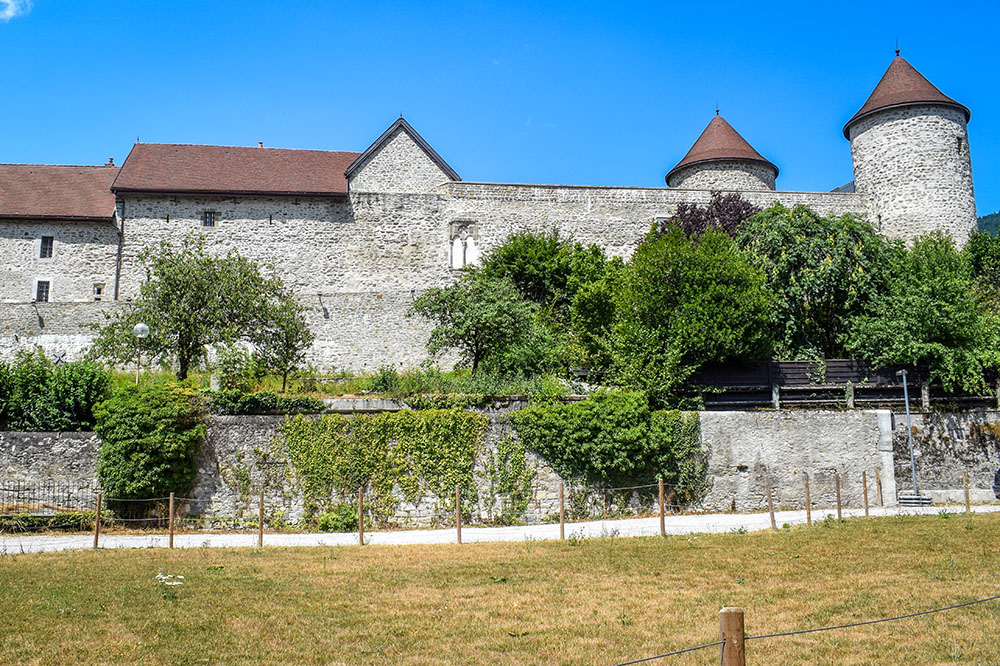
Bonneville Castle, Haute-Savoie © French Moments
Find Accommodation in Bonneville
There are several places to stay in and around Bonneville if you want to explore the Arve Valley and the surrounding mountains at a slower pace.
Bonneville can be a practical base for visiting Le Môle, the Plateau de Solaison, La Roche-sur-Foron and the wider Faucigny area.
For a broader choice of hotels and apartments, you can also compare accommodation in nearby towns such as La Roche-sur-Foron, Cluses, Annemasse or Geneva, depending on your itinerary.