

Belfort is one of those French towns that never felt like a distant place on the map to me, but rather like part of my familiar landscape.
For several years, I lived only about 30 kilometres away, in southern Alsace. I had many friends in the city, and I used to go there twice a week.
Sometimes it was to meet people, sometimes to wander through the centre, and sometimes simply because Belfort was close, lively, and easy to reach.
It became one of those places that quietly settle into your personal geography.
Not a postcard destination discovered in a hurry.
Not a city visited once and ticked off a list.
But a place you return to often, without always realising how much you are getting to know it.
And that is why writing a dedicated article about this city feels quite natural to me. Belfort may not be the most famous destination in eastern France, but it has real character.
It stands between Alsace, Franche-Comté, the Vosges and the Jura, at a crossroads where history, architecture and landscape meet.
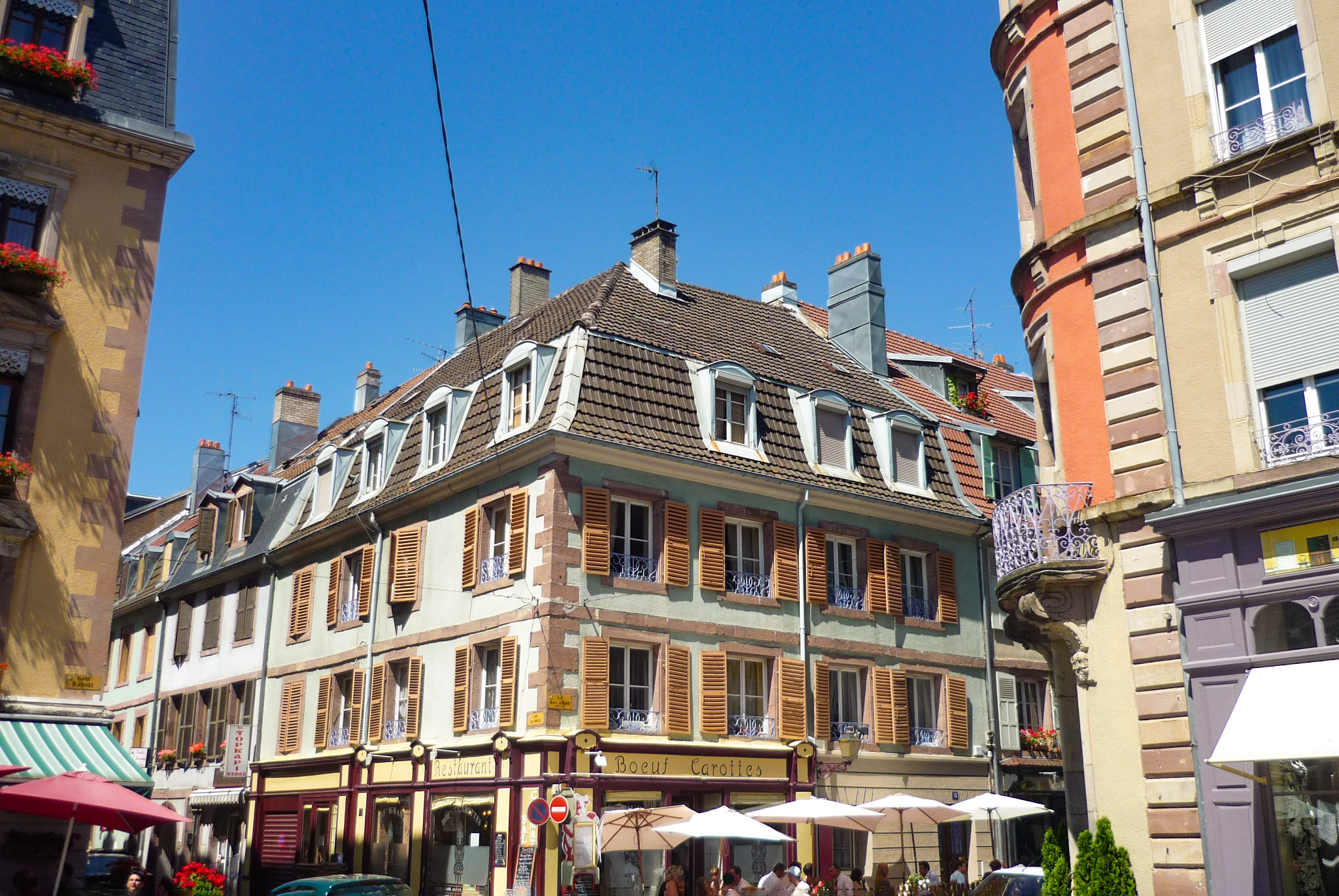
In the old town of Belfort © French Moments
Above the old town rises the citadel. Beneath it, the great Lion keeps watch.
The River Savoureuse runs through the city, the squares invite you to pause, and the streets still carry echoes of a frontier town shaped by sieges, soldiers, merchants and travellers.
So let me take you around the main sights of this proud and intriguing city.
10 Sites to See in Belfort
Before rushing from one monument to another, it is worth understanding the shape of the city.
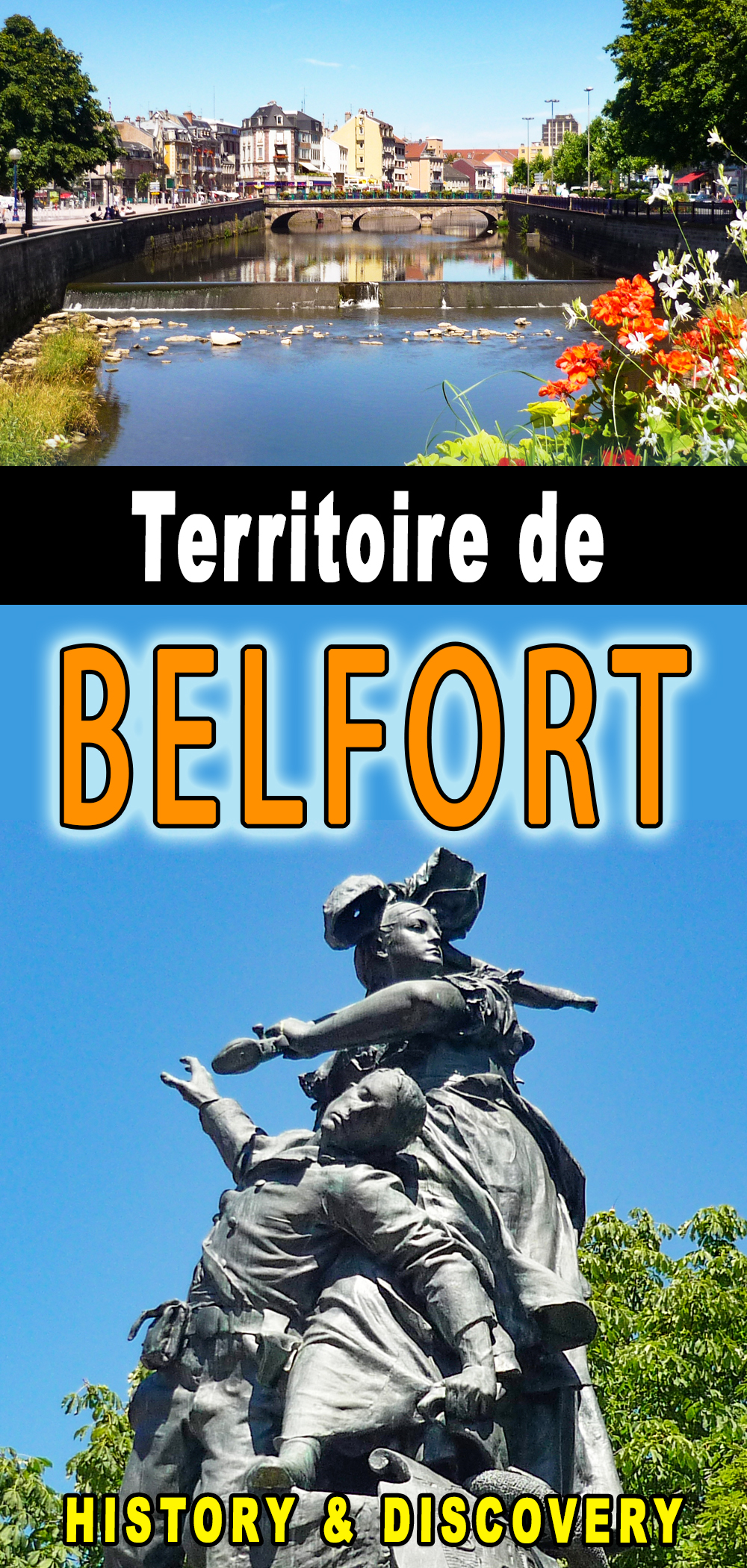
The historic centre sits below the citadel, close to the River Savoureuse. This river is not the Seine, the Loire or the Rhône — nobody is pretending otherwise — but it gives the city a pleasant axis and helps you find your bearings.
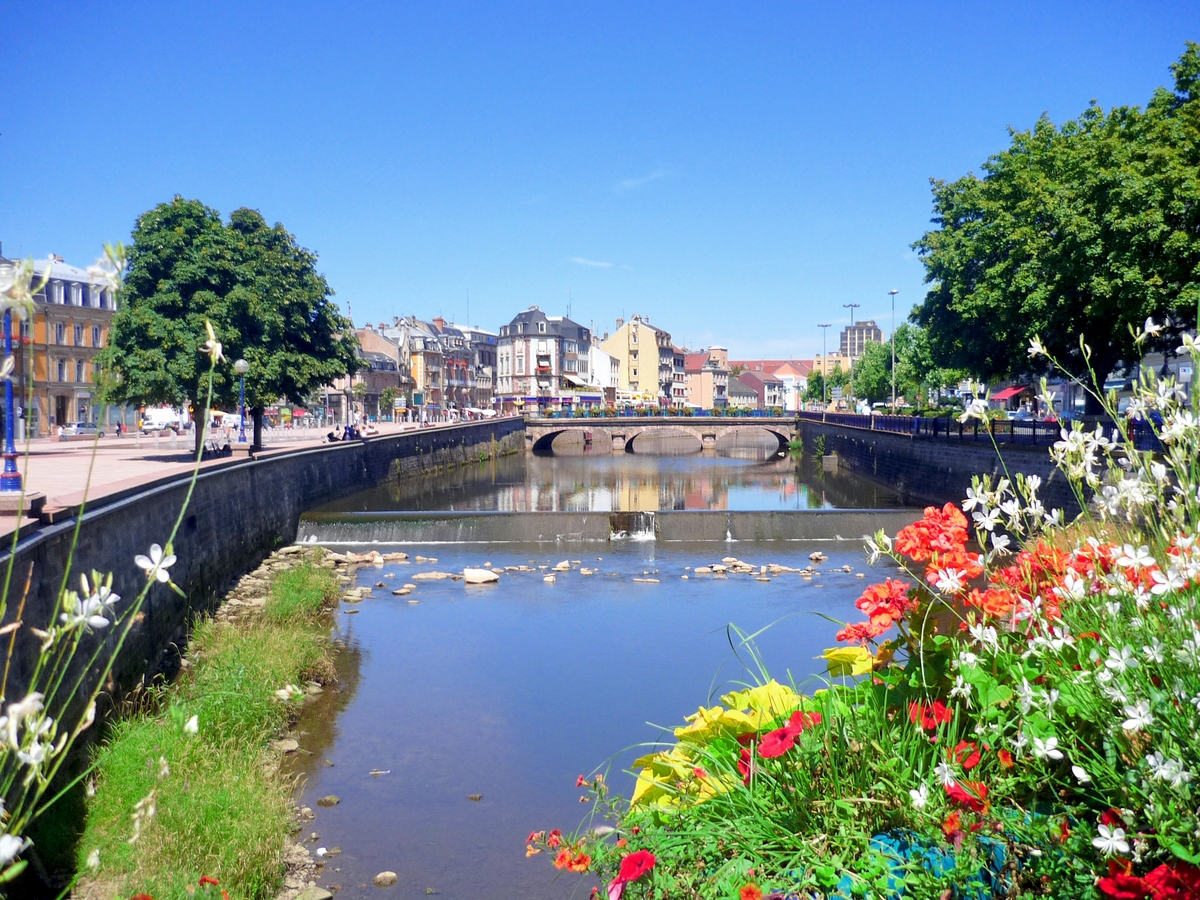
The Savoureuse river © French Moments
From the riverbanks, you can walk towards the old town, the squares, the cathedral and the fortifications.
Then, gradually, the city begins to rise towards the citadel and the Lion.
That is the great pleasure of visiting here: everything feels connected. You can explore much of the historic centre on foot, moving from military architecture to market life, from grand monuments to smaller streets with an Alsatian feel.
Here are ten sites I would include on a first visit.
The Citadel of Belfort
The citadel is the great landmark of the city.
It dominates the old town from its rocky spur, as though it had been placed there specifically to remind everyone that this was never an ordinary provincial town.
Belfort guarded an important natural passage between the Vosges and the Jura, and its fortifications reflect that strategic role.
The site was transformed and strengthened over the centuries, especially under Vauban and later military engineers.
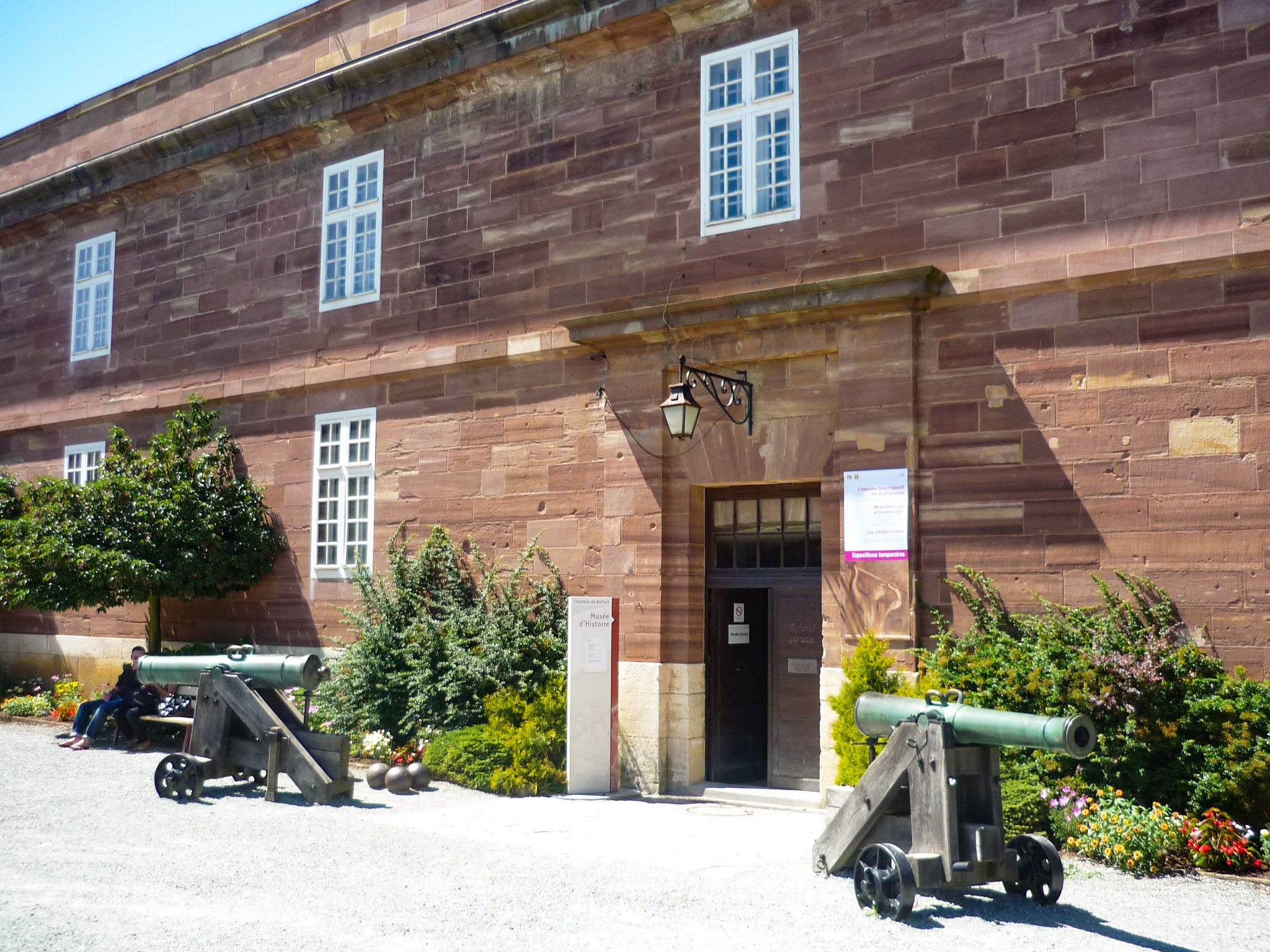
The entrance to the citadel © French Moments
Today, it is not just a fortress to admire from below.
You can walk through parts of the fortifications, enjoy panoramic views and visit the history museum housed within the citadel complex.
What I like about the citadel is that it gives you the key to the whole city.
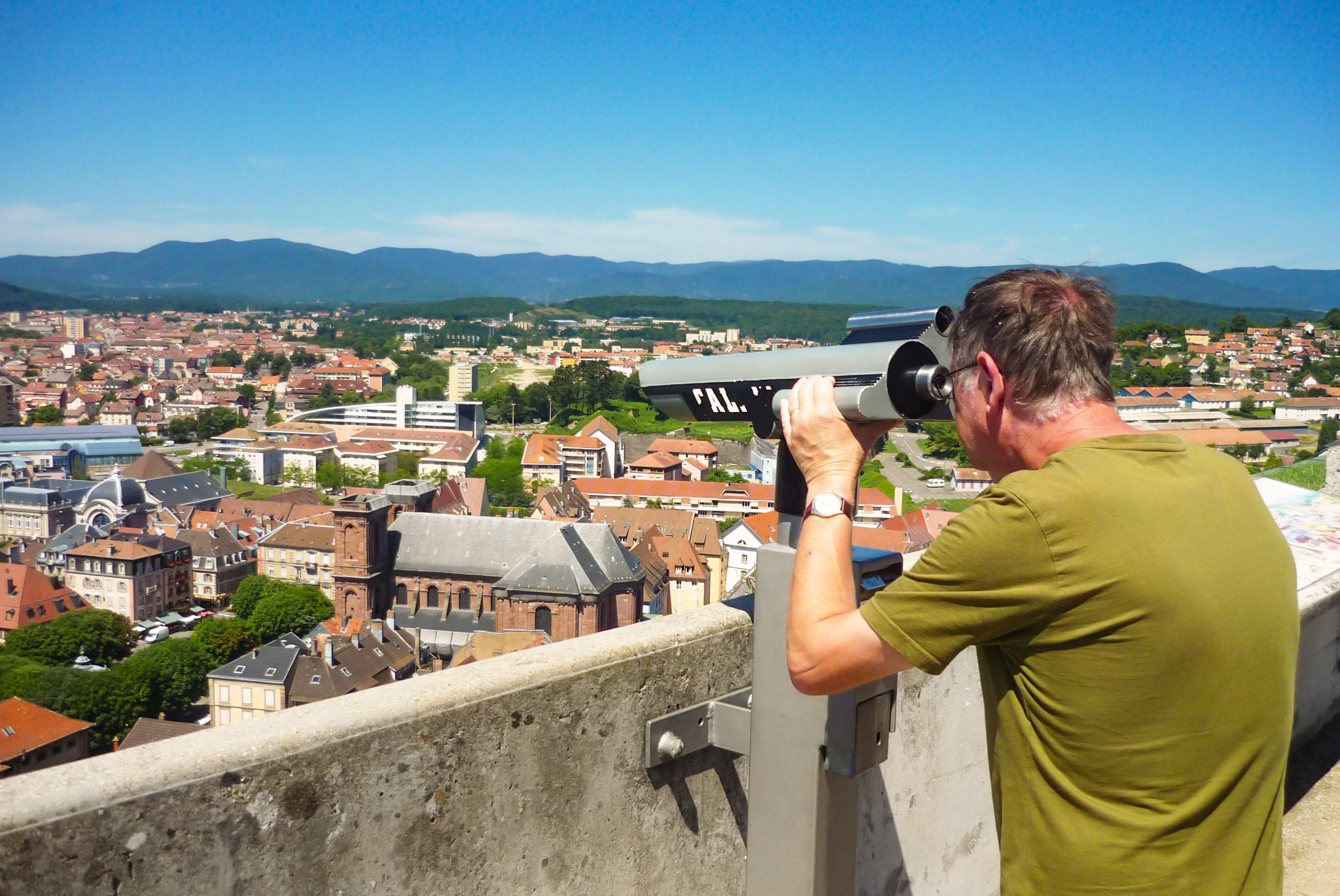
From above, you understand the geography. You see the old town below, the modern city spreading outwards, the surrounding hills, and the corridor that made this place so important.
A visit here is not only about stones and ramparts.
It is about seeing why this city mattered.
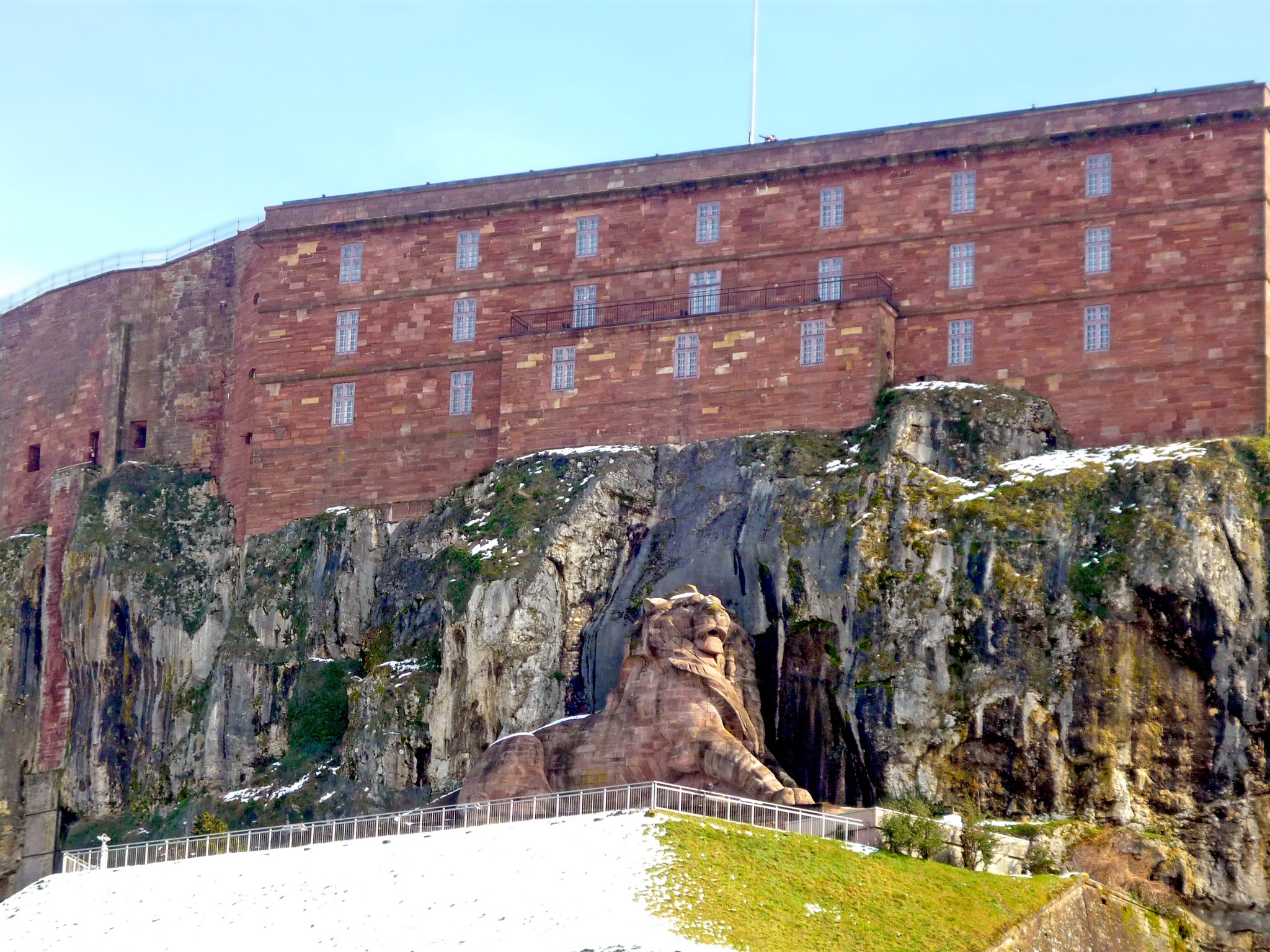
Lion of Belfort under the citadel © French Moments
Carved in pink sandstone and set against the rock below the citadel, this monumental sculpture by Auguste Bartholdi commemorates the resistance of the city during the Franco-Prussian War of 1870–71.
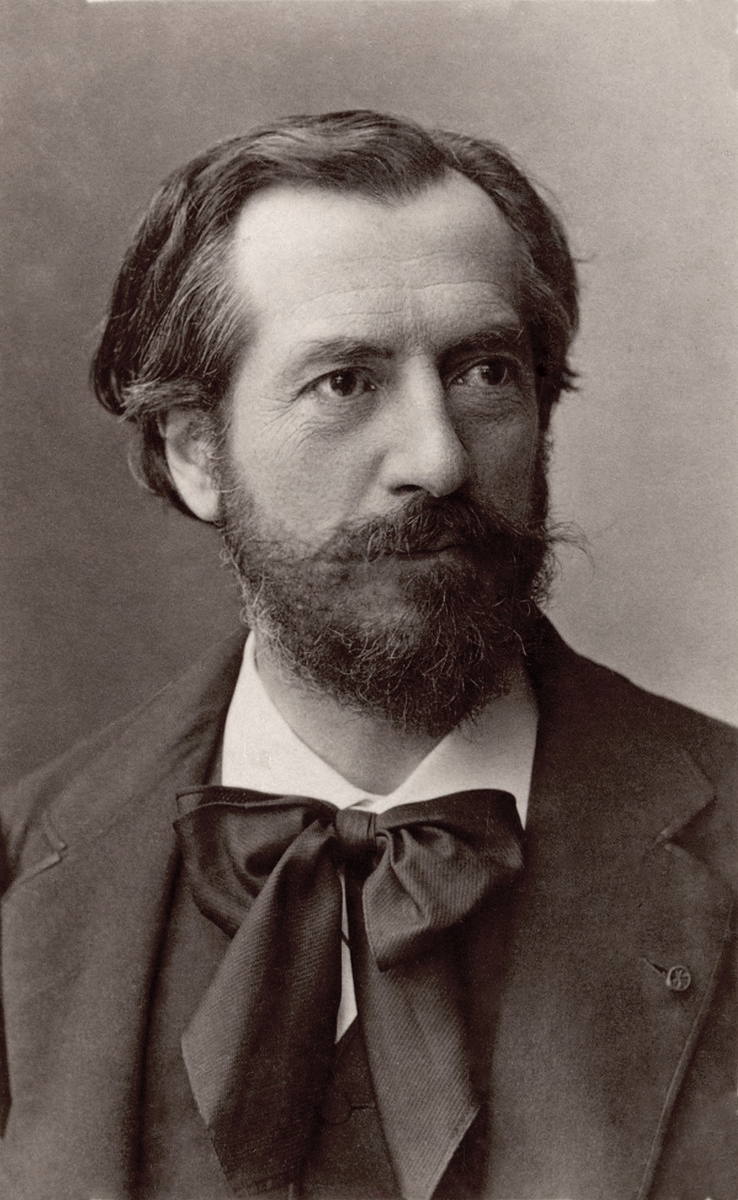
Auguste Bartholdi
Bartholdi, born in Colmar, is better known worldwide for the Statue of Liberty, but in eastern France his Lion remains one of his most powerful works.
The animal is not standing proudly on a pedestal.
It is crouched.
Wounded perhaps.
But not defeated.
That is what makes it so expressive. It symbolises resistance rather than easy triumph. The city suffered, endured, and became a national symbol of courage. The Lion turns that story into stone.
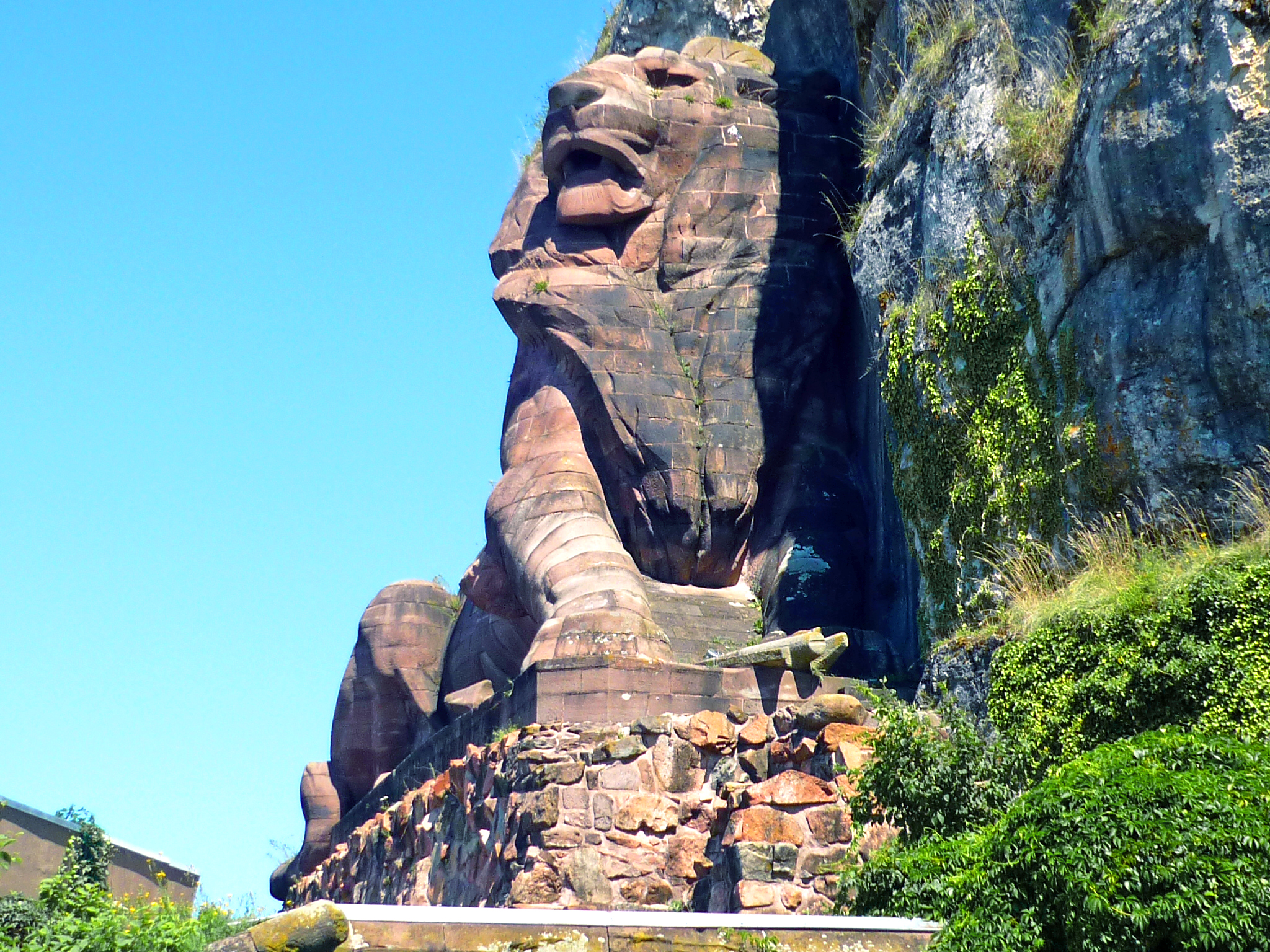
Lion of Belfort © French Moments
When you stand near it, the scale is impressive. From a distance, it appears almost naturally attached to the fortress. Up close, you notice the tension in the body, the mane, the paws, the sense of controlled power.
It is one of those monuments that works because it belongs perfectly to its setting.
Move it elsewhere, and it would lose something.
Here, beneath the citadel, it feels inevitable.
The Belfort Ramparts and the Porte de Brisach
The ramparts are another essential part of the city’s identity.
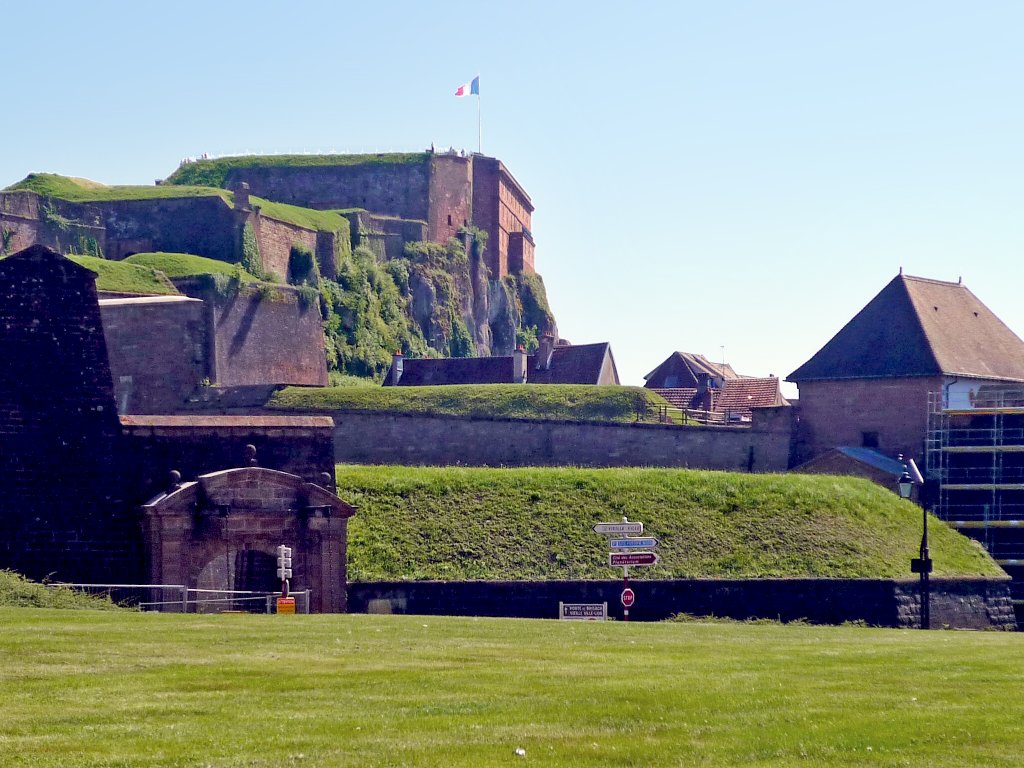
The fortifications of Belfort © French Moments
They remind you that the old town was once enclosed, guarded and organised for defence. Walking near the fortifications allows you to feel the layers of military history that shaped the place.
One of the most interesting surviving features is the Porte de Brisach (Breisach Gate).
![Fortified City Gates of Alsace - Porte de Brisach, Belfort © Andrzej Harassek - licence [CC BY-SA 3.0] from Wikimedia Commons](https://frenchmoments.eu/wp-content/uploads/2021/09/Belfort-Porte-de-Brisach-©-Andrzej-Harassek-licence-CC-BY-SA-3.0-from-Wikimedia-Commons.jpg "Belfort Porte de Brisach © Andrzej Harassek - licence [CC BY-SA 3.0] from Wikimedia Commons")
Porte de Brisach, Belfort © Andrzej Harassek - licence [CC BY-SA 3.0] from Wikimedia Commons
This old gate once formed part of the fortified system and still gives a strong impression of entering a defended town. It is not merely a decorative archway. It has weight, structure and purpose.
For visitors, the area around the ramparts is also a good place to slow down. The walls, gates and defensive lines help create a distinctive atmosphere, especially when you approach the old town from the citadel side.
Belfort is not a city of soft curves and dreamy riverbanks only.
It has edges.
And those edges are part of its charm.
Belfort Old Town and Its Southern Alsatian Character
The old town is one of the areas I enjoy most.
It may not be as famous as Colmar or Riquewihr, and you should not arrive expecting a stage set of half-timbered façades and overflowing geraniums. But that is precisely why it feels authentic.
The historic streets have a character that recalls southern Alsace, which is hardly surprising given the history of the region.
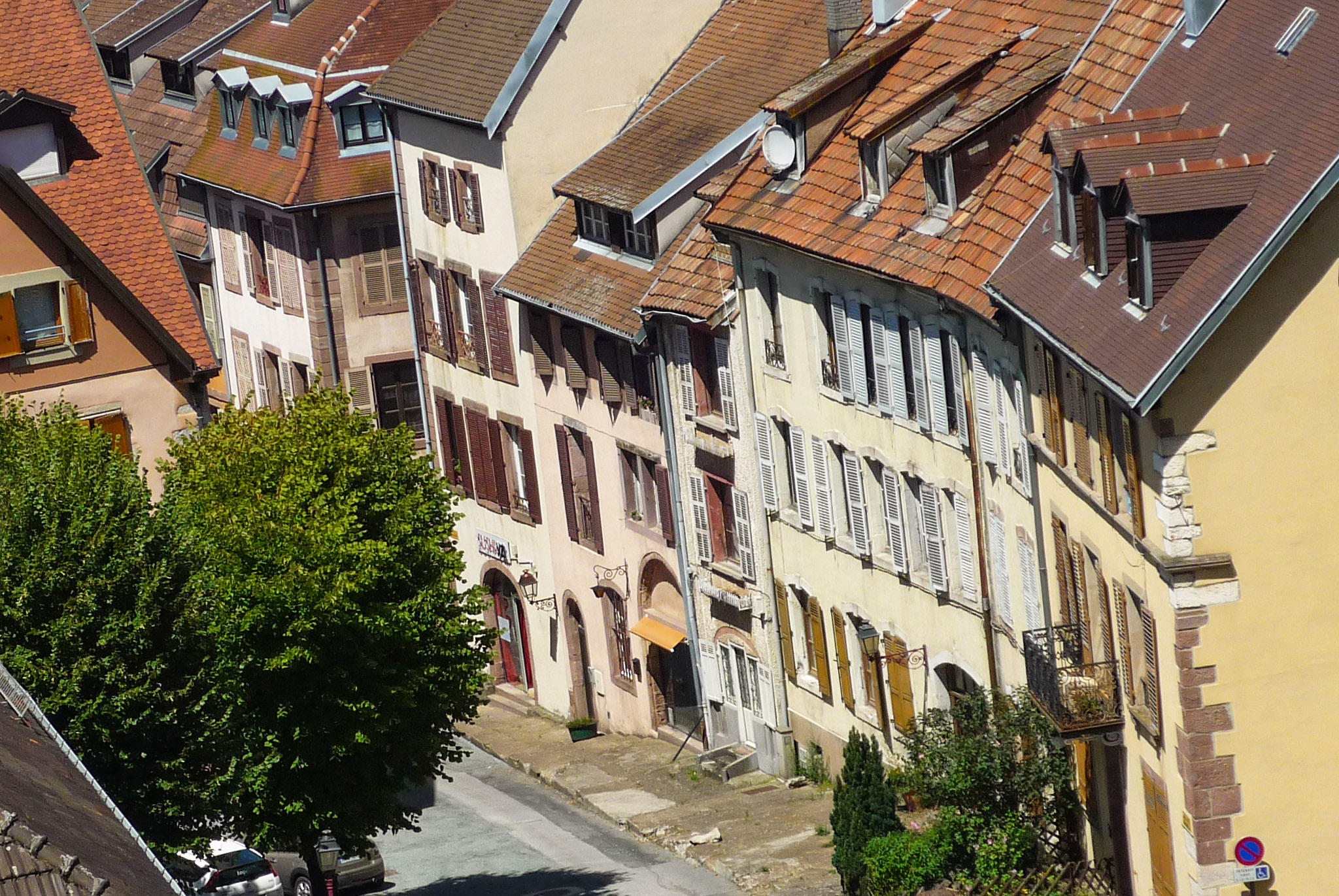
The old streets of Belfort © French Moments
Before 1871, the city was part of the Haut-Rhin département, and culturally it remained closely connected to Alsace.
You feel this in the scale of the streets, the colours, the roofs, the façades and the general atmosphere of the centre.
It is a place to explore slowly.
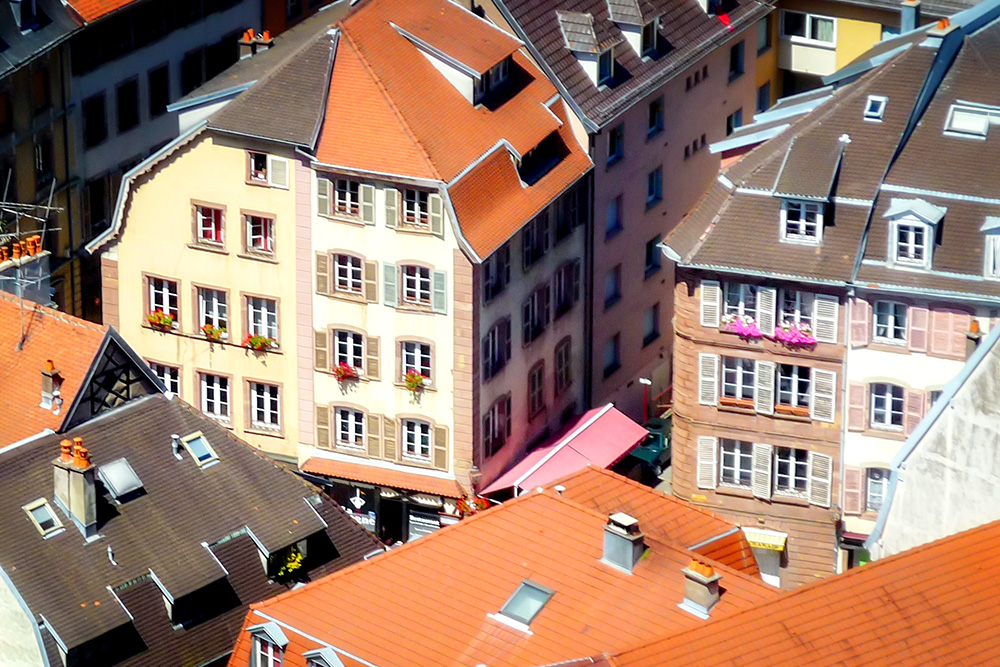
Visit Belfort, France © French Moments
Look up at the buildings. Notice the details around the squares. Follow the streets that lead towards the cathedral and the town hall. Let yourself wander a little.
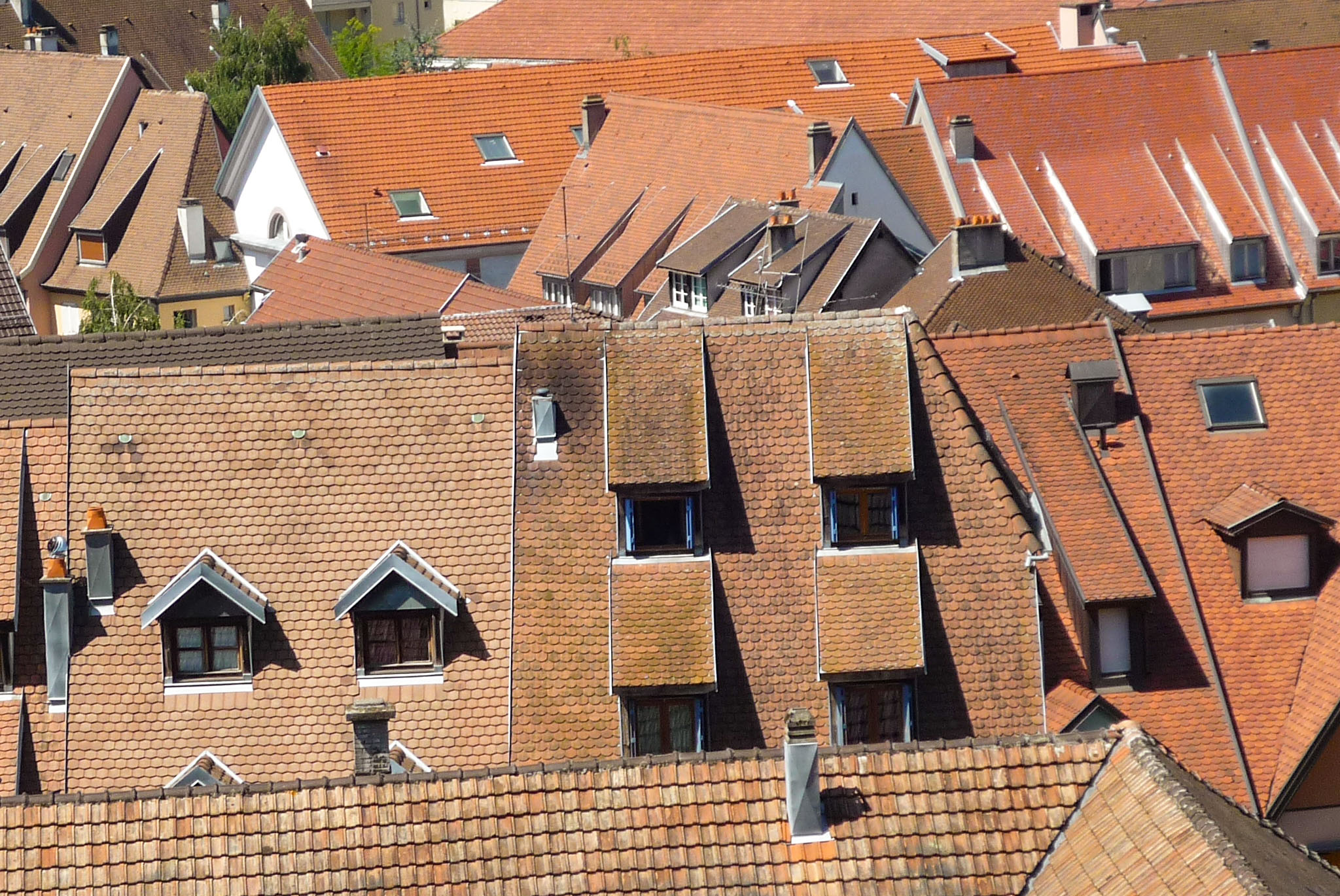
The roofs of Belfort © French Moments
The old town does not shout.
It reveals itself quietly.
And for me, that is often the best kind of French town centre.
Saint-Christophe Cathedral in Belfort
Saint-Christophe Cathedral stands on Place d’Armes, in the heart of the historic centre.

Belfort Cathedral © French Moments
Its warm stone façade gives the square a sense of order and dignity. The building has the calm presence of a church that has seen military parades, markets, civic ceremonies, daily life and probably a great deal of local gossip.
Inside, the atmosphere changes.
The noise of the square fades, and you find a more peaceful space, with the kind of stillness that only old churches seem to manage. Even if you are not especially interested in religious architecture, it is worth stepping inside for a moment.
The cathedral also works beautifully as part of the urban scene.
Stand in Place d’Armes and look around: the cathedral, the surrounding façades, the nearby town hall, the cafés and the streets leading away from the square. This is one of the places where you understand the civic heart of the city.
Not spectacular in an overwhelming way.
But balanced, coherent and very French.
Belfort Town Hall
The town hall is another key building on Place d’Armes.
It forms part of the dignified 18th-century setting of the square and helps give the historic centre its official, almost ceremonial character.
![The Town Hall of Belfort © P-90 - licence [CC BY-SA 4.0] from Wikimedia Commons](https://frenchmoments.eu/wp-content/uploads/2022/03/Belfort-Hotel-de-Ville-©-P-90-licence-CC-BY-SA-4.0-from-Wikimedia-Commons-scaled.jpg "Belfort - Hotel de Ville © P-90 - licence [CC BY-SA 4.0] from Wikimedia Commons")
The Town Hall of Belfort © P-90 - licence [CC BY-SA 4.0] from Wikimedia Commons
In many French towns, the hôtel de ville is more than an administrative building. It represents the local identity.
That is certainly true here.
The façade, the square in front of it, and the proximity of the cathedral all create a sense of civic theatre. This is where the city presents itself.
Take a moment to stand in the square and imagine the different periods of local history passing through it: soldiers, officials, market-goers, schoolchildren, visitors, and residents meeting for a coffee.
A town hall may not always be the first monument tourists rush to see.
But in a city like this, it helps you understand the rhythm and dignity of the place.
The Three Sieges Monument in Belfort
The Monument des Trois Sièges is one of the city’s important commemorative monuments.
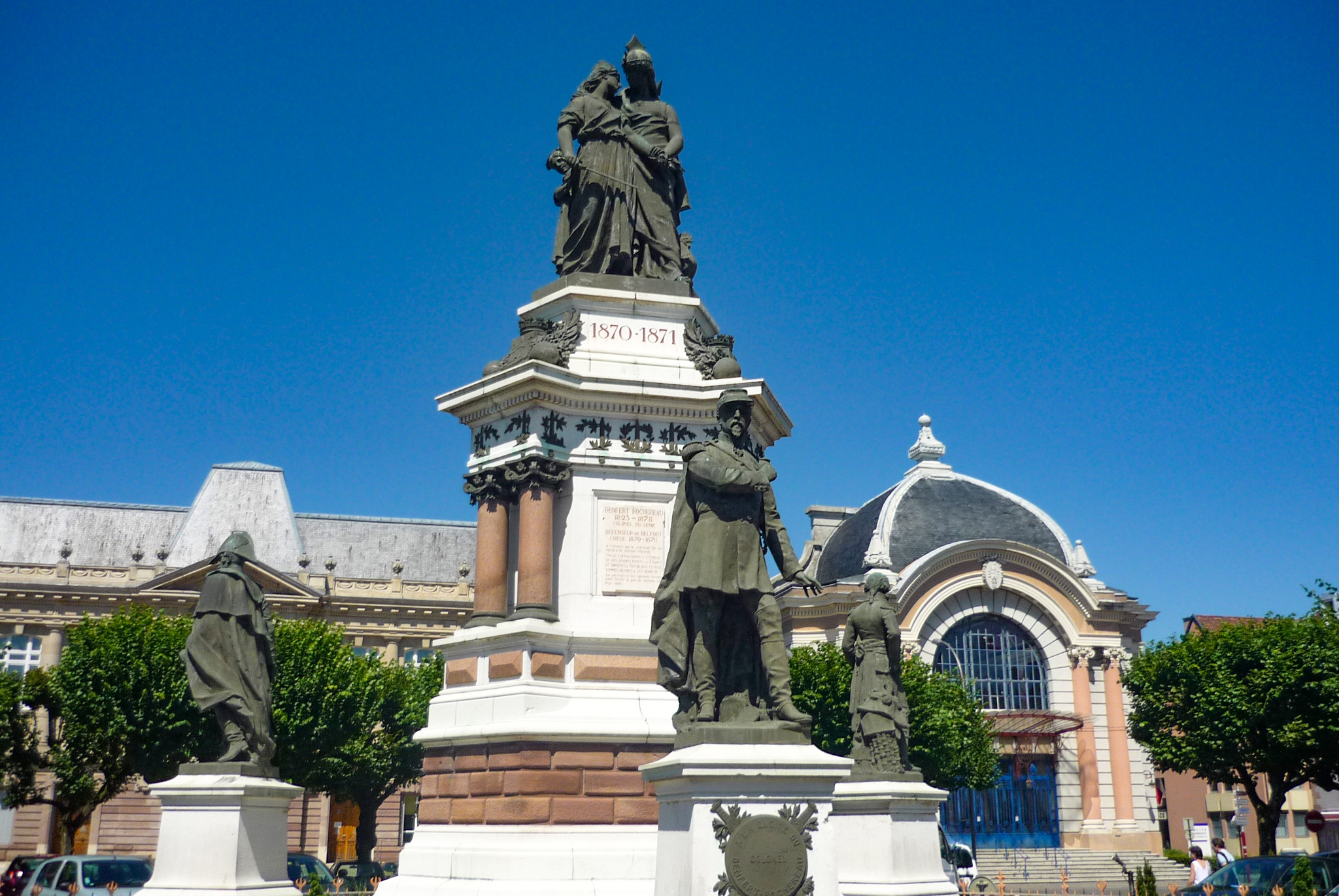
Monument des Trois Sièges © French Moments
Designed by Bartholdi, it honours the defenders of the city during three major sieges in the 19th century. It stands as a reminder that Belfort’s history was shaped not by one dramatic episode only, but by repeated moments of resistance.
This is something visitors should keep in mind.
The Lion may be the great symbol, but it is part of a wider memory landscape. The city has several monuments that speak of conflict, endurance and patriotism. Together, they tell the story of a place that repeatedly found itself at the centre of European tensions.
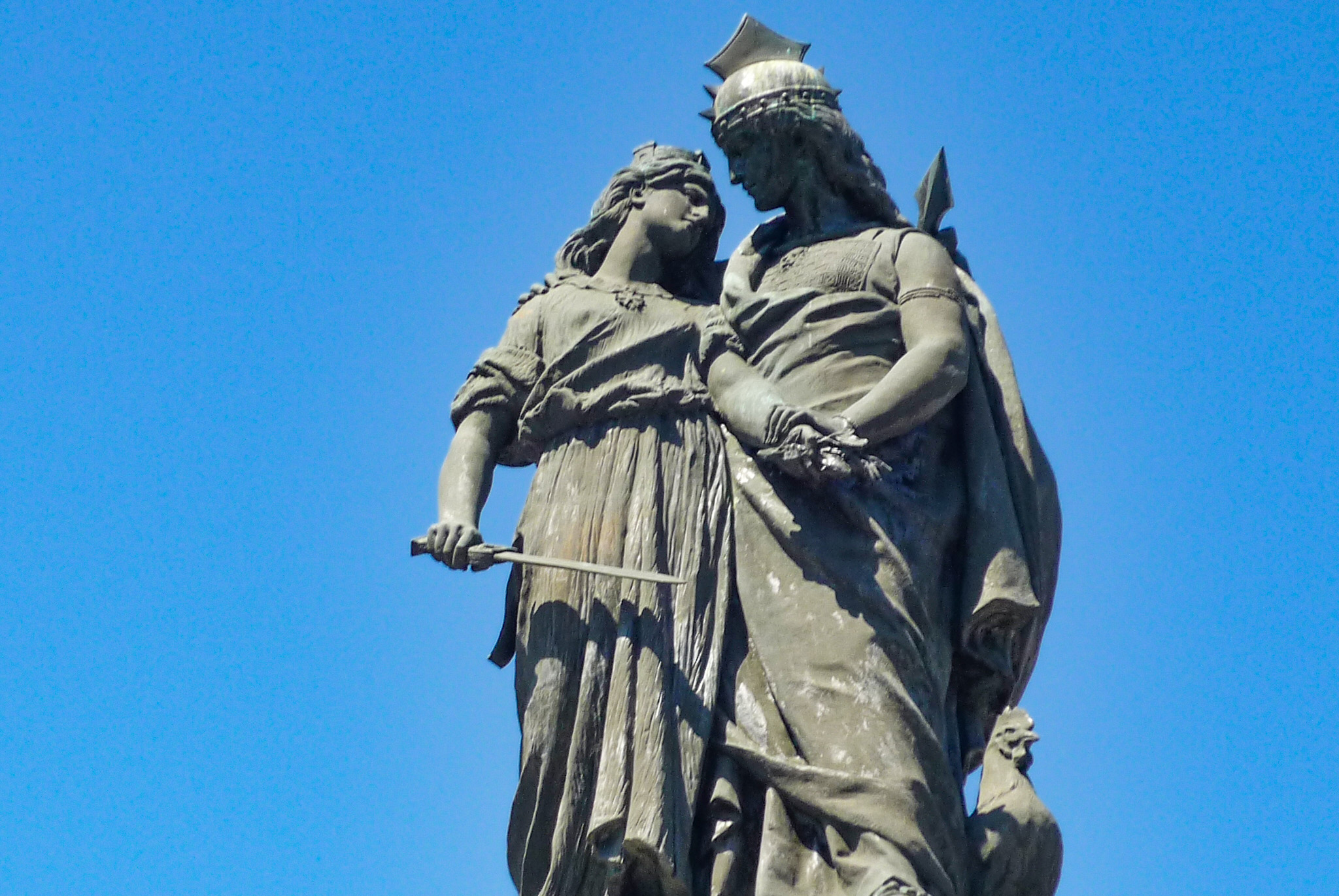
Monument des Trois Sièges © French Moments
The Monument des Trois Sièges is not as instantly famous as the Lion.
But it adds depth to the visit.
It reminds you that Belfort’s identity was not invented by tourism.
It was forged by history.
The Quand-Même Statue
The statue known as Quand-Même is another work connected with the spirit of resistance.

Statue "Quand Même" © French Moments
The expression “quand même” is difficult to translate perfectly into English. It means something like “all the same”, “nevertheless”, or “despite everything”.
And that is exactly the feeling behind the monument.
Despite everything, the city held on.
Despite everything, hope remained.
Despite everything, France would remember.
The statue pays tribute to this stubborn courage. It is the kind of monument that makes more sense when you have already visited the Lion, the citadel and the other memorials.
By then, you begin to see how strongly the theme of resistance runs through the city.
There is a certain emotional consistency here.
Belfort does not present itself as a place of light entertainment only.
It asks you to remember.
And then, quite politely, it invites you to continue your walk.
Halle Fréry
After all that military history and patriotic symbolism, Halle Fréry brings you back to everyday life.
And thank goodness for that.
![Halle Fréry © P-90 - licence [CC BY-SA 4.0] from Wikimedia Commons](https://frenchmoments.eu/wp-content/uploads/2026/07/Halle-Frery-Belfort-©-P-90-licence-CC-BY-SA-4.0-from-Wikimedia-Commons.jpg "Halle Fréry Belfort © P-90 - licence [CC BY-SA 4.0] from Wikimedia Commons")
Halle Fréry © P-90 - licence [CC BY-SA 4.0] from Wikimedia Commons
Because a city is not only its monuments. It is also its markets, its food, its conversations, its habits and its ordinary routines.
The Fréry market area is part of this local rhythm. It gives you a glimpse of the city as residents experience it, rather than as a sequence of historic sites.
Depending on the day and current arrangements, you may find market stalls, local produce and the pleasant bustle that makes French market culture so enjoyable.
This is the sort of place where you can slow down after visiting the fortress.
Buy something simple.
Listen to local voices.
Notice how people greet one another.
For me, these ordinary moments often stay in the memory as much as the famous monuments.
A Lion may symbolise a city.
But a market helps you feel it.
The Miotte Tower
The Tour de la Miotte stands on a hill to the north-east of the centre and is another landmark linked to the defensive history of the city.
![Belfort Fort de la Miotte © Bourgeois.A - licence [CC BY-SA 3.0] from Wikimedia Commons](https://frenchmoments.eu/wp-content/uploads/2026/07/Belfort-Fort-de-la-Miotte-©-Bourgeois.A-licence-CC-BY-SA-3.0-from-Wikimedia-Commons.jpg "Belfort Fort de la Miotte © Bourgeois.A - licence [CC BY-SA 3.0] from Wikimedia Commons")
Belfort Fort de la Miotte © Bourgeois.A - licence [CC BY-SA 3.0] from Wikimedia Commons
It is one of those places that adds a different perspective to a visit. While the citadel gives you the grand historic panorama, the Miotte area offers another viewpoint over the city and its surroundings.
The tower itself has become part of the local visual identity. It may not have the fame of the Lion, but it belongs to the same family of landmarks: military, elevated, symbolic, and connected with the wider landscape.
If you enjoy walking and viewpoints, it is worth including.
Belfort is a city best understood from different angles.
From the old town, it feels compact and historic.
From the citadel, it becomes strategic.
From the Miotte, you sense how it sits among hills, routes and horizons.
Around Belfort: Three Easy Excursions
One of the advantages of staying in or near the city is that you are close to several very different landscapes and destinations.
Within a short distance, you can reach mountain scenery, Alsatian villages, rural countryside and another historic town. That variety is what makes this corner of eastern France so interesting.
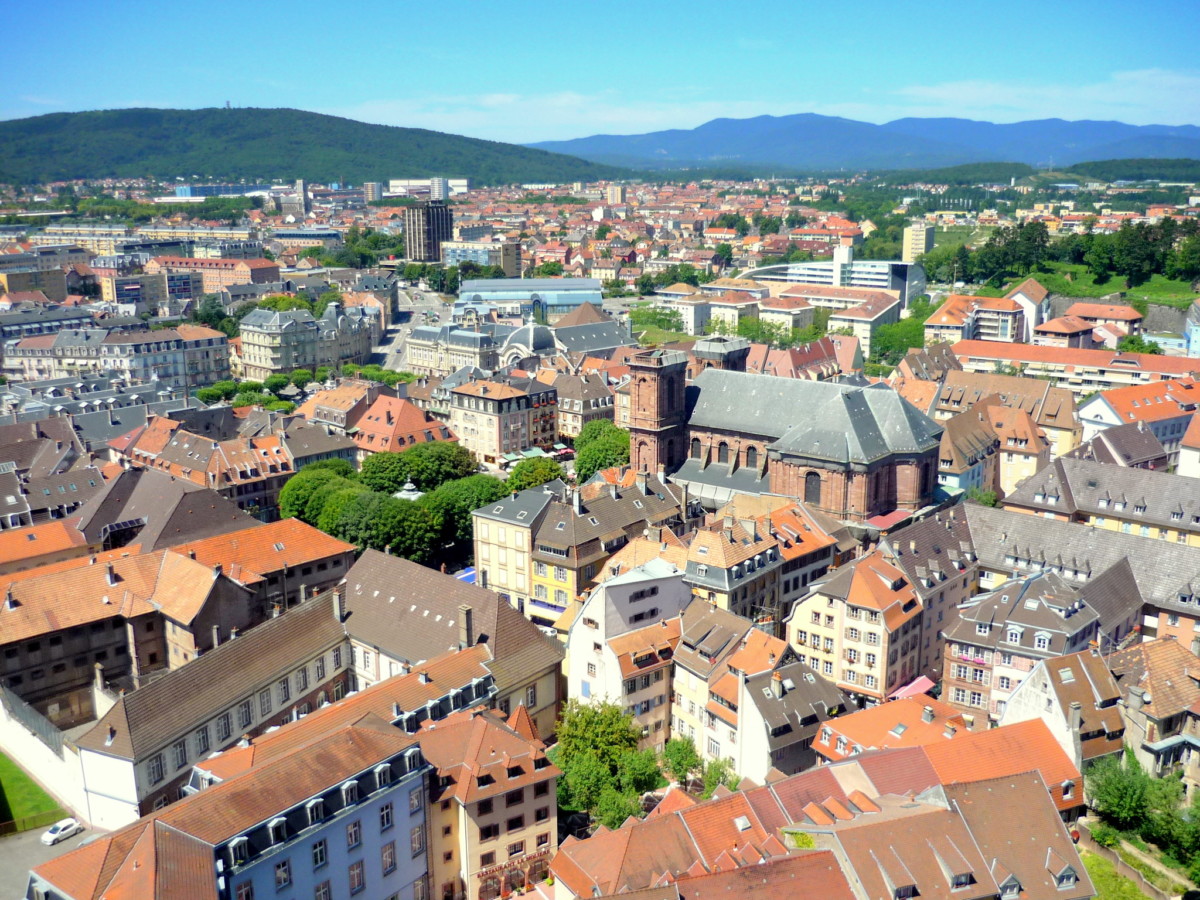
The city of Belfort seen from the Citadel © French Moments
You are not quite in Alsace.
Not quite in the Vosges.
Not quite in Franche-Comté in the stereotypical sense.
You are at a crossroads.
And crossroads are always good places for exploring.
The Ballon d’Alsace: Belfort’s Mountain Escape
The Ballon d'Alsace is one of the best excursions from the city.
This summit in the southern Vosges offers fresh air, open views, walking trails and a complete change of atmosphere. If the city has given you fortifications, squares and stone lions, the Ballon gives you ridges, forests and wide skies.
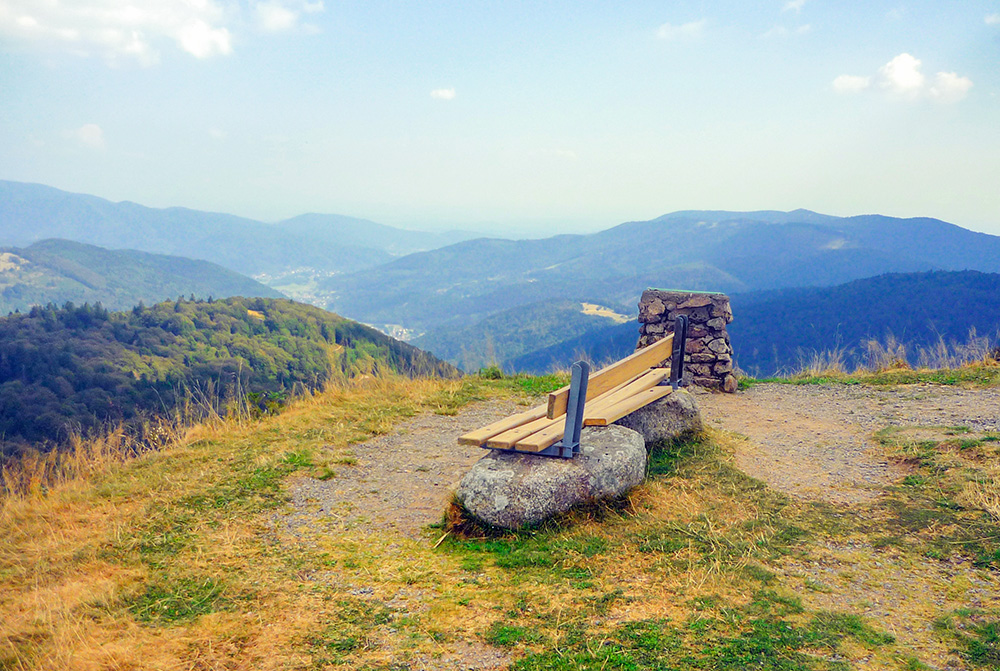
The Ballon d'Alsace (1247 m) © French Moments
It is a favourite destination for nature lovers, especially in good weather. In summer, you can enjoy hiking and scenic drives. In winter, depending on conditions, the area takes on a very different mountain character.
For me, this is one of the pleasures of eastern France.
You can be in a historic town in the morning and up in the mountains later the same day.
No need for drama.
Just a good pair of shoes, a jacket in case the weather changes, and perhaps a healthy respect for how quickly mountain air can remind you that you are not in your living room.
The Sundgau: South of Belfort and Close to Alsace
The Sundgau lies to the south of Alsace and close to the Territoire de Belfort.
This is a gentle rural area of villages, ponds, rolling landscapes and traditional architecture. It is not the Alsace of the most famous wine-route postcards. It is quieter, more discreet, and in many ways more intimate.
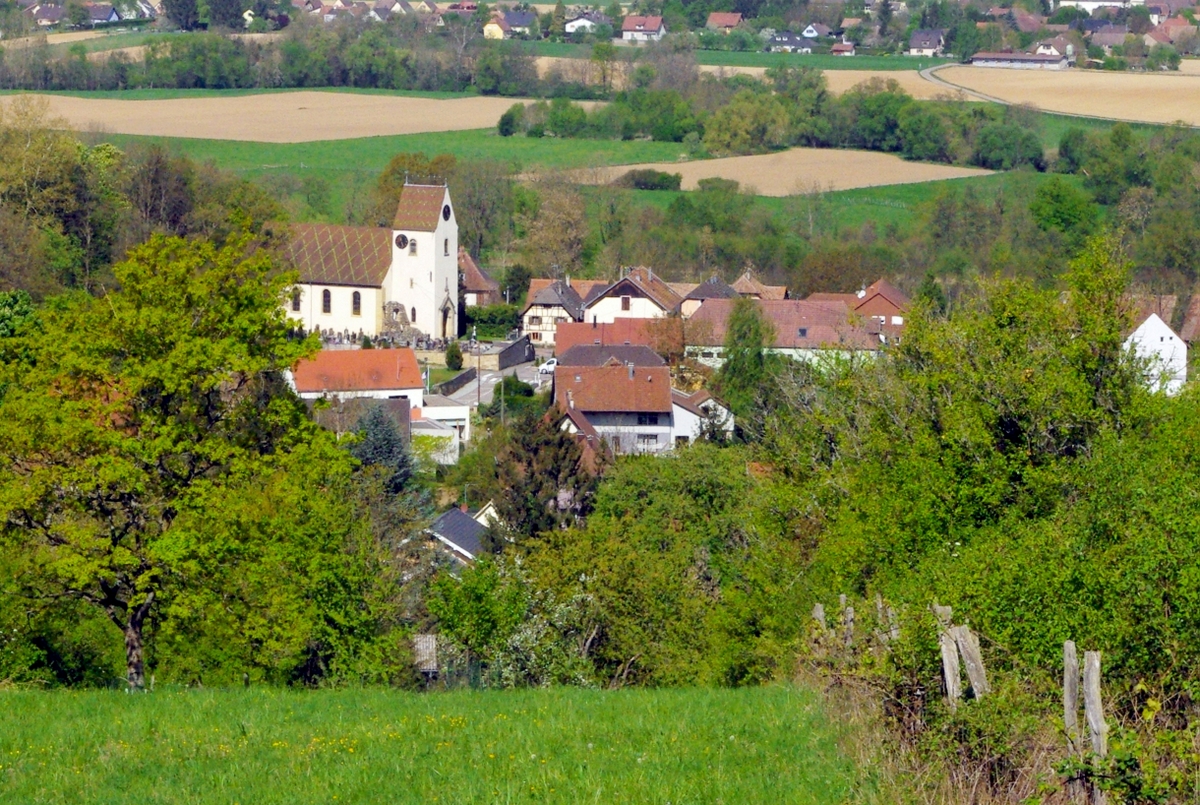
The village of Heidwiller in the Sundgau © French Moments
I know this region well because it was part of my own local world when I lived in southern Alsace.
The Sundgau is a place for slow exploration: village churches, half-timbered houses, country roads, ponds and local food traditions. It is also known for fried carp, a speciality that has become something of a regional marker.
It makes a lovely contrast with the urban and military character of Belfort.
After the citadel and the Lion, the Sundgau offers something softer.
More rural.
More hidden.
And very rewarding if you enjoy places that do not try too hard to impress.
Montbéliard: A Neighbouring Historic Town
Montbéliard is another easy excursion.
It lies to the south-west and has a very different feel, shaped by its own history and by the influence of the former principality of Württemberg.
The town has a historic centre, a castle, colourful façades and a distinctive atmosphere that sets it apart from both Belfort and Alsace.

Montbéliard Castle © French Moments
It is particularly pleasant for a half-day visit.
Walk through the centre, admire the castle from the outside or visit it if time allows, and enjoy the contrast between the two towns. They are not far apart, but they do not feel identical.
That is one of the charms of this region.
Distances are short.
Differences are real.
And each town has its own personality.
Final Thoughts on Visiting Belfort
Belfort deserves more attention than it often receives.
Many travellers pass nearby on their way to Alsace, Switzerland, the Vosges or Burgundy without realising that this compact city has a remarkable story and several memorable sights.
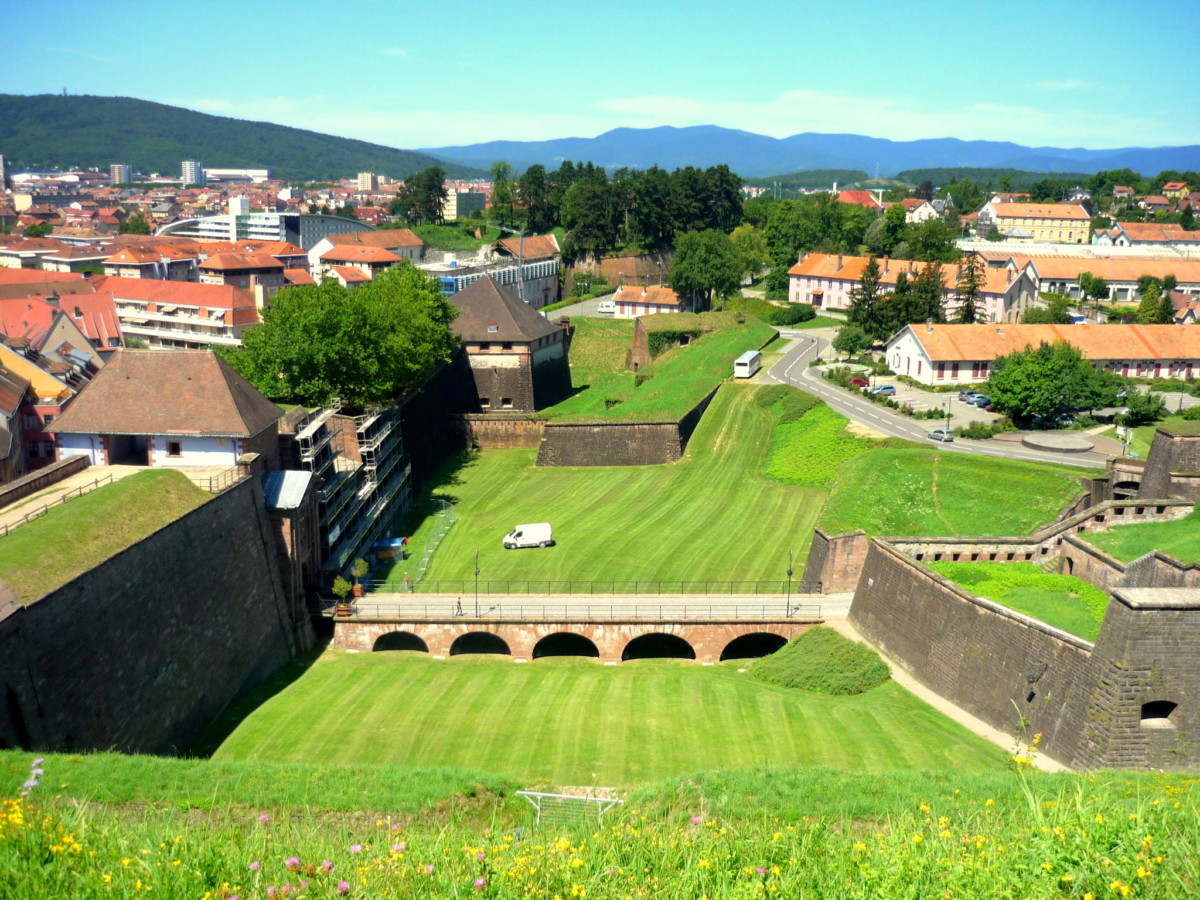
The fortifications of Vauban in Belfort © French Moments
It has the drama of the citadel.
The power of the Lion.
The charm of the old town.
The dignity of its squares and monuments.
And the advantage of being surrounded by beautiful and varied countryside.
For me, however, it is more than a list of attractions. It is a place connected with memories: friends, regular visits, familiar streets, and the feeling of a city that was close enough to become part of everyday life.
Perhaps that is why I see it with a certain affection.
Belfort is not trying to be Paris, Strasbourg or Colmar.
It is itself.
A frontier city.
A city of stone and memory.
A city with a lion under its fortress and mountains on the horizon.
And that, I think, is already more than enough reason to visit.
Learn more about Belfort
If you would like to explore the city in greater depth, I have written several other articles that focus on different aspects of Belfort and its fascinating story.
You can begin with my article on the History of Belfort, which explains how this strategic city developed over the centuries and why it became such an important frontier stronghold in eastern France.
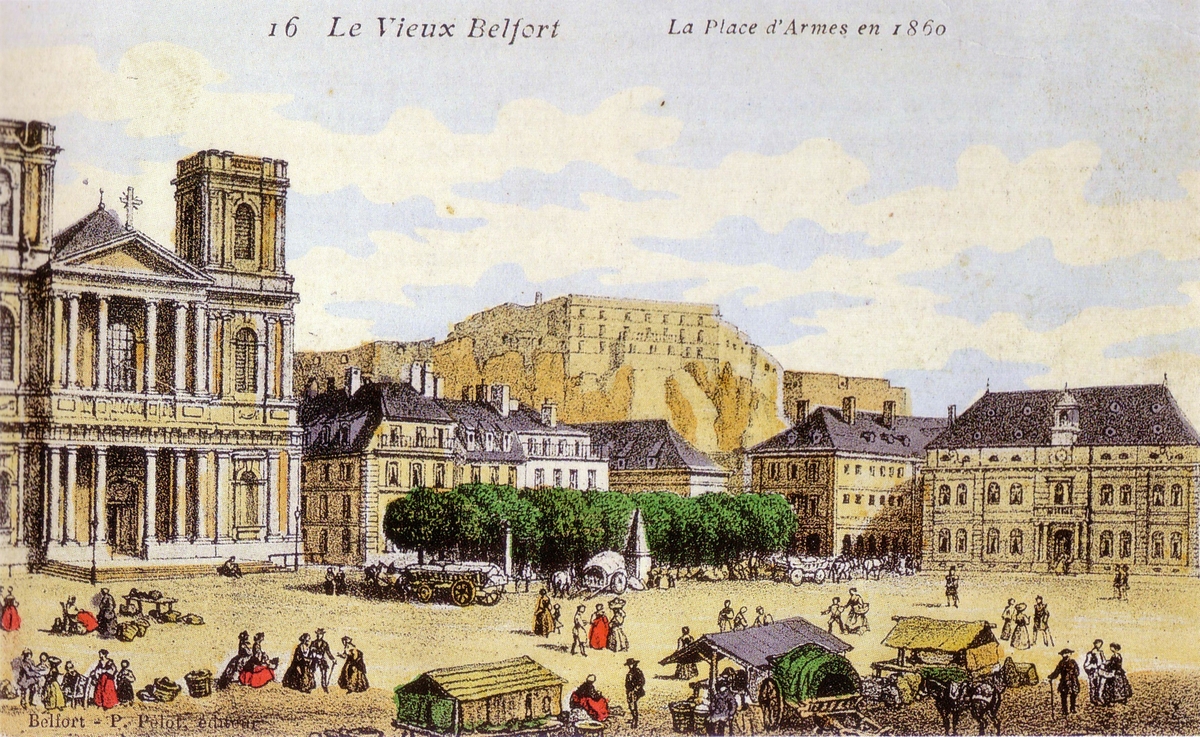
The town in 1860
For a closer look at the city’s most famous landmark, read my dedicated article on the Lion of Belfort, the monumental sculpture by Auguste Bartholdi that has become the proud symbol of the city.
Lion of Belfort under the citadel © French Moments
We published another discovery-article about Belfort, titled Visit Belfort France: 10 Reasons This Town Deserves Your Attention.
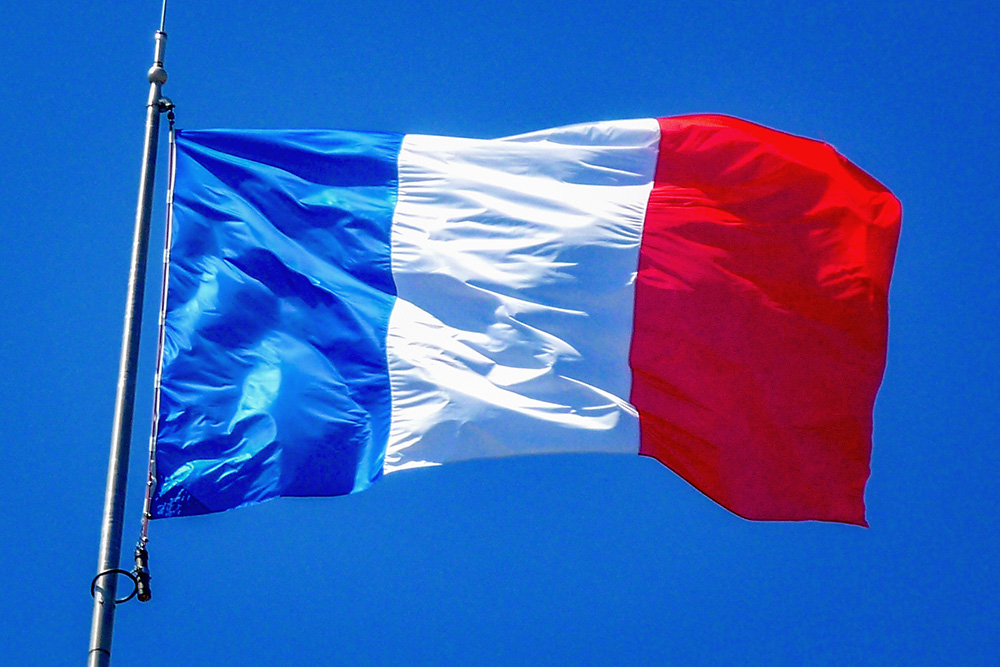
French flag flying in Belfort © French Moments
And to understand the wider region, don’t miss my article on the Territoire de Belfort, one of France’s smallest départements, with a unique history shaped by Alsace, Franche-Comté and the dramatic events of 1870–71.

The Eurockéennes of Belfort (Public Domain via Wikimedia Commons)
Explore Comfortable Accommodations in Belfort
Planning a visit to Belfort? You’ll find a range of comfortable and charming accommodations to suit your needs.
From cosy boutique hotels to modern apartments, there's something for everyone.
Whether you want to stay in the heart of the city or prefer a quiet retreat, Belfort has it all.
Ready to book your stay? Check out the best option available HERE and find the perfect place to rest after exploring this historic city. Browse the map below:
How to get there
- Belfort is easily accessible by car from Alsace’s main cities, Strasbourg, Colmar, and Mulhouse, as well as from Montbéliard and Besançon in Franche-Comté.
- If you travel from Australia, New Zealand, or America, you could fly to Paris Charles de Gaulle, Zurich, or Frankfurt Airports and rent a car there. The nearest airport is the Euroairport near Basel.
- The TGV Rhin-Rhône from Paris-Gare de Lyon takes 2.15 hours to the new Belfort-Montbéliard-TGV railway station.