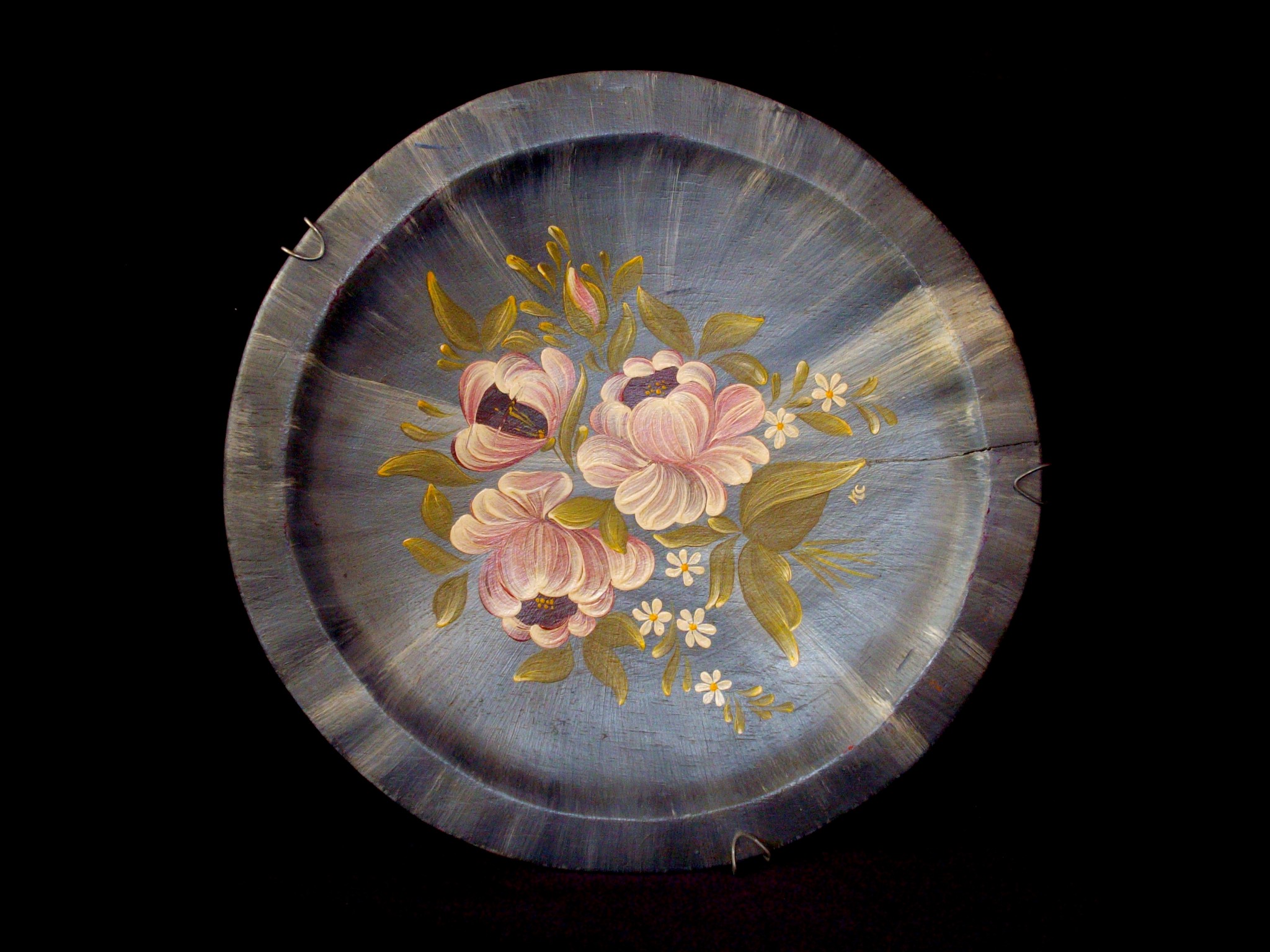


Alsatian wood painting is one of the most colourful expressions of traditional folk art in Alsace.
For generations, local craftspeople transformed chests, wardrobes, beds and small domestic objects with flowers, stars, hearts, dates and family initials.
These pieces were not created merely to brighten a farmhouse interior. They could accompany a marriage, preserve a bride’s trousseau and record part of a family’s story.
Today, Alsatian painted furniture offers a fascinating glimpse into the daily life, beliefs and artistic imagination of earlier centuries.
What Is Alsatian Wood Painting?
The expression refers mainly to the polychrome decoration of wooden furniture and household objects. In English, the tradition is also described as Alsatian painted furniture or country painting.
In rural Alsace, locally available woods such as fir, pine and beech provided practical materials for cupboards, chests and boxes.
Painting made these relatively modest woods more attractive and allowed craftspeople to add personal, religious or protective motifs.
The result was practical furniture with a strong visual identity—proof that the desire to personalise one’s home did not begin with modern interior design.
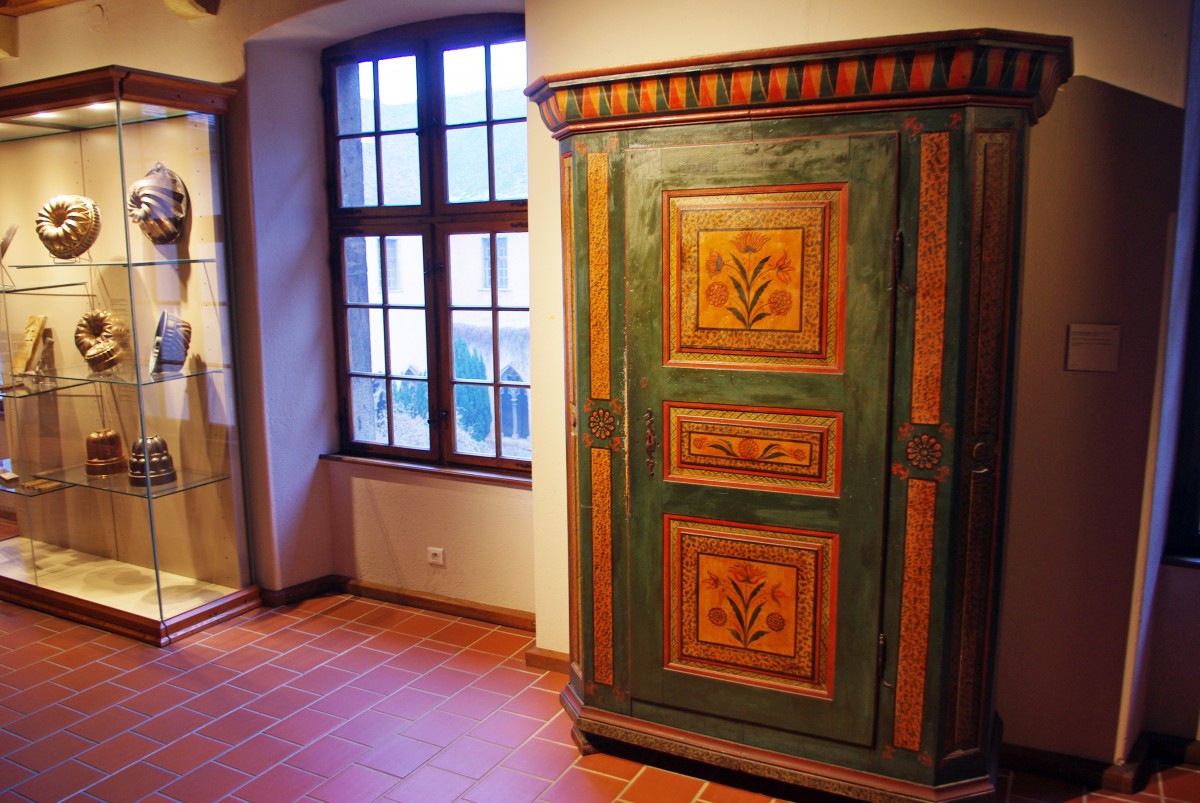
Polychrome Alsatian wardrobe at the Unterlinden Museum in Colmar © French Moments
The History and Techniques of Alsatian Wood Painting
Earlier pieces were often treated with stains that darkened the pale wood while leaving its grain visible. Brown and reddish tones created a warmer appearance and helped define panels and frames.
By the 17th and 18th centuries, craftspeople were using broader palettes and more varied effects. Some designs were painted freehand, while others were applied with stencils or constructed with a compass. Backgrounds could be mottled, grained or marbled.
A remarkable wardrobe made in Vendenheim in 1769, now in the collections of the Musée Alsacien, shows how inventive these techniques could be.
Its brown mottled background was applied with a cut potato, while the floral motifs were added with a stencil. The colours were still limited mainly to white, black and green, but the effect was anything but dull.
As techniques became more specialised, painting was increasingly carried out by the woodworkers who made the furniture. Regional habits varied, however.
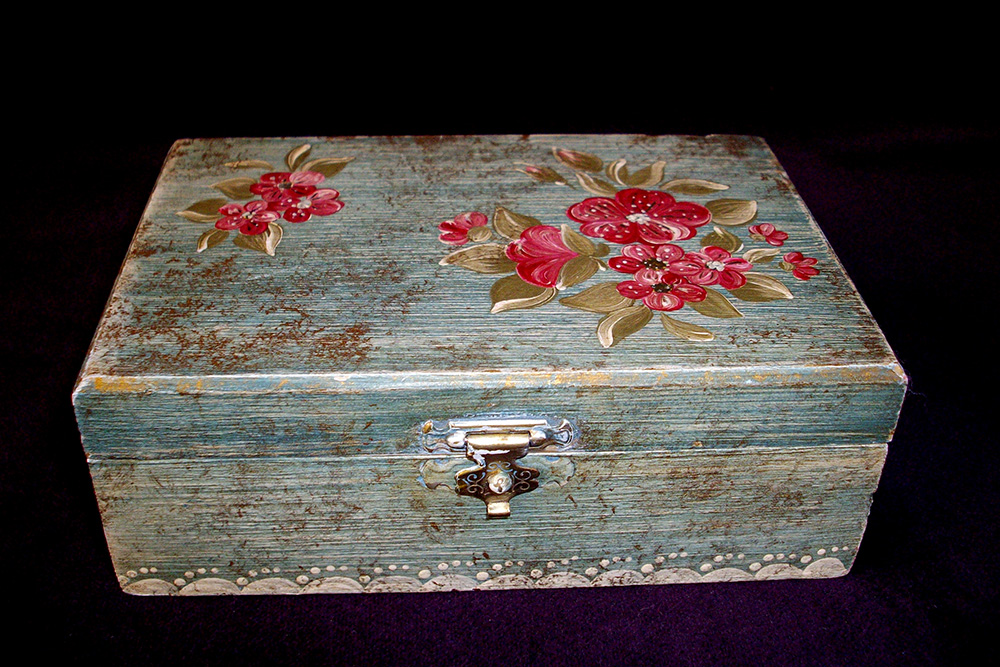
Alsatian Wood Painting © French Moments
Painted Furniture for Everyday Life
The tradition covered a wide range of domestic objects.
Large pieces included wardrobes, beds, cupboards and chests. Smaller items ranged from boxes and cabinets to decorated household tools. Some were intended for daily use, while others were ceremonial or made as gifts.
Wardrobes often contained a section where linen from a bride’s trousseau could be stacked. Chests protected textiles and personal belongings, while painted cupboards brought colour into rooms dominated by timber, plaster and tiled stoves.
An ordinary piece of furniture had to be sturdy and useful. A decorated one could perform the same task while also displaying the household’s tastes, identity or family history.
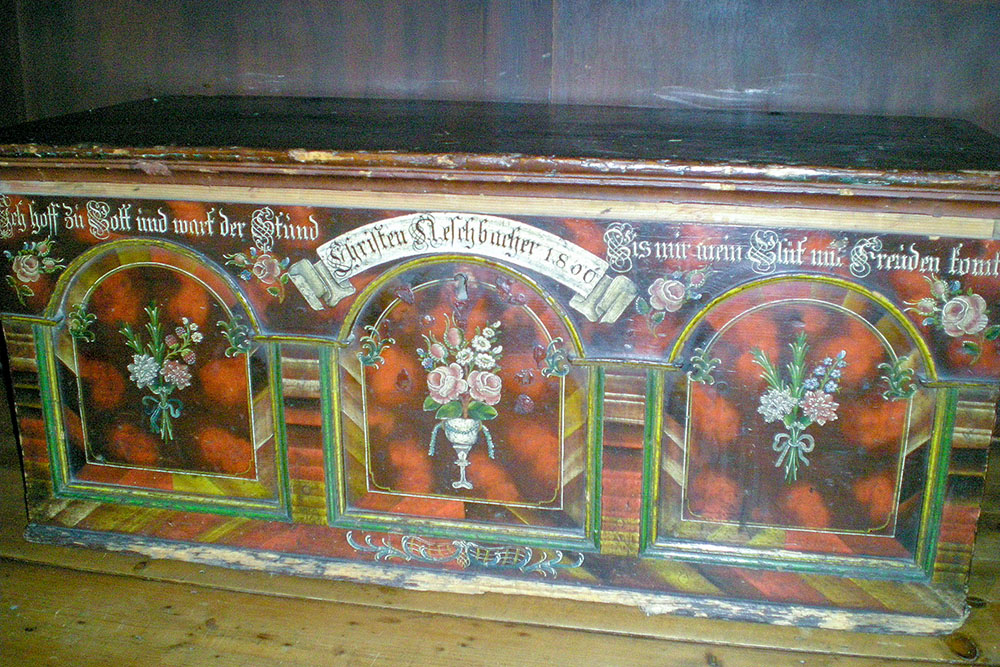
Painted floral motifs on a traditional Alsatian wooden chest © French Moments
Alsatian Wood Painting and Wedding Traditions
Marriage played a central role in the life of many painted pieces.
A wedding chest or wardrobe could form part of a bride’s dowry and accompany her into her new household. The front might bear her initials or full name, the year of the marriage and sometimes a religious inscription or reference to a psalm.
These details turned furniture into a family document. Long after its original owner had died, a dated chest could preserve the memory of a marriage and identify the woman for whom it had been made.
Not every decorated marriage object was intended for heavy use.
The Musée Alsacien holds a polychrome wooden laundry bat made in the Munster Valley in 1772 and given to Catharina Risin for her wedding. Its excellent condition suggests that it was probably a ceremonial gift.
Its compass-drawn rosette was carved and then coloured, using a technique also found on courtship boxes from the valley.
In other words, eighteenth-century wedding presents could be beautiful, symbolic and slightly impractical—some traditions truly are timeless.
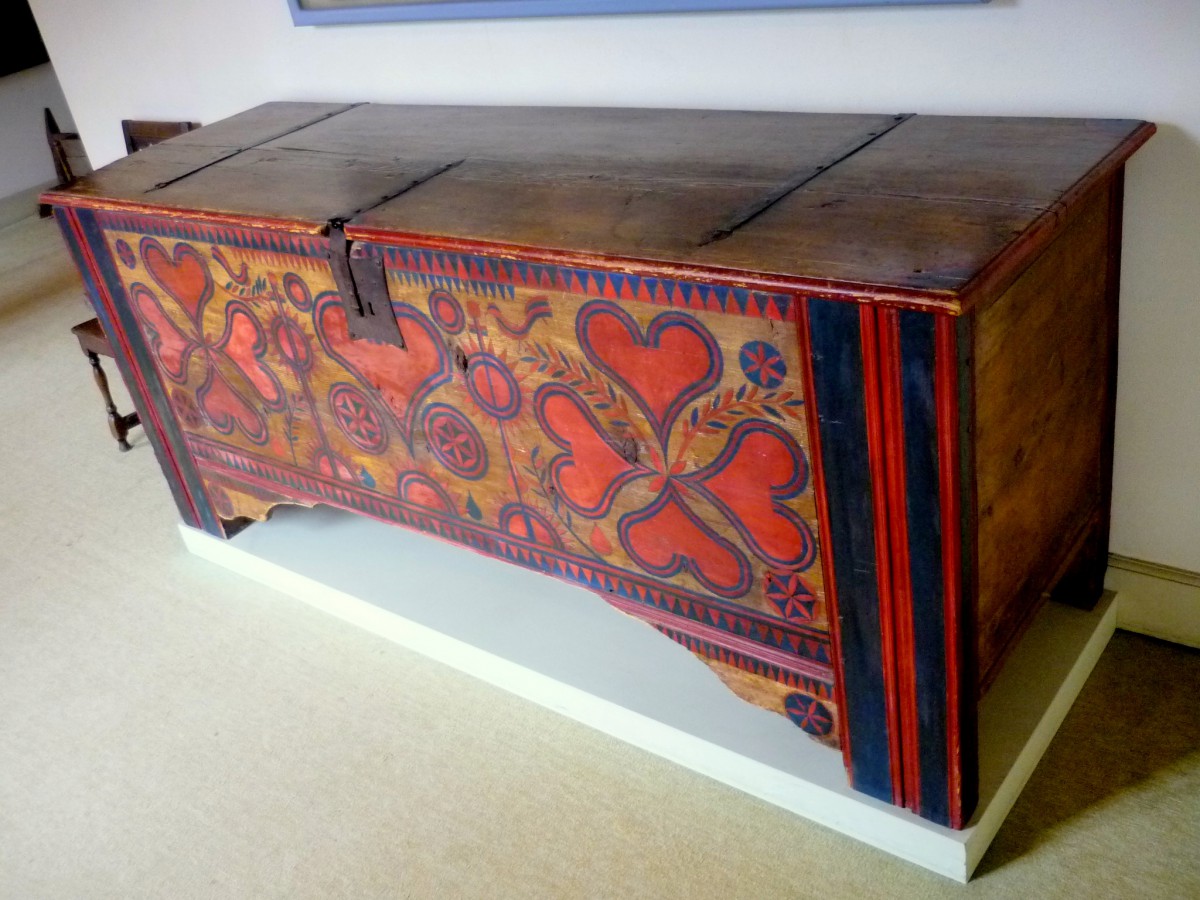
Geometric and floral decoration on Alsatian painted furniture © French Moments
The Minnekästchen: A Small Box with a Romantic Purpose
Among the most charming objects are the coffrets de courtoisie, sometimes known by the German name Minnekästchen.
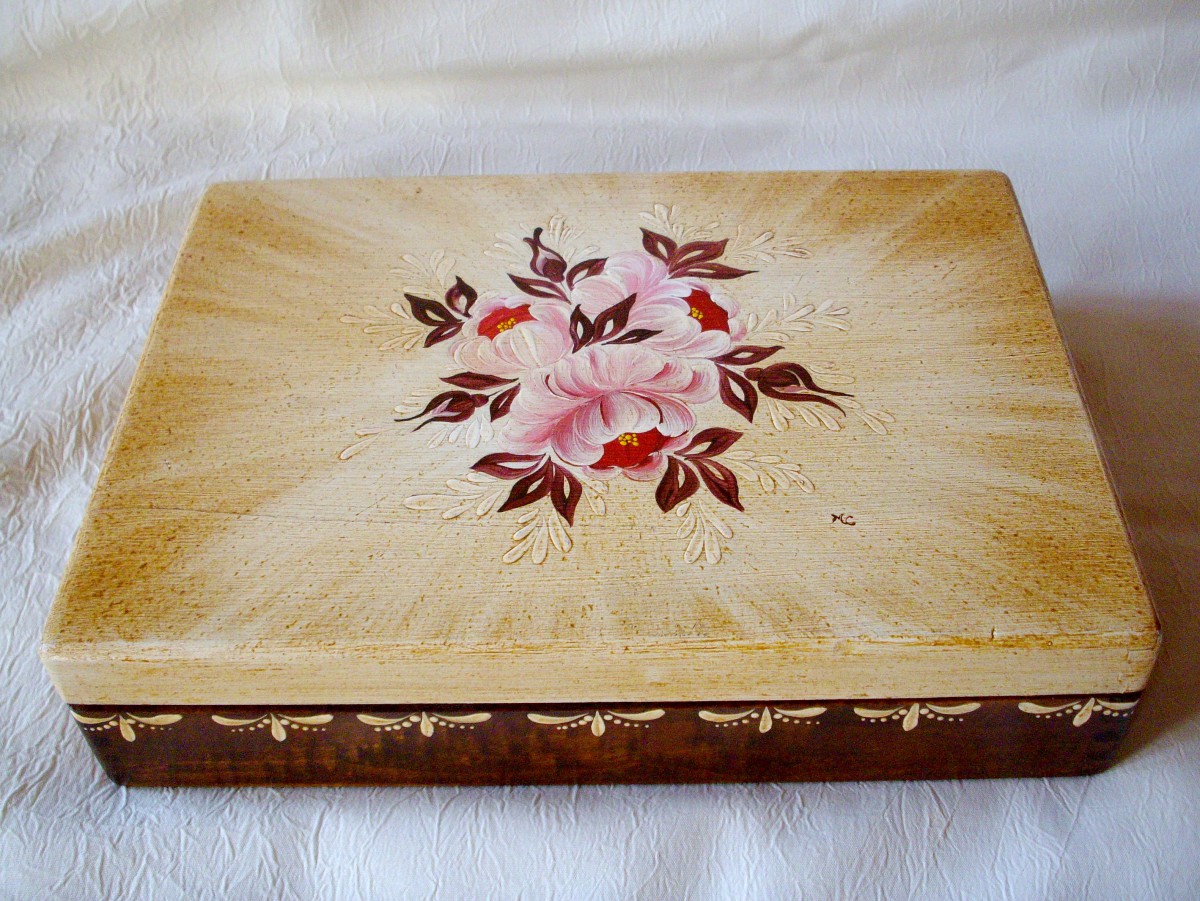
Alsace Wood Painting by MC Guernier © French Moments
These small decorated boxes were offered as tokens of affection, courtship or marriage. A young man might give one to his sweetheart, who could use it to store jewellery, ribbons or other personal possessions.
Some echoed the form of larger marriage chests, with geometric patterns, flowers and carved details.
They remind us that Alsatian painted wood was not limited to imposing wardrobes. It could also appear on an intimate object meant to be held, opened and treasured.
Traditional Motifs in Alsatian Wood Painting
Flowers are among the most recognisable elements of Alsatian wood painting. Tulips, roses, carnations, leaves, vines and stylised bouquets brought the natural world into the home.
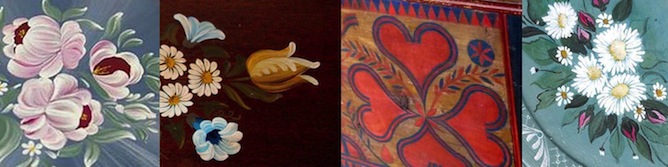
Geometric forms were equally important. Stars, diamonds, circles, rosettes, hearts and interlaced lines could be arranged symmetrically across panels and doors. Craftspeople sometimes used compasses and stencils to repeat these shapes with precision.
Certain motifs were associated with ideas such as love, fertility, prosperity, protection, faith and the continuity of life.
The heart naturally suggested affection and unity, while the tree of life evoked growth and renewal. Rosettes could carry solar associations and refer to the cycle of life.
However, these meanings should not be treated as a universal code. Symbols could change according to place, period, religious background and context.
Names, initials and dates were more straightforward. They placed the object within a particular family and moment in time, making the furniture both decorative and deeply personal.
A painted chest could therefore store a bride’s linen, record her wedding date and wish the couple prosperity—all before flat-pack furniture had even been invented.
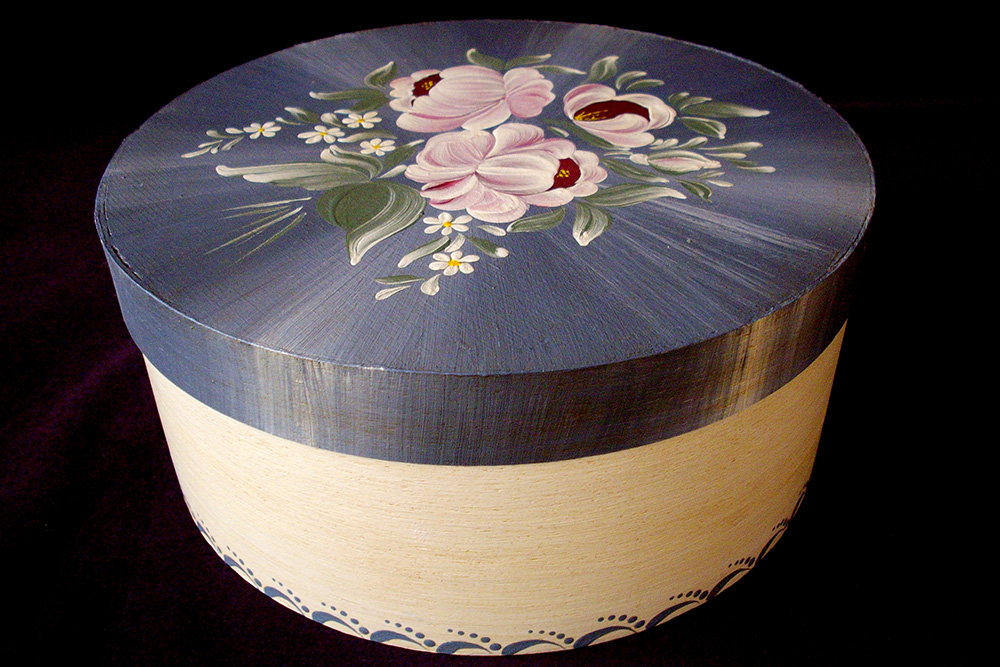
Modern Alsatian wood painting with colourful floral motifs © French Moments
Alsatian Wood Painting as a Living Hobby
Alsatian wood painting has not disappeared from everyday cultural life.
Across Alsace, and particularly in the south of the region and the Sundgau, local associations and creative clubs continue to organise wood-painting classes.
In French, these sessions are known as ateliers de peinture sur bois.
Participants learn how to prepare a wooden object, transfer or draw a design, combine colours and apply the fine brushwork needed for flowers, birds, hearts and seasonal decorations.
Some workshops draw inspiration from traditional Alsatian motifs, while others use more contemporary patterns. The objects painted today may include trays, boxes, small pieces of furniture, signs and decorations for Christmas or Easter.
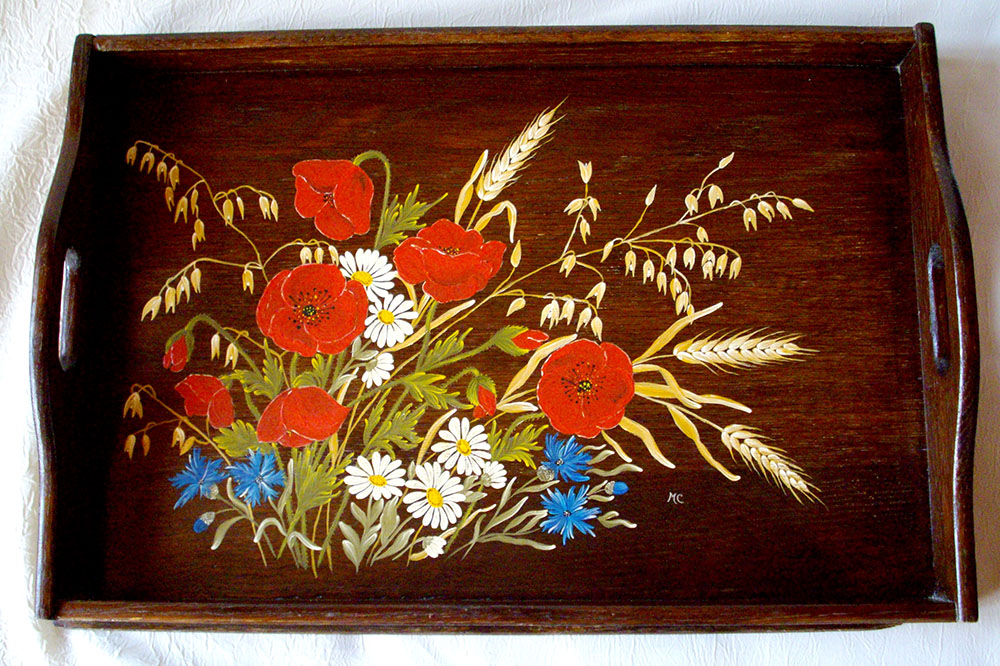
Modern Alsatian wood painting with colourful floral motifs © French Moments
From my own experience of living in the Sundgau, this patient and sociable hobby has long been particularly popular with women, including many retirees.
The weekly workshop provides time to create, exchange ideas and enjoy the company of others—often over several hours, since a detailed floral design cannot be hurried.
Local creative organisations in places such as Hirsingue and Rixheim have offered activities connected with painting on wood, illustrating how the craft continues through clubs and community workshops.
These modern classes are not necessarily attempts to reproduce historic furniture exactly. Nevertheless, they help preserve an appreciation for painted decoration and continue the Alsatian habit of transforming an ordinary wooden object into something personal and colourful.
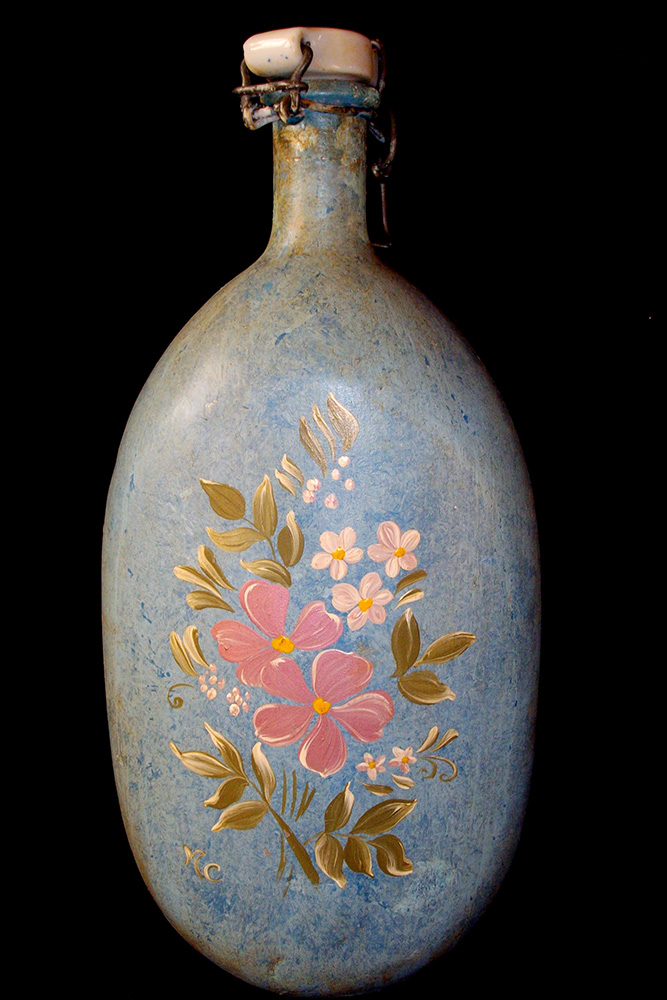
Alsatian Wood Painting © French Moments
Where to See Alsatian Wood Painting
Several museums allow visitors to discover authentic examples of Alsatian wood painting.
Musée Unterlinden in Colmar
Best known for the Isenheim Altarpiece, the Musée Unterlinden also holds ethnographic collections devoted to regional popular arts.
These include courtship boxes, painted furniture, ceramics and other objects connected with everyday life in Alsace.
The museum notes that only a selection is currently displayed while parts of the decorative arts presentation are being reorganised.
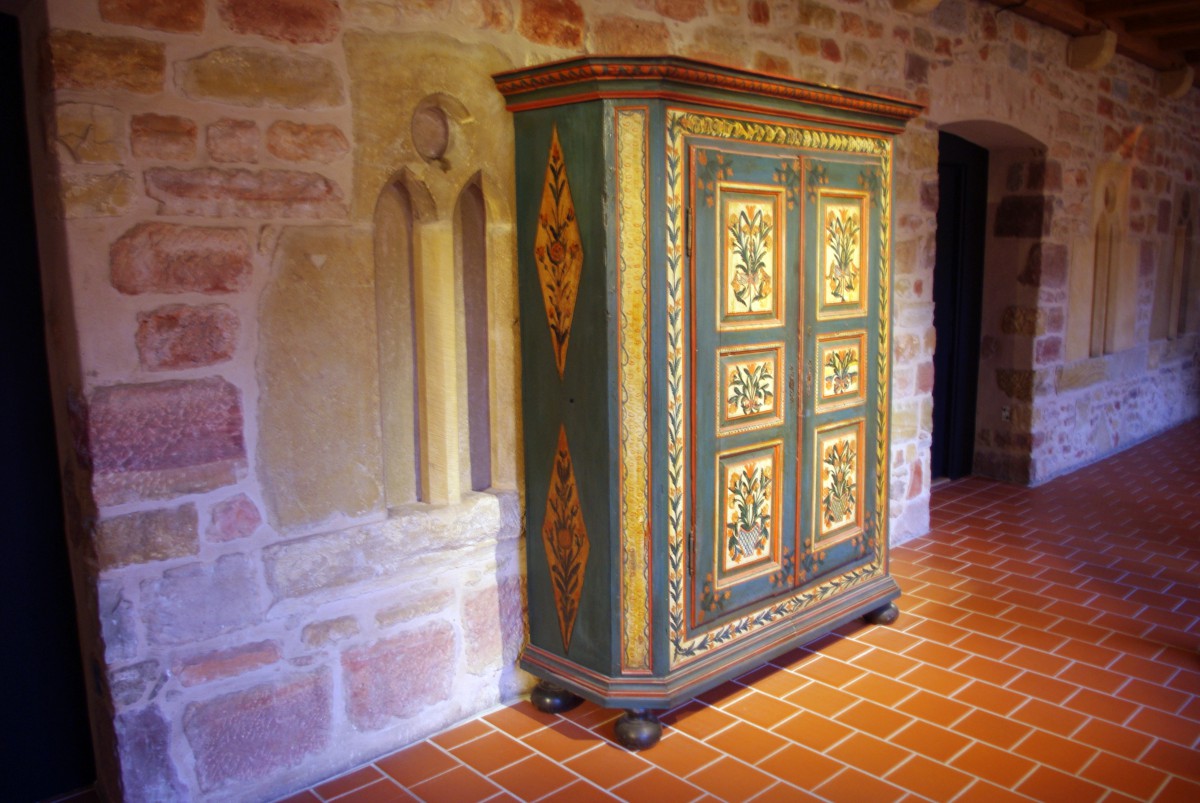
Polychrome Alsatian wardrobe at the Unterlinden Museum in Colmar © French Moments
Musée Alsacien in Strasbourg
The Musée Alsacien has an important collection of furniture, costumes, ceramics and domestic objects.
Its online collection is particularly useful for exploring individual pieces, including the 1769 wardrobe from Vendenheim.
The museum itself is currently closed for renovation, with reopening planned for 2028. Check the official Strasbourg Museums website before planning a visit.
Écomusée d’Alsace
Near Mulhouse, the Écomusée d’Alsace places traditional objects within reconstructed houses and a wider rural setting.
It is a valuable place to understand how timber shaped Alsatian architecture, furniture and everyday life rather than viewing an isolated cupboard in a display case.
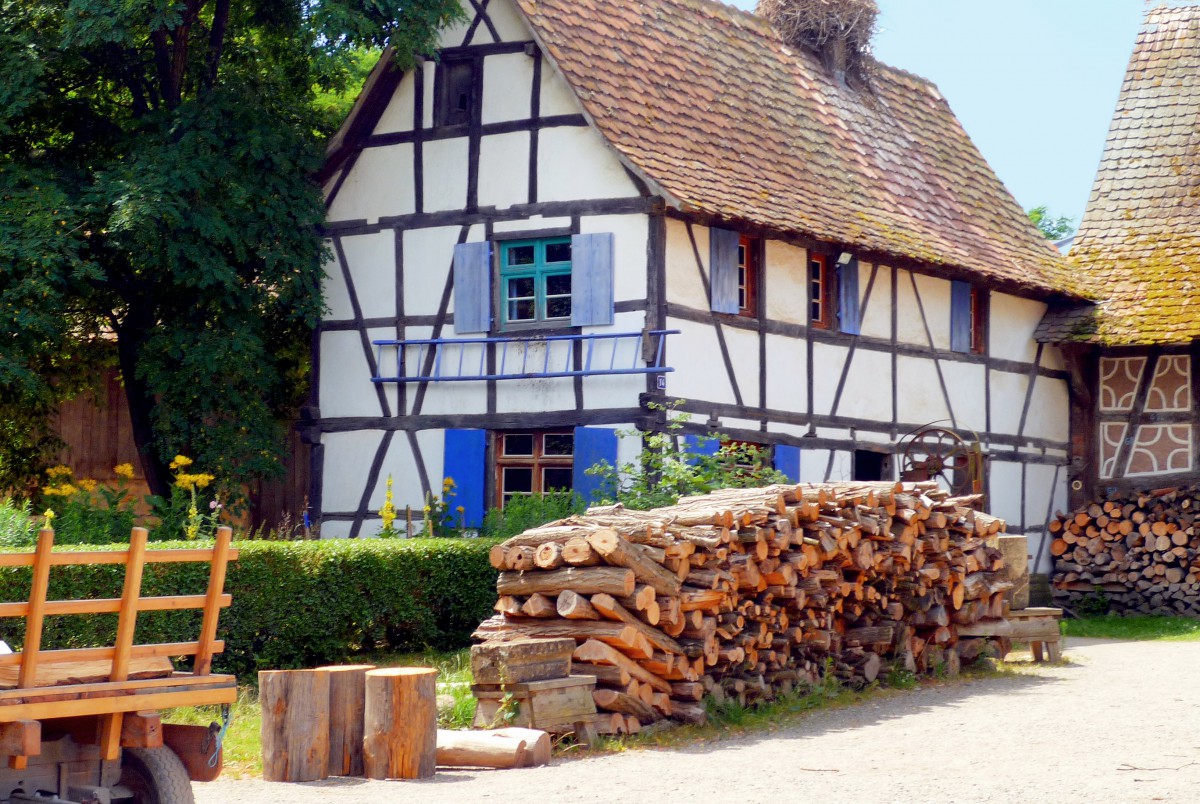
Ecomusée d'Alsace © French Moments
Why Alsatian Painted Furniture Still Matters
Alsatian wood painting brings together craftsmanship, usefulness and memory.
A wardrobe could store linen, decorate a farmhouse room and preserve a wedding date at the same time. A small painted box could hold jewellery while recalling a courtship or engagement.
The appeal of these objects lies not only in their bright colours but also in their individuality. Each flower, inscription and carefully painted panel tells us something about the people who commissioned, made and lived with the piece.
Centuries later, this furniture still succeeds in its original purpose: turning an everyday wooden object into something worth noticing.