Eguisheim is one of the most recognisable villages in Alsace. Its colourful half-timbered houses, cobbled lanes and flower-filled windows appear on countless postcards, calendars and travel brochures.
Yet the village is more than a particularly photogenic collection of old houses.
Its unusual circular layout tells the story of a community that developed around a medieval castle. Its church preserves rare works of religious art, its old courtyards recall the importance of monastic landowners, and its surrounding hills produce some of the best-known wines in Alsace.
Eguisheim lies about five kilometres south-west of Colmar, where the foothills of the Vosges meet the Alsace Plain.
It stands on the Alsace Wine Route and belongs to the association of the Plus Beaux Villages de France.
In 2013, television viewers also chose it as the Village préféré des Français — France’s Favourite Village.
I returned to Eguisheim in late May 2026, almost ten years after my previous visit. The village had not lost its charm, but it had certainly become busier. That visit reminded me that enjoying Eguisheim depends as much on when you arrive as on what you see.
This guide will help you understand the village, follow a logical walking route and make the most of your visit.
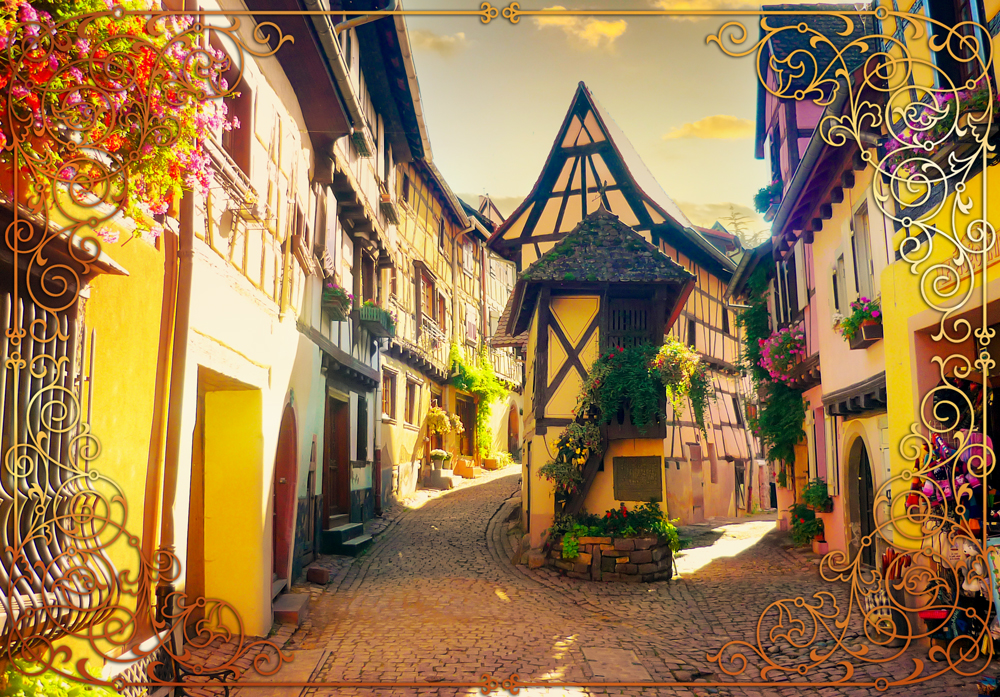
Fairy tale destinations in France - Eguisheim © French Moments
Why is Eguisheim so special?
Seen from above, Eguisheim looks quite different from most French villages.
Instead of developing around one long main street, its historic centre forms a series of rings around the central castle. The curved Rue du Rempart follows the line of the medieval fortifications, creating the circular route for which the village is famous.
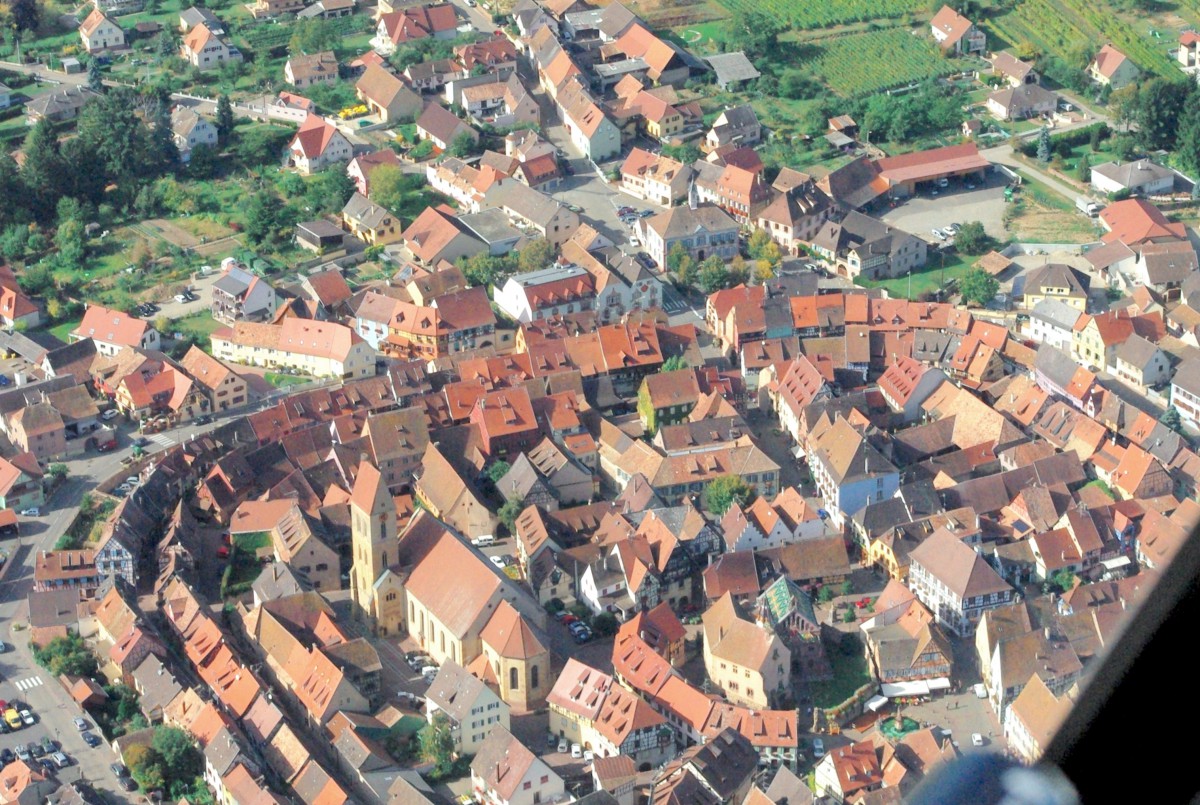
Eguisheim from above © French Moments
This layout is not a piece of modern town planning designed to please photographers. It developed gradually around a fortified residence founded during the early Middle Ages.
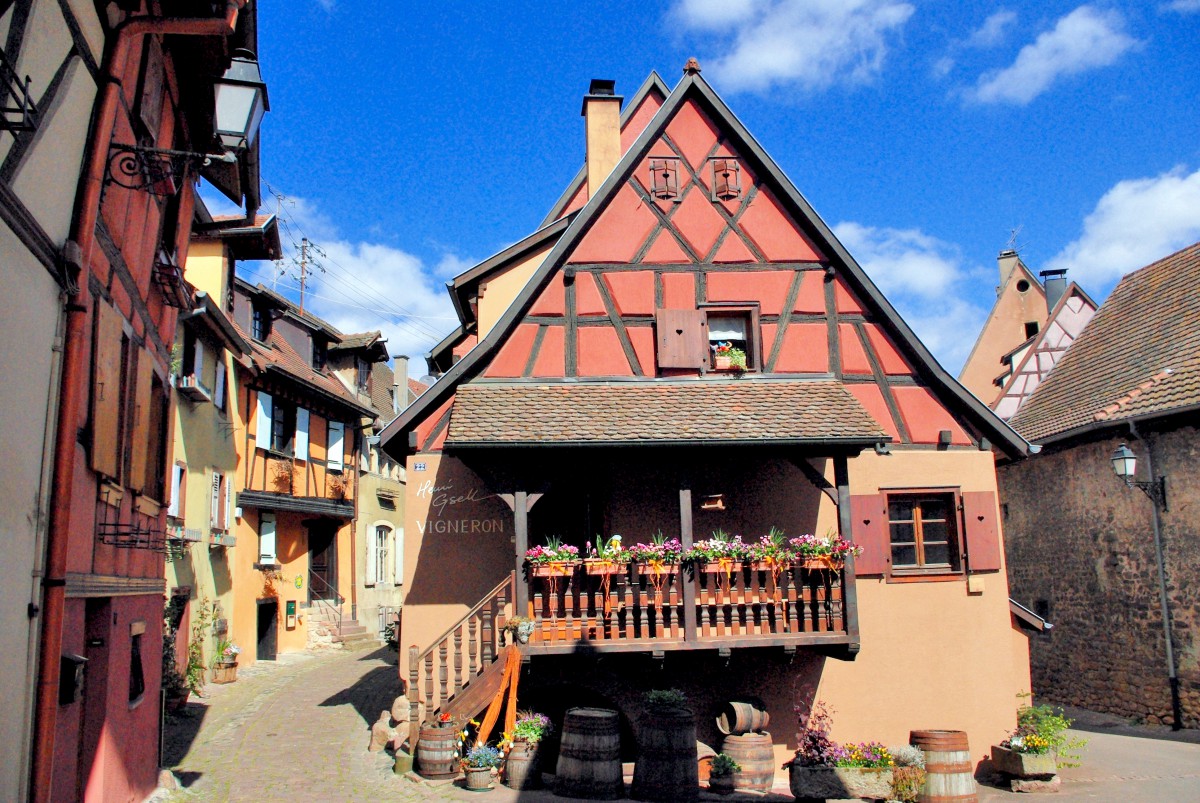
The narrow plots beside the former ramparts were later occupied by winegrowers’ houses. As space was limited, some of these buildings are remarkably narrow, with steep roofs, pointed gables and upper floors projecting above the street.
The result is a village that feels both carefully ordered and wonderfully irregular.
A brief history of Eguisheim
The history of Eguisheim began long before the construction of its half-timbered houses.
Archaeological discoveries show that the area was occupied in prehistoric times. Traces of Roman activity have also been found, and vines were probably cultivated here during the Gallo-Roman period.
The site developed more substantially during the early Middle Ages. According to local tradition, Count Eberhard, a descendant of the early Dukes of Alsace and a relative of Saint Odile, established or restored a castle here around the year 720.
A settlement gradually formed around the fortress. Over the centuries, successive lines of fortifications influenced the circular pattern that still defines the old village today.
Eguisheim later became associated with one of the most important Alsatians of the Middle Ages: Bruno of Eguisheim-Dagsbourg, who became Bishop of Toul and then Pope Leo IX in 1049.
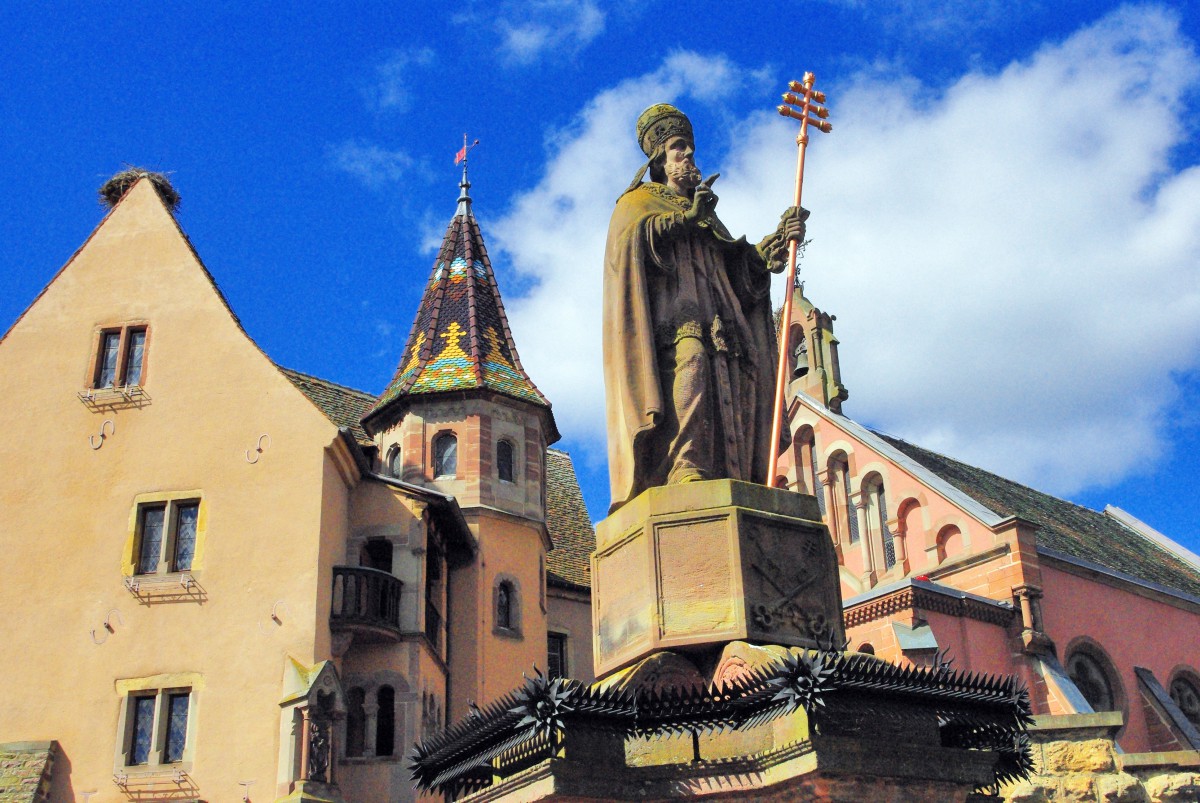
St. Leon, fountain of place du château © French Moments
The village traditionally presents itself as his birthplace. However, historians remain cautious about the precise location. Bruno may have been born at the fortified site in the village or at the Haut-Eguisheim castles in the hills above it.
Whatever the answer, the memory of Pope Leo IX occupies a central place in the identity of Eguisheim.
What to see in Eguisheim
The historic centre is compact and can easily be explored on foot.
You could walk around it quickly in an hour, but that would rather miss the point. Allow at least two or three hours to appreciate the architecture, enter the church and chapel, observe the small details and perhaps stop for lunch or a wine tasting.
A good route begins near the eastern entrance to the old village and follows the Grand’Rue towards Place du Château Saint-Léon. From there, continue around the Rue du Rempart-Sud and Rue du Rempart-Nord.
Begin your visit on the Grand’Rue
The Grand’Rue crosses the historic centre from east to west.
Coming from the Town Hall car park, you enter the old village near the site of the former lower gate, or Niedertor. The fortified gate itself has disappeared, but the fountain near the entrance recalls this former gateway into Eguisheim.
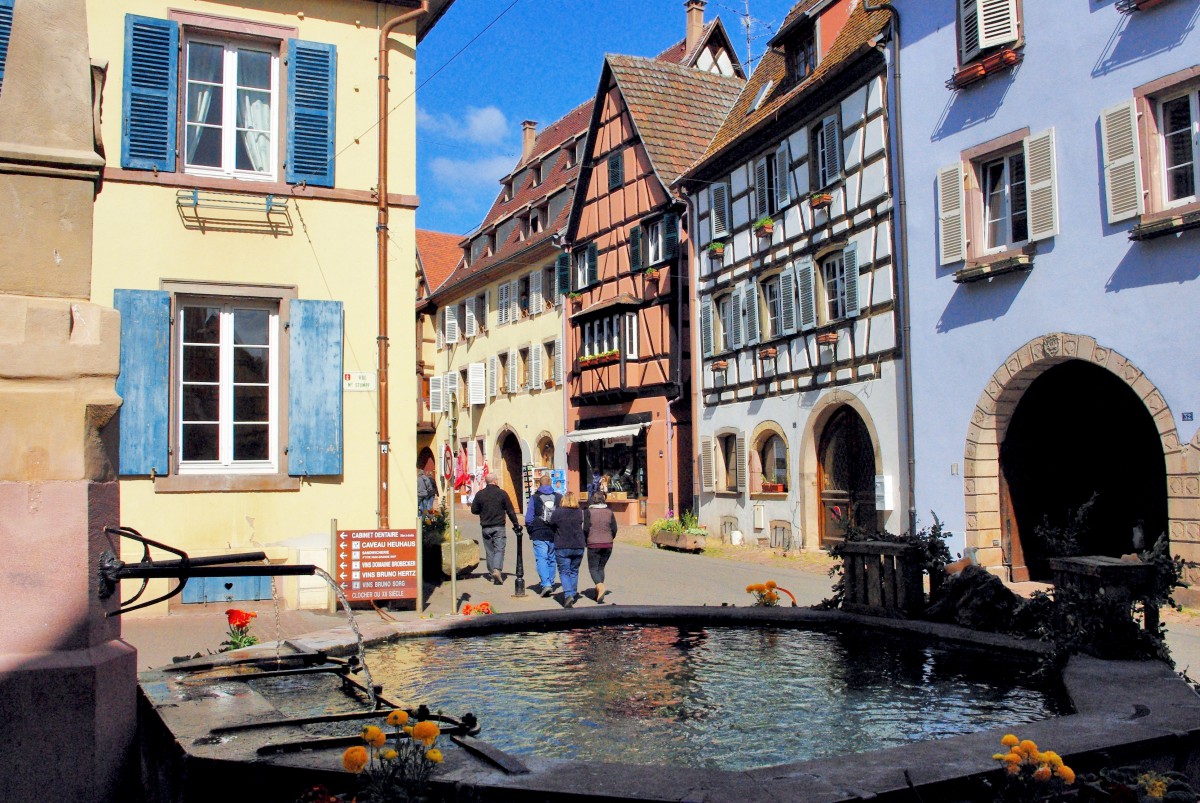
Grand-Rue (Main street) © French Moments
The Grand’Rue is wider than the lanes beside the ramparts. It is lined with substantial houses, carved stone doorways, wine estates, shops and restaurants.
Look closely at the dates and symbols carved above the entrances. Many reveal the age of the house, the profession of its former owner or the initials of the couple who built it.
Discover the Unterlinden Court
Near the beginning of the Grand’Rue stands the Unterlinden Court, also known as the Catharinenhof.

The Unterlinden Court © French Moments
It is one of the former monastic and tithe courtyards that once existed in Eguisheim. These large agricultural estates belonged to abbeys, convents or religious institutions. They provided places where produce could be collected, stored and administered.
The Unterlinden Court is documented from 1290 and was associated with the Dominican nuns of Colmar, whose former convent now houses the Musée Unterlinden.
Its buildings, arranged around a courtyard, date mainly from between the 16th and 18th centuries. They offer a glimpse of an aspect of village life that is easily overshadowed by Eguisheim’s more picturesque houses.
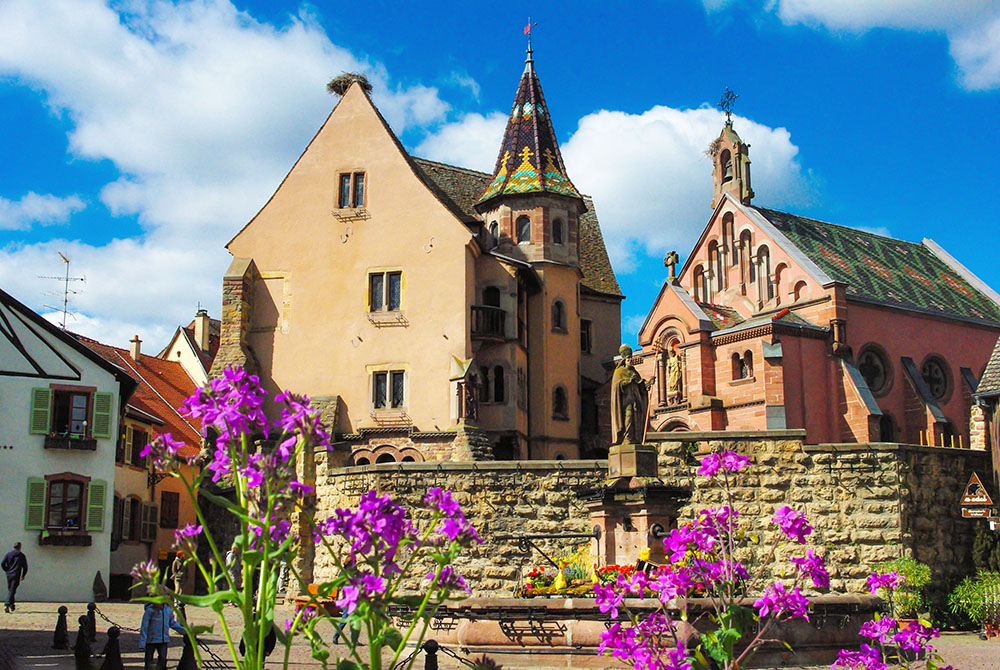
Place du Château Saint-Léon
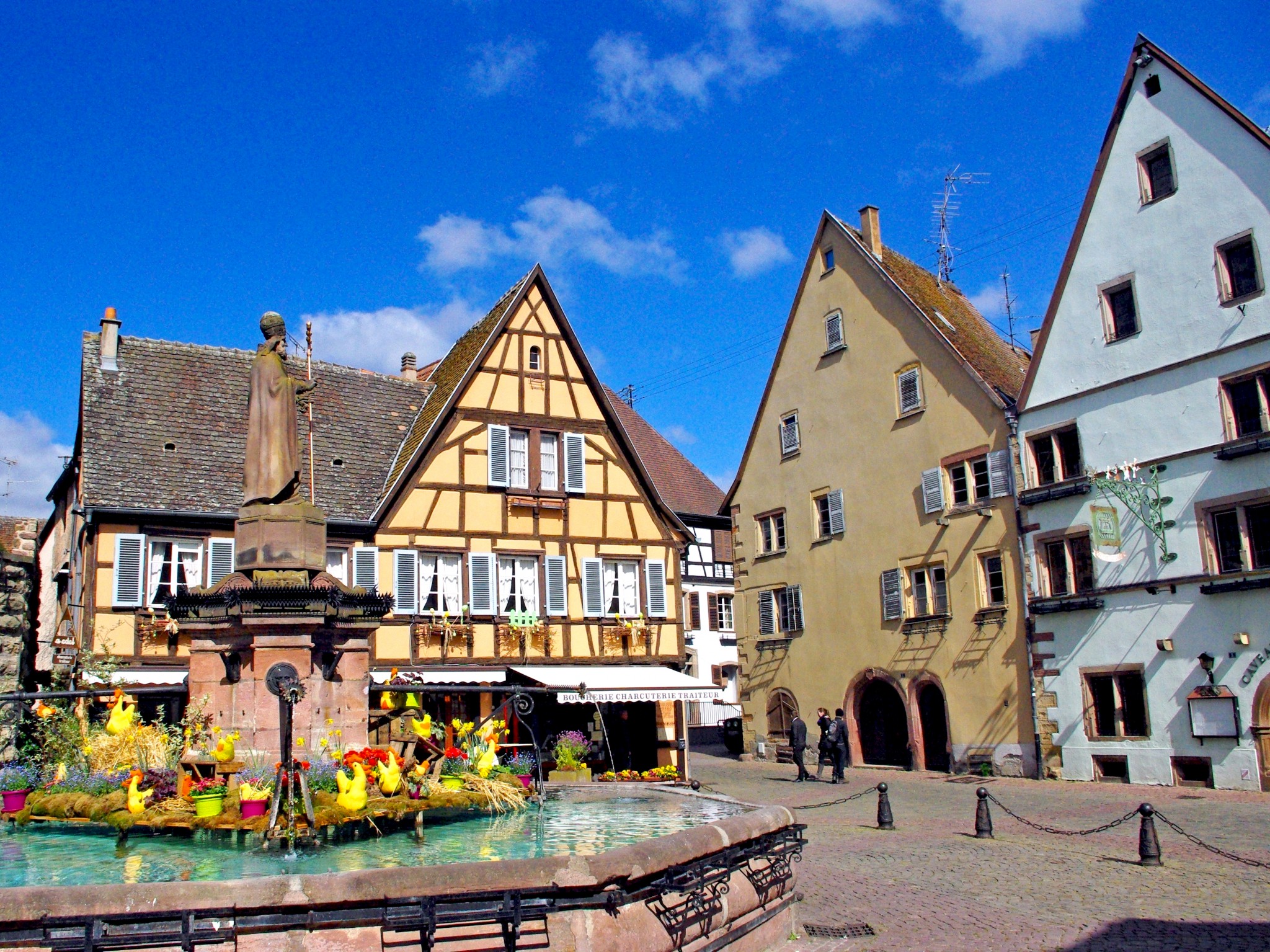
The Grand’Rue leads to the heart of Eguisheim: Place du Château Saint-Léon.
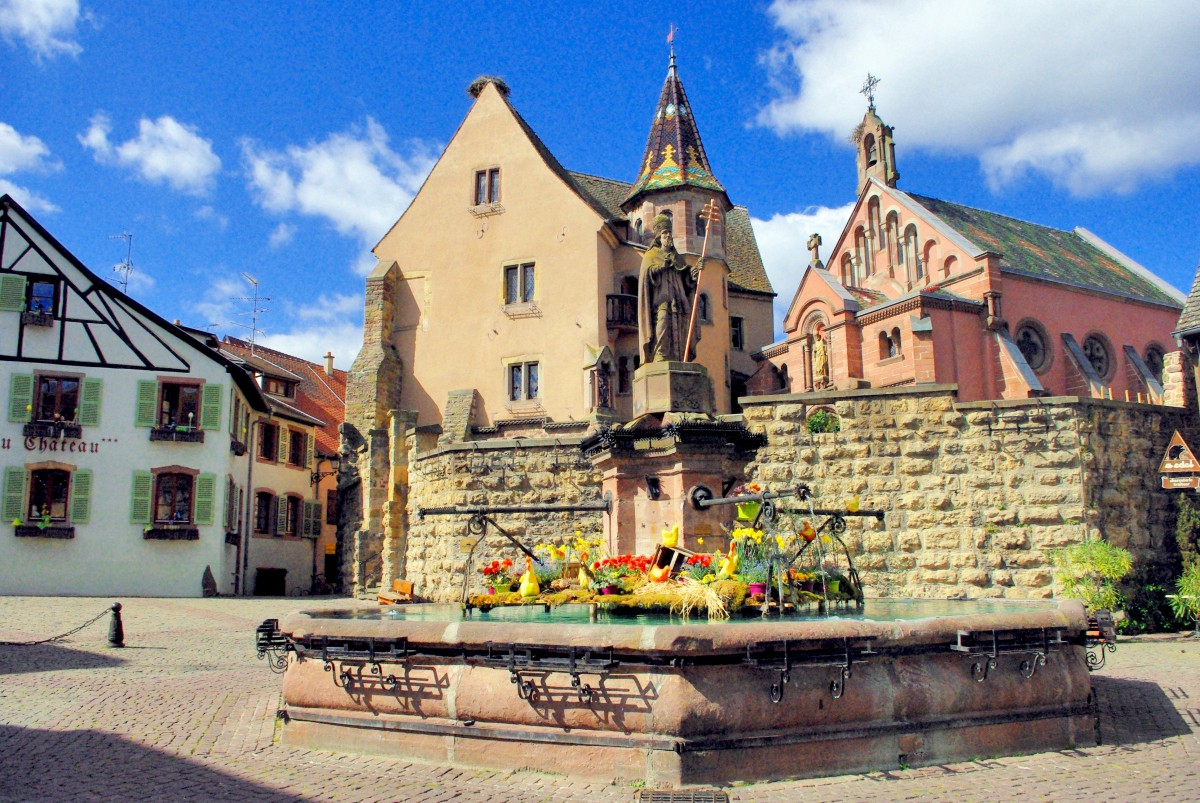
Place du château Saint-Léon © French Moments
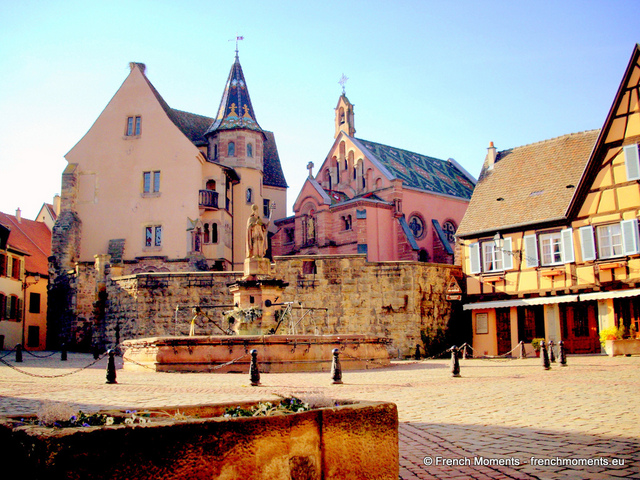
This large square is surrounded by colourful houses and dominated by three monuments closely connected with Pope Leo IX:
- the castle of the Counts of Eguisheim;
- the Saint-Léon Chapel;
- the Saint-Léon Fountain.
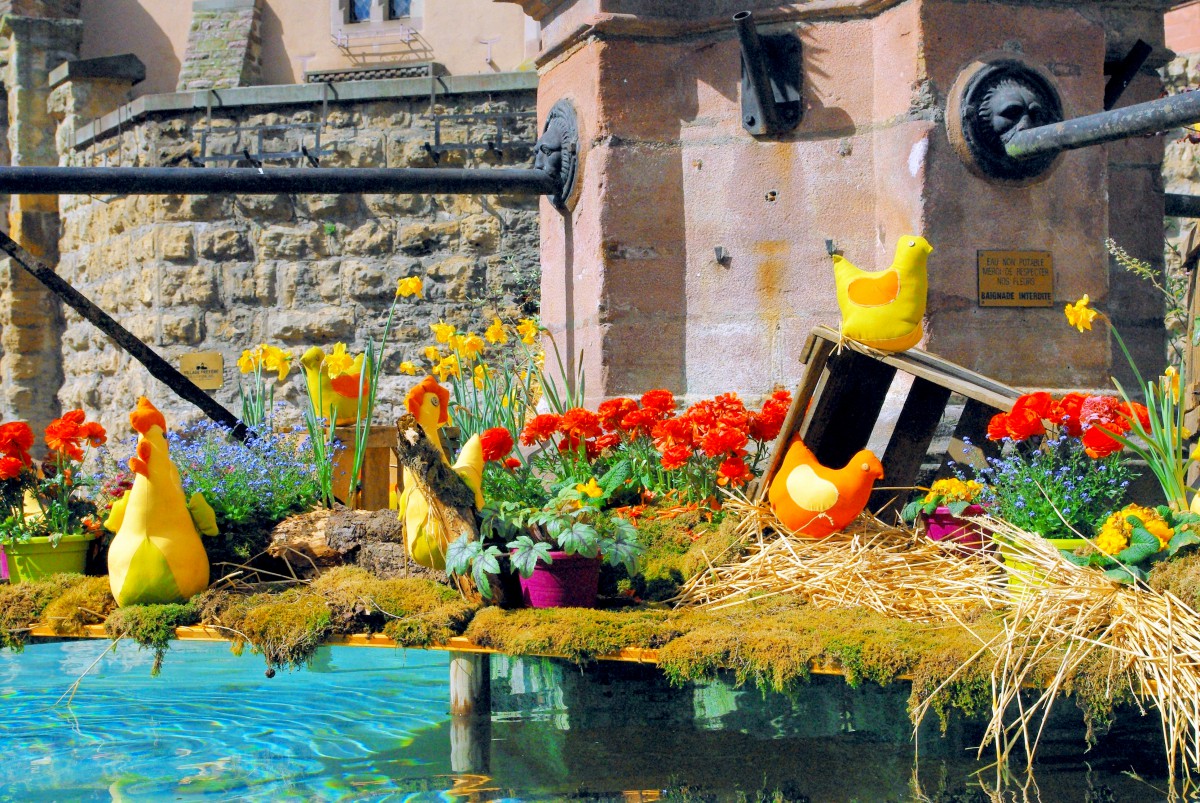
During spring, the fountain is often decorated for Easter. In summer, flowers fill the square, while Advent brings Christmas lights and seasonal decorations.

Eguisheim at Christmas © French Moments
It is the most monumental part of the village, but it can also become its busiest. Early morning is the best time to appreciate the square before groups and day visitors arrive.
The Castle of the Counts of Eguisheim
At the centre of the square stands the former castle of the Counts of Eguisheim.
The fortress is surrounded by an unusual octagonal wall. Parts of the enclosure date from the 13th century, although the site itself is much older and the buildings have been altered repeatedly.
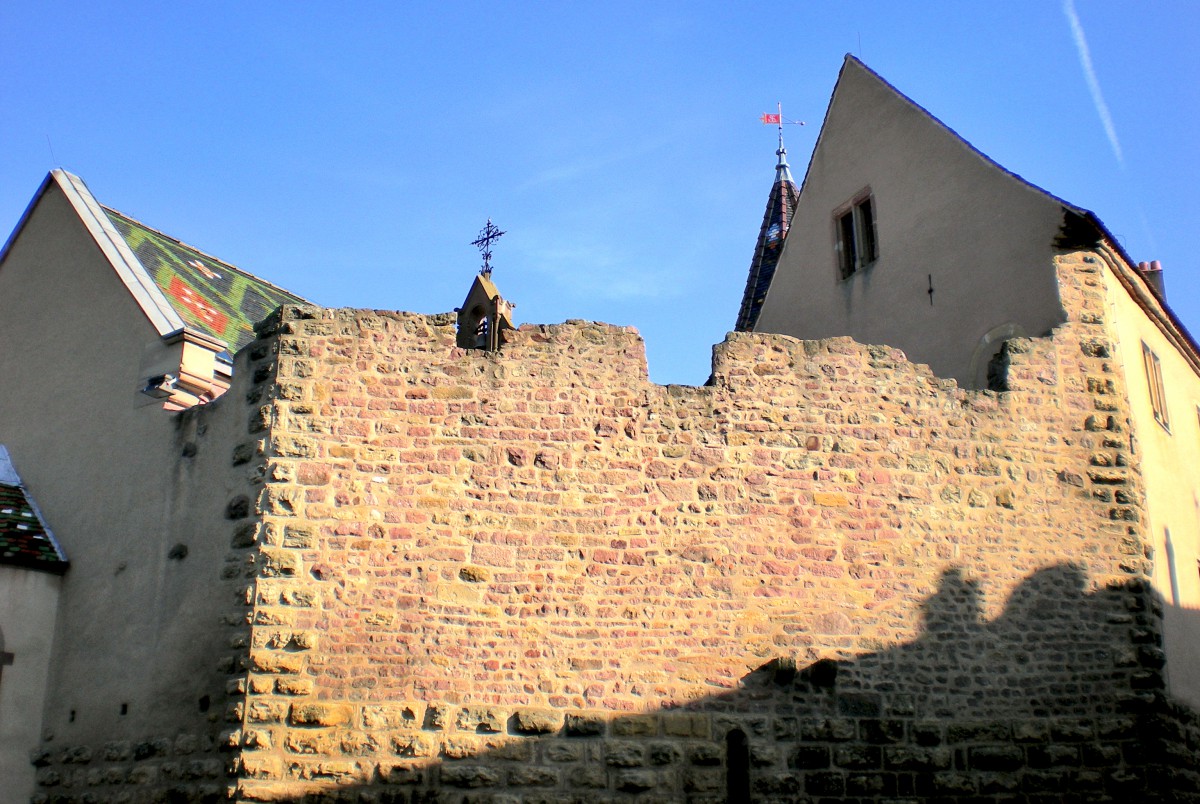
Eguisheim Castle Wall © French Moments
The castle was once protected by a moat. This was drained during the 19th century, leaving the compact fortified enclosure that visitors see today.
The building now belongs to the municipality. It is not normally open for independent visits and can usually only be entered during organised guided tours, exhibitions or special events.
Saint-Léon Chapel
The chapel inside the castle enclosure looks medieval, but it is much more recent.
It was built in the neo-Romanesque style between 1888 and 1894 on the foundations of the former castle keep. The chapel was dedicated to Pope Saint Leo IX and consecrated in 1894.
Inside, seven painted medallions on the vaulted ceiling illustrate episodes from the pope’s life. The stained-glass windows, installed in the 1890s, depict saints associated with Alsace and the family of the Counts of Eguisheim.
A reliquary traditionally believed to contain part of the skull of Saint Leo is also preserved here.
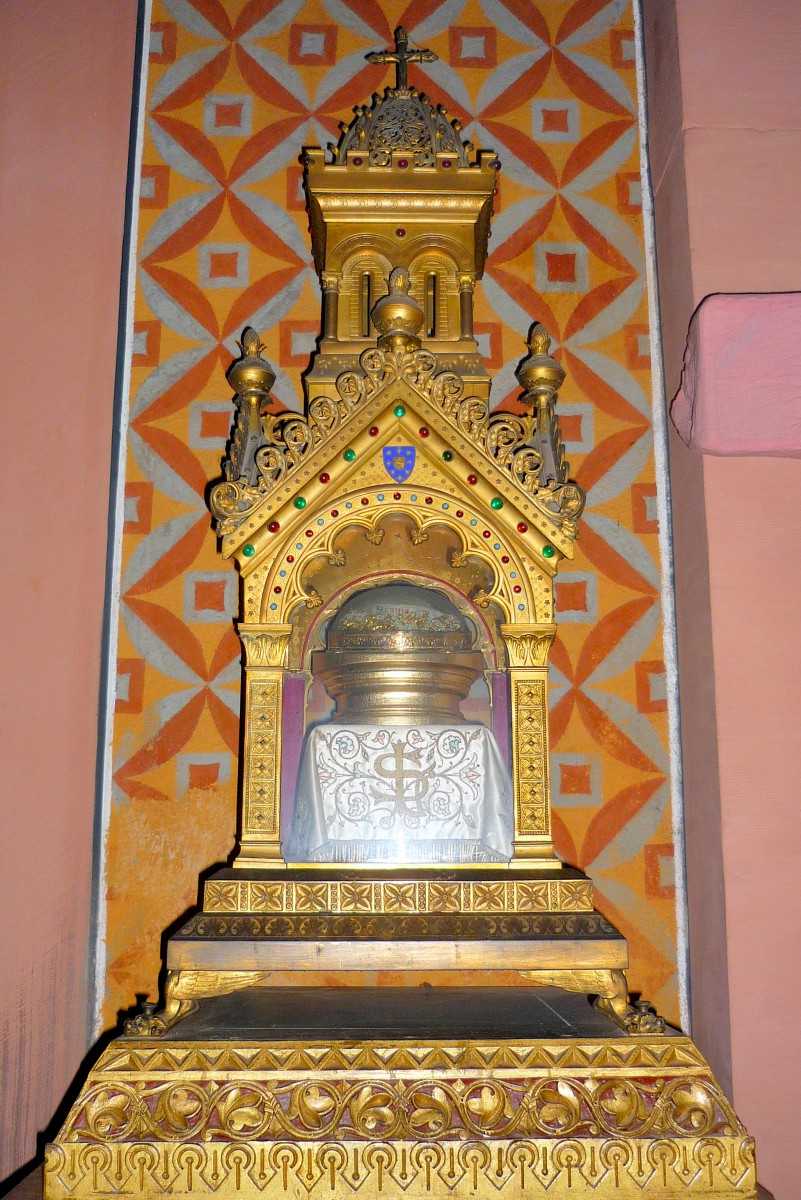
Relics of St. Leon © French Moments
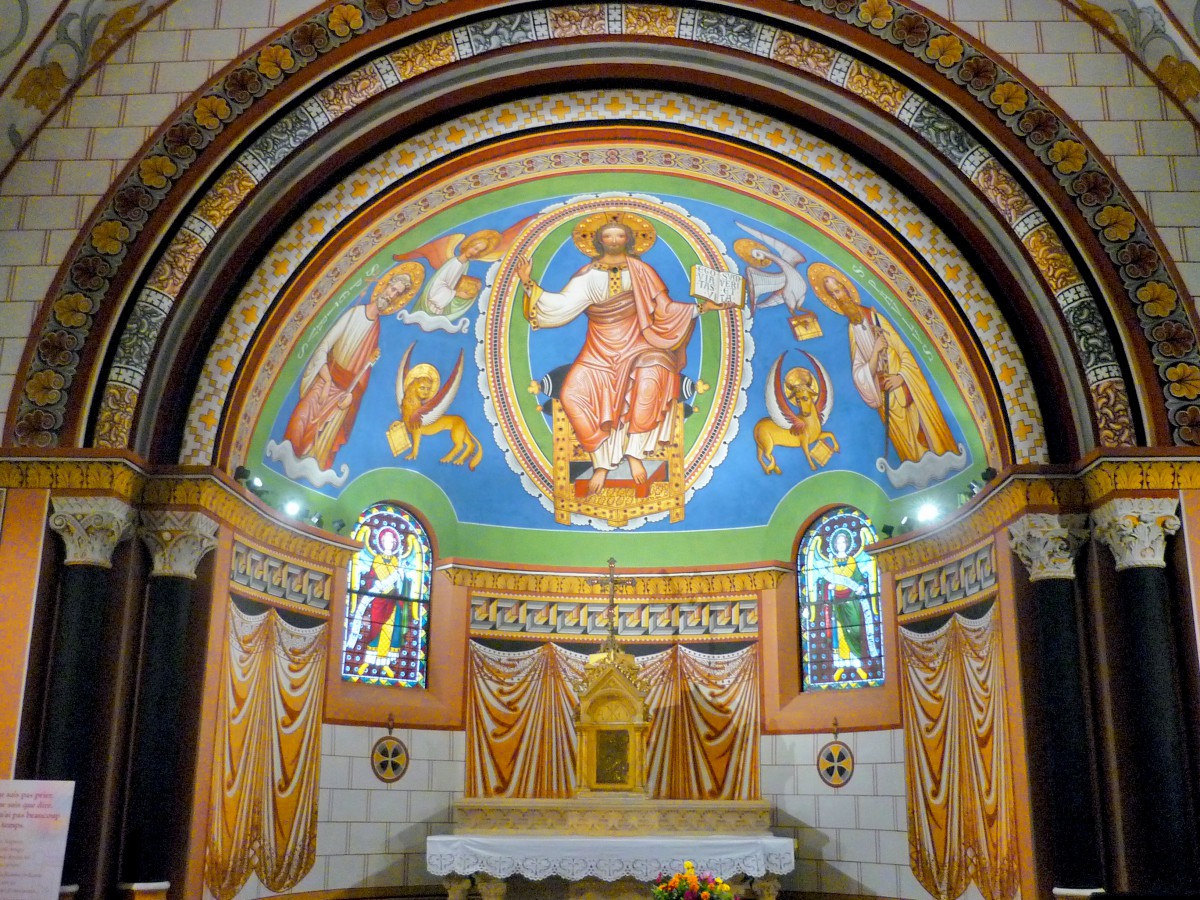
Altar inside St. Leon chapel © French Moments

Painted vault, St. Leon chapel © French Moments
The chapel is small and does not require a long visit, but it provides essential context for understanding the importance of Leo IX to Eguisheim.
Saint-Léon Fountain
The large octagonal fountain outside the castle is one of the most imposing fountains in Alsace.

Fountain of St Leo © French Moments
In the past, it supplied water for domestic use and provided a drinking place for animals. The statue of Saint Leo that rises above the basin was created by a sculptor from Sélestat and installed in 1842.
The Church of Saints Peter and Paul
A few steps from the castle square stands the parish church of Saints Peter and Paul.
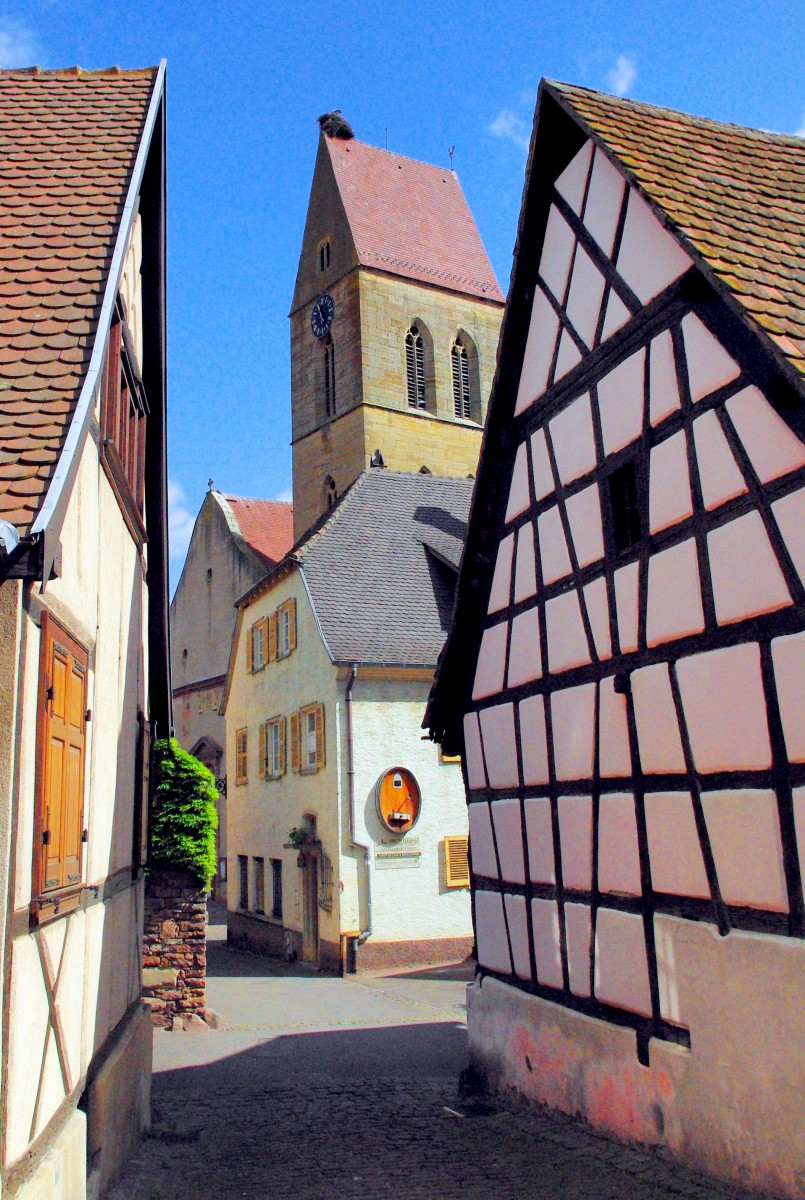
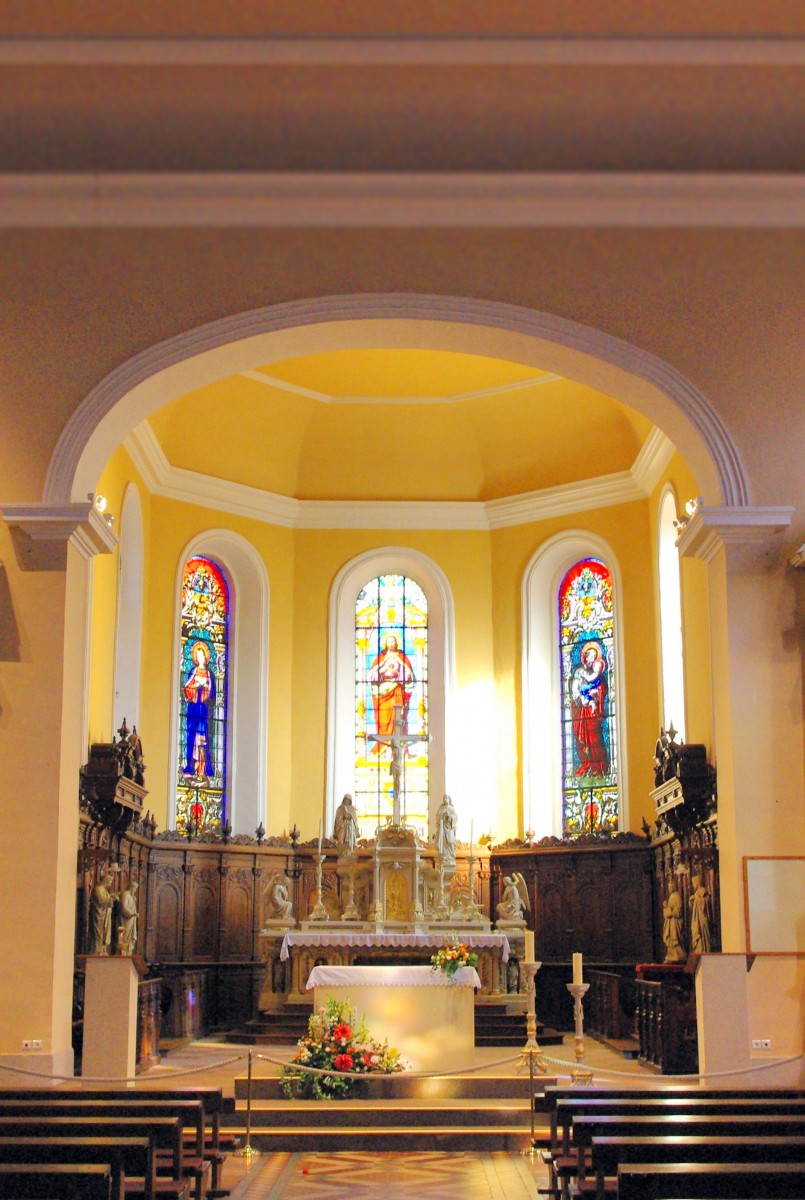
The altar of the Eguisheim parish church © French Moments
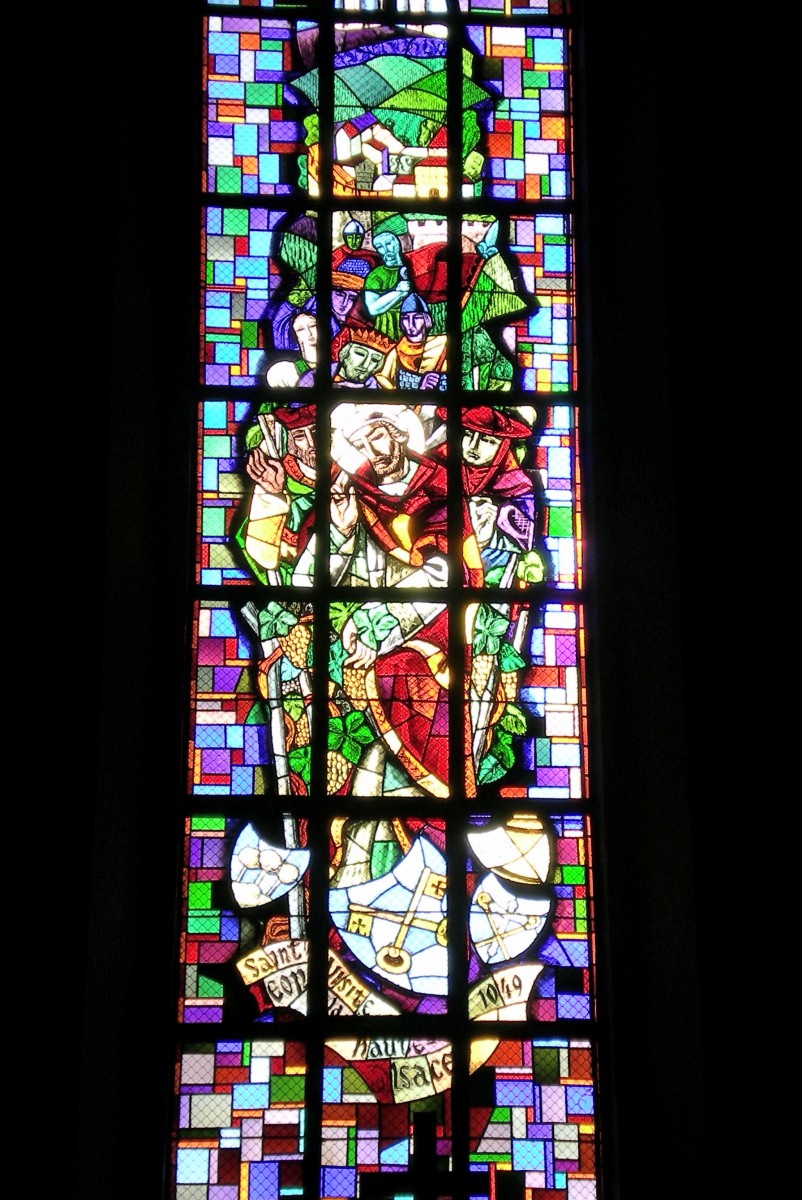
Modern stained-glass windows inside the parish church © French Moments
Most of the present nave dates from the early 19th century. The medieval church had become dilapidated and was demolished in 1807, although its Romanesque-Gothic bell tower and historic portal were preserved.
Walk beneath the tower to see the remarkable polychrome tympanum.
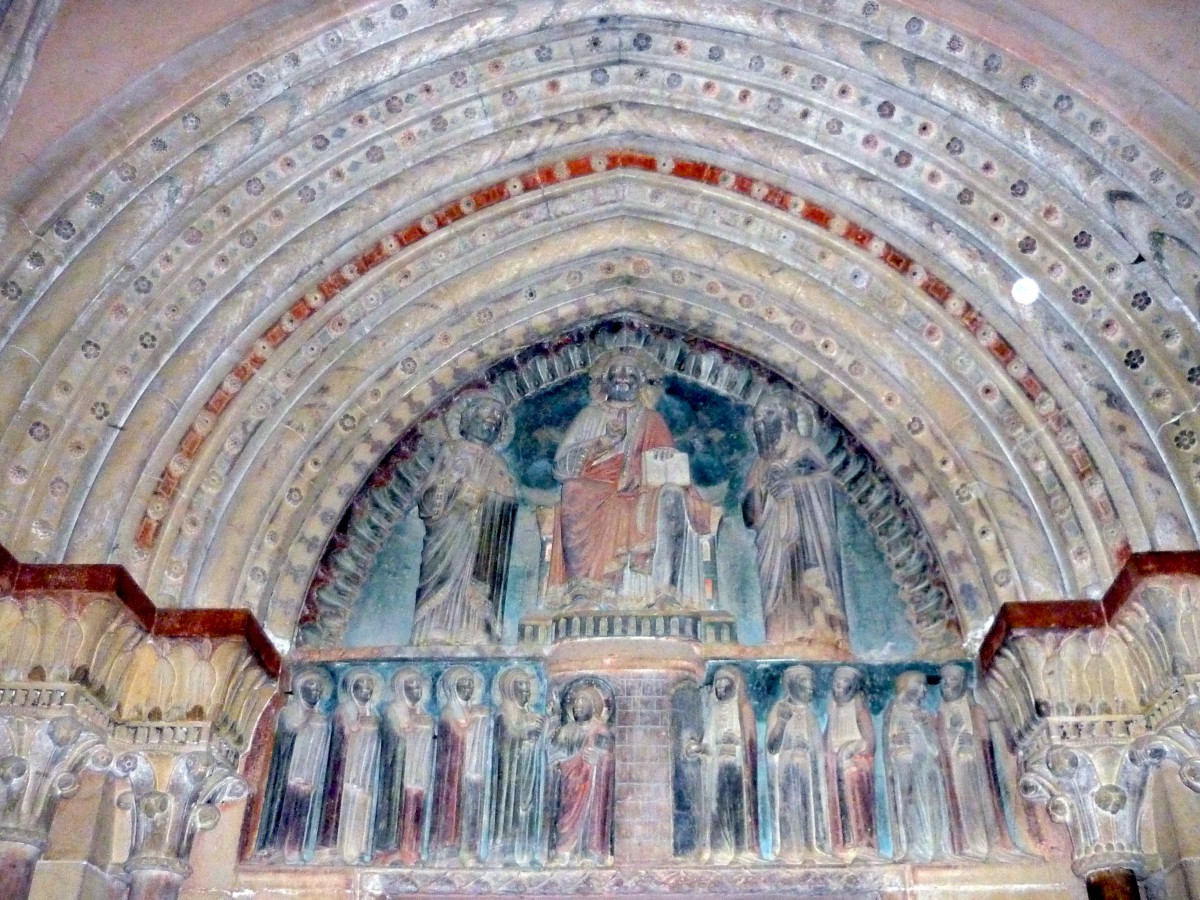
The tympanum inside the bell tower of the church © French Moments
Christ appears in majesty between Saint Peter and Saint Paul, while the lintel depicts the parable of the Wise and Foolish Virgins.
The wise virgins are welcomed through the door of Paradise. The foolish virgins arrive too late and find the door closed.
Inside the church, look for the rare wooden Vierge ouvrante, or Opening Virgin. The sculpture opens like a small shrine, revealing religious figures and imagery within the body of the Virgin.
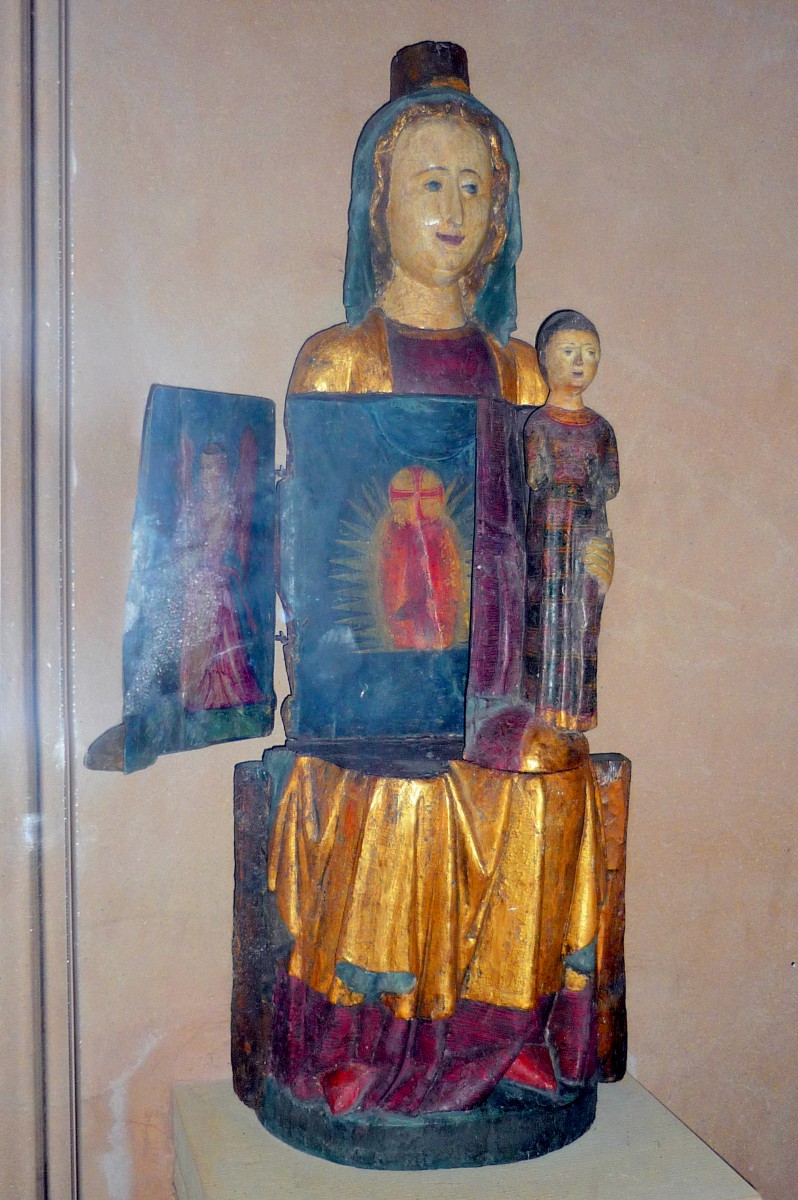
"Vierge ouvrante" © French Moments
The church also contains a Callinet organ dating from 1839, reconstructed by the organ builder Alfred Kern in 1962.
Walk around the Eguisheim ramparts
The most enjoyable part of a visit to Eguisheim is the walk around the former ramparts.
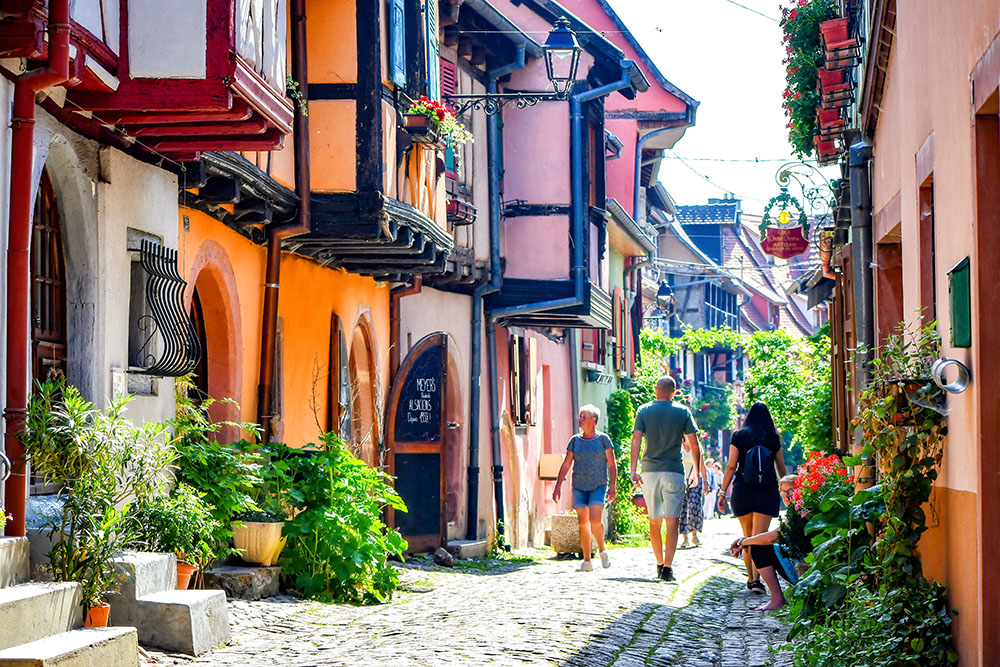
From the centre, make your way towards Rue du Rempart-Sud. The narrow lane curves around the southern half of the old village before continuing as Rue du Rempart-Nord.
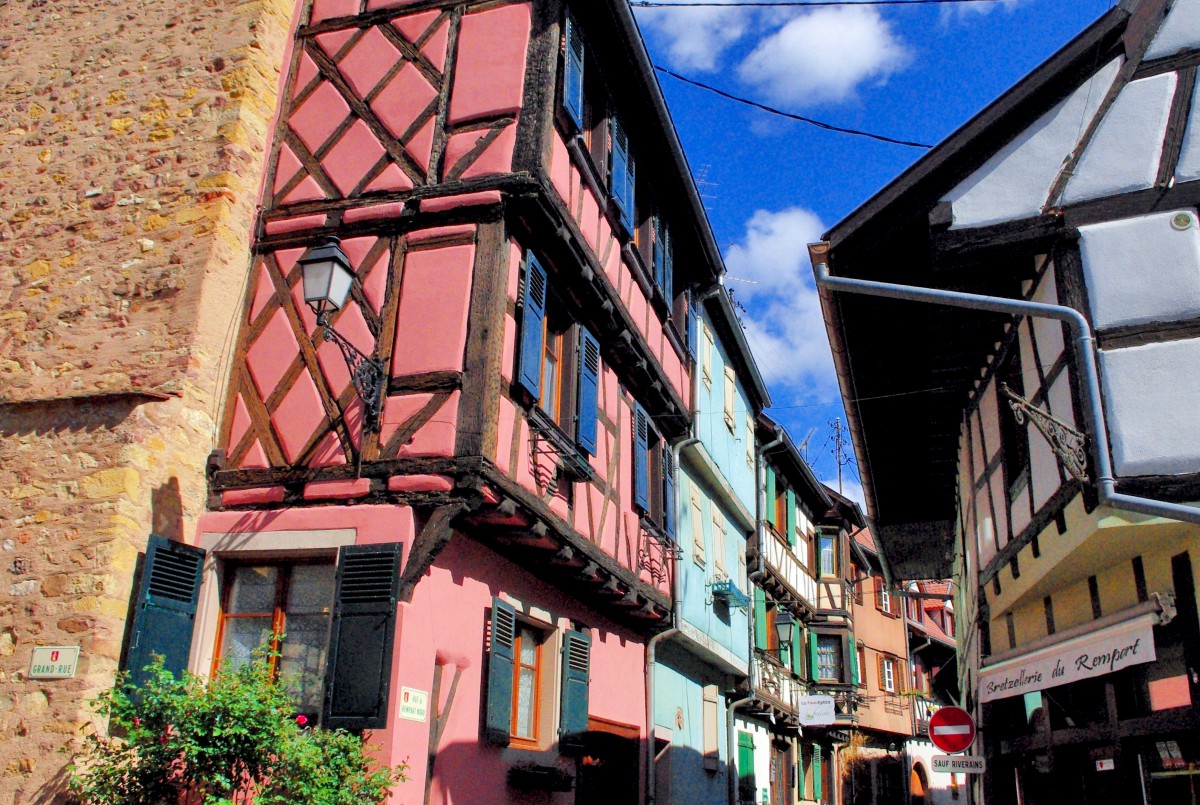
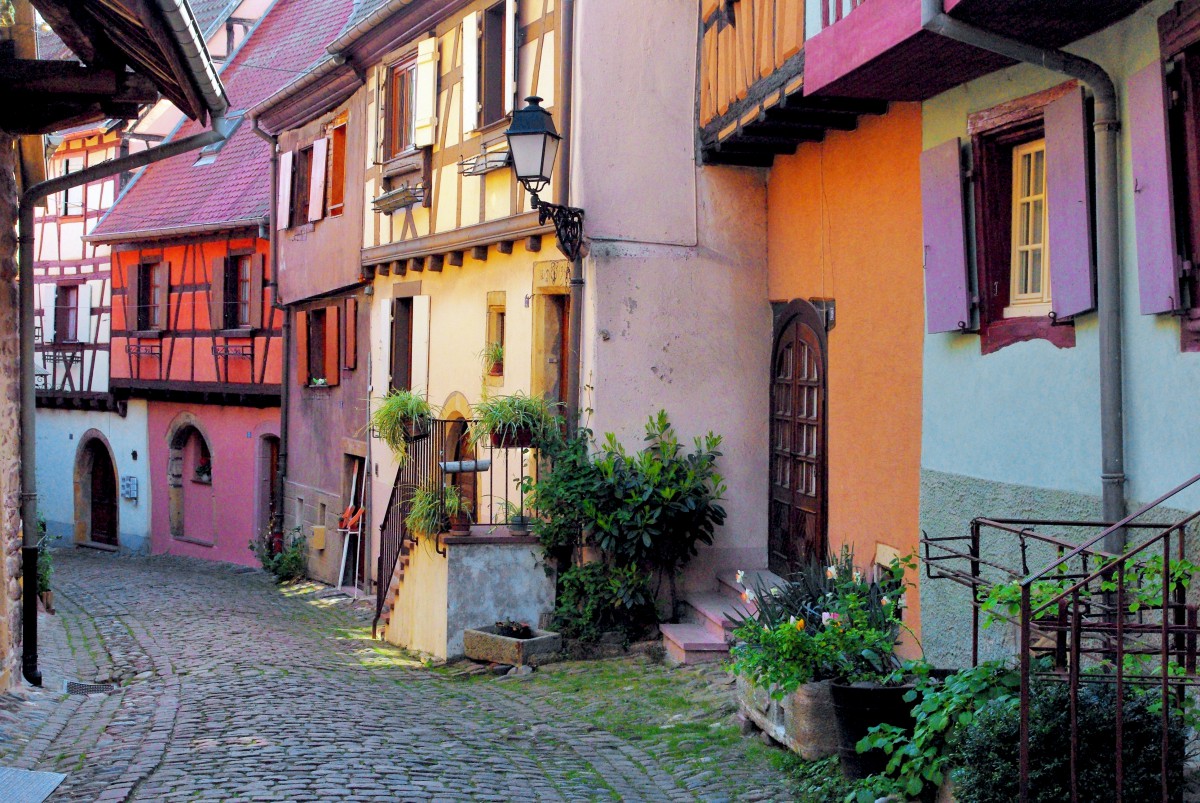
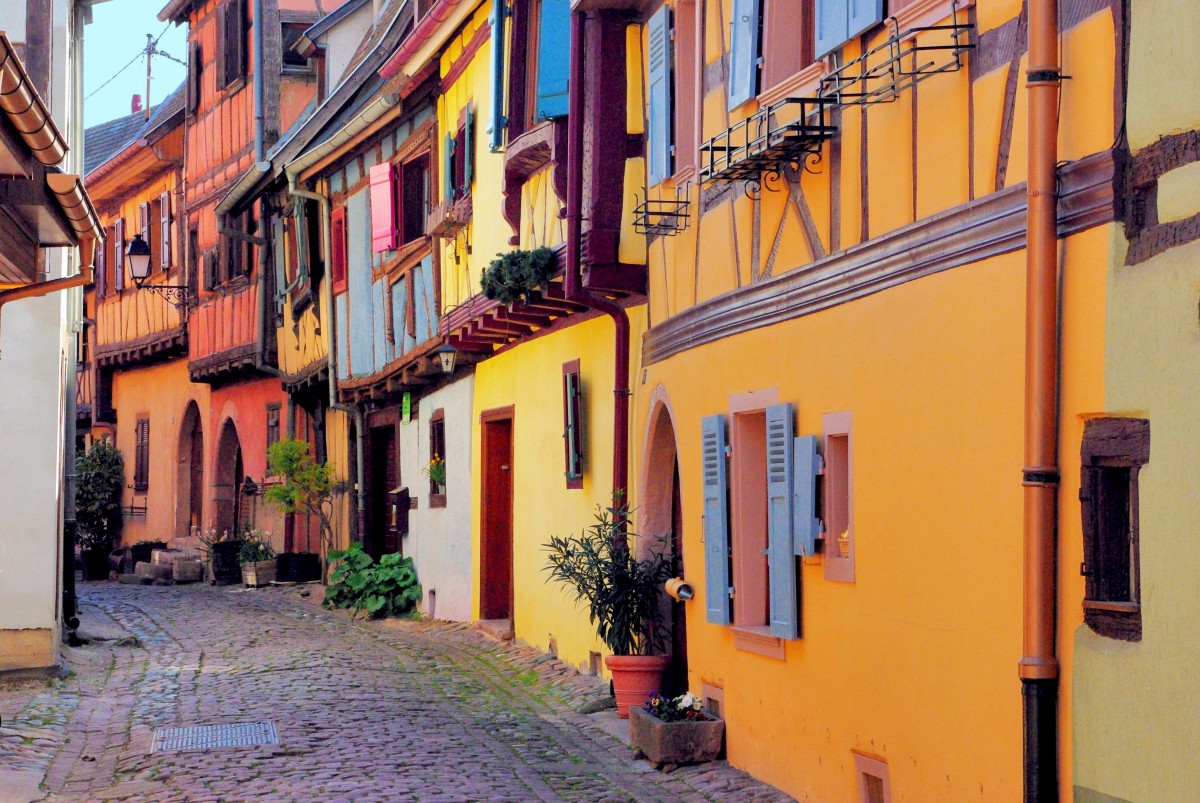
Half-timbered houses on Rue du Rempart © French Moments
The old defensive wall is partly hidden behind rows of houses. Many of these buildings were constructed directly against or beside the fortifications after they lost their military purpose.
Together, the two streets form a loop of roughly 800 metres.
This is where you will find some of the most characteristic sights in Eguisheim:
- narrow winegrowers’ houses;
- projecting upper storeys;
- brightly painted timber framing;
- steeply pitched roofs;
- small courtyards;
- carved lintels;
- wrought-iron signs;
- window boxes overflowing with geraniums.
The houses are so close together that the lane occasionally feels more like a passage through a theatrical set than an ordinary village street.
Yet these were working houses. Their courtyards, cellars and large gateways were designed around the production and storage of wine.
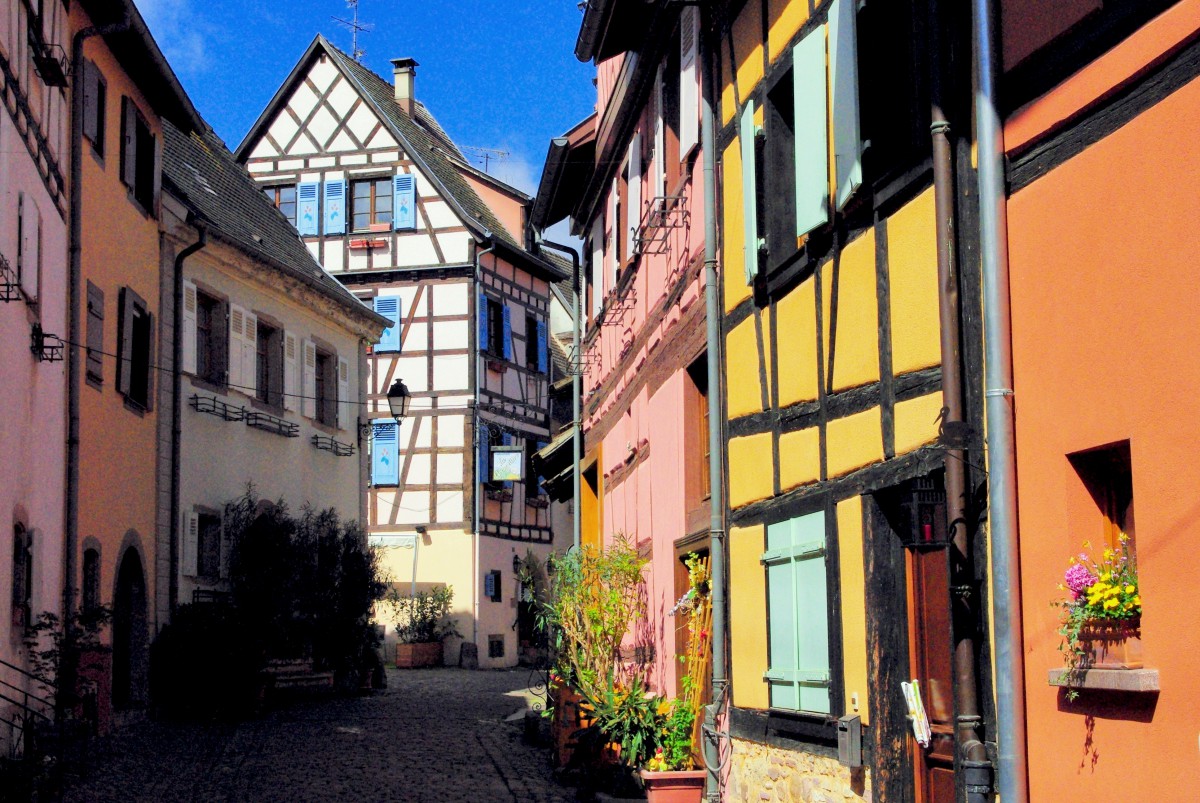
The famous Eguisheim postcard view
The most photographed view in Eguisheim stands near the junction of Rue du Rempart-Sud and Rue de l’Almend-Sud.
Here, the street divides around a narrow, pointed house. With its timber framing, flower boxes and steep roof, the building has become one of the best-known images of Alsace.
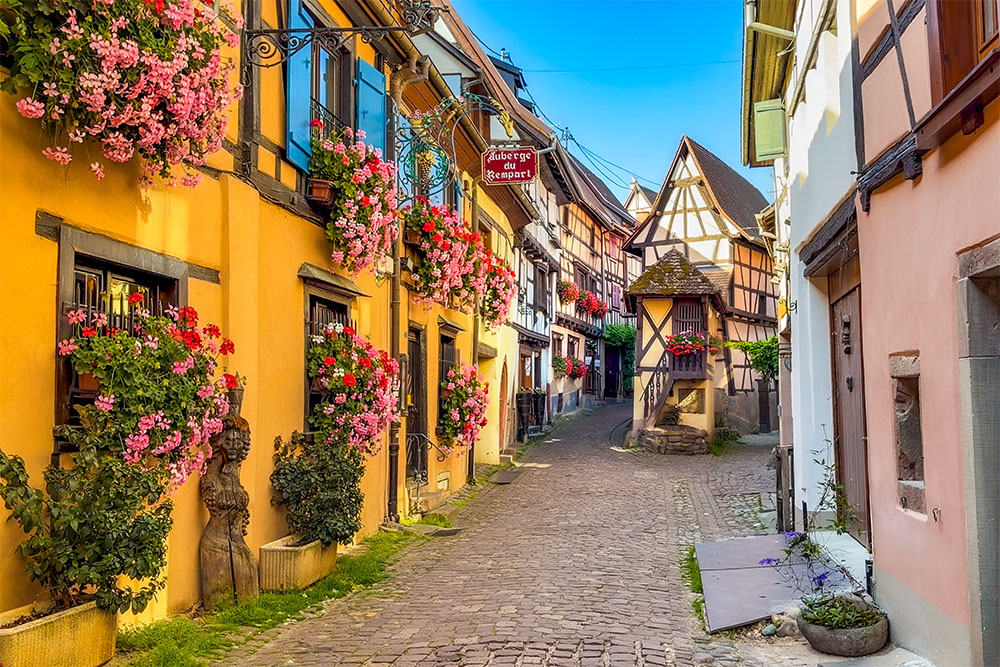
Rue du rempart and Rue de l'Allmend © French Moments
It is a beautiful scene, but it is no longer a secret.
During the busiest part of the day, visitors often queue or gather in the lane to take photographs. Come early in the morning if you would like to see it without a crowd standing in front of it.
Once you have taken the classic photograph, continue along the lane. Some of the quieter and more interesting details are found further around the ramparts, away from this famous corner.
Look beyond the colourful façades
The bright colours are one of the first things visitors notice in Eguisheim, but there is much more to observe.
Look for old inscriptions scratched or carved into stone and timber. Some identify the householder, while others include religious symbols or dates.
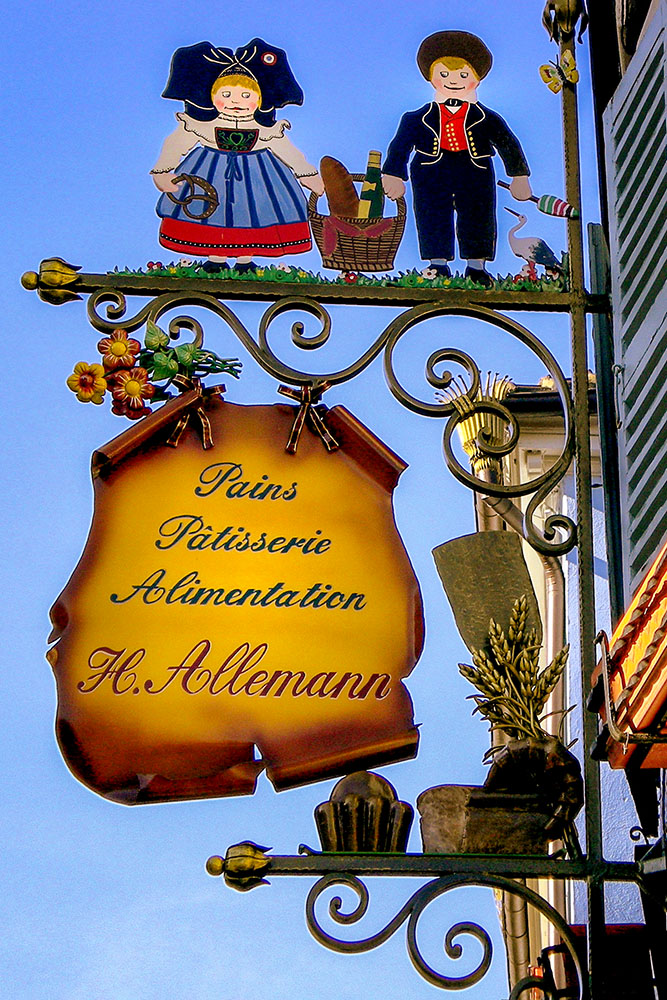
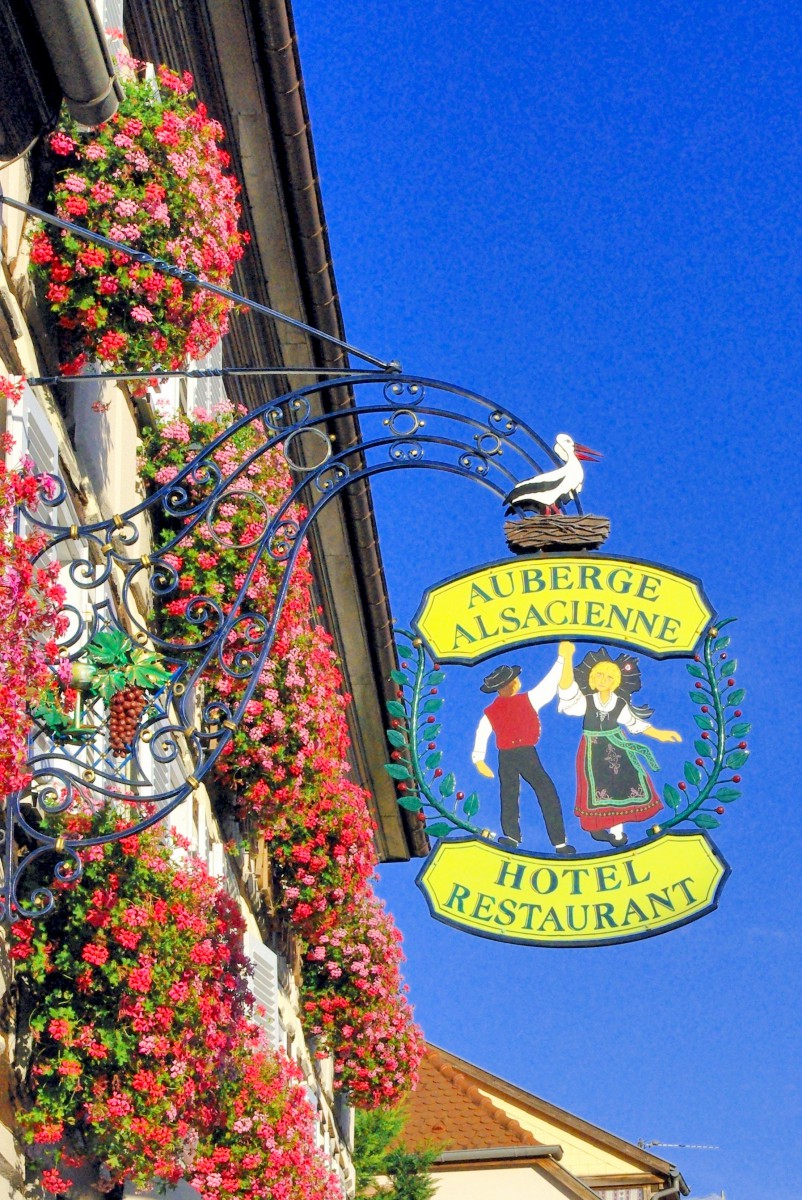
Wrought-iron signs indicate former inns, workshops and wine estates. Small openings in the façades reveal hidden courtyards, and large gateways show where carts once entered agricultural properties.
Eguisheim also has several historic fountains and former monastic courtyards. They remind us that this was not created as a decorative tourist village. It was a community shaped by religion, agriculture, trade and wine production.
The official heritage trail, Entrez dans la ronde d’Eguisheim, uses nine illustrated panels to explain subjects such as the colours of the houses, the fortifications, the former town gates, stonecutters’ marks and the castle.
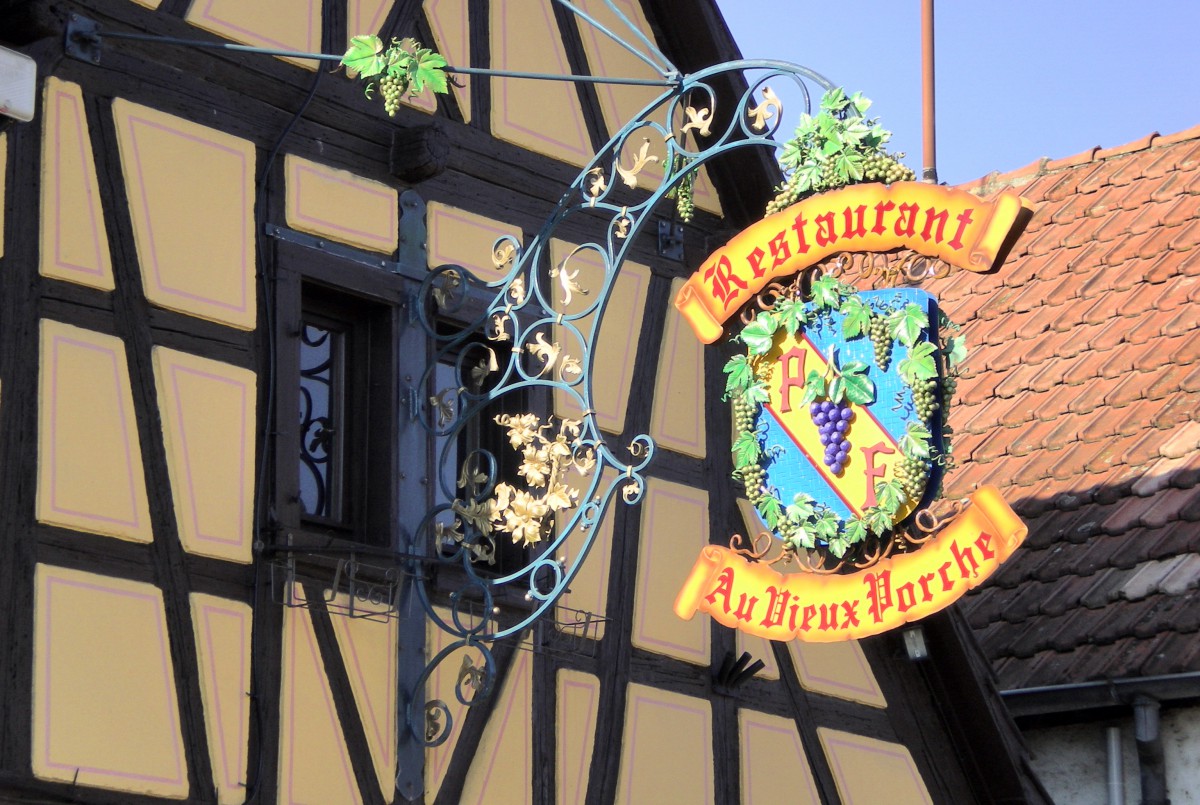
Wrought-iron sign © French Moments
Eguisheim and the Alsace vineyards
It is impossible to separate Eguisheim from wine.
Vines have been cultivated around the village for centuries. By the late Middle Ages, wines from Alsace were being transported northwards through Colmar, Strasbourg and the Rhine to customers across northern Europe.
The vineyards surrounding Eguisheim include two Alsace Grand Cru sites: Eichberg and Pfersigberg.
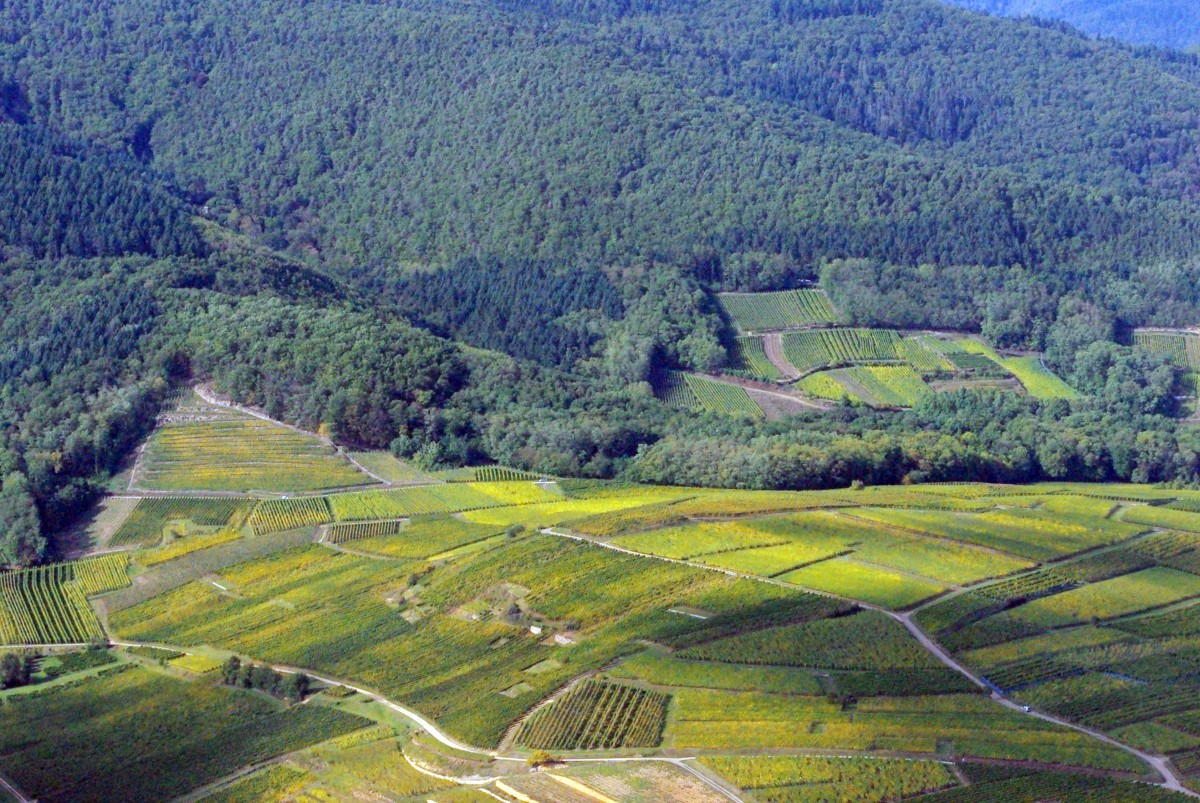
The vineyards of Eguisheim © French Moments
The south- and south-east-facing slopes of the Eichberg rise to the west of the village. The site is particularly associated with Riesling, Pinot Gris and Gewurztraminer.
The Pfersigberg extends across slopes south of Eguisheim. Its wines are often noted for their ripe fruit and spice, particularly in Riesling and Gewurztraminer.
Numerous independent winegrowers have tasting rooms in and around the village. Some welcome visitors without an appointment, while others require advance booking.
A tasting is not simply an additional activity here. It helps explain why the village developed as it did, with deep cellars, large gateways and houses adapted to generations of wine production.

Husseren-les-Châteaux © French Moments
Walk through the vineyards
The Eguisheim wine trail offers a good way to escape the busiest streets and see the village in its landscape.
The route passes through the vineyards and introduces the local grape varieties, growing methods and wine-making traditions. It also provides views towards the village, the Three Castles, the Vosges and, in clear weather, the Alsace Plain.
The tourist train is another option for visitors who prefer not to walk as far. Its circuit combines the historic centre with part of the surrounding vineyard.
See the storks of Eguisheim
Eguisheim has received the Village Cigogne d’Alsace label for its efforts to protect the white stork, the symbolic bird of Alsace.
A small stork park lies outside the historic centre. The birds are cared for by an association involved in their protection and reintroduction.

White storks in Eguisheim © French Moments
You may also see storks nesting on high buildings or flying above the vineyards. The park is particularly interesting for families, although it should be considered a complementary stop rather than the main reason to visit the village.
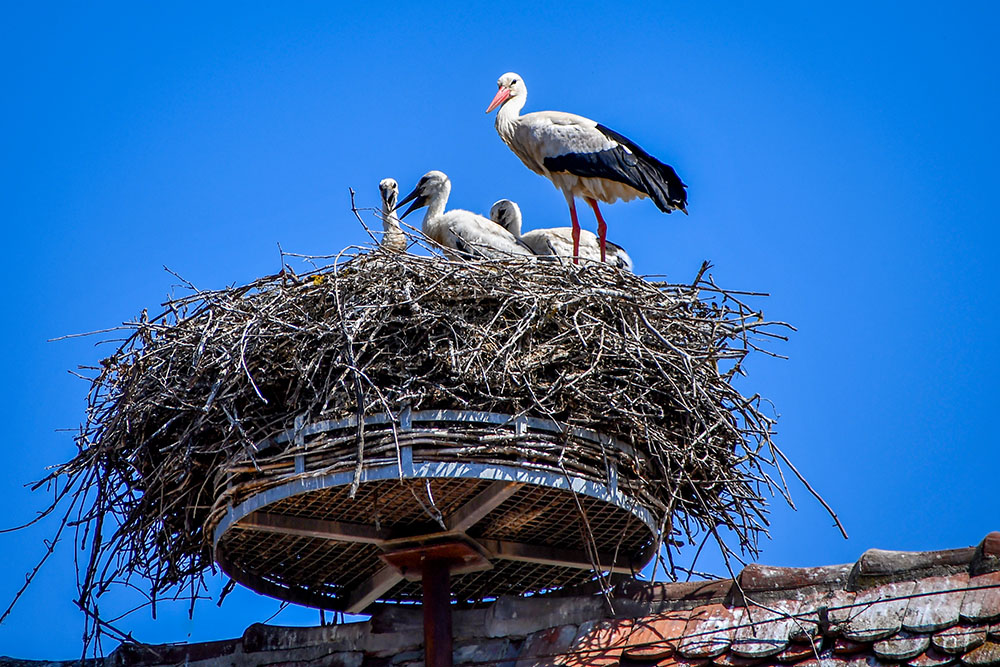
White storks in Eguisheim © French Moments
The Three Castles of Eguisheim
Three ruined towers overlook the vineyards west of Eguisheim.
Known collectively as the Three Castles of Haut-Eguisheim, they are the Dagsbourg, Wahlenbourg and Weckmund. The oldest surviving references to the site date from the early 11th century.
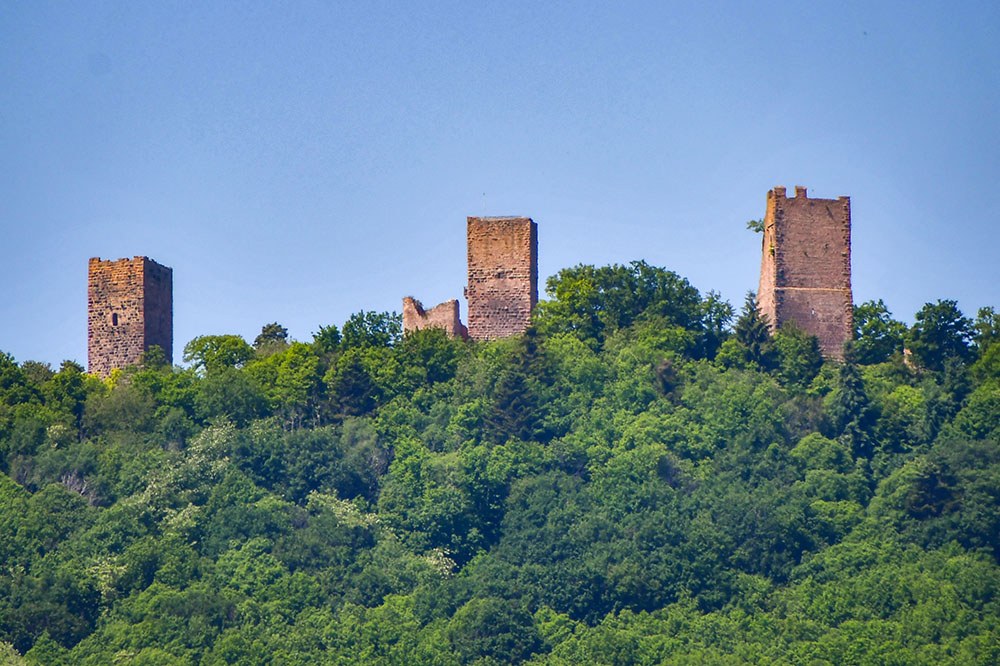
Three Castles of Eguisheim © French Moments
The castles occupied a strategic position above the Alsace Plain. They were eventually ruined during conflicts in the 15th century.
A forest road leads to a car park below the ruins, followed by a short uphill walk. The site stands at around 590 metres and offers extensive views across the vineyards and plain.
The exact birthplace of Pope Leo IX is sometimes associated with these hilltop fortifications rather than the castle in the centre of Eguisheim.
Follow the Five Castles Route
The forest road continues towards two further castles:
- Hohlandsbourg Castle;
- Pflixbourg Castle.
Unlike the ruined Three Castles, Hohlandsbourg has been extensively restored and operates as a visitor attraction during the warmer months. Its ramparts offer one of the finest views over the Colmar region.
The complete Five Castles Route makes an interesting half-day excursion by car, although access to parts of the road can be restricted during winter.
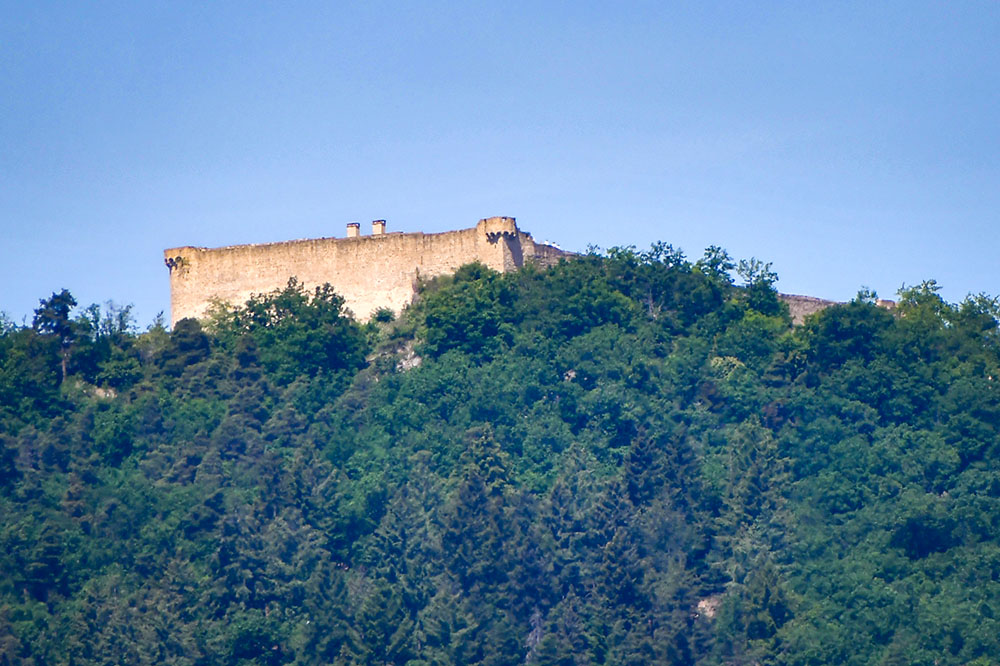
Hohlandsbourg © French Moments
Eguisheim at Christmas
Eguisheim is particularly atmospheric during Advent.
Christmas decorations appear around the fountains and along the ramparts, while the market occupies several small squares in the historic centre.
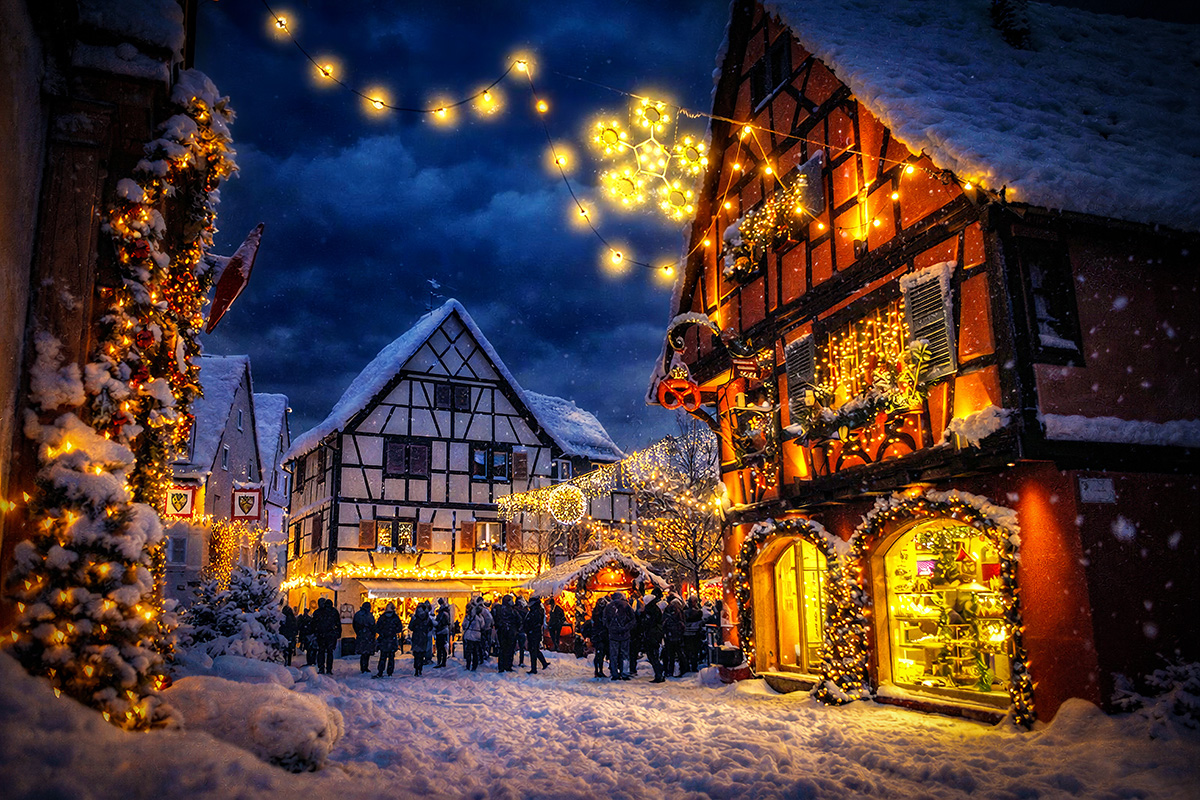
Eguisheim at Christmas © French Moments
Compared with the large Christmas markets of Colmar and Strasbourg, the Eguisheim market feels more intimate. Its emphasis is on Alsatian crafts, food and seasonal traditions, and the village holds the Villes et Villages de Noël label.
However, intimacy does not necessarily mean tranquillity. Weekends can be extremely busy, particularly in the afternoon and early evening.
Visit on a weekday or arrive soon after the market opens. Seasonal shuttle services usually operate between Colmar and Eguisheim, but timetables should always be checked before travelling.
How long do you need in Eguisheim?
Allow around two hours for a leisurely walk through the historic centre.
Three or four hours would give you time to visit the church and chapel, explore the ramparts, stop for a drink and perhaps arrange a wine tasting.
Allow half a day if you also plan to follow the wine trail or have lunch in the village.
A complete day could combine Eguisheim with the Three Castles, Hohlandsbourg Castle or another nearby wine village.
Eguisheim © French Moments
The best time to visit Eguisheim
Eguisheim changes considerably with the seasons.
Spring
Spring brings Easter decorations, fresh greenery and the first flowers. The village is usually quieter than in summer, although Easter weekends can attract many visitors.
Summer
This is when the houses and window boxes are at their most colourful. It is also the busiest season, particularly during weekends and school holidays.
Early autumn
September and early October are excellent months for exploring the vineyards. The weather is often pleasant and the changing vines add warm colours to the landscape.
Remember that the grape harvest is an important working period. Some winegrowers may have less time to welcome visitors.
Advent
Christmas lights and decorations transform the village, but the narrow streets can become crowded. Visit during the week whenever possible.
Easter decorations on the fountain, place du château © French Moments
My advice for avoiding the crowds
During my visit in late May 2026, Eguisheim was already calm early in the morning but much busier after about 10.30 am. By midday, groups filled the central square and the most photographed section of Rue du Rempart-Sud.
My advice is simple: arrive early.
Try to be in the village before 9.30 am. Begin with the ramparts and the famous narrow house before continuing towards Place du Château Saint-Léon.
Alternatively, visit in the late afternoon, when many organised groups and day visitors have left. The evening light on the façades can be beautiful, and the lanes regain some of their atmosphere.
If you plan to visit several famous Alsatian villages in one day, do not attempt to see Eguisheim, Kaysersberg and Riquewihr during their busiest hours. Choose one for the morning and explore a quieter village or the vineyards later in the day.
Place du Château, Eguisheim © French Moments
Where to stay in Eguisheim
Staying overnight in Eguisheim allows you to enjoy the village after the day visitors have left and again early the following morning, when the streets are at their quietest.
Accommodation includes small hotels, guesthouses, holiday apartments and traditional Alsatian houses, both within the historic centre and among the surrounding vineyards.
As options are limited, it is advisable to book well in advance during summer, harvest time and the Christmas-market season.
Use the map below to compare accommodation in and around Eguisheim.
How to get to Eguisheim from Colmar
Eguisheim is approximately five kilometres south-west of Colmar.
By car
Driving is the easiest option if you are exploring several places along the Alsace Wine Route.
Parking is available outside the historic centre. Current principal options include:
- Parking de la Mairie: €5 per day;
- Parking des Marronniers: €5 per day;
- Parking du Millénaire: free of charge.
Charges and arrangements are from 2026 and can change, so consult the tourist office website before travelling. The municipality also provides an area for motorhomes.
By bus
Fluo Grand Est line R030 connects Colmar railway station with Eguisheim and Rouffach.
The journey from Colmar to Eguisheim takes approximately 12 to 15 minutes. Services are not always frequent, particularly on Sundays and public holidays, so check the current timetable before your visit.
By bicycle
The short distance from Colmar makes Eguisheim accessible by bicycle. This can be an enjoyable option, especially when combined with a ride through the vineyards.
Be prepared for traffic on some connecting roads and use marked cycle routes whenever possible.
Rue du Rempart © French Moments
Practical information for visiting Eguisheim
The Tourist Office of Eguisheim is at:
22A Grand’Rue
68420 Eguisheim
It provides village maps, information about guided visits, walking routes, wine estates and seasonal events.
The historic centre is largely flat, but its cobbled and uneven surfaces may make some streets difficult for wheelchairs, pushchairs or visitors with limited mobility.
Comfortable shoes are preferable, particularly if you plan to explore the vineyard or the castle ruins.
Restaurants can become fully booked at lunchtime during weekends and holidays. Reserve in advance or consider eating in one of the less famous villages nearby.
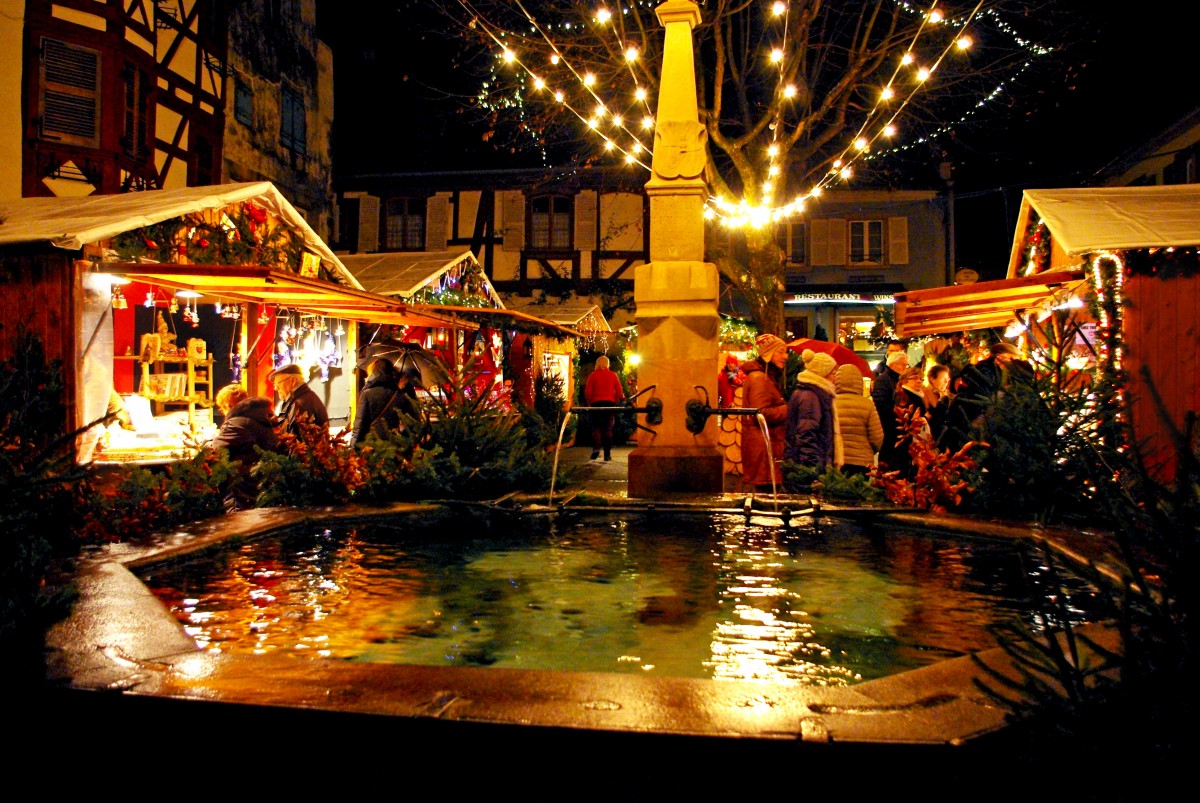
Eguisheim Christmas Market © French Moments
Is Eguisheim worth visiting?
Yes — but timing makes a considerable difference.
Eguisheim deserves its reputation. Its circular plan, preserved architecture, wine-growing heritage and connection with Pope Leo IX give it more substance than its postcard image might suggest.
Nevertheless, it is no longer an undiscovered village. Arrive at midday on a summer weekend and you may find the experience rather different from the peaceful scenes shown in photographs.
Come early, take your time and look beyond the famous narrow house.
Walk around the complete circuit of the ramparts. Enter the church and the Saint-Léon Chapel. Notice the carved doorways and old courtyards. Then leave the centre for the vineyards, where the circular village can be seen in its proper setting beneath the hills of the Vosges.
That is where Eguisheim begins to feel less like a tourist attraction and more like the historic wine village it has always been.
Frequently asked questions about Eguisheim
Is Eguisheim prettier than Colmar?
The two places offer very different experiences. Colmar has canals, museums, large churches and several historic districts. Eguisheim is much smaller and can be explored more easily on foot. It is best considered an excursion from Colmar rather than an alternative to it.
Can you visit Eguisheim and Colmar in one day?
Yes. Spend the morning in Eguisheim before the largest crowds arrive, then return to Colmar for the afternoon and evening.
Is Eguisheim free to visit?
Access to the streets and historic centre is free. You may need to pay for parking, guided visits, the tourist train or organised activities.
Do you need a car to visit Eguisheim?
No. The R030 regional bus connects Eguisheim with Colmar. You can also book a taxi service such as Uber. However, a car makes it easier to explore the surrounding villages, vineyards and castles.
Can you walk around Eguisheim?
Yes. Walking is the best way to explore the village. The historic centre is compact, and the complete circuit of the rampart streets is approximately 800 metres.
When is Eguisheim least crowded?
Weekday mornings outside the summer holidays and Christmas-market period are generally the quietest. Arriving before 9.30 am offers the best chance of seeing the village before day visitors arrive.
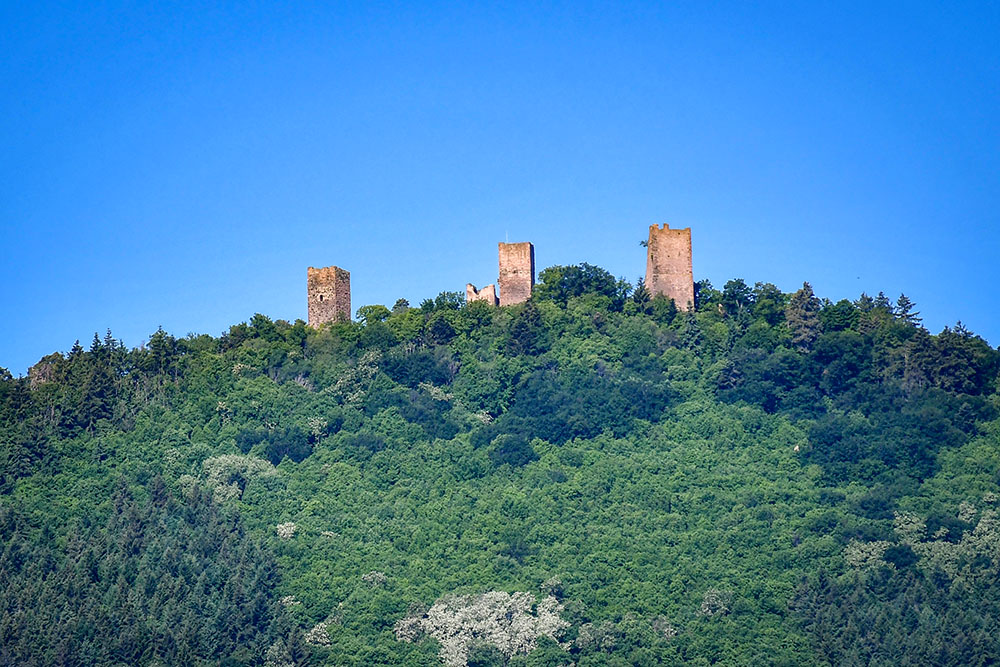
Three Castles of Eguisheim © French Moments