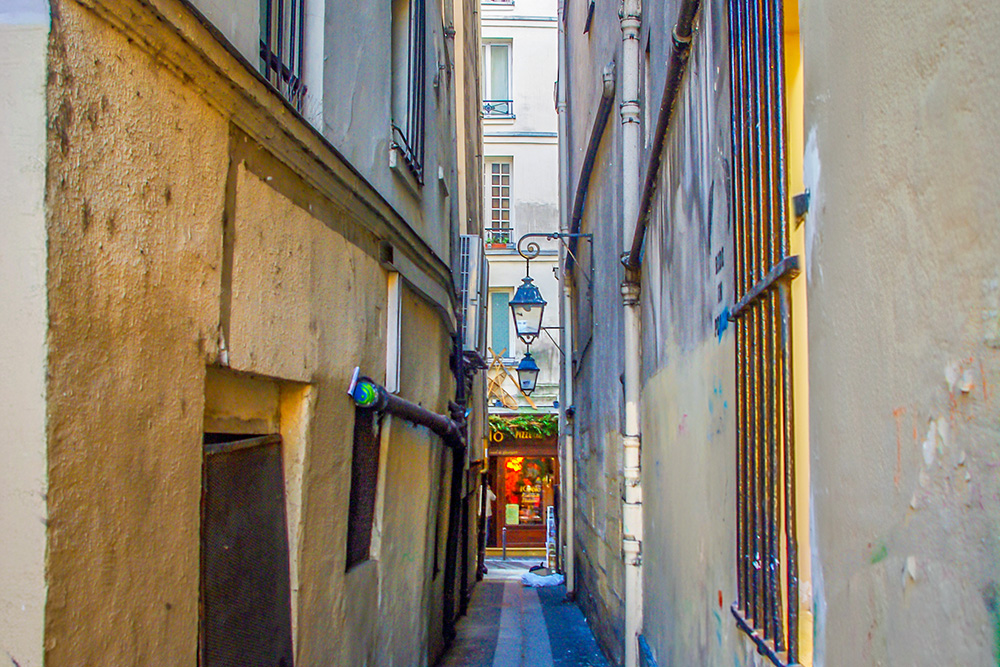


Paris is full of surprises, and Rue du Chat-qui-Pêche is certainly one of them.
Hidden between the lively Rue de la Huchette and the banks of the River Seine, this tiny street in the 5th arrondissement is so narrow that you could easily walk past without noticing it.
And yet, it has something that many of Paris's famous boulevards lack: a curious name, a centuries-old history and a rather extraordinary legend involving a black cat.
I have always enjoyed discovering these little corners of Paris. They remind me that beyond the grand monuments and elegant avenues, the French capital still has a few secrets to reveal.
Rue du Chat-qui-Pêche is one of those places.
Rue du Chat-qui-Pêche: One of the Narrowest Streets in Paris
At just 29 metres long, Rue du Chat-qui-Pêche is hardly an impressive street by Parisian standards.
But what it lacks in length, it certainly makes up for in character.
The passage is famously narrow, measuring around 1.8 metres across at its widest point, with some sections even narrower.
That's barely enough room for two people to pass comfortably.
Walking along it feels rather different from strolling down the Champs-Élysées!
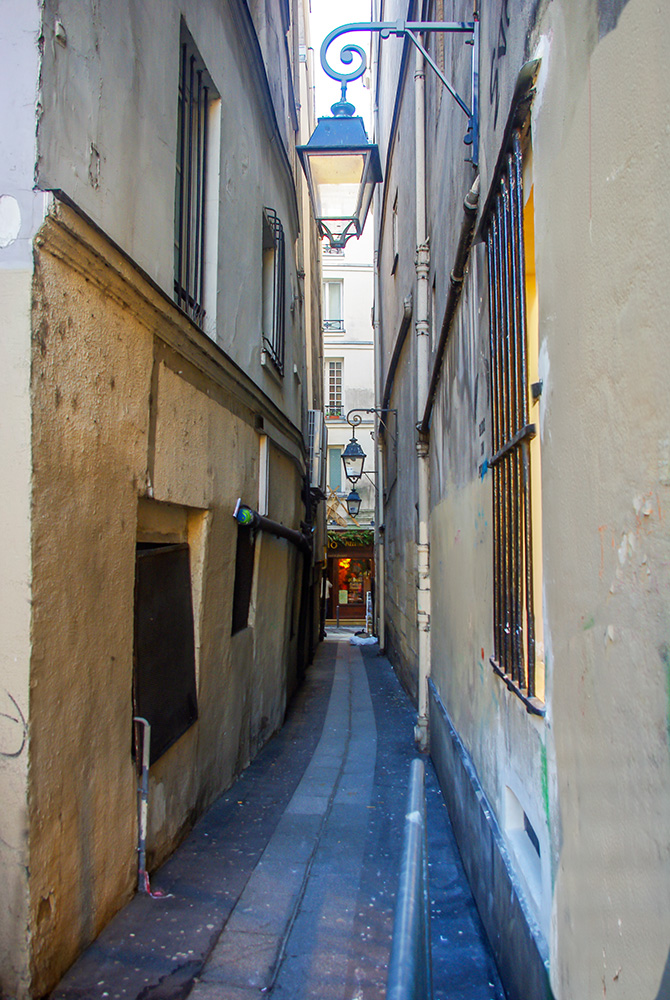
Rue du Chat-qui-pêche in Paris © French Moments
The tall buildings on either side seem almost to lean towards one another, creating an intimate atmosphere that feels a world away from the busy streets nearby.
Look up, and you will notice traditional Parisian street lamps hanging above the passage.
Look down, and you will see the simple paving that leads you from one end to the other.
There are no grand monuments here, no magnificent façades and certainly no spacious pavements.
Just a narrow passage that has survived the centuries.
And perhaps that is precisely what makes it so interesting.
What Does Rue du Chat-qui-Pêche Mean?
Let's begin with the name.
In English, Rue du Chat-qui-Pêche means "Street of the Fishing Cat", or more literally, "Street of the Cat That Fishes".
It is one of those wonderfully unusual French street names that immediately makes you curious.
Why would anyone name a street after a fishing cat?
The most likely explanation takes us back to an old shop sign.
Before modern street numbering became widespread, Parisian businesses frequently displayed distinctive signs to help customers identify their premises.
These signs might feature animals, objects, saints or other recognisable symbols.
Sometimes, the names of these establishments became associated with the streets themselves.
Rue du Chat-qui-Pêche is believed to have taken its name from a sign depicting a cat catching fish.
But, as often happens in Paris, a simple explanation wasn't quite enough.
Over the years, the name inspired a much more entertaining story.
The Legend of the Fishing Cat
According to a local legend, a man named Dom Perlet once lived near the street.
He was said to be a religious figure who also had an interest in alchemy, which was enough to arouse suspicion in those days.
Dom Perlet owned a black cat.
But this was no ordinary cat.
The animal apparently possessed an extraordinary talent for fishing.
It would sit beside the Seine, patiently watching the water, before catching fish with a single swift movement of its paw.
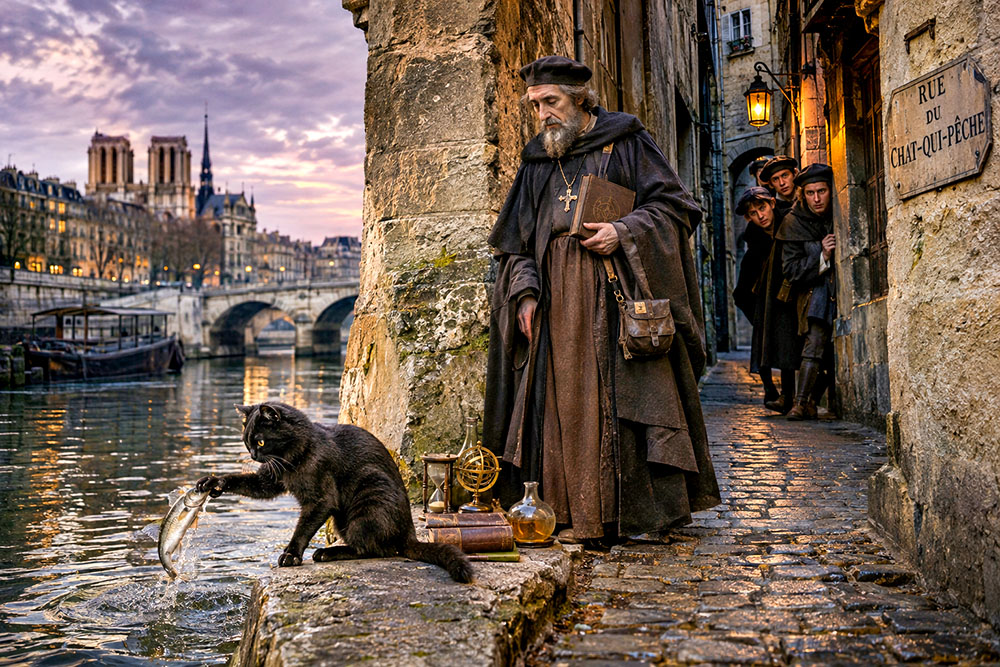
Now, you might think that the sight of a cat catching fish would simply amuse the local inhabitants.
Not so!
According to the story, some students became convinced that something supernatural was happening.
They suspected Dom Perlet of practising sorcery and even believed that the man and his mysterious cat might somehow be connected by dark powers.
One day, the students decided to put an end to the creature's activities.
They caught the cat, killed it and threw its body into the Seine.
Strangely enough, Dom Perlet disappeared around the same time.
The students thought their suspicions had been confirmed.
But the story does not end there.
Some time later, Dom Perlet returned to the neighbourhood.
And, to everyone's astonishment, his black cat was with him!
Had the animal somehow returned from the dead?
Had Dom Perlet used his mysterious powers to bring it back?
Or was the whole story simply an invention?
We will probably never know.
Of course, this is a legend rather than a documented historical event.
But I find it fascinating that such a tiny Parisian passage should have inspired a tale involving a fishing cat, suspicious students and a supposed sorcerer.
It certainly gives the street a personality of its own.
A Little Street With a Long History
The history of Rue du Chat-qui-Pêche goes back several centuries.
The passage appears in written records from 1540, when it was known as Ruelle des Étuves, a name referring to the public baths that once existed in the neighbourhood.
At different times, it was also known by other names, including Rue du Renard and Rue des Bouticles.
Its current name eventually became the one that survived.
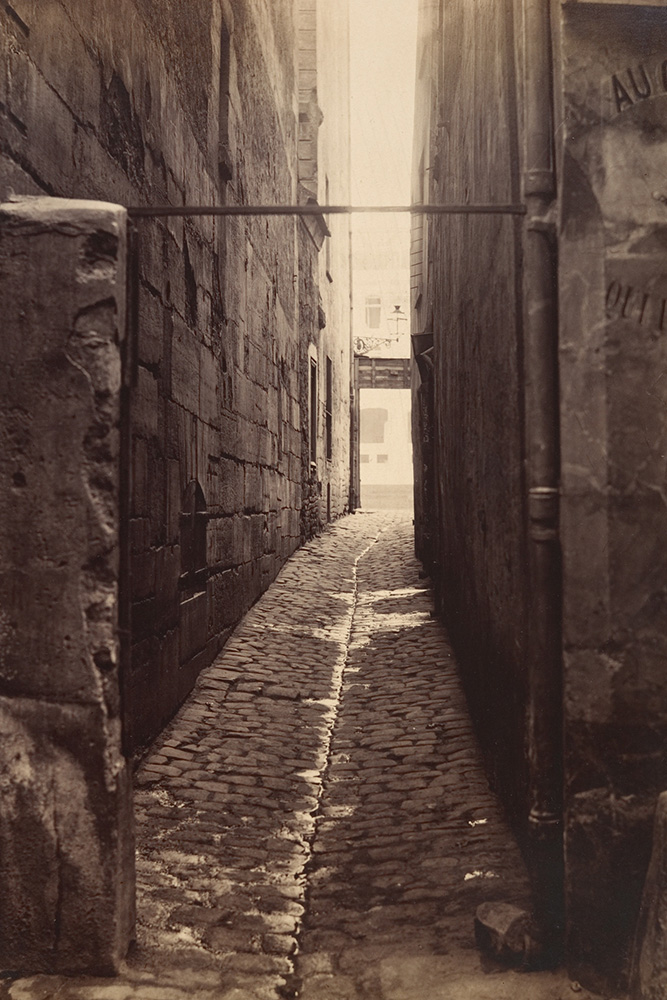
Rue du Chat-qui-Pêche. Photo by Charles Marville, circa 1868 [public domain via Wikimedia Commons]
To understand why this narrow passage exists, we need to imagine Paris before the construction of the great boulevards.
In those days, the banks of the Seine looked very different.
Buildings stood much closer to the river, and little lanes provided access to the water.
For local inhabitants, the Seine was not simply a picturesque feature of the city.
It was part of everyday life.
People depended on the river for various activities, and the surrounding neighbourhood was closely connected to trade and commerce.
Rue du Chat-qui-Pêche formed one of these small connections between the streets of the Latin Quarter and the riverbank.
Although the buildings and surroundings have changed considerably, the passage still offers a reminder of that earlier Paris.
When Baron Haussmann transformed much of the capital during the 19th century, countless old streets disappeared or were radically altered.
Some, however, survived.
Rue du Chat-qui-Pêche is one of those little fragments of the older city that can still be explored today.
Is Rue du Chat-qui-Pêche Really the Narrowest Street in Paris?
You will often read that Rue du Chat-qui-Pêche is the narrowest street in Paris.
It is certainly one of the most famous contenders for that title.
But things are not quite so straightforward.
Paris has several surprisingly narrow streets and passageways, and some are even smaller.
One of my favourites is the Sentier des Merisiers, in the 12th arrondissement.

Sentier des merisiers in Paris © French Moments
Unlike Rue du Chat-qui-Pêche, which is situated in the historic centre of Paris, the Sentier des Merisiers lies much farther east, near Porte de Vincennes.
This unusual passage is approximately 100 metres long and, at its narrowest point, measures just 87 centimetres across!
That is less than half the width of Rue du Chat-qui-Pêche at its widest point.
I have explored the Sentier des Merisiers myself and was struck by its unexpected, almost rural atmosphere.
It is another reminder that Paris isn't only about wide avenues and grand squares.
Sometimes, the most memorable discoveries are tucked away in the narrowest of spaces.
What to Notice When Visiting Rue du Chat-qui-Pêche
The interesting thing about Rue du Chat-qui-Pêche is that there is very little to see in the conventional tourist sense.
You won't find a museum, a famous monument or an impressive historic residence.
Instead, the attraction is the street itself.
When visiting, take a moment to notice a few details:
- The narrowness of the passage: Stand at one end and look towards the other to appreciate just how closely the buildings face each other.
- The traditional street lamps: These add to the atmosphere of the old passage.
- The street-name plaque: Its unusual wording is worth a photograph.
- The contrast with Rue de la Huchette: One moment, you are surrounded by restaurants, cafés and tourists. A few steps later, you are in a very different setting.
- The connection with the Seine: Remember that this little street once provided access towards the river in a neighbourhood where daily life depended heavily on the water.
Personally, I enjoy stopping for a moment and imagining what the place might have looked like several centuries ago.
Of course, modern Paris is never very far away.
You might hear conversations, footsteps or the noise of nearby restaurants.
But that contrast between the old and the new is part of the experience.
Where Is Rue du Chat-qui-Pêche in Paris?
Rue du Chat-qui-Pêche is situated in the 5th arrondissement of Paris, in the Latin Quarter.
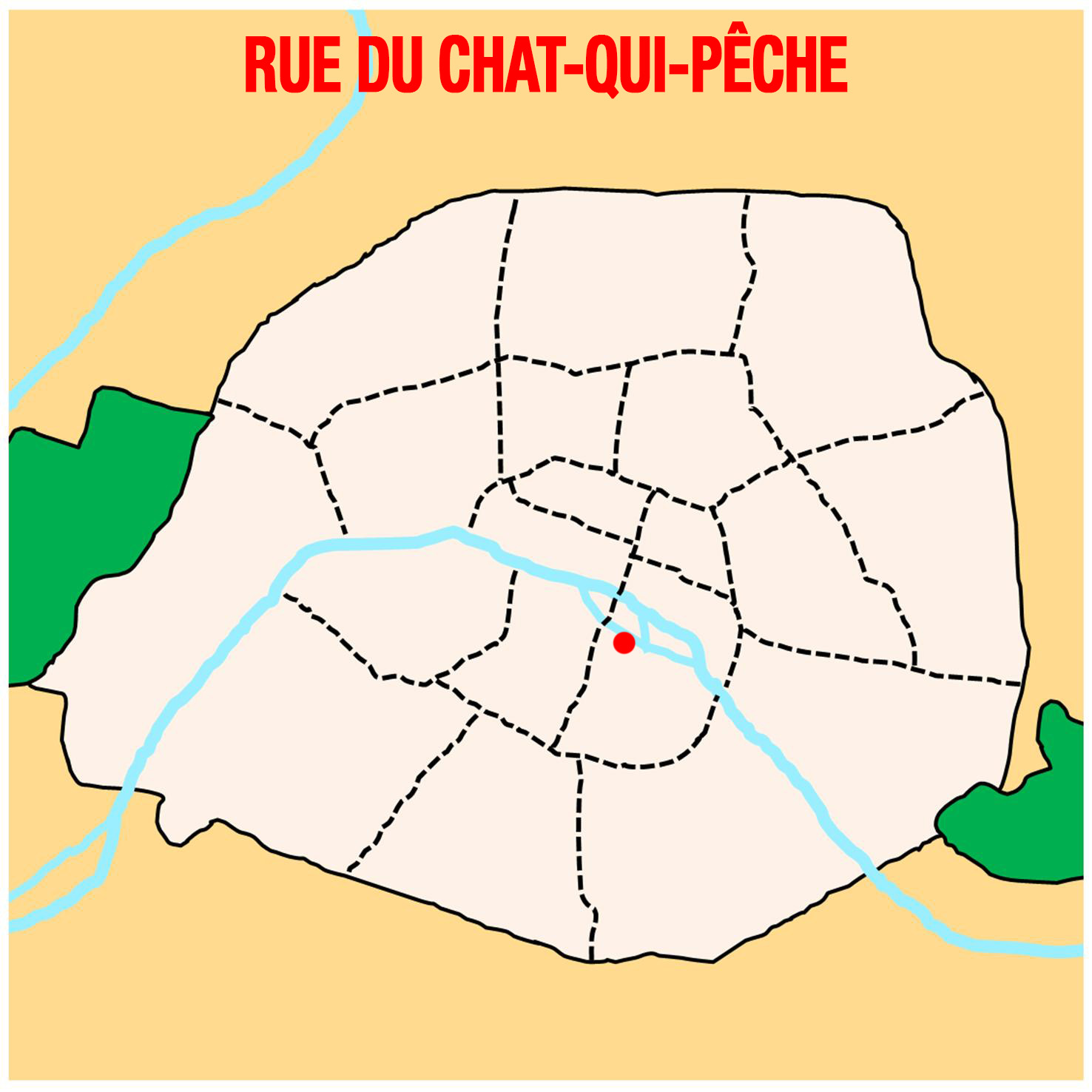
It connects Rue de la Huchette with Quai Saint-Michel, just a short distance from the Seine.
The easiest way to find it is to walk along Rue de la Huchette, keeping an eye out for the small opening between the buildings.
Alternatively, you can approach it from Quai Saint-Michel.
The nearest Métro station is Saint-Michel (Line 4).

Place Saint-Michel in Paris © French Moments
You can also use the Saint-Michel–Notre-Dame RER station, served by lines B and C.
The street is particularly convenient to visit when exploring the Latin Quarter, the banks of the Seine or the area around Notre-Dame Cathedral.
You don't need to make a special journey across Paris to discover it.
Simply include it as a little detour during a walk through the neighbourhood.
And don't worry about setting aside too much time.
At only 29 metres long, you can walk from one end to the other in a matter of seconds!
Although, I suspect you will want to linger a little longer.
Why I Think Rue du Chat-qui-Pêche Is Worth Discovering
I have always believed that some of the most interesting places in Paris are not necessarily the most spectacular.
Rue du Chat-qui-Pêche is a perfect example.
There is nothing particularly grand about it.
In fact, someone unfamiliar with its history might wonder why anyone would stop to photograph such an ordinary-looking passage.
But once you know its story, everything changes.
The narrow walls become a reminder of old Paris.
The curious name brings to mind a fishing cat beside the Seine.
And the legend of Dom Perlet adds a little mystery to a place that might otherwise go unnoticed.
When I walk down Rue du Chat-qui-Pêche, I feel as though I am brushing against the city's playful imagination, where myth and reality meet.
It is Paris at its most intimate: narrow, mysterious and endlessly charming.
So, next time you find yourself wandering through the Latin Quarter, look out for this tiny street.
It may only take a few seconds to cross.
But its story is likely to stay with you much longer.