

William the Conqueror (in French, Guillaume le Conquérant) is one of those historical figures whose name stays with us long after our school history lessons.
A date, 1066. A battle, Hastings. And that long tapestry showing men boarding ships with their horses to cross the Channel.
But one detail particularly interests me: near the beginning of this story, we find Bosham, a village in Sussex, close to Chichester.
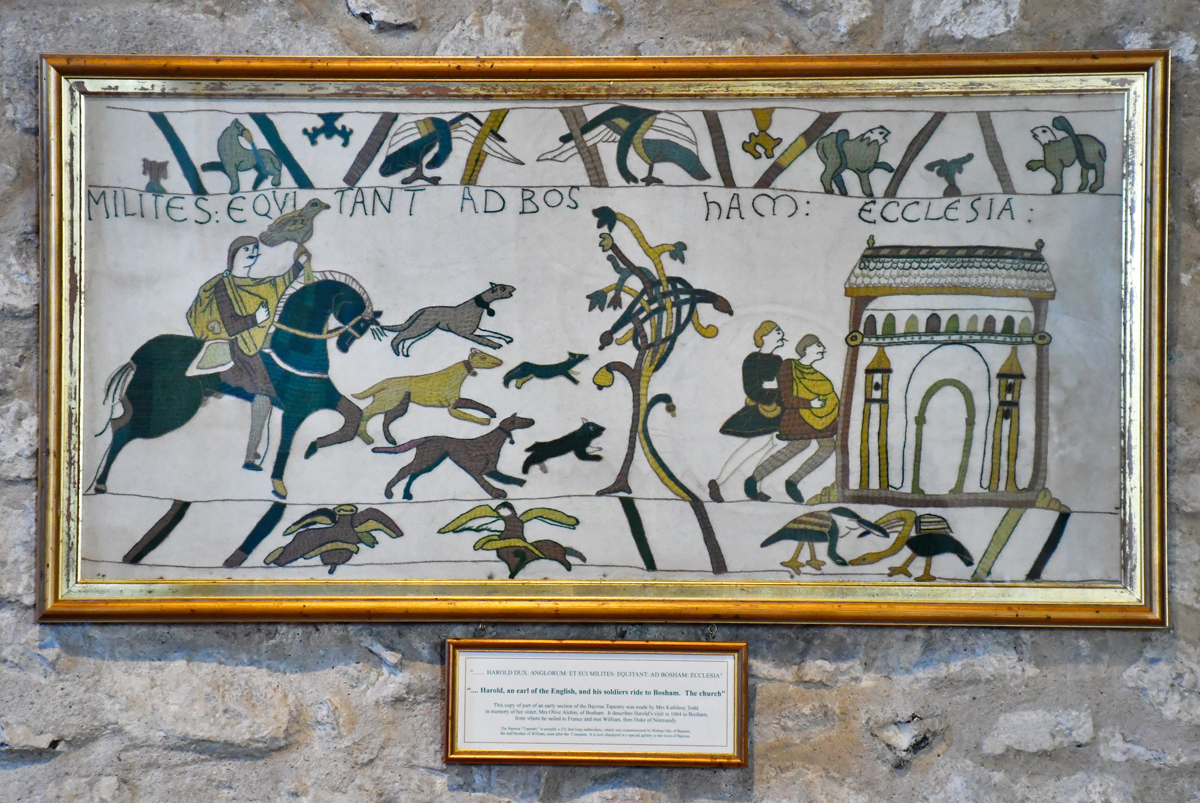
The replica of the Bayeux Tapestry on display in Bosham Church © French Moments
Its name appears in the Bayeux Tapestry. We see Harold, William’s future opponent, arriving with his men, entering a church, then sharing a meal before setting out to sea. Holy Trinity Church is still there, although the centuries have changed it.
Here is a rather tangible way of getting closer to the 11th century. A church we can still visit. A departure by boat. And, at the other end of the journey, an oath with considerable consequences.
To understand how a Norman duke ended up being crowned in London on Christmas Day, though, we need to begin on the other side of the Channel. In Falaise.
Before William the Conqueror, a child in a dangerous duchy
William was born around 1027 or 1028 in Falaise, Normandy. His father, Robert the Magnificent, was duke. His mother, Herleva, also known as Arlette, was not married to Robert.
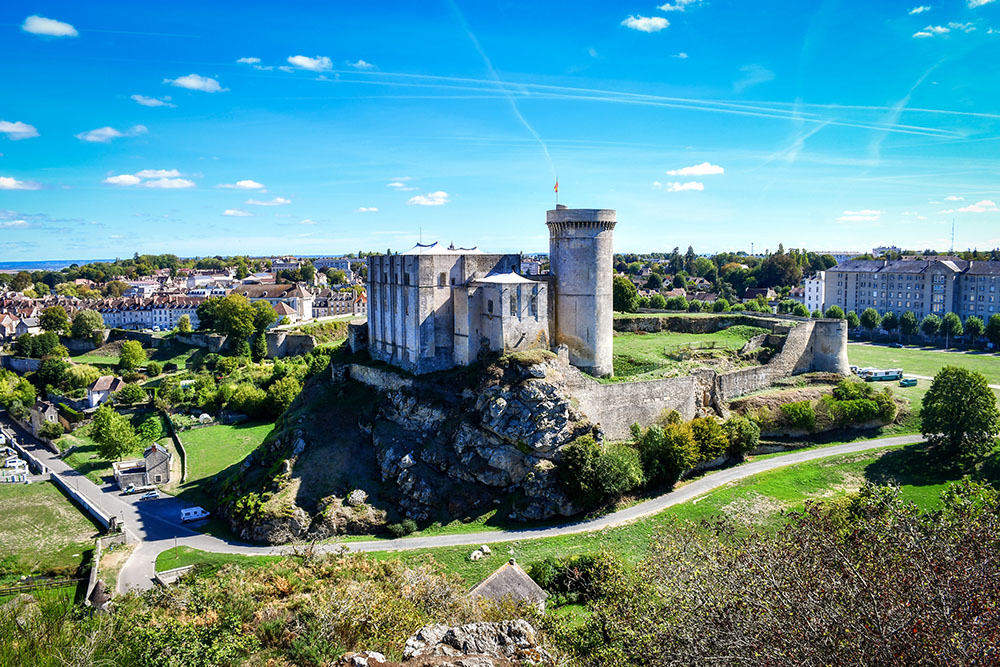
The castle of Falaise © French Moments
His birth earned him the name ‘William the Bastard’ (in French, Guillaume le Bâtard). We are more familiar with the considerably more flattering ‘Conqueror’, but that belongs to a later part of the story.
In 1035, Robert died on his way home from a pilgrimage to Jerusalem. William inherited the duchy when he was only seven or eight years old.
Seven or eight. An age when you still depend very much on adults, and when the adults around you might turn out to be your greatest problem.
His minority was marked by rivalries between powerful lords and murders within his entourage. It took him years to establish his authority. Victory at Val-ès-Dunes in 1047, with the help of King Henry I of France, was an important step.
His marriage to Matilda of Flanders strengthened his position further. By the time he prepared to invade England, William was approaching forty. He had already learnt to command, negotiate and survive in a world of shifting loyalties.
William the Conqueror: a duke who spoke French?
Yes, provided we explain what we mean by that.
William the Conqueror spoke Old Norman, a variety of the langue d’oïl associated with Old French. It was very different from the standard French we use today, although both belong to the same linguistic history.
Another useful detail: before 1066, William was not a king. He was Duke of Normandy and, as such, a vassal of the King of France. The English crown would add a new role to an already powerful figure.
A childless king and several claimants to his throne
In England, Edward the Confessor had reigned since 1042. He had spent many years in Normandy before taking the throne and retained connections with the duchy.
His problem was easy to state: he had no children.
The answer to ‘who will succeed him?’ was rather less straightforward.
According to Norman sources, Edward had promised the crown to William. In England, Harold Godwinson, Earl of Wessex and the king’s brother-in-law, held a particularly strong position.
This brings us back to Bosham. Around 1064 or 1065, Harold left Sussex for the Continent.
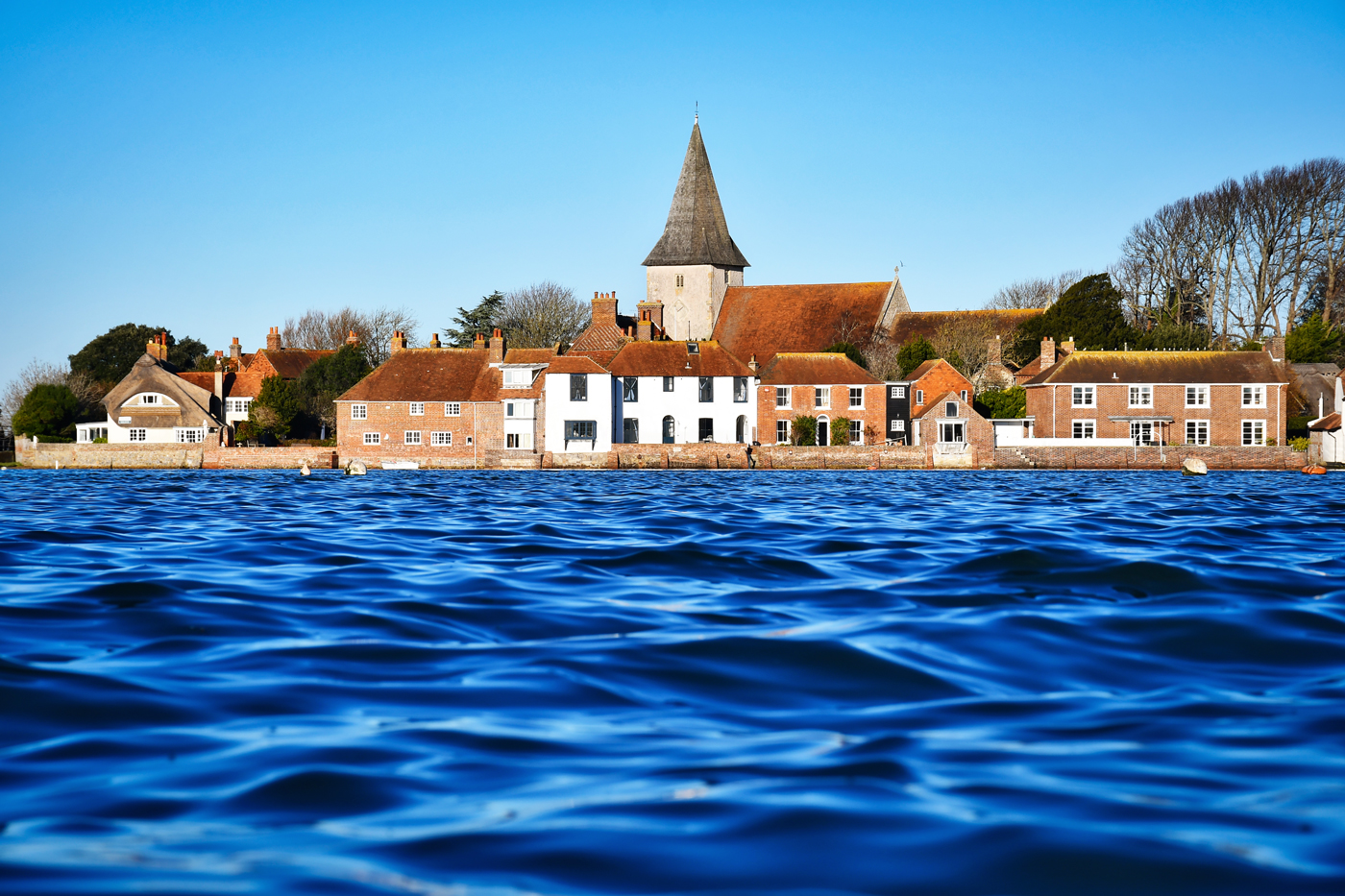
Bosham © French Moments
During his journey, he found himself in William’s company and swore an oath to him.
The Bayeux Tapestry shows him making this gesture over reliquaries. It does not give us the wording of his promise. Norman accounts maintain that Harold pledged to support William’s claim to the throne. The original purpose of the journey and the precise meaning of the oath remain disputed.
Edward died on 5 January 1066. According to the English account, he entrusted the kingdom to Harold on his deathbed. The leading men of the kingdom, assembled in the Witan, chose Harold.
He was crowned the very next day.
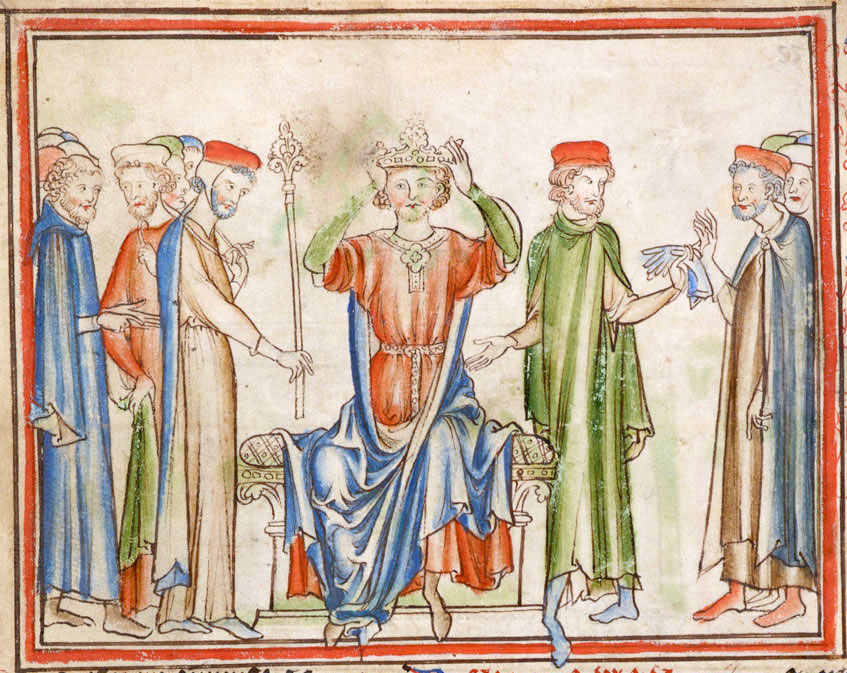
The coronation of King Harold II
To his supporters, England had a legitimate king. To William, a man had seized a crown promised to someone else, breaking his oath in the process. Two interpretations of events, with enough conviction on both sides to prepare for war.
Then a third claimant entered the scene: Harald Hardrada, King of Norway, invoking earlier Scandinavian succession agreements. He allied himself with Tostig, Harold’s exiled brother.
Keep an eye on those two names: Harold in England, Harald in Norway. The chroniclers could have made life a little easier for us.
William the Conqueror prepares to cross the Channel
Claiming a kingdom is one thing. Transporting an army there is another.
During the spring and summer of 1066, William the Conqueror gathered fighting men, had ships built and assembled the supplies they would need. His army included Normans, but also Bretons and men from other parts of the Continent.
Norman sources also credit him with the support of Pope Alexander II, expressed through the gift of a banner. In a dispute over legitimacy, such backing mattered.
Hundreds of ships, with horses aboard
The precise figures elude us. To picture the expedition, think of roughly 7,000 to 8,000 fighting men, perhaps including 2,000 to 3,000 cavalrymen. Estimates vary.
The fleet calls for similar caution: English Heritage suggests 700 to 1,000 ships. The often-mentioned 700 to 800 vessels are therefore an indication of scale, rather than a count made as they left harbour.
The men, their weapons, food and horses all had to be loaded. The horses were essential to the Norman way of fighting. They took up space, needed feeding and did not become any more cooperative simply because a duke had ambitions to conquer England.
The Tapestry shows this practical work: timber being prepared, ships under construction, equipment carried aboard and animals transported. The conquest also began with carpenters and men carrying barrels.
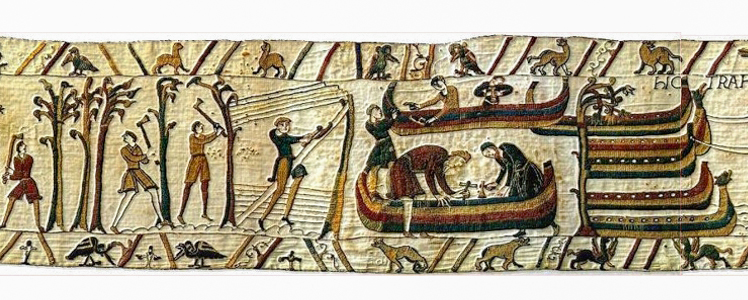
Preparations for the army of William the Conqueror, including the building of the landing craft - The Bayeux Tapestry
The final departure of William the Conqueror was not from Normandy
The fleet first assembled at the mouth of the River Dives, near Dives-sur-Mer. Conditions delayed the crossing.
Around 12 September, it moved to Saint-Valery-sur-Somme. The decisive expedition would therefore leave from the Bay of the Somme, in Picardy.
On 27 September, a favourable wind finally allowed the ships to put to sea. William’s vessel, the Mora, is traditionally described as a gift from Matilda. The fleet crossed overnight and landed at Pevensey on 28 September 1066.
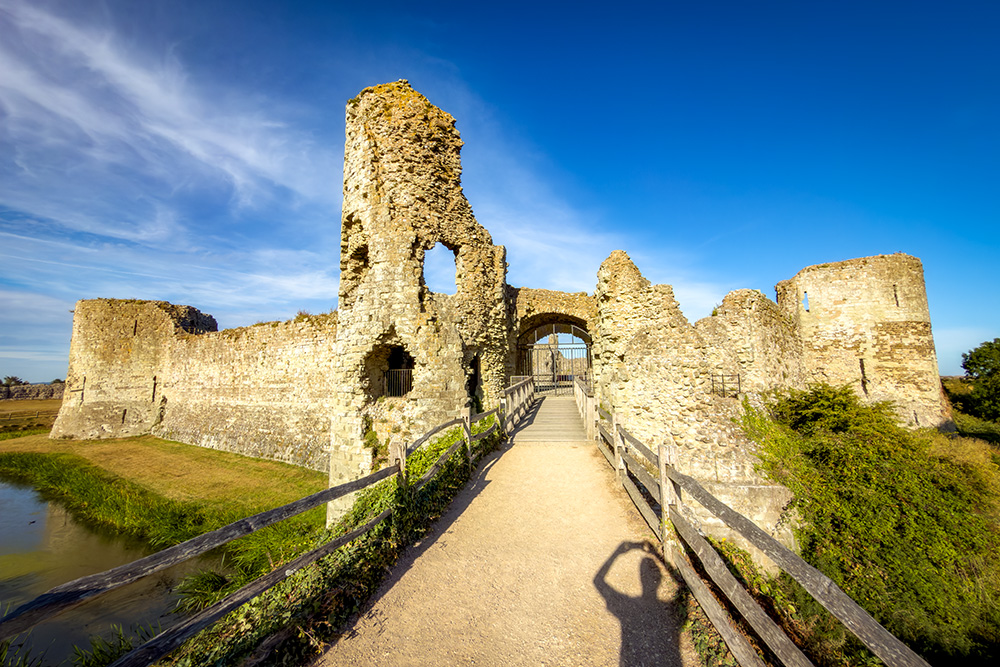
Pevensey Castle in 2026 © French Moments
Imagine the Sussex coast at that moment: ships approaching, then men stepping ashore and bringing the horses off the boats. After months of preparation, the army was in England.
William the Conqueror established an initial fortification within Pevensey’s old Roman defences, then made his base at Hastings. The surrounding countryside was plundered. He needed to feed his men and secure his position; the devastation also put pressure on Harold.
1066 and 1944: two landings on very different scales
The comparison comes quite naturally when you look at a map of the Channel. In 1066, an army left the Continent for England. In 1944, the Allies travelled in the opposite direction, towards Normandy.
The resources available had changed completely.
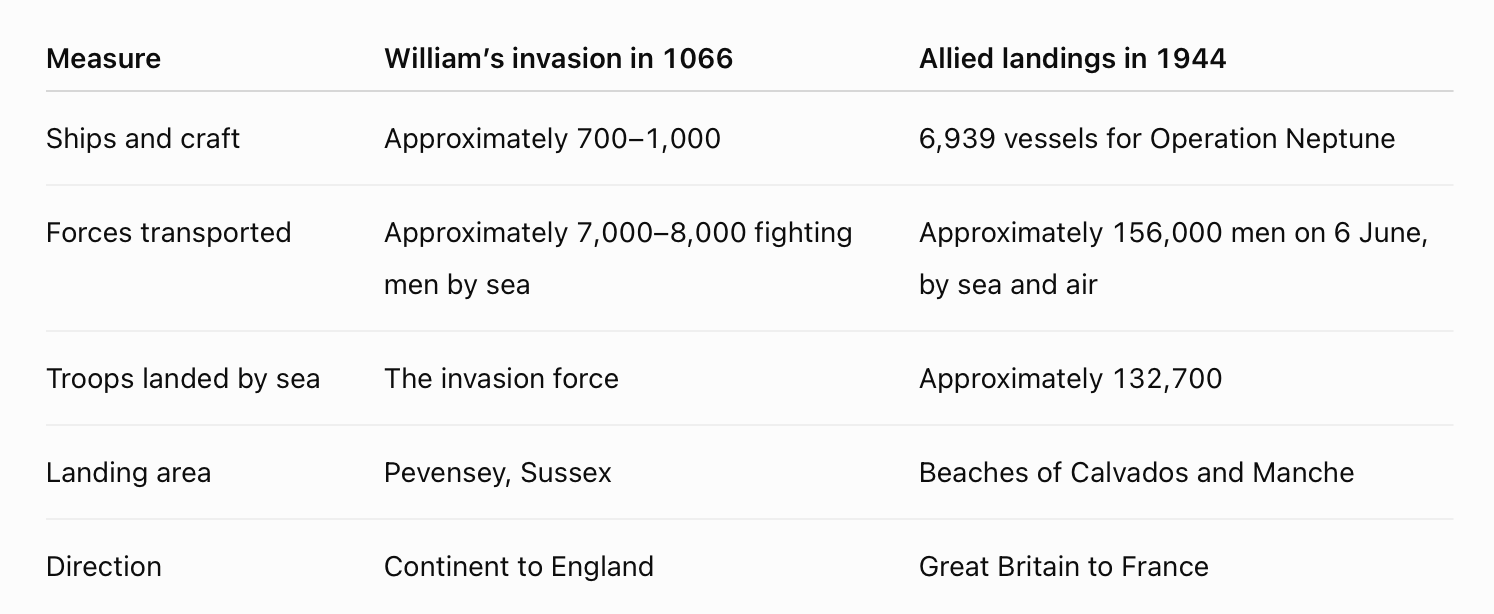
Neptune’s naval total comprised 1,213 naval combat ships, 4,126 landing ships and landing craft, 736 ancillary craft and 864 merchant vessels. This figure covers the naval and assault operation, which ran from 6 to 30 June 1944. The approximately 156,000 men, meanwhile, were those landed on 6 June, including airborne troops.
That gives us roughly seven to ten times as many vessels in 1944, depending on the estimate used for 1066. The comparison provides a sense of scale; it does not, of course, make a medieval boat equivalent to a 20th-century warship.
In both cases, however, the commanders had to work with the Channel and the weather.
Harold wins a battle before heading south again
While William the Conqueror waited for his wind, events were moving quickly in northern England.
Harald Hardrada and Tostig had landed there. On 20 September, they defeated the local English forces at Fulford, near York.
Harold moved rapidly north. On 25 September, he surprised the invaders at Stamford Bridge and won a decisive victory. Hardrada and Tostig were killed.
For Harold, the Norwegian threat had been removed.
Three days later, William landed in Sussex.
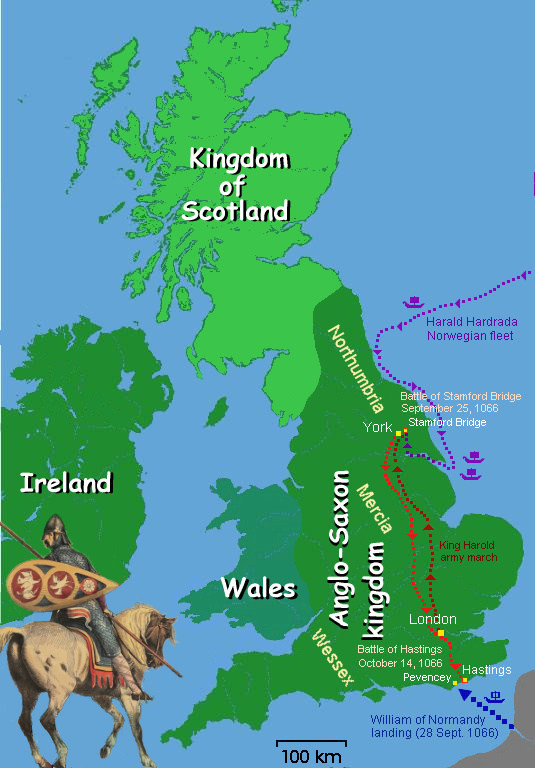
Map of the Battle of Hastings. Public Domain via Wikimedia Commons
Harold had to head south again. He passed through London, gathered fresh forces and continued towards Sussex. Some of his men had just endured considerable travelling and a battle. Others joined the army along the way. We should therefore be careful not to picture the entire English army as a single column that had followed exactly the same route.
On 14 October, the two sides faced each other.
At Hastings, William the Conqueror could have lost
First, a small geographical surprise: the battle took place not in the centre of Hastings, but on the site of the present-day town of Battle, roughly six miles to the north-west.
Harold occupied the high ground. His men fought on foot, forming a shield wall. The housecarls, professional soldiers in his service, stood alongside men called up for military duty.
Facing them, William had archers, infantry and cavalry. The numbers are uncertain; the two armies were probably broadly comparable in size.
The English position was strong. The attackers had to climb the slope, then face a line of fighting men standing close together.
The first attacks were not enough.
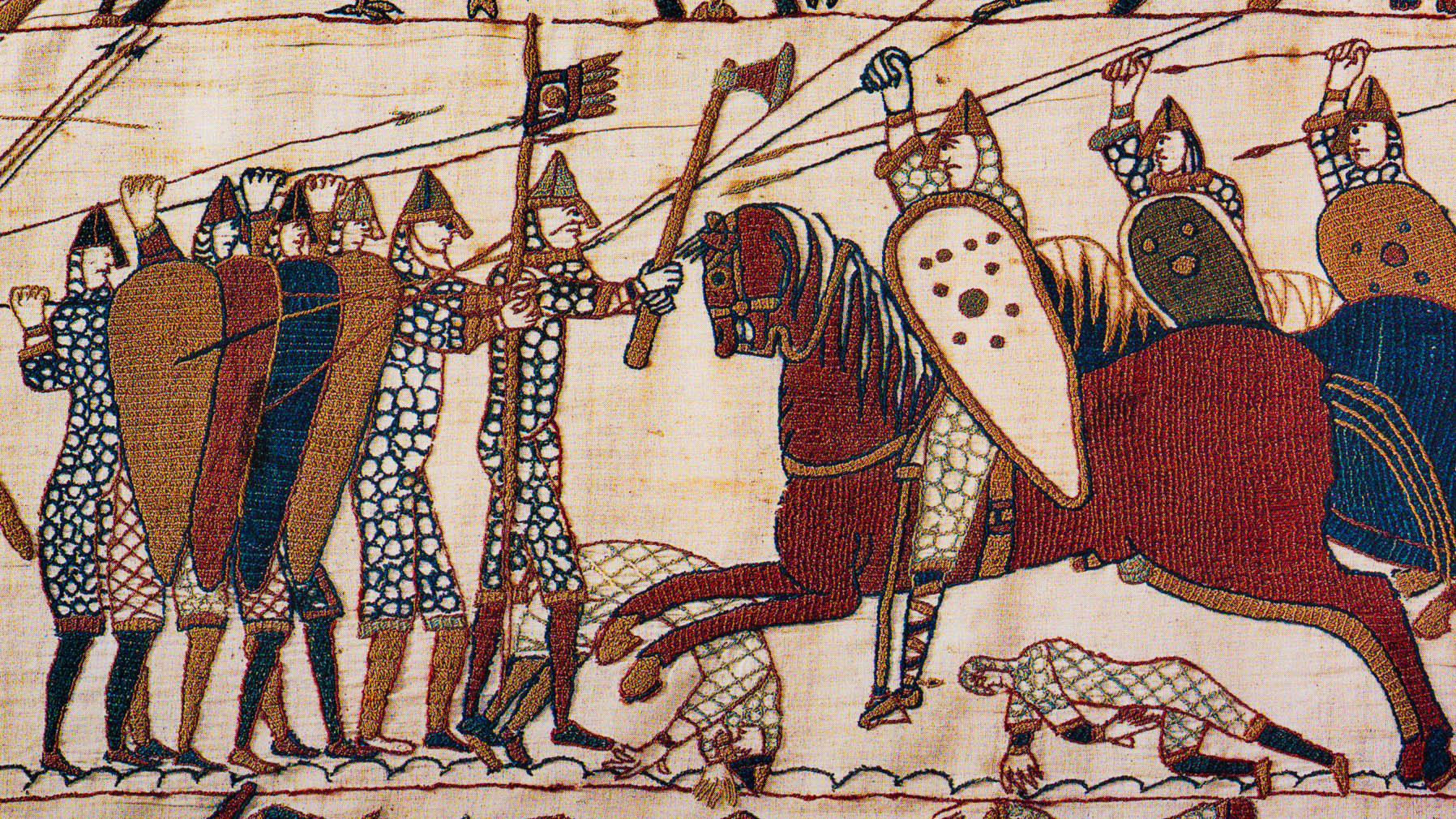
Norman horsemen attacking the Anglo-Saxon infantry at the Battle of Hastings. Bayeux Tapestry. Public domain via Wikimedia Commons
A lifted helmet to stop the panic
Part of William’s army fell back. A rumour spread: the duke was dead.
For a leader whose expedition depended so heavily on his own presence, this was a dangerous moment. William lifted his helmet to show his face and rally his men. The Tapestry depicts the gesture.
Some English soldiers pursued the retreating men down from their position. Cut off from the rest of the army, they were attacked and killed.
According to Norman accounts, William’s men then deliberately used feigned retreats: appearing to flee, drawing defenders out and turning back on them. The precise course of these manoeuvres remains debated.
The fighting lasted almost the whole day. That duration tells us something about the strength of the English resistance. William did not simply ride across the battlefield to collect his crown.
Was Harold really struck by an arrow in the eye?
It is one of the best-known images in English history. Yet it is not a certainty.
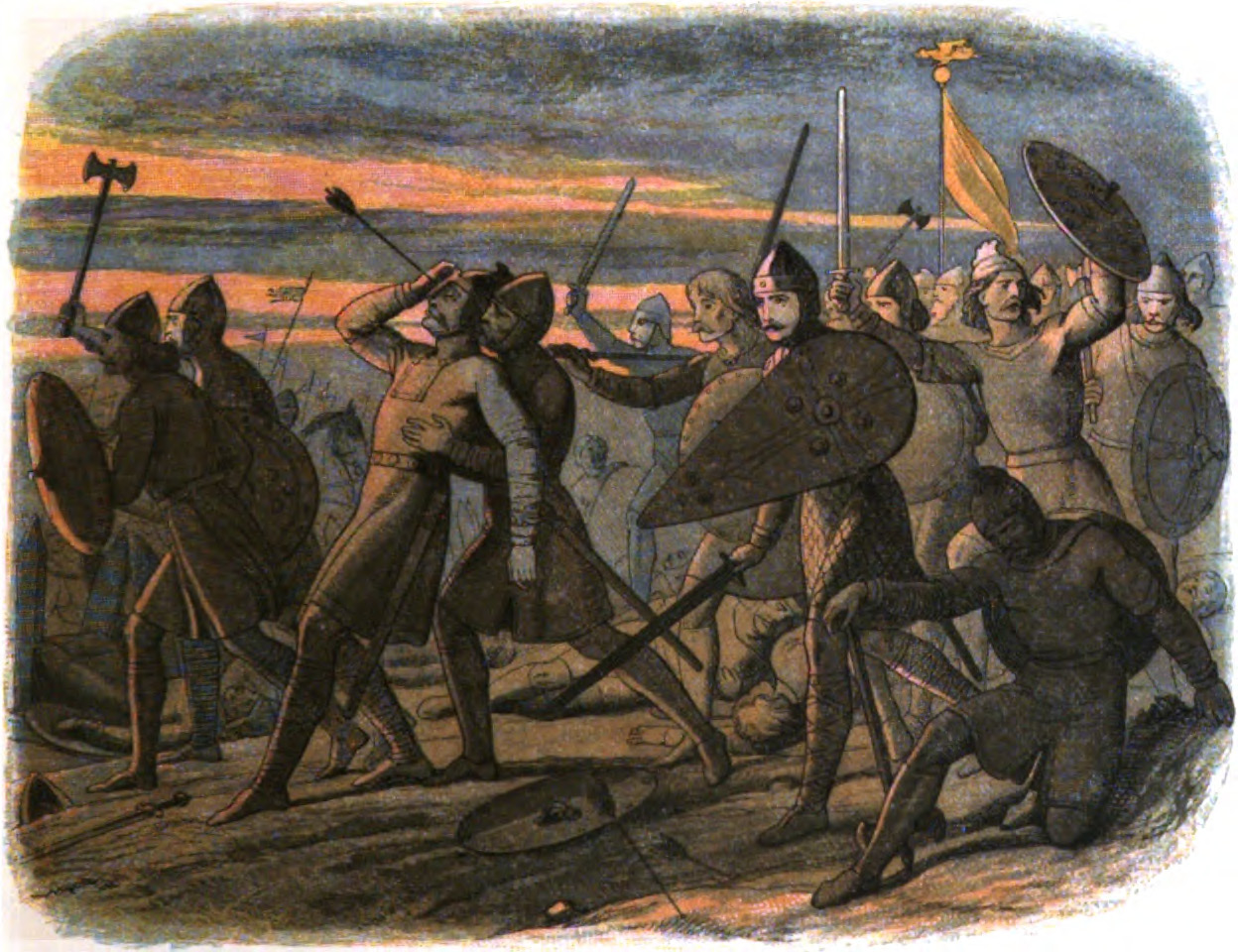
The death of Harold Godwinson at the Battle of Hastings (from *A Chronicle of England*, Public Domain via Wikimedia Commons)
In the Tapestry, near the inscription announcing Harold’s death, one man appears to have been struck in the face, while another is attacked by a horseman. Historians continue to debate the identification of the figures and the exact circumstances of the king’s death. [7]
Harold died during the battle. His brothers Gyrth and Leofwine were also killed. Deprived of its principal leaders, the English army eventually broke up.
William had won Hastings.
London, however, had not yet promised him anything.
Christmas 1066, William the Conqueror's coronation in confusion
The English nobles did not all rally immediately to the victor. Some supported the young Edgar Ætheling, a member of the Anglo-Saxon royal line. He would never be crowned.
William secured the south-east, passed through Dover and Canterbury, then went around London. He crossed the Thames at Wallingford. Military operations and devastation made resistance increasingly difficult.
At Berkhamsted, Edgar and several English leaders submitted.
On 25 December 1066, William was crowned in Westminster Abbey. The choice of venue connected him with Edward the Confessor, whose abbey had been consecrated shortly before his death.
But the ceremony did not take place in a calm atmosphere.
According to the surviving accounts, the Norman guards stationed outside heard the acclamations and mistook them for signs of an attack. They set fire to nearby buildings. Panic spread among the congregation, and people left the church.
The coronation was completed amid the confusion. One chronicler even described William trembling. We should remember that this is a medieval account, but it gives a vivid impression of the tensions surrounding the new regime.
William the Conqueror became William I, King of England. He remained Duke of Normandy: sovereign in his English kingdom, a vassal of the King of France for his duchy.
The Channel now separated the two parts of his possessions. It would also add considerably to his travelling and his worries.
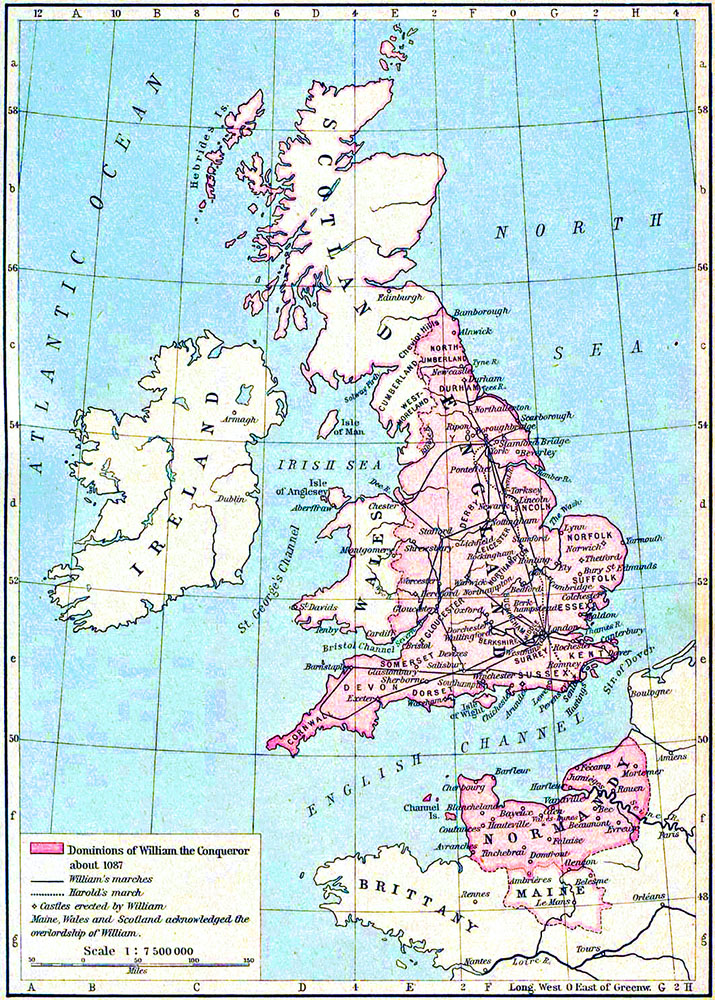
Dominions of William the Conqueror in 1087
Holding a kingdom, sometimes through terror
The coronation did not end resistance.
In the years that followed, William faced rebellions. Repression became particularly violent in northern England in 1069 and 1070, during what is known as the Harrying of the North.
Troops destroyed crops and food supplies. People suffered famine. These operations aimed to break the capacity for resistance by devastating the country.
It would be difficult to describe William’s military achievements without pausing over this reality. For those affected, conquest meant loss, destruction and the disappearance of a familiar order.
Land changed hands. Much of the English aristocracy was replaced by men connected with the new regime.
Castles rose: they housed garrisons and made power visible. In London, the White Tower, begun around 1078, formed part of this effort to control and impress. Great Romanesque churches also helped transform the landscape.
Yet William retained some of England’s administrative structures. He had taken possession of an already organised kingdom, with its shires, officials and taxes.
The Bayeux Tapestry tells the story of victory
We have encountered it at Bosham, aboard the ships and in the middle of the battle. It is time to look at the work itself: the Bayeux Tapestry (in French, la tapisserie de Bayeux)
First of all, the Bayeux Tapestry is an embroidery: woollen threads worked on linen cloth. Its surviving length is approximately 68.3 metres, often rounded to 70 metres.
![Tapisserie de Bayeux - Photo Mairie de Bayeux - licence [CC BY-SA 4.0] from Wikimedia Commons](https://frenchmoments.eu/wp-content/uploads/2026/10/Tapisserie-de-Bayeux-Photo-Mairie-de-Bayeux-licence-CC-BY-SA-4.0-from-Wikimedia-Commons.jpg "Tapisserie de Bayeux - Photo Mairie de Bayeux - licence [CC BY-SA 4.0] from Wikimedia Commons")
Bayeux Tapestry - Photo Mairie de Bayeux - licence [CC BY-SA 4.0] from Wikimedia Commons
It is thought to have been made in the 1070s, probably in England. Its likely patron was Odo, Bishop of Bayeux and William’s half-brother. The attribution to Queen Matilda and her ladies belongs to tradition, without firm supporting evidence.
The inscriptions are in Latin. The illustrated narrative takes the viewer from Edward’s reign to the English defeat at Hastings.
You can follow the great events. But look at what surrounds them, too: the clothes, tools, meals, animals and the dead depicted in the borders.
These details give a physical presence to a world we otherwise know largely through texts.
A story told from the winning side of William the Conqueror
The work broadly favours William’s claim. Harold’s oath is given considerable prominence. That does not mean every scene is easy to interpret, or that Harold is always shown without dignity.
Its creation may have been connected with the consecration of Bayeux Cathedral in 1077. This remains a matter of debate. An inventory from 1476 clearly records its presence in the cathedral treasury and its annual display in the nave.
The surviving section ends with the English defeat. You will find neither the Christmas coronation nor the administration of the kingdom there. A lost ending has been suggested, but we do not know what it might have contained.
To discover the England transformed by William, we need to open another document.
Domesday Book, down to the fields and mills
At Christmas 1085, William the Conqueror ordered a great survey. It was carried out the following year.
Who held the land? What was it worth? What resources could it provide? Domesday Book addressed very practical concerns of government, taxation and defence.
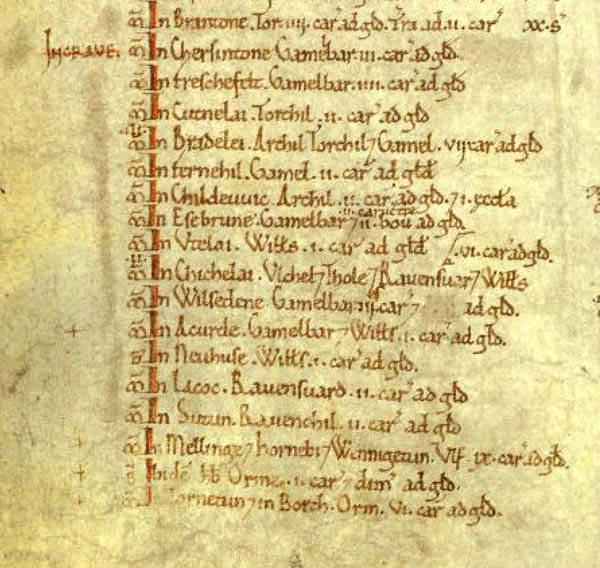
Extract from the Domesday Book
Commissioners gathered statements under oath. Estates were described in terms of their resources and revenues: ploughs, mills, woodland, meadows and dependent populations.
Among the comparisons were the situation at the end of Edward the Confessor’s reign and that of 1086. Twenty years separated them. The document allows us to see how much landholding had changed since Hastings.
It was not a census naming every inhabitant. Nor was its coverage absolutely complete. But the survey was remarkable in its scope for the period.
The National Archives refers to some 13,000 settlements and information concerning around 270,000 people, free and unfree. The findings survive principally in two sets of records, Great Domesday and Little Domesday.
I find this shift to the details of individual estates particularly revealing. After the cavalry charges, oaths and crowns, we come back to cultivated land and the income from a mill. This, too, was where the king’s power was exercised.
The death of William the Conqueror in Normandy
William left England for the last time in 1086. He still had interests to defend on the Continent.
The following year, during a campaign in the Vexin, he became seriously ill after the attack on Mantes. Accounts differ: some mention the heat, others an injury caused by his saddle. The details do not allow us to reconstruct exactly what happened.
He died on 9 September 1087, at the priory of Saint-Gervais, near Rouen. He was about 59. His body was taken to Caen and buried in the church of Saint-Étienne at the Abbaye aux Hommes, which he had founded.
His possessions were divided. Robert Curthose received Normandy. William Rufus became King of England. Henry, the youngest of his surviving sons, received a substantial sum of money.
The two shores now had different rulers.
In Caen, William’s tomb still stands in the choir of the abbey church. It contains only a small part of his remains, however: a thigh bone, following the destruction inflicted on the burial over the centuries.
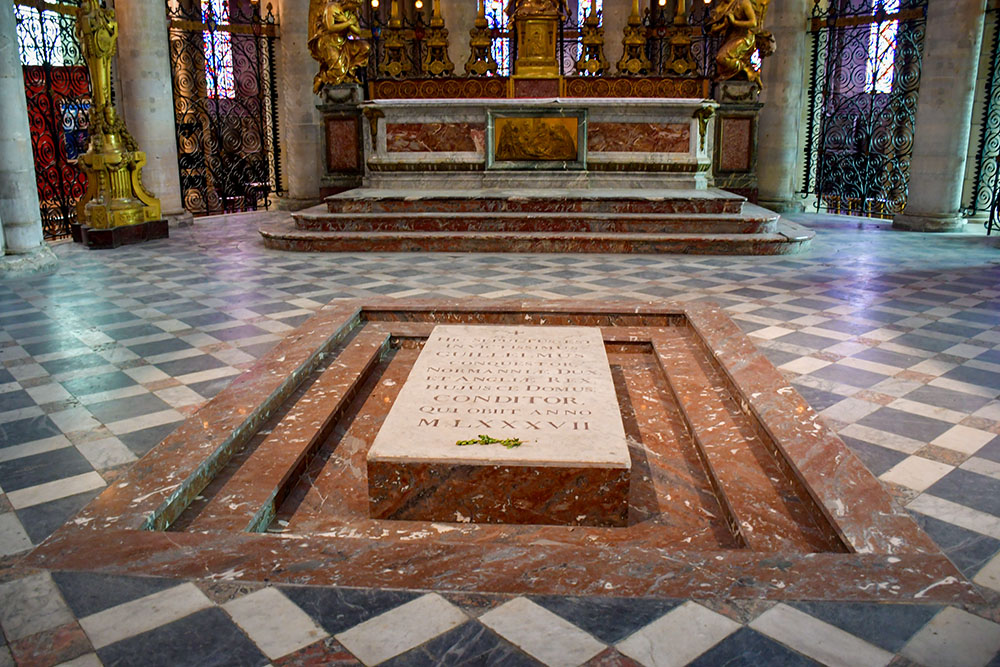
The tomb of William the Conqueror in the church of the Abbaye aux Hommes in Caen © French Moments
That detail strikes me. This man transported an army across the Channel, changed the holders of English lands and left his name in two countries. To trace his story, we have an embroidery, records, fortresses… and, in a church in Caen, an almost empty tomb.
At Bosham, it had all begun with a man entering a church before taking a boat. I shall look at that scene in the Tapestry rather more closely now.
Where can you see the Bayeux Tapestry?
For the time being, seeing the Bayeux Tapestry means heading to London: it is on display at the British Museum from 10 September 2026 to 11 July 2027.
This exceptional loan forms part of a cultural exchange between France and Britain, taking advantage of the closure of the Bayeux museum for renovation and extension.
Treasures from the British Museum, including objects from Sutton Hoo and some of the Lewis chessmen, are due to make the journey in the opposite direction.
The embroidery remains the property of the French state and is due back in Bayeux by 1 September 2027 at the latest, allowing time for condition checks and reinstallation before the museum’s planned reopening in October 2027.
There, a new display will help protect its almost thousand-year-old fabric.
After telling the story of a Channel crossing for centuries, the Tapestry is making a journey of its own, with its return to Normandy firmly on the programme.