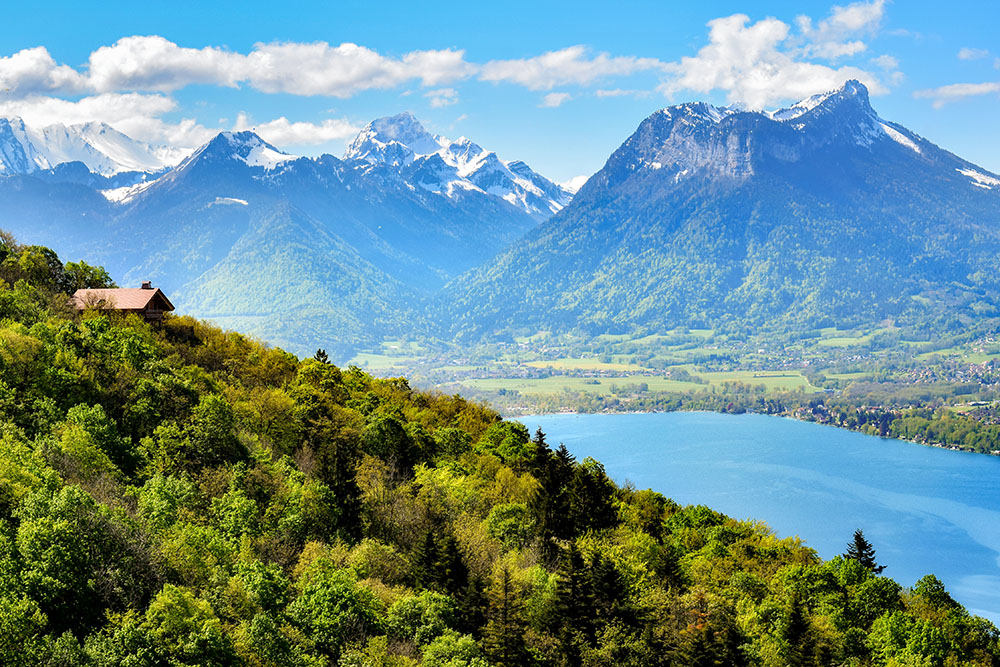


The Bauges Mountains are one of those Alpine territories you often glimpse without always knowing what to call them. You can make them out from Chambéry, Aix-les-Bains, Annecy or Lake Bourget. You may cross them by car, on foot or by bicycle. And yet, for many visitors, they remain a discreet, almost secret massif, tucked between destinations that are far more famous.
To the west lie Chambéry and Aix-les-Bains. To the north, Annecy and its lake. To the east, Albertville and the high Alpine valleys. Between all of these, the Bauges form a world of their own: limestone mountains, alpine pastures, rural villages, forests, passes, cheese, winding roads and open landscapes looking out towards the great lakes of Savoie and Haute-Savoie.
In July 2026, the Tour de France will cross the massif during Stage 17 between Chambéry and Voiron. It will be a fine opportunity to put the Bauges back in the spotlight. But this territory deserves far more than a brief appearance on television. It is a real mountain country: accessible, inhabited, generous, flavourful and deeply endearing.
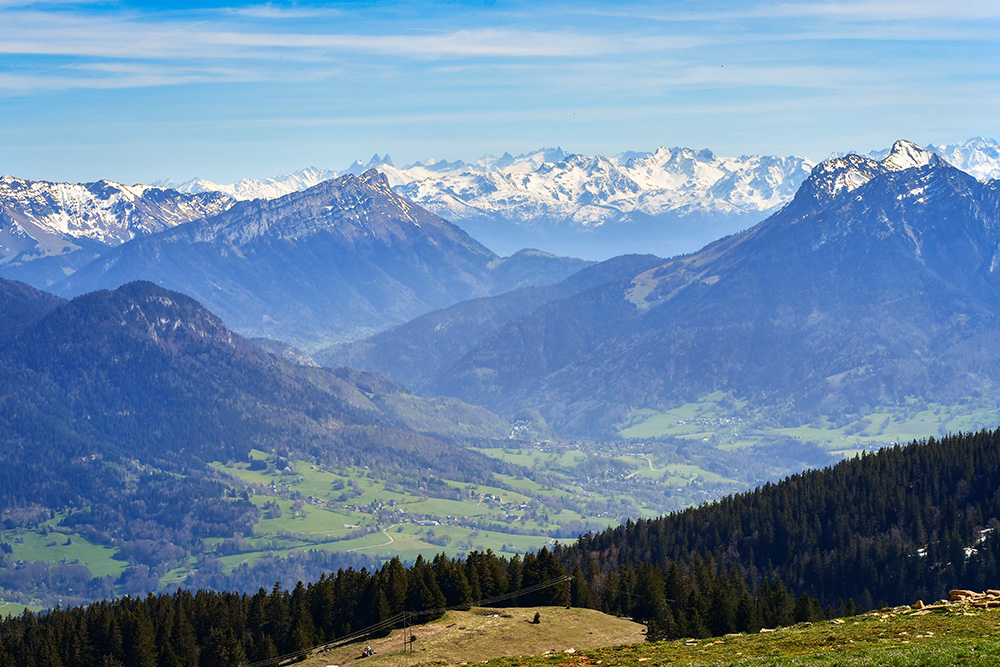
The Massif des Bauges reaching towards the Écrins © French Moments
Where Are the Bauges Mountains?
The Bauges Mountains are located in the Northern Pre-Alps, straddling Savoie and Haute-Savoie. They form a kind of mountainous island between several major Alpine centres: Annecy to the north, Aix-les-Bains and Chambéry to the west, Albertville to the east, and the Isère valley to the south.
It is precisely this position that makes the Bauges so interesting. They are not hidden away at the end of a remote and difficult valley. On the contrary, they lie close to well-known towns, famous lakes and major routes. And yet, as soon as you enter the heart of the massif, the atmosphere changes quickly.
The roads become narrower. The villages feel more mountainous. Meadows take over. Limestone cliffs appear above the forests. You are not in the highest Alps, but you are already very much in the mountains.
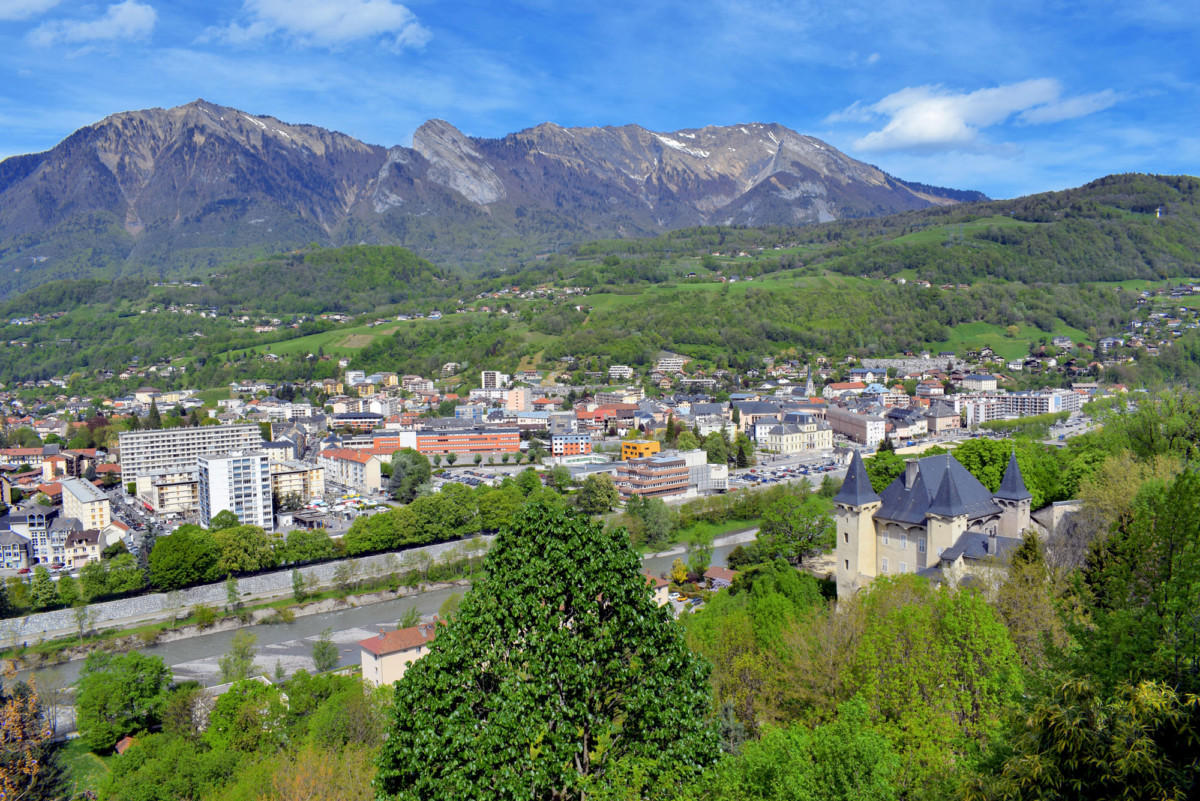
View over Albertville and the Bauges Mountains © French Moments
Today, the massif belongs to the Parc Naturel Régional du Massif des Bauges, also recognised as a UNESCO Global Geopark. This recognition underlines the importance of its landscapes, geology, natural heritage and human traditions.
![Map of the Massif des Bauges © Boldair - licence [CC BY-SA 4.0] from Wikimedia Commons](https://frenchmoments.eu/wp-content/uploads/2026/07/Massif-des-Bauges-Carte-©-Boldair-licence-CC-BY-SA-4.0-from-Wikimedia-Commons.jpg "Massif des Bauges Carte © Boldair - licence [CC BY-SA 4.0] from Wikimedia Commons")
Map of the Massif des Bauges © Boldair - licence [CC BY-SA 4.0] from Wikimedia Commons
The Bauges Mountains: Between Lakes, Alpine Pastures and Secret Valleys
The Bauges do not try to impress in the way Mont Blanc or the Vanoise might. Here, the charm is more subtle. You need to enter the massif, take the small roads, climb towards the passes, stop in the villages, and look at the ridgelines and alpine pastures before gradually understanding what gives the Bauges their identity.
The relief is mainly limestone. This gives the massif its cliffs, combes, pale rock faces and sometimes abrupt summits.
The Arcalod, rising to 2,217 metres, is the highest point in the Bauges.
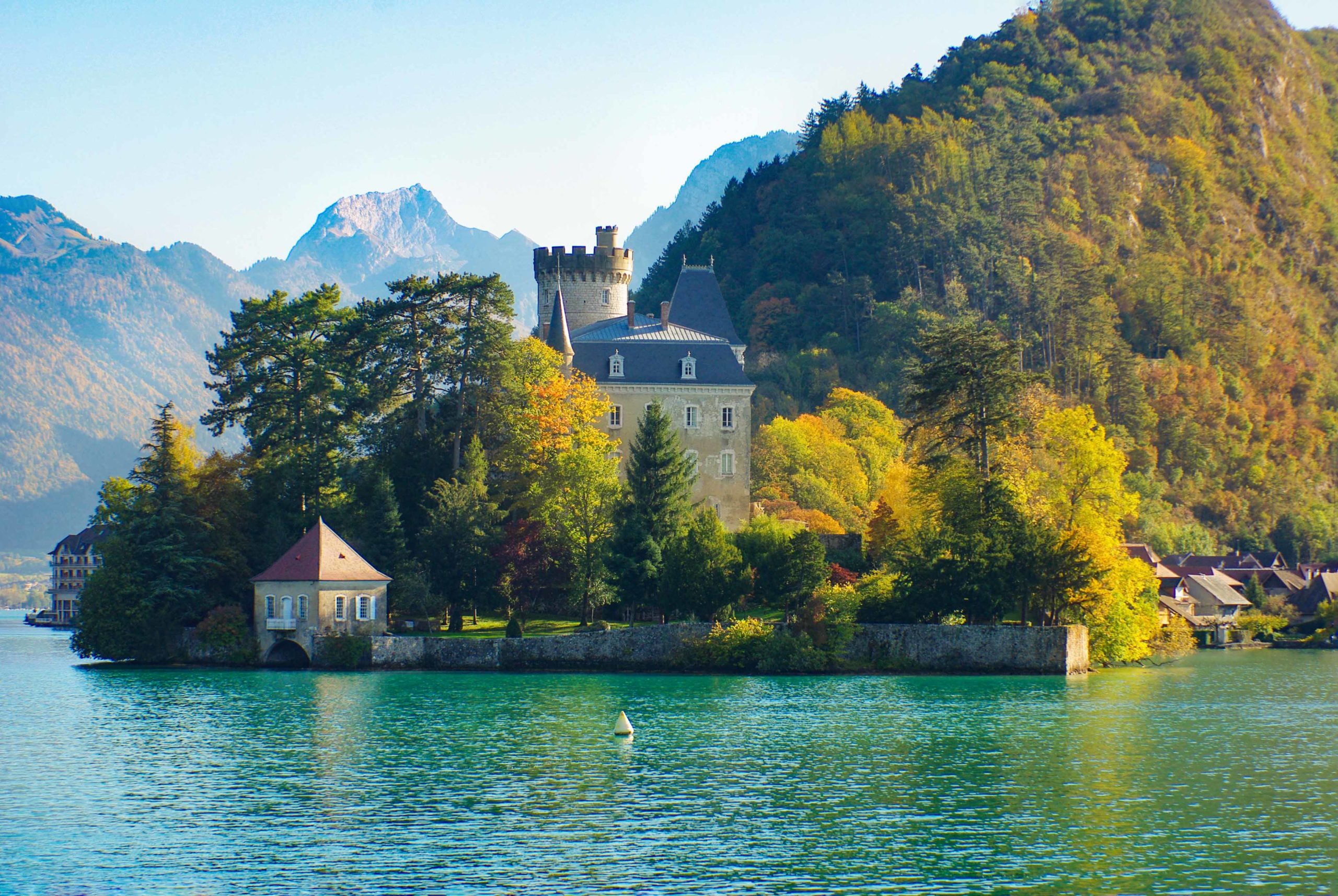
The château of Duingt with L’Arcalod in the background © French Moments
The massif also has several summits above 2,000 metres, including La Sambuy, Le Pécloz, Le Trélod and the Pointe de Chaurionde.
But the Bauges are not only about their summits. Their beauty also lies in the alternation of forests, meadows, pastures, inhabited valleys and balcony roads. You can find a very Alpine atmosphere, then a few kilometres later something almost pastoral.
From some areas, the views open towards Lake Bourget, Lake Annecy, the Chambéry cluse or the high Alps in the distance. This is one of the great attractions of the massif: it is both an inner world and a balcony over the surrounding landscapes.
Le Revard, above Aix-les-Bains, offers one of the finest viewpoints over Lake Bourget.
Le Semnoz, above Annecy, looks towards the lake, the Aravis, Mont Blanc on a clear day, and the softer reliefs of the Bauges.
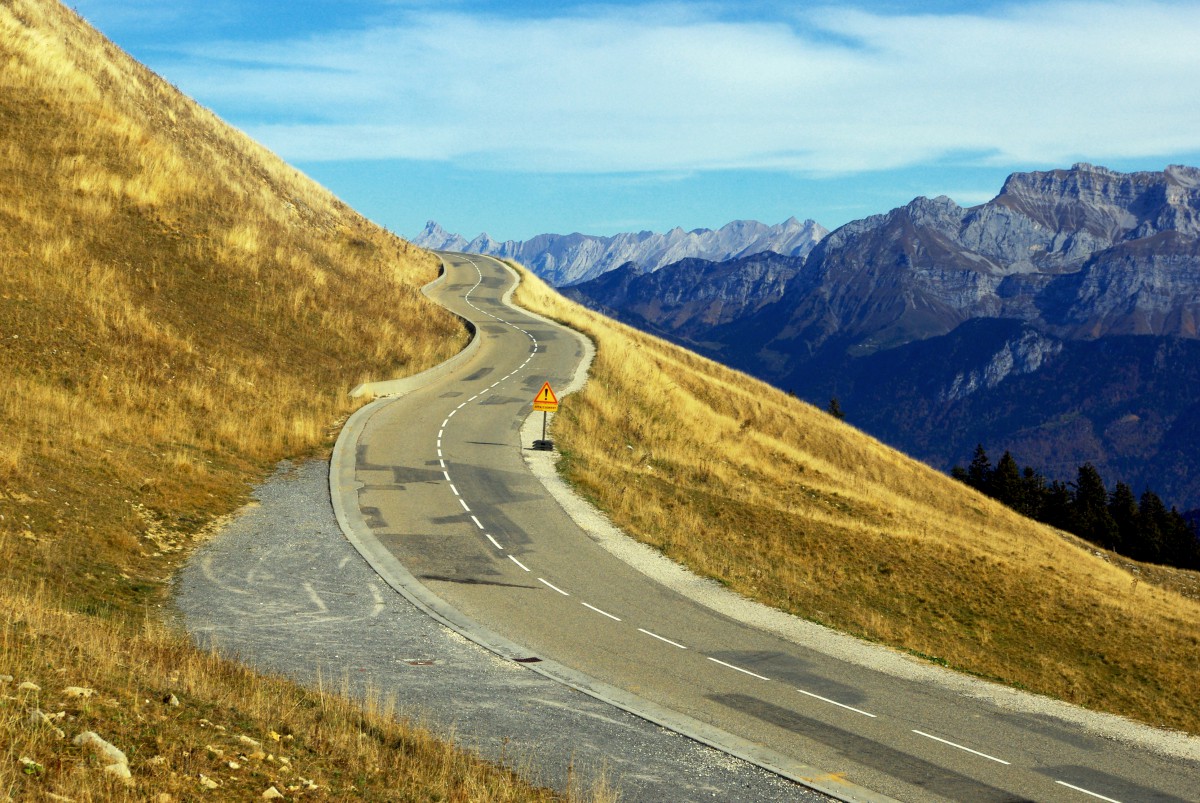
The road to the summit of Le Semnoz © French Moments
Elsewhere, in the heart of the massif, the atmosphere becomes more intimate: quiet roads, clustered villages, church towers, alpine pastures, torrents and wooded slopes.
The Regional Natural Park also highlights the ecological richness of the territory, with a great diversity of animal species, flowers and natural habitats.
But this is not a museum of frozen nature. The Bauges are a living territory, shaped by residents, farmers, livestock breeders, hikers, cyclists and visitors.
Lescheraines and the Villages of the Bauges Mountains
To understand the Bauges, you need to talk about their villages. And among them, Lescheraines occupies a special place.
![Lescheraines © Florian Pépellin - licence [CC BY-SA 4.0] from Wikimedia Commons](https://frenchmoments.eu/wp-content/uploads/2026/07/Lescheraines-©-Florian-Pepellin-licence-CC-BY-SA-4.0-from-Wikimedia-Commons.jpg "Lescheraines © Florian Pépellin - licence [CC BY-SA 4.0] from Wikimedia Commons")
Lescheraines in the heart of the Bauges Mountains © Florian Pépellin - licence [CC BY-SA 4.0] from Wikimedia Commons
Located in the heart of the massif, Lescheraines is a good entry point for grasping the identity of the Bauges. The village lies in the Chéran valley, between Le Châtelard, Bellecombe-en-Bauges, Les Aillons and the roads leading towards the Col des Prés.
It is not a spectacular resort or a museum village. It is rather a simple, lively, central mountain village, surrounded by landscapes that sum up the character of the Bauges very well.
In 2026, the Tour de France will pass through Lescheraines during the Chambéry–Voiron stage. For many television viewers, the name may appear on screen for only a few seconds.
And yet it says a great deal about the massif: a green valley, nearby mountains, roads climbing towards passes, and that feeling of being in a more discreet Savoie, far from the major resorts and summer crowds.
![Lescheraines © Guilhem Vellut - licence [CC BY 2.0] from Wikimedia Commons](https://frenchmoments.eu/wp-content/uploads/2026/07/Lescheraines-©-Guilhem-Vellut-licence-CC-BY-2.0-from-Wikimedia-Commons.jpg "Lescheraines © Guilhem Vellut - licence [CC BY 2.0] from Wikimedia Commons")
Lescheraines © Guilhem Vellut - licence [CC BY 2.0] from Wikimedia Commons
Around Lescheraines, the villages of the Bauges form a kind of rural constellation: Le Châtelard, École, Jarsy, Bellecombe-en-Bauges, Aillon-le-Jeune, Aillon-le-Vieux, La Compôte, Doucy-en-Bauges… Each has its own character, hamlets, meadows, barns, churches and views.
The architecture is often simple and robust. It speaks of a mountain country where people long lived with the seasons, animals, wood, snow, slopes and the constraints of the terrain.
Nothing too decorative, nothing too theatrical. The Bauges do not need to play the postcard game. They are quieter than that.
Perhaps that is part of their charm. In some villages, you can still sense a mountain world that is inhabited, worked and passed down.
You are not merely in a holiday backdrop.
You are in a territory with a strong, rooted identity — sometimes a little rugged, but deeply endearing.
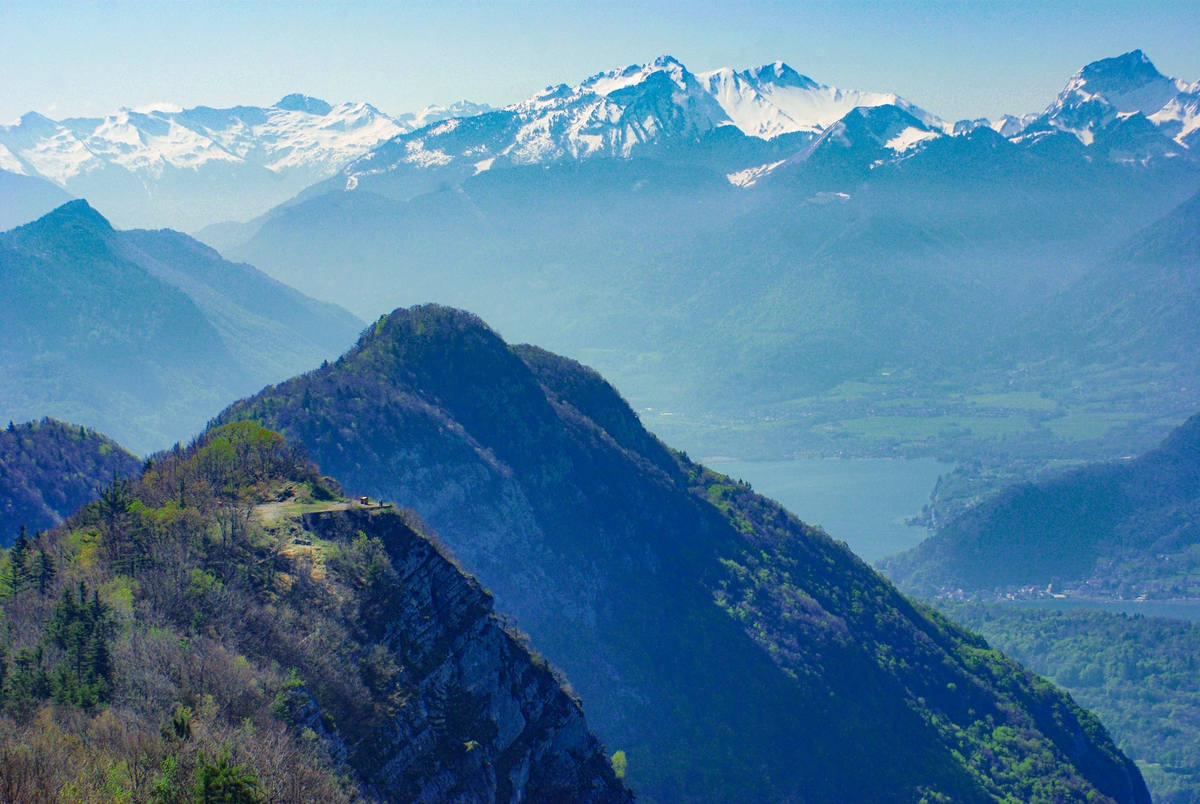
The view from Mont Veyrier over the mountains around Lake Annecy © French Moments
Tome des Bauges and Alpine Pasture Traditions
It is impossible to talk about the Bauges Mountains without mentioning Tome des Bauges. With one “m”, please.
That little spelling peculiarity already seems to say: here, we have our ways, and they are not necessarily those of the rest of the world.
Tome des Bauges is a Protected Designation of Origin cheese produced within the territory of the massif, between Savoie and Haute-Savoie.
The name “tome” is said to come from the Savoyard patois word toma, referring to a cheese made in alpine pastures.
![Tome des Bauges © Coyau - licence [CC BY-SA 3.0] from Wikimedia Commons](https://frenchmoments.eu/wp-content/uploads/2026/07/Tome-des-Bauges-©-Coyau-licence-CC-BY-SA-3.0-from-Wikimedia-Commons.jpg "Tome des Bauges © Coyau - licence [CC BY-SA 3.0] from Wikimedia Commons")
Tome des Bauges © Coyau - licence [CC BY-SA 3.0] from Wikimedia Commons
This cheese tells a large part of the landscape’s story all by itself. It speaks of meadows, herds, fruitières, farms, raw milk, inherited know-how and the pastoral economy.
According to the French Ministry of Agriculture, Tome des Bauges has been produced since the 18th century using raw milk from cows in the massif. It obtained AOC status in 2002, then AOP status in 2007.
In the Bauges, cheese is therefore not merely a tourist product. It is a way into local culture. It helps you understand the link between the inhabitants and their territory.
The alpine pastures are not only beautiful to photograph. They are also places of work, production and transmission.
You might say that the Bauges are tasted as much as they are admired. And frankly, that is rather good news for the visitor.
Hiking in the Bauges Mountains
The Bauges Mountains are a superb hiking area. They offer a wide variety of routes, from family walks in valley bottoms to more demanding ascents towards the limestone summits in the heart of the massif.
![Pointe de la Galoppaz © Florian Pépellin - licence [CC BY-SA 3.0] from Wikimedia Commons](https://frenchmoments.eu/wp-content/uploads/2026/07/Pointe-de-la-Galoppaz-©-Florian-Pepellin-licence-CC-BY-SA-3.0-from-Wikimedia-Commons.jpg "Pointe de la Galoppaz © Florian Pépellin - licence [CC BY-SA 3.0] from Wikimedia Commons")
Pointe de la Galoppaz © Florian Pépellin - licence [CC BY-SA 3.0] from Wikimedia Commons
What makes the Bauges especially appealing is this diversity of atmospheres. You can walk through alpine pastures, cross cool forests, follow torrents, climb towards a pass, reach a viewpoint over Lake Bourget or Lake Annecy, then descend again towards a village where the mountains return to their quiet rhythm.
Among the most appreciated areas, Le Semnoz is one of the most accessible. From its heights, views open towards Lake Annecy, the Aravis and, in clear weather, Mont Blanc. It is an ideal mountain for a first approach to the Bauges, especially for those staying in Annecy.
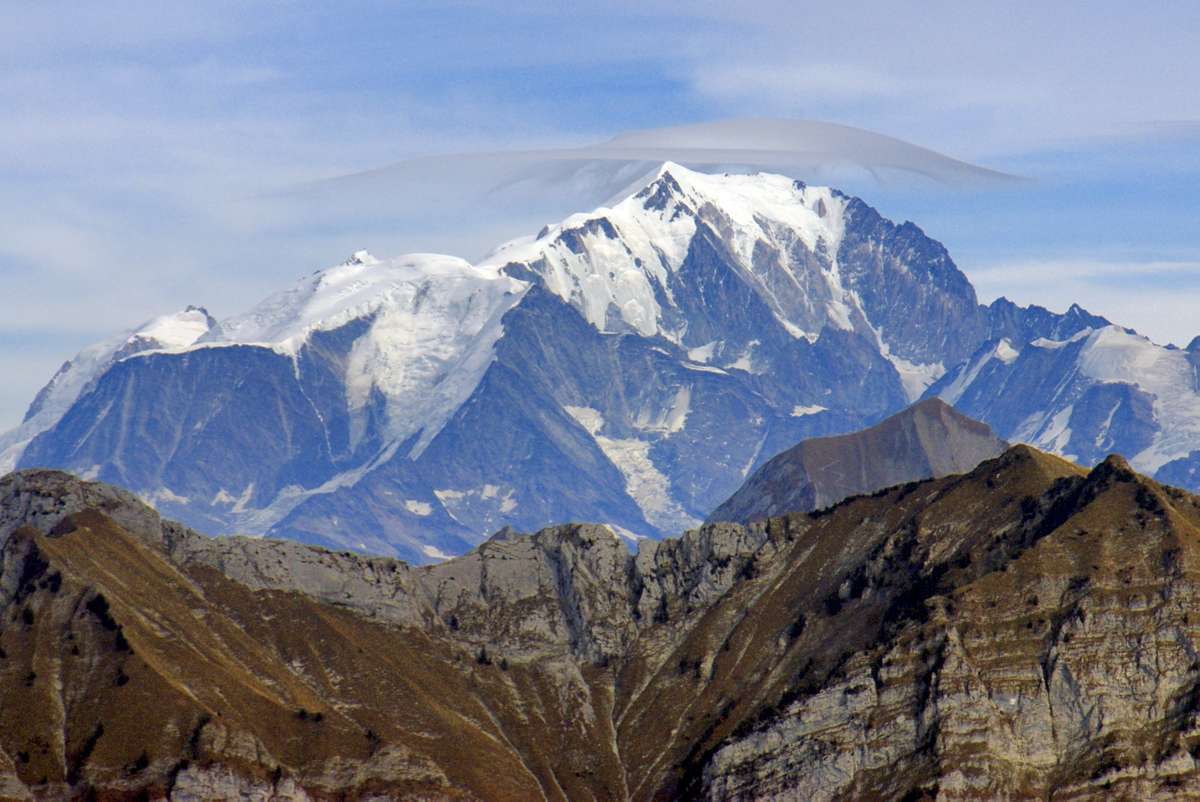
Mont Blanc seen from Semnoz © French Moments
Le Revard, above Aix-les-Bains, also offers magnificent panoramas. The viewpoint overlooks Lake Bourget and helps you understand, in a single glance, the position of the massif between lakes, towns and mountains.
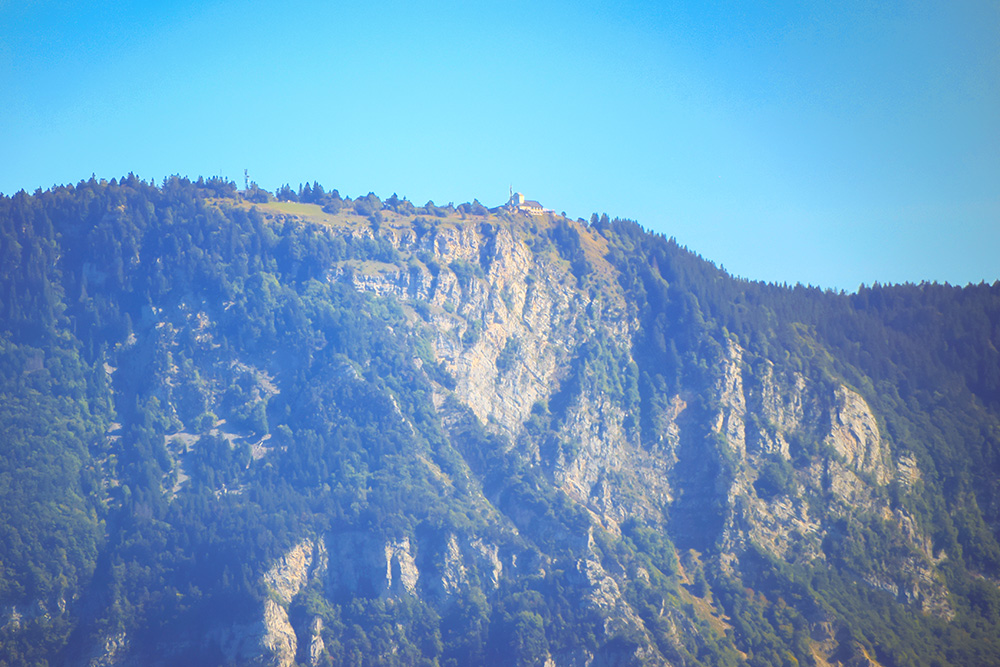
Le sommet du Mont Revard vu du côté occidental du lac © French Moments
In the heart of the Bauges, hikes often take on a wilder character. The areas around Aillon-le-Jeune, École, Jarsy, Bellecombe-en-Bauges and Le Châtelard allow you to discover a more intimate mountain world made up of alpine pastures, ridges, cliffs and discreet villages.
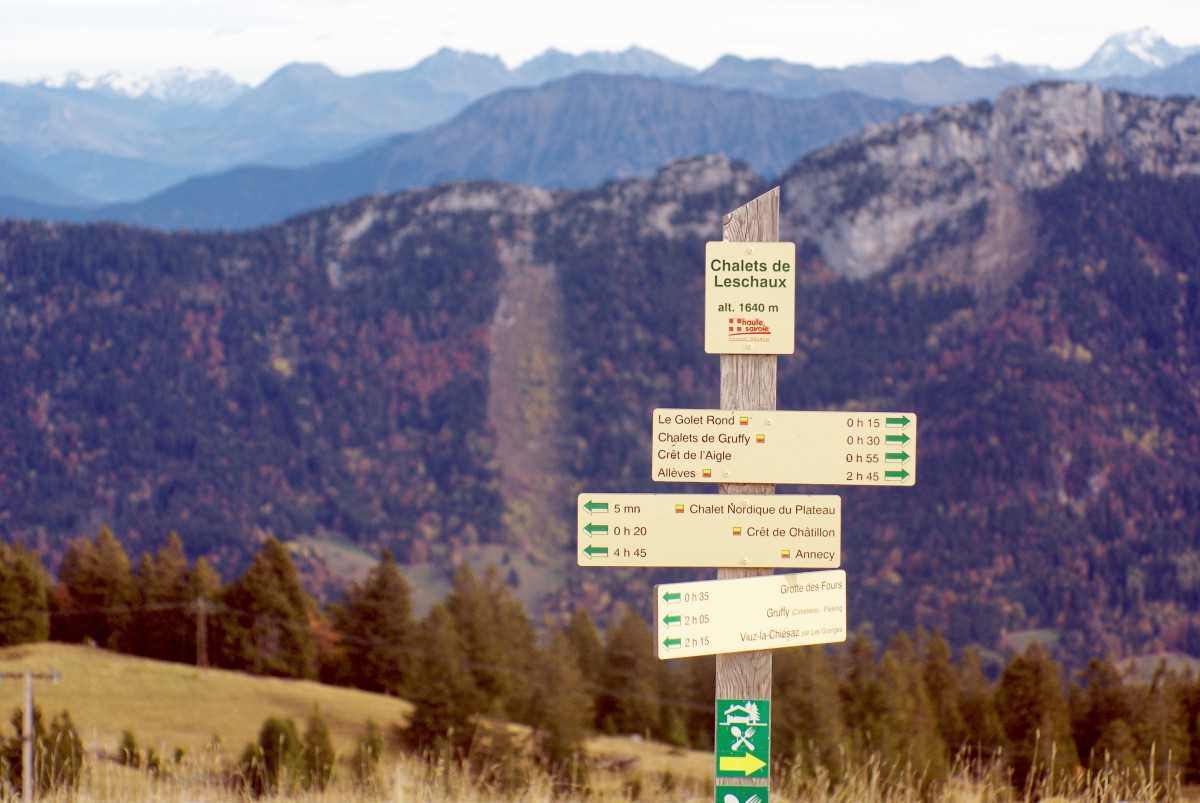
Hiking on the Semnoz © French Moments
More experienced walkers can aim for emblematic summits such as Le Trélod, L’Arcalod or the Dent de Rossanaz. These hikes require more effort, sometimes a good sense of direction and real caution, but they offer superb views over the whole massif and the neighbouring high Alps.
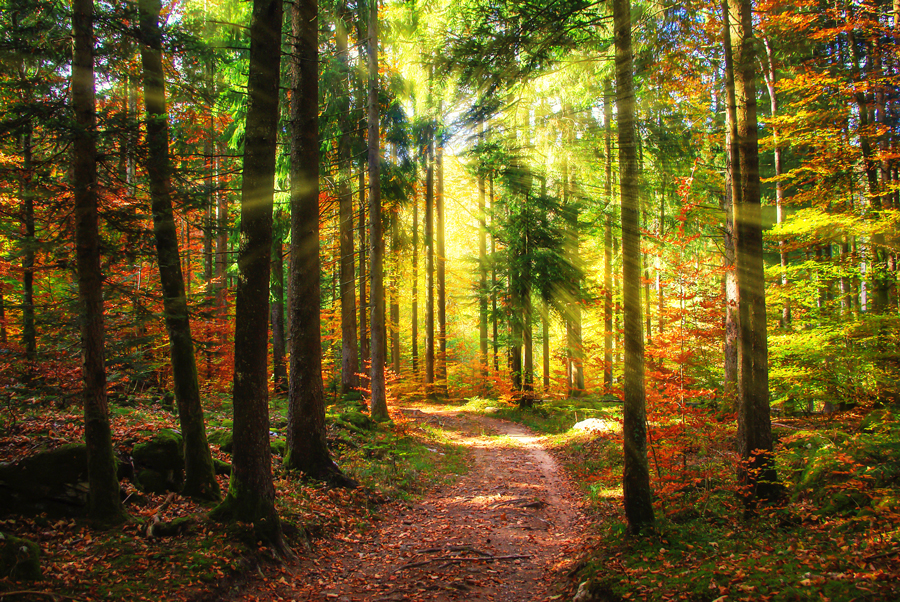
The forest of the Crêt du Maure © French Moments
The Bauges are not a theatrical hiking massif in the most spectacular sense of the word. They seduce instead through their sincerity: mountain paths, open landscapes, living villages, herds in the alpine pastures and the feeling of walking through a Savoie still very close to its rural roots.
As always in the mountains, you need to prepare your route, check the weather, take water, wear good shoes and avoid overestimating your strength. The altitudes are not those of the highest Alpine massifs, but the slopes can be steep, the paths stony and the weather changes rapid.
The Tour de France in the Bauges Mountains
The Bauges Mountains are not the most famous Alpine massif in Tour de France history. They do not have the immediate prestige of the Galibier, the Izoard, Alpe d’Huez or the Madeleine. And yet the Grande Boucle has already found several interesting roads here, especially around Le Revard, Le Semnoz and the Col des Prés.
In 2026, the Tour de France will cross the Bauges again during Stage 17 between Chambéry and Voiron. The stage is scheduled for Wednesday 22 July 2026, over a distance of 174.7 kilometres. The official Tour de France website classifies it as a flat stage, but the route still includes significant elevation gain and several difficulties in the opening kilometres.
The riders will leave Chambéry before heading towards the Bauges massif. The route will pass through Lescheraines, Aillon-le-Vieux, Aillon-le-Jeune and the Col des Prés, before descending back towards the Chambéry area and then continuing towards the Chartreuse and Voiron.
For sprinters, this stage could be an interesting opportunity after leaving the Alps. For breakaway riders, the early difficulties in the Bauges may provide favourable ground for an escape. And for curious television viewers, it will above all be a fine chance to discover a massif that is talked about less often than its neighbours.
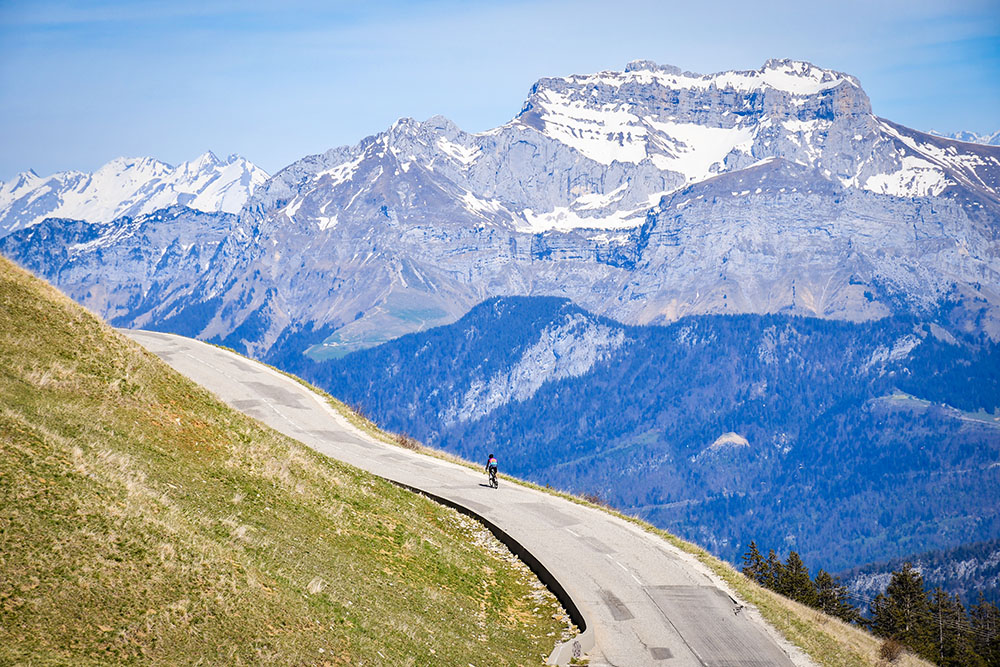
Arriving at the Semnoz © French Moments
The Col des Prés, a Bauges Climb
The Col des Prés will be one of the important points of the Tour’s passage through the Bauges.
Located in the southern part of the massif, it links the Aillons area to the Thoiry valley and the Chambéry basin.
Its altitude is modest by Alpine standards, at around 1,135 metres, but its roads can be demanding, especially when they come as part of an already hilly stage.
![Col des Prés © Florian Pépellin - licence [CC BY-SA 3.0] from Wikimedia Commons](https://frenchmoments.eu/wp-content/uploads/2026/07/Col-des-Pres-©-Florian-Pepellin-licence-CC-BY-SA-3.0-from-Wikimedia-Commons.jpg "Col des Prés © Florian Pépellin - licence [CC BY-SA 3.0] from Wikimedia Commons")
Col des Prés © Florian Pépellin - licence [CC BY-SA 3.0] from Wikimedia Commons
In Tour history, the Col des Prés already has a small story of its own. It was due to be crossed in 1998, but the stage in question was neutralised. In 2013, Pierre Rolland reached the summit first before being relegated in favour of Igor Antón.
For amateur cyclists, the Col des Prés is a good example of what the Bauges can offer: not a mythical climb with famous hairpins, but a medium-mountain road, with sections through forest, meadows, views of neighbouring reliefs and a real feeling of entering the massif.
Le Revard, Balcony over Lake Bourget
Mont Revard is one of the great cycling names associated with the Bauges. Located above Aix-les-Bains, it forms a spectacular balcony over Lake Bourget and the Savoyard cluse. It is also one of the main access points to the Revard plateau and La Féclaz.
![Mont Revard © Florian Pépellin - licence [CC BY-SA 4.0] from Wikimedia Commons](https://frenchmoments.eu/wp-content/uploads/2026/07/Mont-Revard-©-Florian-Pepellin-licence-CC-BY-SA-4.0-from-Wikimedia-Commons-1.jpg "Mont Revard © Florian Pépellin - licence [CC BY-SA 4.0] from Wikimedia Commons")
The view from Mont Revard over the lake © Florian Pépellin - licence [CC BY-SA 4.0] from Wikimedia Commons
The Tour de France has passed through or finished there several times. Specialist sources list passages or finishes at Le Revard in 1965, 1972, 1991, 1998 and 2013, with different altitudes recorded depending on the edition. (Le Dico du Tour)
For cyclists, the climb to Le Revard is a Savoyard classic. It can be tackled from Aix-les-Bains or from the Chambéry basin. It is a long climb, regular in places, sometimes wooded, with a magnificent reward at the top: one of the finest panoramas over Lake Bourget. After the effort comes the reward. And in this case, the reward is rather large-format.
Le Semnoz, Annecy’s Mountain
At the other end of the massif, Le Semnoz dominates Annecy and its lake.
For many residents of Annecy, it is the local mountain par excellence: skiing in winter, hiking in summer, pastures, views towards Mont Blanc and great open vistas over the lake.
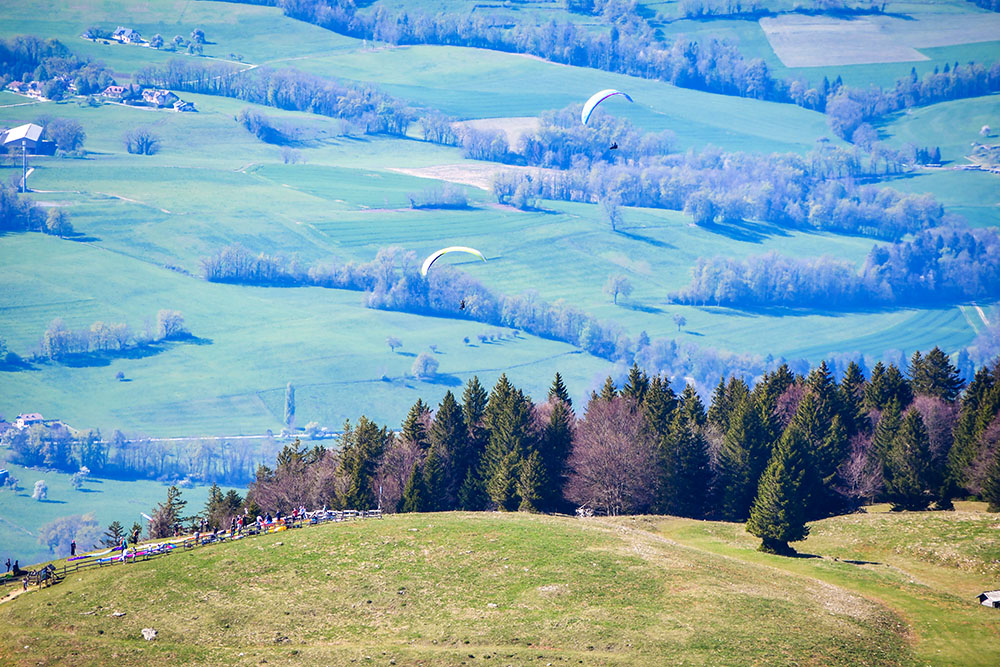
The view from the Semnoz © French Moments
Le Semnoz entered recent Tour de France history in 2013, during the Annecy–Semnoz stage finish at the Crêt de Châtillon. Nairo Quintana won the stage there ahead of Joaquim Rodríguez and Chris Froome, on a climb classified hors catégorie.
The Crêt de Châtillon offers several possible cycling ascents. The profiles vary depending on the side: from Annecy, from Quintal, or from the Col de Leschaux. Le Dico du Tour gives, for example, 17.4 kilometres at 7% from Annecy, 11.3 kilometres at 8.2% from Quintal, and 13.4 kilometres at 5.7% from the Col de Leschaux.
This is a serious climb. You do not need to be a professional to attempt it, of course, but it is best to have good legs and a minimum of respect for the gradient. Le Semnoz has that very Savoyard ability to look welcoming from below, then quickly remind you that the mountain always has the final word.
Cycling in the Bauges Mountains
For cyclists, the Bauges are a tremendous playground. The massif does not have the fame of the great Alpine passes, but it offers something precious: varied roads, climbs that are accessible but serious, beautiful landscapes and often less traffic than in the most touristy areas.
Three routes stand out in particular.
The Col des Prés allows you to discover the heart of the Bauges and the Aillons area. It is an interesting climb for those who want to combine physical effort with a rural atmosphere.
Le Revard is longer and more panoramic. It suits cyclists who enjoy big, steady climbs with a real visual reward at the summit.
Le Semnoz, finally, is the most impressive of the three in terms of profile and status in recent Tour history. Its ascent from Annecy has become something of a classic for cyclists passing through Haute-Savoie.
The Bauges also lend themselves to loops. You can link passes, villages and valleys without necessarily chasing a sporting exploit. That is often the best way to appreciate them: take your time, accept the climbs, enjoy the descents, stop in a village, fill your bottle, look at the summits and set off again gently.
One final piece of simple advice: do not underestimate the Bauges. The altitudes are not extreme, but the roads can be irregular, the gradients surprising and the weather changeable. Just because a massif is discreet does not mean it is easy. Your legs will understand that very quickly.
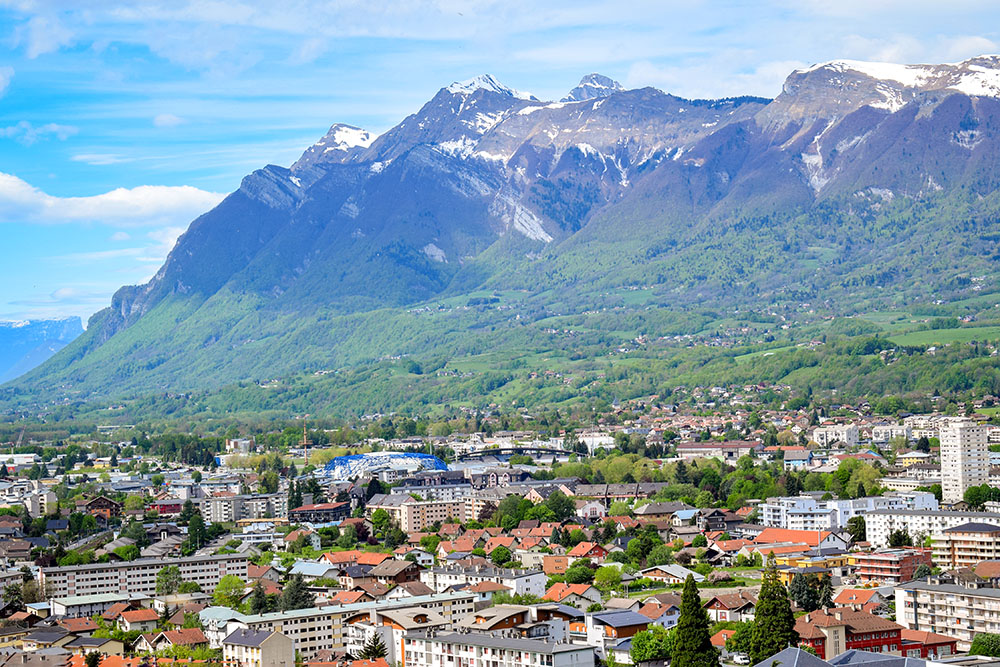
The Bauges Mountains seen from Albertville © French Moments
Why Discover the Bauges Mountains?
The Bauges Mountains are not the most spectacular Alpine massif at first glance. They do not try to compete with the glaciers of Mont Blanc, the great resorts of the Tarentaise or the vertiginous panoramas of the Vanoise.
And that is precisely their charm.
The Bauges are more intimate, more rural, more discreet. They ask for a little attention. You need to travel through them, enter their valleys, climb towards their passes, stop in their villages, taste their cheese, look at their cliffs and agree to slow down.
For the curious visitor, this is a fascinating territory. For the hiker, a massif of summits and alpine pastures. For the cyclist, a demanding but endearing playground. For the lover of landscapes, a balcony between lakes and mountains. And for anyone who enjoys regions of France that are less obvious, less staged and less saturated with images, the Bauges offer a genuine discovery.
The Tour de France 2026 may put the Bauges in the spotlight for a few minutes. But it would be a pity to stop there. For the Bauges Mountains are not merely a backdrop crossed by the race. They are a secret heart of the Savoy Alps — and one of those places you are better off getting to know slowly.