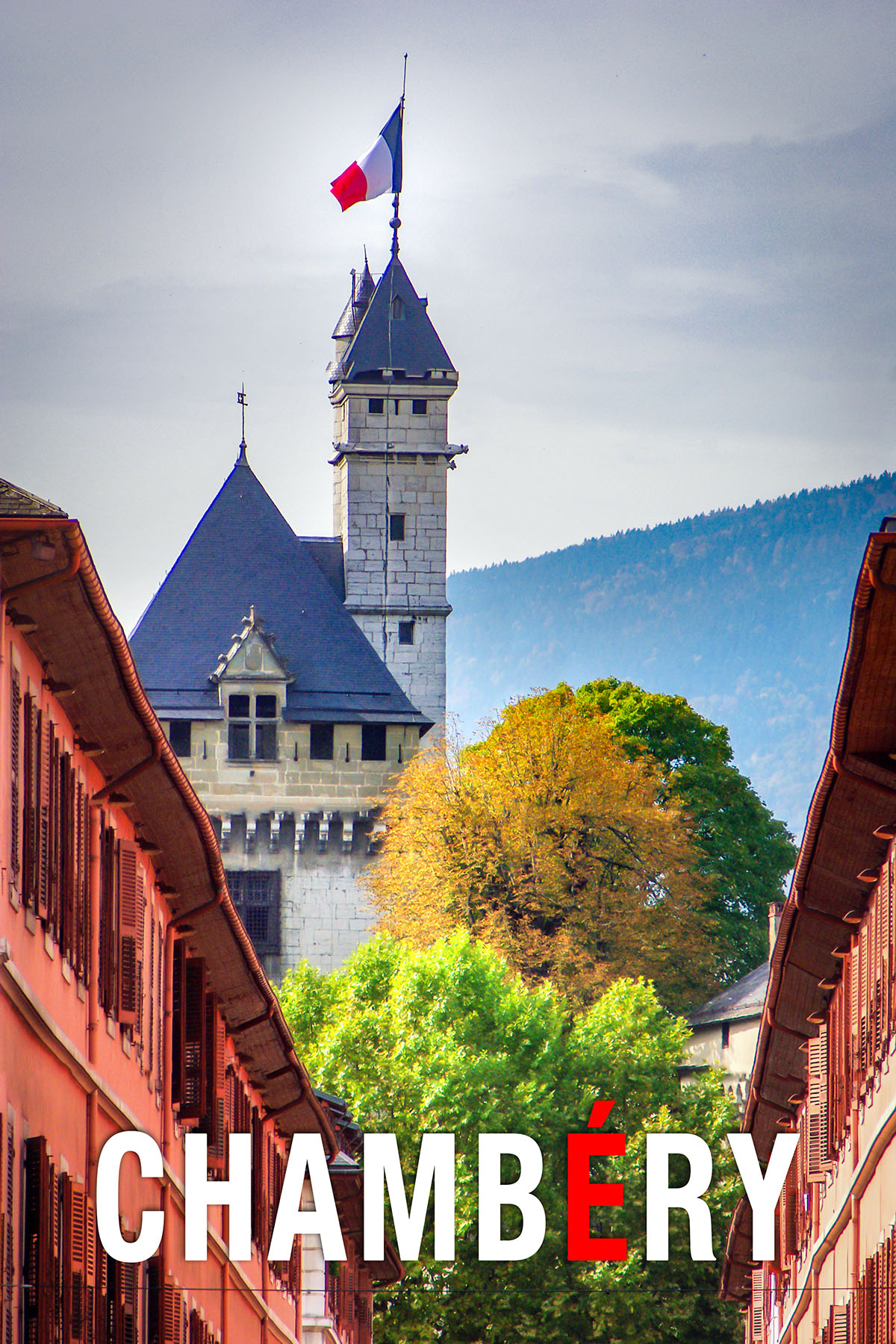
Chambéry is one of those towns you may pass through too quickly, on your way to the Alpine resorts, Lake Bourget, Annecy or Italy.
And yet, it would be a pity not to stop.
As the former capital of the Dukes of Savoy, Chambéry has a much richer heritage than you might first imagine: a ducal castle, secret alleys, inner courtyards, façades with Piedmontese influences, a surprising cathedral, private mansions, a house linked to Jean-Jacques Rousseau and even a fountain with elephants — which, let us admit, is not quite the first animal you expect to encounter at the foot of the Alps.
The town may not have the instant fame of Annecy or the lakeside setting of Aix-les-Bains. But it has something else: real historical depth, a strongly Savoyard atmosphere and an old town that truly deserves to be explored on foot.
In this article, I invite you to discover Chambéry through its geography, history, heritage and main sites to see in the old town and its surroundings.
Where Is Chambéry?
Chambéry is located in Savoie, in the Auvergne-Rhône-Alpes region. The town is the prefecture of the Savoie département and occupies a strategic position between Lyon, Grenoble, Annecy, Geneva, Lake Bourget and the Alpine valleys.
This situation explains a great deal. Chambéry is not only a modern transit town: it is an old crossroads, placed on important routes between France, Italy, the Northern Alps and the Rhône valley.
The town lies around 15 kilometres from Aix-les-Bains, south of Lake Bourget, about 50 kilometres from Annecy, and not far from the main routes leading towards Grenoble, Albertville, the Maurienne, the Tarentaise and the Fréjus Tunnel.
For travellers, Chambéry can therefore serve as a practical stopover, but also as an interesting base for exploring the surrounding area: Lake Bourget, the Bauges massif, the Chartreuse, the Savoie vineyards or the Alpine valleys.
Geography of Chambéry: A Town Between the Bauges, Chartreuse and Lake Bourget
Chambéry developed in a remarkable natural setting, in the heart of a cluse surrounded by reliefs.
To the east rise the Bauges. To the south lies the Chartreuse massif with Mont Granier. To the west stretches the Chaîne de l’Épine, while to the north the landscape opens towards Lake Bourget.
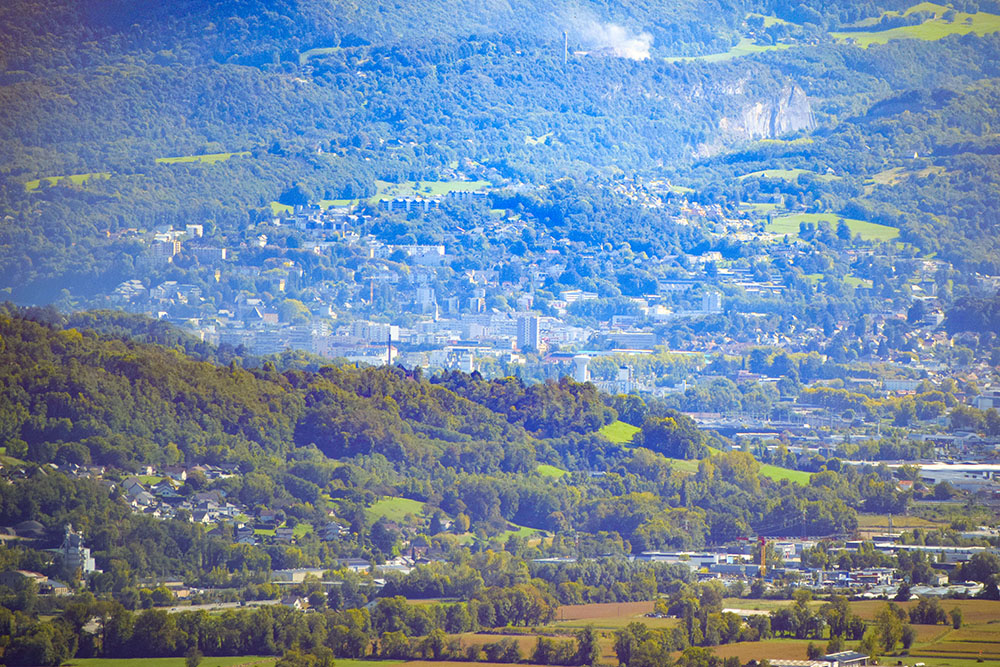
Chambéry seen from Notre-Dame de l’Étoile Chapel, above Lake Bourget © French Moments
This geography gives Chambéry a very particular character. The town is not exactly a mountain resort, nor a lakeside town, nor simply a town on the plain. It stands instead at the meeting point of several landscapes.
That is what makes its setting so interesting. In just a few minutes, you can move from the old centre to the surrounding hills, from shopping streets to views of the massifs, from urban neighbourhoods to the gateways of the Bauges and Chartreuse regional natural parks.
This position as a place of passage shaped its history. Chambéry developed where routes could meet, where valleys opened access towards the Alps, and where Savoyard power could control a territory situated between France, Piedmont and the Alpine world.
In other words, Chambéry’s geography is not merely a backdrop. It explains its historical role.
A Brief History of Chambéry
The history of Chambéry is inseparable from that of the House of Savoy.
The area has been frequented since Antiquity, especially around Lémenc, an ancient site set on the heights. But the great medieval turning point came in the 13th century, when the Counts of Savoy began to take a close interest in Chambéry.
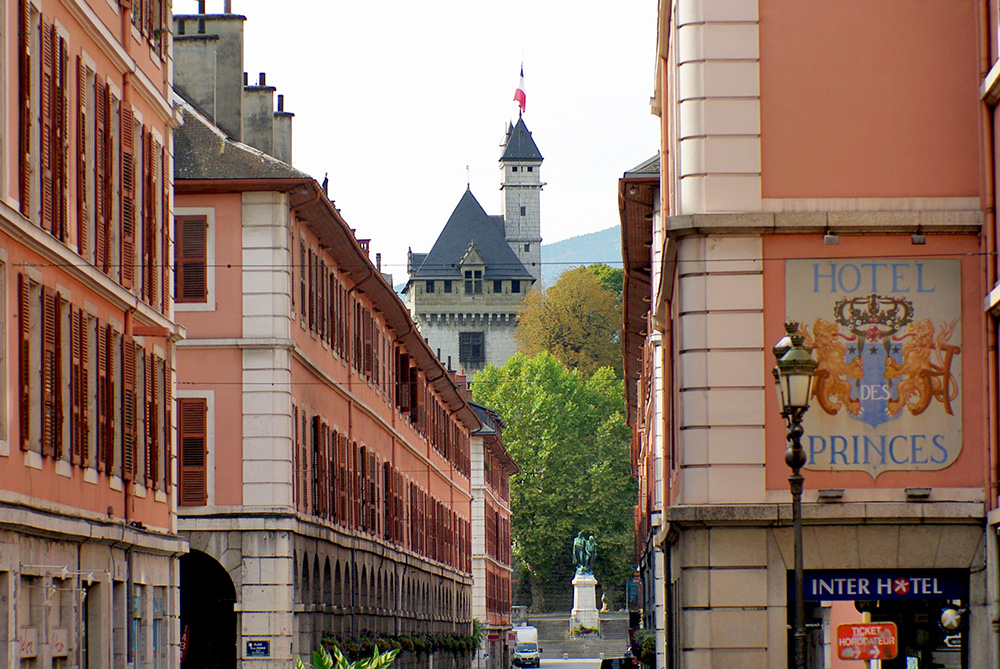
Rue de Boigne © French Moments
The Capital of the Counts and Then Dukes of Savoy
In 1232, Count Thomas I of Savoy bought Chambéry from Viscount Berlion. The town then entered the orbit of the House of Savoy, a dynasty destined to play a major role on both sides of the Alps. From the late Middle Ages onwards, Chambéry became a leading political centre for the Counts of Savoy.
The castle became the seat of their administration and one of their favourite residences. Patrimoines de Savoie also recalls that, from the 13th and 14th centuries, the Counts of Savoy chose Chambéry as their capital and made the castle the centre of their administrative power.
In 1416, Amadeus VIII became the first Duke of Savoy. Chambéry then found itself at the heart of an ambitious Alpine state, the States of Savoy, which looked towards Savoie, Piedmont, Switzerland, Nice, the Aosta Valley and the great transalpine passes.
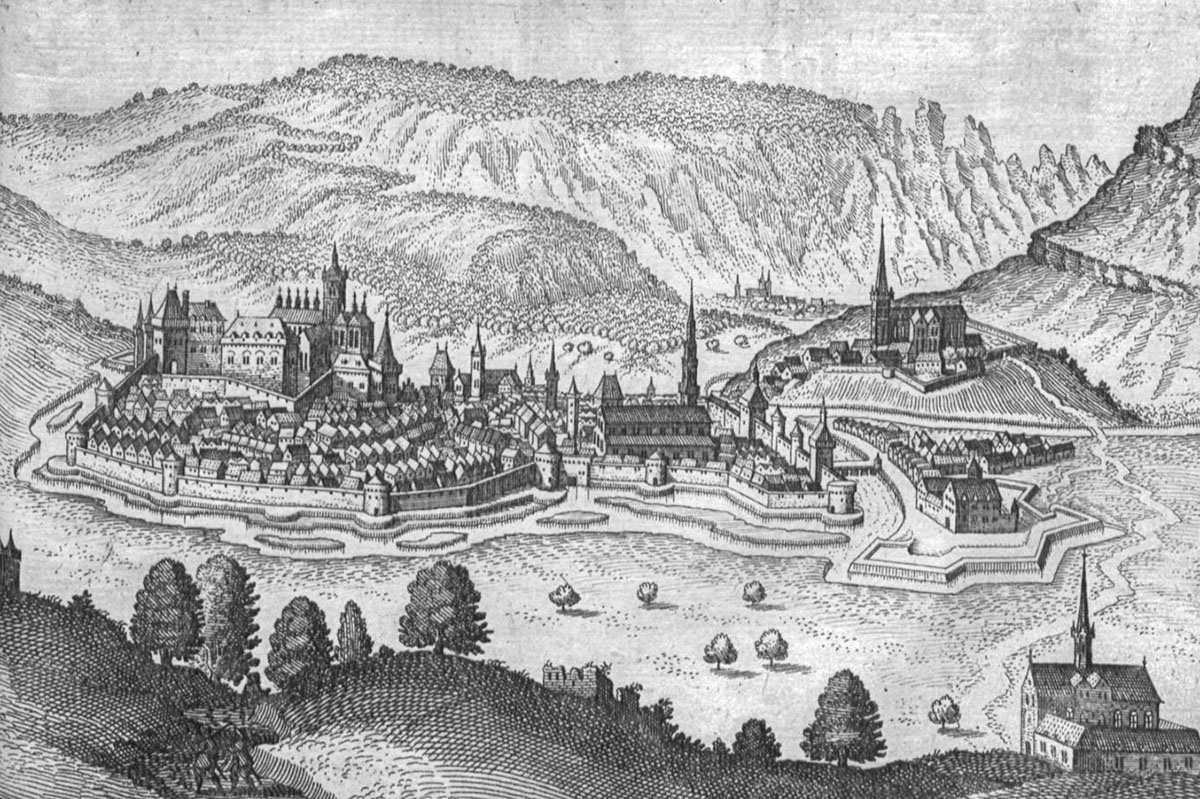
Chambéry in 1645
The town retained this role as political and administrative capital for a long time. But in the 16th century, the centre of gravity of the House of Savoy gradually shifted towards Piedmont.
Turin grew increasingly important and became the new capital of the duchy in 1563. Chambéry lost its rank as capital, but kept a strong administrative and aristocratic identity.
This past explains part of the charm of the old town: the private mansions, inner courtyards, façades with Piedmontese influences and discreet alleys still tell the story of a town of power, magistrates, nobility and administration.
The French Period
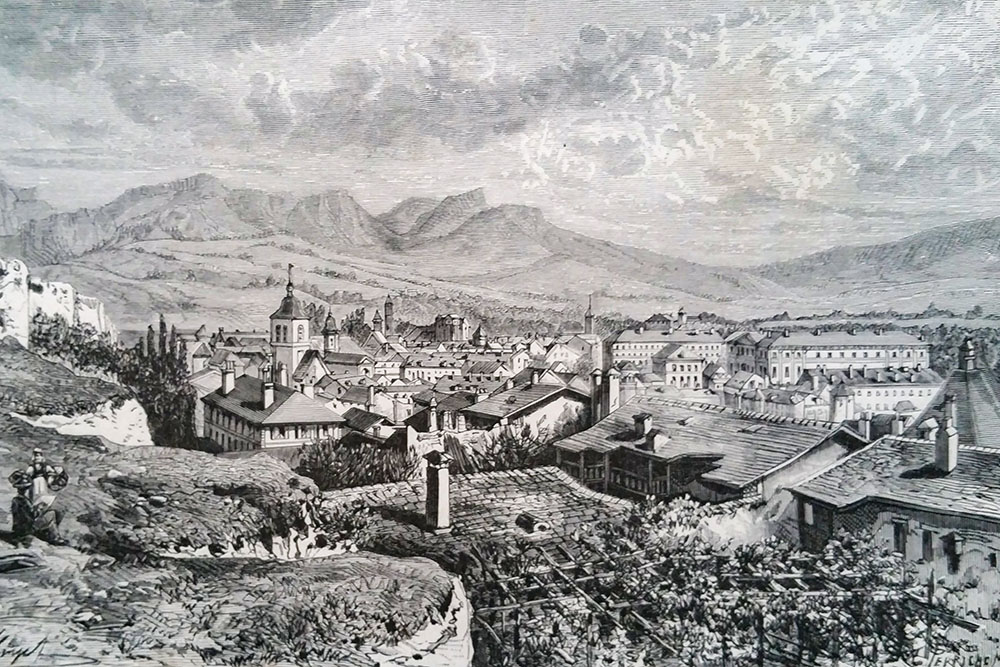
Chambéry in 1880
The French period began for the first time during the Revolution. From 1792 to 1815, Savoy was attached to France, and Chambéry became the administrative centre of the Mont-Blanc département. After 1815, the town returned to the Kingdom of Sardinia, still ruled by the House of Savoy.
The definitive attachment to France came in 1860, with the Treaty of Turin and the plebiscite held in April.
Chambéry then became the administrative centre of the Savoie département. This new period brought significant urban, administrative and railway development.
Chambéry is therefore a town of several layers: medieval town, Savoyard capital, administrative city, French town, railway hub and gateway to the Alps. It is this superposition that makes discovering it so interesting.
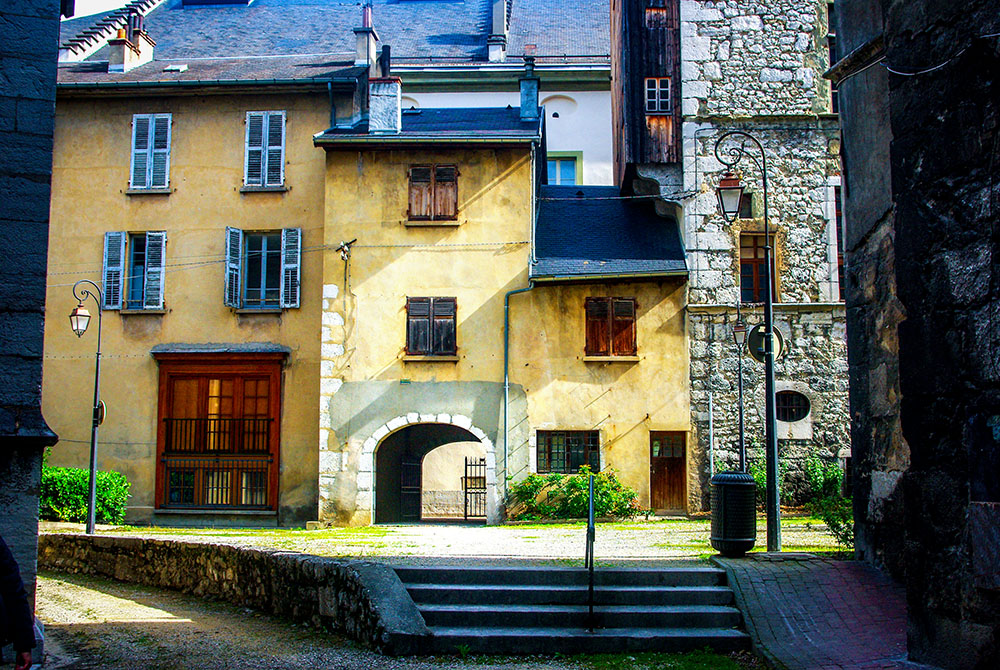
Old town of Chambéry © French Moments
Where to Stay in Chambéry
Chambéry can be an excellent base for discovering Savoie without staying directly in a mountain resort or on the shores of Lake Bourget.
The town offers a good balance between heritage, restaurants, railway station, road access and proximity to the surrounding massifs. It allows you to visit the historic centre easily, but also to explore Aix-les-Bains, Lake Bourget, the Bauges, the Chartreuse, the Savoie vineyards or even Annecy.
Staying in the historic centre is ideal if you want to discover Chambéry on foot, enjoy the old streets, alleys, the castle of the Dukes of Savoy, the Elephant Fountain and the restaurants of the town centre.
The districts close to the station can be practical if you arrive by train or if you are planning excursions to Aix-les-Bains, Annecy, Grenoble or Lyon.
You can also look at accommodation around Chambéry if you prefer a quieter atmosphere, with quick access to the Bauges, the Chartreuse or Lake Bourget.
Browse the map below to compare available accommodation in and around Chambéry.
Chambéry Heritage: What to See in the Old Town and Around
The heritage of Chambéry is not limited to a few isolated monuments. What gives the town its charm is also its urban fabric: alleys, courtyards, façades, passages, squares, perspectives and the surprises you discover as you walk.
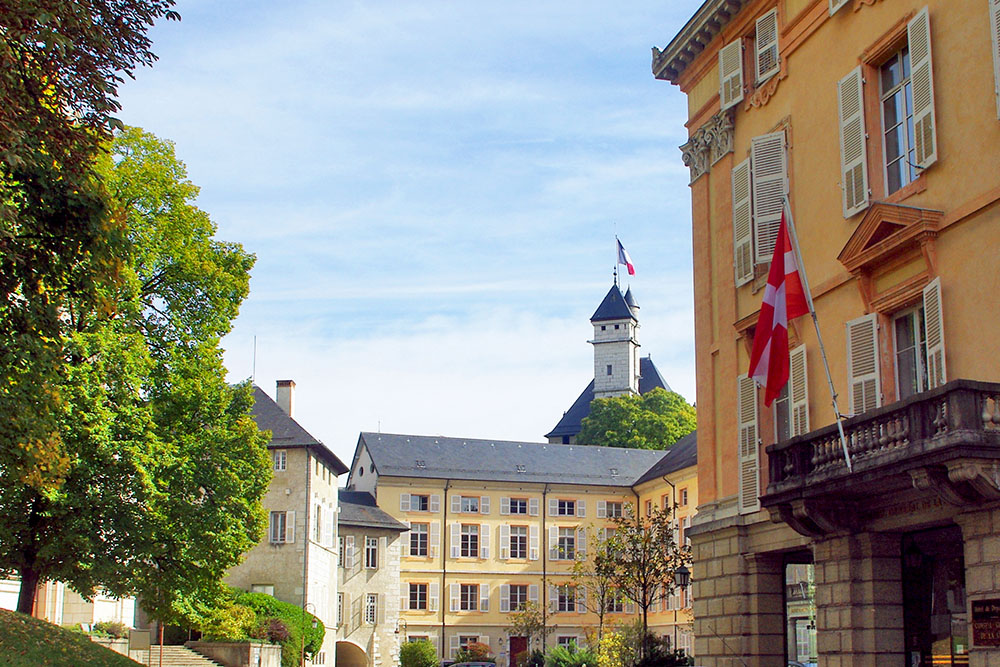
Old town of Chambéry © French Moments
The tourist office describes the old centre as a maze of alleys and courtyards of private mansions, with architecture influenced by Piedmont and often enriched with trompe-l’œil decoration, wrought ironwork and sculptures.
Here are the main sites to see if you want to understand the identity of Chambéry.
The Castle of the Dukes of Savoy
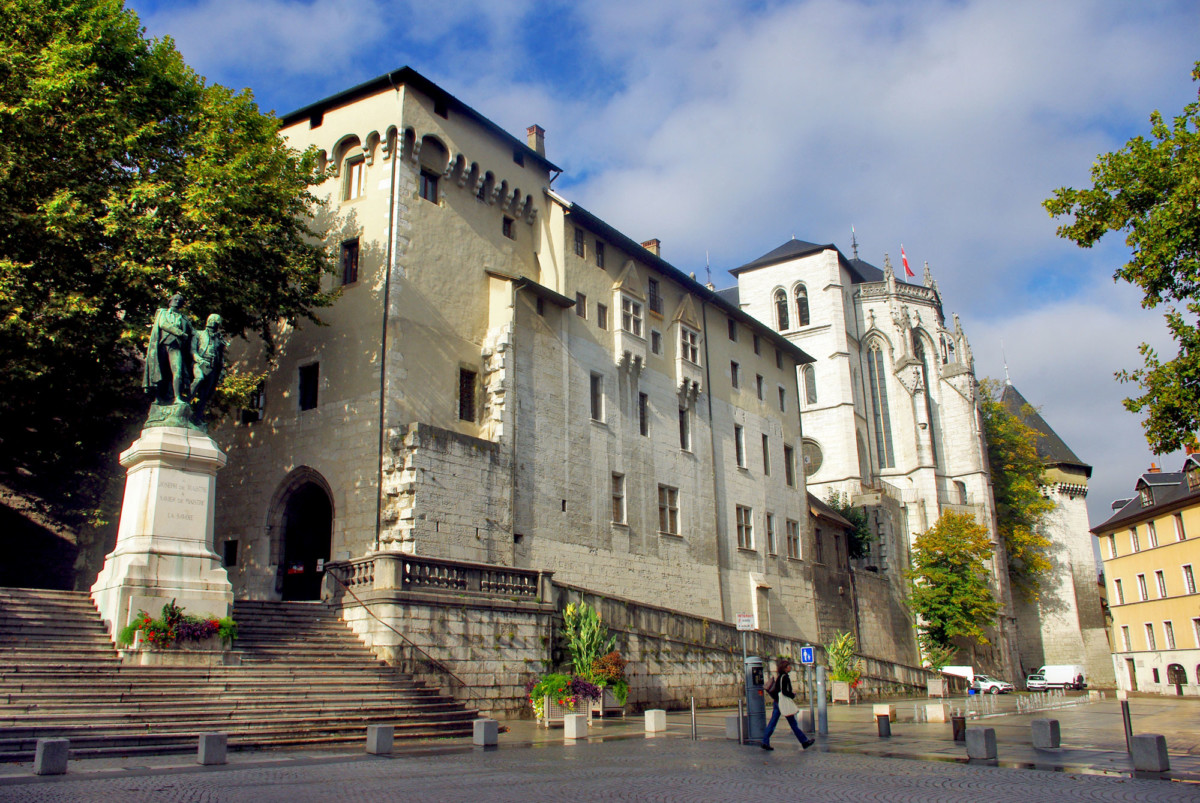
The Castle of the Dukes of Savoy in Chambéry © French Moments
The Castle of the Dukes of Savoy is the great historic monument of Chambéry.
Set in the heart of the old town, it sums up a large part of Savoyard history.
Originally a fortified castle, it later became a princely palace, administrative centre and residence. Its history is closely linked to that of the House of Savoy, the dynasty that controlled a vast territory on both sides of the Alps for centuries.
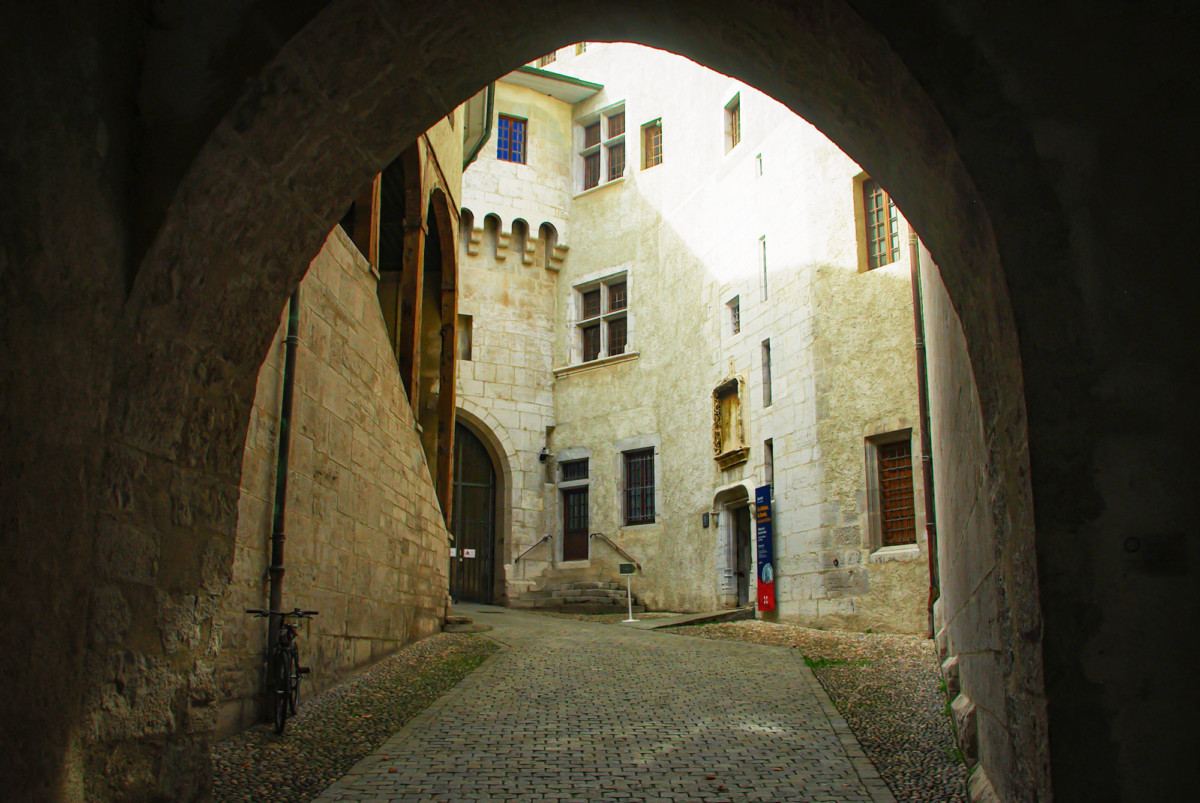
The entrance to the Castle of the Dukes of Savoy in Chambéry © French Moments
The castle changed greatly over time. Fires, reconstructions, extensions and administrative transformations all altered its silhouette.
That is precisely what makes it so interesting: this is not a castle frozen in a single period, but a group of buildings that tells the story of several centuries of Savoyard power.
Today, the castle still has an important administrative role. It houses the Prefecture and the Departmental Council of Savoie. Some parts can be visited as part of guided tours.
The Sainte-Chapelle and the Memory of the Holy Shroud
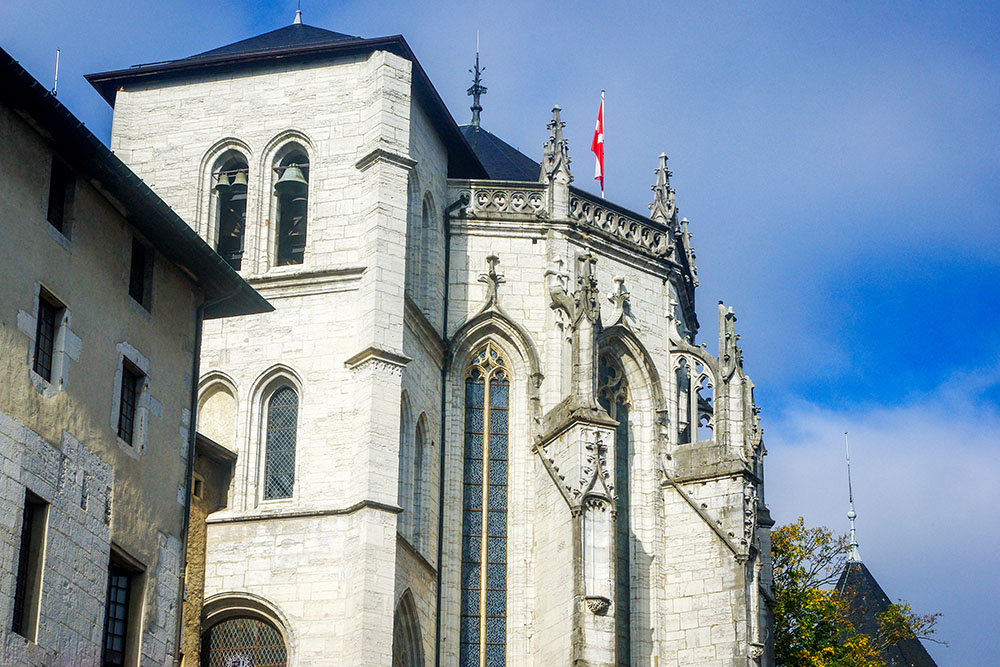
Sainte-Chapelle © French Moments
Inside the castle enclosure stands the Sainte-Chapelle, one of the most important places in the religious history of Chambéry.
Amadeus VIII, the first Duke of Savoy, had this princely chapel built in the 15th century. It was intended to assert the prestige of the Savoyard dynasty, with Gothic decoration entrusted to leading artists.
The Sainte-Chapelle is especially famous for having housed the Holy Shroud, owned by the House of Savoy, before it was transferred to Turin in 1578.
The relic was even saved at the last minute during a fire. This memory explains why the chapel holds such a special place in the history of Chambéry and the House of Savoy.
Place Saint-Léger, the Living Heart of the Old Centre
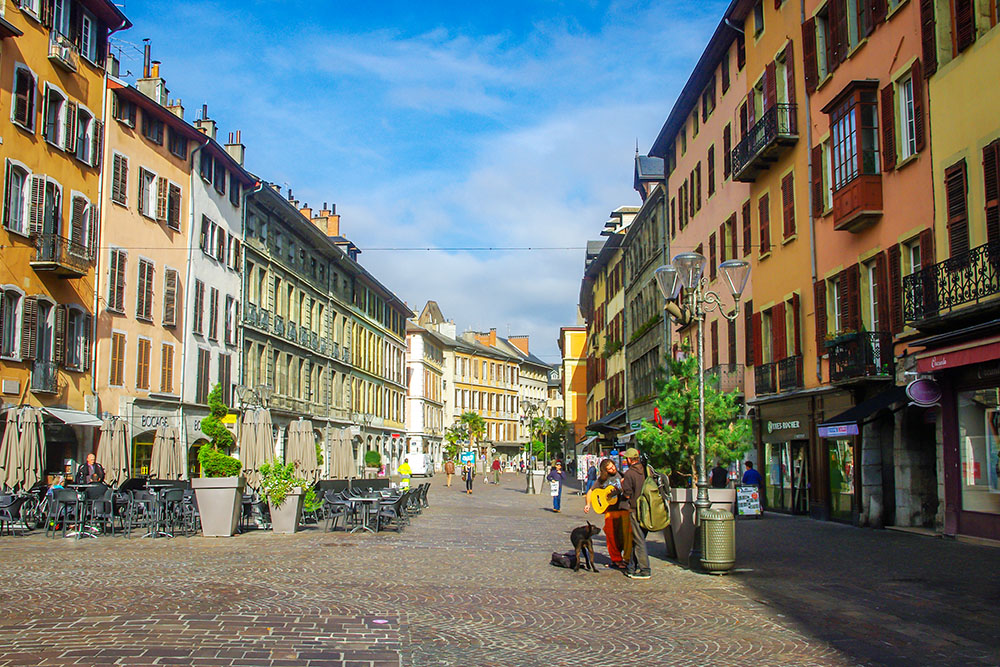
A morning view of Place Saint-Léger © French Moments
Place Saint-Léger is one of the most pleasant places in the historic centre.
With its colourful façades, terraces and lively atmosphere, it forms a living heart in the middle of the old town. Despite its name as a “place”, it looks more like a long widened street, which gives it a very particular character.
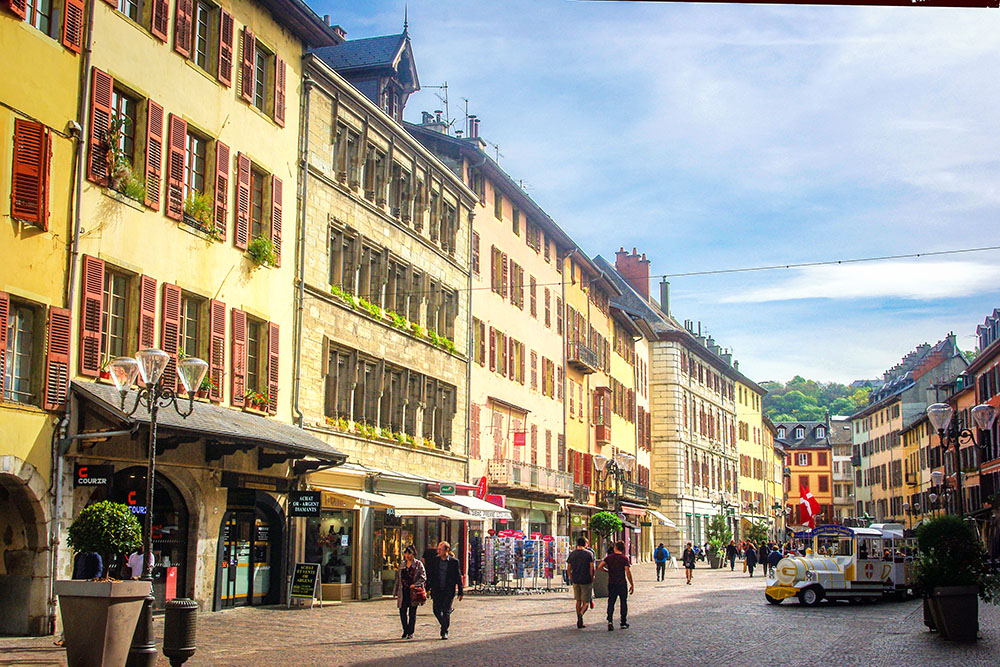
Place Saint-Léger © French Moments
It is a good place to feel the atmosphere of Chambéry: not entirely Alpine, not really Italian, and not simply classically French. The colours, façades and nearby passages recall that Chambéry long looked towards the Savoyard and Piedmontese worlds.
The Alleys of Chambéry, Secret Passages of the Old Town
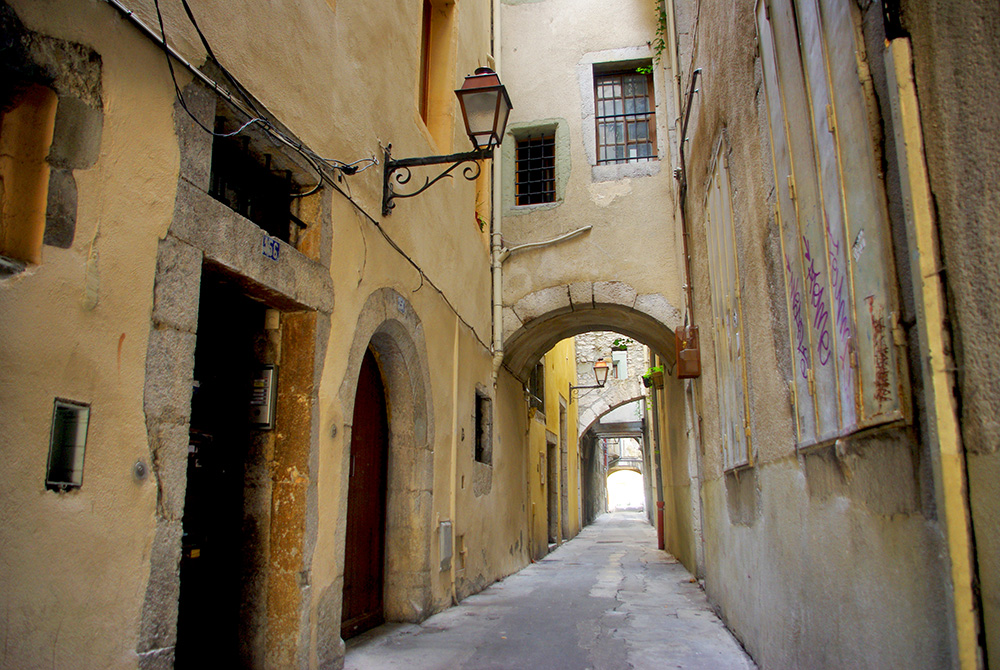
Medieval alley in Chambéry © French Moments
The alleys are one of the great original features of Chambéry.
They cross through old buildings, link streets together, sometimes open onto inner courtyards, and allow you to discover the town in a different way. They may bring to mind the traboules of Lyon, although Chambéry’s alleys have a character of their own.
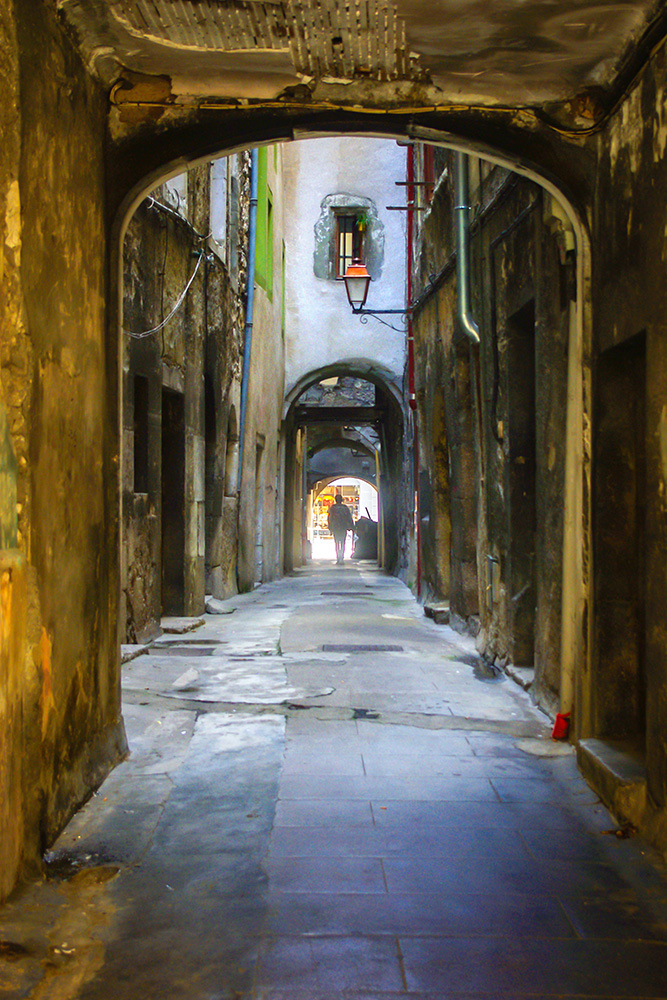
Medieval alley in Chambéry © French Moments
They give the historic centre the atmosphere of a discreet labyrinth. You can walk along a lively street, glance towards a dark entrance, and suddenly discover a passage, a courtyard, a staircase, an old façade or an unexpected perspective.
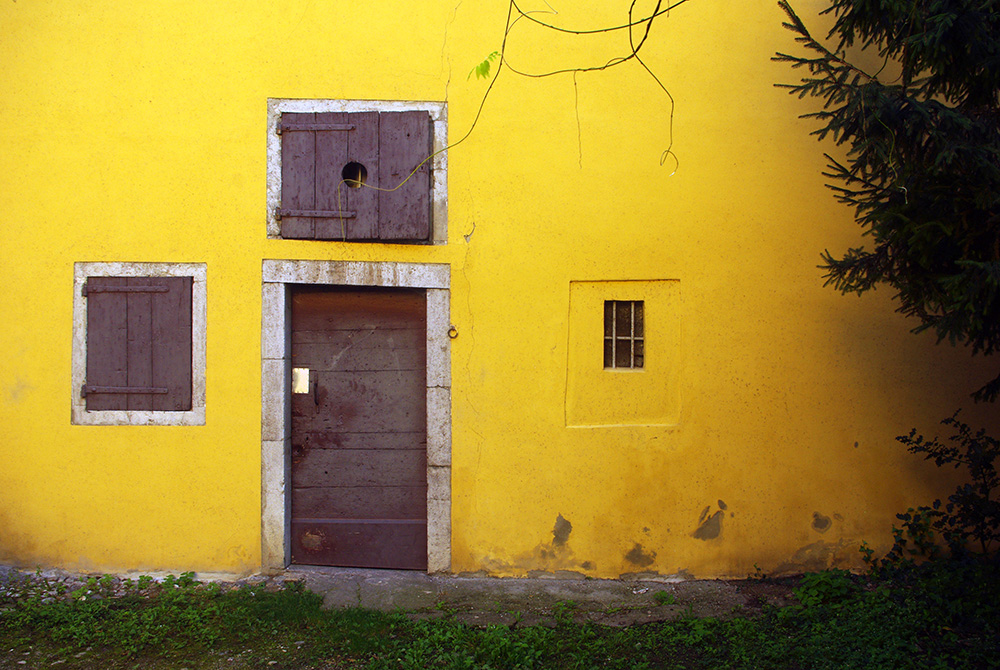
Inside an alley in Chambéry © French Moments
These alleys are not only picturesque. They also tell the story of the old town’s structure, its dense housing, narrow plots and urban history.
This is probably one of the most interesting experiences to have in the old town. Chambéry does not always reveal itself at first glance. Sometimes you need to pass beneath a porch before it begins to speak.
Private Mansions and Inner Courtyards
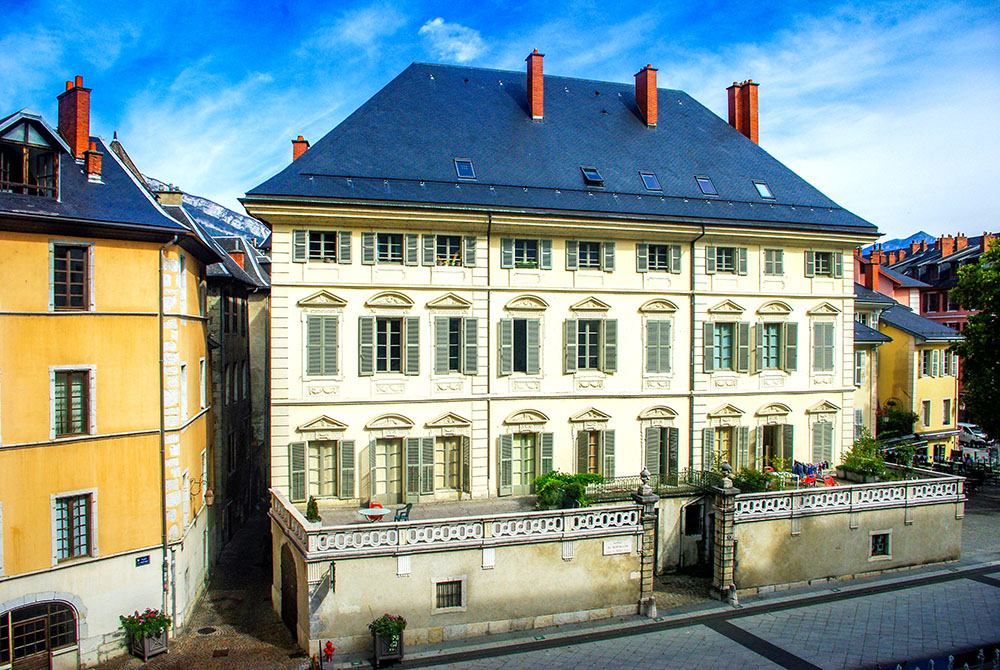
The Hôtel de Montfalcon © French Moments
The former administrative role of Chambéry left many traces in the old centre.
Around the castle and the main streets, you will find several private mansions, inner courtyards and façades recalling the presence of noble families, magistrates and high-ranking Savoyard officials.
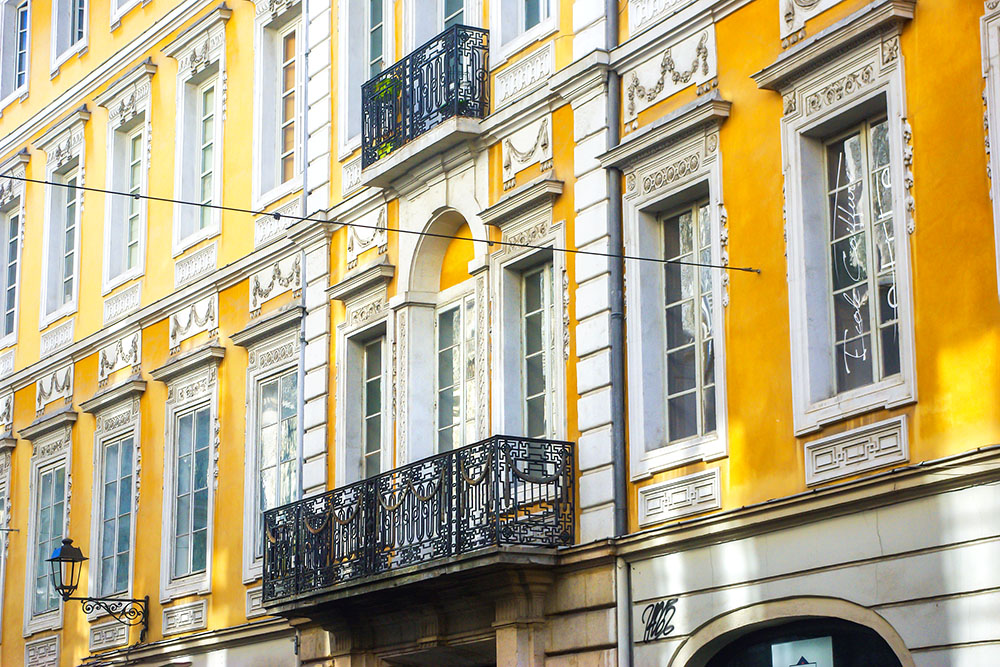
The Hôtel des Marches et de Bellegarde © French Moments
This heritage is sometimes discreet. It does not always impose itself from the street. You need to look at the portals, wrought ironwork, staircases, carved details and courtyards. This is where you understand that Chambéry was a town of power and administration, not merely a pretty old centre.
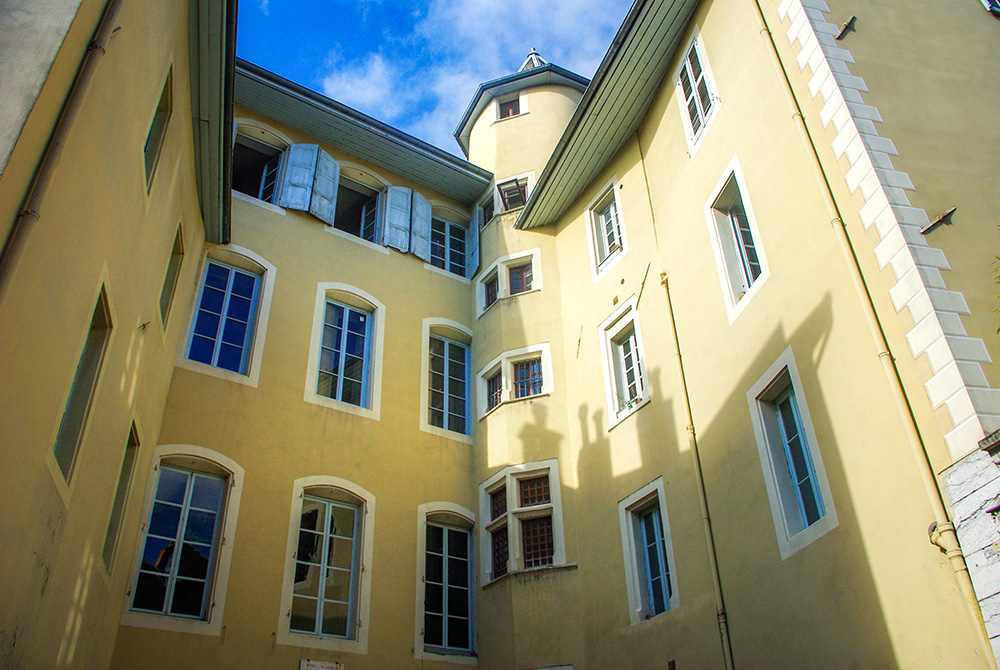
Hôtel de Cordon © French Moments
The Hôtel de Cordon, on Rue Saint-Réal, is a good example. This former 16th-century private mansion now houses the Centre for the Interpretation of Architecture and Heritage, which helps visitors better understand Chambéry’s urban history.
Saint-François-de-Sales Cathedral
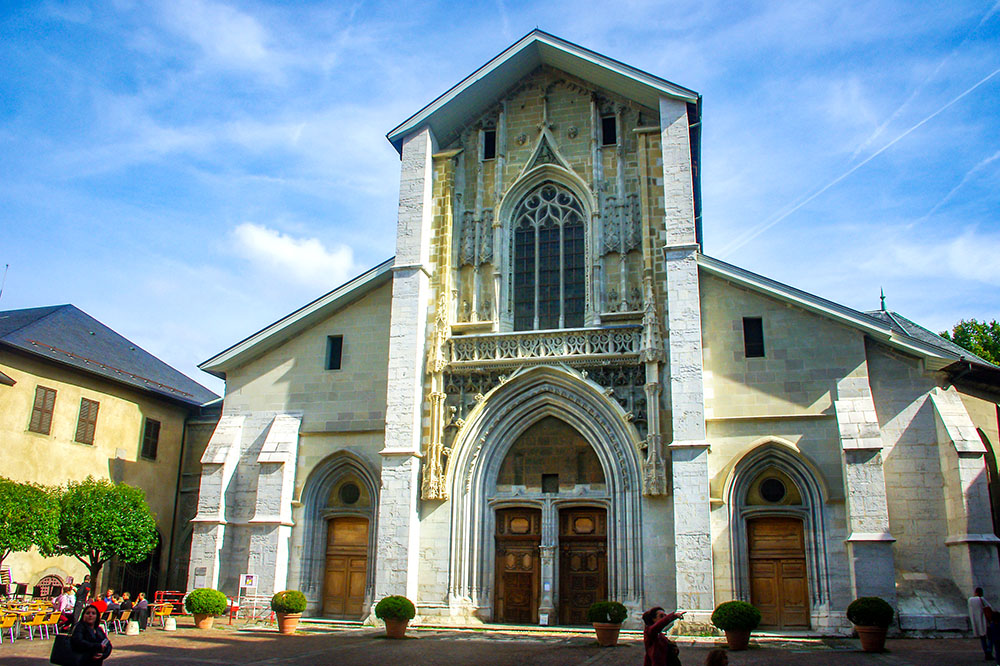
Saint-François de Sales Cathedral © French Moments
Saint-François-de-Sales Cathedral may come as a surprise.
From the outside, its façade remains relatively sober. But inside, it offers a remarkable discovery: a vast ensemble of trompe-l’œil paintings covering the walls and vaults. The building was constructed in the 15th century by the Franciscans, before becoming a cathedral in 1779 when the bishopric of Chambéry was created.
This is exactly the kind of monument you should not judge too quickly from the street. In Chambéry, heritage sometimes likes to hide behind modest façades. The cathedral is a very good example.
![Chambéry Cathedral © Zairon - licence [CC BY-SA 4.0] from Wikimedia Commons](https://frenchmoments.eu/wp-content/uploads/2026/07/Chambery-Cathedral-©-Zairon-licence-CC-BY-SA-4.0-from-Wikimedia-Commons.jpg "Chambéry Cathedral © Zairon - licence [CC BY-SA 4.0] from Wikimedia Commons")
Saint-François de Sales Cathedral © Zairon - licence [CC BY-SA 4.0] from Wikimedia Commons
Its interior decoration also reveals a Savoyard taste for painted decoration, architectural illusions and effects of perspective. Here again, Piedmontese and Italian influence is never very far away.
Rue de Boigne and its Porticoes
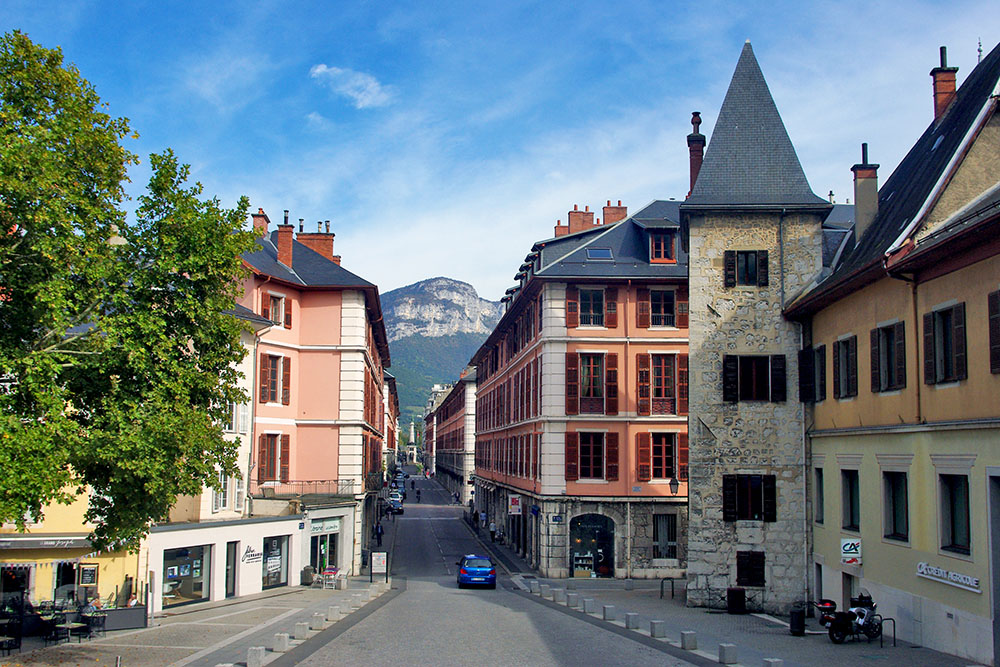
Rue de Boigne seen from the Castle © French Moments
Rue de Boigne links the Castle of the Dukes of Savoy to the Elephant Fountain.
Opened in the 19th century thanks to the generosity of General de Boigne, it forms a genuine cut through the medieval fabric of the town. Its Turin-style porticoes give it a very distinctive, almost Italian appearance.
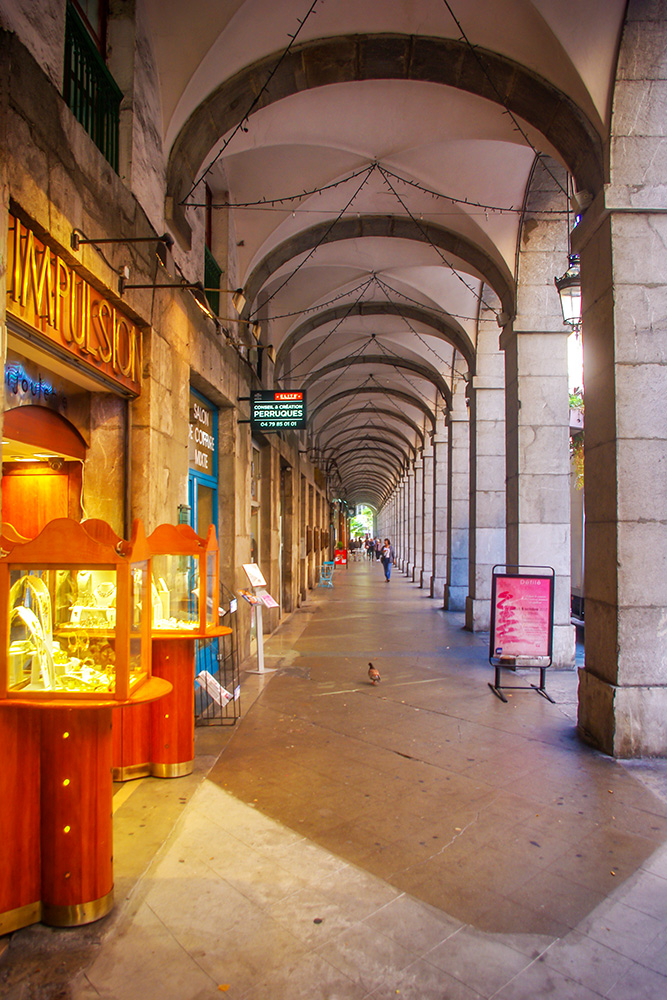
The arcades of Rue de Boigne © French Moments
It is one of the most elegant streets in Chambéry. The street clearly shows the transition between two worlds: on one side, the medieval town with its narrow streets; on the other, the 19th-century town, more monumental, more regular and more open.
In just a few minutes’ walk, you therefore pass from the castle to the Elephant Fountain, following a deliberate, ordered and almost theatrical perspective.
The Elephant Fountain, Symbol of Chambéry
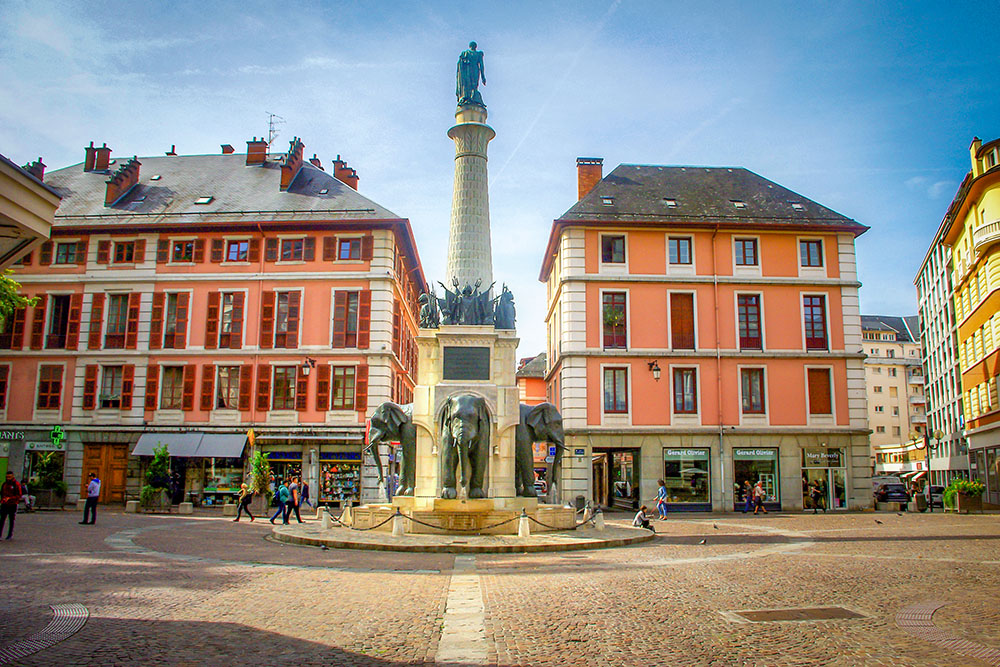
The Elephants Fountain © French Moments
It is impossible to talk about Chambéry without mentioning the Elephant Fountain.
Erected in 1838, it pays tribute to General de Boigne, a major benefactor of the town, who made his fortune in India before returning to Chambéry.
This emblematic monument of the town is surprising: four elephants, a column, a statue and an immediately recognisable silhouette.
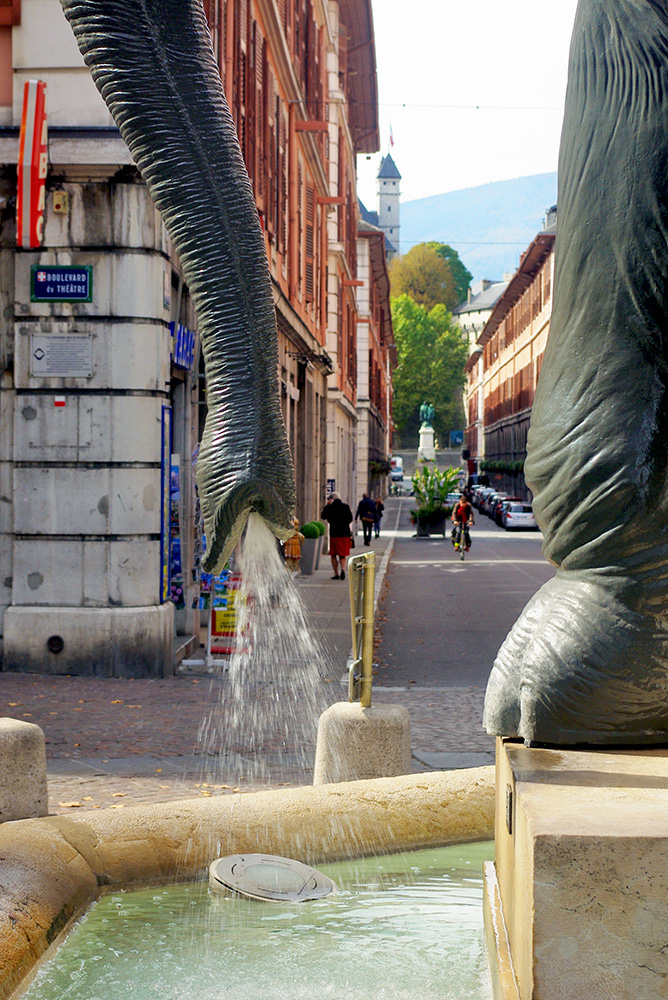
The Elephant Fountain and the perspective of Rue de Boigne © French Moments
The people of Chambéry sometimes nickname it les quatre sans cul — “the four without backsides” — because the elephants seem to emerge from the monument without showing their rear ends. That is an architectural detail which has probably done more for popular memory than many official speeches.
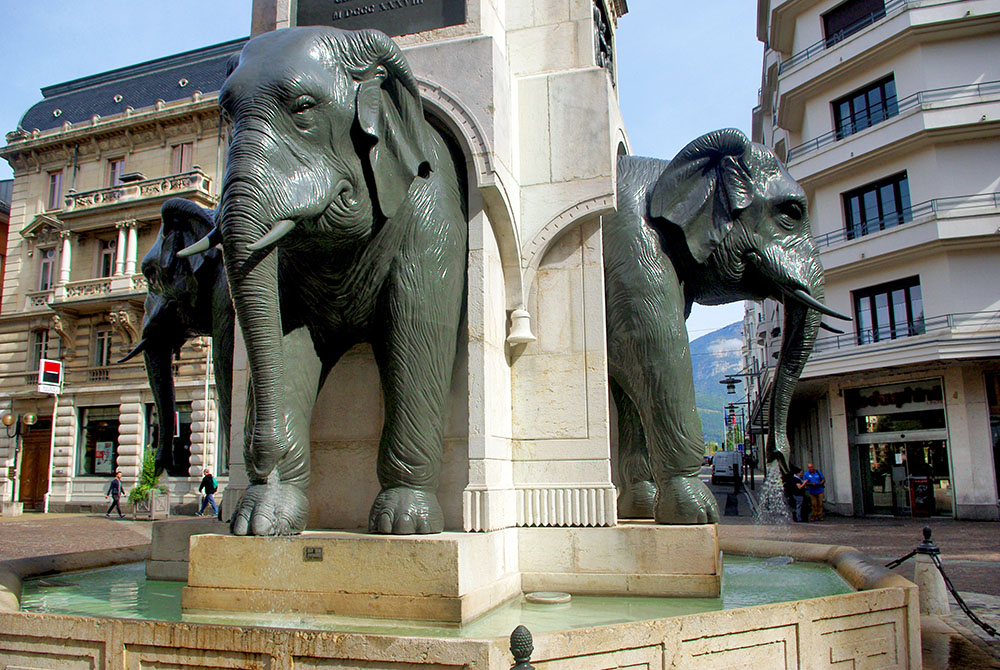
The Elephant Fountain © French Moments
Beyond the anecdote, however, the fountain also tells the story of 19th-century Chambéry: a town that was embellishing itself, modernising and celebrating its great figures.
The Charles-Dullin Theatre
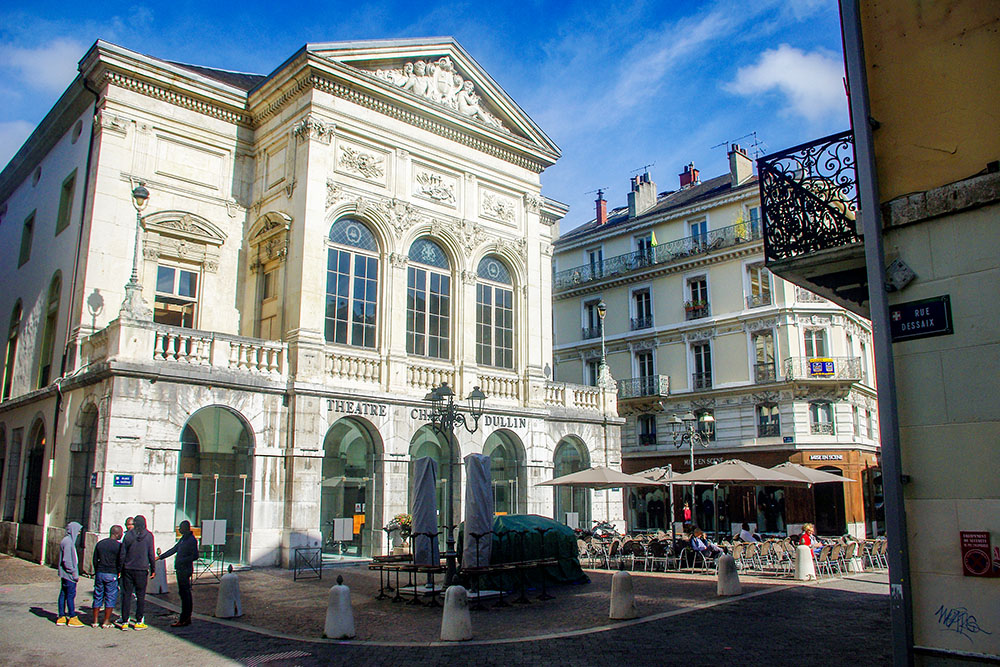
The Charles-Dullin Theatre © French Moments
The Charles-Dullin Theatre is another witness to 19th-century Chambéry.
Located near the historic centre, it recalls the importance of cultural and social life in a town that was not only administrative. Chambéry has long been a town of passage, power, commerce and culture.
The theatre complements the discovery of Rue de Boigne and the Elephant Fountain well. You then understand that the 19th century strongly transformed the image of the town, adding a more modern urban ambition to its ducal heritage.
Even if you do not visit the interior, the building is worth a detour during a walk through the centre.
Carré Curial and the Reinvented Town
![Carré Curial © Florian Pépellin - licence [CC BY-SA 3.0] from Wikimedia Commons](https://frenchmoments.eu/wp-content/uploads/2026/07/Carre-Curial-©-Florian-Pepellin-licence-CC-BY-SA-3.0-from-Wikimedia-Commons.jpg "Carré Curial © Florian Pépellin - licence [CC BY-SA 3.0] from Wikimedia Commons")
Carré Curial © Florian Pépellin - licence [CC BY-SA 3.0] from Wikimedia Commons
Carré Curial shows another side of Chambéry.
A former barracks, this vast complex has been converted into a place of culture, student life, restaurants and evenings out. It is a good example of reused heritage, not as a frozen backdrop, but as a living part of the contemporary town.
![Carré Curial © Florian Pépellin - licence [CC BY-SA 3.0] from Wikimedia Commons](https://frenchmoments.eu/wp-content/uploads/2026/07/Carre-Curial-02-©-Florian-Pepellin-licence-CC-BY-SA-3.0-from-Wikimedia-Commons.jpg "Carré Curial 02 © Florian Pépellin - licence [CC BY-SA 3.0] from Wikimedia Commons")
Carré Curial © Florian Pépellin - licence [CC BY-SA 3.0] from Wikimedia Commons
This district also allows you to move slightly beyond the most classic route. After the castle, the alleys and the old façades, Carré Curial shows how Chambéry has transformed certain military and urban legacies to give them a new function.
It is an interesting stop if you enjoy seeing how towns reinvent their heritage without necessarily erasing it.
The Chambéry Railway Roundhouse, a Spectacular Industrial Heritage Site
![Rotonde Ferroviaire Chambéry © Florian Pépellin - licence [CC BY-SA 3.0] from Wikimedia Commons](https://frenchmoments.eu/wp-content/uploads/2026/07/Rotonde-Ferroviaire-Chambery-©-Florian-Pepellin-licence-CC-BY-SA-3.0-from-Wikimedia-Commons.jpg "Rotonde Ferroviaire Chambéry © Florian Pépellin - licence [CC BY-SA 3.0] from Wikimedia Commons")
Chambéry Railway Roundhouse © Florian Pépellin - licence [CC BY-SA 3.0] from Wikimedia Commons
A little away from the historic centre, the Chambéry railway roundhouse (in French, la rotonde ferroviaire) reminds us that the town is not only a former ducal capital. It is also a major Alpine railway hub.
Built between 1906 and 1910, this immense roundhouse, 108 metres in diameter, could shelter 72 locomotives. Its Eiffel-type metal framework impresses by its scale and technical ambition. The roundhouse was electrified as early as 1928, damaged during the bombing of 1944, and then protected as a historic monument in 1984.
What makes the place even more interesting is that it is not merely a monument preserved for memory. The roundhouse is still an active industrial site, which gives it an exceptional character. Guided tours allow visitors to discover the building and restored electric railway equipment, in partnership with SNCF and the Association for the Preservation of Savoyard Railway Heritage.
Les Charmettes, the House of Jean-Jacques Rousseau
![Les Charmettes © Chris Bertam - licence [CC BY-SA 2.0] from Wikimedia Commons](https://frenchmoments.eu/wp-content/uploads/2026/07/Les-Charmettes-©-Chris-Bertam-licence-CC-BY-SA-2.0-from-Wikimedia-Commons.jpg "Les Charmettes © Chris Bertam - licence [CC BY-SA 2.0] from Wikimedia Commons")
Les Charmettes © Chris Bertam - licence [CC BY-SA 2.0] from Wikimedia Commons
Les Charmettes lies a little away from the centre, in a more peaceful setting.
This is where Jean-Jacques Rousseau stayed with Madame de Warens between 1736 and 1742. Set in a preserved little valley, the site was for Rousseau a place of education, reading, nature and reflection.
The house can now be visited as a place of memory. It reveals another dimension of Chambéry: not the ducal capital or the administrative town, but the Chambéry of the Enlightenment, writers and pre-Romantic sensibility.
Les Charmettes is worth the detour if you have a little more time. After the historic centre, it offers a breath of fresh air, almost a countryside interlude on the edge of town.
Is Chambéry Worth Visiting?
Yes, Chambéry is clearly worth visiting.
The town does not always have the place it deserves in tourist itineraries. Many visitors head straight for the lakes, ski resorts or great Alpine landscapes without stopping in the historic capital of Savoie.
And yet Chambéry has remarkable heritage, real historical depth and a very particular atmosphere. Here you find the legacy of the Counts and Dukes of Savoy, Piedmontese influences, secret alleys, unexpected monuments, lively town-centre life and a natural setting between the Bauges, Chartreuse and Lake Bourget.
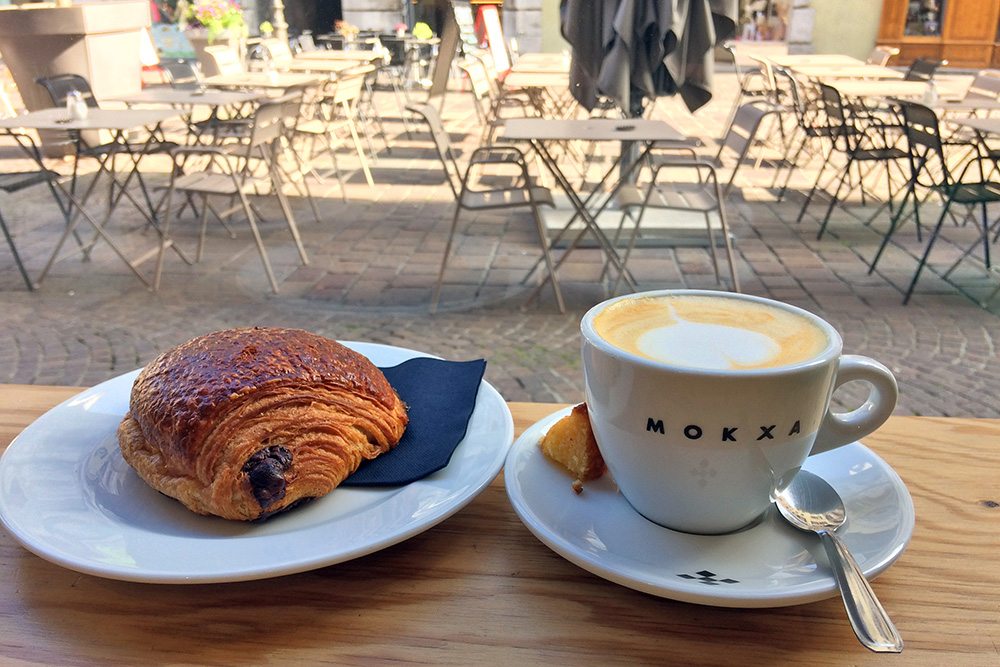
Coffee and pain au chocolat in Chambéry © French Moments
What makes Chambéry so appealing is precisely this combination. The town does not try to rival Annecy or Aix-les-Bains on their own ground. It tells a different story: that of a Savoyard capital that became a French town, an old centre that hides its secrets, and an Alpine crossroads where routes, powers and landscapes meet.
Chambéry is not merely a practical stopover. It is a town that deserves you to push open doors, enter the alleys, look up at the façades and take the time to understand its role in the history of Savoie.
And let us be honest: a town capable of bringing together a ducal castle, secret passages, trompe-l’œil, Rousseau, a railway roundhouse and four elephants at the foot of the Alps deserves at least a proper visit.
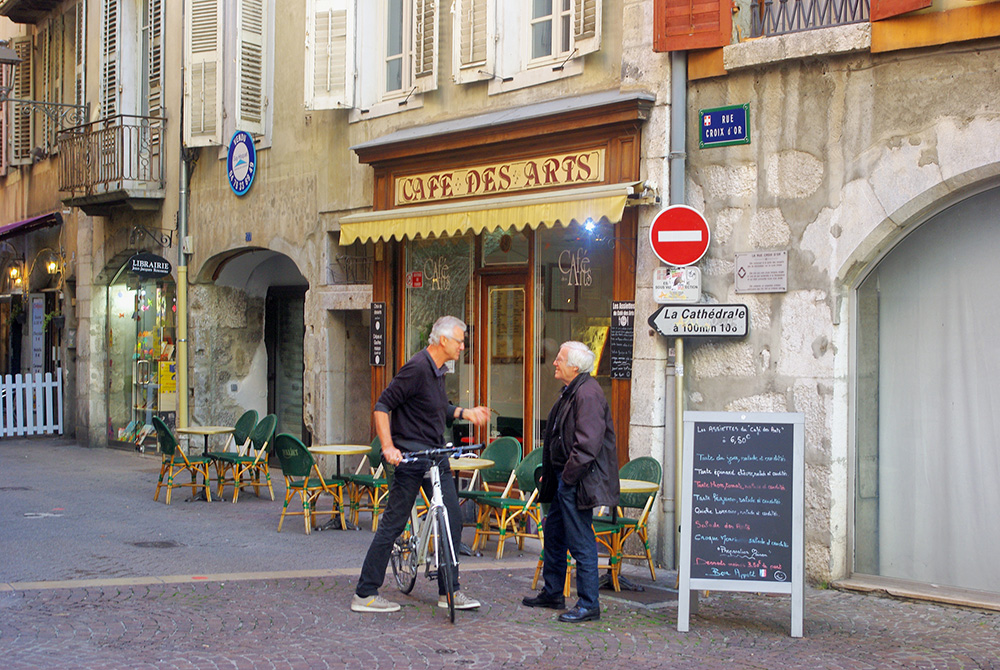
In the old town of Chambéry © French Moments