Plateau de Solaison is one of those places in Haute-Savoie that many people know by name without quite realising how spectacular its setting really is.
Perched above the Arve Valley, between limestone cliffs, alpine chalets and vertiginous roads, Solaison belongs to a more discreet Haute-Savoie, far from the major resorts and the overly perfect postcard scenes.
There is no turquoise lake here, no famous cable car, no grand resort machinery. Instead, there is a road that climbs very seriously, a mountain village, high pastures, nearby summits, and that very particular feeling of being both above the world and still deeply rooted in local life.
In 2026, the Tour de France will bring Stage 15 to the Plateau de Solaison, at the end of a mountain stage starting in Champagnole.
The official Tour route announces a 183.9 km stage, with 3,950 m of elevation gain, and a finish at Brison / Plateau de Solaison at around 1,508 m above sea level.
Where Is the Plateau de Solaison?
The Plateau de Solaison is located in Haute-Savoie, in the Bornes massif, on the territory of Brizon — also very often written as Brison in local and tourist usage.
The plateau lies at around 1,500 m above sea level, above the Arve Valley and Bonneville.
Geographically, the place is beautiful because it is easy to read. To the north rises the Pointe d’Andey. To the south, the Rochers de Leschaux close the horizon.
Between the two, Solaison unfolds its pastures, chalets and open spaces, like a clearing suspended between valley and mountain.
The plateau overlooks the Gorges du Bronze on one side and the Borne gorge on the other. This gives the site a real sense of being a promontory.
You are not on an anonymous mountain shelf, but on a natural balcony placed between several worlds: the Arve, the Borne, the Bornes, the Bargy and, further away, the great Alpine massifs.
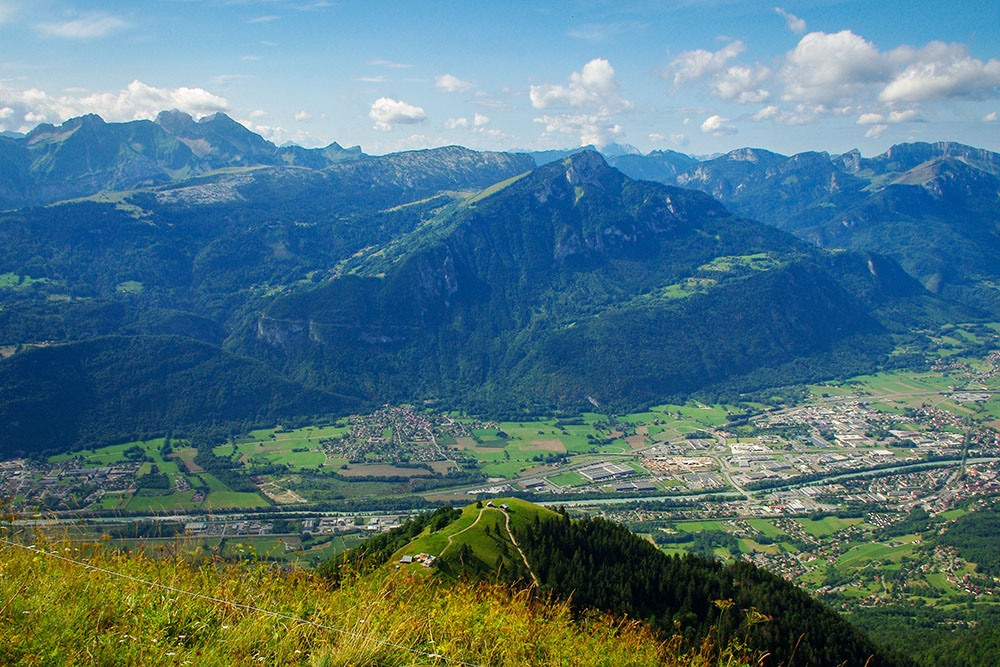
View of Pointe d'Andey and Solaison from Le Môle © French Moments
The Bornes Massif, Solaison’s Natural Setting
The Plateau de Solaison belongs to the Bornes massif, one of those Pre-Alpine massifs that may not have the instant fame of Mont Blanc, but certainly has a strong personality.
![Plateau de Solaison © Christian MOENNE-LOCCOZ - licence [CC BY-SA 2.5] from Wikimedia Commons](https://frenchmoments.eu/wp-content/uploads/2026/07/Plateau-de-Solaison-©-Christian-MOENNE-LOCCOZ-licence-CC-BY-SA-2.5-from-Wikimedia-Commons-1.jpg "Plateau de Solaison © Christian MOENNE-LOCCOZ - licence [CC BY-SA 2.5] from Wikimedia Commons")
Plateau de Solaison © Christian MOENNE-LOCCOZ - licence [CC BY-SA 2.5] from Wikimedia Commons
The Bornes are made of limestone cliffs, alpine pastures, combes, discreet cols and roads that sometimes seem to be searching for a way through the mountain.
Nothing here feels theatrical in an obvious way, and yet everything comes together to create a deeply Haute-Savoie landscape.
Solaison is a good example of this. The plateau does not overwhelm the visitor with scale.
It charms through balance: an open space, enough altitude to feel the mountain, but with an atmosphere that remains pastoral, almost family-like.
That may be what gives it its charm. You can come here to walk, cycle, ski in winter, admire the cliffs, or simply breathe some fresh air. And in Haute-Savoie, fresh air is already quite a programme.
![Plateau de Solaison © CEDRIC BRUN - licence [CC BY 3.0] from Wikimedia Commons](https://frenchmoments.eu/wp-content/uploads/2026/07/Plateau-de-Solaison-©-CEDRIC-BRUN-licence-CC-BY-3.0-from-Wikimedia-Commons.jpg "Plateau de Solaison © CEDRIC BRUN - licence [CC BY 3.0] from Wikimedia Commons")
Plateau de Solaison © CEDRIC BRUN - licence [CC BY 3.0] from Wikimedia Commons
The Bargy Range and the Rochers de Leschaux
Around Solaison, the eye is quickly drawn to the limestone reliefs.
The Rochers de Leschaux form one of the great landmarks of the area. They close the plateau to the south and give the landscape its mineral character, which contrasts so beautifully with the alpine pastures.
The walking loop of the Rochers de Leschaux links the plateaus of Cenise and Solaison, passing through a landscape of alpine chalets, limestone pavements and wide open views.
Further away, the Bargy range adds another layer to the scenery. It feels rougher, sharper and more alpine. From Solaison and its surroundings, you quickly understand that you are in a fascinating transition zone between the softness of pastureland and the power of cliffs.
This tension gives the Plateau de Solaison its character: the place is welcoming, but never ordinary. The mountain remains present, very much so, as if to remind you that a postcard can still have teeth.
Pointe d’Andey: The Classic Hike from the Plateau de Solaison
From the Plateau de Solaison, the Pointe d’Andey is probably the most emblematic hike.
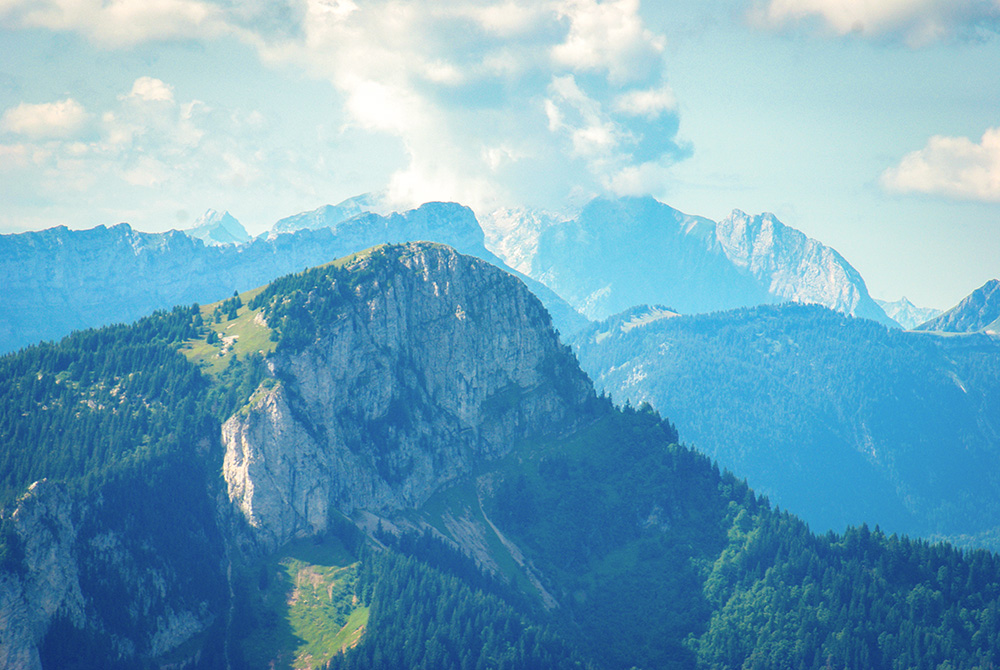
Pointe d'Andey seen from Le Môle © French Moments
This summit rises to 1,877 m above sea level and also belongs to the Bornes massif. It dominates the Arve Valley and, in clear weather, offers a wide panorama over the surrounding area.
The hike starts near the Solaison car park. Several routes lead to the summit, and the municipality of Brison presents the Pointe d’Andey as one of the great walks from the plateau.
This is not a Himalayan expedition, and that is just as well. The Pointe d’Andey offers what Haute-Savoie does so well: a reasonable effort, a real sense of altitude, views that open gradually, and that very personal satisfaction of having climbed a little higher than expected.
Still, this is mountain terrain. The sun can be strong, shade can be scarce, and the ground requires proper footwear. The apparent gentleness of an alpine pasture should never replace common sense.
Brison, the Village Suspended Above the Valley
Before reaching the plateau, there is Brison — or Brizon, according to the official spelling of the commune. The village clings to the slopes above the Arve Valley, in a landscape that already announces the climb towards Solaison.
![Brison © Vamich - licence [CC BY-SA 3.0] from Wikimedia Commons](https://frenchmoments.eu/wp-content/uploads/2026/07/Brison-©-Vamich-licence-CC-BY-SA-3.0-from-Wikimedia-Commons.jpg "Brison © Vamich - licence [CC BY-SA 3.0] from Wikimedia Commons")
Brison © Vamich - licence [CC BY-SA 3.0] from Wikimedia Commons
Brison is not a spectacular resort, nor a backdrop manufactured for tourists. It is a mountain village, connected to its pastures, roads, hamlets and the long relationship between valley and heights.
The Faucigny-Glières tourist office describes Solaison as a sunny alpine pasture suspended above Brison, between the Pointe d’Andey and the Rochers de Leschaux.
That image sums up the place well. Brison is the anchor. Solaison is the opening. You climb from one to the other as if passing from an inhabited world into a wider, brighter and more directly mountainous space.
The Road from Bonneville to the Plateau de Solaison: A Spectacular Climb
The access road to the Plateau de Solaison from Bonneville is already an experience in itself.
Leaving the Arve Valley, the D186 climbs towards Brison before continuing towards Solaison on the D186A.
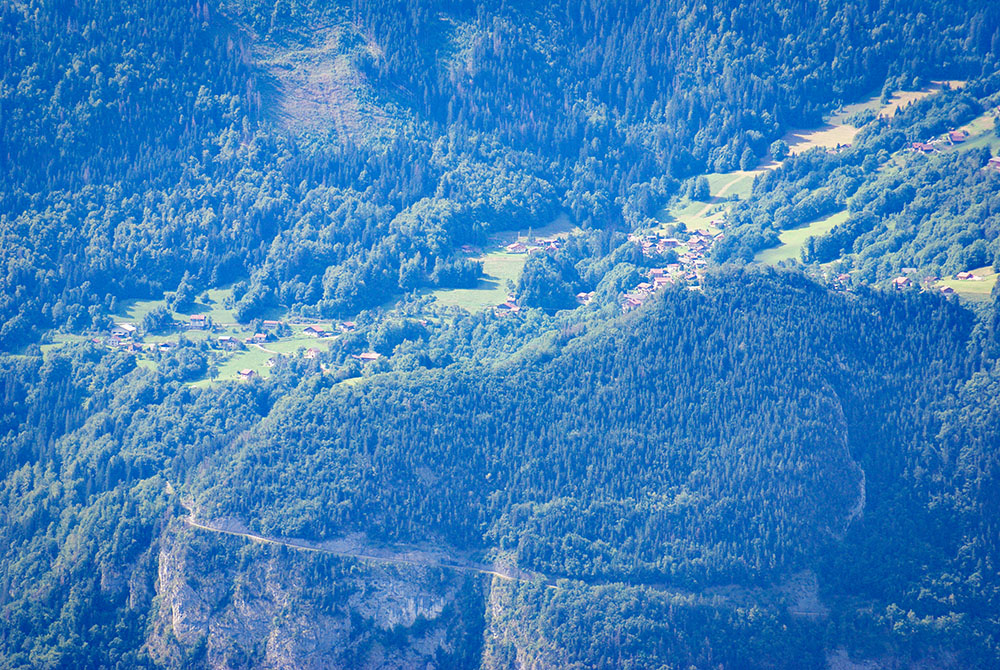
Brison and the RD186 seen from Le Môle © French Moments
For motorists, it is a spectacular mountain road. For cyclists, it is something else entirely: a serious matter involving legs, lungs and gradient.
The climb from Thuet is an ascent of 11.2 km at an average of 9.2%, with sections at 13–14%. The impression is striking: from the flat valley floor, you see the road searching for a way through a mountain that seems almost vertical.
And that is exactly what stays in the mind. In places, the road seems carved into the cliff, suspended above the Gorges du Bronze. You get the impression that someone designed the route by saying, “What if we just went straight up?” Then, thankfully, someone a little more reasonable added a few hairpins.
The climb is beautiful, but it requires attention. The road is narrow, the gradient is steep, and the scenery should not make you forget the driving. This is the kind of approach where it is better to take your time — which is just as well, because the view fully deserves it.
Alpine Pastures, Chalets and Activities on the Plateau de Solaison
Once you reach the Plateau de Solaison, the landscape changes rhythm. The valley is behind you. Ahead, the pastures, chalets and summits give the place a gentler, almost restful atmosphere.
The local economy is linked to tourism and agriculture, as well as to alpine chalets. But Solaison is also a site for mountain activities: cross-country skiing, biathlon, snowshoeing, hiking and paragliding.
In summer, the plateau attracts walkers, families, brave cyclists and anyone simply looking for a place at altitude to breathe. In winter, it becomes a small Nordic area, with an atmosphere very different from that of the large Alpine resorts. Solaison turns into a Nordic site at around 1,500 m, suited to several winter activities.
What appeals at Solaison is precisely this simplicity. The plateau does not need to try too hard. It offers space, light, paths, grass in summer, snow in winter, and that kind of silence you never quite find down in the valley.
![Plateau de Solaison © Rémih - licence [CC BY-SA 4.0] from Wikimedia Commons](https://frenchmoments.eu/wp-content/uploads/2026/07/Plateau-de-Solaison-©-Remih-licence-CC-BY-SA-4.0-from-Wikimedia-Commons.jpg "Plateau de Solaison © Rémih - licence [CC BY-SA 4.0] from Wikimedia Commons")
Plateau de Solaison © Rémih - licence [CC BY-SA 4.0] from Wikimedia Commons
The Plateau de Solaison and the Tour de France: A Glières-Style Destiny?
The Plateau de Solaison did not wait for the Tour de France to exist. Local people, walkers, cyclists and Nordic skiing enthusiasts already know it well.
But the Tour de France has a particular ability to reveal a place to a much wider public. The Plateau des Glières is a good example.
Before the Tour passed through, the Glières Plateau was already a major place of history, memory and nature in Haute-Savoie. But from 2018 onwards, with the Tour’s arrival on the plateau, its name entered the imagination of millions of television viewers.
That year, the Plateau des Glières appeared as a new hors catégorie climb on the Tour, with an average gradient of around 11.2% and an unpaved section across the plateau.
In 2026, Solaison may experience a similar moment. Not a tourist invention — the place is already very real, very alive, and deeply rooted — but a revelation.
During Stage 15 to the Plateau de Solaison, the final climb is presented as being around 11.3 km long, with an average gradient of about 9.1%, making it a very demanding finale.
For television viewers, it may be a discovery. They will see the Arve Valley, the climb towards Brison, the hairpins, the cliffs, and then the opening of the plateau.
For the riders, however, the word “discovery” may feel rather less poetic. After more than 180 km of racing and nearly 4,000 m of elevation gain, Solaison will mostly be a final climb that does not forgive much.
The Tour may give the Plateau de Solaison its quarter of an hour of international fame. But the landscape did not wait for the cameras to become spectacular.
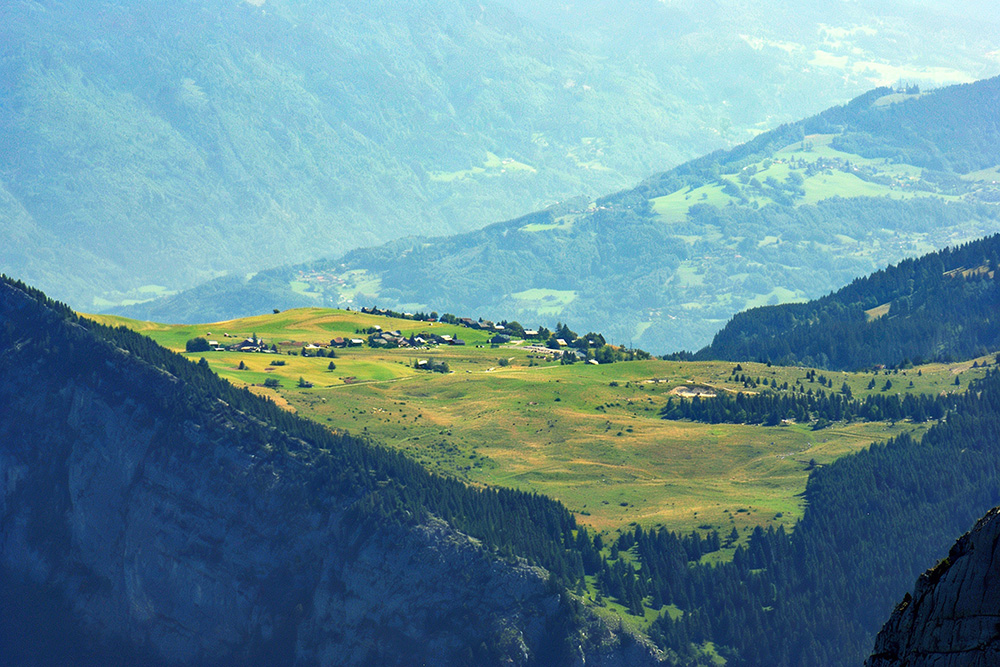
Plateau de Solaison seen from Sous-Dine © French Moments
What to See Around the Plateau de Solaison
The Plateau de Solaison is worth discovering for its own sake, but it also fits very well into a wider exploration of the Faucigny and this part of Haute-Savoie.
Mont-Saxonnex
Not far from Solaison, Mont-Saxonnex offers another village-balcony atmosphere. The site faces the Bargy and the mid-mountain landscapes. It is a good excursion idea if you want to remain in this world of perched villages, alpine pastures and open views.
Lac Bénit
At the foot of the Bargy, Lac Bénit is one of the small natural treasures of the area. This mountain lake, accessible on foot, offers a very different setting from Solaison: more intimate, more enclosed, with the feeling of standing at the foot of a great rocky amphitheatre.
Col de Cenise
The Col de Cenise is another neighbouring pastoral plateau, well known to hikers. The mountain pass can be linked to the Rochers de Leschaux and Solaison area by mountain routes. The Rochers de Leschaux loop connects Cenise and Solaison in a landscape of limestone pavements and alpine chalets.
Bonneville
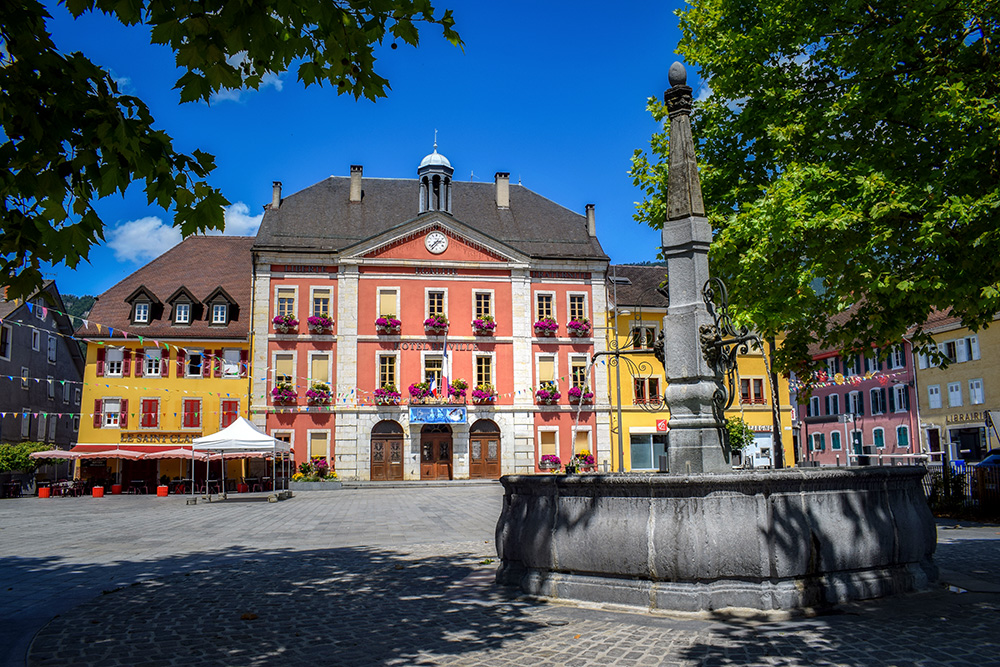
Bonneville in Haute-Savoie © French Moments
Down in the valley, Bonneville helps you understand the landscape before climbing towards the heights. A historic town of the Faucigny, on the banks of the Arve, it makes a practical base for discovering Solaison, Le Môle, the ruins of Faucigny and the Arve Valley.
La Roche-sur-Foron
La Roche-sur-Foron, with its old town, medieval atmosphere and position between Geneva, Annecy and the Arve Valley, also fits well into a day or stay in the area. It adds a more urban and heritage-focused touch to an itinerary dominated by mountain landscapes.
Is the Plateau de Solaison Worth Visiting?
Yes, without hesitation — provided you enjoy mountain places that do not try to compete with the great Alpine stars.
The Plateau de Solaison does not have the fame of Chamonix, the tourist refinement of Annecy or the symbolic power of the Plateau des Glières. But it has something else: presence.
Here you find a spectacular road, a mountain village, alpine pastures, chalets, cliffs, hikes and a real feeling of altitude above the Arve Valley.
In 2026, the Tour de France will turn its cameras towards Solaison. Many people will discover this Alpine balcony for the first time. But those who already know the place understand one thing: the Plateau de Solaison does not need the Tour to be beautiful. The Tour will simply show everyone what the mountain had been keeping a little to itself.