
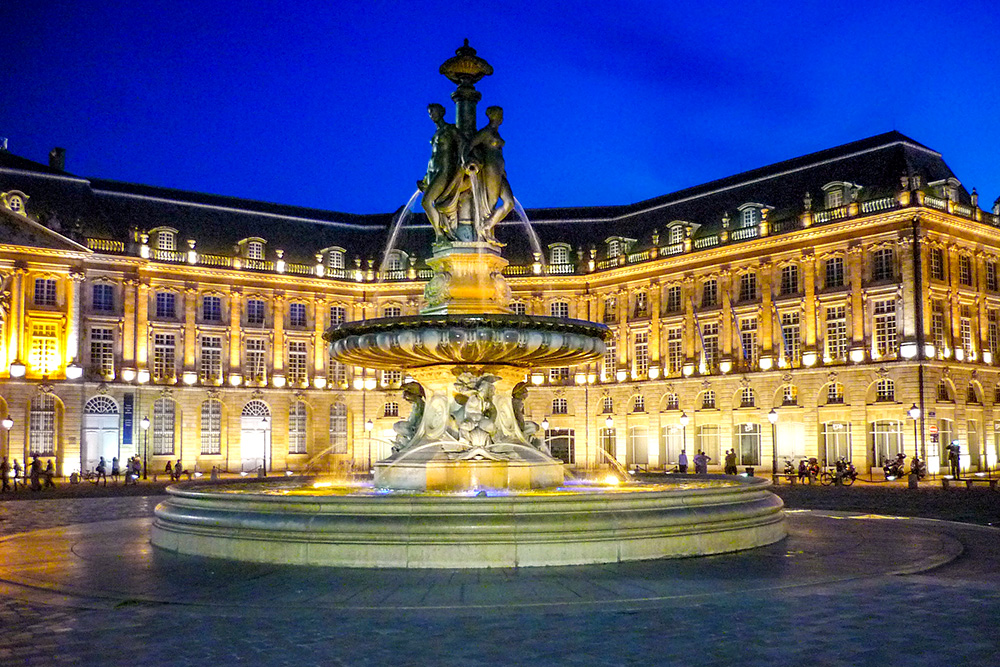


Bordeaux History begins far earlier than the elegant 18th-century façades that define the city today.
While much of the UNESCO-listed centre dates from the Age of Enlightenment, the story of Bordeaux stretches back more than two millennia, to the 6th century BC when the first permanent settlements took root along the Garonne.
From ancient tribes and Roman conquests to medieval power struggles and the rise of a flourishing port, Bordeaux History is a long, layered narrative—one that reveals how this city became the cultural and economic heart of Aquitaine.
Bordeaux History in the beginning
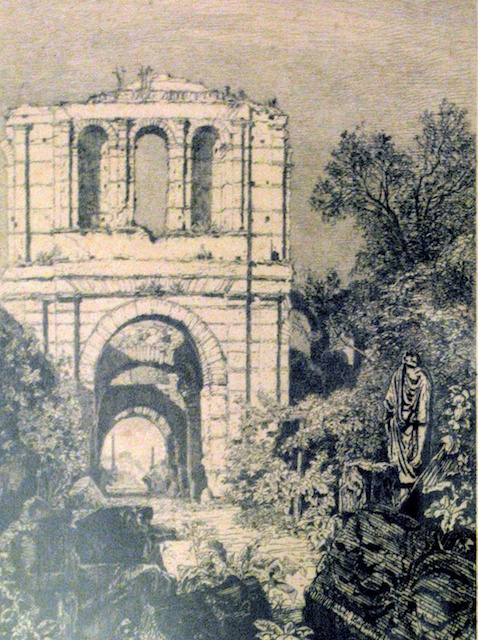
The earliest chapter of Bordeaux History begins with Burdigala, the city founded in the 3rd century BC by the Celtic tribe of the Bituriges Vivisques.
Settled along a natural curve of the Garonne River, the site offered a rare strategic advantage: it stood at the intersection of major routes linking the Atlantic Ocean, the Mediterranean Sea, and the Iberian Peninsula.
Burdigala quickly grew into a key stop on the ancient tin trade route from Great Britain, benefiting from the constant movement of goods and merchants.
A turning point came in 56 BC, when Julius Caesar and his lieutenant Crassus conquered the region and ushered Burdigala into the Roman world.
The settlement soon became an important emporium, a commercial hub that prospered within the vast network of Roman Gaul.
Over the next three centuries, the city expanded significantly and began producing and trading wine, a commodity that would eventually define Bordeaux’s global identity.
This era of growth saw the construction of monumental structures: an amphitheatre, temples, thermal baths, and opulent residences—the kinds of buildings that marked the presence of Roman wealth and influence.
By the height of its development, Burdigala stood among the major cities of southern Gaul, with a population reaching 20,000 inhabitants.
But prosperity was never permanent.
In the third century AD, repeated conflicts between Germanic tribes and the Roman Empire pushed the city to fortify itself. Burdigala was enclosed within a 9-metre-high wall, forming a defensive castrum that protected both the population and its harbour.
Life continued within these strong walls, though the population declined to around 15,000, signalling the beginning of a more turbulent chapter in Bordeaux History.
Bordeaux History in the Middle Ages
The medieval chapter of Bordeaux History begins with the arrival of Christianity in the 4th century, gradually spreading through the region and reshaping its cultural landscape.
But the stability of late Roman Burdigala soon gave way to upheaval.
In the early 5th century, waves of Barbarian invasions struck the city: first the Vandals in 408, followed by the Visigoths, who controlled the area from 414 to 498.
Prosperity faded, and Bordeaux entered a long and uncertain transition.
A new era began in 498, when King Clovis, ruler of the Franks, defeated the Visigoths and absorbed Burdigala into the Merovingian Kingdom.
By the late 7th century, Christian customs and structures were firmly in place.
From their basilicas, churches and monasteries, Frankish bishops oversaw both the spiritual direction and the political organisation of the city.
Yet peace remained elusive.
Between 720 and 848, Bordeaux became the stage for repeated conflicts.
An Arab invasion led to the pillaging of the city in 732, and a century later, in 848, the Vikings attacked with brutal force—burning the settlement and massacring its inhabitants.
Throughout these centuries, Bordeaux was highly coveted.
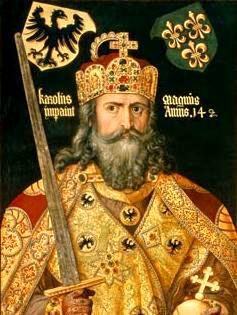
Between the Arab and Viking incursions, Charlemagne attempted to secure the region for his empire.
But after his reign, shifting alliances and dynastic tensions divided control of the area between the Duchy of Gascony and the Duchy of Aquitaine.
The struggle ended in 1032, when the Duke of Gascony died without an heir.
Bordeaux then fell entirely under the authority of the Duchy of Aquitaine, which at that time remained independent and separate from the French crown.
How Bordeaux became English
1. Eleanor, the Duchess of Aquitaine, Queen of France, Queen of England
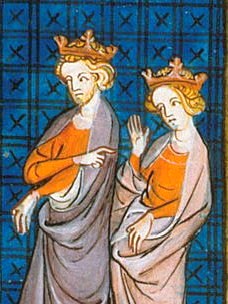
The transformation of Bordeaux’s destiny begins with Eleanor of Aquitaine, the eldest daughter of Guillaume X, Duke of Aquitaine.
After the death of her brother in 1130 and her father in 1137, Eleanor—at just fourteen—became Duchess of an independent and influential territory.
On 25 July 1137, she married in Bordeaux the heir to the French crown, Louis VII, who thereby assumed the title of Duke of Aquitaine.
As Queen of France, Eleanor attracted criticism for her taste for luxury and her behaviour, which many considered provocative.
During the Second Crusade, tensions deepened between the royal couple—fuelled by the hardships of travel and rumours of her closeness with her uncle, Raymond of Poitiers.
After fifteen years of marriage, the union was annulled in March 1152.
Whether the allegations of infidelity were justified or not, Eleanor clearly wished to end the marriage—perhaps already envisioning a future with Henry II, heir to the English crown, whom she had met the previous year in Paris.
Following the annulment, Louis VII lost the title of Duke of Aquitaine, while Eleanor retained full authority over the duchy, still fully independent from the French monarchy.
In 1152, she married Henry Plantagenet, ten years her junior.
He thus became Duke of Aquitaine, and in December 1154, when he was crowned King of England as Henry II, Eleanor became Queen of England.
From that moment, Aquitaine—including Bordeaux—was bound to the English crown.
Their marriage was notably turbulent, marked by Henry’s repeated infidelities, yet the couple had eight children together, including two future kings: Richard I of England and John, King of England.
2. Bordeaux under the English Crown 1154-1453
The 12th century marked the beginning of a golden age in Bordeaux History.
Skilled artisans and labourers from across the region settled in the faubourgs, the districts beyond the old city walls.
As the population expanded, new fortifications became necessary.
Under English rule, Bordeaux did not experience oppressive oversight.
On the contrary, it prospered.
The wine trade, especially with England, generated immense wealth for the city’s bourgeoisie, and certain communal privileges were granted to its inhabitants.
In April 1206, following a series of attacks, the city obtained greater autonomy.
A form of early municipal governance emerged, allowing local notables to elect a mayor—a significant step toward organised civic administration.

By the early 14th century, Bordeaux had reached around 30,000 inhabitants, confirming its status as a major urban centre.
The city’s loyalty to England became particularly visible in 1340, when Edward III—grandson of the French king Philip IV—declared himself King of France, igniting the Hundred Years’ War.
Fifteen years later, in 1355, Edward the Black Prince, son of Edward III, arrived triumphantly in Bordeaux.
From the city, he launched military campaigns across France.
His most notable victory came in 1356 at the Battle of Poitiers, during which he captured John II of France, who was subsequently imprisoned in Bordeaux.
The Treaty of Brétigny in 1360 expanded English territory dramatically, granting control over Poitou, Aunis, Saintonge, Angoumois, Limousin, Périgord, Quercy, Rouergue and Agenais.
Between 1362 and 1372, Bordeaux even became the capital of a powerful principality governed by the Black Prince.
Yet this dominance could not endure.
After prolonged conflict with Charles V, English possessions shrank to a narrow corridor between Bordeaux and Bayonne.
The Black Prince died in 1376.
Even in the early 15th century, Bordeaux remained steadfastly loyal to England.
Although Charles VII briefly retook the city in 1451, the English returned in 1452 and were warmly welcomed by the population.
For nearly three centuries, from Eleanor’s marriage in 1152 to the final English return in 1452, Bordeaux maintained an enduring attachment to the English kingdom—an alliance that profoundly shaped the city’s identity and development.
Integration into the French Kingdom (1453-1715)
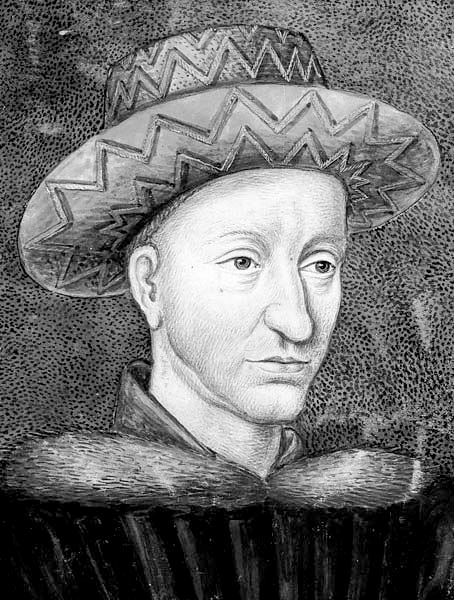
In 1453, Charles VII achieved his final victory over England, bringing the Hundred Years’ War to an end and definitively recovering Bordeaux for the French crown.
Yet the transition was far from smooth.
For decades, many Bordelais—especially members of the bourgeoisie—still felt deeply attached to England.
Around two thousand inhabitants even chose to leave for England rather than become subjects of France.
From 1454 onwards, the French king took deliberate steps to ease the city’s reintegration.
Local privileges were preserved, and two major fortifications were built to secure royal authority and defend Bordeaux against potential threats: Fort du Hâ and Château Trompette.
Trade, however, proved much harder to restore.
Centuries of commercial ties with England meant that Bordeaux’s economy had to be restructured, even with substantial financial support from the crown.
By the end of the 15th century, the city had regained stability and entered a new phase of development.
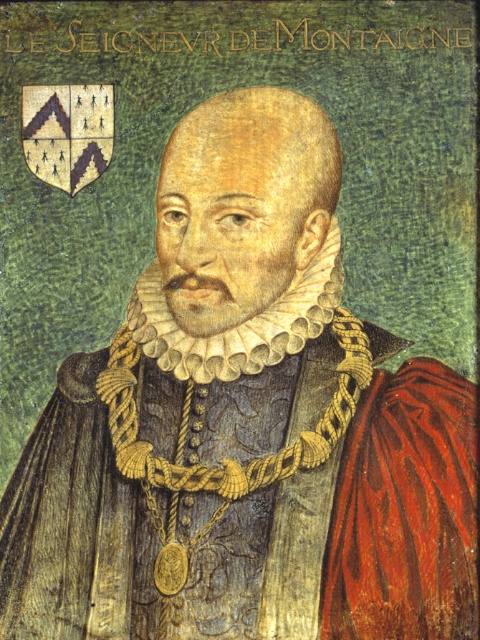
During the 16th century, Bordeaux became an important centre of Humanism.
The renowned writer Michel de Montaigne served as mayor from 1581 to 1585, while the prestigious Collège de Guyenne, founded in 1533, contributed to the city’s growing intellectual influence.
The 17th century, however, brought renewed difficulties.
During the Thirty Years’ War, Bordeaux became—after Paris—the most turbulent city in France. Internal conflicts and open revolts challenged royal authority, particularly during the uprisings against the absolutism of Louis XIV.
In 1653, the young king ultimately subdued Bordeaux by military force, ensuring the city’s firm and irreversible integration into the French kingdom.
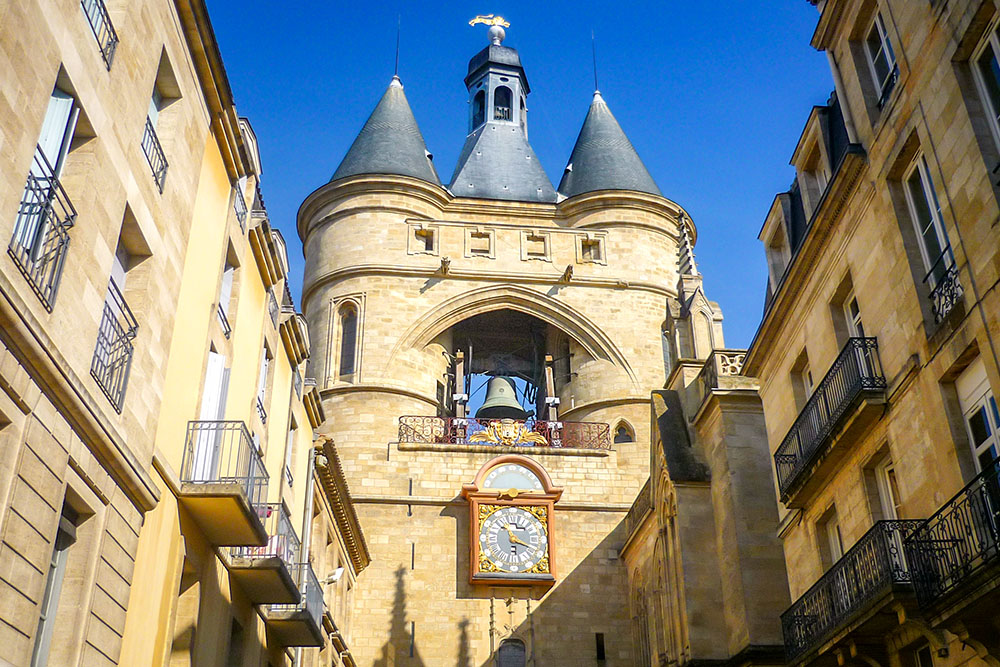
The 18th century: the “Apogée” of the city
The 18th century marked a decisive turning point in Bordeaux History, as the city established itself as one of France’s most vital harbours.
1. The first French harbour
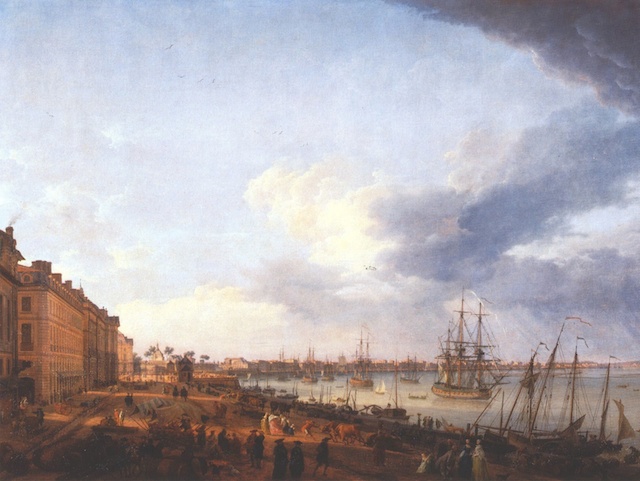
The position of the city on the Garonne, ideally placed for transatlantic navigation, made it a key hub for exports to and imports from the French colonies.
From 1716 onward, Bordeaux became one of the five principal French ports involved in the Three-Way Trade (commerce triangulaire), alongside cities such as La Rochelle, despite the fact that Bordeaux had formally condemned slavery as early as 1571.
During this period, 411 ships departed from Bordeaux to participate in the slave trade: they sailed to Africa, exchanged goods for enslaved people, transported them to North and Central America, and returned loaded with colonial products.
This trade dramatically increased the city’s wealth.
Commodities such as cocoa, sugar, coffee and cotton arrived from the West Indies and were redistributed across Europe through Bordeaux’s booming port.
By the end of the century, Bordeaux had become the largest harbour in France and the second busiest port in the world, surpassed only by London.
2. Development of the city
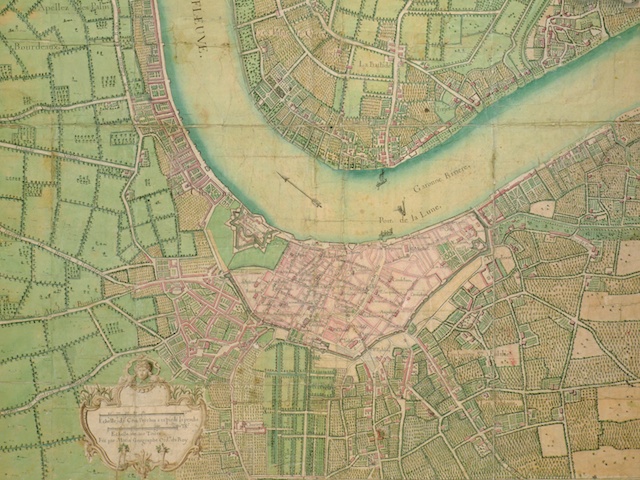
This extraordinary prosperity attracted people, capital and talent from across the country.
Within less than a century, the population grew from 60,000 to 110,000 inhabitants, reshaping the urban fabric.
Bordeaux underwent major improvements and modernisation.
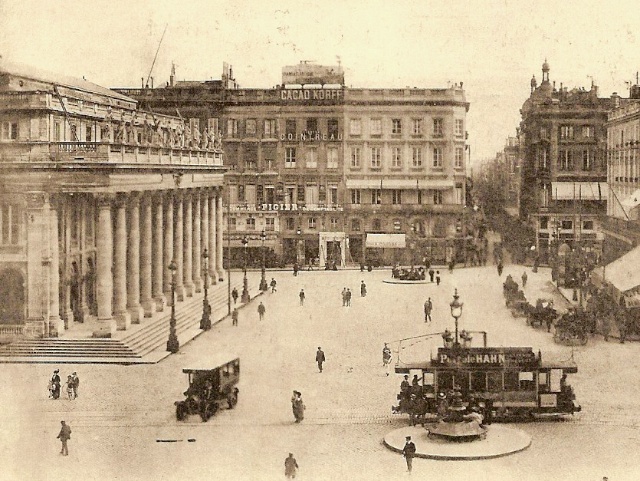
New monumental spaces were created, including the Place de la Victoire (then known as the Triumphal Arch of Aquitaine) and the grandiose Grand Théâtre de Bordeaux, one of the most impressive theatres in France.
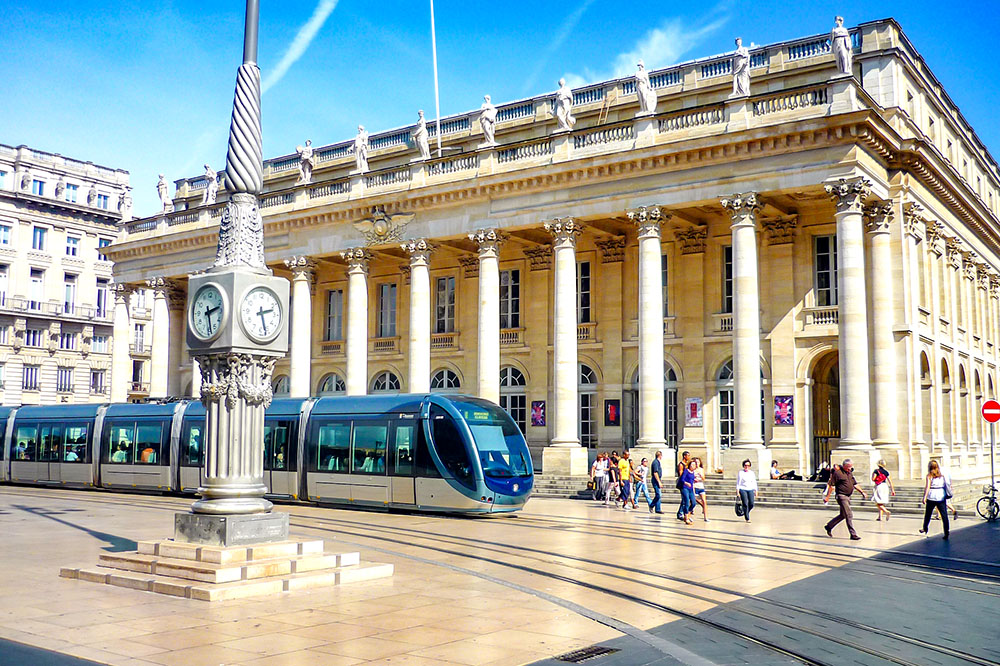
Public gardens were laid out, and elegant streets lined with classical townhouses gave the city its harmonious and bourgeois appearance.
This architectural unity—remarkably preserved today—is one of the reasons why Bordeaux is now listed as a UNESCO World Heritage Site.
3. Bordeaux during the Age of Enlightenment and Revolution
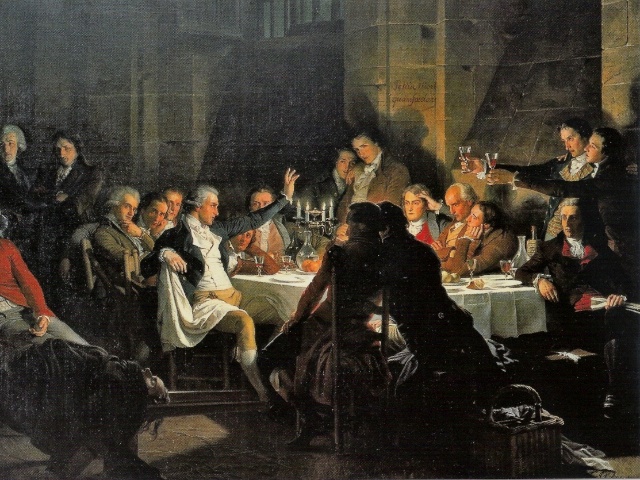
The 18th century was also the Age of Enlightenment, led in France by five major thinkers: Voltaire, Jean‑Jacques Rousseau, Montesquieu, Denis Diderot, and Pierre Beaumarchais.
Among them, Montesquieu lived near Bordeaux and became known locally as the voice of Enlightenment thought.
His influence contributed to the city’s reputation as a centre for intellectual exchange and may explain why Bordeaux developed a notable community of Freemasons.
When news of the storming of the Bastille reached the city in July 1789, Bordeaux celebrated the start of the Revolution.
A year later, in 1790, the Girondins—a prominent and radical revolutionary group—emerged here. (Their name refers to the Gironde, now an administrative département of France.)
The Revolution, however, soon turned turbulent for the city.
The ideological split between the Montagnards, who dominated Paris under the leadership of Maximilien Robespierre, and the Girondins of Bordeaux escalated into open conflict.
Robespierre denounced Bordeaux as a “counter-revolutionary stronghold”.
The Montagnard revolutionary Jean‑Lambert Tallien was sent to impose the Reign of Terror (la Terreur) on the city.
By the end of the century, Bordeaux entered a period of recession, worsened by the disruptions of the Napoleonic wars.
The 19th century: From Napoleon to the Third Republic
The 19th century opened with dramatic political shifts that left a deep imprint on Bordeaux History.
The arrival of Napoleon Bonaparte in 1799 was initially welcomed by the people of Bordeaux, who saw in him the end of the Reign of Terror.
But their enthusiasm did not last.
By 1814, resentment grew over the heavy consequences of the Peninsular War in Spain, and Bordeaux became the first French city to openly support the restoration of the Bourbon Monarchy.
Under the reigns of Louis XVIII and Charles X, the city entered a period of significant expansion.
Major urban transformations reshaped Bordeaux: the first bridge across the Garonne—the Pont de Pierre—was completed in 1822, and the old Trompette Castle was demolished to make way for what is now the vast and emblematic Place des Quinconces.
Political tensions continued to define the century.
During the Revolution of 1848, Bordeaux was notably reluctant to embrace the new regime and opposed the establishment of the Second Republic, reaffirming its reputation for independent political thought.
The broader context of the Industrial Revolution profoundly shaped the city’s development.
Infrastructure improved, industries expanded, and new neighbourhoods emerged.
The population doubled within the century, reaching 230,000 inhabitants by 1891.
By the end of the 19th century, Bordeaux fully embraced the ideals of the Third Republic and celebrated them with civic pride.
Public art competitions were organised to display the city’s republican convictions.
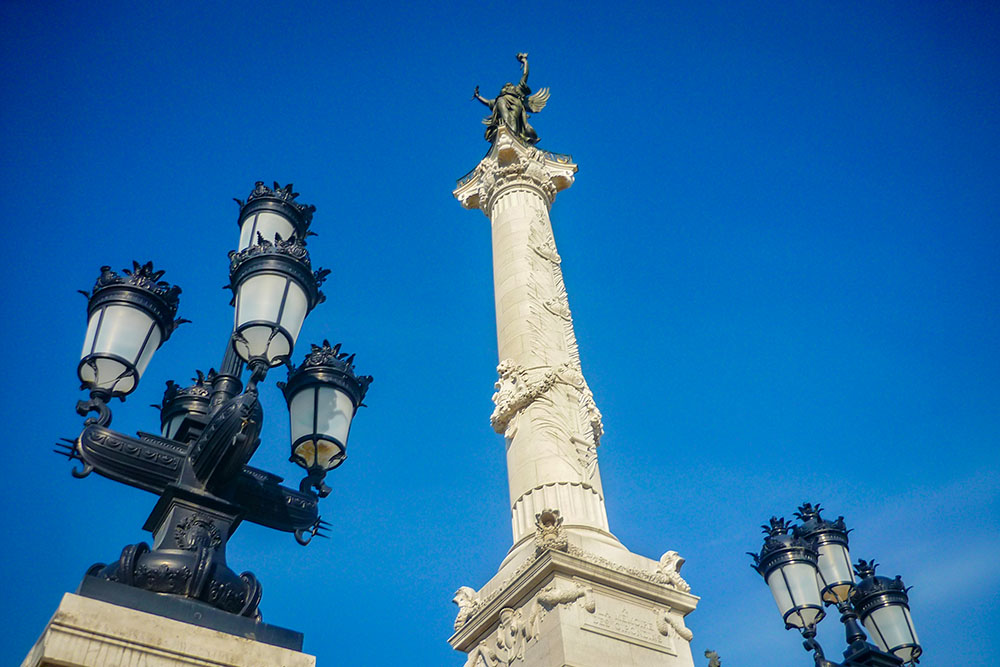
Two monumental creations on the Quinconces—Monument aux Girondins, with its soaring pillar, and the Bronze Horses of the Girondins—stand today as striking tributes to that political and cultural identity.
Bordeaux History in the 20th and 21st Centuries
The 20th and 21st centuries marked a period of profound transformation in Bordeaux History, as the city navigated global conflicts, embraced reconstruction, and gradually reinvented itself into the modern metropolis it is today.
1914-1918
During the First World War, the advance of German forces placed Paris in immediate danger.
As a result, Bordeauxbriefly became the temporary capital of France, hosting government institutions far from the front lines.
The city also benefited economically from its armaments industries, which supplied the wartime effort and kept local activity strong despite the conflict.
1939-1944
With the outbreak of the Second World War, the French Government again sought refuge in Bordeaux, which became known as the “tragic capital”.
The Armistice signed in 1940 by Philippe Pétain marked the start of the collaborationist Vichy Regime, and the city’s mayor, Adrien Marquet, aligned himself with the new authorities.
From 1941 onward, Bordeaux fell under German occupation.
Owing to its strategic position and major harbour, the occupiers built a massive submarine base—the Base Sous-Marine—to protect U-boats and hinder potential Allied landings along the Atlantic coast.
The structure, made of reinforced concrete, remains one of the most imposing military relics of the period.
After four years of occupation, Bordeaux was liberated on 28 August 1944.
1945-2007: The return of the Great Bordeaux
Following the war, Bordeaux entered a period of reconstruction and modernisation.
From 1947 to 1995, the city was led by Jacques Chaban-Delmas, a former Resistance general who became one of the architects of Bordeaux’s transformation.
His long tenure oversaw major developments, including the expansion of the University of Bordeaux, improvements to the hospital system, and the construction of two significant bridges: the Pont Saint-Jean (1965) and the Pont d’Aquitaine (1967).
In 1960, Bordeaux became a regional capital.
The following decades saw rapid economic and industrial growth, as the city became a major centre for aeronautics, space engineering, and the hydrocarbon trade, strengthening its role in the French economy.
In 1995, Alain Juppé became mayor.
His administration launched an ambitious urban renewal plan that profoundly reshaped Bordeaux’s identity.
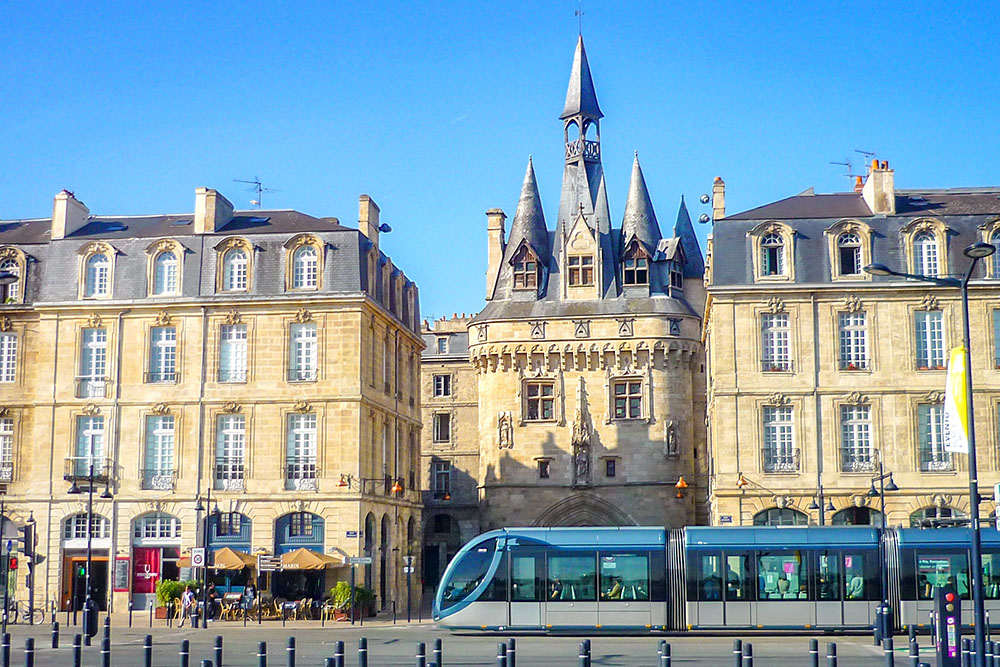
The renovation of the 18th-century façades, the revitalisation of the Garonne riverbanks, and the introduction of a modern tramway system reduced traffic congestion, encouraged pedestrian mobility, and opened the historic centre to residents and visitors alike.
In 2007, these long-term efforts culminated in Bordeaux being inscribed on the UNESCO World Heritage List as the largest urban area in the world listed for its architectural unity—more than 1,800 hectares preserved for their Enlightenment-era elegance.
After 2007: The Renewal of 21st-Century Bordeaux
Since its UNESCO listing, Bordeaux has continued to reinvent itself, entering what many describe as a new golden age.
Major developments of the 2010s and 2020s include:
The Cité du Vin (2016):
A landmark cultural centre celebrating wine civilisations worldwide, housed in an emblematic building on the Garonne at La Cité du Vin. Its opening marked Bordeaux’s emergence as a global cultural destination.The new bridges of Bordeaux:
The Pont Chaban-Delmas (2013), a remarkable vertical-lift bridge, became one of the city’s architectural icons.
The Pont Simone-Veil (2024) further expanded river crossings and eased mobility in a growing metropolitan area.Redevelopment of industrial zones:
Former port and warehouse districts, especially the Bassins à flot, have been transformed into lively waterfront neighbourhoods with museums, housing, promenades, and cultural venues.Cultural revitalisation:
The military submarine base has been repurposed into Les Bassins de Lumières, one of the world’s largest digital art centres (opened 2020), attracting thousands of visitors each week.Sustainable mobility:
The tramway network has grown considerably, promoting low-emission transport. Additional cycling lanes, car-free zones, and green spaces have reshaped everyday life.Urban expansion and tourism boom:
With improved accessibility—particularly the high-speed TGV line launched in 2017 linking Bordeaux to Paris in just 2 hours—the city has seen a dramatic rise in tourism and international visibility.
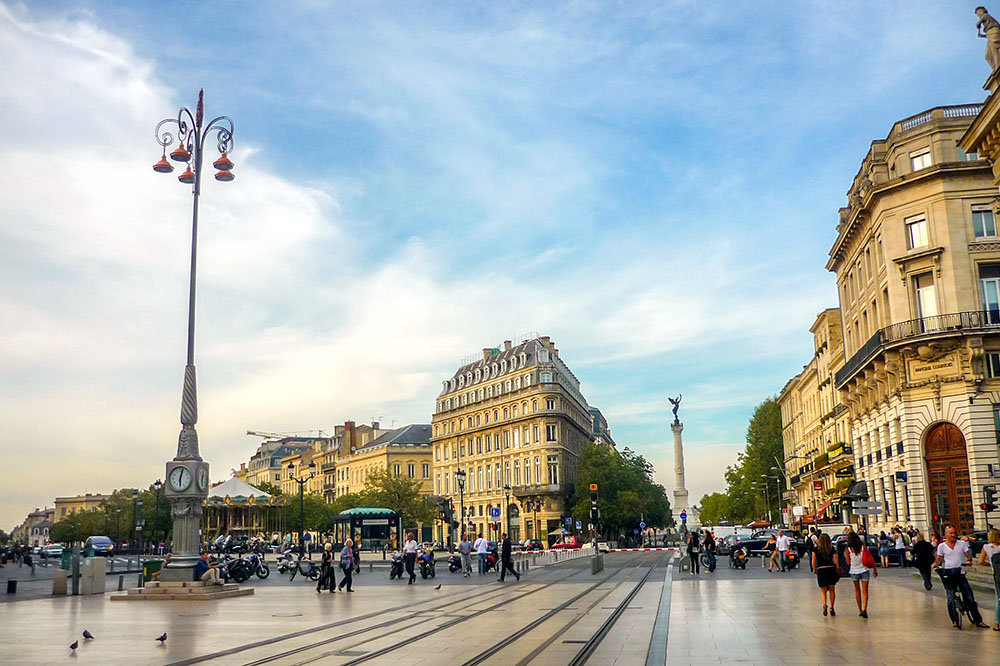
Today, Bordeaux is celebrated as one of France’s most dynamic cities, balancing heritage conservation, modern architecture, sustainable urban development, and a flourishing cultural scene.
The 21st century has solidified its place not only as the historic heart of Aquitaine but also as a major European city with global influence.
Where to stay when you visit Bordeaux?
Choosing the right base can make your trip to Bordeaux Old Town even more enjoyable.
The city is compact and walkable, so staying in or near the historic centre is ideal — especially between the railway station and Place des Quinconces, where you’ll have easy access to restaurants, tram lines, and the main sights.
Below is a curated selection of six hotels, ranging from boutique charm to modern comfort, all perfectly located for exploring the city on foot.
Hôtel Burdigala by Inwood Hotels (★★★★★)
A contemporary five-star stay offering refined comfort, elegant interiors, and a calm atmosphere just a short walk from Mériadeck and the historic centre.
📍 115 rue Georges Bonnac, 33000 Bordeaux
Aparthotel Adagio Bordeaux Centre Gambetta (★★★★)
Modern and practical serviced apartments in a central location, ideal for longer stays or travellers seeking kitchen facilities steps from the city’s main cultural sites.
📍 40 rue Edmond Michelet, 33000 Bordeaux
Radisson Hôtel Bordeaux Saint-Jean (★★★★)
A stylish contemporary hotel near Bordeaux-Saint-Jean station, perfect for visitors arriving by TGV and looking for easy tram access into the historic centre.
📍 13 rue des Gamins, 33800 Bordeaux
Hôtel de Normandie (★★★★)
Classic Bordeaux elegance in a beautifully preserved 18th-century building, ideally located near the Golden Triangle and Place des Quinconces.
📍 7 Cours du 30 Juillet, 33000 Bordeaux
Hôtel Majestic (★★★★)
A refined, traditionally styled hotel in a prime central location, close to Bordeaux’s theatres, upscale shopping streets, and major monuments — ideal for exploring the historic centre on foot.
📍 2 rue de Condé, 33000 Bordeaux
Hôtel Madame (★★★)
A charming boutique hotel set in a quiet street near the cathedral, blending intimate atmosphere, thoughtful design, and excellent access to the historic heart of Bordeaux.
📍 4 rue Bouffard, 33000 Bordeaux
More places in Bordeaux?
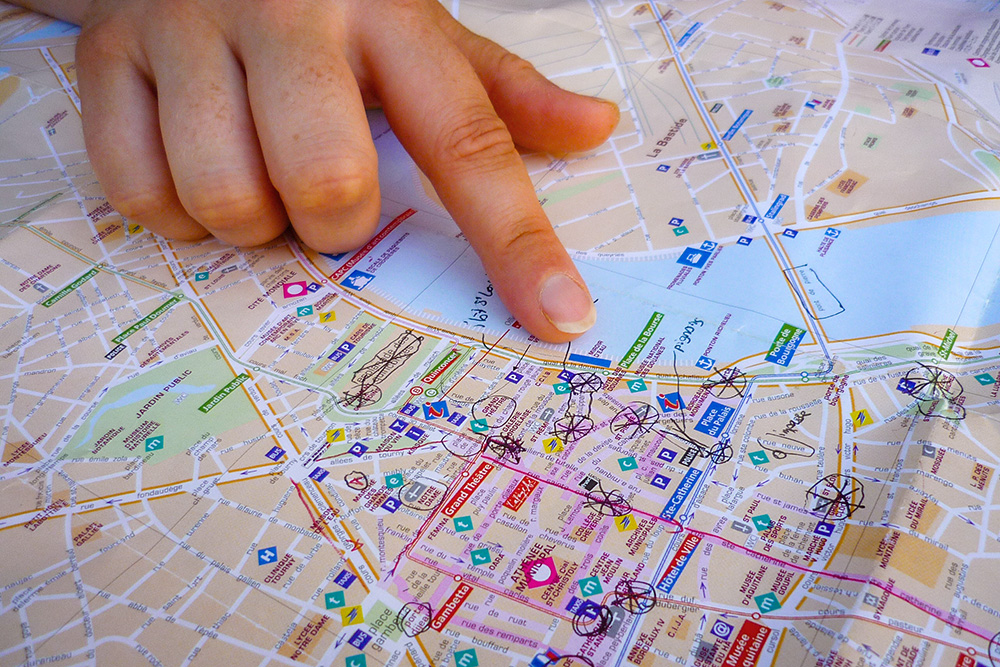
Find your preferred accommodation here or by browsing the map below:
What to do in Bordeaux
Check out the activities and monuments you can visit in Bordeaux Old Town:
The painting with “The French fighting the English at Bordeaux” is actually in Caen. Source: Martial d’Auvergne in Les Vigiles de la mort de Charles VII, v. 1483.
Thank you for pointing this out!